
Full-spectrum or white LED grow lights are the best choice for pothos. If you want to get more specific, a light that leans slightly blue (in the 5000–6500K color temperature range, or one with a noticeable blue channel) will keep your pothos compact and bushy instead of long and leggy. Red-heavy lights work fine for keeping a pothos alive, but blue wavelengths are what tell the plant to stay dense and stop stretching. blank" rel="noopener noreferrer">PPFD is commonly expressed in μmol·m⁻²·s⁻¹ to quantify the light received by plants.
What Color Grow Light for Pothos: Best Spectrum Guide

Marcus Hartley
25 Apr 2026
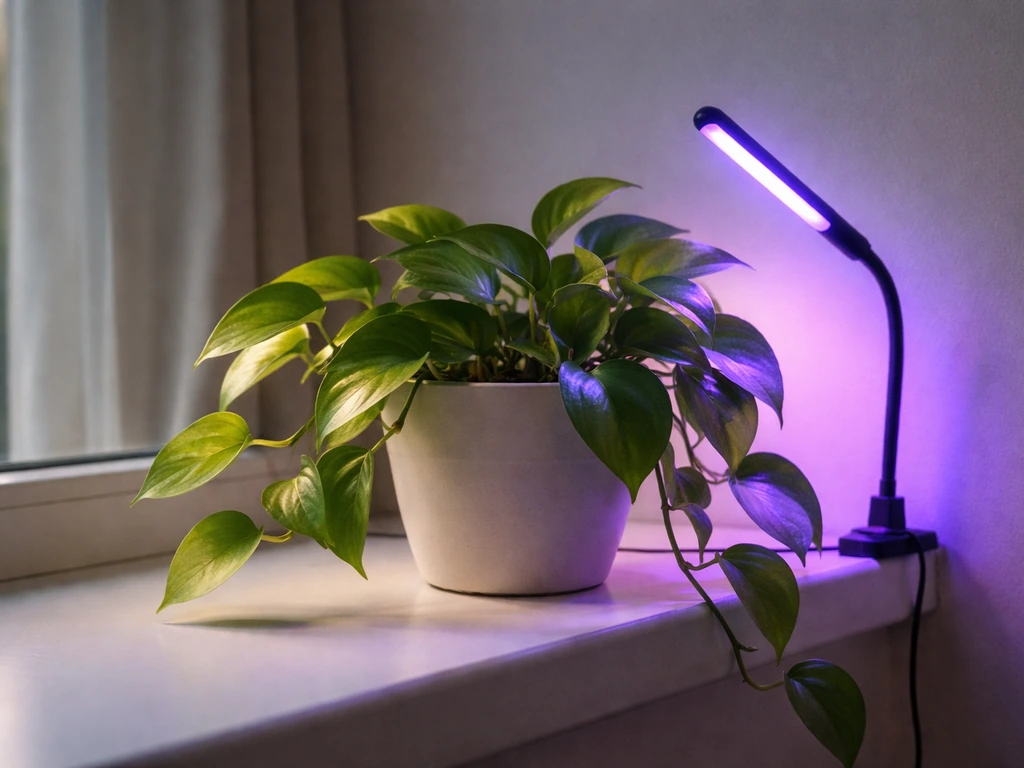
What color light pothos actually needs
Pothos is famously tolerant of low light, but 'tolerant' doesn't mean 'thriving. Pothos can also grow without sunlight as long as you provide adequate artificial light with the right color. African violets do like grow lights when you provide the right spectrum and keep the light on for the right number of hours grow without sunlight. ' Under weak or poorly specced light, it just survives: internodes stretch out, leaves shrink, and new growth slows to a crawl. The color of light you give it has a real effect on whether it grows compactly or starts reaching desperately toward the nearest window.
Plants use different wavelengths for different jobs. Chlorophyll absorbs mostly red and blue light for photosynthesis, but the plant also has dedicated photoreceptors (cryptochromes and phototropins for blue light, phytochromes for red) that act almost like a control system for how the plant builds itself. Blue light around 460–470 nm hits those blue-light receptors and signals the plant to stay compact, limit internode elongation, and produce thicker, more substantial leaves.
Horticulture studies using sole-source LEDs control blue (about 400, 500 nm) and red (about 600, 700 nm) bands separately to regulate extension growth and flowering responses Blue light around 460–470 nm. Red light around 660 nm is excellent for fueling photosynthesis but without enough blue in the mix, pothos tends to stretch.
This isn't abstract theory. Research on Epipremnum aureum (the species pothos belongs to) has specifically used monochromatic blue at 453 nm and red at 660 nm to study how light penetrates and affects the plant. Blue-dominant lighting consistently produces more compact, higher-quality growth across a range of indoor plants, including leafy tropicals like pothos. If you are wondering can pothos grow in artificial light, the same blue-forward approach that supports compact growth here applies.
Blue vs red vs full-spectrum: which one to pick
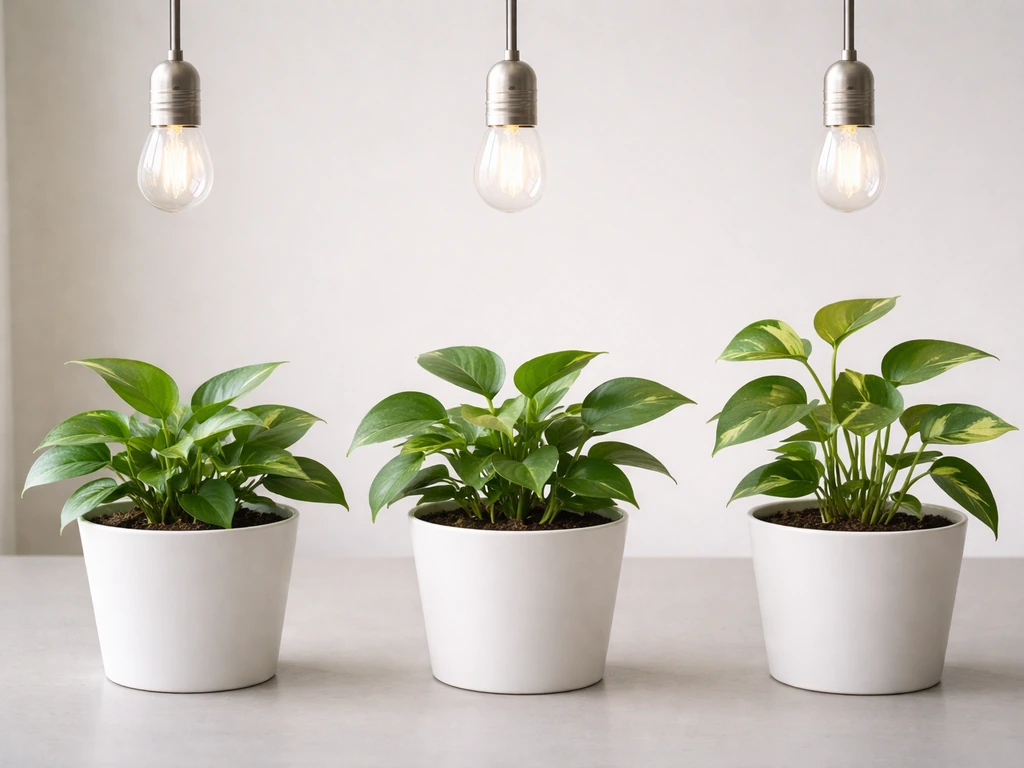
You don't need to obsess over this, but it's worth understanding the tradeoffs so you know what you're buying.
| Light Color/Type | Effect on Pothos | Best For |
|---|---|---|
| Blue-dominant (6000–6500K) | Inhibits stretching, promotes compact internodes and dense foliage | Keeping pothos bushy and full |
| Red-dominant (2700–3000K) | Fuels photosynthesis but encourages elongation over time | Supplementing existing natural light |
| Full-spectrum / white (5000–6500K) | Balanced growth, mimics daylight, supports both photosynthesis and morphology | Best all-around choice for most growers |
| Purple/blurple (red + blue LEDs only) | Efficient but missing green wavelengths; harder to spot stress visually | Works, but white LEDs are easier to manage |
My honest recommendation: go with a full-spectrum white LED in the 5000–6500K range. It gives your pothos the blue light it needs to stay compact, supports photosynthesis well, and lets you actually see the plant clearly. Purple blurple lights (those cheap red-and-blue LED panels you've probably seen) will work, but the pink-purple glow makes it genuinely hard to notice if your plant is getting pale or developing any issues. Full-spectrum white is just easier to live with.
Best grow light types for pothos
Not all grow lights are built the same, and the type matters almost as much as the spectrum.
LED grow lights (best overall)
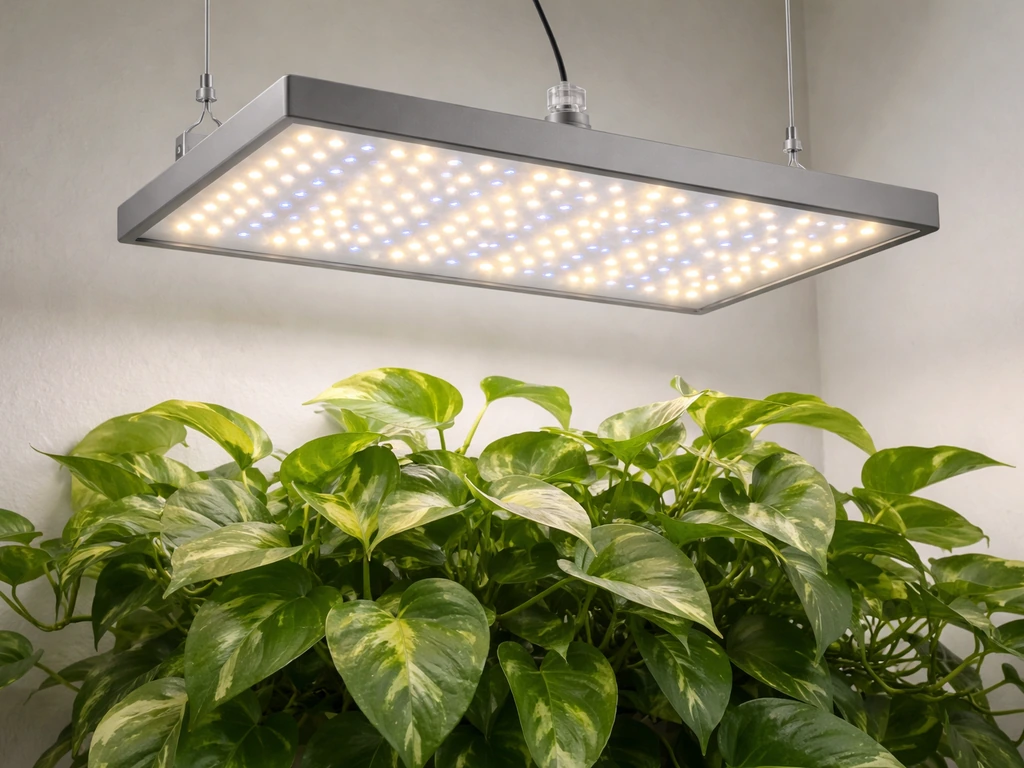
Modern full-spectrum LED panels or bar lights are the top pick for pothos. They run cool (so you can place them closer without heat stress), use less electricity, last tens of thousands of hours, and come in every shape from clip-on desk lights to long shelf bars. Look for ones labeled 'full-spectrum' with a color temperature of 5000–6500K. Brands like Spider Farmer, Mars Hydro, and even budget options from Amazon in the 10–30 watt range are more than enough for a few pots of pothos.
Fluorescent and T5/T8 tubes (solid budget option)
T5 and T8 fluorescent or LED tube lights in the 5000–6500K range are a great low-cost option, especially if you're growing pothos on a shelf. They spread light evenly over a wide area and have been used by indoor gardeners for decades. If you already have shop lights in your basement or grow area, grab 6500K daylight bulbs and you're set. The downside is they're less efficient than modern LEDs and need replacing more often, but the upfront cost is low.
Clip-on and desk grow lights (perfect for beginners)
If you just have one or two pots of pothos on a desk or shelf and you want something simple, a clip-on LED grow light with a full-spectrum white bulb is completely fine. These small lights (often 10–20 watts) won't transform a dark room into a grow tent, but they give a single pothos the boost it needs to stop stretching toward the window. Many come with timers built in, which is genuinely convenient.
How many hours a day, and how close to put it
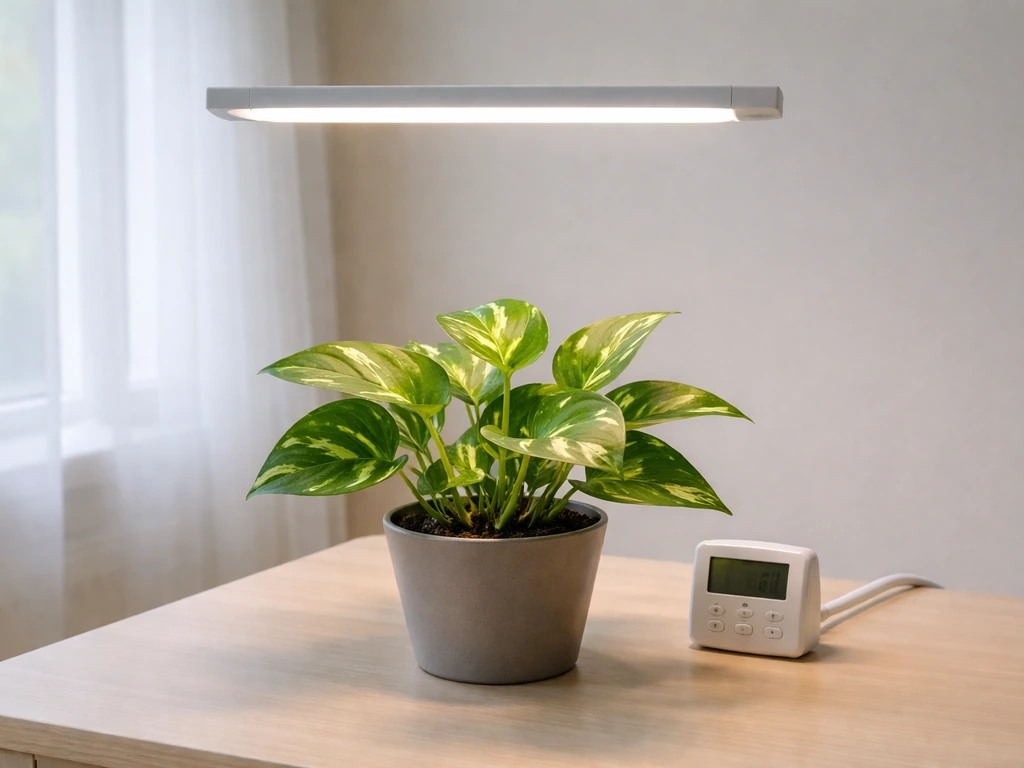
Pothos does best with 12–14 hours of grow light per day when it's getting little or no natural light. If it gets a few hours of indirect sun from a window, 10–12 hours of supplemental light is plenty. Use a simple outlet timer, set it, and forget it. Running the light 24 hours is not better and actually stresses the plant since pothos needs a dark period just like any other plant.
For distance, here's a simple starting rule: with a low-to-mid power LED (10–30 watts), start at about 12–18 inches (30–45 cm) above the top leaves. With a stronger light (40+ watts), begin at 18–24 inches and work down if the plant isn't responding. The goal is to deliver enough light without bleaching the leaves or causing the pale, washed-out look that comes from light that's too intense.
- 10–20W clip-on or desk LED: 8–14 inches above the canopy
- 20–40W full-spectrum LED panel: 12–18 inches
- 40W+ LED bar or panel: start at 18–24 inches and adjust
- T5/T8 fluorescent tubes: 6–12 inches (these are lower intensity, so you can go closer)
One thing I'd add from experience: don't just set the light and walk away for a month. Check on the plant after the first week or two. New leaves will tell you a lot about whether the intensity and distance are right.
How to tell if it's working (and what to fix if it's not)
A happy pothos under a good grow light will produce new leaves at a steady pace, keep internodes (the stem sections between leaves) short and tight, and hold large, deep-green (or well-variegated) leaves. If you've been using a grow light and those things are happening, you're in good shape.
Signs the light isn't enough (or spectrum is off)
- Long, stretched stems with big gaps between leaves (legginess): the plant is reaching for more light, or the spectrum lacks enough blue
- Small new leaves that are noticeably smaller than older ones
- Pale or yellowish new growth on a plant that otherwise looks healthy
- Slow or no new growth over several weeks
- Variegation fading on golden or marble queen pothos
If you're seeing these signs, move the light closer, increase daily hours up to 14, or swap to a higher-kelvin (bluer) bulb. Legginess almost always means not enough blue-spectrum light or not enough total light intensity.
Signs the light is too intense or too close
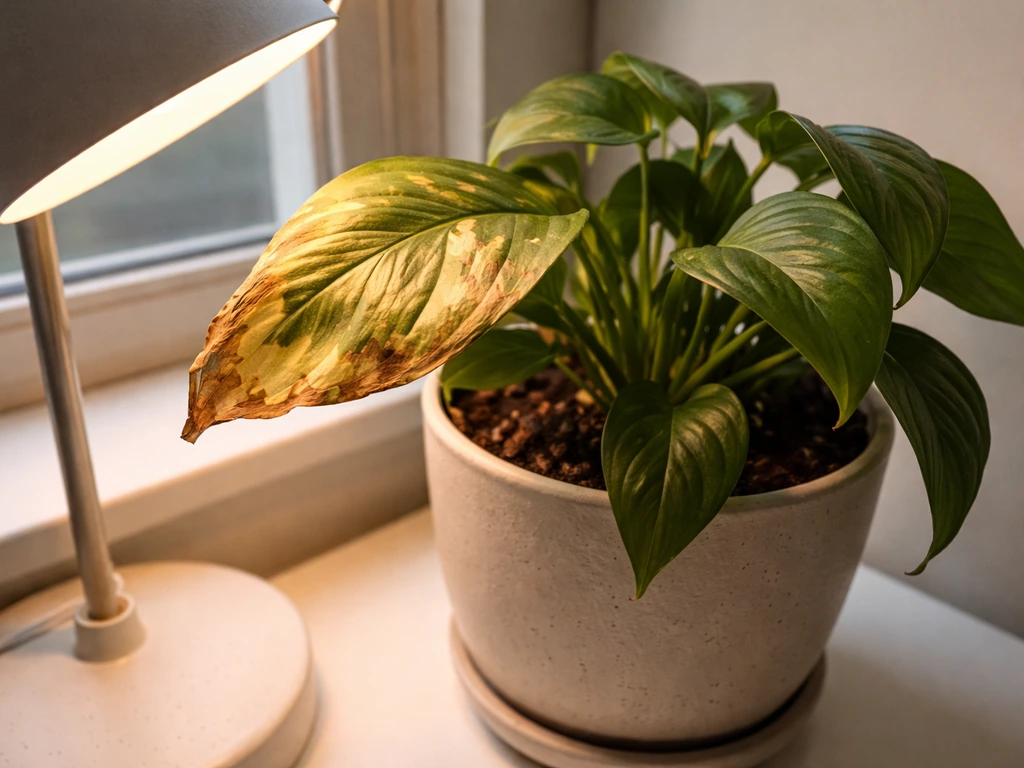
- Pale, bleached, or yellowing patches on leaves closest to the light
- Crispy or papery leaf edges without obvious underwatering
- Leaves curling downward or cupping
- Overall washed-out color instead of deep green
If you notice any of these, raise the light by 4–6 inches and see if new growth comes in normal. Heat stress is rarely an issue with modern LEDs, but intensity can still bleach leaves if the light is too close.
What to look for when you're shopping
The grow light packaging and product listings can be confusing, with lots of buzzwords and vague claims. Here's a quick checklist of what actually matters when choosing a light for pothos.
- Color temperature: look for 5000K–6500K (labeled 'daylight' or 'cool white' or 'full-spectrum'). Avoid anything below 4000K as a primary grow light for pothos.
- Full-spectrum labeling: means the light covers both blue and red wavelengths, ideally with some green mixed in. Avoid lights that only list 'red + blue' or show a strong purple color.
- Wattage: 10–20W is enough for one to three pots. For a shelf or larger collection, go 30–45W. More isn't always better; match wattage to the area and distance.
- PPFD or lux rating (if listed): pothos is happy around 50–150 µmol/m²/s PPFD at the leaf surface. This is a medium-low demand. Very high PPFD lights (400+) are overkill and may bleach leaves.
- Timer compatibility or built-in timer: makes your life much easier. Set it to 12–14 hours and forget it.
- Adjustable height or gooseneck: lets you reposition as the plant grows or if you need to dial in the distance.
You don't need to spend a lot. A $20–$40 full-spectrum LED clip light or a simple T8 shop light with 6500K daylight bulbs will do the job for most pothos setups. The expensive gear makes more sense if you're growing fruiting plants or flowers with higher light demands. Pothos is forgiving, and the right spectrum matters more than raw wattage or price. African violets generally do like dedicated grow lights, especially when indoor light is limited do african violets like grow lights.
If you're curious whether pothos genuinely benefits from grow lights or whether it can get by on artificial light alone, those are worthwhile questions to dig into alongside this one. The short version is that pothos is one of the most adaptable plants you can grow indoors, and giving it the right color of grow light is one of the easiest ways to keep it looking full and healthy rather than just surviving. Do snake plants like grow lights too?
FAQ
Can pothos grow under a red-only or mostly red grow light?
If the light you have is only red-purple (the common “blurple” panels), pothos may survive, but compact, dense growth is less consistent. If you must use blurple, run it at the recommended height and give closer to the higher end of the daily hours range, then watch for leggy new growth as your signal to switch to a cooler full-spectrum bulb.
Will a normal warm-white LED bulb (like 2700K) work for pothos?
Yes, but prioritize the actual light spectrum and intensity. A 2700K “warm” indoor bulb is usually not ideal for compact growth, because it lacks enough blue, even if it is bright. If you only have warm bulbs, compensate by using brighter output and adding a blue-leaning bulb or a full-spectrum fixture.
How close should the light be to avoid bleaching or leggy growth?
Use the plant response as your guide, not just distance. Start at the height you chose (often 12–18 inches for small LEDs), then look at the newest leaves after 7 to 14 days. If leaves look pale, washed out, or new growth is smaller with stretched stems, move the light farther by a few inches.
Is it better to run the grow light longer, like 18–24 hours?
A short answer: usually not. Pothos needs a dark period for normal rhythm, so avoid running grow lights 24/7. If your space is very dim, increase from 10–12 hours toward 14 hours rather than adding extra dark-free time.
What if I have multiple pothos on a shelf, how do I size the light?
For a single pothos, 10–20 watts from a clip-on full-spectrum light is often enough. For multiple plants on a shelf, you will typically need a longer bar or higher output so the whole canopy gets similar coverage, otherwise plants farther from the center will stretch.
How can I tell whether my grow light spectrum is actually helping, especially with blurple lights?
A practical check is to compare the color temperature and what you can see on the plant. If your light makes it hard to judge leaf color and the bulb looks very pink-purple, it can mask early pale-leaf problems. Full-spectrum white (5000–6500K) is easier because leaf color stays “readable” and you can more easily adjust distance.
If I switch to a bluer light (higher Kelvin), should I change the distance or hours?
If you increase blue content (higher Kelvin or a cooler full-spectrum), keep an eye on overall intensity, not just color. Cooler bulbs can feel brighter, so you might need to raise the light slightly to prevent pale, sunburn-like bleaching on tender new leaves.
Do variegated pothos need a different grow light color than regular green pothos?
Variegated pothos can need more light than solid green forms, and blue-forward full-spectrum usually helps maintain healthier, thicker growth. If variegation looks less pronounced or leaves become smaller, try moving the light slightly closer or extending toward 12–14 hours, then recheck after a week.