Leafy greens like lettuce, spinach, arugula, and kale, plus herbs like mint, chives, and parsley, are the most reliable edible plants you can grow indoors without direct sunlight. They don't need a south-facing window or full sun. What they do need is some usable light, whether that comes from a window, a fluorescent shop light, or an LED grow light. If you're completely in the dark, a basic grow light setup will get you harvesting salad greens in as little as 30 to 45 days. Mushrooms are the one genuinely low-light exception: they don't photosynthesize at all and can thrive with nothing more than ambient room light.
What Can Grow Without Sunlight Indoors: Edible Plants
Marcus Hartley
16 May 2026
What 'without sunlight' really means for plants
Most people searching this question mean one of two things: they have no south-facing window, or they're in a basement, apartment, or office with no natural light at all. Those are very different situations, and the answer changes depending on which one applies to you.
Here's the honest biology: almost every plant that produces food needs light energy to run photosynthesis. Chlorophyll absorbs light, converts it to chemical energy, and uses that energy to build leaves, stems, and (eventually) fruit. If there's genuinely zero light, virtually nothing edible will grow. The good news is that 'no sunlight' doesn't mean 'no light.' Artificial sources can fully replace the sun for many crops, especially leafy greens.
There's also a spectrum issue worth knowing about. Plants don't care whether the photons hitting their leaves came from the sun or an LED panel. They respond to light in the 400–700 nanometer range, called photosynthetically active radiation (PAR). So a grow light that delivers the right spectrum can be just as effective as a sunny windowsill, sometimes more so because you control the duration and intensity. Mushrooms are the true outlier here: they don't photosynthesize at all, and they use light only as a directional cue for fruiting, not as an energy source.
For practical purposes, 'low light' means you're working with a north-facing window, a spot several feet from any window, or a room lit only by overhead fixtures. 'No direct sunlight' means the sun's rays never land directly on the plants, but ambient or artificial light is available. Both situations are workable. A truly dark room with zero light is not, unless you're growing mushrooms. If you want to grow without sunlight, that means choosing plants like mushrooms that can handle very low light conditions truly dark room with zero light.
Best edible crops for low-light or no-direct-sun indoor growing
Some crops are forgiving about light because they only need to grow leaves, not ripen fruit. Fruiting crops like tomatoes and peppers want a lot of light energy, and you'll be fighting an uphill battle without a serious grow light setup. Larger container volume is needed for bigger fruiting plants, with leafy greens generally being easier container crops that can do well in smaller pots than tomatoes or peppers leafy greens are easier container crops than tomatoes or peppers. Stick to these categories and you'll actually get harvests.
Leafy greens (the reliable workhorses)
- Lettuce: The gold standard for low-light indoor growing. Leaf varieties like 'Black Seeded Simpson' or red-leaf types can be harvested in 30–45 days. They actively grow at a daily light integral (DLI) as low as 6.5 mol per square meter per day.
- Arugula: Fast-growing and peppery. Plan on harvesting the whole plant around 30–35 days in. One caveat: keep temperatures below about 75°F (24°C) or it bolts quickly.
- Spinach: Needs a bit more light than lettuce, roughly 12 hours per day from a grow light. Harvest outer leaves to keep it producing.
- Kale and chard: Slower than lettuce but very tolerant of lower light conditions. Good for cut-and-come-again harvesting.
- Microgreens: The fastest option. Sunflower, radish, pea, and broccoli microgreens can be ready in 7–14 days and need very modest light levels.
Herbs worth trying
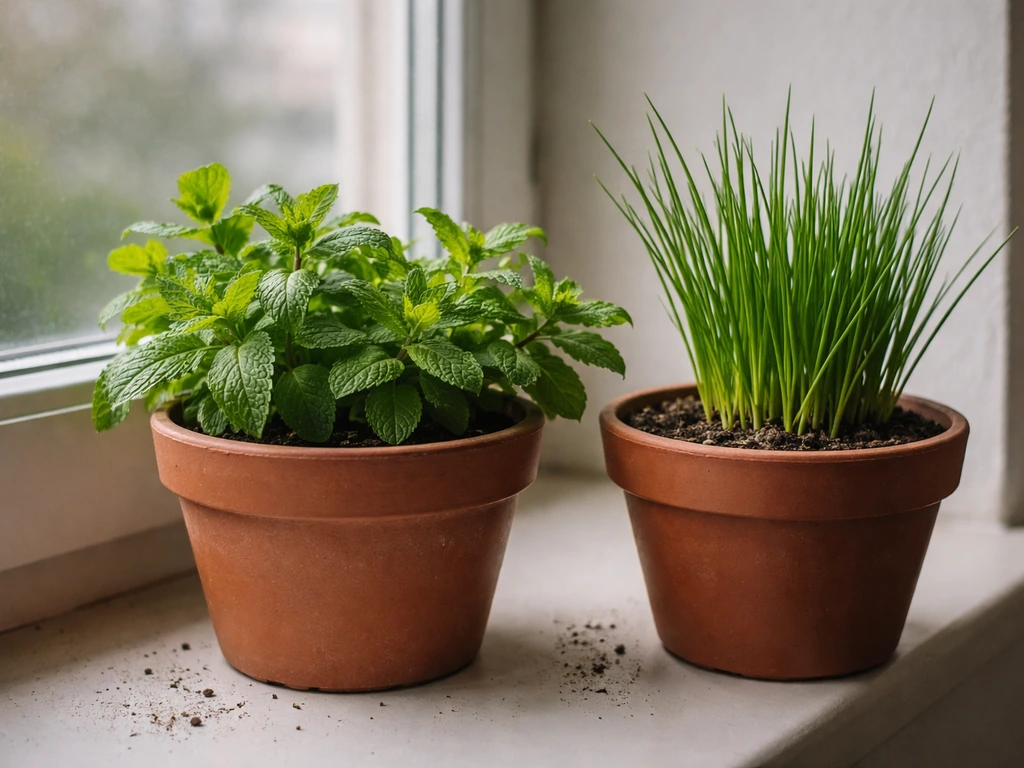
- Mint: One of the most shade-tolerant culinary herbs. Grows aggressively even under low light. Keep it in its own pot.
- Chives: Surprisingly low-light tolerant. Snip from the top and they keep coming back.
- Parsley: Slow to start but manageable under a grow light with 12–14 hours of daily exposure.
- Cilantro: Does okay indoors but bolts fast in warm rooms. Best treated as a cut-and-use crop.
The special case: mushrooms
Mushrooms are genuinely in a different category. They don't photosynthesize, so they don't need light as an energy source at all. What drives mushroom growth is humidity, temperature, air exchange, and substrate nutrition. Light is only a cue that tells the mycelium which direction to grow the fruiting bodies. A simple timer-controlled LED or even ambient room light is enough. Oyster and shiitake mushrooms are the most approachable options for home growers and will do just fine in a closet, basement, or cabinet.
Light source options when you don't have sunlight
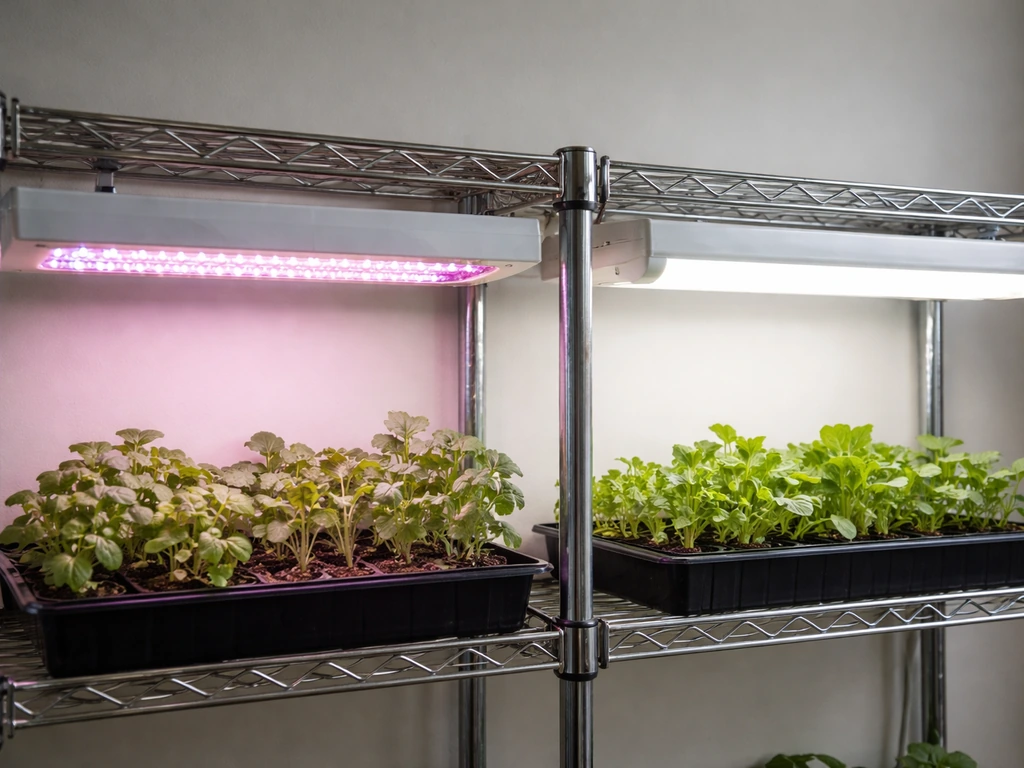
This is where most beginner indoor gardeners get tripped up. The light source you choose matters a lot, not just for plant health but for your electricity bill and setup simplicity. Here's a practical breakdown.
| Light Source | Best For | Pros | Cons |
|---|---|---|---|
| LED grow lights (full-spectrum) | All edible crops, especially leafy greens | Energy-efficient, low heat, long lifespan, correct spectrum | Higher upfront cost than fluorescent |
| T5/T8 fluorescent tubes | Leafy greens, herbs, microgreens, seed starting | Cheap to buy, widely available, decent spectrum for leafy crops | Less efficient than LED, bulbs need replacing |
| Compact fluorescent (CFL) bulbs | Small herb pots, microgreens | Very cheap, fits standard lamp sockets | Low output, only practical for tiny setups |
| Regular LED bulbs (non-grow-specific) | Limited use only | Already in your home | Typically lack the right spectrum balance; weak output for most food crops |
| Ambient room light only | Mushrooms, possibly mint in a bright room | Free | Almost always insufficient for edible crops to produce well |
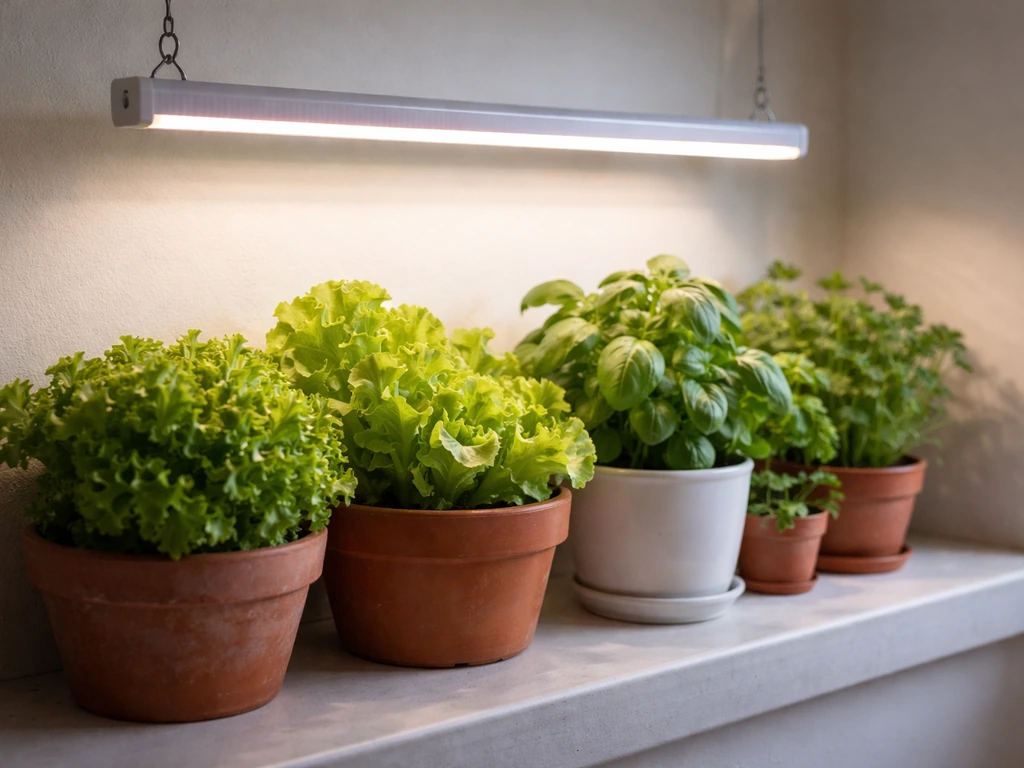
For most people starting out, a T5 fluorescent shop light or a budget full-spectrum LED panel in the 20–45 watt range is the practical sweet spot. You don't need to spend a lot. A $30–50 LED grow light on a timer will grow real lettuce. NASA-backed research has helped drive down the cost and improve the spectrum quality of consumer LED grow lights, so the options available today are genuinely good.
One thing to avoid: using lux readings from a regular light meter to plan your setup without knowing the light source's spectrum. Lux measures brightness as the human eye perceives it, but plants respond to different wavelengths than our eyes do. A warm white bulb can look bright but deliver relatively little useful PAR. Stick to grow lights labeled with PPFD (micromoles per square meter per second) specs if you want accurate planning data.
How much light to provide
You don't need to become a lighting engineer to get this right. The key number for most home growers is DLI, daily light integral, which is basically the total amount of usable light your plant receives in a day. For leafy greens, you're aiming for a DLI of roughly 6. Leafy greens are commonly grown with PPFD around 150, 250 µmol·m−2·s−1 at a 16-hour photoperiod (DLI about 8, 14 mol·m−2·d−1) in controlled indoor plant environments Leafy greens are commonly grown with PPFD around 150–250 µmol·m−2·s−1 at a 16-hour photoperiod (DLI about 8–14 mol·m−2·d−1). 5 to 14 mol per square meter per day. That sounds technical, but here's how it translates to real life.
| Crop | Target PPFD (µmol/m²/s) | Daily Duration | Result |
|---|---|---|---|
| Lettuce (minimum viable) | 52–85 | 12 hours | Slow but active growth; DLI ~6.5 mol/m²/d |
| Lettuce (good production) | 150–250 | 16 hours | Steady harvests; DLI ~8–14 mol/m²/d |
| Arugula / spinach / kale | 150–250 | 14–16 hours | Healthy vegetative growth |
| Herbs (mint, chives, parsley) | 100–200 | 12–14 hours | Adequate for continuous harvesting |
| Microgreens | 100–200 | 12–16 hours | Ready in 7–14 days regardless |
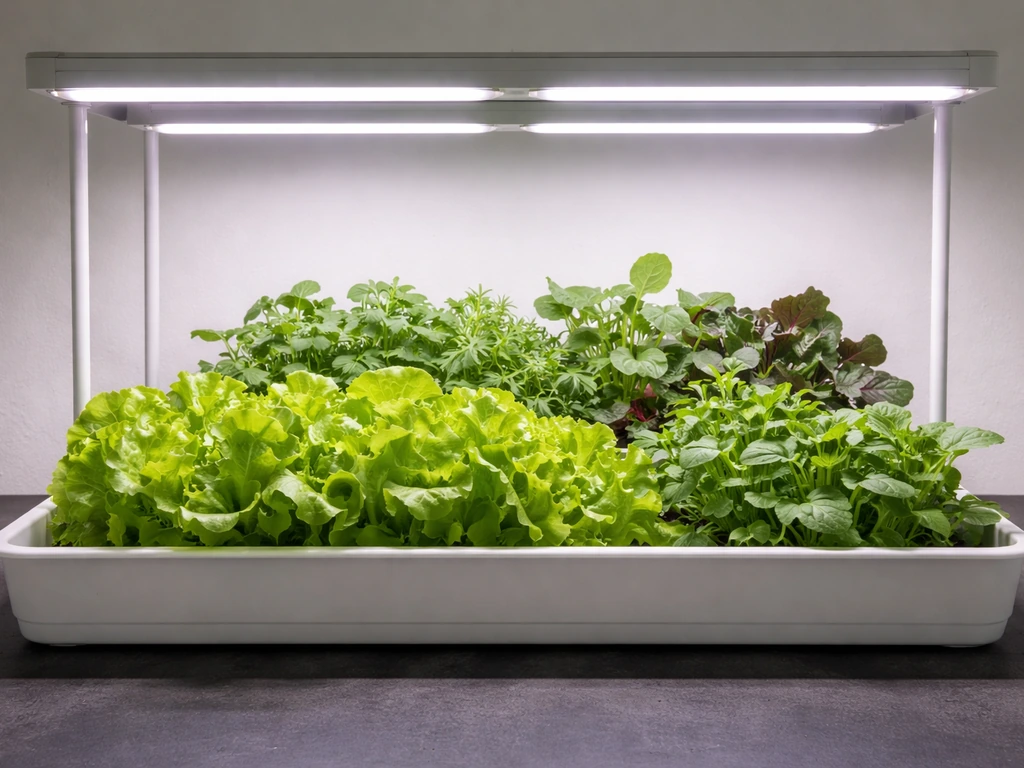
The practical takeaway: set your grow light on a timer for 14–16 hours per day and position it 6–12 inches above leafy greens. Light intensity drops sharply with distance, so don't hang the light 3 feet up and wonder why growth is slow. If you don't have a PPFD meter, use the general rule that the light should feel noticeably bright (not just 'on') when you hold your hand under it at plant height. That's not scientific, but it's a reasonable sanity check.
Step-by-step setup for growing food indoors
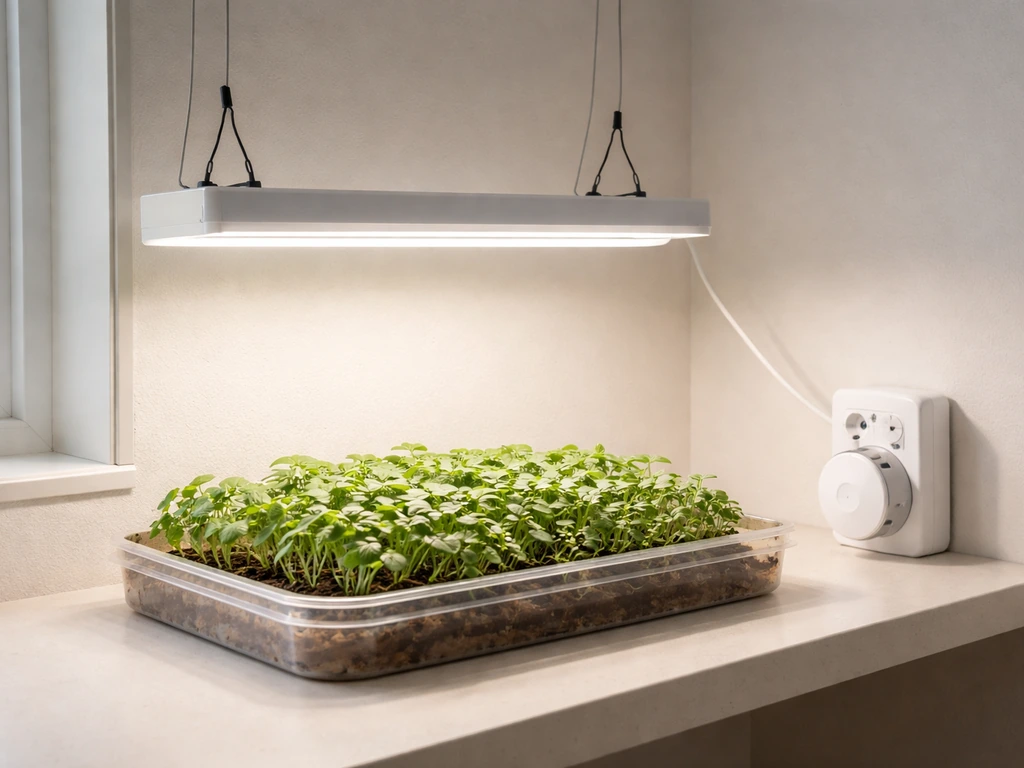
Here's how to actually get started today, from picking your container to your first harvest. This applies to leafy greens and herbs, which are the most practical choice for no-sunlight setups.
- Choose your container. For lettuce, arugula, and most herbs, a container 6–12 inches deep with drainage holes is enough. Kale and chard benefit from slightly deeper pots. If you're eyeing bigger crops like kale in bulk or anything root-heavy, go for at least 12–18 inches of depth. Most leafy greens are forgiving; even a recycled plastic tub works.
- Pick your growing medium. A quality all-purpose potting mix works well. Avoid garden soil, which compacts and drains poorly indoors. If you're growing microgreens, a thin layer of potting mix or a coco coir mat on a shallow tray is all you need.
- Start with seeds or transplants. Seeds are cheaper and work great for lettuce, arugula, spinach, and microgreens. Scatter them thinly on the surface, press lightly, and keep the soil moist until germination (usually 3–7 days). Herbs like mint and chives are easier to start from nursery transplants because they're slow from seed.
- Position your light. Hang or place your grow light 6–12 inches above the seedling tray or pot. If using a clip-on or desk grow light, position it as close as the manufacturer allows without heat risk. Set a timer for 14–16 hours on, 8–10 hours off.
- Water carefully. Indoor plants in containers need consistent moisture but not waterlogged roots. Check daily: if the top inch of soil feels dry, water thoroughly until it drains from the bottom. Empty the saucer after 30 minutes so roots don't sit in standing water.
- Feed lightly after the first two weeks. Use a diluted liquid fertilizer (half the recommended dose) every two weeks. Leafy greens are light feeders; overfeeding causes problems faster than underfeeding.
- Harvest regularly. For lettuce and arugula, start harvesting outer leaves when plants are 4–6 inches tall. For spinach and kale, same approach. Regular harvesting signals the plant to keep producing. Microgreens get cut at the soil line when the first true leaves appear.
Troubleshooting low-light growth problems
Most indoor gardening failures trace back to light problems, even when growers think their setup is fine. Here are the most common symptoms and what to do about them right now.
Leggy, stretched, or spindly stems
This is the classic sign of not enough light. The plant is literally reaching toward whatever light source it can find, elongating its stems in the process. Lack of light is the primary cause of leggy seedlings and weak, floppy greens. Fix it by moving the light closer (aim for 6–8 inches for seedlings), increasing the daily duration by 2–4 hours, or upgrading to a brighter light source. You can't reverse stretched growth, but new growth will come in tighter once conditions improve.
Yellowing leaves
Yellow leaves have a few possible causes: insufficient light means plants can't produce enough chlorophyll, overwatering cuts off oxygen to roots, or nutrient deficiency (especially nitrogen) shows up as pale, yellowing foliage. Check the obvious one first: is the soil soggy? If yes, ease up on watering and make sure drainage is working. If watering is fine, increase light duration or intensity. If yellowing persists with good light and watering, try a diluted balanced fertilizer.
Slow or stalled growth
If your plants look okay but just aren't growing, the most likely culprit is low DLI. You may have enough light intensity but not enough hours per day. Try bumping your timer to 16 hours. Also check that the light is actually reaching the plants at a useful intensity: a grow light 2 feet above a small seedling is delivering a fraction of what it would at 8 inches. Move it closer.
Plants look fine but taste bitter or bolt quickly
Bolting (going to flower and seed prematurely) in arugula and spinach is usually triggered by heat, not light specifically. If your grow light is close and the room is warm, surface temperatures under the light can creep up. Keep temperatures under 75°F and harvest more aggressively before the plant decides it's time to reproduce. Bitterness in lettuce is also often a temperature and stress response.
Plant shopping list and starter plans for different light levels
Here's a practical starting point based on whatever light situation you're actually dealing with. Pick the scenario that matches yours and start there.
Scenario 1: No natural light at all (basement, interior room)
You need an artificial light source. Full stop. Budget for a 20–45W full-spectrum LED grow panel or a 4-foot T5 fluorescent shop light (around $20–50). Set it on a 16-hour timer.
- Lettuce (loose-leaf varieties like 'Black Seeded Simpson' or 'Red Sails')
- Arugula
- Radish microgreens or sunflower microgreens
- Chives
- Oyster mushrooms (no grow light needed, just ambient room light and a kit)
Scenario 2: North-facing window or low ambient light
You have some natural light but not enough for reliable food production on its own. Supplement with a grow light for 10–12 hours per day to bridge the gap.
- Lettuce and spinach (place close to the window, supplement with a small LED grow light)
- Mint (genuinely tolerates low light better than most herbs)
- Kale (slow but steady under these conditions)
- Parsley (needs patience but manageable with supplemental light)
Scenario 3: East or west-facing window (indirect light, a few hours of direct morning or afternoon sun)
This is actually a decent growing situation for leafy greens and herbs without any supplemental light. You can expand your options and get consistent harvests.
- All leafy greens: lettuce, arugula, spinach, kale, chard
- Mint, chives, cilantro, parsley
- Possibly green onions/scallions, which are very low-demand
- Ivy (very shade tolerant for ornamental purposes, though not edible)
If you want to explore beyond greens and herbs, certain ferns and other low-light foliage plants are excellent companions for these setups. And if you're curious about how plants manage light in truly extreme low-light environments, like deep cave ecosystems or ocean environments, those situations involve completely different biological strategies than what home food crops use. In the ocean, some plants can grow without sunlight by using alternative energy sources and specialized adaptations plants grow in ocean environments without sunlight. Plants in deep cave ecosystems can still grow by using non-sunlight energy sources and specialized biology. For edible indoor gardening, the practical ceiling is leafy greens and herbs unless you invest in serious lighting for fruiting crops.
The most important thing is to just start. Pick one plant from the list above that matches your light level, grab a bag of potting mix, and set up even a basic grow light on a timer. Lettuce is genuinely forgiving, fast, and satisfying. Get one successful harvest under your belt and you'll have a much clearer sense of what your space can actually support.
FAQ
How do I know if my room has enough light to actually grow edible greens, not just keep them alive?
Aim for “bright on purpose,” not just a lit room. If plants only get overhead light, you usually need a grow light timer and the light should sit close to the canopy (often 6 to 12 inches for leafy greens). Without that proximity, the plants may stay alive but grow slowly.
Can I use a shorter grow-light schedule if I already have some daylight coming in?
Yes, but “no sunlight” can still mean some usable light. If your space gets consistent ambient daylight, you may be able to run your grow light for fewer hours per day (for example, 6 to 10 hours) instead of a full 14 to 16. Watch growth rate and color, then adjust the timer upward if leaves look pale or growth is sluggish.
What’s the biggest mistake people make when trying to dial in a grow light schedule?
Avoid making frequent small adjustments. With LEDs or fluorescents on a timer, change one variable at a time, such as moving the light closer by a few inches or increasing runtime by 2 to 3 hours. Rapid swings in intensity and schedule can stress plants and cause inconsistent results.
If my greens are yellow, how do I tell whether it is light, watering, or nutrients?
Track issues at the plant level. If you see stretching and pale, you are likely low on usable light (DLI). If leaves yellow while soil stays wet, that’s often overwatering or poor drainage. If yellowing happens even when soil is correctly moist and light is adequate, consider a light nutrient correction, especially nitrogen.
Why can’t I just use a lux meter to set up my indoor garden?
No, regular brightness readings are often misleading for plants. Lux focuses on human vision and does not directly tell you how much PAR your plants get. If you can, plan using PPFD or DLI targets from grow-light specs; otherwise, rely on distance, runtime, and visible growth as your guide.
Is it better to leave the grow light on all day or use a timer?
Most leafy greens respond well to timers, but don’t run them continuously. A common mistake is going too long, which can increase stress and heat under the light. For leafy greens, a practical range is 14 to 16 hours per day, then tweak based on growth and leaf color.
My light is mounted high, but the setup works at first. Why does growth slow down, and what should I adjust?
Distance matters because intensity drops fast as you move away from the source. If growth is slow, first lower the light closer to the canopy (while keeping it safe, not scorching). If you cannot move it closer, the fix is usually more runtime rather than expecting the same output at a taller mounting height.
What harvesting approach helps indoor greens succeed in low-light setups?
Start with small containers and harvest often. Lettuce and herbs give quicker results when you trim “outer leaves” regularly instead of waiting for full heads every time. This reduces the chance of bolting and gives you a steady supply while you fine-tune lighting.
Can I grow tomatoes or peppers indoors without sunlight if I use a grow light?
Fruiting crops usually need much more light than leafy greens, so “no sunlight” setups often underperform even with a grow light. If you try peppers or tomatoes, plan on a stronger, higher-output light and longer runtime, and expect smaller yields or slower ripening unless you can deliver substantially higher DLI.
Why are my spinach or arugula bolting if the light seems adequate?
Temperature under the light is easy to overlook. Even if the room feels cool, the surface near the bulb or panel can warm enough to trigger bolting in spinach or arugula. Keep the growing area reasonably cool (often under about 75°F) and harvest earlier if you notice early flowering.
If mushrooms grow without sunlight, do they still need a grow light at all?
Mushrooms are different. You do not need light for photosynthesis, but consistent humidity, fresh air exchange, and correct substrate nutrition matter more than lamp choice. Room light or a simple low-power LED used on a timer for viewing can be enough.