Plants don't need total darkness to grow, but they do need a regular dark period as part of a healthy day/night cycle. If your goal is to compare how plant growth changes under different lighting conditions, a normal night period versus continuous light is a practical test worth running. Think of it less like 'plants crave the dark' and more like 'plants need a proper schedule.
Do Plants Need Darkness to Grow? The Real Answer
Marcus Hartley
27 Apr 2026
' Keeping a plant in continuous light 24/7 or in complete darkness for days will both cause problems, just in different ways. The sweet spot for most indoor plants is 12 to 16 hours of light followed by 8 to 12 hours of darkness, repeated consistently.
That same idea helps explain why mung beans can grow better when you allow a proper dark period instead of keeping them under constant light why do mung beans grow better in the dark.
How plants actually use light
Photosynthesis is the obvious reason plants need light. They absorb light in the 400–700 nm range (the photosynthetically active radiation, or PAR range) and use it to fix CO2 into sugars. When the light goes off, CO2 fixation essentially stops within seconds. One study tracked this biochemical switch and found that the Calvin-Benson-Bassham cycle shuts down almost immediately when light is removed, and the plant shifts into a different metabolic mode involving the TCA cycle (basically switching from 'building' to 'maintenance'). That's important context: in total darkness, a plant isn't photosynthesizing. It's just burning through whatever reserves it built up during the light period.
But light does more than fuel photosynthesis. Plants have dedicated photoreceptors that detect light signals and use them to coordinate nearly everything else about their development. Phytochromes respond mainly to red and far-red light and exist in two interconvertible forms: Pr (inactive, formed in darkness) and Pfr (active, formed in light).
As the sun goes down and darkness sets in, [Pfr gradually reverts back to Pr, and the plant uses that reversion as a way to measure how long the night has been. ](https://pmc. ncbi. nlm.
nih. gov/articles/PMC4414745/) Cryptochromes detect blue light and influence everything from stem elongation to flowering time. There are also LOV-domain proteins like ZEITLUPE that fine-tune circadian timing based on blue light cues. Together, these photoreceptors give a plant a surprisingly sophisticated sense of both time and light quality.
When light hits these receptors, it rapidly switches off repressor proteins (the COP/DET/FUS complex) and lets positive transcription factors like HY5 accumulate. HY5 then drives the expression of photosynthesis-related genes and promotes normal, compact growth. In the dark, repressors called PIFs take over and suppress that photosynthetic gene expression. This is why a plant that never sees light starts to look leggy, pale, and stretched, which is the etiolation response, a developmental program triggered entirely by darkness.
What 'darkness' actually means for a growing plant
There's a real difference between 'total darkness for an extended period' and 'a normal night. ' When someone asks whether plants need darkness, they're usually asking one of two different questions. The first is whether a completely dark space (like a windowless room or a closet) can support a plant without any artificial light. In that kind of indefinite darkness, seeds will not reliably grow until light and normal conditions return seeds grow in darkness.
The answer to that is no, not for long. The second, more nuanced question is whether plants need a nightly dark period even when they're otherwise getting plenty of light. If you want a quick science project version of the idea, test how growth changes with a normal night period versus continuous light. If you are wondering can plants grow in the dark, this is also the key comparison: a normal night period is very different from complete darkness.
The answer to that is yes, and here's why it matters.
A regular dark period is how plants set their internal clock. That regular dark period is especially important for mung beans, because they tend to grow better when the night is long enough and uninterrupted <a data-article-id="3A909252-B7A3-4DBD-8A2F-B18A3BCF675F">internal clock. If you’re growing beans, the key takeaway is that they generally perform best when the light and dark schedule is balanced, with a nighttime period long enough for their internal rhythms mung beans.
Their circadian system is entrained, meaning it synchronizes, to the light-on (dawn) and light-off (dusk) signals each day. Research on stomatal behavior in bean plants (Phaseolus vulgaris) showed that stomata maintain a circadian rhythm even in continuous darkness, but the timing of that rhythm is set by the previous light/dark signals. In other words, the plant 'remembers' when dawn and dusk happened and regulates its stomatal opening and closing accordingly, even after the lights go off.
Disrupting that schedule, either by keeping lights on too long or chopping the dark period short, doesn't just mess with flowering. It affects gas exchange, water regulation, and overall metabolic timing.
Total darkness is a completely different situation. A plant in a windowless room with no grow lights isn't experiencing 'a long night.' It's experiencing an indefinite blackout. Without any light input, photosynthesis stops, the photoreceptor signals that drive normal development disappear, and the etiolation program kicks in. Seedlings grown in complete darkness become pale, elongated, and structurally weak as they desperately reach for a light source that isn't there. Can plants grow in the dark? Usually, no, because without light they cannot photosynthesize and will quickly show stress like pale, stretched growth. That's not healthy growth; it's a survival response.
Why a regular dark period matters for development
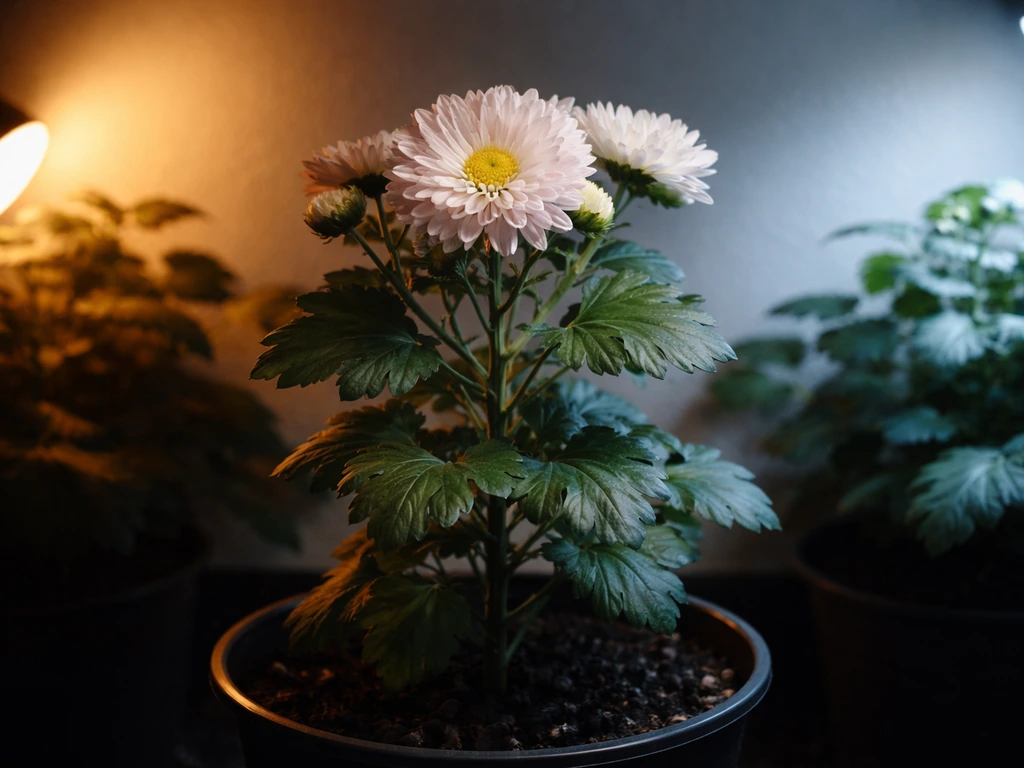
The most well-known reason plants need a dark period is photoperiodism, which is how day length (really, night length) controls flowering. Short-day plants like chrysanthemums and poinsettias flower when the uninterrupted dark period exceeds a critical threshold, typically around 8 or more hours of continuous darkness. If you interrupt that night with even a brief flash of light, you reset the phytochrome clock and prevent flowering. Long-day plants work the opposite way: they flower when nights are short. Neutral-day plants like tomatoes don't care as much about day length, but they still benefit from a consistent light/dark cycle for other physiological reasons.
Beyond flowering, the dark period is when plants do a lot of internal housekeeping. Circadian-regulated ABA (abscisic acid) signaling, which controls how stomata respond to stress, is tied to the light/dark cycle. The plant's internal clock gates hormone production and gene expression so that certain processes happen at the right time of day. Running your grow lights 24 hours a day doesn't give plants more energy to grow; it desynchronizes their internal timing and can actually reduce efficiency over time.
A lettuce study found that extending the dark period by just 4 extra hours caused measurable drops in photosynthetic activity during the following light period, around 7 to 11 percent less productivity in repeated trials. It works the other direction too: shortchanging the dark period has its own costs.
Signs your indoor plant is getting too little light (or too much darkness)
If you're trying to diagnose a growth problem right now, here are the signs that a plant isn't getting enough light. These are different from overwatering or nutrient issues and show up in a pretty recognizable pattern once you know what to look for.
- Leggy, stretched stems with long gaps between leaves (the plant is reaching for light)
- Pale green or yellowing leaves, especially on new growth, due to reduced chlorophyll production
- Smaller than normal new leaves
- Leaning heavily toward a window or light source
- Slow or stopped growth even during the growing season
- Soil staying wet far longer than usual (low light means low transpiration, which means less water use)
Complete darkness, even for a few days, makes these symptoms accelerate dramatically. A plant left in a dark room over a long weekend won't die, but it will start to look worse pretty quickly. The longer a plant goes without light, the more it draws down its sugar reserves and the more its photosynthetic capacity declines. Extended darkness also suppresses the genes that build and maintain chlorophyll, so recovery can take longer than you'd expect once you do get the plant back into light.
It's worth noting that some plants handle low light far better than others. Calathea, for instance, can function at very low PPFD levels (researchers have studied their photosynthetic response at light levels as low as around 6 µmol m⁻² s⁻¹ in extreme shade conditions). That doesn't mean they thrive there, but they survive where many other plants wouldn't.
CAM plants like certain succulents and orchids can even take up CO2 during the dark period because of their modified photosynthetic pathway, which makes them more tolerant of unusual light/dark schedules than typical C3 plants. Depending on the species and conditions, CAM plants’ net CO₂ uptake occurs largely during nighttime when leaf-air vapor pressure deficit is lower, improving water-use efficiency [CAM plants like certain succulents and orchids can even take up CO2 during the dark period](https://pmc. ncbi. nlm.
nih. gov/articles/PMC4065858/).
How to set up the right light schedule for indoor plants
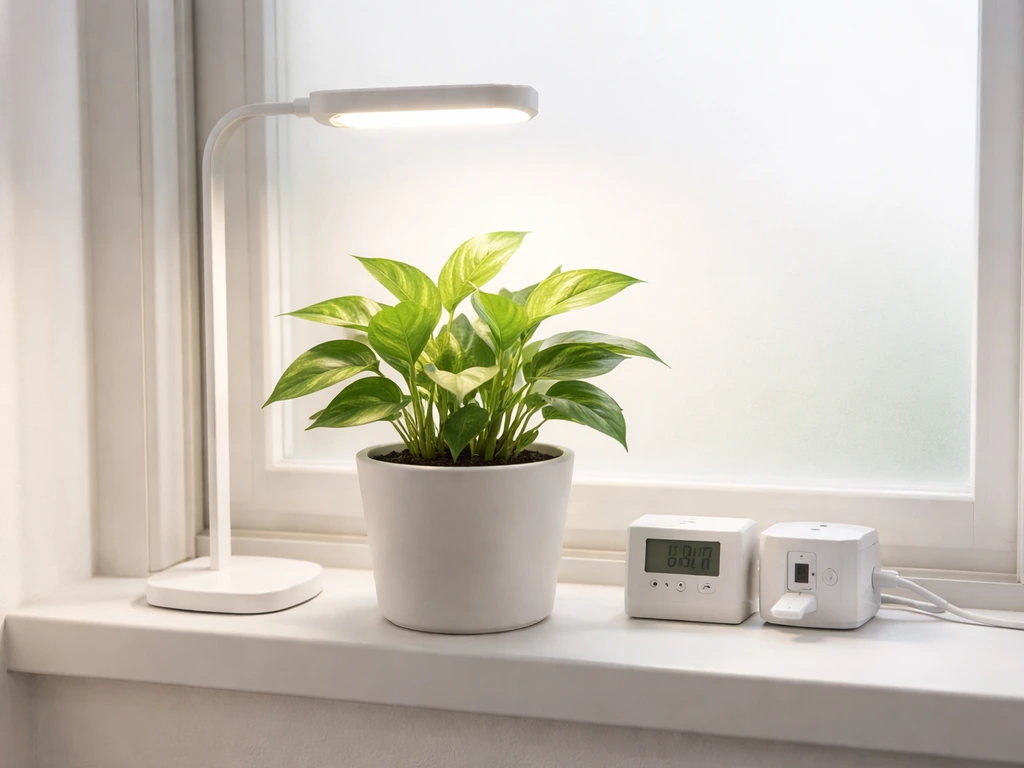
The practical goal is delivering enough light during the day period and then giving a consistent, uninterrupted night period. For most indoor edibles and houseplants, that means 14 to 16 hours of light and 8 to 10 hours of darkness. For flowering plants that are photoperiod-sensitive, you'll need to match the light/dark schedule to what triggers the response you want (shorter days for poinsettias to bloom, for example).
The most useful metric for quantifying indoor light is DLI, or Daily Light Integral. DLI measures the total moles of photons a plant receives per day, calculated from your light intensity (PPFD, in µmol m⁻² s⁻¹) multiplied by the number of hours the light is on, with a conversion factor. As a rough starting point, leafy greens like lettuce do well at a DLI of about 8 to 12 mol m⁻² day⁻¹, which you can achieve with a PPFD of around 150 to 200 µmol m⁻² s⁻¹ over a 14-hour photoperiod. Fruiting plants generally want higher DLI, closer to 20 to 30 mol m⁻² day⁻¹.
Distance between your grow light and your plants matters more than most beginners expect. A fixture that's rated for a certain intensity will deliver much lower PPFD if it's hung too far away. A good rule of thumb is to start with your LED grow light about 12 to 18 inches above the canopy for most plants, then adjust based on how the plants respond. If you want to be precise, a basic quantum (PAR) meter will show you actual PPFD at the plant level rather than relying on marketing numbers.
| Plant type | Recommended PPFD | Daily light hours | Target DLI |
|---|---|---|---|
| Low-light houseplants (pothos, ZZ, snake plant) | 50–150 µmol m⁻² s⁻¹ | 12–14 hours | 3–8 mol m⁻² day⁻¹ |
| Leafy greens and herbs | 150–250 µmol m⁻² s⁻¹ | 14–16 hours | 8–14 mol m⁻² day⁻¹ |
| Fruiting vegetables (tomatoes, peppers) | 400–600 µmol m⁻² s⁻¹ | 14–16 hours | 20–30 mol m⁻² day⁻¹ |
| Flowering houseplants (photoperiod types) | 150–300 µmol m⁻² s⁻¹ | 8–14 hours (species-dependent) | 8–16 mol m⁻² day⁻¹ |
A plug-in timer is probably the single most useful tool for any indoor grower. Set it to turn your grow lights on and off at the same time every day. Consistency in the light/dark cycle matters more than obsessing over whether it's exactly 14 or 15 hours. Plants adapt well to a steady schedule; they struggle with an unpredictable one.
Choosing the right path: shade-tolerant plants vs more light
If you're dealing with a genuinely low-light space and you can't add a grow light, your best move is to choose plants that are actually adapted to low light rather than fighting the conditions. Some plants tolerate, and even prefer, lower light levels because they evolved on forest floors or in the understory where direct sun never reaches.
- Pothos (Epipremnum aureum): one of the most light-flexible plants you can own, handles everything from bright indirect to genuinely dim corners
- ZZ plant (Zamioculcas zamiifolia): slow-growing but remarkably tolerant of low light and irregular watering
- Snake plant (Sansevieria / Dracaena trifasciata): very low light tolerance, great for rooms with only artificial ambient lighting
- Cast iron plant (Aspidistra elatior): lives up to its name in terms of toughness and shade tolerance
- Calathea and Maranta species: adapted to forest floor conditions, prefer indirect and lower light
- Peace lily (Spathiphyllum): handles low light well, though it flowers better with a bit more
If you want to grow herbs, vegetables, or most flowering plants in a low-light space, you'll need to add supplemental lighting rather than just hoping they'll adapt. A simple LED grow light panel in the $30 to $80 range is enough to make a meaningful difference for a small herb garden or a few houseplants on a shelf. You don't need a professional horticultural setup to improve your results. A reasonable grow light on a timer, placed at the right distance, is genuinely all most people need.
The honest truth is that some spaces just can't support certain plants without a grow light, and that's okay. A north-facing room with no windows isn't the right spot for a tomato plant, full stop. But it might be perfect for a pothos or a snake plant with a small LED fixture running 14 hours a day. Matching the plant to the realistic conditions of your space, rather than trying to force a bad fit, is almost always the smarter and less frustrating path.
What to do right now
If your plant is showing signs of too little light, here's where to start today. Move it closer to a window or light source first. If you already have a grow light, lower it to within 12 to 18 inches of the canopy and plug in a timer set for 14 to 16 hours on, 8 to 10 hours off.
If you don't have a grow light and your space genuinely can't support the plant you're trying to grow, either invest in a basic LED panel or swap the plant out for something more appropriate for your conditions. Give any changes at least two to three weeks before judging results, because photosynthetic recovery after light stress takes time. And remember: consistency in the schedule matters as much as the intensity.
A reliable day/night cycle is what keeps a plant's internal clock in sync, and that's the foundation everything else builds on.
FAQ
Can I leave my plants in a dark room for a few days and they will be fine?
Not always. Many plants can tolerate darkness if you still provide a timed light phase that matches their needs, but seedlings and low-light houseplants will usually deteriorate if they get days with no light. If you want to “rest” plants, do it by shortening or reducing light intensity, not by removing light entirely.
If a plant gets darkness, does a little stray light at night still cause problems?
For most photoperiod-sensitive flowering plants, even small light interruptions during the night can matter. A brief flashlight “check,” leaving LEDs on all night, or moonlight through a thin curtain can be enough to disrupt the uninterrupted dark period, especially for short-day plants that need continuous darkness to flower.
Does continuous light make plants grow faster than a normal day/night schedule?
No. If you keep the lights on 24/7, the plant does not gain extra growth automatically, because its circadian timing, hormone signaling, and gene expression rhythms are thrown off. You may see stretched growth or reduced efficiency over time, even though photosynthesis is occurring.
How exact does the dark period need to be, down to the minute?
Yes, but prioritize continuity. The critical requirement is an uninterrupted night block, not exact minute-by-minute timing. A timer that consistently turns off for the required hours is better than manually switching lights, which often creates accidental light leaks.
Will dimming, flickering LEDs, or gradual light changes affect how the “darkness” works?
If you use smart bulbs or any controller that can flicker or abruptly ramp brightness, it can create irregular light cues that confuse the internal clock. Use steady-output grow lights and a timer, or at least ensure the photoperiod is stable and transitions are not wildly inconsistent.
How does darkness affect flowering, and what night length should I target?
Yes, especially during flowering. Short-day plants typically require a sufficiently long, uninterrupted dark window to trigger bloom, so a schedule that is too short can delay flowering. Long-day plants may respond differently, so matching the night length to the plant type is key.
Are some plants able to grow well with little or no dark period?
Mostly, no. Different plant types have different tolerance, but the general rule holds that typical houseplants still need a regular dark interval. True “no-dark” setups only make sense if you specifically choose plants adapted to unusual schedules, otherwise expect weak, pale, or leggy growth.
If my plant is already leggy, will giving it a normal dark cycle fix it quickly?
Etiolation can come back, even if your plant had a normal schedule previously. If you reduce darkness suddenly, or your night becomes too short, the plant may stretch and change color. It usually takes time to recover once the schedule is corrected, so avoid making repeated schedule changes.
What should I measure to know if my schedule is enough: hours of darkness or DLI/PPFD?
Use your light intensity and duration together. DLI (Daily Light Integral) incorporates both, so two setups with the same “hours on” but different PPFD can produce very different results. If growth is poor, check whether you are hitting a reasonable DLI for your plant type, not just the photoperiod.
Is it okay to keep a dim room light on at night while my plants get “darkness”?
Yes, but only if it does not create light during the dark window. During the night period, turn off the grow light completely and avoid door LEDs, display screens, or reflective flashlights that might briefly illuminate the canopy.
What’s the best way to change from 24/7 lighting to a normal day/night schedule?
Generally, yes. If you switch from continuous light to a normal cycle, do it gradually over a few days, especially for stressed plants, to reduce shock. Then keep the new schedule consistent, because the circadian system synchronizes to repeated cues.