No, plants cannot grow in <a data-article-id="10189323-834C-4B19-9FEB-C973775A2AB0">complete, total darkness. No plant thrives in complete darkness, but a solid group of houseplants are genuinely adapted to dim, shaded environments does a plant need some darkness to grow science project. </a> Not long-term, anyway. Every plant needs some light to survive because light is the energy source that powers photosynthesis, the process that lets plants make their own food. Without it, a plant will eventually starve, no matter how good the soil, water, or fertilizer is. That said, 'dark' is a word that gets thrown around loosely, and most of the situations people actually face in their homes are not true darkness. They're low light, dim corners, windowless rooms, or north-facing spaces. And in those conditions, the right plants absolutely can grow, especially with a bit of help from artificial lighting.
Can Plants Grow in the Dark? Low-Light Setup Guide
Complete Darkness vs. Low Light: What's the Real Difference?
Complete darkness means zero photons reaching the plant, ever. This is the difference between low light and complete darkness, and it also helps answer plant grow in dark vs light when you compare their effects on photosynthesis Complete darkness means zero photons reaching the plant, ever.. Think of a sealed closet with no light source whatsoever. In that environment, a plant can't photosynthesize at all. It will burn through its stored carbohydrates (the starch reserves it built up from previous photosynthesis), and once those are gone, growth stops and the plant begins to decline. Research on how plants manage dark periods shows that starch reserves accumulated during the day are rationed carefully through the night, calibrated to last just until dawn. That's fine for a normal night cycle, but in permanent darkness, those reserves run out and there's nothing to replenish them.
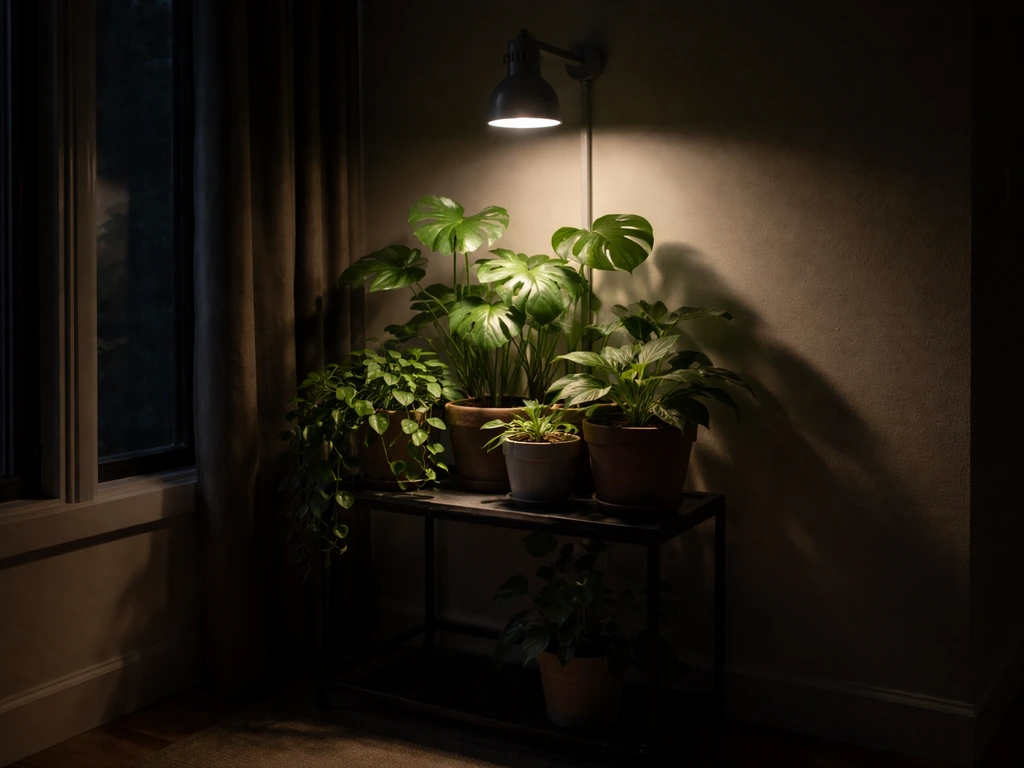
Low light is a completely different situation. It might be 25 to 150 foot-candles of light (roughly the brightness of a softly lit room), which isn't much, but it's enough to trigger photosynthesis in shade-adapted plants. University extension guidelines classify indoor light into ranges, with 'low light' generally falling around 25 to 150 foot-candles (roughly 270 to 1,600 lux). Some species, like snake plants, can survive at as little as 25 foot-candles, though they grow very slowly at that intensity. That's survival mode, not thriving. The practical takeaway: if your space gets any ambient light at all, whether from a distant window, a hallway fixture, or a lamp, you're dealing with low light, not true darkness, and that changes your options considerably.
Why Light Matters: Photosynthesis and What Happens Without It
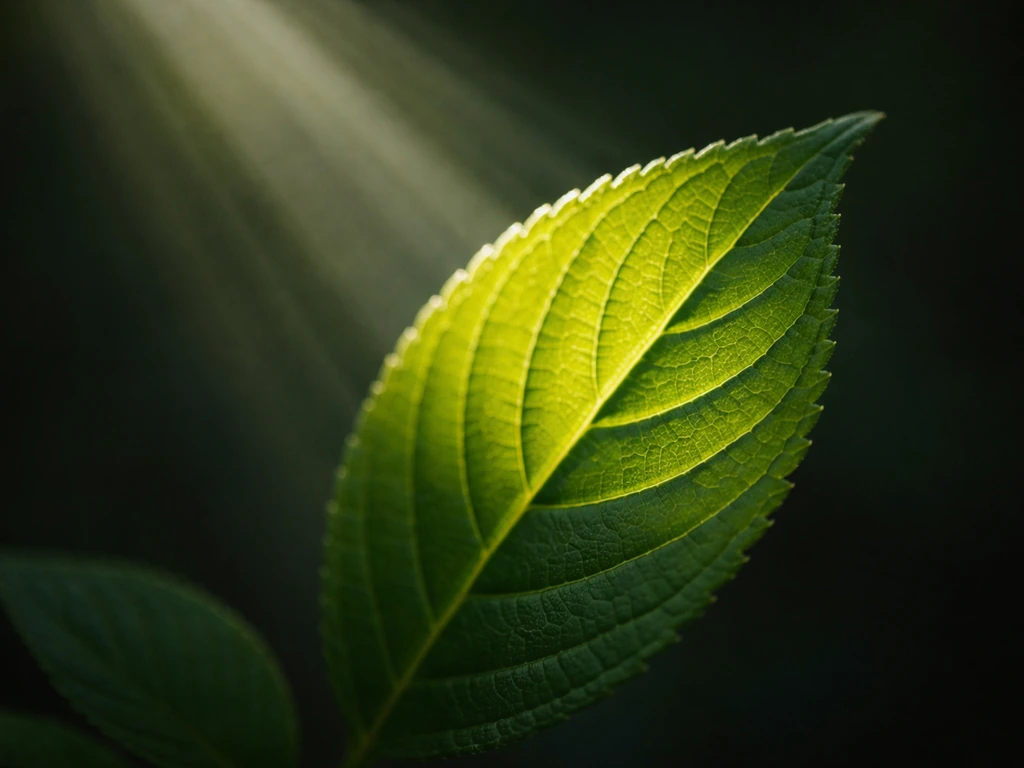
Plants use light to convert carbon dioxide and water into glucose and oxygen. That glucose is the actual 'food' that fuels every process in the plant, from building new leaves to pushing out roots. Without light, photosynthesis stops, and the plant can't manufacture new carbohydrates. It can still respire (consuming oxygen and burning stored energy), but it's running on reserves with no way to refuel. This is why 'plants grow without light' is a myth that gets disproven pretty quickly the moment you try it.
Beyond energy, light also acts as a signal that controls how a plant develops. Plants have photoreceptors, including phytochromes (which detect red and far-red light) and phototropins (which respond to blue light), that essentially tell the plant what kind of environment it's in. In darkness or very low light, a different developmental program kicks in. Researchers call it skotomorphogenesis, or 'dark growth,' and it produces the spindly, pale, elongated seedlings you've probably seen when a seed sprouts in a dark cupboard. The plant is essentially searching for light. When light is present, a different program (photomorphogenesis) takes over and produces normal, compact, green growth. This switch is controlled by a network of proteins including COP1 and HY5, and it explains why even a tiny amount of light can fundamentally change how a plant develops.
Do Plants Actually Grow Faster in the Dark?
This one comes up a lot, and the answer is: it depends on what you mean by 'grow.' Stems can elongate faster in darkness or very low light, but that's not healthy growth. It's a stress response. When a plant detects low or poor-quality light (specifically a low ratio of red to far-red light, which happens in shade), phytochrome signaling triggers a shade-avoidance response. The plant pumps auxin (a growth hormone) into its stems and starts stretching upward, essentially gambling that there's better light above. This is why a seedling left in a dim corner will become tall and spindly almost overnight. It's getting 'bigger' in one sense, but the plant is weaker, the stems are thinner, and it's not putting energy into leaves, roots, or flowers.
So if you're wondering whether keeping your plant in the dark will accelerate growth, the answer is no, not in any useful way. You'll get etiolated, leggy growth that's structurally weak and prone to flopping over. The question of whether plants grow 'better' in the dark versus light is addressed more deeply in related comparisons of dark vs. If you're curious about mung beans specifically, the light cues that drive healthy development explain why mung beans grow better in the dark only in particular low-light setups the question of whether plants grow 'better' in the dark versus light. If you mean real development rather than just stretching, the answer comes down to the light cues beans receive, and those cues behave differently in dim setups than in true darkness mung beans grow better in the dark. light growing conditions, but the short version is: light wins, every time, for real growth.
Plants That Actually Tolerate Low Light Indoors
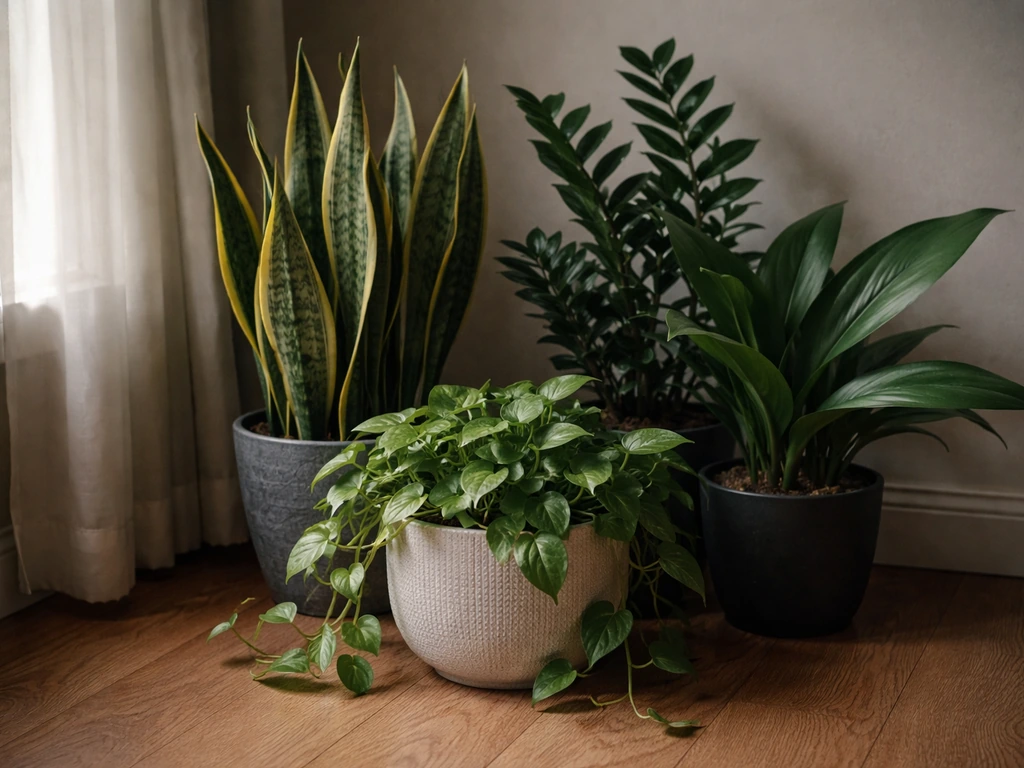
No plant thrives in complete darkness, but a solid group of houseplants are genuinely adapted to dim, shaded environments. These are your best bets for low-light spaces like windowless offices, basement apartments, or interior rooms. Just be realistic: even the toughest low-light plants grow slowly in dim conditions. They survive, but they don't exactly flourish. For faster growth, you'll want to supplement with artificial light, which I'll cover in the next section.
| Plant | Minimum Light Tolerance | What to Expect in Low Light |
|---|---|---|
| Snake Plant (Sansevieria / Dracaena trifasciata) | ~25 foot-candles | Very slow growth, stays alive, minimal new leaves |
| ZZ Plant (Zamioculcas zamiifolia) | Very low (similar to snake plant) | Slow but steady; stores water in rhizomes so it's forgiving |
| Cast Iron Plant (Aspidistra elatior) | Very low | Earns its name; survives neglect and dim conditions well |
| Pothos (Epipremnum aureum) | Low to medium | Will grow slowly and lose variegation; tolerates dim spaces |
| Peace Lily (Spathiphyllum) | Low | Survives well; may not flower without brighter light |
| Chinese Evergreen (Aglaonema) | Low | Dark-leaf varieties handle low light better than light-leaf ones |
| Dracaena (various species) | Low to medium | Slow growth, may drop lower leaves; survives dim rooms |
| Heart-leaf Philodendron | Low to medium | Grows slowly but steadily; leggy without enough light |
A quick note on seeds: if you're wondering whether seeds need light to germinate, most don't. Seeds typically sprout in darkness and only need light once the seedling emerges. Seeds also need an adjacent light cue for later development, so if you're comparing germination versus growth in darkness, the related discussion of whether do seeds grow in darkness helps connect the two stages. That's a related topic on its own, but it's worth knowing that sprouting and growing are two different stages with different light requirements.
How to Set Up a Low-Light or Dark-Room Garden: Step by Step
If your space genuinely gets very little natural light, here's how to set it up properly so your plants actually have a shot. This isn't about expensive setups. I've done versions of this in a windowless bathroom and a dim hallway, and it works.
- Measure your actual light level before buying plants. Use a free lux meter app on your phone or a cheap handheld meter. Anything below 270 lux (about 25 foot-candles) is genuinely very low and you'll need artificial lighting. This step saves you from killing plants that were never suited for the space.
- Pick plants from the low-light list above. Match the plant to the space, not the other way around. If you love tropicals but your room is dim, accept that you'll need a grow light, or choose a ZZ plant and save yourself the frustration.
- Choose your artificial light source (see the next section for specifics). For a single plant or small shelf, a simple LED grow bulb in a clip lamp works fine. For a whole shelf or growing area, a T5 or T8 fluorescent strip or a dedicated LED panel is more practical.
- Set the photoperiod to 12 to 14 hours of light per day. Iowa State University Extension recommends this range for supplemental indoor lighting. Use a cheap outlet timer so you don't have to think about it. This is one of the easiest wins in indoor gardening.
- Position the light at the right distance. This matters more than most people realize. A fluorescent tube at 6 inches delivers far more light than at 24 inches. Start at 6 to 12 inches for most low-light plants and adjust based on how the plant responds.
- Water less than you think you need to. Plants in low light photosynthesize slowly, which means they use water slowly too. Overwatering is one of the most common ways to kill low-light plants. Check soil moisture before every watering.
- Give it 4 to 6 weeks before judging results. Low-light plants grow slowly. Don't panic if you don't see dramatic new growth in the first few weeks. Look for signs of health: firm leaves, consistent color, no yellowing.
Choosing the Right Light Source for a Dark Space
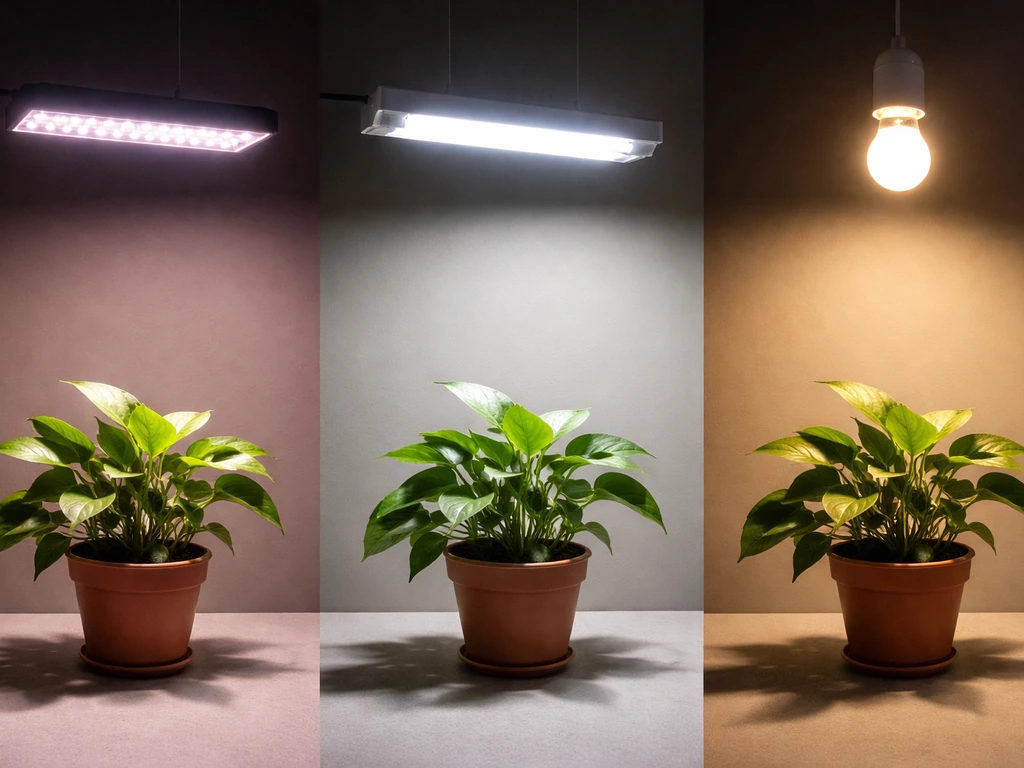
This is where a lot of people get overwhelmed, but it doesn't need to be complicated. Here's a plain-language breakdown of your main options and when each one makes sense.
LED Grow Lights
LEDs are currently the best all-around option for most indoor gardeners. They're energy-efficient, run cool, last a long time, and the better ones deliver a full spectrum that covers both the blue and red wavelengths plants use most for photosynthesis. For low-light plants, you don't need a high-powered unit. A simple 10 to 20 watt LED grow bulb in a standard clip lamp can handle one or two plants easily. For a larger shelf, look for an LED panel or strip light in the 20 to 45 watt range. Position it 6 to 18 inches above the plant canopy depending on intensity, and adjust based on plant response.
Fluorescent Tubes (T5 and T8)
Cool-white fluorescent tubes have been the go-to for indoor plant lighting for decades, and they still work well. University of Maryland Extension notes that grow lights can enhance foliar growth and produce thicker stems than cool-white tubes, and it outlines practical fixture options for indoor cultivation. They're inexpensive, widely available, and deliver decent blue-spectrum light that's well-matched to vegetative growth. University of Missouri Extension includes distance-to-intensity tables for fluorescent fixtures, and the general guidance is that most plants need the tube within 6 to 12 inches for meaningful light delivery. Warm-white fluorescents can also work, though they skew toward red wavelengths. A combination of cool-white and warm-white tubes gives a broader spectrum. T5 fixtures are smaller and more intense; T8s are more common in standard shop lights and work fine for low-light species.
Regular Incandescent or CFL Bulbs
Standard incandescent bulbs produce a lot of heat and are pretty inefficient for plant growth. They're not recommended. Compact fluorescent bulbs (CFLs) are a step up and can work for low-light plants in a pinch, especially if you use a daylight-spectrum (5000K to 6500K) bulb positioned close to the plant. They're not as efficient as LEDs or T5 tubes, but if you already have a CFL desk lamp, it's better than nothing for a snake plant or pothos sitting nearby.
| Light Source | Best For | Distance from Plant | Cost | Energy Efficiency |
|---|---|---|---|---|
| LED grow light (panel or bulb) | Most indoor setups; best all-around | 6 to 18 inches | Moderate upfront, low running cost | Excellent |
| T5 fluorescent tube | Shelves, propagation, multiple plants | 3 to 12 inches | Low to moderate | Good |
| T8 fluorescent (shop light) | Budget-friendly shelf setups | 6 to 12 inches | Very low | Good |
| CFL (daylight spectrum) | Single plant, temporary use | 4 to 8 inches | Very low | Moderate |
| Incandescent bulb | Not recommended for plants | N/A | Low | Poor |
Whatever you choose, the schedule matters as much as the intensity. Run your light for 12 to 14 hours per day on a timer. This gives plants a consistent photoperiod, which is what drives healthy development. Some sources suggest up to 16 hours for supplemental lighting in very dim spaces, but 12 to 14 is a reliable starting point for most houseplants.
Troubleshooting: Leggy Growth, Pale Leaves, and Slow Progress
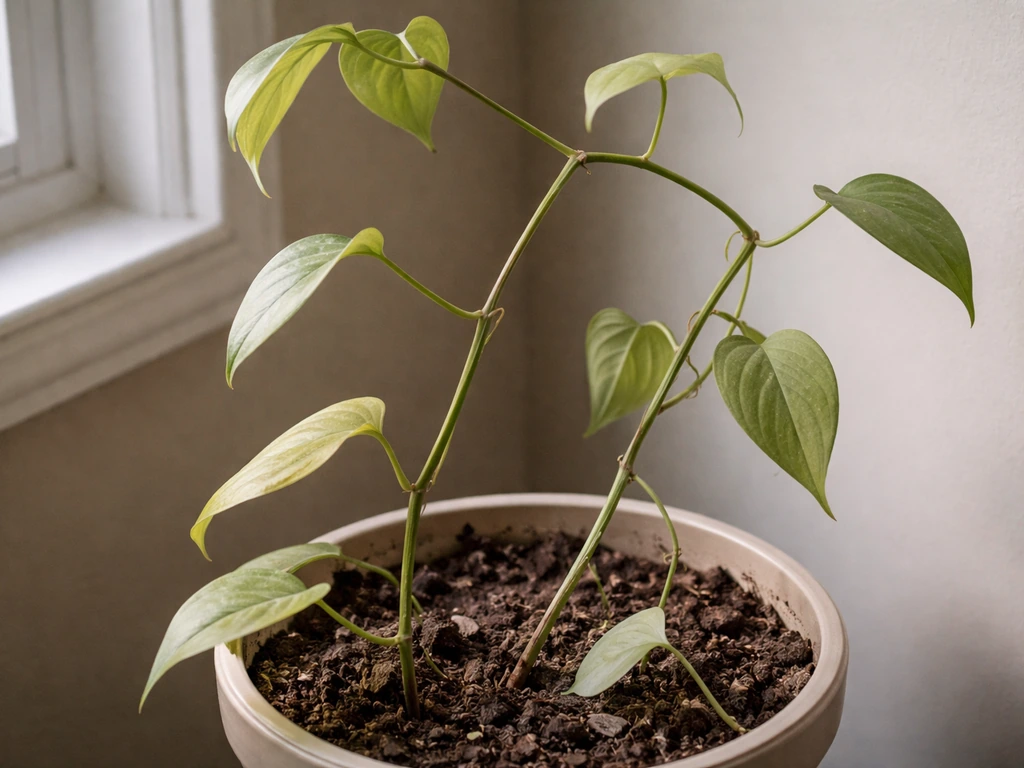
Even with the best intentions, low-light growing comes with a predictable set of problems. Here's how to read what your plant is telling you.
Leggy, Stretched-Out Stems
Long, weak stems with wide gaps between leaves (long internodes) almost always mean insufficient light. This is that shade-avoidance response in action: the plant is stretching toward any light it can find. University of California IPM lists inadequate light as the primary cause of leggy houseplant growth. The fix is simple: move the plant closer to your light source or increase the duration. If it's a hanging or trailing plant like pothos, this might not bother you aesthetically, but it signals the plant isn't getting what it needs.
Pale, Yellowing, or Washed-Out Leaves
Pale or yellowish foliage in low-light setups usually points to one of two things: not enough light for chlorophyll production, or overwatering (which is common in low-light plants that are being watered at the same rate as sun-loving species). Before you assume it's a light problem, check the soil moisture. If it's consistently wet, ease up on watering first. If the soil is fine but leaves are still pale, add more light or extend your photoperiod. UC IPM notes that pale growth has overlapping causes including nutrient deficiency, so if adjusting light and watering doesn't help, consider a diluted balanced fertilizer.
No New Growth or Extremely Slow Growth
Low-light plants grow slowly by nature, but if your plant hasn't produced a single new leaf in two or three months, that's a sign it's in survival mode rather than growth mode. First, make sure your light is on for at least 12 hours per day and positioned close enough (within 12 inches for most compact fixtures). Second, check that the plant isn't root-bound or in need of fertilizer. Low-light plants still need nutrients, just less of them, and at lower frequency than high-light plants.
Leaves Turning Toward the Light (or Away From It)
If your plant's leaves are all angling hard toward one side, it's telling you the light isn't reaching it evenly. Rotate the pot a quarter turn every week or two to encourage even growth. If leaves are curling away from the light source, the light may be too intense or too close, causing mild stress. Back the fixture off a few inches and reassess.
The bottom line is that growing plants in low-light or near-dark spaces is genuinely doable, but it requires matching the right plant to your conditions and supplementing with artificial light when needed. You won't be growing sun-loving vegetables in a windowless room, but a ZZ plant, a snake plant, or a pothos can do surprisingly well with the right setup. Start simple, measure your light, pick a forgiving plant, and adjust from there.
FAQ
How can I tell whether my plant is in true darkness or just low light?
Do a quick test by reading a book near the plant for 10 minutes. If you can read comfortably without turning on additional lights, it’s likely low light rather than complete darkness, and shade-tolerant plants can survive. If you cannot see well enough to read, assume you are near the low-light threshold and add a small grow light.
If I use a timer, do plants need a day-night cycle or can I leave grow lights on constantly?
Plants generally do better with a consistent dark period. Running lights 24/7 can stress growth and encourage abnormal stretching. A practical target is 12 to 14 hours on and 10 to 12 hours off, then adjust based on how your plant responds.
Will a plant “store up” energy in daylight so it can handle nights longer than normal?
Yes, plants do ration stored carbohydrates through the dark period, but storage is meant for a typical overnight interval. If you extend the dark period for weeks, growth will stall and decline can follow even if the plant stays alive. If your space is dim, prioritize increasing total daily light duration with a timer rather than relying on storage.
Do any plants actually benefit from darkness, like longer nights to grow better?
Darkness triggers developmental signals (like elongation responses) mainly when light is limiting, so “more dark” usually leads to weak, stretched growth rather than stronger plants. The exception is normal photoperiod cycling, where some darkness is required, but more than your plant’s needs usually hurts overall development.
Why do my plants get leggy only at certain times of day?
Often it’s because the light source is too far, too weak, or blocked, so the plant only gets adequate light during a short window. Another cause is a timer or smart plug that turns the light off earlier than expected. Check both intensity and schedule, and rotate the pot so all sides receive light over time.
Can I grow food crops in a windowless room at all?
Some crops can be grown with artificial light, but windowless success depends on providing enough daily light for photosynthesis, not just “survival.” For vegetables and fruiting plants, you typically need higher output and a longer photoperiod than you would for low-light houseplants, and you may need multiple fixtures for uniform coverage.
Do plants need light to germinate from seed?
Most seeds germinate in darkness, because the embryo can use stored energy initially. Light usually becomes important after the seedling emerges, for normal leaf development and avoiding excessive stretching. If your seedlings look pale and stretched, that’s a sign they need light sooner.
My plant looks pale. How do I know if it’s light deficiency or overwatering?
Check the soil, not just the leaves. If the mix stays wet or soggy for days, reduce watering first, because low light slows water use. If the soil dries appropriately and the plant still pales, increase light duration or move the grow light closer, then reassess over 1 to 2 weeks.
Is rotating the pot always necessary in low light?
Rotation helps when the plant is leaning toward the light source, which is common with side-mounted lamps or single fixtures. If new growth is evenly green and compact, rotation may not be critical. If leaves cluster on one side or the plant leans, rotate a quarter turn every week or two.
How close should I place an LED grow light in a low-light setup?
A common starting point is 6 to 18 inches above the canopy, but the correct distance depends on bulb strength and how the plant responds. If you see mild leaf curl or bleaching, move the light farther away. If growth is slow with long gaps between leaves, move it closer or extend the daily light hours.