
Yes, flowers can absolutely grow and bloom under artificial light. Tube lights can work as a form of artificial light for plants, but they still need the right intensity, spectrum, and hours to produce blooms. The key is giving them the right intensity, the right spectrum (the mix of light colors), and the right number of hours per day. Get those three things roughly correct and most common flowering houseplants will thrive under LEDs or fluorescent bulbs with no sunlight at all. Miss one of them badly, and you'll get lush green leaves with zero blooms, or a leggy, sad-looking plant that never really gets going.
Can Flowers Grow With Artificial Light? A Practical Guide
Marcus Hartley
15 May 2026
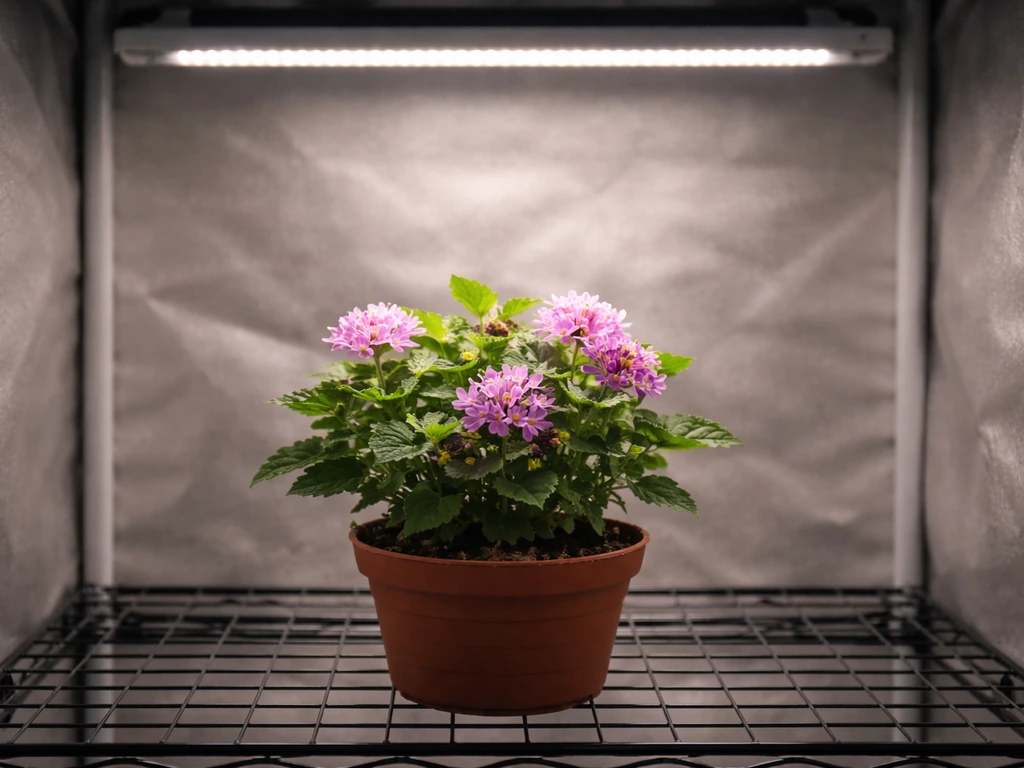
Can flowers actually grow and bloom under artificial light?
The honest answer is yes, with an important caveat. Flowers don't care whether light comes from the sun or a bulb. What they care about is whether that light contains the right wavelengths (particularly red and blue), arrives at sufficient intensity, and runs for the right number of hours each day. Sunlight happens to deliver all three reliably. Artificial light can too, but you have to be intentional about it.
Where people run into trouble is treating grow lights like lamps: they flip them on in the morning, off when they leave for work, and wonder why the plant never flowers. Plants time their internal clocks using photoperiod, which is just the number of hours of light versus darkness they receive per day. University of Minnesota Extension research confirms that flowering plants can fail entirely to produce flower buds if light duration or intensity is insufficient. So the setup matters as much as having the light at all.
There's also the photoperiodism piece, which sounds fancy but is really just the fact that some plants need short days to bloom, some need long days, and some (day-neutral plants) don't care either way. This matters practically: if you run your lights 18 hours a day trying to maximize growth, you might actually be preventing a short-day plant like a Kalanchoe from ever blooming. Getting this right is less complicated than it sounds once you know which category your plant falls into.
Which artificial lights actually work: LEDs vs fluorescent vs regular bulbs
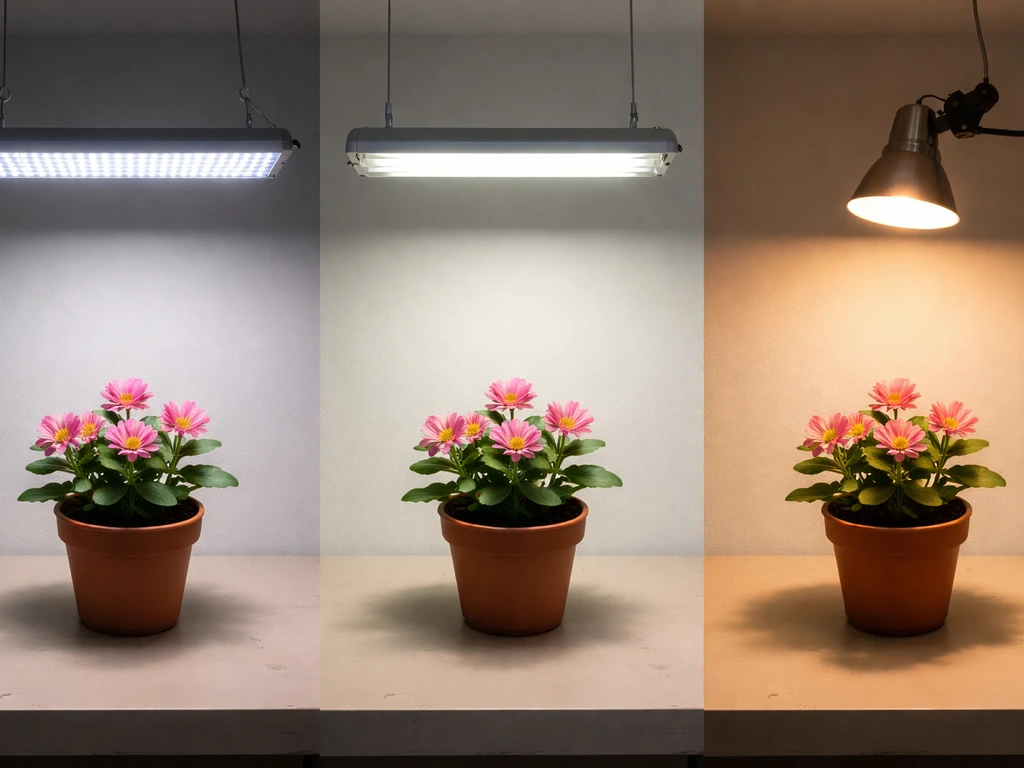
This is probably the question I get asked most, and the good news is you have real options at every budget. Here's how the main types stack up for flowering plants specifically.
| Light Type | Spectrum Quality | Energy Efficiency | Heat Output | Best For | Verdict for Flowering |
|---|---|---|---|---|---|
| Full-spectrum LED grow lights | Excellent (tunable red/blue/white) | Very high | Very low | All flowering plants, long-term setups | Best overall choice |
| Fluorescent (T5/T8 tubes) | Good (wide spectrum) | High | Low-moderate | Seedlings, low-light bloomers, herbs | Great budget option |
| Compact fluorescent (CFL) | Decent (varies by bulb) | Moderate | Low-moderate | Small setups, supplemental light | Fine for shade-tolerant bloomers |
| Incandescent / halogen bulbs | Poor (heavy red, lacks blue) | Very low | High | Not recommended | Avoid for flowering |
| Regular white LED (not grow-spec) | Moderate (limited red/blue) | High | Low | Very low-light tolerant plants only | Weak for blooming |
Full-spectrum LED grow lights are the clear winner for flowering plants. They deliver the red and blue wavelengths plants use most efficiently, run cool enough to place close to plants, and use a fraction of the electricity of older options. Research from Michigan State University has specifically identified light spectrum as a key regulator of flowering, which is why generic white LEDs and old incandescent bulbs underperform: they don't deliver the right spectral mix in sufficient amounts.
T5 fluorescent tubes are still a solid, affordable choice, especially if you're just starting out or growing shorter plants like African violets or begonias. A study comparing compact fluorescent to incandescent bulbs found that swapping bulb types can actually delay flowering in some crops (petunias were one example), so if you're using CFLs and struggling to get blooms, the bulb type itself might be part of the issue. Stick with full-spectrum fluorescents or LEDs labeled for grow use.
How much light flowers need: intensity, spectrum, and daily hours
Light intensity: what the numbers mean in plain language
Light intensity for plants is measured in PPFD (Photosynthetic Photon Flux Density), expressed as micromoles per square meter per second (µmol·m⁻²·s⁻¹). You don't need to memorize that. What you need to know is that most ornamental flowering plants thrive in the range of 40 to 60 µmol·m⁻²·s⁻¹ for steady growth, based on MSU Extension research. High-light bloomers like geraniums or tomato-type plants want more, around 100 to 200 µmol·m⁻²·s⁻¹. Low-light bloomers like peace lilies can manage on much less.
The practical takeaway: intensity drops off fast as you move the light farther away. A grow light that's perfect at 12 inches might be almost useless at 36 inches. This is why placement matters so much, and it's one of the most common reasons people's setups don't work.
Spectrum: what colors your plant actually needs
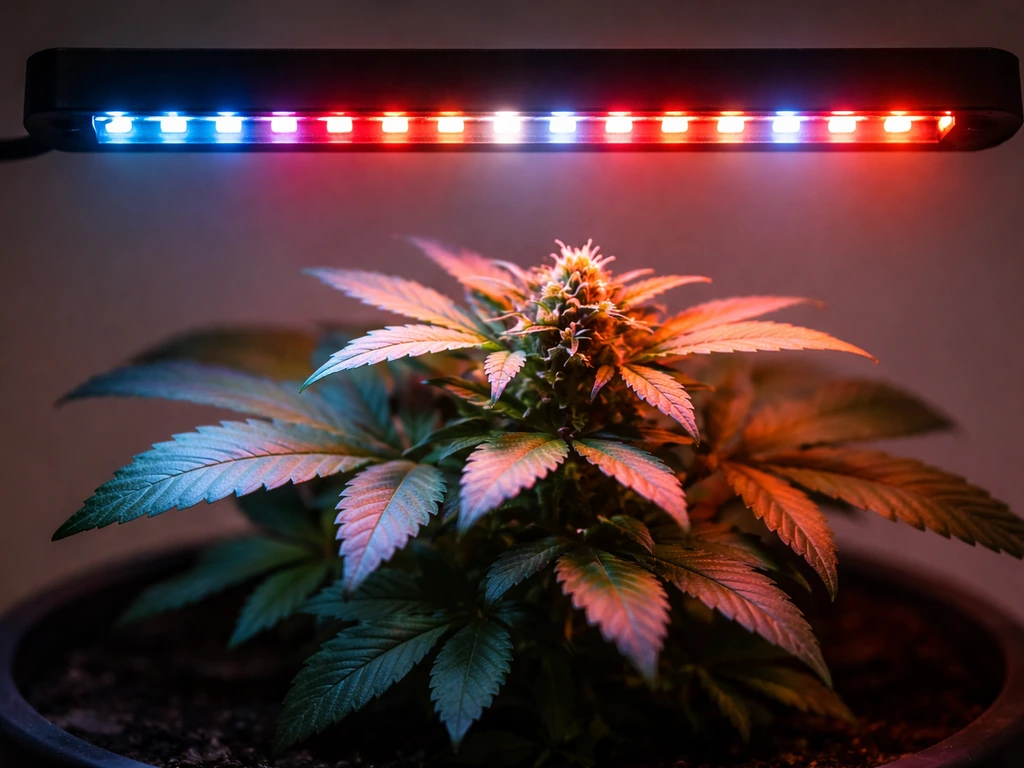
Plants use blue light (roughly 400 to 500 nm) for vegetative growth and red light (roughly 600 to 700 nm) for flowering and fruiting. A grow light labeled 'full-spectrum' typically covers both. Look for lights that specify a red-to-blue ratio or are marketed specifically for flowering stages. The ISHS research on Kalanchoe (a short-day flowering plant often studied for exactly this reason) found that blue-light-related photoperiod extension could trigger flowering, while supplemental red or green light alone did not. That's a useful signal: blue matters more than people think, especially for triggering bloom cycles.
Photoperiod: how many hours of light per day
This is where plant categories really matter. Short-day plants like Kalanchoe, Christmas cactus, and poinsettia need fewer than 12 hours of light to trigger blooming. Long-day plants like petunias and certain flowers need more than 14 hours of light. Day-neutral plants like African violets and some begonias will bloom regardless of day length if the intensity and spectrum are right. UNH Extension also warns that even small amounts of stray light during the dark period can disrupt flowering in short-day plants, so if you're trying to bloom a Kalanchoe under artificial light, make sure it gets complete darkness for 12 or more hours and isn't sitting near a lamp or window that lets in ambient light at night.
| Plant Category | Hours of Light Needed | Examples | Common Mistake |
|---|---|---|---|
| Short-day plants | Less than 12 hours to trigger bloom | Kalanchoe, Christmas cactus, poinsettia | Leaving lights on too long and preventing blooms |
| Long-day plants | 14+ hours to trigger bloom | Petunias, carnations, some herbs | Too few light hours causing plants to stay vegetative |
| Day-neutral plants | 12 to 16 hours works well | African violet, begonia, impatiens | Insufficient intensity rather than duration |
Setting up your lights: placement, distance, and timing
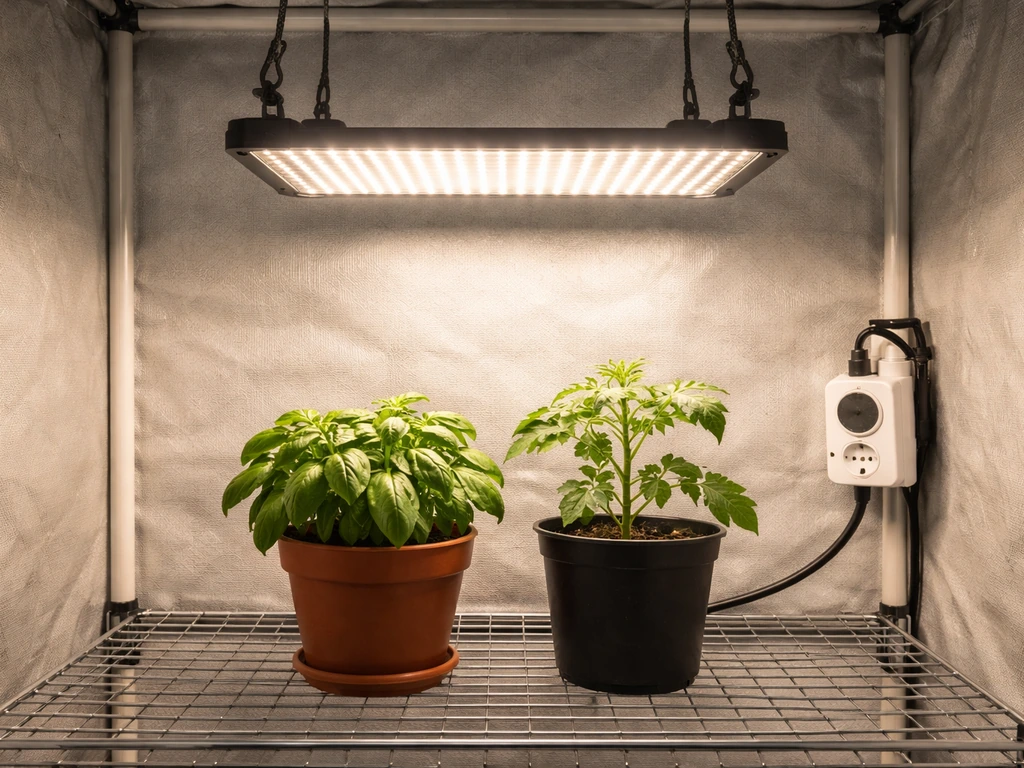
Setup is where most people leave performance on the table. A great grow light positioned wrong is almost as bad as no grow light at all. Here's how to do it right.
Distance from plant to light
As a starting guideline, most LED grow lights for flowering plants should sit 12 to 18 inches above the canopy. Fluorescent tubes can go closer, sometimes as close as 4 to 6 inches, because they generate less heat. Check your specific light's manual, but if you don't have that, start at 12 inches and watch the plant for a week. Leaf bleaching or upward curling means too close; leggy stretching toward the light means too far.
Photoperiod timing: use a timer, not guesswork
Buy a cheap plug-in timer. This is genuinely non-negotiable if you want consistent flowering. Your schedule varies, you forget to turn lights on and off, and inconsistent photoperiods stress plants and prevent blooming. An outlet timer costs less than $10 and removes all of that uncertainty. Set it based on your plant's category: 12 to 14 hours for most long-day and day-neutral flowering plants, 10 to 12 hours if you're trying to induce blooming in short-day plants.
Light coverage and layout
- One 20 to 45 watt LED grow panel typically covers a 2x2 foot area well enough for most small flowering plant setups.
- Rotate plants every week or two so all sides get even light exposure, especially under overhead single-source lights.
- Reflective surfaces (white walls, silver reflective film) behind and beside your plants bounce light back and meaningfully increase efficiency.
- If growing multiple shelves, T5 fluorescent shop lights mounted under each shelf are a classic, cost-effective setup that works well for African violets, begonias, and similar plants.
- Keep lights at a consistent height. As plants grow, adjust the light upward to maintain your target distance.
Troubleshooting: why your flowers aren't blooming or look unhealthy
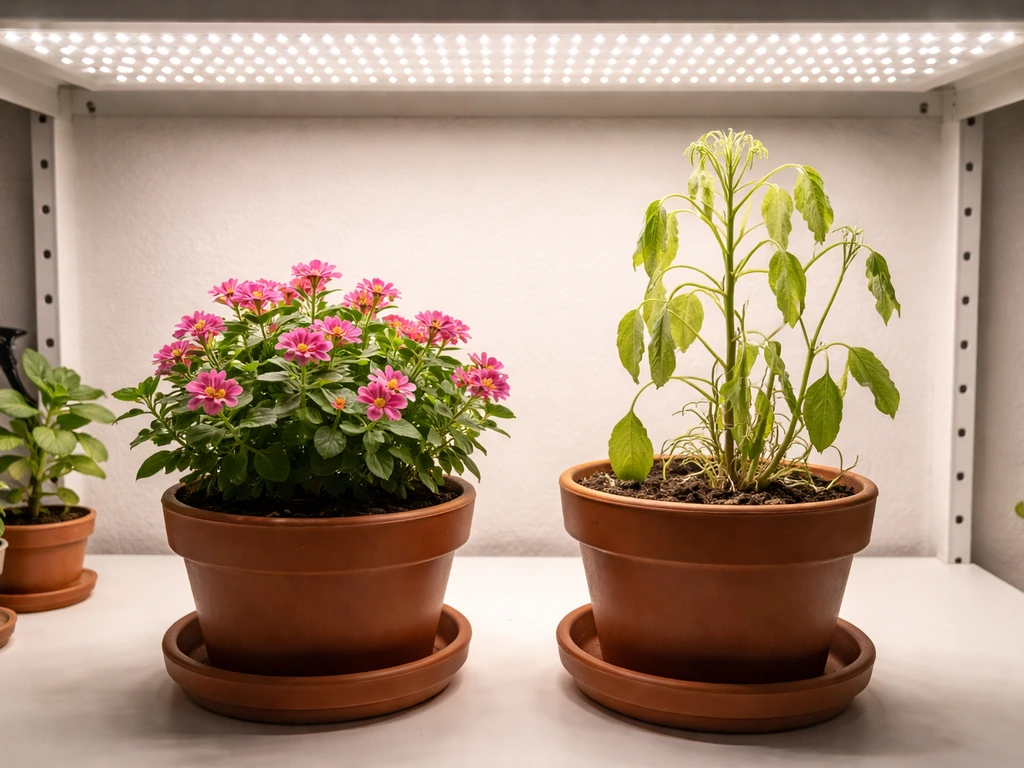
If you've set up your lights and something still feels off, here's a quick diagnostic to run through. Most problems have a clear cause once you know what to look for.
| Symptom | Most Likely Cause | Fix |
|---|---|---|
| Plant is tall and spindly, leaning toward light | Light is too far away or too dim | Move light 4 to 6 inches closer; check that it's a grow-spec bulb |
| Leaves are yellowing (older leaves first) | Insufficient light or too many hours causing stress | Increase intensity or adjust photoperiod; check for overwatering too |
| Plant is growing well but won't bloom | Wrong photoperiod for plant type, or stray light disrupting dark period | Identify your plant's day-length category; use a timer; block stray light at night |
| Leaf tips or edges are browning | Light too close causing heat or light burn | Move light farther away by 4 to 6 inches |
| Plant is pale overall, not dark green | Light intensity too low | Upgrade to a higher-output grow light or move it closer |
| Growth is very slow despite correct setup | Intensity likely below 40 µmol·m⁻²·s⁻¹ or spectrum is wrong | Switch to a full-spectrum LED grow light rated for flowering |
One thing worth mentioning: stray light during the dark period is a sneaky problem. If your Kalanchoe or Christmas cactus sits near a hallway where the light flicks on at night, or gets ambient light from a street lamp through a window, that can be enough to reset its flowering clock and prevent blooms entirely. UNH Extension specifically flags this as a concern. The fix is simple: either move the plant somewhere truly dark at night, or use a dark-out cover or cardboard tent for the dark period.
Best indoor flowering plants for artificial light setups
Not every flowering plant is equally forgiving under artificial light. Some are practically designed for it. Here's how to match plants to your setup.
For lower-light or more modest setups (T5 fluorescent or basic LED panels)
- African violet (Saintpaulia): probably the most popular artificial-light bloomer, genuinely thrives under fluorescent tubes, day-neutral, blooms reliably with 12 to 14 hours of light.
- Begonia: compact varieties do well, tolerates lower intensity, produces consistent color and blooms.
- Peace lily (Spathiphyllum): handles low intensity better than most, though blooms are less frequent in very low light.
- Anthurium: slow but steady, tolerates artificial light well, long-lasting blooms once triggered.
- Impatiens: easy going, day-neutral, reliable bloomer under fluorescent setups.
For brighter setups (full-spectrum LED grow lights with higher output)
- Kalanchoe: a short-day plant that responds dramatically to controlled photoperiods under artificial light, well-studied and reliable when you manage the dark period correctly.
- Geranium (Pelargonium): needs stronger light, rewards you with heavy blooming, good for LED setups positioned 12 to 16 inches overhead.
- Petunia: long-day plant, needs 14+ hours for best blooming, does well under higher-output LEDs.
- Miniature roses: need strong light (closer to 200 µmol·m⁻²·s⁻¹) and good air circulation, but can bloom indoors under quality LED setups.
- Herbs with blooms (basil, chives, lavender): practical double-duty plants that flower under grow lights and are useful in the kitchen.
It's also worth knowing that some flowering plants under constant light (no dark period at all) can be stressed rather than helped. If you've read about growing plants in constant light conditions, be aware that most flowering plants specifically need some darkness, unlike purely vegetative crops. Lettuce can grow under 24 hour light for leaf production, but you still need to keep the light intensity and spectrum appropriate and avoid stressing the plant 24-hour light schedules. That's a different conversation, but it's worth keeping in mind if you're experimenting with 24-hour light schedules.
Your step-by-step plan to start today
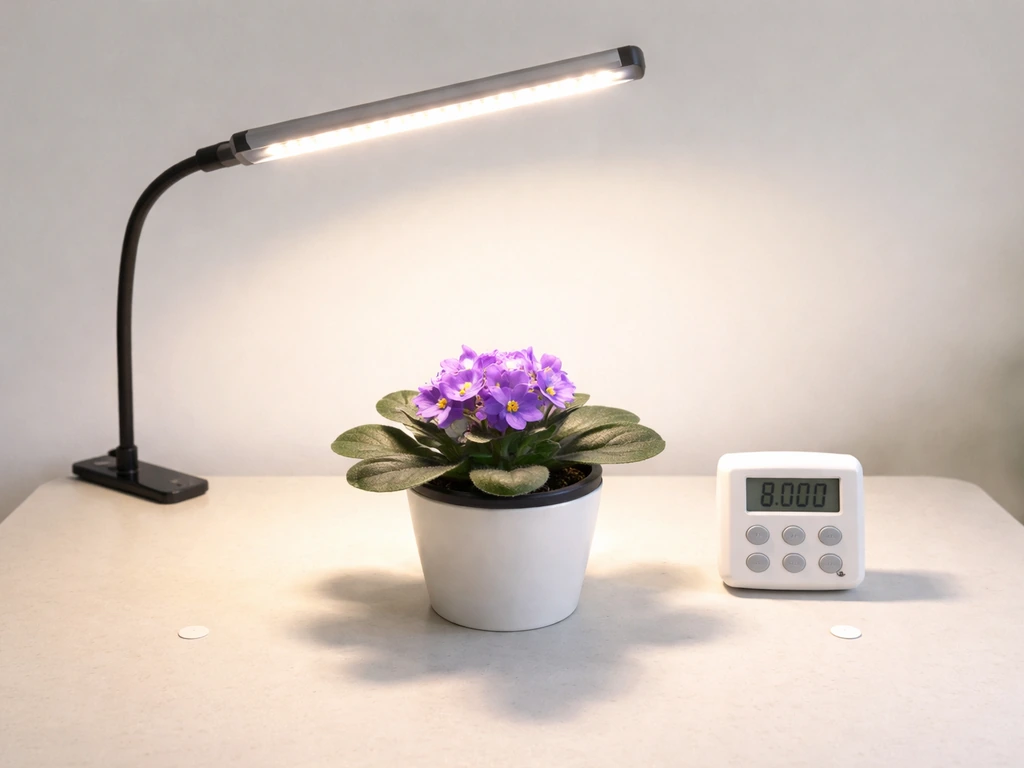
You don't need to overhaul your whole setup or buy expensive gear to start. Here's exactly what to do right now.
- Pick one plant to start with. Choose a day-neutral flowering plant like an African violet or begonia if this is your first attempt. They're forgiving and responsive, and you'll learn the most from watching them succeed.
- Get the right light. If you don't have a grow light yet, a T5 fluorescent shop fixture or a basic full-spectrum LED grow panel in the 20 to 45 watt range is a solid, affordable starting point. Look for 'full-spectrum' on the label.
- Set your distance. Start with the light 12 to 18 inches above the plant for LEDs, or 4 to 6 inches for fluorescent tubes. Mark the position so you can track adjustments.
- Buy a plug-in outlet timer. Set it for 14 hours on, 10 hours off as a default for day-neutral or long-day plants. Adjust down to 10 to 12 hours on if you're targeting a short-day bloomer like Kalanchoe.
- Eliminate stray light during the dark period. Check that your plant isn't near a lamp, TV, or window with night light. Stray light can quietly prevent flowering even when everything else is right.
- Observe for two weeks before changing anything. Plants respond slowly. Give your setup two full weeks before adjusting distance or timing. Write down what you changed and when.
- If growth is leggy after two weeks, move the light 4 inches closer. If leaves bleach or curl upward, move it 4 inches farther. If the plant is growing but not blooming after 6 to 8 weeks, revisit the photoperiod settings for your specific plant.
- Scale up once you see results. When your first plant responds well, you'll have a clear sense of what works. Add more plants, a second shelf, or a slightly more powerful light as you go.
The biggest mistake people make is trying to solve everything at once. Start with one plant, one light, one timer. Get that working. Then expand. Artificial lighting for flowers is genuinely not complicated once you understand the three levers: intensity, spectrum, and photoperiod. Dial those in and you'll have blooming plants even in an apartment with no south-facing windows.
FAQ
Can I grow flowers with a normal desk lamp or only with dedicated grow lights?
You can, but you must treat brightness like a measurable input, not a guess. If the light only feels “bright” to you, it may still be too low for flowering. Use the fixture’s specs or a PPFD meter if possible, and adjust height or wattage until you reach the target intensity range for your plant type.
Do flowers need any natural sunlight at all if I use artificial light?
Generally, yes, but you still need the right photoperiod and enough intensity. Many people successfully use artificial light for blooming without any sunlight, as long as the light provides appropriate red and blue and runs the correct hours. If the plant is short-day, the bigger issue is avoiding any light leaks during the dark period.
How important is running the lights on a timer instead of turning them on and off myself?
Do not rely on your memory or a manual switch. Even small timing mistakes can interrupt flowering, especially for short-day plants. A plug-in timer that stays accurate is the easiest fix, and you should test it once (for example, verify the light turns on and off at the right times).
Will a small amount of light at night ruin flowering?
Yes, especially for Kalanchoe, Christmas cactus, and poinsettia. For short-day types, aim for complete darkness for the required window, and keep the plant away from hallway lights, TVs, chargers with indicator LEDs, or street light through windows. Consider a dark-out cover only during the dark period.
My plant has lots of leaves but no flowers, what does that usually mean under artificial light?
It can happen if the light is too far away or too weak. When intensity is insufficient, many flowering plants respond by growing leaves without forming buds. If you see “stretching” toward the light, raise intensity by moving the light closer (within the manufacturer’s safety guidance) or using a stronger fixture.
What signs tell me my grow light is too close or too strong?
It often points to the light being too intense or positioned too close, or to heat stress if the fixture runs hot. Look for bleaching, scorched leaf tips, or leaves curling upward. Back the light up slightly and keep airflow gentle so you do not create extra stress.
How do I choose the right number of hours per day for flowering?
For most ornamental flowering plants, a common failure mode is using the wrong daily light duration. Long-day and day-neutral plants typically need around 12 to 14 hours, while short-day bloom induction is closer to 10 to 12 hours. Use the plant’s category to set the timer before changing anything else.
Why do two “full-spectrum” LED lights give different flowering results?
Often. Even with “full spectrum,” two fixtures can deliver very different PPFD at the plant canopy. If your light brand does not publish output, treat placement and distance as adjustable variables, and confirm results over a week rather than expecting immediate bud formation.
Can I run lights 24 hours a day to get more blooms faster?
Sometimes, but constant light can be stressful for flowering plants because it removes the dark period they use to regulate blooms. Instead of 24 hours, most flowering plants do better with a controlled light/dark cycle. If you experiment with unusual schedules, change only one factor at a time.
Are day-neutral flowering plants still affected by photoperiod under artificial light?
Yes. Day-neutral plants like African violets and some begonias are generally less sensitive to day length, but they still need adequate intensity and a spectrum that includes enough red and blue. If they fail to bloom, check PPFD and make sure they are not being starved of nutrients or too cool for bud formation.
Should I change my light settings when a plant moves from vegetative growth to flowering?
It depends on the growth stage. Many “flower” claims mainly reflect red and blue balance, but seedlings and vegetative growth can still be handled with the same fixture if intensity is appropriate. If your plant is leggy in the first weeks, you likely need more intensity or a different distance rather than switching to a different bulb.
How does light distance affect blooming, especially in a small indoor setup?
Yes, if the plant is very low or the fixture spreads light poorly. Light intensity drops quickly with distance, and in multi-tier setups lower plants can end up underlit. If you stack plants, adjust light height per tier or use multiple fixtures to keep PPFD consistent across the canopy.