
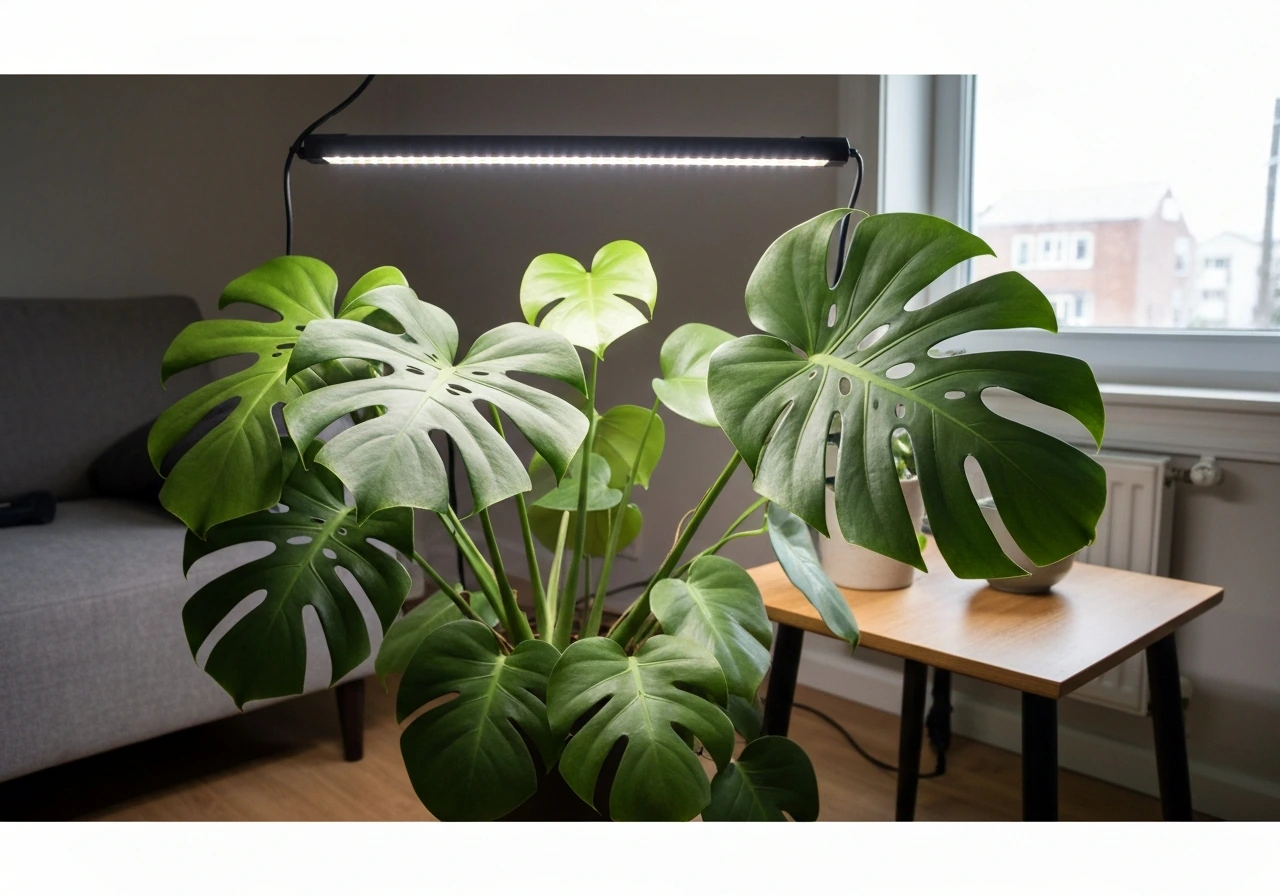
Yes, Monstera can absolutely grow under artificial light, and plenty of plant parents are doing it successfully right now in windowless offices and dim apartments. The key is giving it enough intensity and enough hours per day. A full-spectrum LED grow light running 12 to 14 hours a day, positioned 12 to 24 inches above the plant, will keep a Monstera deliciosa healthy and growing. It won't be as fast as a plant sitting in a bright south-facing window, but you'll get real growth, good leaf size, and eventually fenestration if you dial in the setup.
Can Monstera Grow in Artificial Light? LED Guide
Marcus Hartley
4 May 2026
Monstera's light needs in plain terms
Monstera deliciosa is a tropical understory plant, which means in the wild it grows beneath a forest canopy where light is filtered, not blazing. Penn State Extension recommends keeping it near a sunny window where it gets bright but indirect light. That's the sweet spot. It's not a true low-light plant (more on that distinction in a moment), but it's also not a sun-lover that needs a south-facing window in full January light.
In practical terms, Monstera performs best in what most gardeners call "bright indirect light," which roughly translates to a spot where you could comfortably read a book without turning on a lamp. It can survive in lower light, but surviving and growing well are two different things. If you want new leaves, larger leaves, and eventually those iconic split fenestrations, the plant needs enough light energy to actually fuel that growth. That's true whether the light source is the sun or a bulb.
It's also worth noting that Monstera is not the same as truly low-light tolerant plants like sansevieria or certain pothos varieties. Those plants can make do with very little. Monstera needs a meaningful amount of light, even if it doesn't need direct sun. If you're trying to answer whether a can Swiss cheese plant grow in low light, the key takeaway is that it typically needs a meaningful amount of light to do more than just survive. Keep that expectation realistic going in.
Can Monstera grow in artificial light (LED, fluorescent, and general room light)
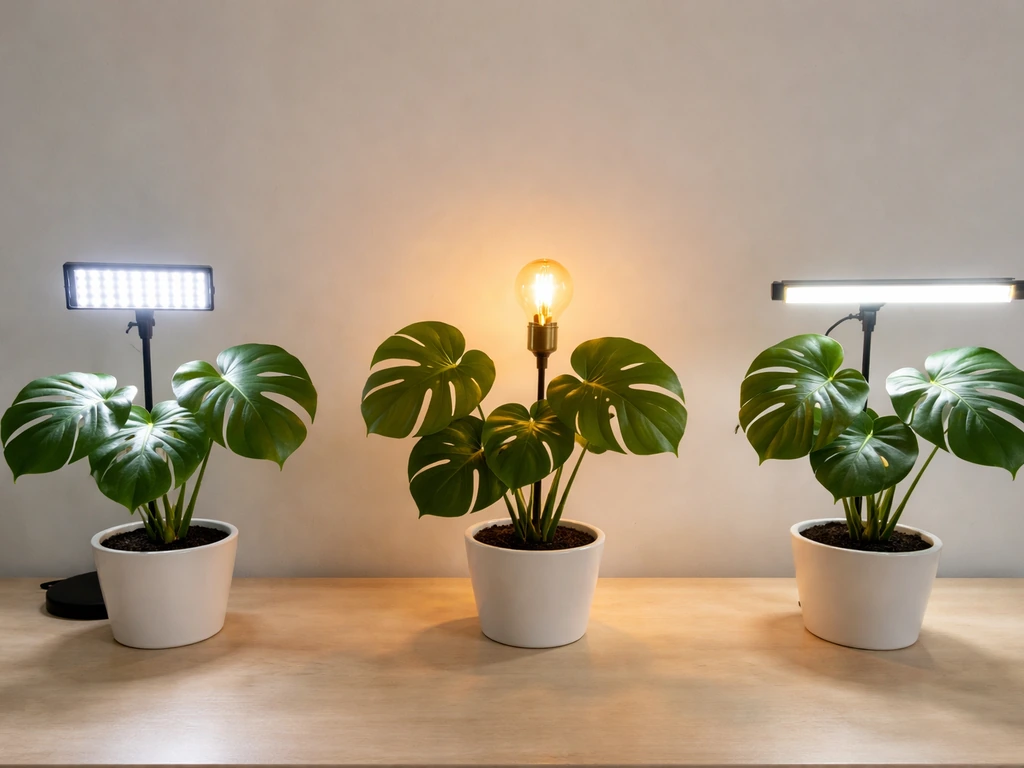
The short practical answer is yes, but the type of artificial light matters enormously. Not all indoor lighting is useful to a plant. Your regular overhead incandescent or warm-white LED room bulbs emit very little of the light spectrum that plants actually use for photosynthesis. They might keep your Monstera alive in a pinch, but you won't see meaningful growth from room ambiance lighting alone.
UConn Extension has written about artificial lighting as a legitimate way to supplement or fully replace natural light for indoor plants, and full-spectrum LED grow lights are the most practical option for most home growers today. They're energy-efficient, they run cool enough to place close to plants, and the better ones deliver the right wavelengths (primarily the red and blue spectrum that drives photosynthesis) to actually push growth. Fluorescent bulbs, including T5 and T8 shop lights, also work well and are a budget-friendly option that has been used in indoor growing for decades. They don't penetrate as deep into a large plant canopy, but for a single Monstera on a shelf or in a corner, they get the job done.
What won't work: a single decorative lamp in the corner of a room, a distant overhead fixture, or placing your Monstera ten feet from the nearest window and calling it "low light friendly." That's where most people go wrong.
| Light Source | Useful for Monstera? | Practical Notes |
|---|---|---|
| Full-spectrum LED grow light | Yes, best option | Energy efficient, cool-running, easy to find; best all-around for artificial setups |
| T5/T8 fluorescent grow bulb | Yes, solid option | Budget-friendly, widely available, works well for single plants on shelves |
| Standard warm-white room bulb | Barely, not recommended | Wrong spectrum, not bright enough for real growth; okay as a very short-term supplement only |
| Overhead cool-white fluorescent (office) | Partial, situational | Better than warm incandescent but usually too distant and not targeted enough |
| Natural window light (indirect) | Yes, ideal complement | Best used alongside grow lights when available; even a few hours helps significantly |
How much light is "enough": distance, duration, and intensity targets
This is where a lot of guides get vague, so let's be concrete. Iowa State University Extension explains that what matters to plants isn't just the brightness of a light, but the total amount of usable light energy delivered over time, a concept measured through metrics like PPFD (micromoles per square meter per second) and DLI (daily light integral, which is basically PPFD accumulated over your photoperiod). You don't need to memorize these terms to succeed, but understanding the principle helps: it's not just how bright the light is, it's also how long you run it.
For a Monstera under artificial light, target these practical parameters:
- PPFD at the leaf surface: aim for 100 to 200 micromoles per square meter per second (µmol/m²/s) for good vegetative growth. Many mid-range LED grow lights easily hit this at 12 to 24 inches.
- Duration (photoperiod): 12 to 14 hours of light per day is the standard recommendation for tropical foliage plants. Shorter than 10 hours and growth stalls noticeably.
- Distance from the light: for most panel-style LED grow lights, 12 to 18 inches above the plant is the sweet spot. For smaller, lower-powered LED bulbs in a standard socket, 6 to 12 inches is more appropriate.
- Fluorescent T5 fixtures: keep them 6 to 12 inches above the plant for adequate intensity.
- Daily Light Integral (DLI) target: a DLI of around 8 to 12 mol/m²/day is a reasonable goal for healthy Monstera growth indoors.
A simple way to check if your light is adequate without a meter: if you hold your hand about 12 inches above the plant's leaves under the grow light and you can see a clear, defined shadow from your hand, the intensity is probably workable. If the shadow is very faint or barely visible, the light is likely too weak or too far away.
What you'll notice if the light is too low
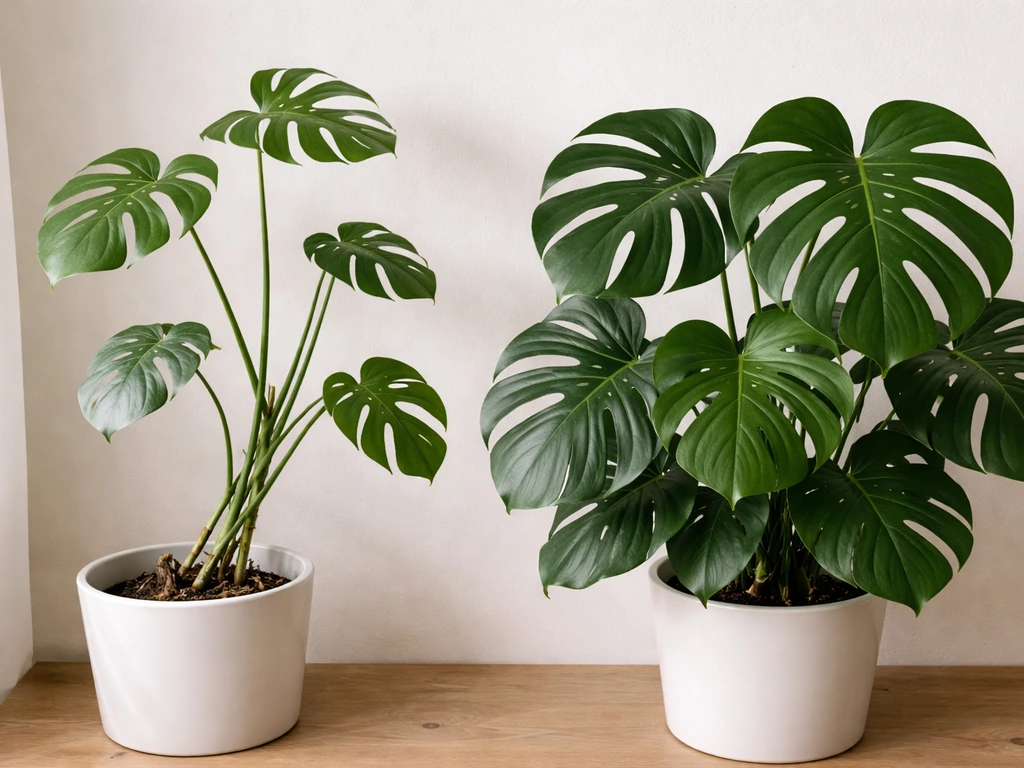
Monstera under insufficient light will tell you pretty clearly, just not always immediately. The first thing you'll see is slower new leaf production, sometimes dramatically slower. If your plant is putting out a new leaf every few weeks in good conditions, it might slow to one new leaf every two or three months in low light. That's a big red flag.
The other major sign is etiolation. University of Maine Extension describes this as the spindly, leggy growth that happens when a plant isn't getting enough light. The plant is stretching toward whatever light source it can find, producing elongated stems and smaller, thinner leaves as it tries to cover more ground to capture more light. It's a survival response, and it looks exactly as bad as it sounds: long, weak stems with sad little leaves spaced far apart.
Here's the full list of symptoms to watch for:
- New leaves are significantly smaller than previous ones
- Stems are long and "reaching" toward the light source, often leaning dramatically
- Leaves are a darker green than normal (the plant is producing more chlorophyll to compensate) or conversely appear pale and washed out
- Fenestrations (the splits and holes) fail to develop even on mature leaves, or existing large leaves have fewer splits than expected
- Overall growth rate drops to near zero for weeks or months at a stretch
- Leaves feel thinner and more fragile than usual
One thing that trips people up: a Monstera can look perfectly healthy and green for months in low light without actually growing. It's just maintaining, not thriving. Yes, but it will grow more slowly, so keep the light consistent and strong enough to avoid stalling can syngonium grow in low light. If you want real development and those beautiful fenestrated leaves, you need enough light to drive actual photosynthesis, not just survival mode.
How to set up the best artificial lighting for your Monstera
You don't need an expensive commercial grow setup to do this well. Here's a practical checklist you can work through today.
Choosing the right bulb or fixture
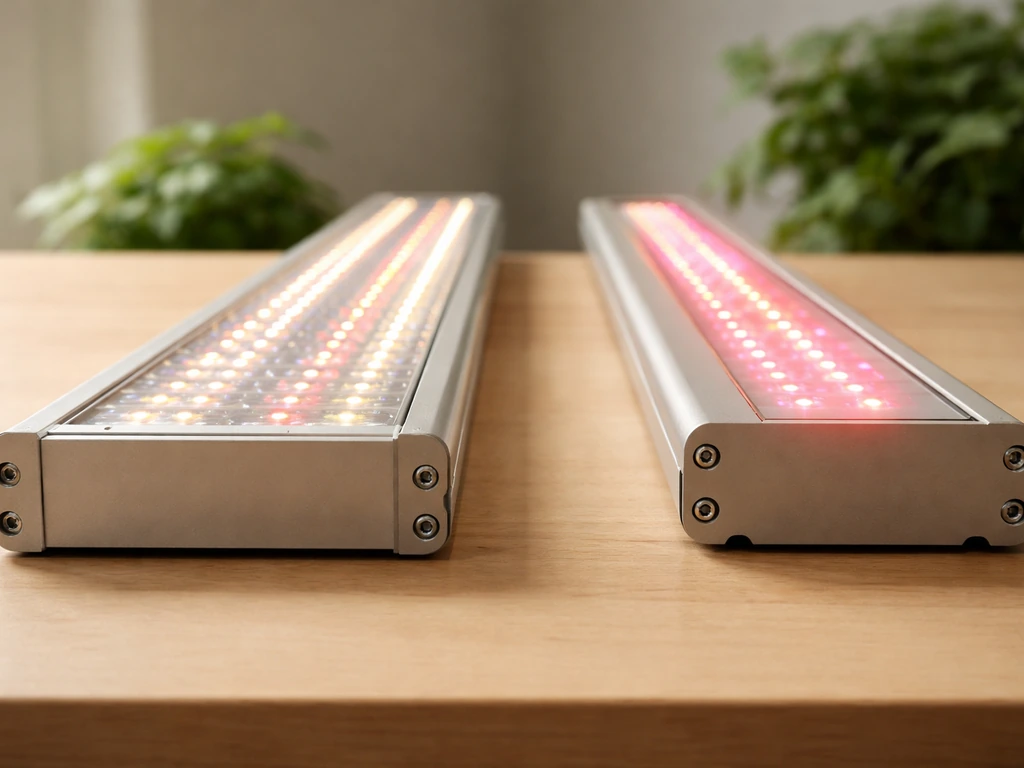
- Full-spectrum LED grow lights (panel or bar style) are the top recommendation. Look for ones labeled "full spectrum" that include both red and blue wavelengths. Brands like Spider Farmer, Mars Hydro, or even simple Amazon panel lights in the 20 to 45 watt range work well for a single Monstera.
- Full-spectrum LED grow bulbs in a standard screw socket are a budget-friendly entry point. A single 10 to 15 watt grow bulb positioned close to the plant (6 to 12 inches) works in a pinch for smaller plants.
- T5 fluorescent fixtures are a proven, affordable classic. A 2-foot or 4-foot fixture with full-spectrum or 6500K bulbs placed 6 to 12 inches above the plant works reliably.
- Avoid: single-color purple/blurple LED panels with only red and blue diodes. They technically provide the right wavelengths but are uncomfortable to look at and not necessary for a home setup where you'll be in the room.
Placement and positioning
- Position the light source directly above the plant, not to the side, to encourage upright growth rather than leaning.
- Start at 18 to 24 inches for a panel LED and 6 to 12 inches for a bulb or fluorescent fixture, then adjust based on the plant's response over 4 to 6 weeks.
- If the plant starts stretching toward the light, move the light closer or add more hours. If leaf edges look bleached or crispy, move the light farther away.
- Use an adjustable arm, a simple clamp light fixture, or a small grow light shelf to make height adjustments easy.
Using a timer
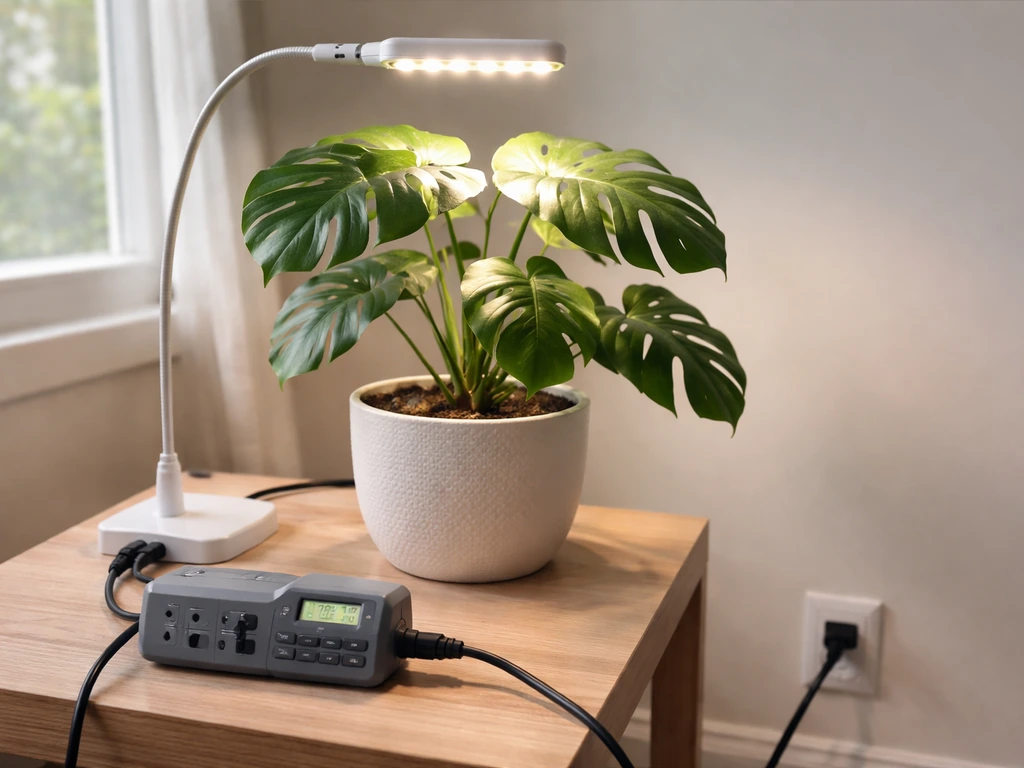
A timer is non-negotiable if you want consistent results. University of Maryland Extension notes that photoperiod (the duration of light exposure) is part of how plants regulate their growth response. A Monstera doesn't know if you forgot to turn the light on one day. A simple plug-in outlet timer costs less than five dollars and takes two minutes to set up.
Set it for 12 to 14 hours on, 10 to 12 hours off, at the same time each day. Virginia Tech Extension also provides a DLI calculation example that links PPFD, light hours, and a target DLI delivery requirement for LED setups like this [Set it for 12 to 14 hours on, 10 to 12 hours off](https://www. pubs. ext.
vt. edu/content/pubsextvt_edu/spes/spes-720/spes-720. html). This consistency matters more than most people realize.
Care tweaks that make artificial-light Monstera succeed
Growing under artificial light means you're controlling the entire environment, and that changes a few things about day-to-day care. Getting these details right is often the difference between a plant that just survives and one that actually looks good.
Watering
Plants under artificial light, especially in indoor environments without a lot of airflow, tend to dry out more slowly than plants in a sunny window. This is the number one mistake I see: people water on the same schedule regardless of light conditions. Under low or artificial light, a Monstera is photosynthesizing less, which means it's using less water. Overwatering becomes a real risk. Always check the soil before watering. Stick your finger 2 inches into the soil; if it's still moist, wait. Let the top 50 to 75 percent of the soil dry out before watering again.
Fertilizing
Scale fertilizing to match actual growth. Under artificial light, growth is often slower than it would be in a bright window, which means the plant's nutrient demand is lower. Over-fertilizing a slow-growing plant leads to salt buildup in the soil, which causes root burn. During active growth periods (spring through early fall), a balanced liquid fertilizer at half strength once a month is plenty. In winter, skip it entirely or go once every six to eight weeks at most.
Humidity and airflow
Monstera is a tropical plant and appreciates humidity above 50 percent when possible. Under grow lights in a dry indoor environment, leaves can get crispy edges over time. A small humidifier nearby helps significantly. Also make sure there's some airflow around the plant, since grow lights running for 12-plus hours can create a slightly warm, stagnant microenvironment. A small fan on low nearby keeps air moving and strengthens stems over time.
Troubleshooting when it won't grow: common mistakes and fixes
If you've set up a grow light and your Monstera still isn't growing, run through this checklist. Most problems come down to a handful of very fixable mistakes.
| Problem | Likely Cause | Fix |
|---|---|---|
| No new growth after 6+ weeks | Light too far away or running too few hours | Move light 6 to 8 inches closer; add 2 hours to daily timer duration |
| New leaves are tiny and pale | Insufficient intensity (underpowered bulb) | Upgrade to a more powerful grow light or add a second light source |
| Long, leggy stems reaching toward light | Light source is too far or positioned to one side | Reposition light directly above plant and reduce distance |
| Yellowing lower leaves with slow growth | Overwatering combined with low light | Reduce watering frequency; let soil dry out more between waterings |
| Leaves look dark green but no growth | Plant is in maintenance/survival mode from low light | Increase light duration and intensity; supplement with a window when possible |
| Fenestrations not developing on large leaves | Insufficient light for mature leaf development | Increase PPFD by moving light closer or extending photoperiod to 14 hours |
| Crispy leaf edges under grow light | Light too intense or humidity too low | Move light a few inches farther away; add a humidifier nearby |
| Fertilizer buildup (white crust on soil) | Over-fertilizing in low-light conditions | Flush soil with plain water; reduce feeding to once every 6 to 8 weeks |
One last thing worth saying: if you've tried everything and your Monstera still looks rough, check whether it's actually a light problem or a root problem. A plant that's severely rootbound or has damaged roots from previous overwatering won't respond to better lighting until the root system is healthy. Sometimes a repot is the missing piece, not more light.
Growing Monstera under artificial light is genuinely achievable, and it's a great solution if you're working with a windowless room, a north-facing apartment, or just a space that doesn't get the light that a big beautiful tropical plant deserves. Get the intensity and duration right, use a timer, adjust your watering, and give it a few months to respond. You'll be rewarded with real growth and, with patience, those gorgeous fenestrated leaves that make Monstera one of the most satisfying plants to grow indoors.
FAQ
Can Monstera grow in artificial light in a completely windowless room?
Yes, as long as you replace both intensity and photoperiod. Use a real grow light, run it 12 to 14 hours daily with a timer, and keep the light close enough (around 12 to 24 inches) that you get a visible, defined shadow. If you only run a decorative lamp or keep the light far away, it may stay green but stall.
How do I know if my light is too weak versus just not bright enough to grow fast?
Weak light usually shows up as slower new leaves and, over time, etiolation (stretchy stems and smaller, thinner leaves). If it looks healthy but growth is just gradual, it might be maintaining rather than thriving. The “hand shadow” test helps, but watch for whether leaves are consistently arriving over 8 to 12 weeks.
Is it better to run the grow light for longer hours or use a stronger light for fewer hours?
Either can work, but most Monstera setups succeed by prioritizing consistency. Aim for a stable photoperiod (commonly 12 to 14 hours) and choose a light that you can position close enough without heat stress. Longer hours with a weak light often still results in stalling, because the usable light energy over the day remains too low.
Can I use a regular LED bulb instead of a grow light?
In many cases, regular warm-white LEDs or incandescent bulbs can keep a Monstera alive, but they usually do not drive meaningful growth because they provide limited wavelengths for photosynthesis. If you want actual leaf size increases and fenestration, upgrade to full-spectrum grow lighting or dedicated fluorescent shop lights.
What distance should I keep the light from my Monstera, and what if I can’t place it close?
A common starting range is 12 to 24 inches above the plant. If you must keep it farther away, you usually need a stronger fixture and possibly multiple lights to maintain usable intensity across the canopy. If your hand shadow is barely visible at the leaf level, the distance is likely too great for the current fixture.
Will artificial light affect watering and fertilizer schedules?
Yes. Under grow lights, Monstera often dries more slowly, so watering “by the calendar” can lead to overwatering. Check soil moisture before watering and let the top 50 to 75 percent dry. Fertilize more conservatively too, since slower growth means lower nutrient demand and higher risk of salt buildup.
How long will it take to see results under grow lights?
Expect noticeable changes within a few months if the light is adequate. The first sign is often a return to steady new leaf production. If growth remains extremely slow after 8 to 12 weeks, reassess light intensity, distance, and consistency of the timer before changing everything else.
Can too much artificial light be a problem for Monstera?
Yes. Even indoors, excessive intensity or poor placement can stress the plant, leading to scorched-looking patches or irregular leaf damage. If leaves develop unusual discoloration or crispy areas despite proper watering, reduce intensity by moving the light farther away or shortening the daily photoperiod.
Do I need a humidity controller and a fan if I’m using a grow light?
Humidity above 50 percent helps, especially in dry indoor air, because leaf edges can crisp over time. A small fan improves airflow and reduces stagnation under long-running lights. This matters most in rooms without natural breezes, where the microclimate around the plant becomes dry or warm.
What should I do if my Monstera isn’t growing even after I set up the light correctly?
First confirm the light runs the right hours daily on a timer, then check soil and roots. If roots are damaged or the plant is severely rootbound, improved light may not translate into growth. Consider inspecting roots and repotting into appropriate mix and drainage if watering has been excessive or the plant has been struggling for months.