
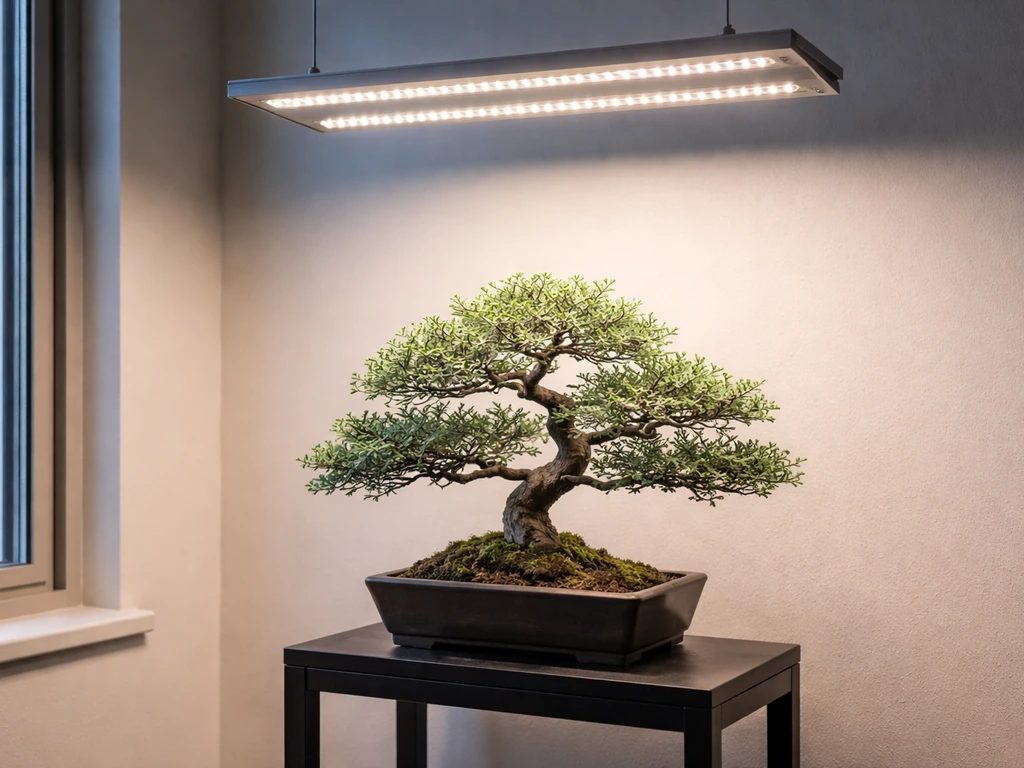
Yes, you can absolutely use a grow light for a bonsai tree, and for many indoor growers it's the difference between a bonsai that slowly declines and one that actually pushes new growth. Most homes just don't have enough natural light to keep a bonsai healthy year-round, especially in winter or in rooms without south-facing windows. A full-spectrum LED grow light on a timer solves that problem directly.
Can You Use a Grow Light for a Bonsai Tree? Setup Guide
Marcus Hartley
6 May 2026
What Bonsai Actually Need from Light
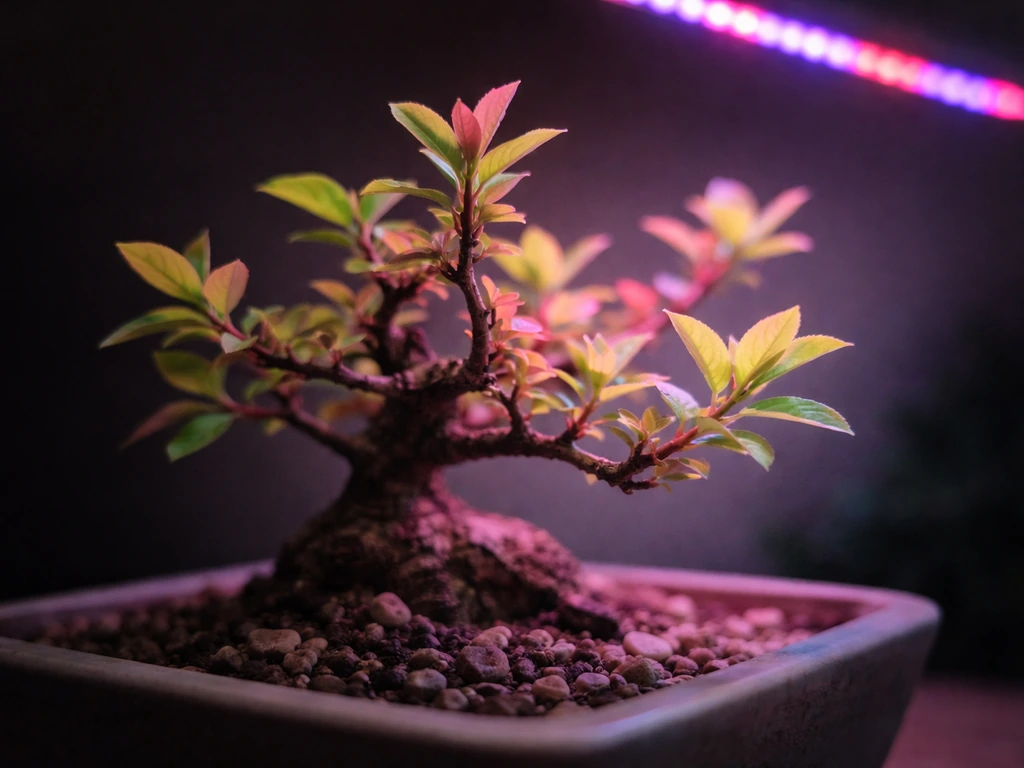
Before picking a light, it helps to understand what you're trying to replicate. Bonsai, like all plants, photosynthesize using the red and blue portions of the light spectrum. The two numbers that matter most are intensity (how bright) and duration (how long). Lumens, which is how most regular bulbs are rated, measure brightness for human eyes, not plant-useful light.
For plants, the metric you want is PPFD (photosynthetic photon flux density), measured in µmol/m²/s. It tells you how many usable photons are actually hitting the leaf surface per second.
The cumulative version of that, integrated over a full day, is called DLI (daily light integral), measured in mol/m²/day. You don't need to calculate these by hand, but knowing they exist helps you read grow light specs and make smarter choices.
For most tropical and subtropical bonsai kept indoors, you're aiming for a photoperiod of about 12 to 15 hours of light per day. If your bonsai sits more than about half a meter (roughly 18 inches) from a good window, running a grow light for the full 12 to 15 hours is the right call rather than trying to split the difference.
Species matter too: a ficus or fukien tea is more forgiving than a juniper, which really wants outdoor conditions. If you are wondering about lighting for fiddle leaf figs, the key is giving them enough full-spectrum light with the right distance and a consistent timer ficus or fukien tea. But for any species being kept indoors, consistent light is the foundation.
How Intense Does the Light Need to Be?
Different bonsai species need different intensities, but a practical middle ground for most indoor-suitable species is a PPFD somewhere in the range of 200 to 500 µmol/m²/s at canopy level. That's enough to support healthy foliage and moderate growth without frying the leaves. The distance between the light and your bonsai's canopy is how you control that intensity, since most LED fixtures are fixed wattage. A general starting rule: keep a lower-wattage LED (under 300W equivalent) about 12 inches above the canopy, and move up from there for higher-powered fixtures. Bonsai are small, so you rarely need a high-powered light at all.
LED vs. Fluorescent: Which Grow Light Works Best for Bonsai
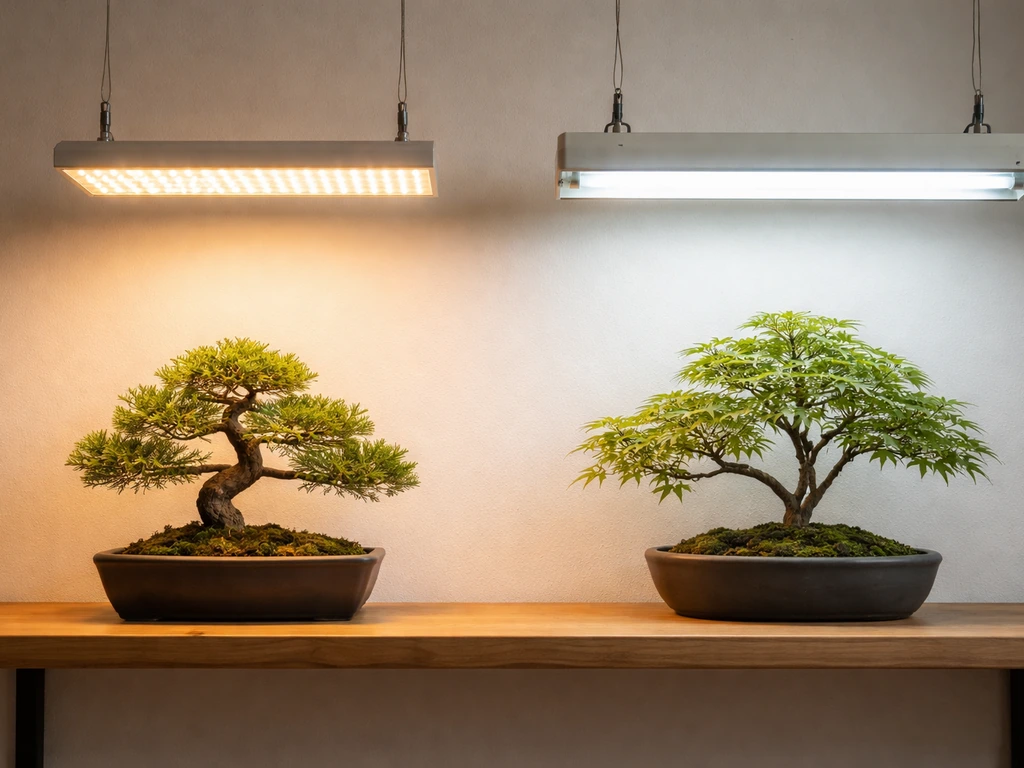
Both can work, but they're not equal. Here's an honest comparison:
| Light Type | Spectrum | Heat Output | Energy Use | Best For Bonsai? |
|---|---|---|---|---|
| Full-spectrum LED | Broad, includes red and blue peaks, often mimics daylight | Very low | Efficient, low running cost | Yes, top choice |
| T5 Fluorescent | Decent blue-heavy spectrum, some full-spectrum options available | Moderate | Moderate | Good, especially for lower-light species |
| CFL (Compact Fluorescent) | Adequate but limited intensity | Low to moderate | Moderate | Only for very low-light species |
| HID / HPS / MH | Good intensity but heavy spectrum gaps depending on type | High | High | Overkill and too hot for bonsai |
Full-spectrum LEDs are the clear winner for bonsai. They run cool (which matters when the light is close to a small tree), they're energy efficient over a 12 to 15 hour photoperiod, and modern panels deliver a balanced spectrum that covers both the blue wavelengths for compact, healthy growth and the red wavelengths for photosynthesis efficiency. Avoid lights that are heavily skewed toward red only: too much red relative to blue can promote stretched, leggy stems rather than the tight, compact growth you want in a bonsai. T5 fluorescents are a solid budget option, especially for lower-light tropical species, but they degrade faster and need replacing every year or two.
What to Look for When Choosing a Grow Light
- Full-spectrum output (roughly 400–700 nm, covering both blue and red peaks). Look for labels like 'full spectrum' or 'sunlike spectrum' rather than 'blurple' (purple-only) lights.
- PPFD data at the distance you'll be using it. Reputable brands publish light maps. If a brand doesn't provide PPFD specs, that's a red flag.
- Appropriate coverage area for one or a few small bonsai pots. You don't need a 4x4 foot panel for a single tree on a shelf.
- Low heat output. Heat from the fixture, not just the light intensity itself, can stress a bonsai. LEDs are best here.
- Dimmable option if possible. Being able to dial back intensity is useful when first introducing a bonsai to artificial light.
Setting Up Your Indoor Bonsai Light: Placement, Timers, and Day-to-Day Care
The hardware is only half the job. How you set things up and manage them daily is what actually makes the difference for your bonsai.
Height and Distance
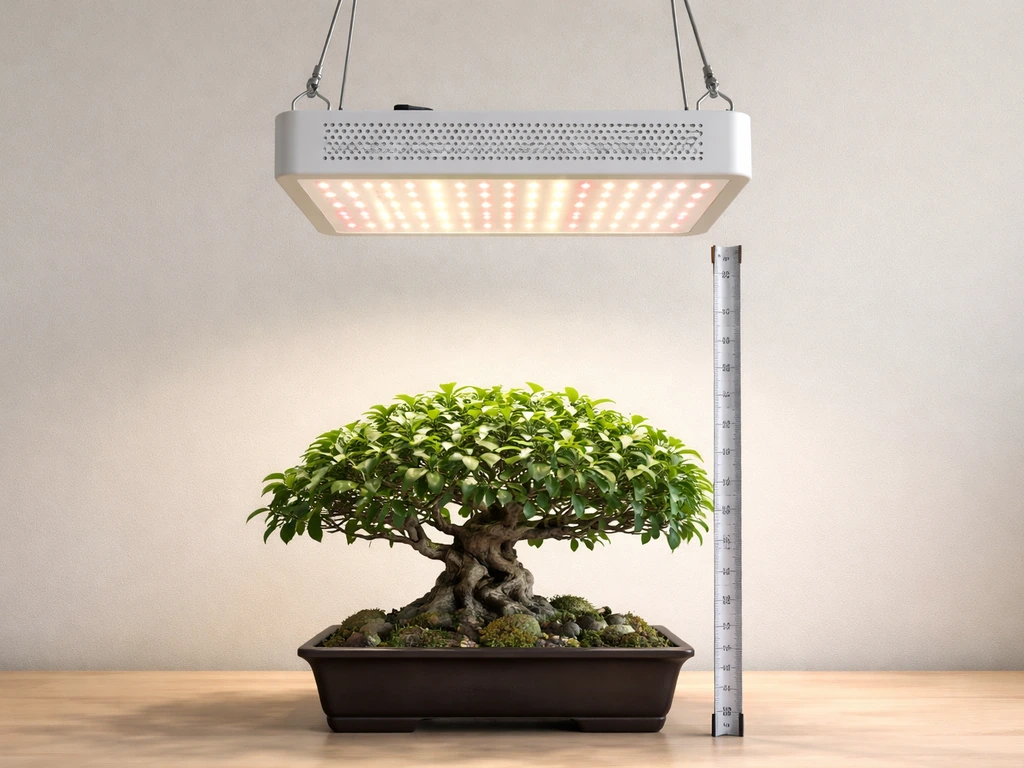
Start with the light about 12 to 15 inches above the top of the canopy for a typical compact LED panel. This places the canopy in the sweet spot for most indoor-suitable bonsai species. If after two weeks you're seeing bleached or yellowing tops, pale new growth, or the leaves are curling upward (sometimes called 'taco-ing'), the light is too close or too bright. Raise it by a few inches and reassess.
If growth is stretching and nodes are spreading far apart, the light is too far away or too dim. One practical guideline from InBonsai: don't go closer than about 15 cm (6 inches) or farther than about 60 cm (24 inches) from the canopy. That range keeps you safe for most LED panels.
Use a Timer, Always
Set a plug-in mechanical or digital timer and let it do the work. Aim for 12 to 14 hours on and 10 to 12 hours off for most tropical bonsai species. Consistency matters more than perfection. Running the light at the same hours every day reduces stress on the plant and makes it easier for you to diagnose problems when they come up. I'd suggest running the light during your waking hours so you can actually observe the plant rather than having it on overnight.
Rotation
Even a centered light casts slightly more intensity on some areas of the canopy than others, and bonsai will grow toward the strongest light source. Rotate your pot a quarter turn every week or two to encourage even growth on all sides. This is especially important if the bonsai is near a window at the same time: competing directional light sources will cause the tree to lean noticeably over a few weeks.
Combining Natural and Artificial Light
If your bonsai gets some window light, count that toward your total daily light budget. If a south-facing window delivers 4 to 5 hours of decent light on sunny days, you might only need 8 to 10 additional hours from the grow light. In practical terms, just set the timer to run the light during morning and evening hours and let the window handle midday. During overcast winter days, let the light run for the full 12 to 14 hours regardless.
Signs Your Bonsai Isn't Getting the Right Amount of Light
Bonsai are honest communicators once you know what to look for. The tricky part is that both too little and too much light can cause slow or poor growth, so you need to look at the specific symptoms to diagnose correctly.
Not Enough Light
- Etiolation: long, stretched internodes (the spaces between leaf nodes get noticeably longer than normal). This is the classic 'leggy' look.
- Small, pale, or yellowish new leaves that lack the deep color of healthy foliage.
- Leaf drop, especially older inner leaves that receive the least light.
- Very slow or no new growth despite appropriate watering and fertilizing.
- The tree leans aggressively toward the nearest light source.
Too Much Light (or Light Too Close)
- Bleached or whitish patches on the tops of leaves closest to the light (leaf scorch).
- Leaves curling upward along the edges, sometimes called taco-ing.
- Crispy, brown leaf edges, especially on the uppermost foliage.
- Rapid soil drying combined with stressed-looking foliage (the heat from a poorly placed light also accelerates moisture loss).
- Stunted growth that looks different from etiolation: compact but with yellowing or bronzing rather than stretching.
The fix for too little light is straightforward: lower the fixture, extend the photoperiod, or upgrade to a more powerful light. The fix for too much is just as simple: raise the fixture, reduce the photoperiod, or dim the light if it has that option. Houseplants also need a rest period, so gardeners generally avoid running more than about 16 hours of light per day Lighting. Either way, give the plant a week or two after each adjustment before drawing conclusions.
Adjusting Lighting Through the Seasons
Light management isn't a set-it-and-forget-it situation across the whole year. As natural daylight hours change, your bonsai's needs shift too, and the way you manage the grow light should reflect that.
Winter: More Artificial Light, Less Natural
This is when grow lights earn their keep. Days are short, window light is weaker even on clear days, and many bonsai that sit near glass will be exposed to cold drafts that stress the root system. Run the grow light for the full 12 to 15 hours. If you've been relying on a window for part of the light budget during summer, don't assume that still holds in December. Reassess based on how much direct sun actually reaches the plant.
Spring and Summer: Supplement or Step Back
As daylight hours increase and the sun gets stronger through windows, you may not need the grow light at all during summer for a tree in a bright spot. Or you can run it for just 6 to 8 hours to top up early morning and late evening light. Watch the plant. If it's pushing healthy compact growth, the natural light may be doing the job. If you're planning to move the bonsai outdoors for summer, do it gradually over one to two weeks, starting with morning shade and increasing sun exposure. Going from 12 hours of artificial light straight to full outdoor sun in a single step will cause immediate leaf scorch.
Transitioning Back Indoors in Autumn
Bring the bonsai back inside before nighttime temps drop consistently below about 50°F (10°C) for tropical species. The reverse acclimation applies here too: the tree has been running on full outdoor light intensity all summer and will need a gradual step-down. Start the grow light on shorter cycles (8 to 10 hours) when you first bring the tree in, then ramp back up to 12 to 14 hours over two to three weeks. This gives the plant time to adjust its photosynthetic machinery to the indoor environment rather than going into sudden light shock.
Building a Simple Indoor Bonsai Lighting Setup
You don't need a complicated or expensive rig to make this work. Here's a practical framework you can set up today:
- Choose a full-spectrum LED panel sized for your space. For one to three small bonsai on a shelf or table, a 20 to 45 watt full-spectrum LED with published PPFD data is plenty. Brands like Mars Hydro, Spider Farmer, or similar horticultural LED companies offer small, affordable panels. Avoid cheap 'blurple' lights with no PPFD specs.
- Mount or hang the light 12 to 15 inches above the canopy. An adjustable hanging kit (most panels include one) makes it easy to dial in the height and change it as needed. A simple shelf with an adjustable arm also works.
- Plug it into a mechanical or digital timer. Set it for 12 to 14 hours on, starting in the morning. A basic $10 plug-in timer is all you need.
- Rotate the bonsai pot a quarter turn every one to two weeks to keep growth even.
- Check in after two weeks. Look for the signs listed above. If growth is healthy and compact with good leaf color, your setup is working. Adjust height or timer duration based on what you see.
- Reassess at the start of each season. Dial back the timer in late spring as natural daylight increases, and ramp it back up in early autumn as days shorten.
If you're also growing other plants under artificial light, the same principles apply broadly. The main difference with bonsai is that they tend to be more sensitive to dramatic light changes than something like a philodendron or snake plant, so gradual adjustments and close observation matter more. Philodendrons can also benefit from grow lights, especially when natural light is limited. Bonsai reward attention, and once you find the right setup for your specific tree and space, maintaining it is genuinely straightforward.
The bottom line: a grow light is not a workaround or a compromise for bonsai. Used correctly, it's a reliable tool that lets you keep a healthy, actively growing bonsai in a space that would otherwise be unsuitable. Do jade plants like grow lights too, so you can apply many of the same indoor lighting ideas to them as well.
If you want healthy calatheas indoors, do the same kind of light setup so they get enough bright, indirect light without scorching grow light. Get a full-spectrum LED, set a timer for 12 to 14 hours, keep it about a foot above the canopy, and let the plant tell you if anything needs adjusting.
Corals also rely on light for photosynthesis, so matching the intensity and schedule to the needs of your species is essential for healthy growth corals need light. For algae cultivation like chaetomorpha, the best light to grow it depends on getting the right spectrum and delivering enough usable intensity with a consistent photoperiod best light to grow chaetomorpha.
FAQ
Can I leave a grow light on 24 hours for my bonsai?
Yes, but avoid running a grow light on all night. Bonsai still need a dark period for normal day night rhythm, and continuous lighting can make it harder to spot overexposure since symptoms build gradually. Start with a 12 to 14 hour on, 10 to 12 hour off schedule and keep it consistent.
How do I know if my grow light is too strong or too weak for a bonsai?
Your goal is light at the canopy, not the bulb’s rating. If your fixture has a dimmer or adjustable height, use that to dial in intensity, then confirm by watching for specific signs after 1 to 2 weeks. Bleaching, yellowing, curled leaves (taco-ing) usually means too much, while long internodes and sparse foliage usually means too little.
If my grow light has high lumens, is it automatically good for bonsai?
Not exactly. Lumens are based on human vision and can look “bright” even when plant usable photons are low. Look for manufacturer PPFD maps, PPFD at a stated distance, or at least spectrum quality (full spectrum with meaningful blue plus red). If you cannot find PPFD info, start at the recommended height, keep the schedule moderate, then adjust using the plant’s response.
Do I need a special fixture for even light coverage, or will any LED work?
A diffuser can help, but it does not replace correct distance. If the center of the canopy is getting much higher intensity than the edges, a more even spread or multiple smaller fixtures can outperform a single panel with a diffuser. For one light setup, rotate the pot a quarter turn every week or two to reduce uneven growth.
Can I use a grow light together with my window light and still keep the schedule right?
Yes, but only as a supplement and only after you account for the window hours. Count “decent” sun hours you actually get on the foliage (not just daylight in the room), then shorten the grow light timer accordingly. In winter, cloudy days often reduce direct window light enough that the grow light should run closer to the full 12 to 14 hours.
What’s the safest way to transition from a grow light indoors to outdoor sun?
You can, but start gradually. If your bonsai will go from indoor grow light conditions to full outdoor sun, step down the light first by reducing grow light hours and exposing the tree to outdoor shade in the morning before increasing intensity over 1 to 2 weeks. This reduces leaf scorch and sudden stress.
Will a grow light work for all bonsai species the same way?
Probably, but it depends on the species and its lighting tolerance. Species like ficus and fukien tea typically handle indoor grow light schedules better than juniper, which usually prefers more outdoor-like conditions. For less tolerant species, use the same light principles but start with lower intensity and a closer observation routine.
Do I need to adjust the grow light height as my bonsai grows?
Yes, and it’s a common mistake to ignore height changes when plants grow. As new growth extends, the canopy effectively rises, so the intensity at leaf level may drop. Recheck distance from the top of the canopy every few weeks, then adjust height or timer based on the plant response.
Will a grow light fix winter problems if my bonsai is near a cold window?
Often, yes. Even with a perfect light schedule, drafts and cold can slow growth because roots are stressed. If your bonsai sits near a drafty window, keep the grow light running as planned but also reduce temperature swings, for example by moving the pot slightly back from the glass or improving insulation.