
Dracaena can survive in low light, but there's a real difference between surviving and growing. In genuinely dim conditions, most dracaenas will hold on, keep their leaves, and look okay for months. What they won't do is put out strong new growth, maintain vivid color, or stay compact and healthy over the long term. If your goal is a plant that just doesn't die, low light might be enough. If you want one that actually thrives, you'll probably need to tweak your setup a bit.
Can Dracaena Grow in Low Light? Signs and How to Help
Marcus Hartley
3 May 2026
How much light dracaena actually needs
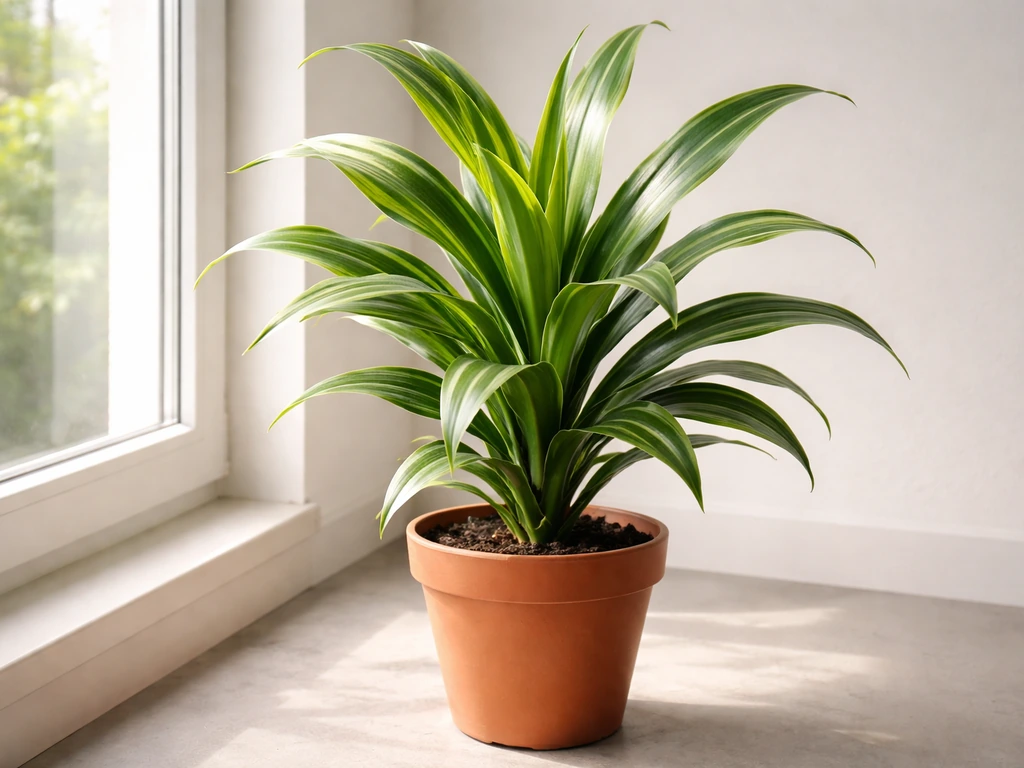
In commercial greenhouse production, dracaenas are typically grown at light intensities between 2,000 and 3,500 foot-candles depending on the stage and variety. That's far brighter than most indoor rooms, even sunny ones. A north-facing room with no direct sun might measure somewhere around 25 to 100 foot-candles on a typical day. So when people say dracaena tolerates low light, they're using a relative standard, not a strict one.
What dracaena actually tolerates well, compared to many other houseplants, is the low end of indoor ambient light. It won't demand a south-facing window. It can do reasonably well a few feet back from an east or west window, or near a bright north window in summer. The key word there is reasonably. It won't grow fast, it won't push out a lot of new leaves, and variegated varieties will start losing some of their color contrast in lower light. But it won't collapse.
The phrase "low light" gets used loosely. If your space gets no natural light at all and relies entirely on overhead fluorescents or dim LED bulbs, that's a different situation than a shaded corner near a window. Dracaena can handle the latter; the former is where you'll want to supplement.
Signs your dracaena isn't getting enough light
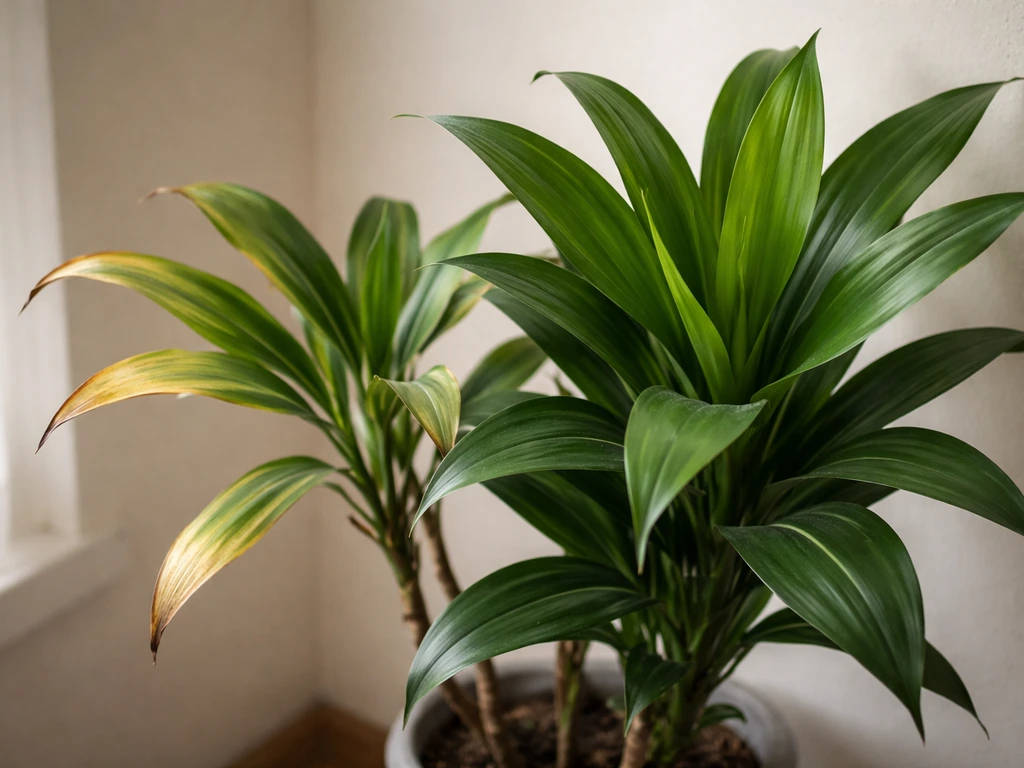
The plant will tell you before it gets critical, if you know what to look for. Slow growth is normal in low light, but when you combine it with these other signs, it usually means the light situation needs attention.
- New leaves are smaller and more narrow than older growth
- The stem is leaning or reaching noticeably toward the nearest light source
- Variegated leaves are losing their pattern, going more uniformly green or fading overall
- Lower leaves are yellowing and dropping faster than usual
- New growth looks pale or washed out rather than rich in color
- The plant feels loose or wobbly, with a soft, stretched-looking stem
Before blaming light, run through a quick checklist. What's your window orientation? North-facing windows in the Northern Hemisphere get the least light year-round. East and west are moderate. South is brightest. How far is the plant from the window? Light intensity drops dramatically with distance, often by half for every few feet you move back. Are there obstructions like trees, overhangs, or window tinting? How many hours of light does it get per day? Dracaena generally wants at least 8 hours of ambient light daily. And if you're relying on overhead room lighting, what type of bulbs are they? Standard incandescent and most cheap LED bulbs don't output the spectrum plants use for photosynthesis efficiently.
Which dracaena varieties handle low light best
Not all dracaenas are equal when it comes to shade tolerance. Choosing the right variety from the start makes a real difference, especially if your space is genuinely dim.
| Variety | Shade Tolerance | Notes |
|---|---|---|
| Dracaena fragrans (Corn Plant) | High | One of the most forgiving; solid green types handle low light better than variegated cultivars |
| Dracaena sanderiana (Lucky Bamboo) | High | Extremely adaptable; often sold for low-light situations |
| Dracaena marginata (Dragon Tree) | Moderate | Tolerates lower light but grows very slowly and may lose color definition |
| Dracaena trifasciata (Snake Plant) | High | Technically reclassified but widely grouped here; exceptional low-light tolerance |
| Dracaena 'Janet Craig' | High | Deep green, no variegation to lose; bred specifically for interior environments |
| Dracaena reflexa 'Song of India' | Low–Moderate | Needs more light to hold its yellow leaf margins; struggles in truly dim spots |
The general rule is this: the more variegated the leaf, the more light the plant needs to maintain that pattern. A solid dark-green dracaena like 'Janet Craig' was practically designed for office lobbies and dim apartments. A heavily striped or yellow-edged variety will start reverting to plain green in low light, and that's the plant telling you it doesn't have enough energy to maintain those color cells. If you're locked into a dim space, go for the plain green cultivars.
Where to put it in your space
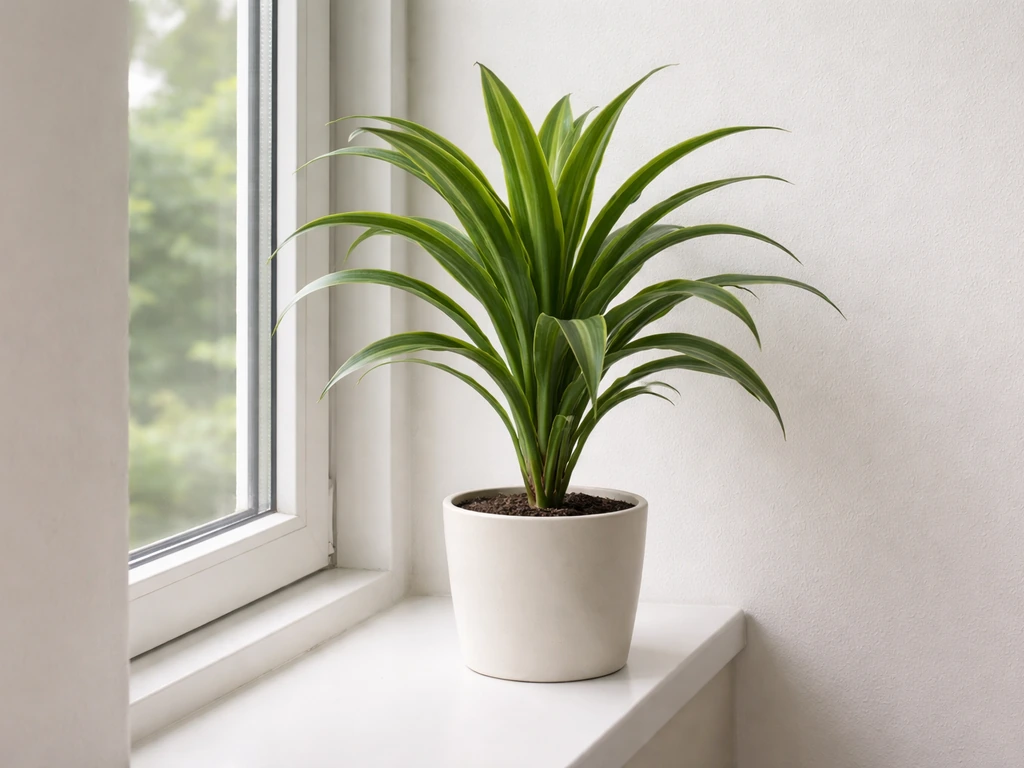
Placement is where most people can make the biggest improvement without spending anything. Start by getting your plant as close to the brightest natural light source as possible without putting it in direct harsh sun, which can scorch the leaves. For most low-light setups, that means within 3 to 5 feet of a window rather than pushed into a corner across the room.
If you only have a north-facing window, place the plant directly on or right next to the sill rather than back in the room. North light is consistent but weak, so every foot of distance costs you significantly. A sheer curtain is fine for south or west windows where direct sun might be too intense, but skip any curtains at all on north or east windows if light is already limited.
Rotate your plant a quarter turn every week or two. Dracaena will lean toward its light source over time, and rotating keeps the growth more even and prevents the plant from developing a permanent lean. This is especially important in low-light setups where the plant is working harder to reach whatever light it can find.
Avoid placing dracaena near heating or cooling vents, drafty windows in winter, or directly above or below artificial light sources that generate significant heat. Heat stress compounds light stress, and a plant already running slow from low light doesn't have the energy reserves to deal with temperature swings.
Care adjustments that actually matter in low light
Low light changes your plant's metabolism, and if you keep caring for it like it's in a sunny spot, you'll run into problems. The biggest one is overwatering. In lower light, dracaena photosynthesizes more slowly, which means it uses water more slowly. Soil that would dry out in a week in a bright spot might stay wet for two to three weeks in a dim one. Wet soil for too long means root rot, and that's usually what kills dracaena in low-light setups, not the light itself.
- Water only when the top inch or two of soil is fully dry, and always check before watering rather than going by a schedule
- Use a well-draining potting mix with perlite added if your current soil retains moisture heavily
- Make sure your pot has drainage holes, since stagnant water in a cache pot can go unnoticed and cause root rot
- Ease off fertilizer significantly in low light: a plant that's barely growing doesn't need feeding, and unused nutrients build up as salts in the soil
- If you do fertilize, use a balanced liquid fertilizer at half the recommended strength, and only during spring and summer
- Dracaena prefers moderate humidity but tolerates typical indoor air reasonably well; if your space is very dry, occasional misting or a small humidifier nearby helps
One thing that often gets overlooked: when you move a dracaena from low light to a brighter spot, even gradually, you'll notice the new leaves that emerge are noticeably thicker and larger than the older growth. That's a reliable sign the plant has more energy to work with. It's a good diagnostic trick if you're ever unsure whether a change in placement made a real difference.
When to add artificial lighting and how to do it
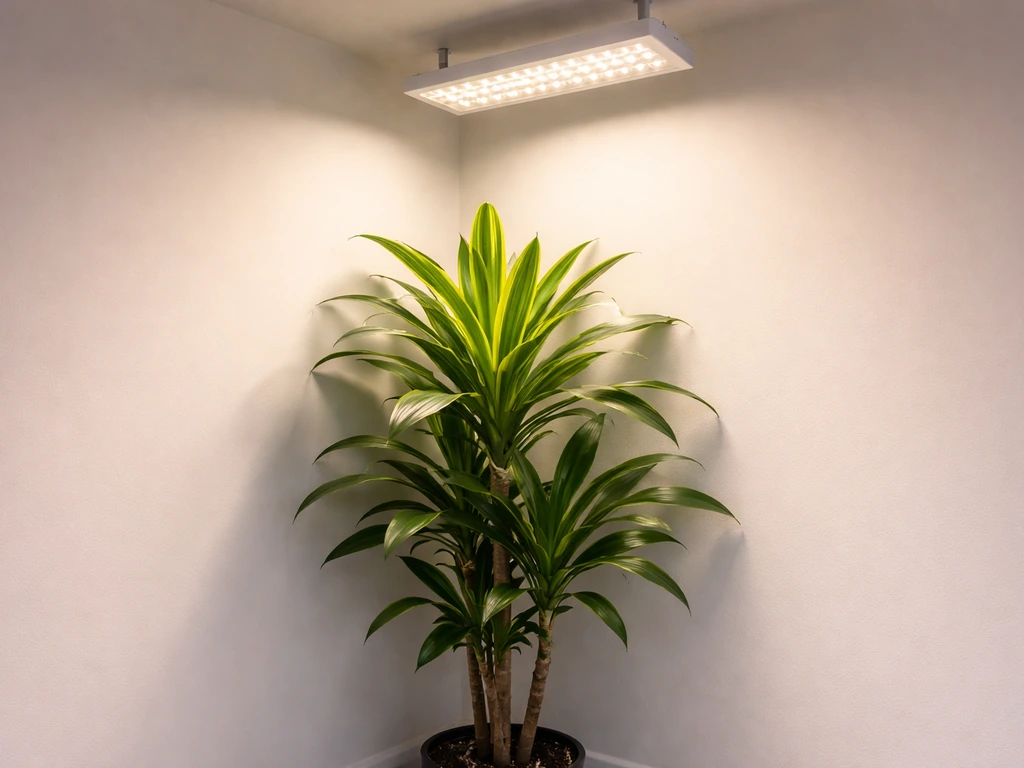
If your space gets very little natural light, or if you're heading into fall and winter when daylight hours drop significantly, supplemental lighting is a straightforward fix. You don't need an elaborate grow light system. A basic LED grow light or a full-spectrum fluorescent tube placed close enough to the plant will make a meaningful difference.
For dracaena specifically, LED grow lights with a full spectrum or a warm-to-cool white balance (around 3000K to 6500K color temperature) work well. You don't need high-wattage lights. A 10 to 20 watt LED panel or a clip-on grow bulb positioned 12 to 24 inches above the plant gives enough intensity without heat stress. Fluorescent shop lights in the same color temperature range also work, especially T5 or T8 tubes, and they're often cheaper up front.
Run your artificial light for 12 to 14 hours per day if it's the primary light source. If it's supplementing some natural light, 8 to 10 hours is usually fine. A cheap plug-in timer takes the guesswork out of this entirely, and consistent light duration matters more than occasional long sessions. Dracaena doesn't need darkness the way some flowering plants do, but giving it a consistent light and dark cycle keeps its rhythm stable.
One thing to watch with artificial lighting: avoid placing bulbs directly above the plant if they emit heat. Standard incandescent and some cheaper LEDs can warm up the leaves if placed too close. LED grow lights marketed for plants are usually fine at 12 to 18 inches. Check by holding your hand at the leaf level for 30 seconds. If it feels warm, move the light up.
What to realistically expect, and how to troubleshoot
In honest terms: blank" rel="noopener noreferrer">in true low light, dracaena will survive but grow very slowly). You might get one or two new leaves over several months rather than steady regular growth. That's normal, not a failure. The plant is conserving energy. Where it becomes a problem is if the existing leaves start deteriorating faster than the plant can produce new ones, which is the sign that conditions are too stressed for even maintenance.
If you make a placement or lighting change, give the plant four to six weeks before expecting to see a response. Plants move on their own schedule, and in lower light that schedule is slower. The first sign of improvement is usually a new leaf unfurling that looks healthier than recent growth, or a visible slow lean correcting itself after regular rotation.
Here's a quick troubleshooting roadmap for common issues in dim spaces:
- Yellow leaves dropping from the lower stem: usually overwatering combined with slow metabolism in low light. Let soil dry out more between waterings and check drainage.
- Pale, washed-out new leaves: not enough light intensity. Move closer to the window or add a grow light.
- Leggy, reaching growth with long gaps between leaves: classic low-light stretch. The plant wants more light and is physically growing toward it. Reposition and consider supplemental lighting.
- Brown leaf tips: more often a watering or humidity issue than a light issue. Check your watering frequency and whether the soil is staying too wet or too dry.
- Loss of variegation or color pattern: the plant doesn't have enough light energy to maintain complex pigmentation. Move to a brighter spot or increase artificial light duration.
- No new growth at all for 3 or more months during spring or summer: light is likely insufficient for any real growth. This is the point to add artificial lighting rather than just optimizing placement.
Dracaena is one of the more forgiving plants for lower-light spaces, and it's a reasonable choice compared to light-hungry options like rubber trees or anthuriums, which typically want brighter indirect light to look their best. Weld County notes that indoor plants, including the corn plant (blank" rel="noopener noreferrer">Dracaena fragrans), are discussed in the context of indoor-air concerns such as formaldehyde sources in homes. Unlike dracaena, rubber plants are often asked about whether they can grow in low light long term can rubber plant grow in low light. Anthuriums are often happier with brighter indirect light, but many will tolerate some lower light if you monitor leaf color and growth. If you're wondering about rubber trees, the answer depends on how low the light truly is, since they generally need brighter conditions than most dracaenas. But even dracaena has a floor, and knowing where that floor is for your specific setup, and how to raise it with smart placement or a simple grow light, is what separates a plant that lingers from one that genuinely lives in your home.
FAQ
What’s the difference between dracaena tolerating low light and actually growing well?
In low light, dracaena usually slows metabolism rather than failing immediately. The key difference is whether you get consistent new leaves with stronger color and normal leaf thickness, versus only occasional growth plus duller color (especially on variegated types).
How long can a dracaena live in a dim room without supplemental light?
It can often survive for months, sometimes longer, but growth rate tends to be very slow. If the leaves start declining faster than the plant can produce new ones, that’s the practical sign the room is below your plant’s floor and supplemental light or closer placement is needed.
Does low light cause dracaena to lose leaves or drop them?
Yes, but usually due to the combo of low light and overwatering rather than light alone. In dim conditions the soil stays wet longer, and root stress can lead to leaf drop, yellowing, or limp leaves.
Should I water less when my dracaena is in low light?
Absolutely. Let the soil dry more deeply and wait longer between waterings, because slower photosynthesis means slower water use. A simple approach is to water only after the top portion of the potting mix has dried and the pot feels noticeably lighter.
Can I fix low light by moving the plant closer to the window, or do I need a grow light?
Moving it closer often works if you have at least weak natural light. Aim for within a few feet of the brightest window light without harsh direct sun. If your home has genuinely low ambient light or no natural light, a small LED grow light is more reliable.
How much should I rotate my dracaena in low light?
Rotate about a quarter turn every week to two weeks. In dim setups the plant leans toward the brightest available spot, so regular rotation helps prevent permanent asymmetrical growth.
Do variegated dracaena need more light than solid green varieties?
Yes. The more pronounced the stripes or yellow edges, the more light is needed to maintain that pattern. In low light, variegated plants commonly fade or revert toward plain green before other damage shows up.
What artificial light should I choose for dracaena if I don’t have a sunny window?
Use full-spectrum LED or a warm-to-cool white around 3000K to 6500K, and place it close enough to create real intensity. For most setups, a small 10 to 20 watt LED panel or clip-on grow bulb works better than relying on a distant “room bulb” that barely reaches the leaves.
How many hours per day should a grow light run for dracaena?
If it’s the primary light source, run it about 12 to 14 hours daily. If it supplements some natural light, 8 to 10 hours is usually enough. Use a timer so the light cycle is consistent.
Will any grow light work, or can heat from lights harm dracaena in low light?
Some lights can add heat stress, especially if they sit too close or produce a lot of warmth. Check by holding your hand at leaf level for 30 seconds, if it feels warm, raise the light or switch to a cooler LED grow light.
What’s the safest way to transition a dracaena from low light to brighter light?
Increase light gradually and watch the new growth. A helpful diagnostic is that new leaves that emerge after the change often look thicker and larger if the plant has more energy, but don’t jump suddenly from a dim corner to strong direct sun.
If growth is slow, how can I tell my dracaena is fine versus struggling?
Slow growth can be normal, but look for leaf quality trends. If the older leaves deteriorate while the plant cannot produce healthy new growth, your light is likely below the level it needs, and you should adjust placement or add supplemental light.
Does dracaena need darkness at all?
Unlike flowering plants, dracaena does not require a strict dark period for bloom. Still, it does benefit from a consistent day-night rhythm, so avoid leaving lights on nonstop and aim for a regular schedule with your timer.