
Yes, a money tree (Pachira aquatica) can survive in low light, but it won't do much more than hang on. If you want it to actually grow, stay full, and keep its glossy leaves, you need at least moderate indirect light. An areca palm can grow in low light, but it will still grow more slowly than it would under brighter indirect light can areca palm grow in low light. The good news is that low-light spaces are fixable with smart placement and affordable grow lights, and this guide walks you through exactly how to make it work.
Can Money Trees Grow in Low Light? Practical Tips
Marcus Hartley
30 Apr 2026
What light does a money tree actually need?
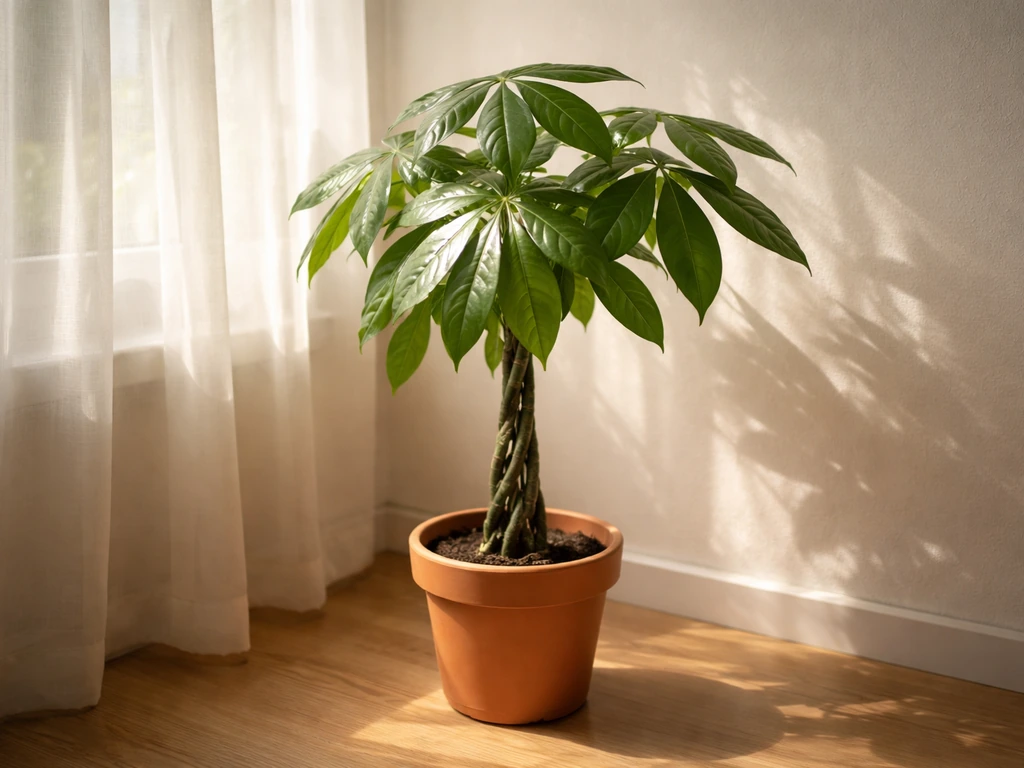
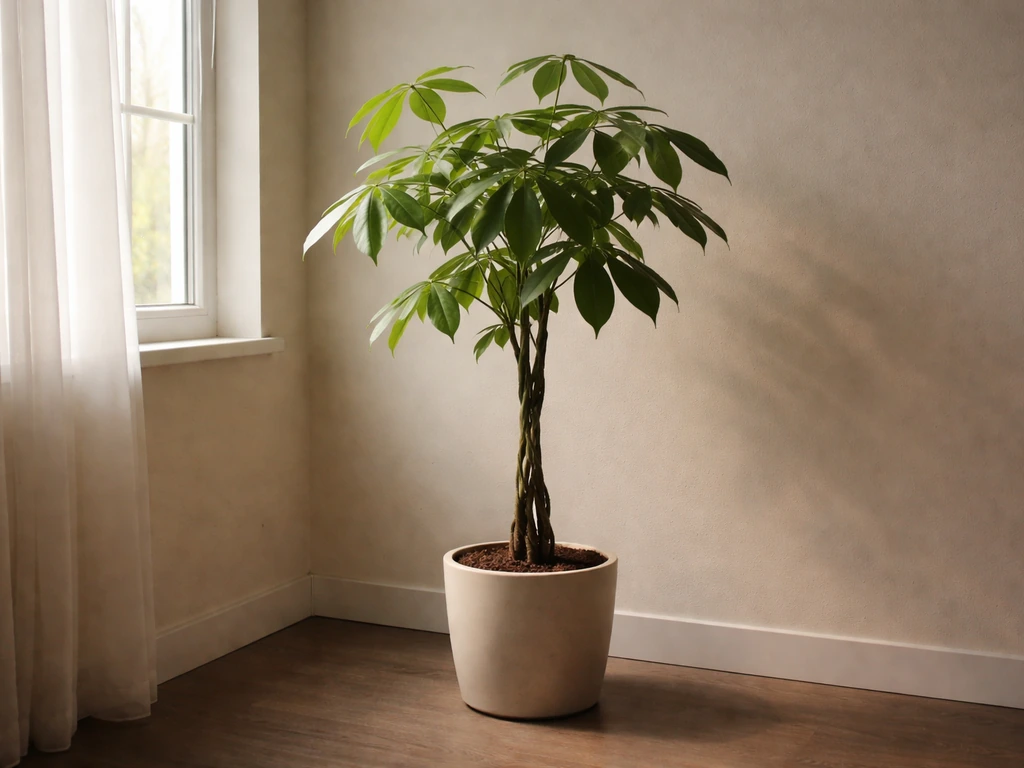
Money trees are tropical understory plants, which means in the wild they grow beneath a forest canopy. They're used to filtered, indirect light rather than blazing direct sun. Indoors, they do best in bright to medium indirect light. In practical terms, that means within about 3 to 6 feet of a south- or east-facing window where the light is strong but the direct sun rays don't hit the leaves for more than an hour or two.
In measurable terms, medium light for houseplants falls roughly in the range of 75 to 150 foot-candles. A foot-candle is a simple unit: about the brightness of a single candle one foot away. A bright windowsill might reach 1,000 foot-candles or more on a sunny day, while the middle of a room with no windows nearby might hover under 50. A money tree is happiest somewhere in the middle of that range, not in the dark corner and not baking on a south-facing sill in July.
Surviving vs. actually thriving in low light
This distinction matters a lot. A money tree in truly low light won't immediately die, and that can trick you into thinking everything's fine. What's actually happening is the plant is running a slow deficit. It can't photosynthesize enough to support vigorous growth, so it starts making trade-offs: stretching its stems toward any available light source, producing smaller leaves, and eventually dropping older leaves to reduce the energy it needs to maintain itself.
Research on Pachira aquatica confirms this directly. Studies have documented that low light conditions cause accelerated internode elongation (that's the leggy, stretched-out look) and leaf abscission (leaf drop). The plant isn't dying dramatically, it's just slowly losing its ornamental quality. If your goal is a full, compact, healthy plant, low light alone won't get you there without some intervention.
Signs your money tree isn't getting enough light
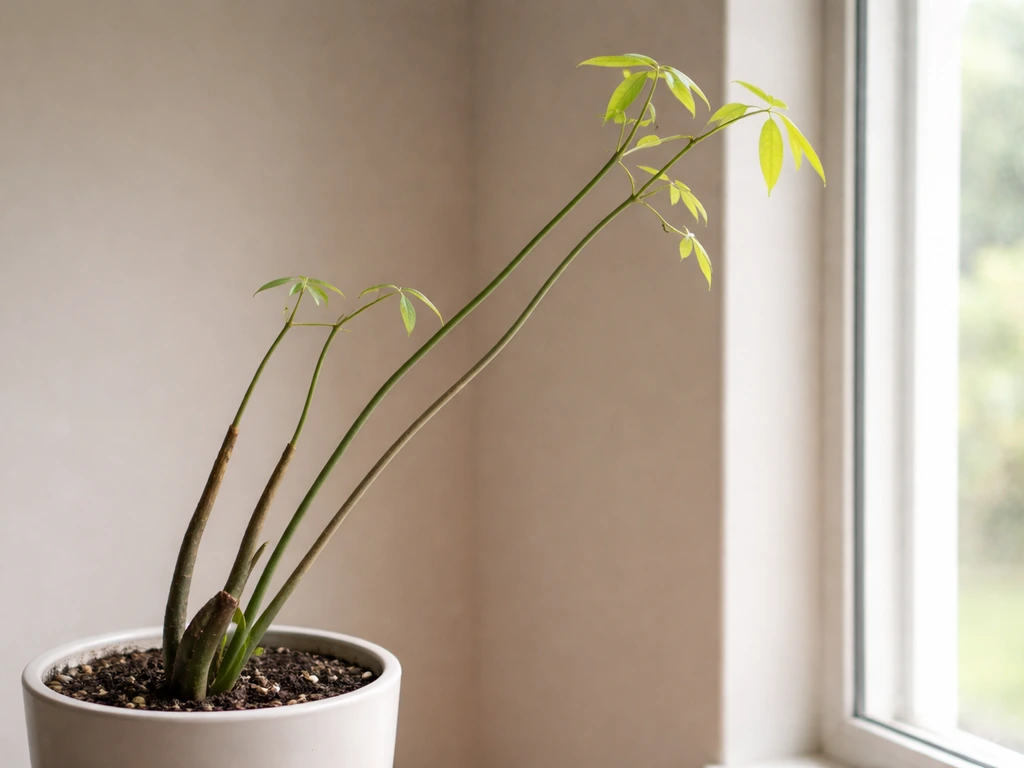
Before you rearrange your whole room, it helps to know what to look for. These are the clearest signals that your plant is light-starved:
- Leggy, stretched stems: New growth reaches and leans toward the light source, with long gaps between leaf nodes
- Smaller leaves than usual: New leaves come in noticeably smaller than the ones that grew under better conditions
- Pale or yellowing leaves: Foliage loses its deep green color, turning lighter or yellowish, especially on older leaves
- Leaf drop: The plant sheds leaves, often starting with lower or interior ones, to conserve energy
- Stalled or almost nonexistent growth: Weeks pass with no new leaves, even during the growing season (spring and summer)
- Soil staying wet too long: Less light means slower photosynthesis and less water uptake, so the potting mix dries out much more slowly than expected
That last point is worth emphasizing. When light drops, the plant's water needs drop with it. A lot of money trees in low light end up dying not from the lack of light itself, but from overwatering that follows because the owner keeps to their usual schedule without adjusting.
How to place your money tree for the best results in a low-light space
If your space is genuinely limited on natural light, placement becomes a game of making the most of what you have. If you’re wondering whether can yucca grow in low light, the answer depends on how low your conditions really are and whether you supplement with extra light. These steps will help you squeeze out every bit of usable light.
- Get as close to a window as possible: Even a north-facing window beats the middle of the room. Put the plant right on or next to the sill, not a few feet back.
- Prioritize east or west-facing windows: East light is gentler morning sun, west is stronger afternoon light. Both work better than north-only. South-facing windows give the most light but can be too intense for direct leaf contact in summer.
- Use a sheer curtain as a filter, not a blackout: If you have a bright south window but worry about direct sun scorching the leaves, a sheer curtain diffuses the light without gutting the intensity. This is a much better solution than moving the plant further into the room.
- Rotate the plant every 1 to 2 weeks: Money trees will lean toward the light source. Rotating a quarter turn regularly keeps growth even and prevents the plant from developing a permanent tilt.
- Keep it away from cold drafts and heat vents: A windowsill is ideal for light, but if it sits above a heating vent or gets cold air from a drafty window in winter, that stress compounds whatever light deficiency exists.
Using artificial light to make up the difference
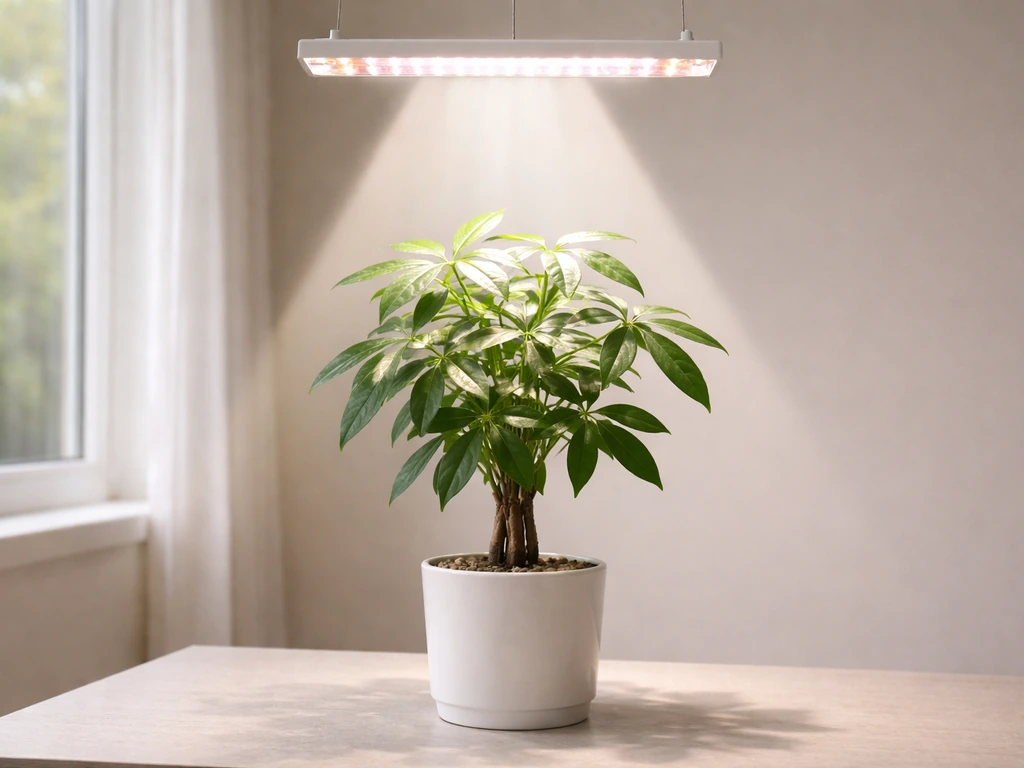
If your windows just aren't enough, grow lights are genuinely the most reliable fix. They've gotten much more affordable and practical in recent years. You don't need an elaborate setup. A simple LED grow light placed above the plant can do most of the work.
LED grow lights (the best option for most people)
Full-spectrum LED grow lights are the best all-around choice for money trees and most houseplants. They're energy-efficient, run cool enough that you can place them close to the plant without heat damage, and they last for years. Look for a light that covers the full visible spectrum, including both blue wavelengths (which support leafy growth) and red wavelengths (which support overall development). For a single money tree, a panel or bulb in the 15 to 30 watt range placed 12 to 24 inches above the canopy is a reasonable starting point. Adjust closer if growth is slow, further if leaves show signs of bleaching.
Fluorescent bulbs
T5 and T8 fluorescent tubes have been used for houseplants for decades and still work well. They're especially practical if you have a shelf setup or want to light several plants at once. They run cooler than older HID lights but warmer than LEDs, and they're less energy-efficient. If you already have a fluorescent shop light fixture, it's worth using before buying anything new. Position it about 12 inches above the plant and keep it on for 12 to 16 hours a day.
Regular incandescent and standard LED bulbs
Standard household bulbs, whether incandescent or regular white LEDs, are not designed to deliver the spectrum plants need. Incandescent bulbs also produce a lot of heat relative to useful light output. They can provide a small boost in a bright room but aren't a substitute for actual grow lights if your space is genuinely dark.
| Light Type | Energy Efficiency | Heat Output | Spectrum Quality for Plants | Best Use |
|---|---|---|---|---|
| Full-spectrum LED grow light | Excellent | Very low | Excellent | Best all-round option for single plants or small setups |
| T5/T8 fluorescent tubes | Good | Low to moderate | Good | Shelf setups, multiple plants, budget-friendly |
| Standard white LED bulb | Good | Low | Poor to fair | Minor supplemental boost only, not a standalone fix |
| Incandescent bulb | Poor | High | Poor | Not recommended for plant lighting |
Light schedule, watering adjustments, and ongoing care
Once you've got your placement or grow light sorted, the next step is dialing in the routine. Here's how to keep things on track:
- Run grow lights for 12 to 16 hours per day: Money trees need a dark period too, so don't leave lights on 24/7. A simple outlet timer takes the guesswork out of this completely.
- Water less frequently in low light: In a low-light setup, the soil will stay moist longer. Always check the top inch or two of soil before watering. If it's still damp, wait. Overwatering in low light is the most common way these plants decline.
- Hold off on fertilizing until growth resumes: Fertilizing a plant that isn't actively growing pushes salts into the soil without benefit. Wait until you see consistent new growth before feeding, then use a balanced liquid fertilizer diluted to half strength once a month during spring and summer.
- Keep leaves clean: Dust on leaves blocks light absorption. Wipe the leaves gently with a damp cloth every few weeks, especially if the plant is in a low-light spot where it needs every photon it can get.
- Avoid repotting or major changes when light is limited: Stress compounds stress. If the plant is already light-limited, don't also repot it or move it repeatedly. Stabilize the light situation first.
How to tell if it's actually working
Give any placement or lighting change at least four to six weeks before judging results. Plants don't respond overnight. The signs you're looking for are: new leaves unfurling at a normal size and color, stems staying compact rather than reaching and stretching, and the overall plant holding onto its existing leaves rather than shedding them. If you see one or two new healthy leaves in that window, you're on the right track. If the plant continues to drop leaves or produce only tiny, pale growth, the light level still isn't enough.
A grow light intensity check is worth doing if you have doubts. Missouri Extension provides useful guidance on distance-based light output from fixtures. Most LED grow lights also list their recommended distance and intensity on the packaging. If your plant isn't responding positively, try moving the light closer (in 2-inch increments) before assuming the light itself is the problem.
When low light is simply too low
There is a point where the practical answer is: this spot just doesn't work for a money tree, and that's okay to admit. If you've placed the plant as close to a window as possible, added a grow light running 14 hours a day, adjusted watering, and you're still seeing persistent leaf drop and zero new growth after two months, the realistic options are to either upgrade to a stronger grow light or swap the plant for something genuinely more shade-tolerant.
Plants like calathea or peperomia are better adapted to lower light levels and will do better in spaces where a money tree struggles. Yes, calathea can handle low light better than many other houseplants, but the exact level still affects how vigorous it grows. Peperomia also can grow in low light, especially if you give it bright indirect light whenever you can can peperomia grow in low light.
If you're attached to the money tree, the other option is to find it a better spot in your home and put a different plant in the dark corner. Not every plant can go everywhere, and matching the right plant to the actual conditions of a space is better gardening than fighting the environment. The money tree will thank you for the upgrade.
FAQ
If I move my money tree from low light to brighter light, will it bounce back?
Yes, but only briefly. If your money tree is kept in low light for months, it often becomes leggy and keeps shedding older leaves. The plant can recover if you move it to moderate indirect light or use a grow light, but do it gradually over 1 to 2 weeks to avoid leaf stress.
How many hours a day should I run a grow light for a money tree in low light?
Avoid leaving a grow light on continuously. Most indoor setups work best around 12 to 16 hours per day, then shut off to give the plant a dark period. Running it longer than that usually adds cost without noticeably speeding up growth.
What’s the most common reason money trees fail in low light besides insufficient light?
If you see stretching, tiny pale leaves, or leaf drop, first check water habits. In low light, the soil stays wet longer, so let the top few inches dry more than you would in bright rooms, and use a pot with drainage to prevent roots from sitting in water.
Can a window that feels bright to me still be “too dim” for a money tree?
Yes, but position matters. A money tree far from a window can still receive enough light if it is near a bright wall or reflective surface. Conversely, a spot close to a window can still be effectively low light if the plant is blocked by sheer curtains, blinds, or a porch overhang.
How long should I wait to know whether my low-light setup is working?
A practical rule is to aim for moderate indirect light, then verify with behavior. If after 4 to 6 weeks you get new leaves that are normal size and the plant stops dropping older leaves, your lighting is probably adequate. If not, adjust light distance or upgrade the light.
Does “low light” mean the money tree will stop growing completely?
It depends on what you mean by low light. If it means very close to a dark corner with no direct sun and little ambient brightness, growth will be minimal. If it means not in direct sun but still near a window, growth can improve once you reach moderate indirect conditions.
When using a grow light, where should I measure distance from and what signs mean it’s too far or too close?
Use the plant’s canopy as the reference point and measure from that height, not from the floor or shelf label. If your light is too far, the plant will still stretch, and if it’s too close you may see leaf bleaching at the top surfaces.
Should I rotate my money tree when it’s in low light?
Rotate the pot about once a week, especially if you are relying on a window. Without rotation, the side facing the light can develop better and the plant may lean, even if the overall light level is only marginal.
How can I tell whether leaf drop in low light is from light starvation or watering problems?
If the lower leaves drop but the top keeps producing small new leaves, that is usually a light deficit combined with acclimation, not an immediate death signal. If leaves yellow, feel mushy, or the pot stays wet for many days, that pattern points more toward overwatering than light alone.
If my space is consistently dark, should I just give up on a money tree?
Yes, but be realistic about expectations. Money trees tolerate lower light better than many tropicals, yet they are still not ideal for deep shade. If you truly cannot provide moderate indirect light or a strong grow light, switching to a more shade-tolerant plant is often the best long-term outcome.