
Yes, mint can grow indoors without sunlight, but it needs a replacement light source that actually delivers enough intensity and hours to keep it happy. If you're hoping mint will survive in a dim corner with no window and no grow light, that won't work. But if you have a bright window, or you're willing to run a basic LED grow light for a chunk of the day, mint is genuinely one of the easier herbs to grow indoors. Here's exactly what you need to know to make it happen.
Can Mint Grow Indoors Without Sunlight? A Practical Guide
Marcus Hartley
20 Apr 2026
What mint actually needs from light (and what 'sunlight' means indoors)
Mint's baseline requirement is 6 to 8 hours of good light per day. That comes straight from UC Davis horticultural guidance, and it holds up in practice. The thing is, indoors, 'sunlight' doesn't just mean sun through a window. It means light in the right wavelength range (called PAR, or photosynthetically active radiation) delivered at a usable intensity, measured in PPFD (micromoles per square meter per second, or µmol·m⁻²·s⁻¹). That might sound technical, but the practical upshot is simple: the intensity and duration of light together determine how well your mint grows.
Research on Mentha species under LED lighting points to a PPFD of around 150 to 200 µmol·m⁻²·s⁻¹ as a workable range for indoor cultivation, with peppermint in particular showing shade-tolerant behavior at the lower end of that range. Spearmint and other varieties tend to want a bit more. As a starting benchmark for indoor mint, aim for at least 150 to 200 µmol·m⁻²·s⁻¹ if you're using a grow light, or target a source with those qualities if you're relying on a window.
Full sun vs direct sun indoors: can mint handle it?
Outdoors, mint is described as a 'full sun or partial shade' plant, and it genuinely thrives in both. UC Statewide IPM notes that mint grows best with full sun to partial shade, getting about 4 to 6 hours of sun per day full sun to partial shade, about 4 to 6 hours of sun per day. Indoors, 'full sun' near a south-facing window can actually become too much of a good thing. Research on mint under LEDs found that very high PPFD causes photoinhibition, leading to leaf yellowing and reduced growth. So while mint loves good light, blasting it with intense direct midday sun through glass, especially in summer, can stress the plant.
If you have a south- or west-facing window that gets direct sun for several hours a day, mint will generally do well there. Just watch for any yellowing or bleaching of leaves, which is a sign the light is too intense rather than too little. A sheer curtain to diffuse midday sun can fix this easily. East-facing windows, which get gentler morning direct sun, tend to be a sweet spot for indoor mint.
Can mint grow in indirect sunlight?
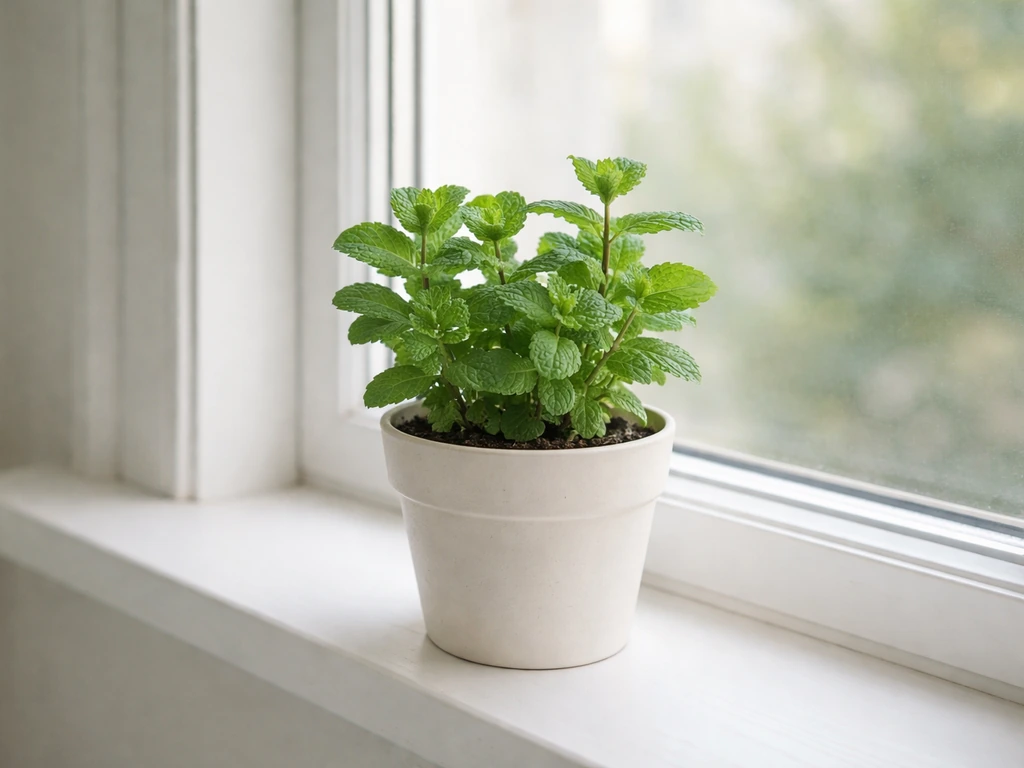
It can, but with honest caveats. Bright indirect light, say, a spot that's well-lit by a window but not in the direct beam of the sun, can work if the quality and duration are high enough. Mint needs those 6 to 8 hours of meaningful light. Moderate indirect light from a north-facing window, or a spot set several feet back from any window, usually won't cut it. In my experience, mint in those conditions grows slowly, gets leggy, and loses most of its flavor. So, if you are wondering whether can money trees grow in low light, it helps to think in terms of how much meaningful light they receive each day. Can areca palm grow in low light? The answer depends on whether it gets enough bright, usable light each day can money trees grow in low light.
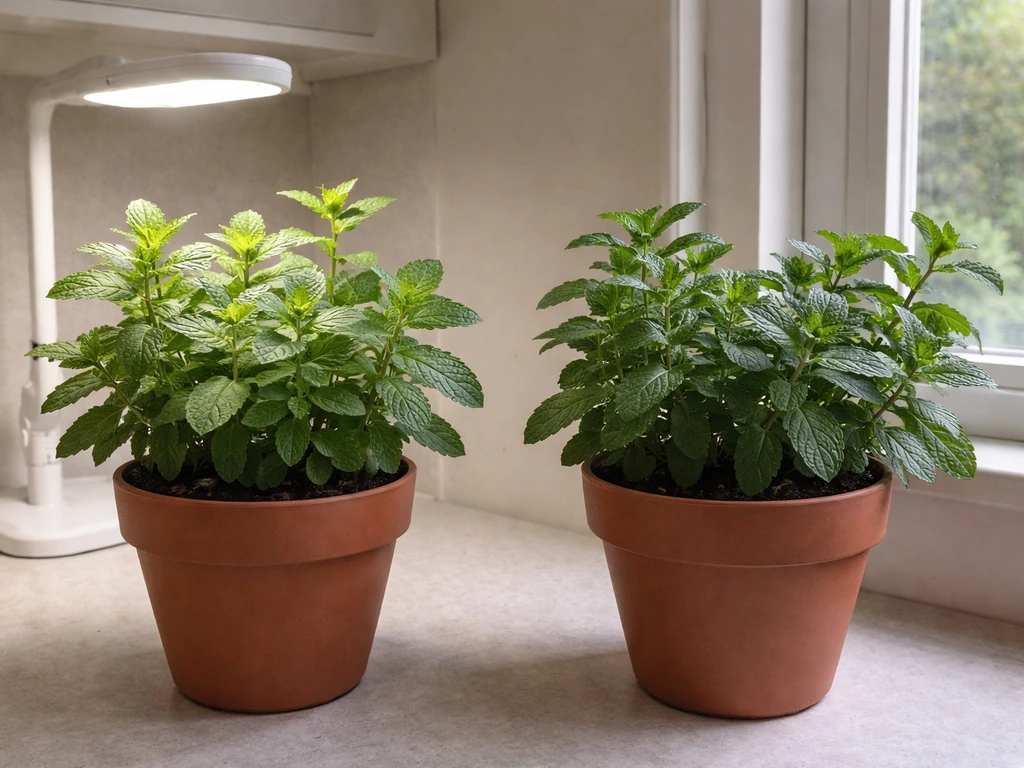
If your best window option is indirect light, position the plant as close to the glass as possible and try to maximize hours of exposure. If that means moving the pot to the windowsill during the day and back at night, it's worth the effort. For genuinely low-light window spots, supplementing with even a basic grow light makes a real difference. If you’re trying to grow plants in truly low light, that kind of simple grow-light supplementation is often what makes the difference supplementing with even a basic grow light.
Growing mint with no sunlight at all: artificial light is the answer
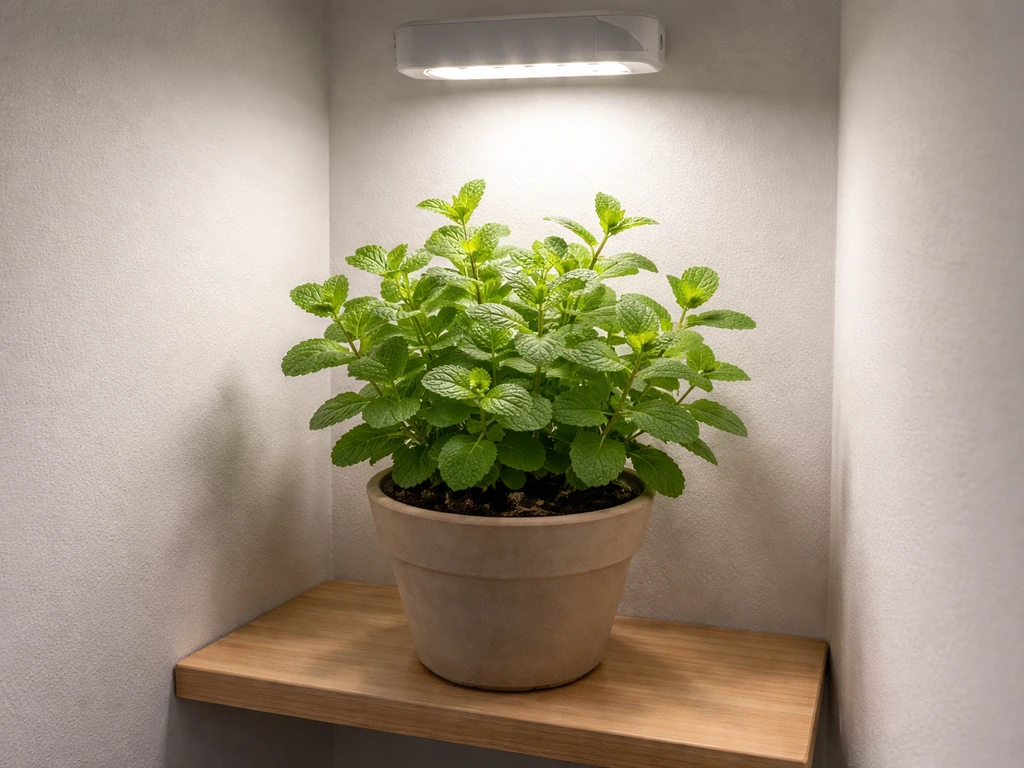
If your space has no usable window light, you can absolutely grow mint under artificial lights. This is the most important point to understand: mint doesn't know the difference between photons from the sun and photons from a quality LED grow light. What it cares about is getting the right intensity for enough hours each day.
University of Missouri Extension guidance for plants with no outdoor light recommends running artificial lights for 16 to 18 hours per day. Research on peppermint in controlled environments used a 16-hour photoperiod at 150 µmol·m⁻²·s⁻¹, which produced healthy plants. A 2022 Frontiers investigation on peppermint cultivation under LED lighting also reported a 14, 16 hour photoperiod increased essential oil content and quality, using experimental PPFD intensities across mint developmental stages a 14–16 hour photoperiod increased essential oil content and quality. Gorilla Grow Tent's mint grow guide recommends 12 to 16 hours of light daily and a PPFD of 200 to 400 µmol·m⁻²·s⁻¹ for optimal results under LEDs. That broader range reflects the difference between just keeping mint alive and getting it to grow vigorously and produce lots of flavorful leaves.
The logic behind longer photoperiods in artificial-only setups comes down to something called DLI, or daily light integral. DLI is simply the product of intensity multiplied by duration. If your grow light isn't super powerful, you compensate by running it longer. A 16-hour day at 150 µmol·m⁻²·s⁻¹ can deliver a similar total light dose as a shorter day at higher intensity. This is why a cheap fluorescent or entry-level LED can still work for mint if you give it enough hours.
What happens when mint doesn't get enough light
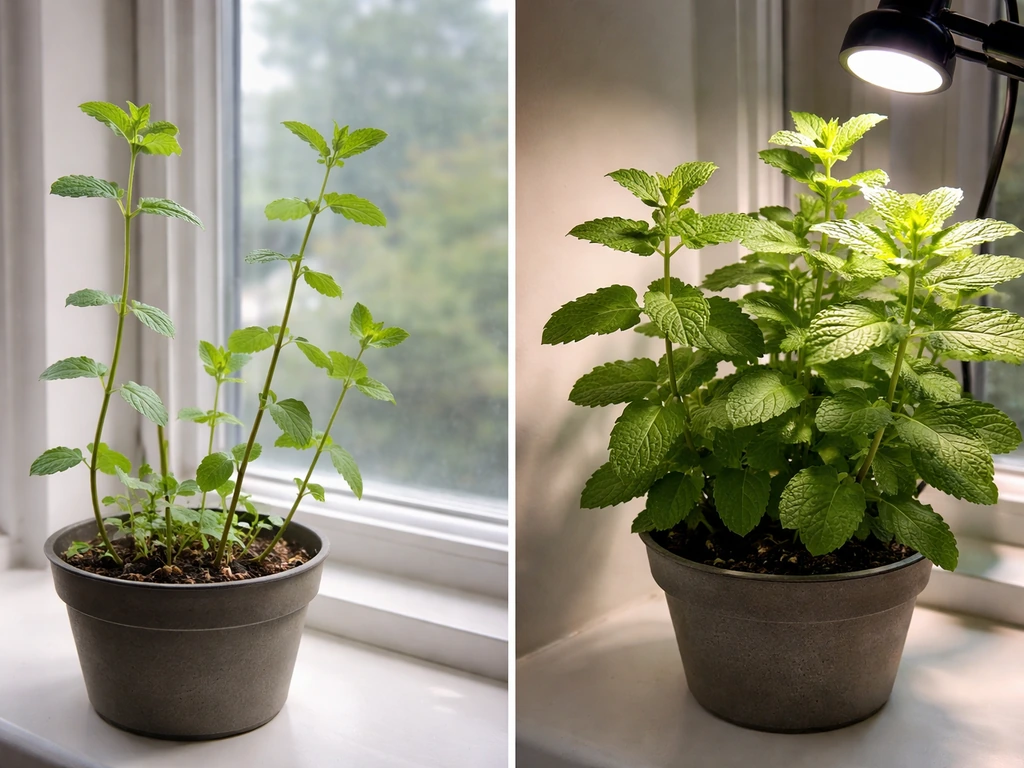
Mint is pretty expressive when it's light-starved, and the signs show up faster than you might expect, sometimes within a week or two of being in a low-light spot. Knowing what to look for helps you catch the problem early before the plant really struggles.
- Leggy, stretched stems: internodes (the gaps between leaf pairs) get noticeably longer as the plant reaches for light. This is called etiolation.
- Smaller leaves: new leaves come in significantly smaller than older ones, and they may feel thinner than usual.
- Pale or yellowish color: leaves lose their rich green because chlorophyll production slows down without enough light.
- Weak, floppy growth: stems that can't support themselves are a classic low-light sign.
- Reduced flavor and scent: mint's essential oils are produced partly in response to light. A light-starved mint plant smells and tastes noticeably weaker.
The flavor loss is the one that usually surprises people the most. You can grow a technically living mint plant in dim conditions, but if you're growing it to actually use in cooking or drinks, it needs enough light to produce those oils. Leggy, pale mint isn't just an aesthetic problem.
How to set up indoor mint lighting today
Window light setup
If you're going the window route, a south- or east-facing sill is your best option. Get the pot as close to the glass as physically possible. During shorter winter days, be realistic: a north-facing window in January probably isn't delivering 6 hours of useful light, and your mint will show it. A simple clip-on grow light running a few hours in the morning or evening can bridge the gap.
Artificial light setup
For a fully artificial setup, a full-spectrum LED grow light is the most practical choice today. They run cool, are energy-efficient, and most entry-level options work fine for herbs. Here's what to do from day one:
- Position the light 6 to 12 inches above the top of your mint plant. This is the practical sweet spot recommended for mint specifically, and it reflects the real-world principle that light intensity drops significantly with distance from the source.
- Set your timer for 14 to 16 hours of light per day if you're using a lower-power light, or 12 to 14 hours if you have a stronger setup. A plug-in outlet timer costs a few dollars and takes all the guesswork out of this.
- Target a PPFD of 200 to 400 µmol·m⁻²·s⁻¹ at the canopy level. If your light came with intensity specs, this is your reference range. If not, start with the light at 8 to 10 inches above the plant and adjust based on how the plant responds.
- As your mint grows taller, raise the light to maintain that 6 to 12 inch gap. Don't let the canopy get too close to the bulb, especially with any light that generates noticeable heat.
Window + grow light hybrid (often the best real-world option)
The most practical setup for most indoor gardeners is combining a window with supplemental artificial light. Put the mint near your best window and run a small grow light for a few additional hours in the morning or evening to fill out your target photoperiod. This approach doesn't require a powerful grow light, keeps electricity costs minimal, and gives mint much more consistent light than a window alone, especially through winter.
| Setup | Best for | Light hours needed | Key limitation |
|---|---|---|---|
| South/east-facing window | Homes with bright direct sun exposure | 6–8 hrs natural light | Seasonal variation; winter days too short |
| North/indirect window | Low-light apartments | Supplement needed | Rarely enough on its own for good flavor |
| Full artificial LED only | No window access | 14–16 hrs per day | Needs timer and correct placement |
| Window + supplemental LED | Most real-world situations | Window light + 4–6 hrs LED | Minor electricity cost; very reliable |
Troubleshooting and what to do next
If your mint is already showing the leggy, pale, or flavorless signs described above, the fix is almost always moving the light closer or extending the photoperiod, or both. Start with one change at a time so you can tell what's working. The plant will respond within one to two weeks if the adjustment was meaningful.
- Leggy growth: move the grow light 2 to 3 inches closer, or add 2 more hours to your daily light schedule. Watch for new growth coming in more compact.
- Yellowing leaves (without other obvious causes): check whether you're accidentally overdoing intensity. Mint shows photoinhibition at very high PPFD. If your light is very powerful and very close, try raising it a few inches.
- Slow overall growth: extend the photoperiod before assuming you need a stronger light. Going from 12 to 16 hours per day at the same intensity meaningfully increases total daily light.
- Mint survives but tastes bland: this is almost always a light problem. Boost both intensity and duration, and give it two to three weeks before evaluating.
- Plant bouncing back from low light: trim back the leggy growth once new compact shoots start appearing. This encourages bushier, healthier growth going forward.
One last thing worth knowing: mint is a forgiving plant that recovers well once conditions improve. Unlike some finicky houseplants, it will bounce back quickly if you give it what it needs. If you're into comparing how different plants handle low light, it's worth noting that plants like calathea or peperomia are generally much more tolerant of genuinely dim conditions than mint is. If you are specifically asking can calathea grow in low light, remember that it still does best with brighter indirect light than mint does calathea or peperomia. Mint wants real light, whether it comes from the sun or a grow light, but with a simple setup, that's easy to give it.
FAQ
How far should I place an LED grow light above my mint to avoid light stress?
Start so the mint receives the target PPFD range, then keep a few inches of adjustment room. If leaves begin yellowing, blanching, or curling up, raise the light or reduce run time. If growth stays slow with pale new growth, lower the light slightly or extend the photoperiod.
Is it enough to run an LED grow light 12 hours a day for indoor mint if my PPFD is low?
It can be, because what matters most is daily light integral (DLI), intensity multiplied by duration. If your light is on the weaker side, lean toward longer run time, for example 14 to 18 hours, but avoid running it excessively long if heat or drying becomes an issue.
Can I use a regular household bulb, like a warm white LED, instead of a grow light?
Often it will keep mint alive but not perform well for flavor and dense growth. Household bulbs typically lack enough PAR intensity in the right wavelengths. If you use one anyway, place the plant very close and monitor for legginess, pale leaves, and reduced aroma.
Do I need a light timer, or is turning the grow light on and off manually fine?
A timer is strongly recommended because mint responds to consistent daily light. Variable schedules make it harder to hit the 6 to 8 hour meaningful window (for windows) or the daily light integral (for LEDs), which can translate into uneven growth and weaker flavor.
Should mint get 24 hours of light indoors?
No, continuous lighting is usually counterproductive. Plants need an off period to maintain normal rhythms and avoid stress. For artificial-only setups, stick to a practical photoperiod such as 12 to 18 hours rather than 24.
What signs tell me my mint is getting too little light versus too much light?
Too little light usually shows up as slow growth, leggy stems, smaller or pale leaves, and weaker mint scent. Too much intensity or direct glass-sun can cause yellowing, bleaching, or stressed looking new growth. The fix differs, so adjust light intensity or duration accordingly rather than guessing.
If my mint is in a north-facing window, can I still grow it without a grow light?
Usually not reliably, especially in winter. North-facing light often falls short of the daily meaningful hours. If you want window-only, expect slow, thin growth, otherwise plan to supplement for a few hours each day.
Will rotating the pot help indoor mint that is near a window or single LED?
Yes. Mint will lean toward the light source, so rotate the pot every few days to keep growth even. This reduces one-sided legginess and helps you harvest a fuller plant.
Does indoor mint need special fertilizing if it is grown under LED light?
You may need slightly different fertilizing frequency, but light is the main driver of growth. If you extend photoperiods or increase light intensity, mint can grow faster, so apply fertilizer at label strength but avoid overfeeding weak, light-starved plants.
How long does it take to see improvement after changing the light setup?
Expect noticeable changes within one to two weeks if the adjustment is meaningful. New growth is the best indicator, look for darker leaves, shorter internodes, and improved aroma rather than judging by older leaves alone.