
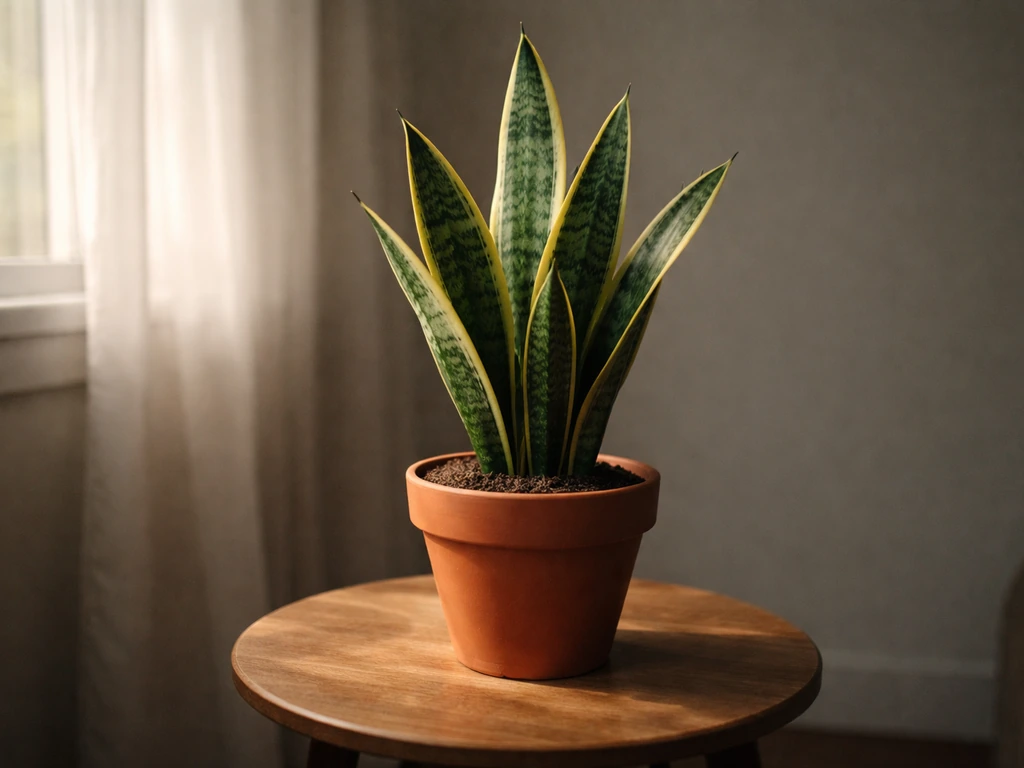
A snake plant can survive in a very dim room, but it cannot grow in true darkness. It still needs some light to photosynthesize, even if that amount is tiny compared to most houseplants. The good news is that snake plants are genuinely one of the most light-tolerant plants you can keep indoors, able to persist at light levels as low as 25 foot-candles, which is dimmer than most people's hallways. So if your room has any light at all, including a distant window or a lamp that stays on for several hours, there's a real chance your snake plant will be fine. But if the room has zero natural or artificial light, the plant will slowly decline, not thrive.
Can Snake Plant Grow in a Dark Room? What to Expect
Marcus Hartley
14 May 2026
What 'dark room' actually means in a real home
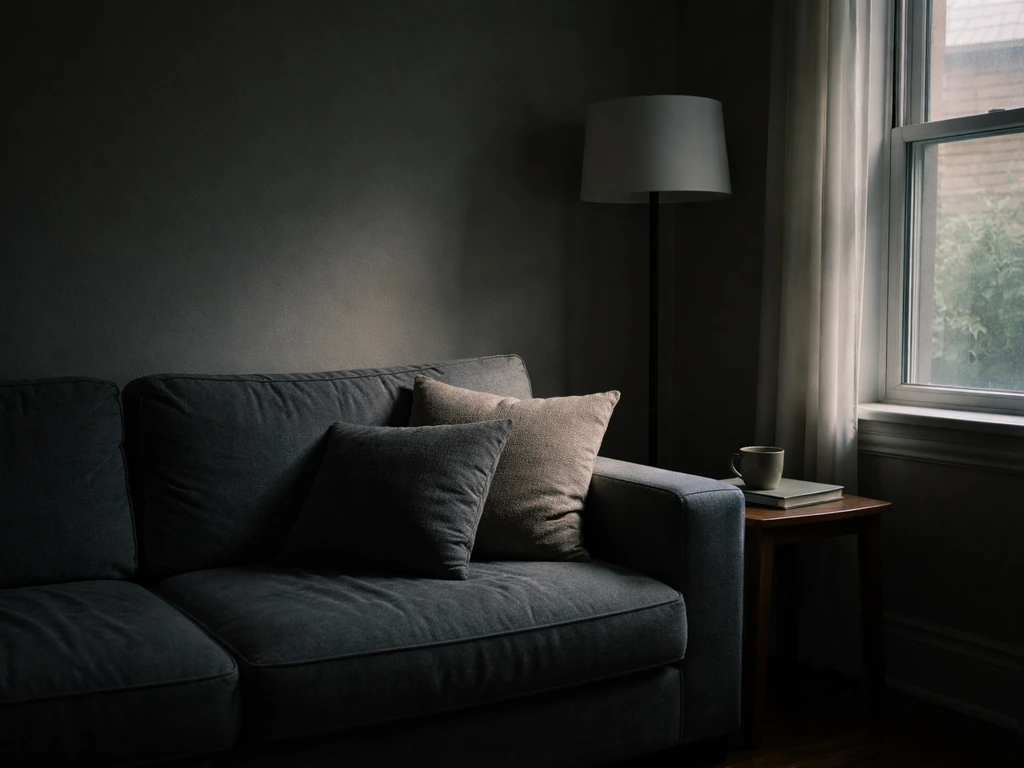
When people say 'dark room,' they usually mean a room that feels dim, not one that is literally lightless. True darkness, like a sealed closet with no light source at all, will kill any plant eventually. But most dim rooms in a home still receive some ambient light: light bleeding under a door, a single small window facing a shaded wall, a hallway fixture that stays on, or reflected light from a neighboring room.
In practical terms, what plant parents are usually dealing with is low light, measured roughly between 25 and 100 foot-candles (fc). University of Maryland Extension also lists ZZ plants, snake plants, cast iron plants, peace lilies, and other options as suitable for “low light” rooms measured around 25, 100 foot-candles [low as 25–100 foot-candles (fc)](https://www. extension. umd.
edu/resource/lighting-indoor-plants). For reference, a well-lit office desk sits around 200 to 500 fc, while a room with no windows at all may measure under 10 fc. Snake plants can manage at the lower end of that 25 to 100 fc range, which is exactly why they show up on every 'low-light plant' list from university extension offices.
If you want to know exactly what you're working with, a basic light meter app on your phone or an inexpensive lux meter will give you a reading you can actually act on.
What snake plants actually need versus what they can tolerate
Snake plants (Sansevieria trifasciata, also classified as Dracaena trifasciata) are categorized by the University of Illinois Extension as capable of growing in 'any light intensity from dim interior to full sun,' which is a genuinely impressive range. Mississippi State University Extension places them in the 25 to 75 fc low-light category. Penn State Extension found them surviving at 25 fc in measured indoor conditions. But tolerating low light and thriving are two different things.
In bright indirect light (200 to 500 fc), a snake plant will grow new leaves regularly, hold its color, and stay compact. Drop it into a dim room at 25 to 50 fc and it will probably survive for months or even years, but growth slows dramatically, sometimes to one or two new leaves per year.
If you are wondering specifically about whether a money plant can grow in a dark room, it will still need at least some low ambient light to avoid declining can money plant grow in dark room. The plant is essentially idling, using just enough light to keep its cells alive.
Below 25 fc consistently, it starts to decline: leaves lose their sharp yellow margins, the green fades, and root health deteriorates because the plant can't produce enough energy to sustain itself. As the University of Nebraska-Lincoln Extension puts it, plants still need light to manufacture food, and no amount of fertilizer or good soil can substitute for that.
Signs your snake plant isn't getting enough light
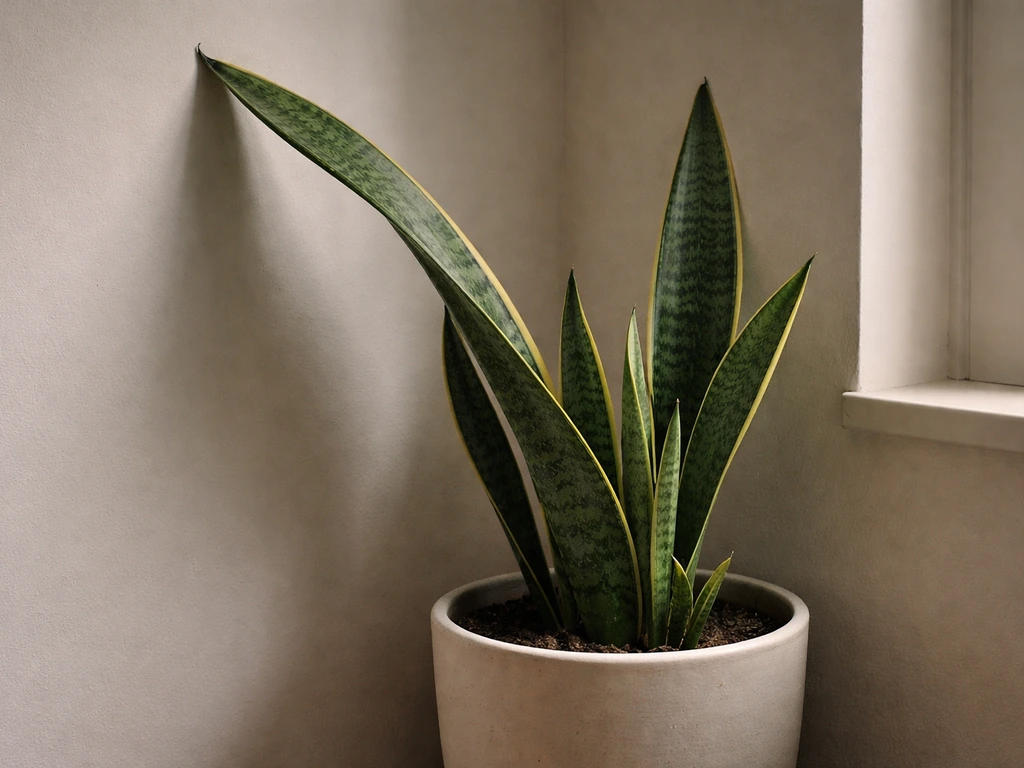
This is where a lot of people get confused, because the symptoms of too little light can look like other problems. I've seen snake plants in dark corners that looked like they had a watering issue or even a root problem, when the real culprit was light starvation. Here's what to watch for:
- Leaves leaning or reaching dramatically toward any available light source (classic etiolation)
- New leaves coming in thinner, narrower, or paler than established ones
- Yellow margins fading to plain green or the whole leaf turning a washed-out color
- Very slow or zero new growth over several months
- Soft, mushy leaves that aren't explained by overwatering (low light causes the plant to use water more slowly, which leads to sitting in wet soil too long)
- Drooping or flopping leaves that used to stand upright
If you're seeing mushy leaves or yellowing and you haven't changed your watering schedule, check the light before assuming root rot. In a dark room, even a watering schedule that worked fine in a brighter spot can suddenly become too much because the plant is barely transpiring. Move the plant closer to any light source first, then reassess the damage.
How to set up lighting in a low-light room
Making the most of natural light
If the room has any window at all, position the snake plant as close to it as possible. Even a north-facing window that never gets direct sun will provide usable light within a meter or two of the glass. Keeping windows clean makes a measurable difference, as does removing heavy curtains or replacing them with sheer ones. If the room has a window but it's partially blocked by furniture or objects, clearing that line of sight to the plant can noticeably bump up what it receives.
Affordable artificial lighting options
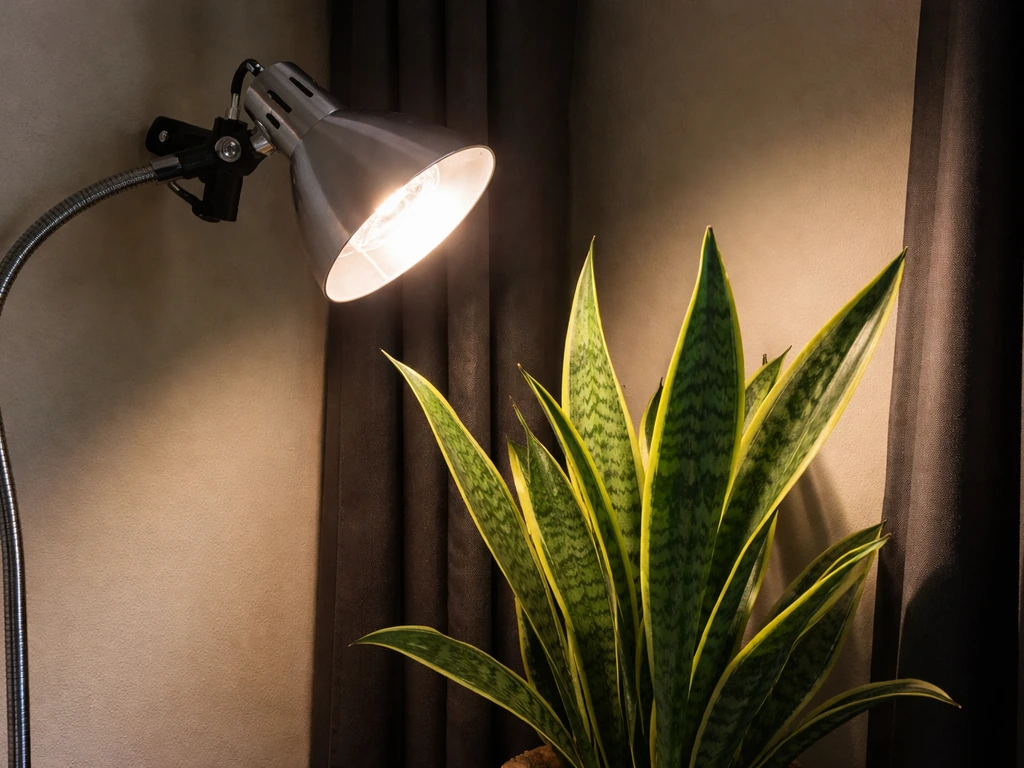
If natural light genuinely isn't an option, a grow light is not as complicated or expensive as it sounds. A basic LED grow bulb (around 10 to 15 watts, full-spectrum) screwed into a standard clamp lamp or floor lamp can give a snake plant exactly what it needs. For a single plant in a dim room, you're looking at a setup that costs under 30 dollars.
Fluorescent shop lights work too, especially T5 or T8 fixtures, which put out a wide spread of light useful for multiple plants. The key specs to look for are a color temperature between 5000K and 6500K (which mimics daylight) and placement about 12 to 24 inches above the plant. Run the light for 12 to 14 hours per day using a simple outlet timer so you don't have to remember to switch it on and off.
At that distance and duration, even a modest LED bulb can push light levels well past the 50 fc threshold a snake plant needs to stay healthy and even grow slowly.
| Option | Cost | Best for | Placement |
|---|---|---|---|
| Full-spectrum LED grow bulb in clamp lamp | $15–$30 | Single plant or small corner | 12–18 inches above plant |
| LED grow light panel (bar or flat) | $25–$60 | Multiple plants or a shelf | 18–24 inches above plants |
| T5/T8 fluorescent shop light | $20–$50 | Wide coverage, budget setups | 12–24 inches above plants |
| North-facing window (no supplement) | $0 | Rooms with any natural light | Place plant within 1–2 meters of glass |
Care adjustments that matter most in a dark room
Light level changes everything downstream in plant care, and snake plants in dim conditions need noticeably different treatment than those in bright spots.
- Water much less frequently: in a dark or dim room, soil dries out slowly because the plant is barely photosynthesizing or transpiring. Instead of a fixed schedule, always check the soil before watering. Stick your finger 2 inches deep; if it still feels damp, wait. In winter or very dark conditions, this might mean watering every 4 to 6 weeks instead of every 1 to 2 weeks.
- Use a well-draining potting mix: a cactus or succulent mix, or a standard potting soil cut with 20 to 30 percent perlite, helps prevent the waterlogged conditions that cause root rot in low-light plants.
- Water at the base, not the leaves: soggy soil from overhead watering in a slow-drying dark environment is one of the fastest ways to lose a snake plant.
- Rotate the pot every few weeks: if there is a directional light source (a window, a lamp), rotating the plant keeps it growing evenly and prevents it from permanently leaning toward that source.
- Skip or reduce fertilizer: a plant in low light is barely growing, and feeding it actively can cause fertilizer salt buildup without the plant having the energy to use the nutrients. At most, fertilize once in spring with a diluted balanced liquid fertilizer.
- Watch pot size: a snake plant in a dark room should be in a pot that fits its root ball snugly, not one that's oversized. More soil means more moisture held around roots for longer.
When to add a grow light or switch plants entirely
Sometimes the honest answer is that a room is too dark for even a snake plant to be happy long-term, and that's okay to admit. If your goal is plants that can grow in a dark room, you will need to rely on low-light tolerant options and accept slower growth. Here's a quick checklist to help you decide whether to invest in artificial lighting or choose a different plant:
- Measure your light: if your room consistently reads below 20 fc and there's no window at all, a grow light isn't optional, it's necessary for any plant to survive.
- Check for the warning signs listed above: leaning, fading, no growth in 6 or more months, or repeated soft leaves despite correct watering all point to inadequate light.
- Try a grow light for 4 to 6 weeks before giving up: even a basic LED bulb on a timer can reverse early light deficiency signs in a snake plant. If the new growth coming in looks normal (upright, colored, not thin), the light is working.
- If the room truly has no usable light and you can't commit to a grow light setup, consider switching to a more forgiving option: ZZ plants (Zamioculcas zamiifolia) are often considered even more tolerant of very low light than snake plants. Cast iron plants and pothos are also worth considering for extremely dim spots.
- If you're already running a grow light and still not seeing improvement after 8 weeks, check for root rot by gently unpotting the plant: damaged roots from prior overwatering in the dark are the most common secondary cause of failure.
Snake plants are genuinely forgiving, and for most dim rooms in real homes, they're one of the best choices you can make. The key is understanding that 'low light tolerant' doesn't mean 'no light required,' and making a few small adjustments to watering and setup based on the actual conditions in your space.
If you want alternatives to snake plants, there are other plants that can grow in dark corners too, though many still need a little ambient light. If you're exploring other options for truly dark spots, plants like ZZ plants, cast iron plants, and certain ferns are worth looking into for rooms where even a snake plant struggles. But for most people asking this question, a snake plant, positioned well and watered carefully, is going to do just fine.
FAQ
How can I tell if my room is “dark” for a snake plant, or just dim?
Not if it is truly lightless. If you can’t measure any usable ambient light, the plant may only survive briefly at best, then decline. In practice, check whether you can read in the room for several hours without turning on a light, if not, assume you are below the 25 fc threshold and plan on a grow light.
Can a snake plant grow in a dark room if I’m patient? What growth rate should I expect?
Yes, but it is slower and less predictable. Expect growth to stall or produce only occasional new leaves when light is near the low end (around 25 to 40 fc). If you want steady growth, aim to keep the plant closer to the light source or use a grow light on a timer for consistent daily exposure.
If I use a grow light, should I turn it on daily or only when I’m home?
Use a timer, not a manual habit. Snake plants in low light respond well to stable schedules, typically 12 to 14 hours per day under a grow light, and changing the schedule often can make watering mistakes more likely because the plant’s transpiration rhythm shifts.
If my snake plant is doing poorly in a dim room, should I assume root rot and repot immediately?
Yes, and it can be a big reason for failure in low-light corners. If leaves are mushy or roots smell bad, inspect light exposure first, then reduce watering frequency. In dim rooms, snake plants need much less water because soil stays wet longer and the plant uses less energy.
If I improve the lighting, should I move the plant immediately to the brightest spot?
Move it gradually and reassess after 2 to 3 weeks. A sudden shift from near-low light to brighter light can stress the plant, especially if it was already declining. Start by moving it closer to the light source or stepping up grow-light intensity, then observe for new leaf firmness and color.
What placement matters most in a dim room, distance from the window or angle to the light?
They need to be positioned so light actually reaches the leaves, not blocked by walls or plants. For windows, keep the snake plant within about 1 to 2 meters of the glass, and for grow lights place the bulb roughly 12 to 24 inches above the plant, then adjust if the tips start to pale.
Do window treatments really affect snake plants in low light?
Cleanliness matters. Dirty window glass and heavy curtain fabric can reduce light meaningfully, even when you think the room “has a window.” Wipe the glass (or choose a sheer curtain), then move the plant to the clearest line of sight for a noticeable improvement.
Will fertilizer help a snake plant that’s living in a very dim room?
A “low-light” snake plant still needs some light to manufacture food, so fertilizer will not fix darkness. If growth is stalled, avoid increasing fertilizer, instead correct light first and water based on soil dryness. Fertilizing a stressed low-light plant can worsen decline.
Does low-light mean I should water on the same schedule as usual?
Only temporarily, and it is easy to overwater. In low light, soil dries slowly, so even the same watering schedule can become too much. Use a moisture check (finger in the soil or a simple moisture meter) and water only when the potting mix is dry several inches down.
What are the most reliable signs of “too little light” versus “too much water”?
Fungal issues and stretched growth are common warning signs of chronic low light. Look for faded color, loss of distinct yellow margins, slow or absent new leaves, and soft tissue. If the plant becomes limp while soil is wet, first suspect low light plus overwatering.
How do I decide between keeping the snake plant or switching to another plant for a very dim room?
When deciding, prioritize light you can reliably provide for months. If your room stays under about 25 fc most of the day, switch strategy: either plan for a grow light with a timer, accept slow survival without new growth, or choose a plant that tolerates lower light in your specific conditions.