
Beans can grow without direct sunlight, but they genuinely struggle in low light and won't produce pods without enough of it. If you're working with a dim apartment or a windowless room, you'll need a dedicated grow light to get real results. A bright, sunny windowsill (south or west facing) can work for foliage growth, but even then, most bean varieties need supplemental lighting to flower and pod reliably indoors. The good news: with the right artificial light setup, you can absolutely grow beans year-round inside, no outdoor garden required.
Can Beans Grow Without Sunlight Indoors? Light Guide
Marcus Hartley
6 May 2026
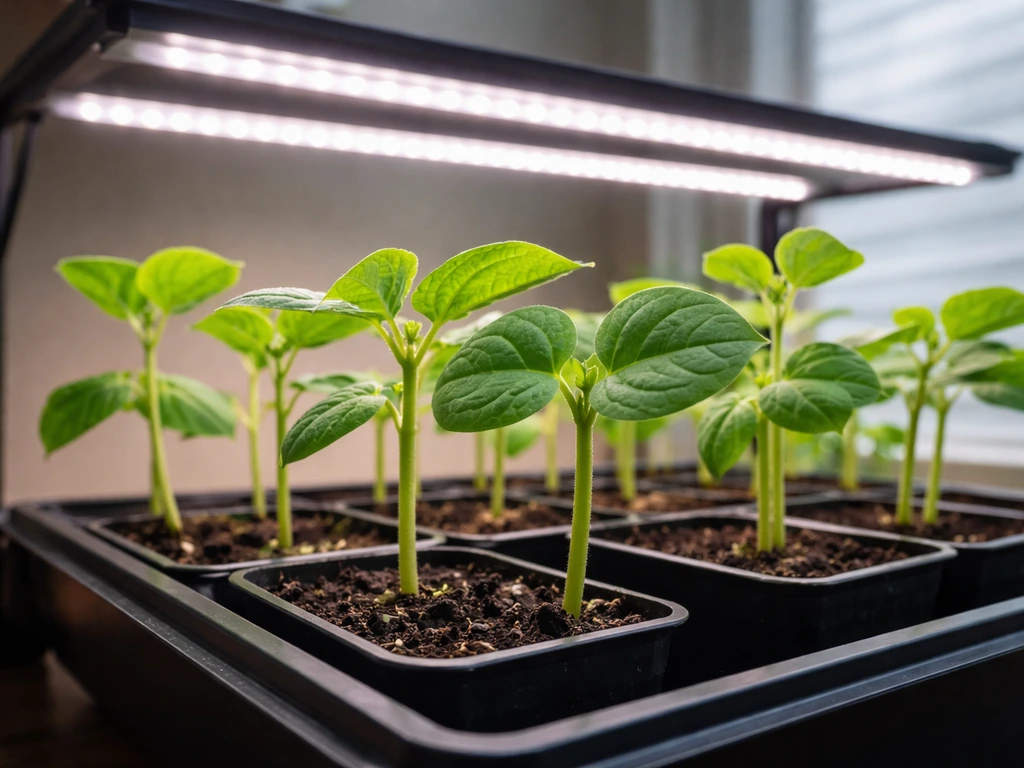
Do beans actually need sunlight, or just light in general?
When people ask whether beans can grow without sunlight, they usually mean one of two things: Can beans survive in a shaded room with only ambient indoor light? Can chia seeds grow without sunlight? They also need enough light to support healthy growth, so a grow light or bright indirect light is usually required. Or can artificial light fully replace the sun? Those are very different questions. The first answer is: not well. The second answer is: yes, if you set it up properly.
Beans (Phaseolus vulgaris, the common garden bean) are what botanists call short-day plants. That means they're wired to flower when days are shorter, typically around 12 to 12.5 hours of light. Studies comparing natural 12.5-hour daylengths to extended 18-hour photoperiods found that longer days delayed flowering significantly. So ironically, giving beans too much light for too long can actually slow down pod production. You want to hit that sweet spot of around 12 to 14 hours of good-quality light per day.
The bigger issue indoors isn't usually photoperiod though. It's total light intensity. Beans need bright light to photosynthesize efficiently and build the energy reserves that fuel flowering. 'No sunlight' in plant terms means no photons reaching the leaves at meaningful intensity. Your average indoor room light, even a bright one, delivers maybe 50 to 200 lux. Beans want something closer to 20,000 to 40,000 lux at the canopy during their active growth phase. That gap is why beans grown on a dim shelf look sad within two weeks.
What actually happens when beans get too little light
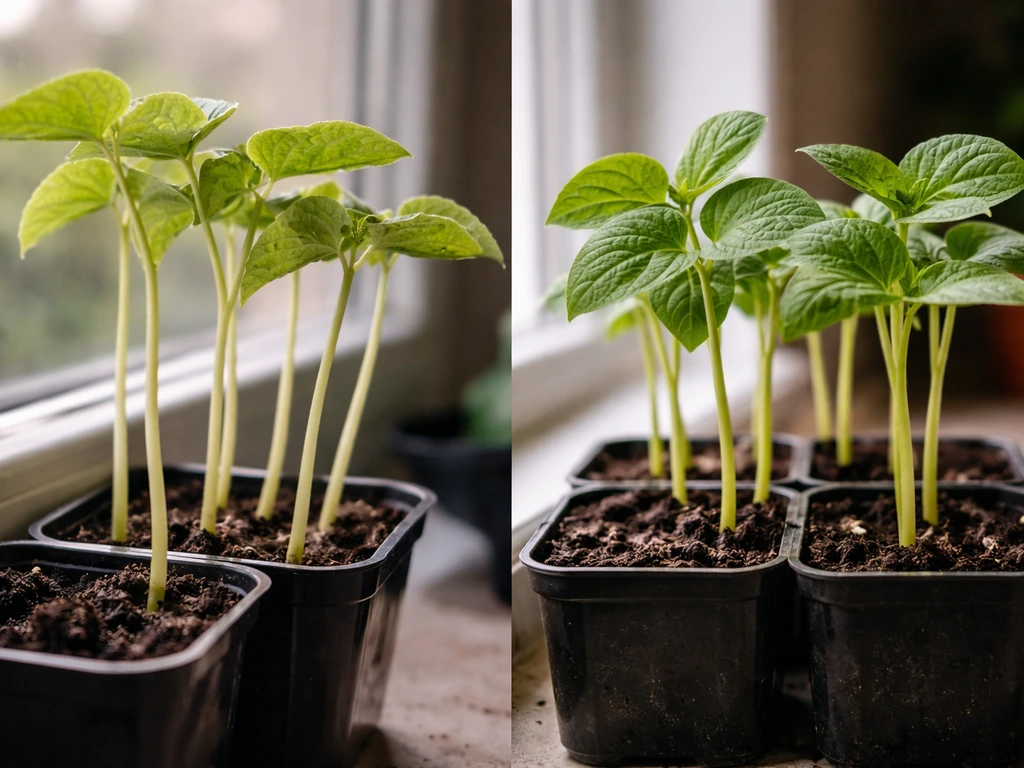
I've made the mistake of trying to grow beans on a north-facing windowsill in my apartment. The seedlings came up fine, looked promising for about a week, and then started doing what all light-starved plants do: they stretched. Tall, thin stems reaching desperately toward any brightness. No side branching, pale green leaves, and absolutely zero flowers. That response is called etiolation, and it's the plant burning through its stored energy trying to find better light.
Research on Phaseolus vulgaris confirms what any indoor gardener eventually notices: reduced light levels suppress chlorophyll development. Bean plants grown under low or intermittent light produce leaves that are low in chloroplast pigments, which directly limits their ability to capture energy from any light source. Less chlorophyll means less photosynthesis, less photosynthesis means weaker stems, smaller leaves, and a plant that can't support the metabolic load of flowering and fruiting.
Here's what to watch for if your light is borderline:
- Stems growing tall and spindly with long gaps between leaf nodes (leggy growth)
- Leaves turning pale yellow-green instead of a rich, dark green
- Slow or stalled growth after the first set of true leaves
- Flowers forming but dropping before they develop into pods
- No flowers at all after 6 to 8 weeks of growth
How to measure your light level right now
You don't need to guess. A basic lux meter (they cost around $15 to $25 on Amazon) will tell you exactly what your space is delivering. Hold it at plant canopy height and take a reading during the brightest part of the day. When measuring, use PPFD (not lux) and take readings at canopy level, averaging across multiple points PPFD (not lux) and measure at canopy level. If you don't want to buy a meter, the free Photone app on your phone (formerly Korona) gives a reasonable estimate using your phone's camera sensor. It's not lab-accurate, but it's good enough to know whether you're in the ballpark.
| Light Level | Lux Range | What It Means for Beans |
|---|---|---|
| True darkness / windowless room | 0–50 lux | Beans will not grow. Period. |
| Dim indoor ambient light | 50–500 lux | Seedlings will germinate but etiolate quickly. Not viable long-term. |
| Bright indirect window light | 1,000–5,000 lux | Slow, weak growth. May survive but won't flower reliably. |
| Bright south/west window (direct) | 10,000–20,000 lux | Possible with warm seasons and south exposure. Still borderline for pods. |
| Good grow light setup | 20,000–40,000 lux at canopy | Healthy growth, flowering, and pod set are achievable. |
If your window is delivering less than 5,000 lux for fewer than 6 hours a day, you need supplemental lighting. If you're below 1,000 lux all day, you need a full grow light solution, not just a boost.
LED vs fluorescent: which light actually works for beans
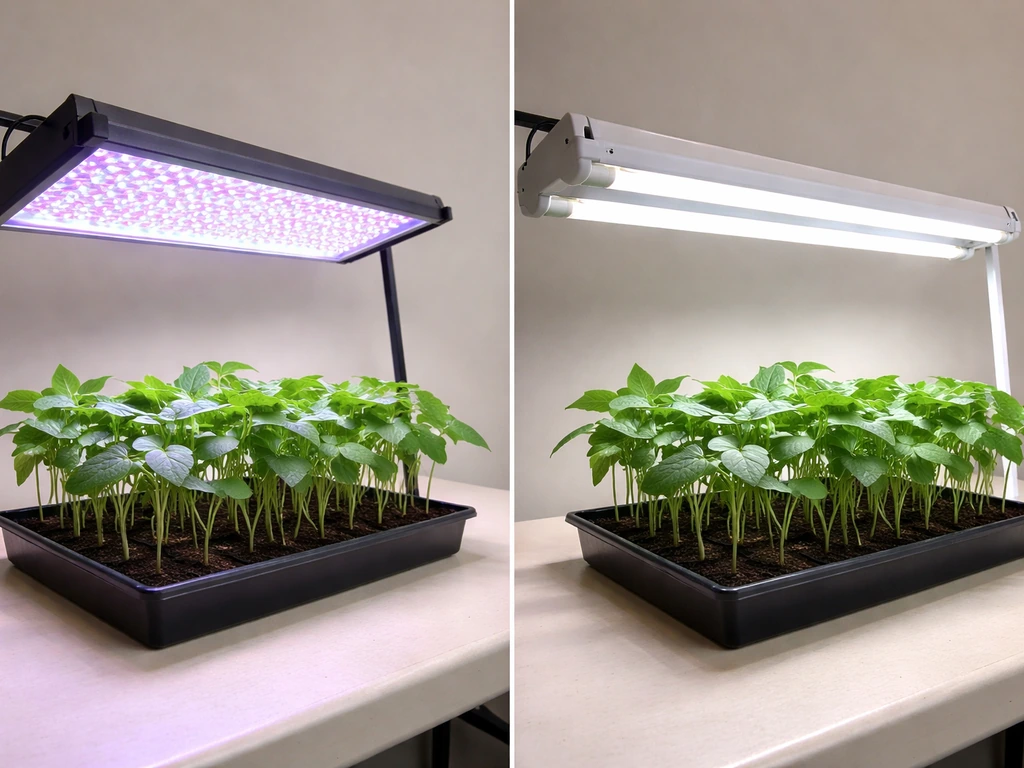
Both LED grow lights and fluorescent tubes can grow beans successfully. The differences come down to efficiency, heat output, and how high you can push intensity. For most indoor bean setups, I'd lean toward full-spectrum LED grow lights, but let me break down why.
| Feature | Full-Spectrum LED | T5/T8 Fluorescent |
|---|---|---|
| Energy efficiency | High (less heat per lumen) | Moderate (more heat generated) |
| Upfront cost | $30–$150 for quality panels | $20–$60 for fixtures and bulbs |
| Light intensity output | High — can reach 30,000+ lux close up | Moderate — typically 10,000–20,000 lux close up |
| Adjustability | Many have dimmer and spectrum controls | Limited; swap bulbs to change spectrum |
| Lifespan | 50,000+ hours typical | 10,000–20,000 hours typical |
| Best for beans | Excellent for full cycle including flowering | Good for seedlings and foliage, borderline for pod set |
For beans specifically, you want a light that covers the red spectrum (around 630 to 660nm) well, since red light drives flowering and fruiting in short-day plants. Most quality full-spectrum LED panels marketed for vegetables cover this range. Avoid blue-only or 'cool white' fluorescents as your only source. They're fine for leafy greens but won't push beans into flowering the way a balanced or red-heavy spectrum will.
If you're already growing other plants indoors, like herbs or microgreens, you might be surprised that beans need significantly more intensity than most of them. Coriander, for instance, manages reasonably well in lower light conditions compared to beans. Beans are hungrier for photons than most compact indoor herbs.
Setting up your lights correctly
Getting the distance and timing right matters as much as choosing the right light. I've seen people burn leaves by hanging lights too close and others wonder why their plants look weak when the lights are three feet away. Here's what actually works for beans:
Distance from the canopy
- Full-spectrum LED panels (mid-range, 45W to 100W): 12 to 18 inches above the canopy for seedlings, lower to 8 to 12 inches once plants are established and actively growing
- T5 fluorescent tubes: 4 to 6 inches above the canopy (fluorescents lose intensity rapidly with distance, so keeping them close is essential)
- As plants grow taller, raise the light to maintain the same distance — adjustable hangers or ratchet straps make this easy
- Check with your lux meter or Photone app after any adjustment to confirm you're hitting 20,000+ lux at the leaf level
Daily light hours (photoperiod)
Run your lights for 12 to 14 hours per day for beans. Because common beans are short-day plants, keeping lights on for 16 or more hours can actually delay or prevent flowering, even if the intensity is great. A simple outlet timer set to 12 or 13 hours on, 11 or 12 hours off works perfectly. I use a 6am to 7pm schedule, which also means I can actually see my plants in the evening without turning anything on.
During the dark period, keep the room as dark as possible. Light leaking in during the 'night' phase from hallway lights or streetlights can interrupt the photoperiod signal beans use to time their flowering. A small dark closet or a grow tent solves this completely.
Preventing leggy growth
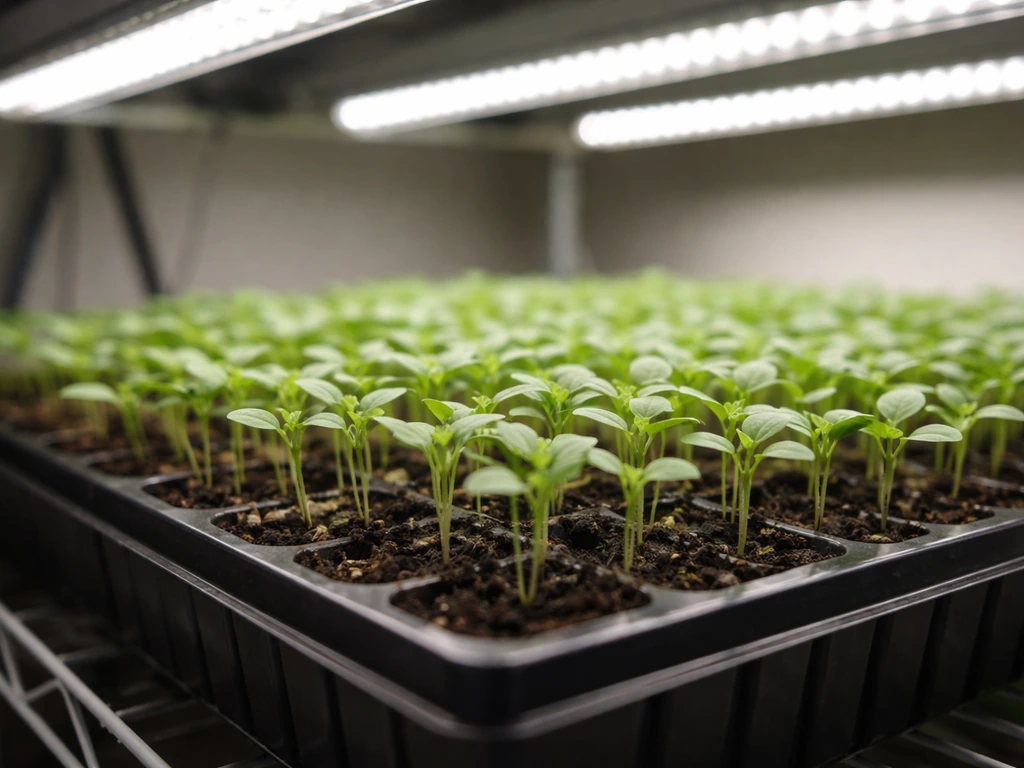
- Start seeds under the grow light from day one, not on a windowsill first
- Keep light distance tight, especially in the first two weeks when seedlings are most prone to stretching
- Use a small fan on low to create gentle airflow — it strengthens stems and prevents the fungal issues that come with humid grow setups
- Rotate containers every few days if plants seem to lean toward a light source
Troubleshooting when beans aren't growing or flowering
If your beans are under grow lights but still not performing, work through these common culprits before changing variety or giving up.
- Plants are leggy with pale leaves: Light is too far away or intensity is too low. Measure lux, move the light closer, or upgrade to a stronger panel.
- Leaves yellowing from the bottom up: Usually a nitrogen deficiency exacerbated by low light. Feed with a balanced liquid fertilizer and increase light intensity.
- Flowers forming but dropping before pods set: Either light intensity is still insufficient during the flowering stage, or the photoperiod is too long (over 14 hours). Check your timer and consider shortening the light cycle by one hour.
- No flowers after 8 to 10 weeks: The photoperiod may be too long. Reduce to 12 hours. Also check that you're not interrupting the dark phase with ambient light.
- Stunted overall growth with dark green leaves: Could be overwatering, not light — check that soil isn't waterlogged. Beans like well-draining mix.
- White or bleached patches on upper leaves: Light too close, causing light burn. Raise the fixture 4 to 6 inches and check for heat stress by holding your hand at canopy level for 30 seconds.
Which bean varieties actually work indoors
Not all beans are equally forgiving indoors. Pole beans grow tall (often 5 to 8 feet) and need substantial vertical support, which can be awkward in a small grow tent or on a shelf. Bush beans are the better choice for most indoor setups. They stay compact (usually 18 to 24 inches), don't require staking, and produce pods faster, typically 50 to 60 days from germination. Washington State University’s Vegetable Guide lists typical days to maturity and germination timing for bush beans, which can serve as general reference ranges for indoor timing typically 50 to 60 days from germination.
Within bush beans, look for varieties described as 'compact' or bred for container growing. A few that perform reliably under grow lights include Bush Blue Lake (a classic), Contender (fast maturing), and Mascotte (bred specifically for container cultivation). Mascotte in particular stays under 18 inches and has shown solid performance in indoor settings without needing massive light rigs.
There aren't true 'shade-tolerant' bean varieties the way there are for some leafy greens. All beans need substantial light for pods. What varies between varieties is how quickly they respond to good light and how compact they stay in a limited vertical space. Some photoperiod-sensitive genotypes are more forgiving about exact day length, which can help if your indoor setup isn't perfectly dialed in. In general, choose varieties labeled for container or patio use, as these have been selected for exactly the kind of constrained, artificial environment you're working with.
The best small-space indoor bean setup
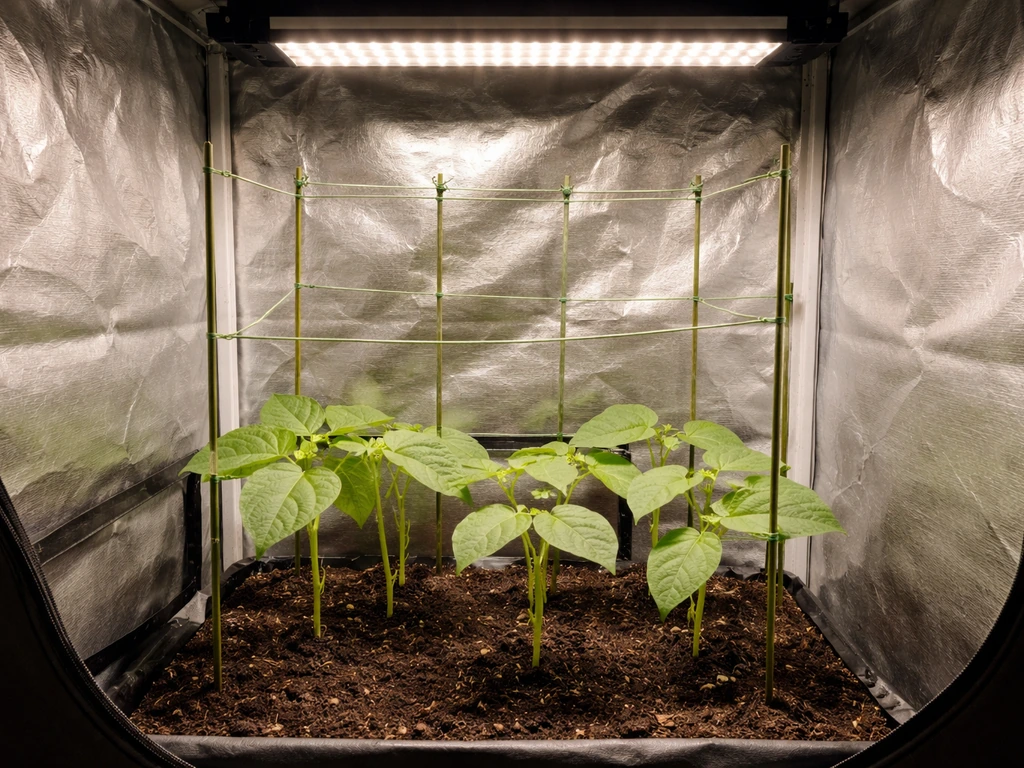
If you want to cut to the chase and set up something that actually works today, here's what I'd recommend for a small indoor space like an apartment balcony room, a grow tent, or a spare corner:
- A 2x2 or 2x4 foot grow tent with reflective interior walls (maximizes light use and keeps the photoperiod clean)
- A 45W to 100W full-spectrum LED grow light with red/blue coverage, hung on adjustable ratchet straps
- A plug-in outlet timer set to 13 hours on, 11 hours off
- 3 to 5 gallon containers with well-draining potting mix
- Bush bean varieties like Mascotte, Contender, or Bush Blue Lake
- A small USB or clip fan for airflow
- A liquid vegetable fertilizer for feeding every 2 weeks once plants are 4 inches tall
Total cost to set this up from scratch is roughly $80 to $150 depending on whether you already have containers or fertilizer. That's not nothing, but it's a real, functioning growing system rather than a failed experiment on a windowsill.
Quick decision checklist: can your space grow beans?
Run through this before you commit to planting. If you answer 'no' to most of these, consider starting with a less light-demanding plant (leafy greens, microgreens, or herbs) and upgrading your setup before tackling beans.
- Can you deliver at least 20,000 lux at canopy height for 12 to 14 hours per day, either from a strong south-facing window or a grow light?
- Can you keep the space dark for 10 to 12 hours each night without light leaks?
- Do you have at least 18 to 24 inches of vertical clearance above your containers for bush beans (more for pole beans)?
- Can you maintain temperatures between 65 and 85°F (18 to 29°C) in the growing space?
- Are you able to water consistently and feed every couple of weeks without skipping?
- Have you chosen a compact bush variety suited to container growing?
If you checked all six boxes, you're in a great position to grow beans successfully without any sunlight at all. If you're missing one or two, figure out which is easiest to fix first. Light intensity is almost always the limiting factor indoors, so if you can only change one thing, invest in a better grow light before anything else. If you already have your lights set up but wonder about natural options, can chia pets grow without sunlight is a helpful related comparison.
FAQ
If my room is too dim for pods, will beans at least germinate indoors?
Beans can sprout with weak light, but they usually stall afterward, because the plant needs enough intensity to build energy for flowering. Expect pale, stretchy growth if you use ambient indoor light only, and plan on adding light once the seedlings reach a few inches tall.
Can I grow beans under a grow light but keep the room lights on at night?
If you only run the lights during the day and let the room stay bright at night, you can accidentally give the plants longer light exposure and disrupt flowering. Use a timer and make the dark period truly dark (no hallway or streetlight spill) at canopy height.
Is higher intensity always better for growing bean pods indoors?
Yes, but be cautious: many common LED fixtures are strong enough for vegetative growth and still insufficient for reliable pod set. The practical rule is to target canopy brightness around the 20,000 to 40,000 lux range during active growth, and raise the light or shorten distance only within the fixture’s safe limits.
My beans look healthy but won’t flower, could my light schedule be the problem?
You generally want lights on about 12 to 14 hours, because beans are short-day plants and can delay flowering if they get too long a photoperiod. A simple fix when growth looks “stuck” is to reduce daily light time before changing anything else.
How can I tell whether my problem is low light intensity or a wrong light color/schedule?
If they stretch toward the light and the leaves are small or very pale, that points to low intensity. If they’re not stretching but are still not flowering, check day length and light leaks during the dark period, then verify the spectrum is not blue-only or cool-white focused.
Will a normal household full-spectrum LED bulb work for beans?
A regular “full spectrum” bulb is often marketed for home decor and not for plant canopy intensity. For beans, prioritize fixtures designed for grow use, then verify output with a lux meter or by observing whether leaves stay compact without etiolation.
Are pole beans possible indoors without taking over my space?
Start with bush beans for most indoor setups, because pole beans take height, training, and more space for branching. If you want pole beans anyway, give them a tall trellis and plan for more light coverage vertically, not just across the pot.
Why do my beans look weak even though I think my grow light is powerful?
If the canopy is far from the light, you can easily fall below the intensity beans need even if the lamp seems bright. Measure and adjust distance with the lux meter at canopy level, since moving a light even a little closer can make a big difference in photon delivery.
What should I check if beans flower but don’t form pods indoors?
If your beans are producing flowers but dropping them, check for temperature swings and inconsistent watering as well as light. Indoor bean flowers need steady conditions, and overly wet or overly dry soil can stop pods from developing.
What’s the easiest way to prevent light leaks during the dark period?
For best results, use a timer and remove sources of light during the dark phase. A practical workaround is a small closet, grow tent, or a cover that blocks all external light, because even small light leakage can shift the plant’s flowering timing.
Where and when should I measure lux to know if my setup is sufficient for beans?
The best time to measure is during the brightest part of your photoperiod, with the sensor at the same height as the leaf canopy. If you measure at pot height or at a different time of day, you may misjudge whether the plants are getting enough light.