
Here's the short answer: grass cannot grow in total darkness. No light means no photosynthesis, and no photosynthesis means no growth, plain and simple. But the longer, more useful answer is that "without sunlight" covers a wide range of situations, and a lot depends on whether you mean zero light, a dim room, or a spot that gets some indirect brightness. If you have a window, a shaded balcony, or a grow light, you have real options. If you have a basement with no light source at all, you don't, and that's worth knowing upfront so you don't waste a bag of seed.
Can Grass Grow Without Sunlight? Indoor Options to Succeed
Marcus Hartley
22 Apr 2026
Total darkness vs. ambient or indirect light: they are not the same thing
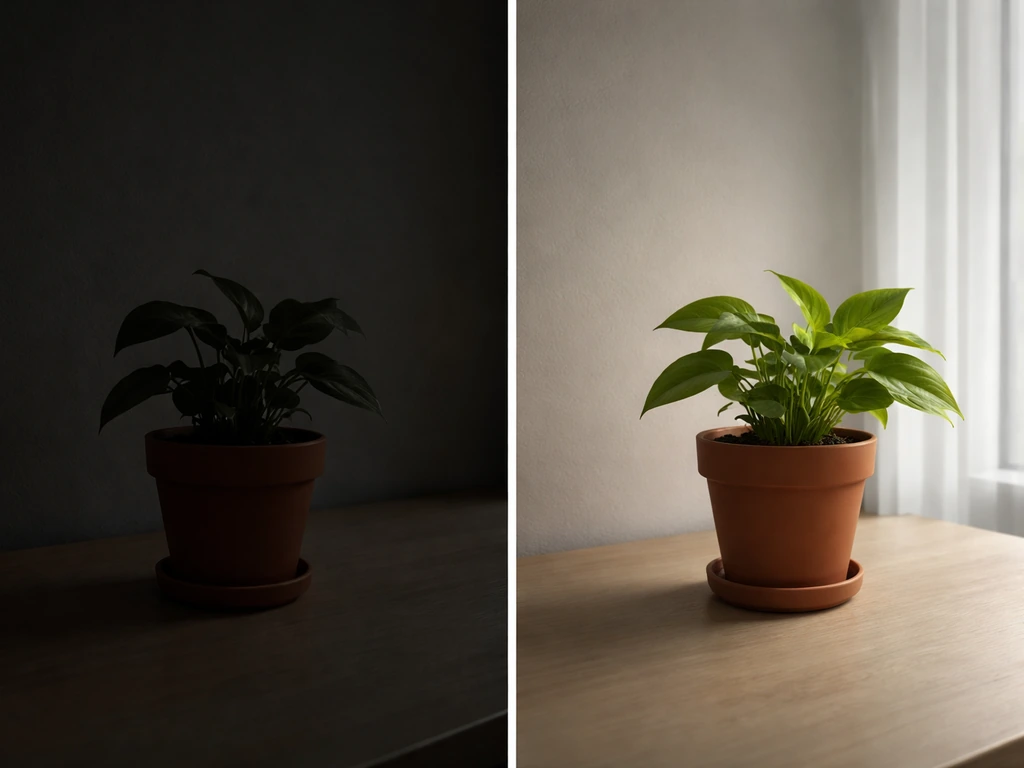
People often use "no sunlight" to mean a few different things: a room with no windows, a spot that never gets direct sun, or a space that just feels dark. These situations produce very different results for grass, so it helps to be specific about what you're actually working with.
In true total darkness, grass will not grow. Grass blades are green because they contain chlorophyll, and chlorophyll only does its job when light hits it. Without light energy, the plant cannot convert carbon dioxide and water into sugars. A grass seedling might push a pale shoot up for a day or two using stored energy from the seed, but it will stop, yellow, and die within a week. There's no workaround for this. Complete darkness is a hard no.
Indirect or ambient light is a different story. A room that receives diffused light through a window, a skylight, or even a bright hallway is not in total darkness, even if it never gets a beam of direct sun. Grass can survive in these conditions, but it will struggle. Extension guidance from Oklahoma State University notes that reduced light intensity is a primary limiting factor in shade, leading to thinner shoots, fewer tillers, and weaker root systems. So you may get growth, but you won't get the lush, dense turf most people picture. Think of it as survival mode, not thriving mode.
What grass actually needs from light (the plain biology)
Grass is a sun-loving plant by nature. Most turfgrass species evolved in open environments where they compete aggressively for light. In practical terms, a well-lit outdoor lawn receives somewhere in the range of 1,500 to 2,000+ micromoles of photons per square meter per second (PPFD) on a clear summer day. Indoors without supplemental lighting, even a bright south-facing window rarely delivers more than 200 to 300 PPFD on the glass surface, and light levels drop off sharply just a few feet back into the room.
What this means for you practically: grass grown indoors will nearly always be working with less light than it wants. The goal isn't to replicate full sun (that would require a very serious lighting setup), it's to clear the minimum threshold the plant needs to run basic photosynthesis and keep growing. For most common grass types used indoors, like wheatgrass, ryegrass, or ornamental grass varieties, that minimum threshold is somewhere around 100 to 200 PPFD for slow but viable growth, with better results above 300 PPFD.
One thing worth knowing: light doesn't just fuel growth, it also plays a role in germination for some grass species. Research on annual ryegrass (Lolium rigidum) shows that germination behavior is tied to temperature and light conditions together, and some seed populations actually release dormancy more readily in darkness during hydrated storage. Research on annual ryegrass (Lolium rigidum) reports that dormancy release is promoted in the dark, while light inhibits dormancy release annual ryegrass (Lolium rigidum) dormancy release and germination behavior is tied to light conditions. This means the seed itself and the growing plant have different light relationships. A seed doesn't need light to sprout, but the seedling that emerges absolutely does.
Starting from seed vs. growing established grass: the difference matters
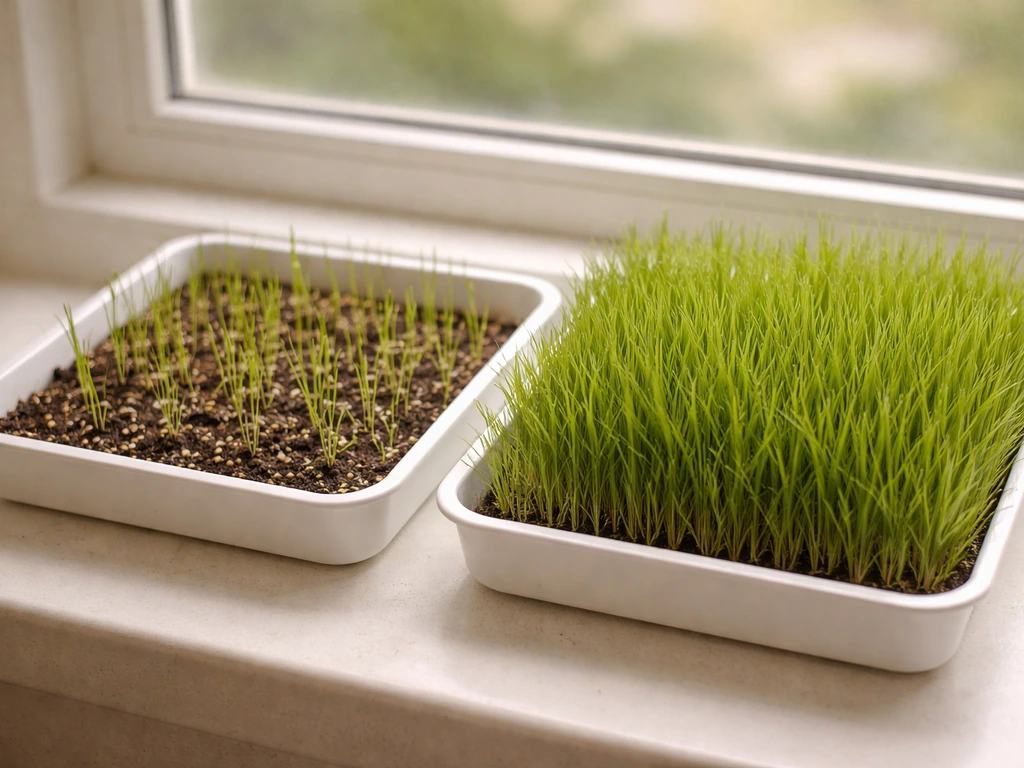
If you're starting grass from seed, you have a little more flexibility in the very early stages. Many grass seeds will germinate in the dark or with minimal light, because germination is driven primarily by moisture, temperature, and dormancy release rather than photosynthesis. Wheatgrass, for example, will sprout in a damp container with very little light in three to five days. The seed has enough stored energy to push a shoot up before it needs to start making its own food.
The catch is what happens next. Once that seedling breaks the surface and unfurls its first blade, it needs light immediately. If it doesn't get enough, it starts etiolating, which just means it stretches tall and pale trying to reach a light source it can't find. Etiolated grass looks like thin white or yellow threads rather than healthy green blades. The plant is burning through its seed reserves and getting weaker by the day. You have maybe three to five days after germination before light deprivation causes permanent damage to a seedling.
Established grass has slightly more resilience because it already has a functioning root system and some energy reserves built up, but it will still thin out and decline fairly quickly without adequate light. University of California guidance on shade lawn management confirms that turfgrass in low light conditions thins progressively, while the higher relative humidity that comes with low-light enclosed spaces also raises the risk of fungal disease. So established grass in a dark room isn't going to slowly coast along, it's going to decline.
Assessing your indoor space before you plant anything
Before you commit to a setup, spend five minutes actually assessing the light in your space, because a lot of people overestimate how bright their rooms are. Here's a simple way to test it: stand in the spot where you want to grow grass at the brightest time of day. Hold your hand about a foot above a piece of white paper. If you see a crisp, well-defined shadow, the light level is reasonable. A soft, blurry shadow means the light is dim but present. No shadow at all means you're in very low light and will almost certainly need supplemental lighting to grow grass successfully.
For a more precise reading, a cheap lux meter (around $15 to $20) or a free smartphone app like Photone can give you a real number. As a rough guide: above 10,000 lux puts you in the range where grass can manage on natural light alone, 2,000 to 10,000 lux is marginal and shade-tolerant grasses might do okay, below 2,000 lux and you need a grow light if you want reliable results.
- South-facing window with direct sun access: usually 10,000 to 30,000 lux near the glass, enough for most grass varieties
- East or west-facing window with indirect light: typically 1,000 to 5,000 lux, workable for shade-tolerant grasses but not ideal
- North-facing window or light from a nearby room: often 200 to 1,000 lux, too dim for reliable grass growth without supplemental light
- Interior room, basement, or hallway with no windows: below 200 lux, not viable without a dedicated grow light
Choosing and setting up artificial light to replace the sun
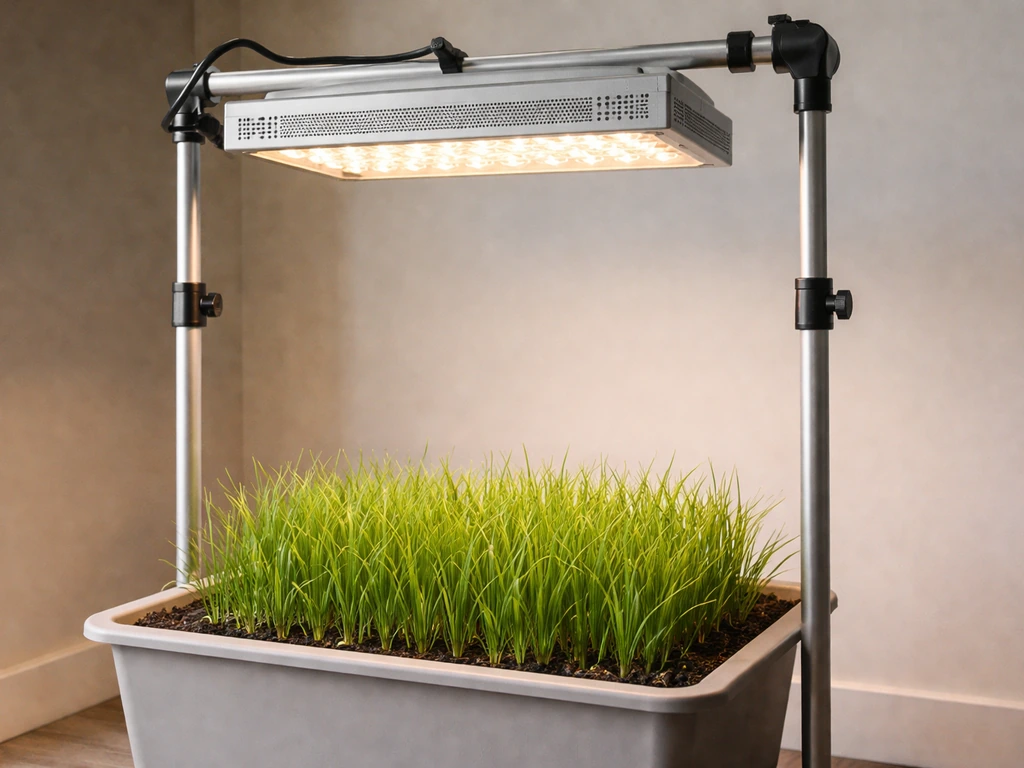
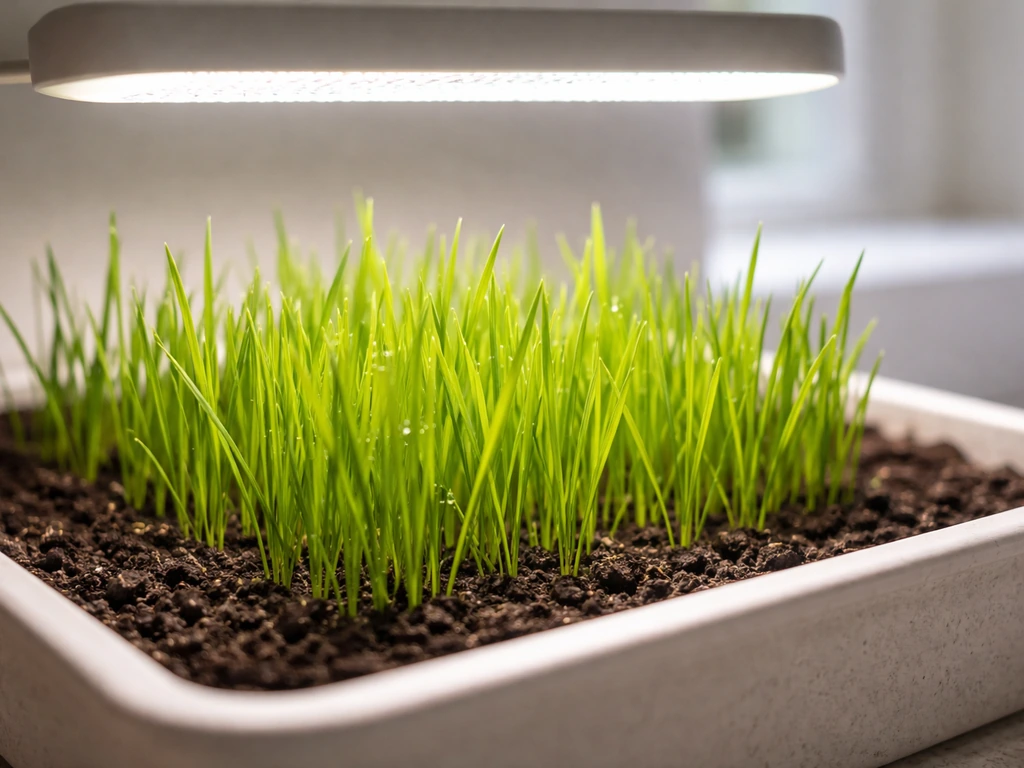
If your space doesn't have enough natural light, a grow light is genuinely the most practical solution, and you don't need to spend a fortune. For growing grass indoors, the setup is much simpler than, say, fruiting plants, because you're only trying to maintain leafy green growth, not trigger flowering or fruiting.
LED grow lights: the best choice for most people
A full-spectrum LED grow light is the best option for indoor grass in 2026. LEDs run cool, use much less electricity than older lamp types, and last a long time. For a small container of wheatgrass or a tray of ornamental grass, you don't need anything powerful. A 20 to 45 watt LED panel or strip light positioned 6 to 12 inches above the grass will deliver more than enough PPFD for healthy growth. For a larger flat tray (say 10x20 inches), something in the 45 to 65 watt range works well.
Look for a light labeled as "full spectrum" with a color temperature of 4,000K to 6,500K, which covers both the blue wavelengths that drive vegetative growth and enough red to support overall plant health. You don't need a fancy Samsung quantum board for grass. Many affordable strip lights and bar-style LEDs in the $20 to $50 range work perfectly well for this application.
Fluorescent and CFL alternatives
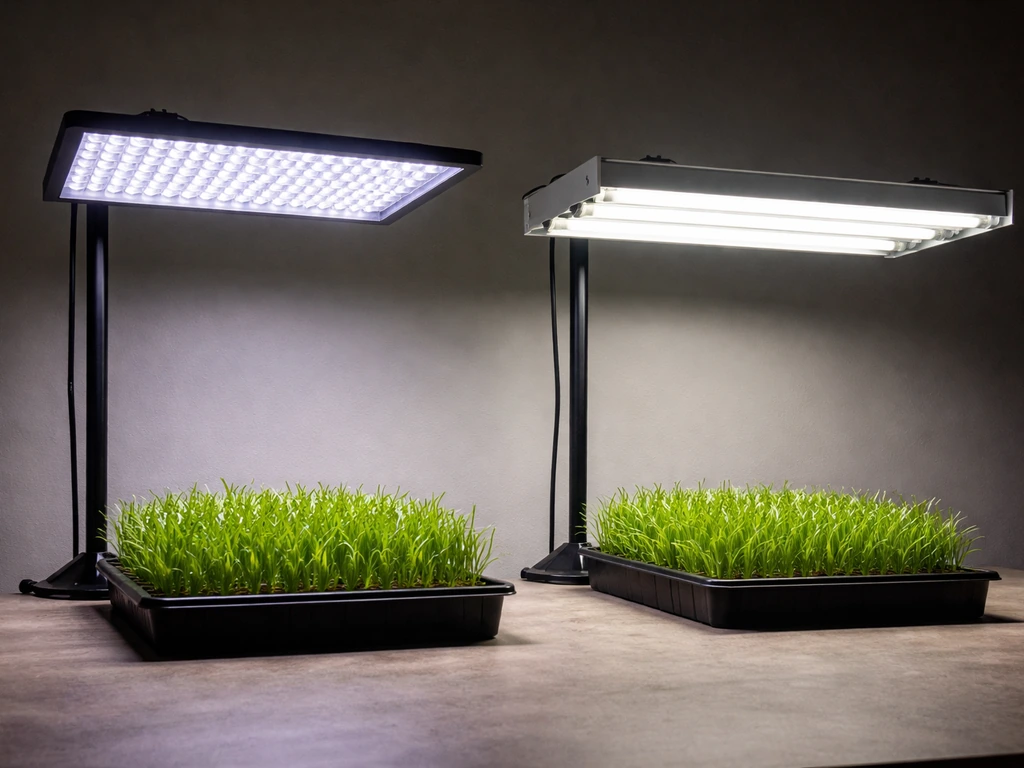
If you already have a fluorescent shop light or CFL bulbs around, they'll work as a backup option, just less efficiently. T5 fluorescent tubes are the most capable of this group and are still sold widely. A two-tube T5 fixture (54 watts total) held 4 to 6 inches above a grass tray will provide usable light. Standard T8 or T12 shop lights are dimmer and should be placed even closer, around 3 to 4 inches, to be effective. CFL bulbs in a reflector clamp work for very small containers but are inefficient and generate more heat relative to their output. LED is a better investment if you're starting fresh.
| Light Type | Best Distance Above Grass | Relative Efficiency | Best For |
|---|---|---|---|
| Full-spectrum LED panel/bar | 6–12 inches | High | Most indoor grass setups |
| T5 fluorescent (2-tube fixture) | 4–6 inches | Medium | Budget setups, existing fixtures |
| T8/T12 shop light | 3–4 inches | Lower | Very short-term or supplemental only |
| CFL in reflector clamp | 2–4 inches | Low | Very small containers only |
| Natural window light (south-facing) | N/A | Free but variable | Best option if available |
The recommendation here is straightforward: if you're buying something new, get a full-spectrum LED bar or panel in the 30 to 65 watt range. It will serve you better long-term, and if you ever want to grow other plants like herbs, chia, or coriander indoors, the same light works for all of them.
How long to run your lights and what schedule to use
Grass doesn't need a complicated light schedule. For germination, you can start seeds in darkness or under low light for the first two to three days while they sprout, then immediately introduce 14 to 16 hours of light per day once any green shoots appear. This extended photoperiod compensates for the lower intensity of artificial light compared to full sun outdoors.
For established grass or seedlings past the germination stage, aim for 14 to 16 hours of light per day to get good growth. Going below 12 hours will produce noticeably slower and thinner growth. Going above 18 hours doesn't offer much additional benefit for most grass types and wastes electricity. A simple plug-in timer (around $8 to $12) makes it easy to automate without thinking about it. Set it to run during daylight hours, roughly 6 AM to 10 PM, or any 14 to 16 hour window that works for you.
Watch your grass after the first week and adjust based on what you see. If blades are growing tall and pale and flopping over, the light is too far away or not on long enough. If growth is compact, green, and thickening from the base, you're in good shape. Grass grown purely under artificial light won't be as dense as outdoor grass, but under a good LED at the right distance and duration, a tray of wheatgrass or ryegrass will look genuinely healthy.
When things go wrong: weak grass, stretching, mold, and other issues
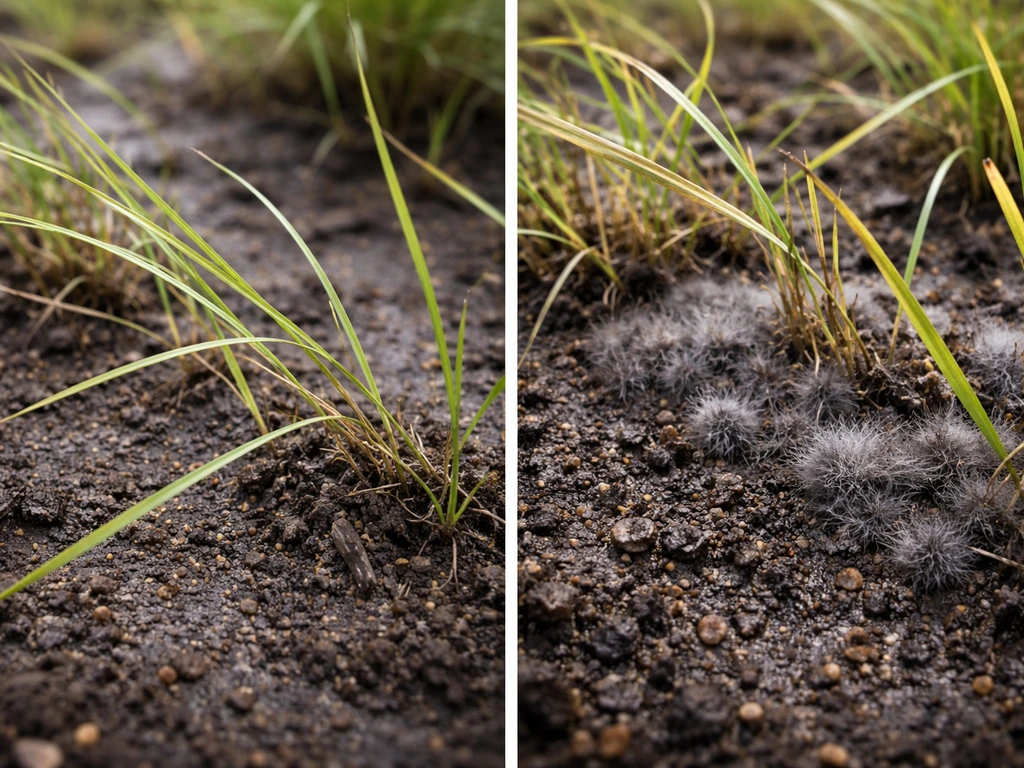
Thin, pale, or falling-over blades
This is almost always a light problem. Either the intensity is too low, the light is too far away, or the daily duration is too short. Move the light closer by 2 to 3 inches and extend the photoperiod by an hour or two. If blades are yellowing from the base upward, check your watering too, because soggy roots can cause similar symptoms.
Mold on the soil surface
Mold is one of the most common problems when growing grass indoors, especially at the germination stage when the soil is kept consistently moist. Low light, poor airflow, and overly wet conditions create the perfect environment for fungal issues. To prevent it: water from the bottom by setting the tray in a dish of water rather than pouring on top, ensure there's some air circulation in the room (even a small fan on low), and don't oversaturate the growing medium. A light dusting of cinnamon on the soil surface is a low-effort home remedy that genuinely helps. Once grass is a few inches tall and you're watering less frequently, mold risk drops significantly.
Seeds not germinating at all
If nothing is sprouting after five to seven days, temperature is the first thing to check. Most grass seeds germinate best between 60°F and 75°F (15°C to 24°C). A cold basement or a drafty windowsill in winter can drop soil temperature low enough to stall germination even with moisture present. A seedling heat mat set to around 68°F to 70°F solves this immediately. Also check seed viability: old seed stored in damp conditions loses germination rate fast.
Grass grows for a week then stalls or browns
This often happens when light was sufficient for the first flush of growth but then something changed, or the initial seed energy ran out and the plant can't sustain itself in the available light. Reassess your light levels with the shadow test or a meter. Also consider whether the container is too small or shallow for good root development, grass roots need at least 3 to 4 inches of growing medium to establish properly.
A quick decision guide for your situation
If you're not sure whether your space can support grass, run through this decision path before planting:
- No light source at all (basement, closet, interior room with zero ambient light): Don't attempt growing grass without a grow light. You will get nothing past the seedling stage.
- Dim ambient light or indirect light from a distant window (below 2,000 lux): Grass will germinate and show initial growth, but will thin, stretch, and struggle. Add a grow light for reliable results.
- Indirect window light, reasonably bright (2,000 to 10,000 lux): Shade-tolerant grasses like certain ryegrass varieties or wheatgrass may grow acceptably, especially if the window faces east or west. Expect thinner growth than outdoor grass.
- Good window light (above 10,000 lux, south-facing with direct sun periods): Most grass types will grow well with window light alone. No grow light needed.
- No window but you have or are willing to get a grow light: Fully viable. A 30 to 65 watt full-spectrum LED at 6 to 12 inches, running 14 to 16 hours per day, will grow healthy grass from seed.
Growing grass indoors is genuinely doable, but it rewards honesty about your space. The same principles that apply to grass apply in similar ways to other seeds you might be considering for indoor growing, whether that's beans, chia seeds, or coriander. For beans, the same idea applies: they may sprout with limited light early on, but they cannot grow without sunlight once growth ramps up, so plan on enough usable light either way. Chia seeds also need light after sprouting to keep growing, even if they can germinate with minimal light at first. If you want coriander to grow indoors, make sure it gets enough usable light after sprouting, because complete darkness will stop growth. All of them need some form of usable light after germination, and all of them will fail in complete darkness once the seed's stored energy runs out. The setup that works for grass will also support those plants, so getting your light situation right once pays off across the board.
FAQ
If my room has no windows, can I still get grass to grow?
No. “No sunlight” and “no light” are different, but if your room has zero usable light (no brightness and no light source contributing), grass will not progress past a brief pale push from seed reserves. Even if a sprout appears, it will yellow and fail soon after it needs to make its own sugars.
What’s the difference between “no sunlight” and “dark” for grass?.
It depends on whether there is any ambient daylight. If light comes from a bright hallway, a skylight, a diffused window, or even bounced light from white walls, grass can survive but will usually be thinner and slower. If you cannot get a readable “shadow test” result (no shadow at all at midday), plan on using a grow light.
Can I germinate grass in the dark and add light later?
Yes, but with a strict timing rule. Let seeds germinate in low light only for the first few days, then introduce 14 to 16 hours of light as soon as green shoots appear. If you wait too long, seedlings will etiolate and you will often not recover density, even if you add light later.
My seedlings are stretching and turning pale. What does it mean and what should I do?
Aim for green blades, not just “something growing.” Tall, pale, floppy growth usually means the light is too weak or too far away. A practical fix is to raise intensity by moving the light 2 to 3 inches closer and keeping the photoperiod at 14 to 16 hours.
How do I prevent mold when growing grass indoors with weak light?
Use your watering to reduce mold risk when light is limited. In low-light setups, keep the medium just moist, not saturated, and water in a way that avoids constant surface wetness (bottom-watering works well). Also add airflow, for example a small fan on low, because stagnant air makes fungal issues much more likely.
Can low temperature stop grass from growing without affecting light?
Yes. If your grass is in a deep container, the root zone may stay cooler and slow growth even if the light is adequate. Keep the growing medium roughly in the 60°F to 75°F germination-friendly range, and if your space runs cold, a heat mat set near 68°F to 70°F can make germination reliable.
What if I’m giving it light but nothing sprouts?
Old or poorly stored seed can mimic a light problem. If nothing sprouts after 5 to 7 days, check viability, not just lighting, especially if seeds were stored in damp conditions. You can also do a quick germination test in a damp paper towel to confirm viability before committing to a full tray.
Can established grass live long-term in a dim room?
Typically not. Many common grasses will decline fairly quickly in persistently low-light rooms, especially enclosed spaces where humidity rises. Even with some ambient light, expect thinning over time unless you supplement with a grow light or improve the light level.
Why does my grass thin out even though I added a light?
Yes. If the container is too small or shallow, roots cannot establish well, and the grass will thin even with adequate lighting. As a rule of thumb from the article’s guidance, plan on about 3 to 4 inches of growing medium for better rooting in indoor trays.
What should I look for when buying an LED grow light for grass?
Many “full spectrum” labels are vague, but you can sanity-check. Look for a color temperature in the 4,000K to 6,500K range and place the light close enough to your tray. If you can see only slow, pale growth, it usually means intensity is still too low, not the wavelength category.
Do I need exact hours on a grow light schedule for grass?
Use the timer like a growth tool, not an exact schedule. Staying in the 14 to 16 hour range is a good target, but if growth still looks sparse, the first adjustment should be light distance and intensity, then duration. Going well past 18 hours usually wastes electricity without a big benefit for most grass types.