
Rhubarb can genuinely grow in very low or near-zero light, and people do it on purpose. The technique is called forcing, and it produces pale, tender stalks by depriving the crowns of light after a cold dormancy period. But 'growing in the dark' doesn't mean rhubarb thrives without any light forever. It means you can coax edible stalks out of a dormant crown under a bucket or in a dark shed for a few weeks, and the result is something most garden-grown rhubarb can't match: sweet, blushed-pink stalks that are less fibrous and far more tender.
Why Does Rhubarb Grow in the Dark? Indoor Forcing Guide
Marcus Hartley
30 Apr 2026
Is rhubarb actually growing in complete darkness?
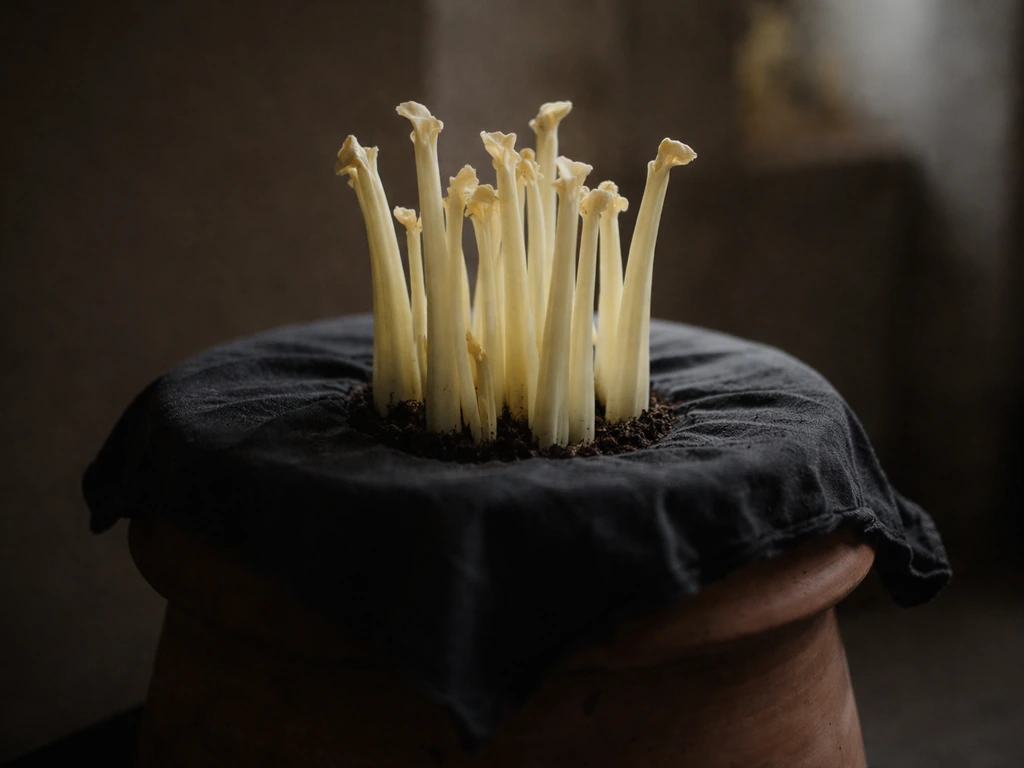
Yes, within limits. Rhubarb crowns have enough stored energy from the previous growing season that they can push out stalks without any photosynthesis happening at all, at least for a short forcing window. University extension research confirms that light is not required for forcing rhubarb because the initial stalk and petiole growth draws on carbohydrates already stored in the roots, not on energy the plant is making in real time. So when you cover a crown with a box or tuck it into a dark corner, the emerging stalks aren't photosynthesizing. They're running on reserves.
The catch is that this only works after the crown has gone dormant and received enough cold hours to 'reset.' Without that chilling requirement being met, nothing happens, dark or not. And once the stored energy runs out, the plant needs light to keep going. Think of it like a phone running off battery backup: you can operate for a while, but you can't recharge without a power source.
What 'dark growing' rhubarb (forcing) really means
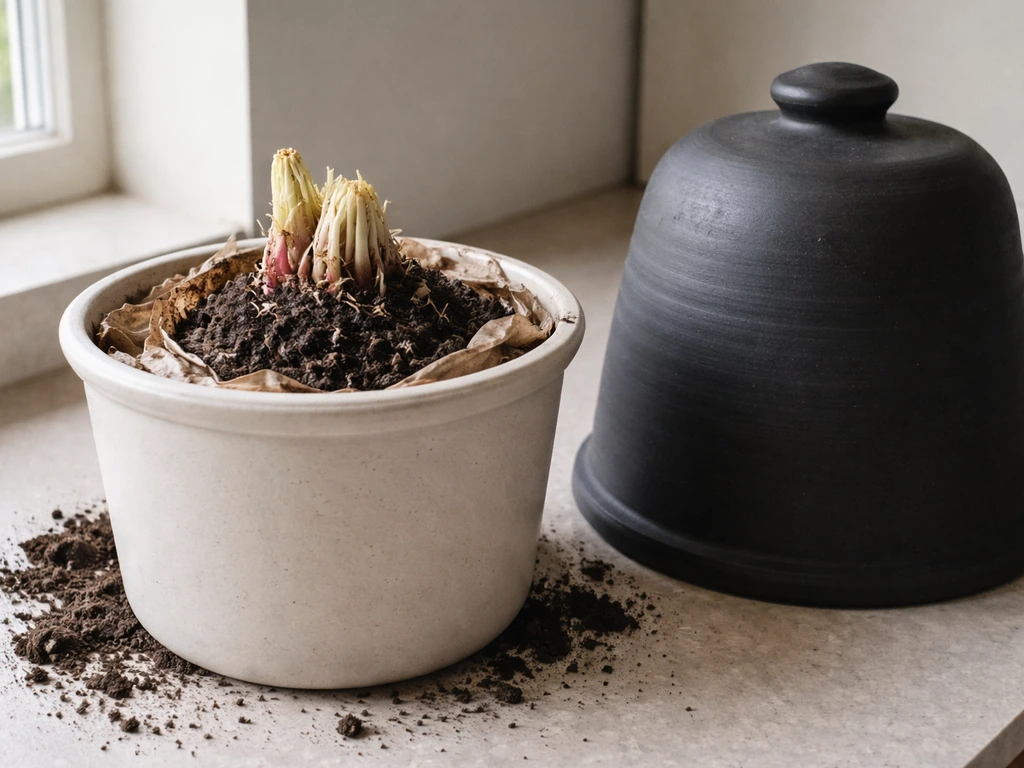
Forcing is a centuries-old trick, used commercially in the UK's famous 'Rhubarb Triangle' and by home gardeners everywhere. The idea is straightforward: you give a rhubarb crown a full winter of cold dormancy (typically exposure to temperatures between 28°F and 40°F for several weeks), then move it somewhere warmer and darker. Oregon State University Extension cites 56°F as the target temperature to trigger forcing once dormancy conditions have been met. That temperature shift is the real signal. The darkness just ensures the stalks stay pale and tender instead of going green and tough.
You'll see the term used in two ways. Outdoor forcing means covering an established garden crown in early spring with an opaque pot or special terracotta forcer to exclude light. Indoor forcing means digging up a crown, chilling it, and then moving it inside to a dark space like a cellar, a box under a table, or a garage corner. Both approaches work. The indoor method gives you more control over timing and temperature, which is useful if you're working with a small space or a short winter.
Why low light changes rhubarb stalk color and texture
When rhubarb stalks develop in the absence of light, they can't produce chlorophyll, so they stay pale yellow, cream, or a soft blush-pink rather than the deep red or green you'd see outdoors. This is called etiolation, and it's the same reason bean sprouts grown in the dark are white and a basil seedling stretched toward a window gets leggy and pale. The plant skips the steps that produce green pigment because there's no light signal triggering that process.
Beyond color, forced stalks are genuinely different in texture. Because they grow quickly in warm, dark conditions without the stress of wind, fluctuating temperatures, or intense UV, the cell walls stay thinner and the stalks remain less fibrous. Commercial rhubarb foragers describe forced stalks as almost 'whispering' when you snap them, versus the thick, stringy crunch of outdoor summer rhubarb. The flavor is also sweeter and less sharp because the oxalic acid content tends to be lower in young, fast-grown forced stalks.
This all comes down to photomorphogenesis, which sounds complicated but just means the way light shapes how a plant physically develops. Light tells rhubarb to toughen up, produce pigments, and slow its growth rate. Remove light, and the plant grows fast and stays soft. That's exactly what you want for forcing.
Indoor forcing setup: cooling, potting, covering, and watering
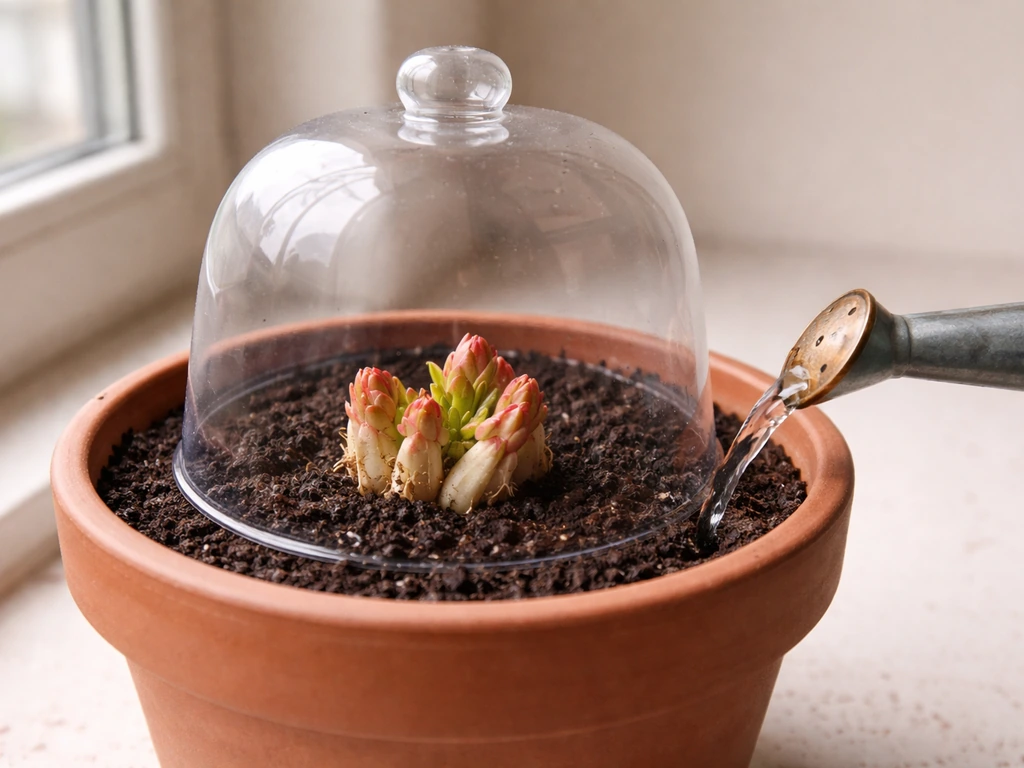
If you want to force rhubarb indoors, here's the practical sequence. It's not difficult, but each step matters.
- Chill the crown first. Rhubarb needs several weeks of cold to break dormancy properly. If your crown is already in a garden that gets real winter temperatures (28°F to 40°F), it should be ready by mid to late winter. If you're in a mild climate or working with a potted crown, you can fake the chill by putting it in a garage, unheated shed, or even a second fridge for 6 to 10 weeks.
- Dig up or pot the crown. Carefully dig up an established outdoor crown (at least 2 to 3 years old works best) after it has gone dormant in fall or early winter. Pot it into a large container, like a 5-gallon bucket or a deep planter, using a loose potting mix or garden soil. Don't pack it tight. The crown needs some space around the roots.
- Bring it inside to a warm, dark space. Move the potted crown to a space that stays around 50°F to 60°F. A basement, a dark cupboard, under a table covered with dark cloth, or a heated garage all work. OSU Extension points to 56°F as ideal. Too cold and growth stalls; too warm and you risk rot and mold before the stalks have a chance to develop.
- Cover it to exclude light. If your space isn't completely dark, cover the crown with an opaque bucket, a large pot, a cardboard box lined with a bin bag, or any container that blocks light entirely. The goal is total darkness at the crown level.
- Water lightly but consistently. This is where most people go wrong. The growing medium should stay just barely moist, like a wrung-out sponge. Too much moisture and you'll get crown rot or gray mold, especially in a low-airflow space. Water sparingly every 5 to 7 days and check that there's no standing water at the bottom.
- Provide a little airflow if possible. A slightly cracked door or a small vent in your covering helps prevent the humid, stagnant conditions that mold loves. You don't need a fan, just avoid completely sealing the crown in an airtight space.
Light vs no light: what it actually affects
It helps to be specific about what darkness does and doesn't do to a forcing rhubarb crown, because this confuses a lot of indoor gardeners.
| Factor | In darkness (forcing) | With normal light |
|---|---|---|
| Stalk color | Pale yellow, cream, or blushed pink | Deep red or green depending on variety |
| Stalk texture | Tender, thin-walled, low fiber | Firmer, more fibrous |
| Leaf development | Leaves emerge small and yellow; not functional | Large, green, photosynthetically active |
| Growth speed | Fast initial push (2 to 6 weeks) | Slower, season-long growth |
| Long-term plant health | Depletes crown reserves; crown needs rest afterward | Replenishes reserves through photosynthesis |
| Flavor | Sweeter, less sharp | More tart and robust |
The key thing to understand is that forcing is a one-time draw on the crown's energy bank. The leaves that emerge in the dark are pale and small because they can't photosynthesize without light. They're not feeding the plant at all. That's fine for a short forcing session, but if you keep the crown in darkness for too long, it runs out of stored energy and the stalks become weak, then stop altogether.
After forcing, the crown needs to go back into the garden or a sunny spot to recover for a full season before you force it again. If you're wondering about nether wart specifically, light exposure is another key factor that affects how it grows can nether wart grow in light.
How fast rhubarb grows when forced, and when to harvest
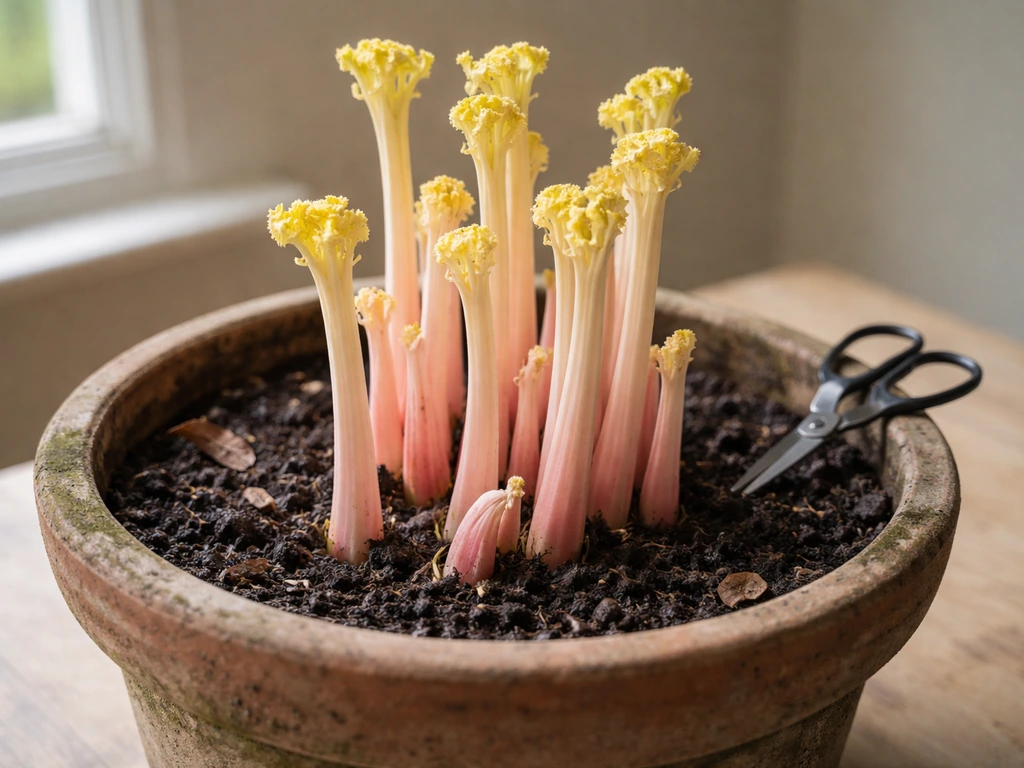
Once you move a properly chilled crown into a warm, dark environment, growth usually starts within one to two weeks. BBC Gardeners’ World describes forcing rhubarb by covering the crowns to prevent light reaching them, which encourages early growth and typically produces harvestable stalks around 20, 30cm long harvestable length.
If you're wondering whether nether wart grows faster in the dark, the answer depends on its light and temperature requirements, which are very different from forcing rhubarb warm, dark environment. By week three or four, you should have stalks that are 8 to 12 inches long and ready to harvest. Some setups with warmer temperatures and well-established crowns can produce harvestable stalks in as little as two to three weeks.
Cooler forcing environments (closer to 50°F) will slow things down but tend to produce slightly better-quality stalks with less risk of mold.
Harvest by pulling or cutting stalks once they reach 8 to 12 inches and while they still feel firm, not floppy. Don't strip the crown bare. Leave a few stalks and the small leaves behind so the crown has something to work with when it goes back into the light. Once you've taken what you want, move the crown outside or into a bright indoor spot and let it recover. Don't force the same crown again for at least a full year, ideally two. RHS also cautions that you should not force the same rhubarb plant in consecutive years, so it has time to recover between forcing sessions RHS cautions against forcing the same plant in consecutive years.
The entire forcing window, from setup to final harvest, is typically four to six weeks. After that, the quality drops and the risk of exhausting or rotting the crown increases sharply.
Troubleshooting: spindly stalks, rot, slow growth, and when grow lights help
Stalks are pale but spindly and weak
This usually means the crown didn't get enough cold hours before forcing, so it's starting from a lower energy reserve. It can also happen if the forcing temperature is too high (above 65°F), which pushes growth too fast for the stalks to develop properly. Check your temperature and, if possible, let the crown chill longer before the next attempt. Spindly stalks are usually still edible, just less impressive.
Rot or gray mold on the crown
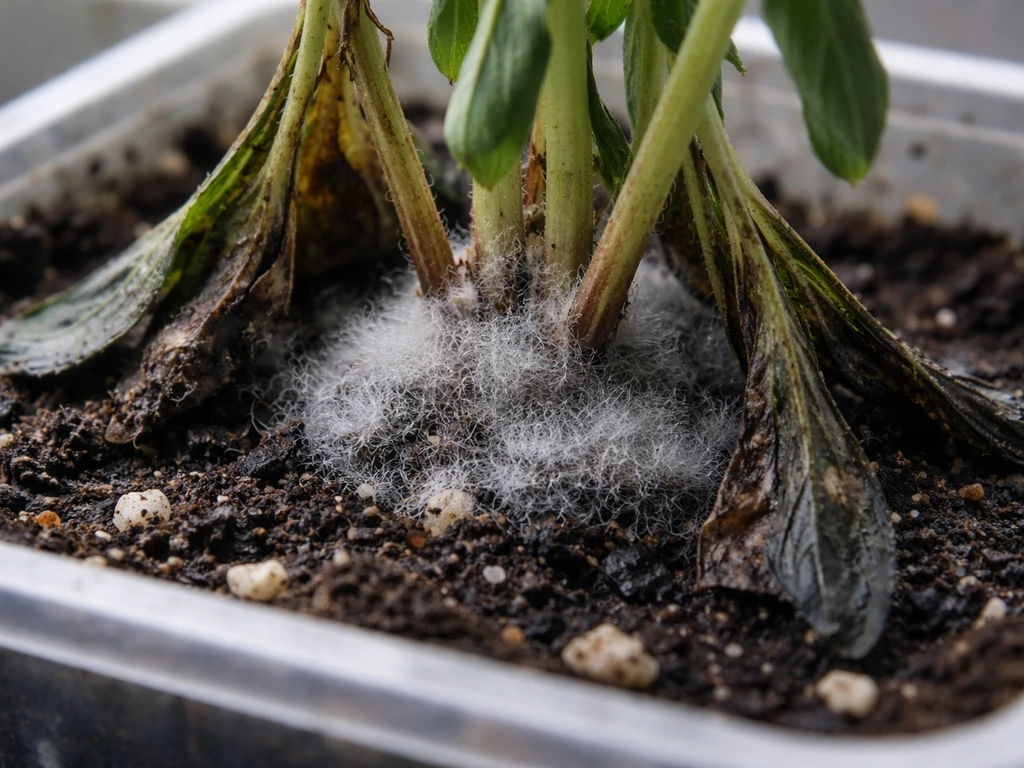
This is the most common forcing failure, and it almost always comes down to overwatering or poor airflow. If you see gray fuzzy mold (Botrytis) or the base of the stalks turning mushy, reduce watering immediately and increase ventilation. Remove any affected stalks cleanly. If the crown itself is rotting at the base, you've probably lost the forcing session, but you may be able to save the crown by drying it out and replanting outdoors.
Nothing is growing after three weeks
If the crown is sitting in warmth and darkness and nothing is happening, the most likely culprit is insufficient chilling. Do glow berries need darkness to grow? Like forcing rhubarb, some plants can use stored energy in low light, but the requirements depend on the growth stage. Rhubarb needs that dormancy reset. Try extending the cold period next time. Also check that the temperature in your forcing space is actually reaching 50°F to 60°F, because a space that feels 'warm enough' can still be too cool to trigger growth.
When to bring in a grow light
Here's where the site's usual plant-lighting advice actually applies to rhubarb, just not in the way most people expect. You don't use a grow light during forcing because the whole point is to keep the stalks pale and tender. But once forcing is done and you want to nurse the crown back to health indoors, a full-spectrum LED grow light is genuinely useful.
Give the recovering crown 12 to 14 hours of moderate light daily (around 2000 to 4000 lux at the crown level) and it will rebuild its leaf mass and replenish root energy much faster than if you just stick it in a dim corner. This is especially helpful for apartment dwellers who can't move the crown outside to a garden bed.
It's a bit like the difference between forcing mushrooms and then caring for the block afterward: the dark period does the productive work, but light is what keeps the organism healthy long-term. If you're interested in other crops where darkness plays a role in growth, the same principle applies to organisms like lion's mane mushrooms, where light exposure matters differently depending on the growth stage. Lion's mane mushrooms also have specific light needs that vary by growth stage. Does mycelium need light to grow, and how does light exposure affect mushrooms like lion's mane other crops where darkness plays a role in growth.
Quick troubleshooting reference
| Problem | Likely cause | Fix |
|---|---|---|
| Spindly, weak stalks | Insufficient chilling or too-warm forcing space | Lower forcing temp to 56°F; increase chill time next round |
| Gray mold or rot | Overwatering or no airflow | Water less; crack the cover for ventilation; remove affected material |
| No growth after 3 weeks | Crown not properly dormant or too cold to trigger growth | Confirm chilling was adequate; raise space temp to 56-60°F |
| Stalks going green quickly | Light leaking into the forcing space | Check cover seals; use an opaque container or add a black liner |
| Crown exhausted after forcing | Stripped too many stalks or forced too long | Move to bright light or outdoors; rest crown for a full season before re-forcing |
FAQ
If I keep the crown in a dark shed the whole winter, will that replace the cold dormancy requirement?
No. Rhubarb forced indoors should be kept warm, dark, and well ventilated, but the crown must still have completed its cold dormancy first. If you skip chilling, darkness cannot “trigger” forcing, and you will usually get no stalk growth at all.
How long can I keep a rhubarb crown in darkness after I harvest the stalks?
Move it back to light as soon as you finish harvesting, then recover it for the rest of the season. A forced crown that stays dark after harvest is more likely to exhaust its reserves and develop weakness, which reduces next year’s yield.
What should I do if mold appears while forcing rhubarb indoors?
If you see gray fuzzy mold at the stalk bases (Botrytis) or the crown feels mushy, remove affected stalks immediately and improve airflow. Also cut back watering right away, because forcing environments can stay humid even if the room feels dry.
Why are my forced rhubarb stalks coming out spindly or oddly weak?
Too much heat is a common cause of disappointing results. When forcing temperatures run above roughly 65°F, growth can race ahead of proper development, which often leads to weak, spindly stalks. Aim closer to about 50°F to 60°F for steadier quality.
Can I harvest forced rhubarb more than once instead of taking everything at once?
Yes, you can harvest gradually, just don’t strip the crown completely. Leaving a few stalks and small leaves supports recovery when the crown returns to brighter conditions, which helps the plant regain energy for the next season.
Can I grow rhubarb from seed and force it in the dark like established crowns?
Don’t. Forcing usually relies on moving a previously dormant crown into a dark, warm space, not on planting bare roots or seeds directly into darkness. If you try to start from scratch, you typically won’t get true forced stalks on the timeline you expect.
How much should I water a rhubarb crown during forcing?
Water only to keep the rooting area slightly moist, not wet. The goal is to prevent drying out while avoiding soggy conditions around the crown, since poor drainage and slow-drying soil greatly increase rot and mold risk.
What if nothing happens in my dark forcing space, but the area feels warm to me?
If the temperature in your forcing spot is too cool, growth slows down, but it should still eventually start if dormancy requirements were met. If you want a reliable timeline, verify actual air temperature near the crown, because “warm room” estimates can be wrong.
How do I know the right moment to harvest forced rhubarb?
Forced stalks are best harvested when firm, while they’re still young and tender. Waiting too long can make them less crisp and increase the chance that quality declines because stored energy is running low.
Does the cover need to be completely airtight, or is “dark enough” with airflow better?
Use dark, opaque covers that exclude light effectively, but avoid airtight setups that trap moisture. Even in darkness, the crown needs ventilation to reduce fungal problems, so keep the enclosure breathable where possible.
When can I force the same rhubarb crown again?
After forcing, place the crown in a bright indoor spot or outdoors where it can rebuild leaf mass, then plan to leave it alone for at least a full year before forcing again. Re-forcing too soon commonly leads to smaller stalks and weaker crowns.