
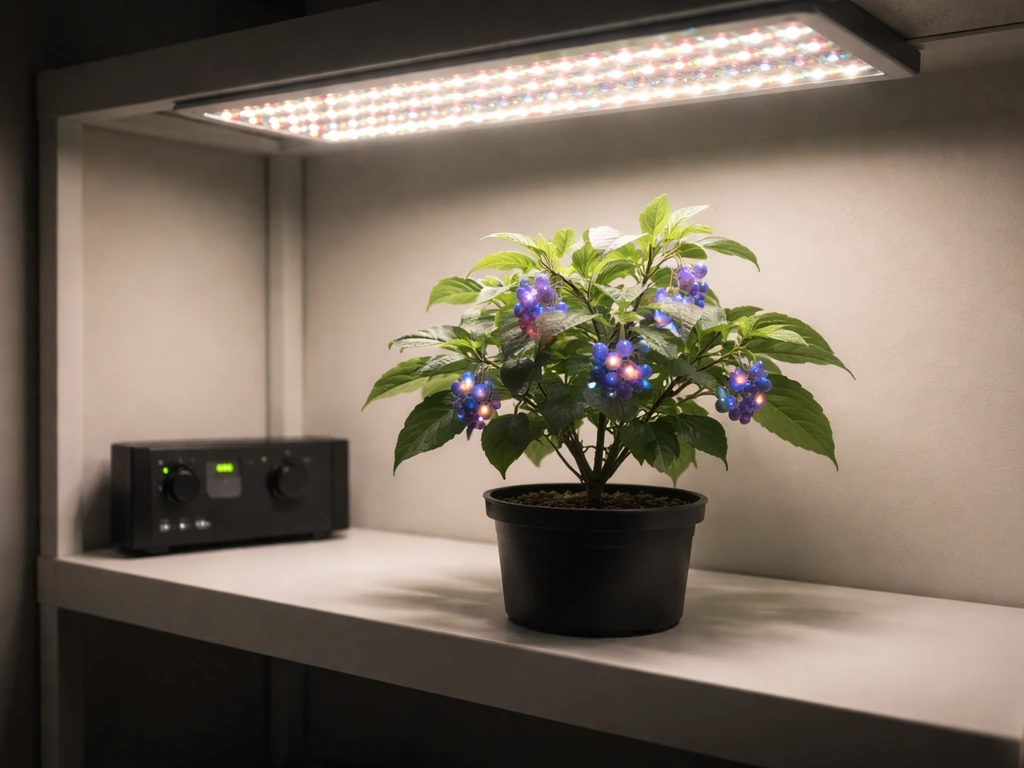
Glow berries do not need darkness to grow, and they will not grow better if you keep them in total darkness. They are day-neutral, meaning the presence or absence of a dark period does not trigger or block their growth or fruiting. What they do need is a consistent, adequate light source for photosynthesis, plus a reasonable day-night cycle to support their internal rhythms. If you are growing glow berries indoors, your job is to make sure they get enough light each day, not to engineer the perfect darkness.
Do Glow Berries Need Darkness to Grow? Indoor Light Guide
Marcus Hartley
23 Apr 2026
Why plants use light and dark differently
There are two separate things going on inside a plant when it comes to light: photosynthesis and photoperiodism. Photosynthesis is the process of turning light energy into sugars the plant uses to grow. More usable light generally means more photosynthesis, more food for the plant, and more growth. Darkness does nothing to help photosynthesis, because there is no light energy to convert.
Photoperiodism is something different entirely. It is how some plants use the length of the night to time their flowering or fruiting. Short-day plants flower when nights are long. Long-day plants flower when nights are short. Day-neutral plants, like glow berries, just do not care about night length at all, so no particular dark period is required to get them to produce fruit. That said, plants still have internal clocks tied to a roughly 24-hour cycle, and research confirms that stomata open during the day and close at night as part of normal circadian function. So a regular day-night rhythm is still beneficial for healthy growth, even if the exact hours of darkness are not critical for flowering or fruiting.
What "dark" actually means for glow berries
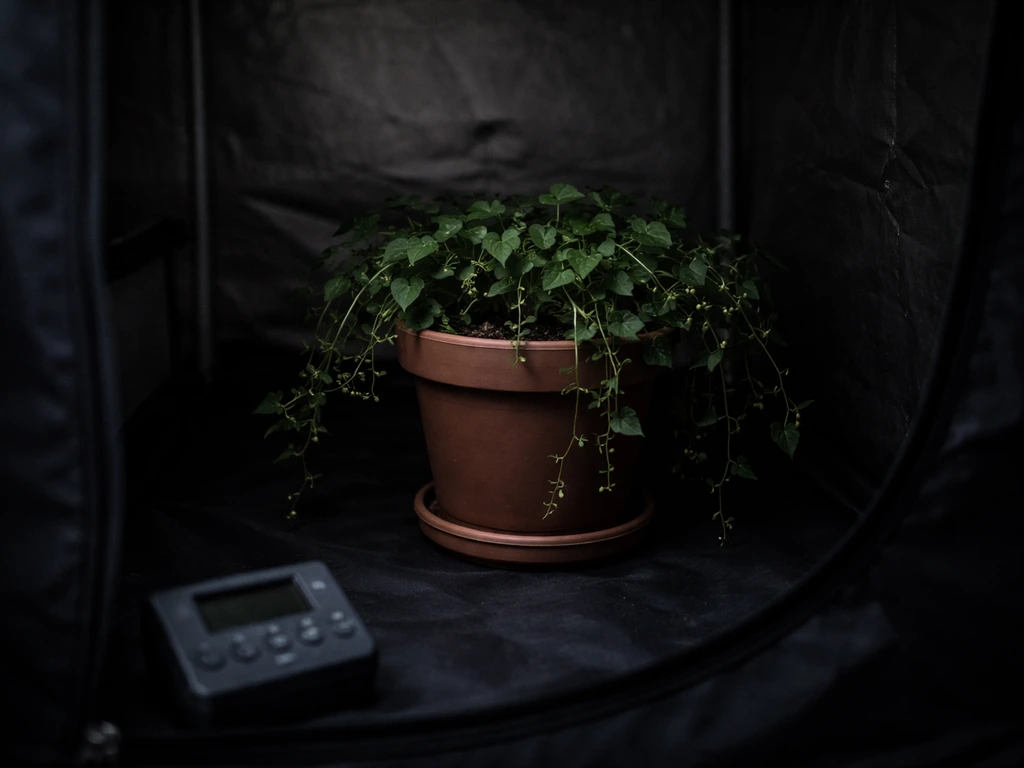
Total darkness, as in lights off all the time, is not a condition that helps glow berries. They will not thrive in a closet with no light. What they need is a normal night period as part of a consistent day-night cycle, not pitch blackness as a growing strategy.
The confusion often comes from thinking that darkness equals rest and that more rest means more energy saved for growth. Plants do not work that way. They accumulate energy during the light period and use some of it during the dark. Research on plants grown under continuous 24-hour light versus a 16-hour light and 8-hour dark schedule shows that completely skipping the dark period changes how plants photosynthesize, respire, and grow.
In lettuce studies, the continuous-light plants performed differently than those on a standard day-night cycle, and not always better. A night period keeps the plant's biological clock calibrated and supports normal gas exchange. What you want is a structured dark period as part of a rhythm, not total darkness as a growing environment.
There is also a common question about whether frequent light-dark cycles help. The short answer is no. Research from 2026 showed that increasing the number of light-dark cycles within a 24-hour period (basically chopping the day into many small on-off chunks) actually reduced growth, leaf area, and biomass compared to a single standard day-night cycle. Stick with one light period and one dark period per day.
Best light schedule for glow berries indoors
A 14 to 16 hour light period followed by 8 to 10 hours of darkness is a solid starting point for glow berries grown indoors. This gives the plant plenty of time for photosynthesis while preserving a consistent night period that keeps its circadian rhythm healthy. Since glow berries are day-neutral, you have flexibility here. You are not going to accidentally trigger early flowering by giving them 14 hours of light versus 16.
The more important number to think about is your Daily Light Integral, or DLI. On Wikipedia, DLI is defined as the total accumulated photosynthetically active photons per square meter per day and is calculated from PPFD and photoperiod, including the common approximation DLI ≈ 0. 0036 × PPFD(µmol/m²/s) × hours [Daily Light Integral, or DLI](https://en. wikipedia.
org/wiki/Dailylightintegral). Virginia Tech’s extension guide provides an introductory, step-by-step overview of [calculating and using DLI](https://www. pubs. ext.
vt. edu/content/dam/pubsextvt_edu/spes/spes-720/SPES-720. pdf) for horticultural lighting decisions based on PPFD and total daily light. DLI is the total amount of light energy the plant receives over a full day, measured in moles of photons per square meter per day (mol/m2/d).
For controlled-environment berry production, extension guidance from Oregon State University points to achieving a minimum DLI through a combination of natural light and supplemental grow lighting. A general target for young plants in production is around 10 to 12 mol/m2/d, and mature fruiting plants typically benefit from higher levels. If your space is very low in natural light, your grow light needs to compensate, which means either more intensity or more hours, or both.
Setting up grow lights for glow berries
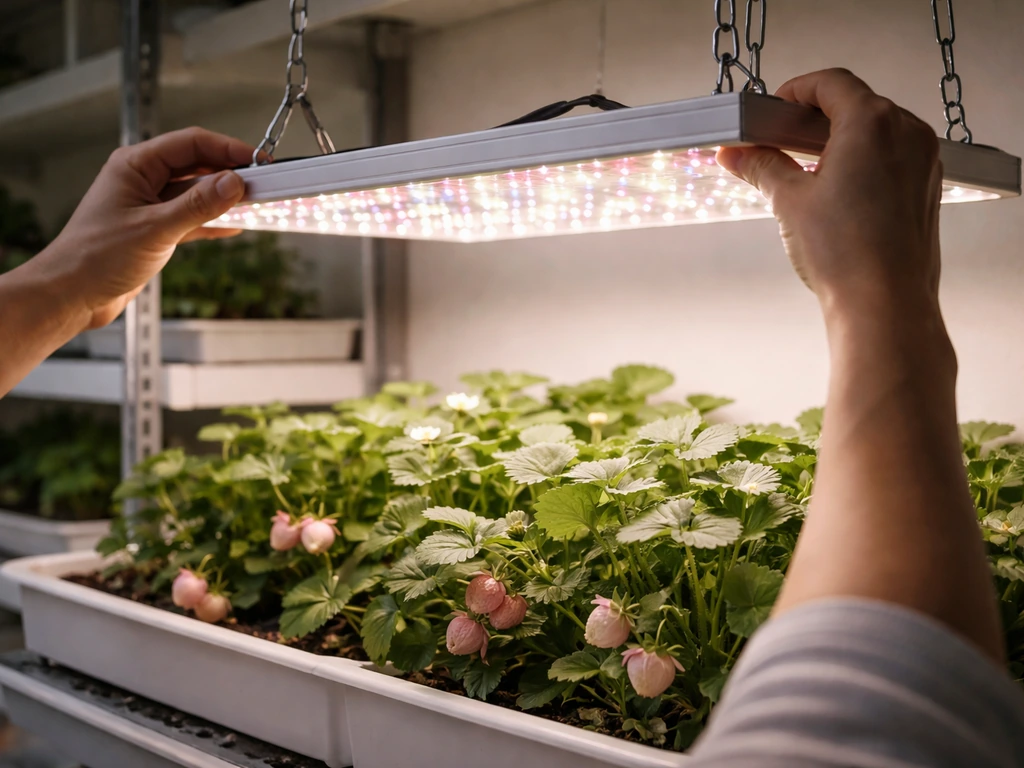
LED grow lights are the most practical choice for indoor glow berries. They are energy-efficient, run cooler than older lamp types, and modern LEDs deliver a much better output per watt than fluorescent or HID options. When setting up your light, the two things you can control are distance from the canopy and duration. Both directly affect how much light the plant actually receives.
Distance and intensity
Most LED grow light guides recommend positioning the light so that the canopy receives somewhere between 400 and 800 µmol/m2/s (PPFD) during active vegetative and fruiting stages. Moving the light closer increases intensity; moving it farther away reduces it. Start at the manufacturer's recommended height, which is typically 12 to 24 inches above the canopy for most consumer LEDs, and adjust based on how the plant responds. If you are seeing bleached or curled leaves, the light is too close. If the plant is stretching toward the light with long, leggy stems, it needs more intensity or a shorter distance.
Practical setup checklist
- Use a full-spectrum LED grow light rated for the square footage of your growing area
- Set a timer for 14 to 16 hours of light followed by 8 to 10 hours of darkness
- Position the light 12 to 24 inches above the canopy to start, then adjust based on plant response
- Aim for a PPFD of 400 to 800 µmol/m2/s at canopy level during the vegetative and fruiting stages
- If you have a light meter or phone app that reads PPFD, take a reading at canopy level mid-session to confirm your setup
- Keep the light schedule consistent day to day, avoid frequently switching the timer
Signs your glow berries are getting too little or too much light
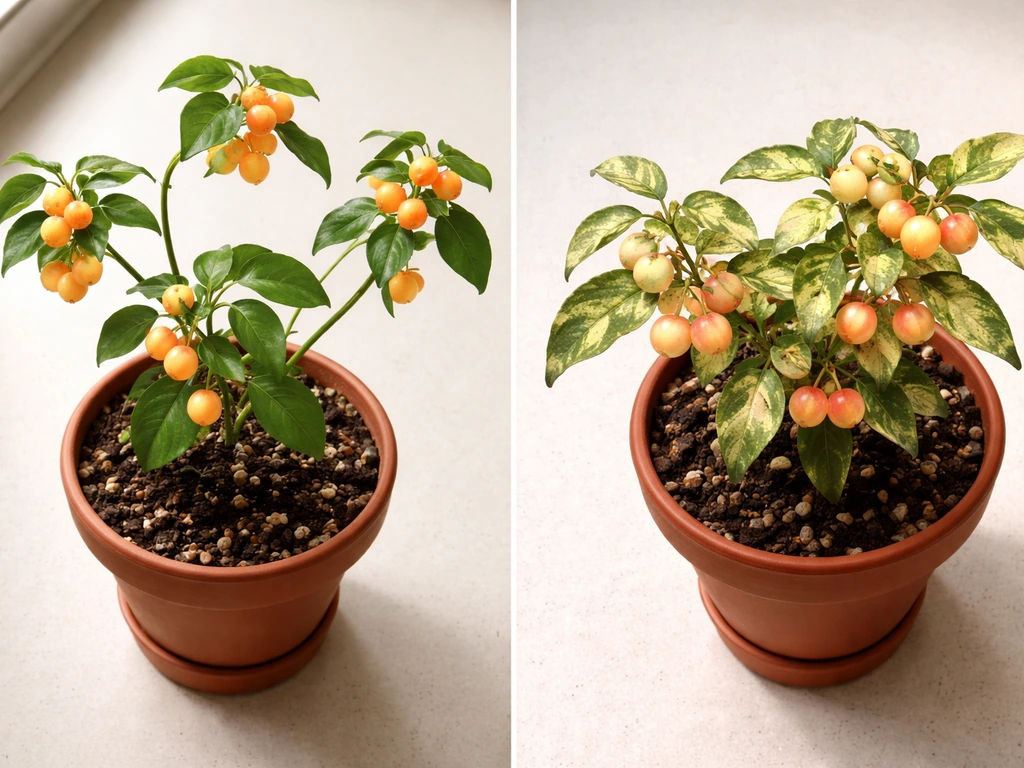
Plants are pretty good at telling you when the light is off, if you know what to look for. Here is what to watch for and what to do about it.
| Symptom | What it usually means | What to do |
|---|---|---|
| Leggy, elongated stems reaching toward the light | Not enough light intensity or too few hours | Move light closer or increase light duration by 1 to 2 hours |
| Small, pale or yellowing leaves | Insufficient light for photosynthesis | Increase PPFD by lowering the light or upgrading to a stronger fixture |
| Slow or no fruit development | DLI likely too low for the fruiting stage | Extend photoperiod slightly or reduce light-to-canopy distance |
| Leaf bleaching, white or tan patches on upper leaves | Light intensity too high, possible light burn | Raise the light fixture 3 to 6 inches and monitor for improvement |
| Curling or cupping leaves | Can indicate excess light or heat stress from the fixture | Raise the light and check that airflow is adequate around the canopy |
| Brown leaf tips with otherwise healthy foliage | Often heat stress from a light positioned too close | Raise the fixture and check ambient temperature under the light |
One thing worth noting: if your glow berries are struggling and you have been keeping them in very low light or actual darkness because you thought that would help them, that is almost certainly the issue. Get them under a proper grow light on a consistent schedule and give them a week or two to adjust before making further changes.
How to test and refine your setup starting today
You do not need a lab to figure out if your light setup is working. Here is a simple approach you can start right now.
- Photograph your plant today and note the current setup: light type, hours on, estimated distance from canopy, and any visible symptoms.
- Set or confirm your timer for a 14 to 16 hour light period starting at a consistent time each day.
- Measure or estimate the light-to-canopy distance. If you have no idea, start at 18 inches for a standard consumer LED and adjust from there.
- Check the plant again after 7 days. Look for new growth: are new leaves a healthy green and normal size? Are stems upright and compact rather than stretching?
- If you see improvement, keep the setup as is for another week before making any further changes.
- If you see no improvement or symptoms are getting worse, make one change at a time: either move the light 3 to 4 inches closer (if the plant looks pale and leggy) or farther away (if you see bleaching or curling), then observe for another 5 to 7 days.
- Once your plant looks stable and healthy, you have found your working baseline. Write it down so you can replicate it.
Trial and error is a completely normal part of indoor growing. Even experienced growers dial in a new setup by observation rather than hitting perfect numbers on the first try. The goal is a consistent, adequate light schedule with a real night period, not a magic formula. Get those basics right and glow berries are genuinely easy to manage under grow lights.
If you are curious about how other crops handle the light-versus-darkness question differently, it is worth knowing that some plants have very specific requirements. Nether wart and mycelium, for example, have their own quirks around light conditions that are quite different from a fruiting crop like glow berries. If you are also growing fungi, mycelium generally does not behave the same way as typical fruiting plants, and its light needs are different.
And the concept of forcing growth in darkness, like the technique used for rhubarb blanching, is a completely different mechanism than what is happening with a light-loving berry plant. That is why rhubarb blanching relies on special conditions, while glow berries focus on getting enough light why does rhubarb grow in the dark. If you are wondering can nether wart grow in light, the key is understanding how its light tolerance differs from plants like glow berries.
For glow berries, light is always the goal, not darkness.
FAQ
What happens if I leave the grow lights on 24/7 for my glow berries?
You should still provide darkness as a repeating part of a 24-hour rhythm, even if glow berries are day-neutral. If the lights never turn off, their internal cycle and gas exchange can shift, which often shows up as slower growth or poorer plant performance compared with a normal on-off schedule.
Can too much light or too long of a light period hurt glow berries?
If you accidentally give too much light with a long photoperiod, the risk is heat stress and leaf burn, not “premature fruiting.” Adjust by trimming either intensity (raise the light) or duration (return to 14 to 16 hours) when you see bleaching, crispy edges, or unusually dark, stressed foliage.
Do clouds, daylight variability, or power outages affect glow berry growth indoors?
Yes. If the light is bright but intermittent, like frequent power outages or a timer that cuts the schedule short, the Daily Light Integral can fall below what your plants need. Use a reliable timer and consider checking actual runtime daily, especially if growth seems stalled despite “correct” settings.
If glow berries do not need darkness, why is 8 to 10 hours of dark still recommended?
Not exactly. You can run a 12 hour light plus 12 hour dark cycle, but if the total Daily Light Integral drops below your target, the plant will grow more slowly. Aim for adequate daily light energy (DLI) first, then choose a comfortable 8 to 10 hour dark window within a 24-hour cycle.
How long can glow berries tolerate low light before I need to change the setup?
If your timer or bulbs fail, the plants can be fine overnight, but not fine across multiple days of low light. When restarting after a gap, move back to your normal schedule gradually only if plants show stress, otherwise keep the light steady and give them one to two weeks to recover.
Will running several shorter light periods during the day work better than one long light period?
A faster cycle is not better. Splitting the day into many on-off chunks generally reduces growth compared with one continuous light period and one continuous dark period. Stick to one lighting block per day rather than “short bursts”.
Why do some parts of my glow berry plants look healthy while others look weak under the same light?
Height and PPFD readings matter, but uneven lighting can still cause patchy growth. If only part of the plant looks healthy, rotate the pots or raise/lower the light so the canopy receives a more uniform PPFD across the whole tray.
How should I adjust my grow light if I also get some natural daylight?
Yes, because DLI depends on both intensity and time. If natural light contributes some energy, you can shorten the photoperiod. If natural light is near zero, you often need either higher PPFD, longer photoperiod, or both to reach a practical DLI for young plants.
What are the visual signs my light schedule or intensity is off?
The main signs of insufficient light are stretching, pale or small leaves, and slow new growth. Signs of too much light near the canopy include bleached patches, leaf curling, and scorching at the tips or edges, those usually improve by increasing distance or shortening the light window.
I changed from low light to grow lighting, when should I expect improvement?
If you just switched from very low light or near darkness, growth will not bounce back immediately. Keep the schedule consistent, then reassess after about 7 to 14 days, since the plant needs time to resume normal photosynthesis and re-balance its daily rhythm.