Yes, plants can grow with mirrored light, but the mirror itself isn't doing the growing, your existing light source is. What a mirror or any reflective surface actually does is redirect light that would otherwise hit a wall, floor, or ceiling and send some of it back toward your plants. Done right, that can meaningfully boost the usable light reaching leaves that would otherwise sit in shadow. Done carelessly, it can create hotspots that bleach or burn foliage, or simply do almost nothing because the reflection is too weak or aimed at the wrong spot. So the real question isn't "can it work?" but "how do you make it work without frying your plants?"
Can Plants Grow With Mirrored Light? Indoor Guide
Marcus Hartley
22 May 2026
What "mirrored light" actually means for your plants
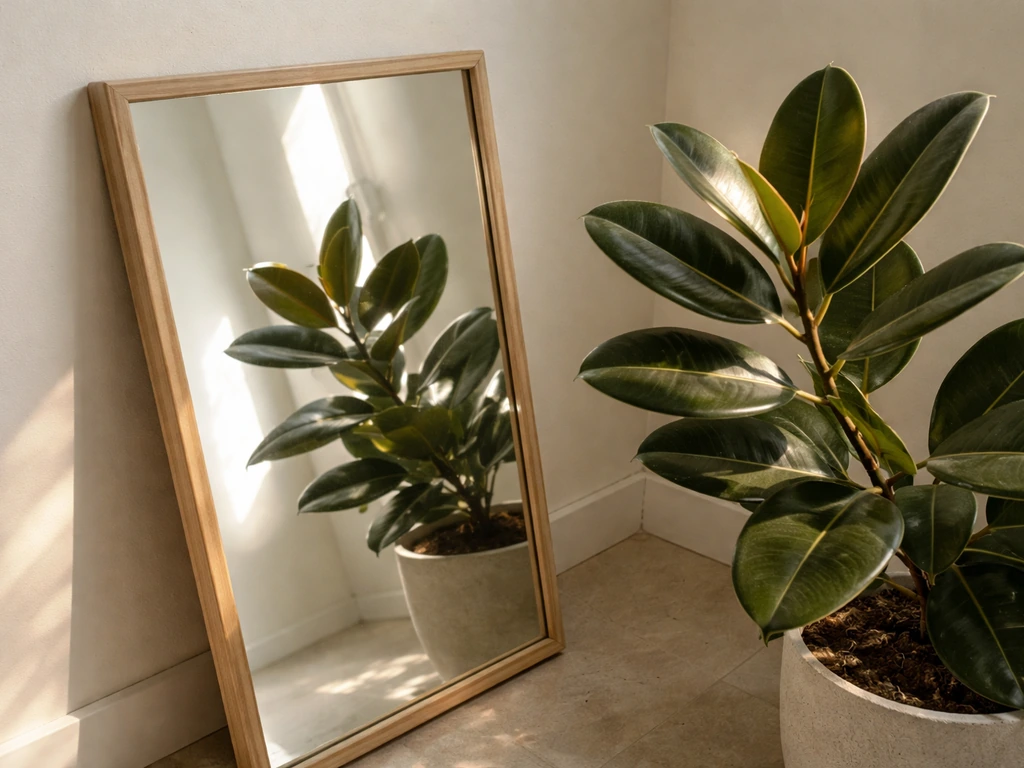
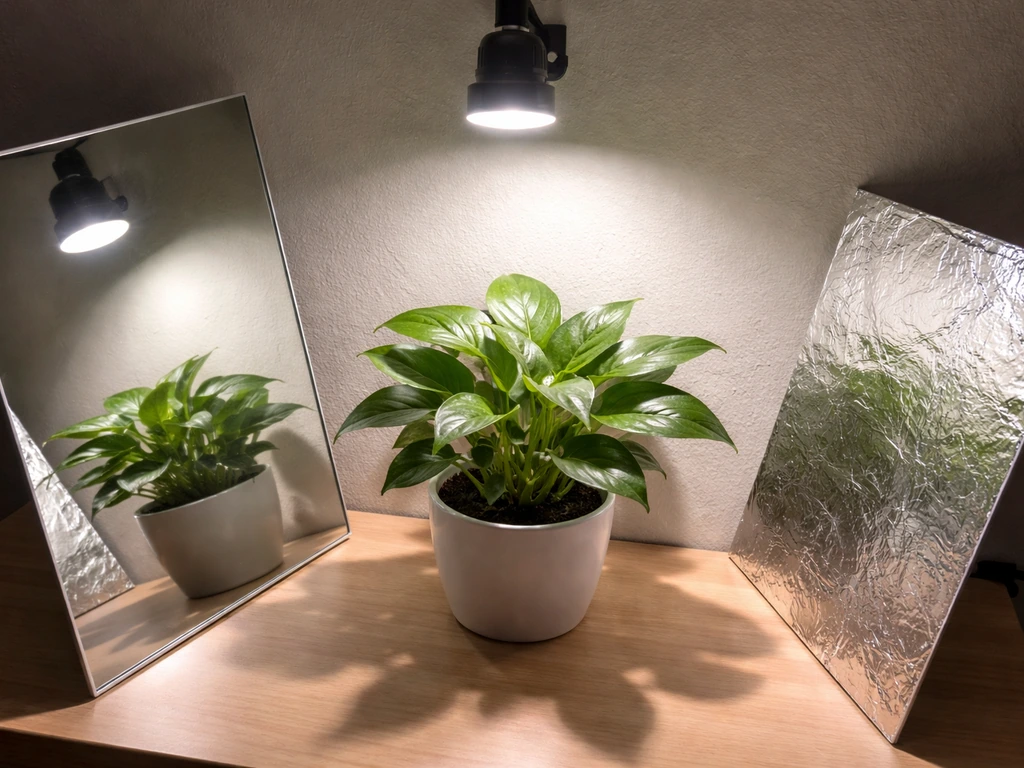
When indoor gardeners talk about mirrored light, they usually mean one of two things: placing a household mirror near plants to bounce natural or artificial light toward them, or lining a grow space with reflective materials like Mylar sheeting, white paint, or aluminum foil. All of these work on the same basic principle, redirecting photons that would otherwise be wasted.
Here's the key thing to understand: a mirror doesn't generate light or change its spectrum. It reflects what's already there. If your grow light is heavy on red and blue wavelengths (the photosynthetically active radiation, or PAR, that plants actually use), the mirror sends more of those same wavelengths back. If your light source is weak in PAR to begin with, a mirror just gives you more of that same weak light. The mirror is an amplifier, not a light source. That distinction matters a lot when you're troubleshooting why your plants aren't responding the way you expected.
Reflective surfaces also behave differently depending on their texture. A smooth mirror creates specular reflection, meaning it bounces light at a predictable angle, almost like a billiard ball off a cushion. A matte white wall or diffuse Mylar creates diffuse reflection, scattering light broadly in many directions. For plants, diffuse reflection is often more useful because it distributes light more evenly across the canopy rather than creating a concentrated beam aimed at one spot. A horticultural diffuse-light review explains that diffuse light reshapes spatial light distribution in the canopy, creating a more uniform vertical and horizontal distribution that can affect photosynthesis beyond just increasing brightness diffuse reflection is often more useful because it distributes light more evenly across the canopy.
How reflection actually changes what your plants receive
The metric that matters for plant growth is PPFD, or photosynthetic photon flux density, measured in micromoles per square meter per second (µmol/m²/s). That's the number of plant-usable photons hitting a leaf surface each second. Lumens, the number printed on most household bulb packaging, measure how bright a light looks to human eyes, not how useful it is to plants. A mirror bounces PAR back toward your plants, which can raise their effective PPFD without you buying a single new bulb.
Research on reflective ground covers in orchards found that reflected light increased PAR levels by roughly 1.6 to 3.9 times at one meter above the reflective surface, specifically improving light penetration into shaded parts of the plant canopy. That's a meaningful boost for plants that were previously sitting in shadow. In a grow tent or closet setup with reflective walls, you can see similar effects: light that hits a reflective wall gets redirected toward the lower and outer portions of your plants that would otherwise receive far less than the canopy top.
There's a physics catch, though. Light intensity falls off dramatically with distance from the source, following what's known as the inverse-square law. Double the distance between your light and the plant, and you get roughly one quarter of the intensity. This means a mirror placed far from both the light source and the plant has very little to offer. The reflection has to travel a meaningful distance to get back to the leaf, losing intensity along the way. Mirrors work best in compact, enclosed spaces where distances are short.
Direction matters too. A flat mirror on a wall reflects light back at the same angle it arrived, so its usefulness depends entirely on where your light source is and where your plants sit relative to the mirror. Angling the mirror slightly can redirect light downward into the canopy instead of just bouncing it sideways. Diffuse reflective materials like flat white paint sidestep this geometry problem entirely by scattering light in all directions.
When mirrors help, and when they hurt
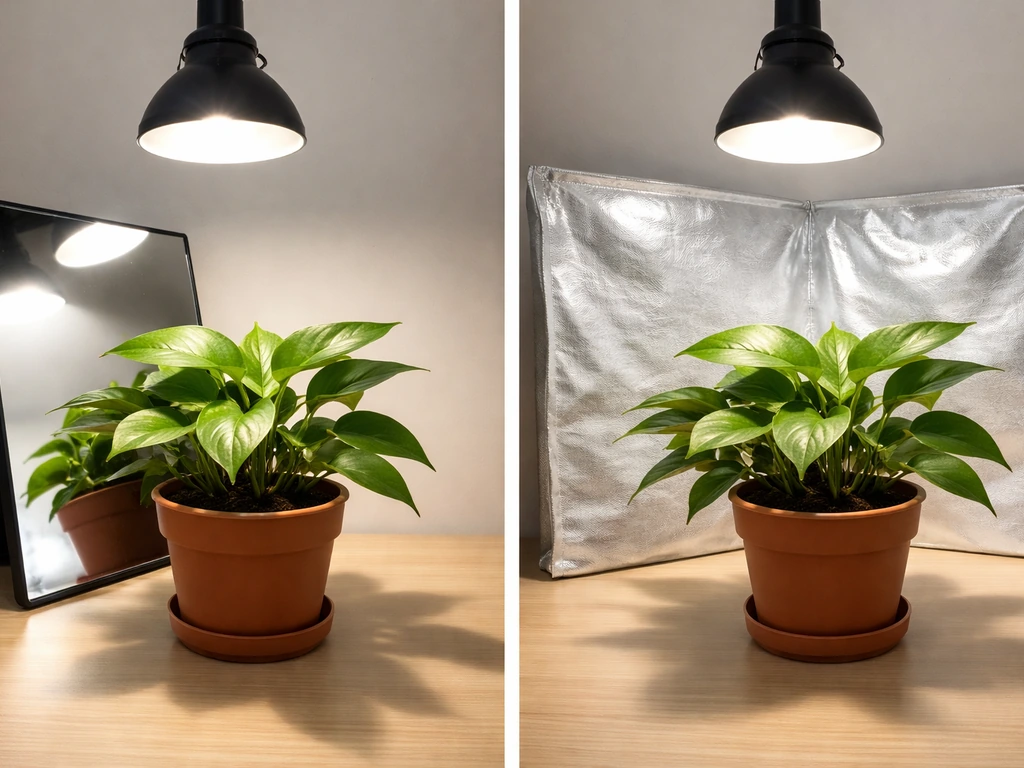
Mirrors and reflective surfaces genuinely help in a few situations. If you have a single overhead light and the sides and lower portions of your plants are noticeably dimmer, adding a reflective surface on the opposite side of the light can redirect some of that wasted light back into the shadier zones. In a grow tent or closet setup, reflective walls are one of the best bang-for-buck upgrades you can make because they keep all the light inside the growing space rather than letting it escape into the room.
But mirrors can cause real problems too. A smooth, angled mirror concentrating intense LED or HID light onto a single section of leaves can create a hotspot, a small area receiving far more light than the plant can process. This leads to photoinhibition, where the plant's photosynthetic machinery (specifically PSII, the part of the system most sensitive to excess light) gets overwhelmed and starts shutting down. What you see on the leaves is bleaching, pale or white patches, or in severe cases, crispy brown tissue. This is distinct from the dull, yellowing look of a plant that's getting too little light, so being able to tell these two symptoms apart matters.
Plants can also experience stress from uneven light distribution. If one side of a plant is getting intense reflected light while the other stays dim, the plant can develop uneven growth, leaning toward or away from the concentrated light. Sun-loving plants tolerate more intensity before showing stress, but many common houseplants, think pothos, philodendrons, or peace lilies, have low PPFD ceilings and can get burned even by reflected light from a moderately powerful grow light.
| Signal | What it means | What to do |
|---|---|---|
| Pale or bleached patches on upper leaves | Too much light intensity (hotspot from reflection) | Angle the mirror away, increase distance, or switch to diffuse reflector |
| Crispy brown edges or tips | Acute light burn or heat stress near hotspot | Remove mirror or reposition immediately, check ventilation |
| Plant leaning toward one side | Uneven light distribution from reflection angle | Rotate plant, adjust mirror angle for more even coverage |
| No visible change after adding mirror | Reflection not reaching leaves or too weak | Move mirror closer, check angle, consider diffuse material instead |
| Slow growth continues despite mirror | Light source itself is insufficient, not a reflection problem | Upgrade light, extend photoperiod, or choose lower-light plants |
How to actually set up mirrors and reflective materials around grow lights
The safest, most effective approach for most home setups is to use diffuse reflective materials rather than flat mirrors. Flat white paint on grow room walls reflects roughly 85 to 95 percent of light diffusely, which means it scatters light in all directions without creating concentrated beams. Mylar sheeting (the crinkled, metallic-looking material sold specifically for grow tents) reflects upward of 90 percent of light and does a good job distributing it more evenly than a flat mirror. White foam board, available at any craft store, is a cheap and easy option for directing reflected light toward a specific plant.
If you do want to use a household mirror, place it at a shallow angle so it reflects light across the canopy rather than concentrating it on one point. Start with the mirror further away and move it closer slowly over several days while watching your plants for stress signs. Never aim a mirror so that it concentrates direct LED or HID light onto a leaf surface at close range.
Safety is not optional here, especially near water or in humid growing environments. Electrical hazards near grow lights are real: keep cords, fixtures, and any powered components away from reflective foil or Mylar that could conduct electricity if it contacts a live wire. Aluminum foil in particular conducts electricity, so keep it well away from any fixture wiring. Make sure your grow space has adequate ventilation whether or not you're using reflective materials, because enclosed reflective spaces can trap heat, raising both air temperature and leaf surface temperature, which stresses plants even if the light level is appropriate.
- Line grow tent or closet walls with Mylar or paint them flat white before positioning plants
- Place any additional flat mirror at a 30 to 45 degree angle to the light source, aimed at the shadier side of the canopy
- Keep at least 12 inches between any concentrated reflection and leaf surfaces to start
- Ensure airflow across plants, especially in enclosed reflective setups, to prevent heat buildup
- Keep all reflective materials, especially foil, away from electrical wiring and light sockets
- Observe plants for 5 to 7 days after adding any reflective surface before making further adjustments
Mirrors vs other ways to get more light to your plants
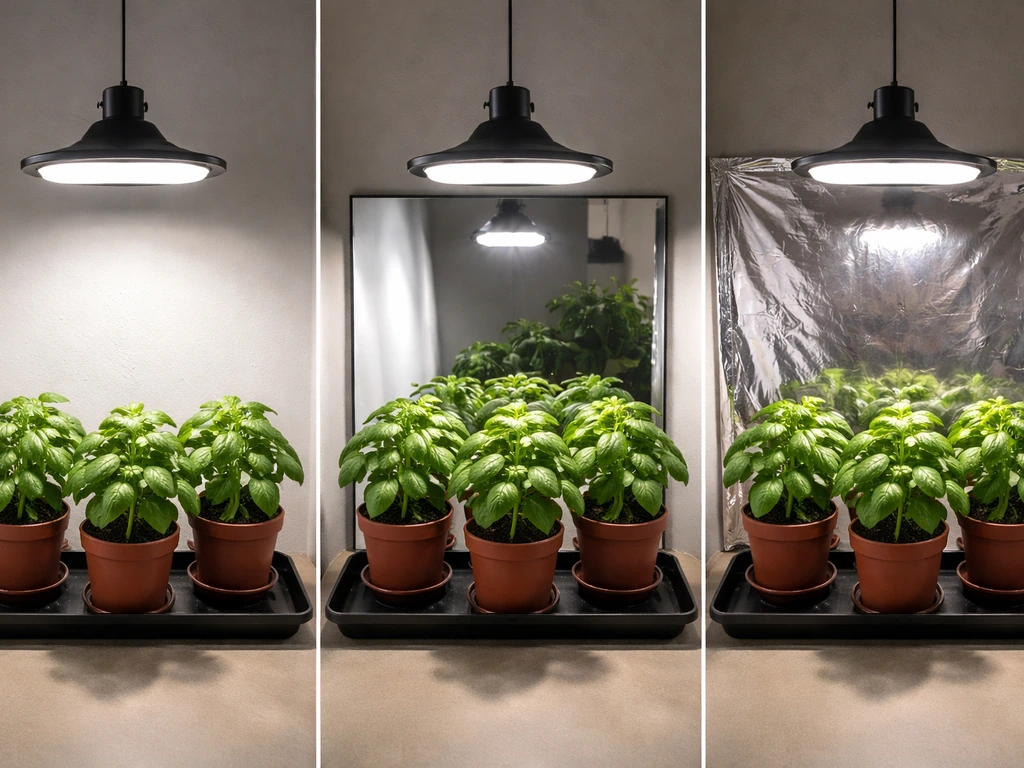
Before you go rearranging mirrors, it's worth asking whether reflection is actually the right solution for your situation. Mirrors work best as a supplement, not a substitute, for adequate lighting. If your grow light is underpowered for the plant you're growing, a mirror will not fix the problem. A low-light houseplant like a pothos needs at least 50 µmol/m²/s PPFD to grow reasonably well. An herb like basil needs 100 to 500 µmol/m²/s. A flowering plant like a tomato needs 400 µmol/m²/s or more. If your light isn't producing those numbers at the plant's location, a mirror gives you a fraction of an already insufficient number.
| Strategy | Best for | Cost | Effectiveness |
|---|---|---|---|
| Reflective walls/Mylar in grow tent | Enclosed spaces, multiple plants | Low ($10–30) | High: keeps all light inside the grow space |
| Flat mirror angled toward plant | Single plant getting uneven light | Low (free if you have one) | Moderate: depends heavily on placement and angle |
| Upgrading to a more powerful grow light | Plants not meeting minimum PPFD | Medium-High ($40–200+) | High: directly increases total PAR output |
| Moving plant closer to existing light | Plant too far from light source | Free | High: uses inverse-square law in your favor |
| Extending photoperiod (more hours of light) | Supplementing daily light integral (DLI) | Free (timer cost $10–15) | Moderate: adds total daily light dose without changing intensity |
| Adding a grow light reflector hood | HID or bare-bulb setups | Low-Medium ($15–60) | High: redirects wasted upward light downward toward plants |
Moving a plant closer to its light source is often the single most effective and cheapest adjustment you can make. Because of the inverse-square law, cutting the distance between a bulb and a plant in half can roughly quadruple the intensity hitting the leaves. That's almost always more impactful than adding a mirror at a distance. Extending the photoperiod by an hour or two per day is another free option that increases the daily light integral (DLI), the total dose of plant-usable light your plant gets in 24 hours, without changing intensity at all.
Choosing the right plants for a mirrored or reflective setup
Not every plant will respond well to increased reflected light, and that's okay. Low-light houseplants like pothos, snake plants, peace lilies, and philodendrons are adapted to thrive at PPFD levels below 100 to 250 µmol/m²/s. These plants didn't evolve for bright, direct, or intense reflected light, and bombarding them with it (especially from a hotspot) will stress them rather than help them grow faster. For these species, a bit of reflective material to even out light distribution across the plant is useful, but you don't need, and probably shouldn't want, intense reflection.
Sun-loving plants are where reflective setups really earn their keep. Herbs like basil, cilantro, and mint, succulents, vegetable seedlings, and flowering plants like orchids in their high-light phases all benefit from getting more PAR. If you're growing these under grow lights in a tent or enclosed space, reflective walls can make a real difference in yield and vigor. Orchids, for example, can tolerate PPFD from about 40 µmol/m²/s up to 500 µmol/m²/s depending on species and growth phase, so there's room to work with reflected light without causing harm.
- Good candidates for reflective setups: basil, mint, cilantro, succulents, vegetable seedlings, orchids in active growth, fruiting plants like tomatoes and peppers
- Handle with care (low-light species that can burn easily): pothos, peace lily, ZZ plant, snake plant, most ferns, calathea
- Middle ground (moderate light, tolerate some reflection): philodendrons (50–250 µmol/m²/s), spider plants, English ivy, some begonias
If you're unsure whether your plant is a shade lover or a sun lover, look up its natural habitat. Plants native to forest floors (most tropical houseplants) are shade adapted. Plants from open fields, deserts, or Mediterranean climates want more light and will benefit most from a reflective boost.
How to measure whether it's actually working
The best way to know if your reflective setup is helping is to measure PPFD before and after. A PAR meter gives you a direct readout in µmol/m²/s. If you don't want to spend on a dedicated meter, several smartphone apps can give you a rough approximation of light levels using the phone's camera sensor. They're not perfectly accurate for PAR specifically, but they're useful for comparing relative changes (is the reflected spot brighter than without the mirror?) and catching obvious problems.
If you don't want to measure at all, your plants will tell you what's happening over time. New growth that's a healthy green color, normal leaf size, and upright stems are signs the light is in a useful range. Pale, washed-out new leaves or bleached patches on older leaves point to too much intensity. Small, dark green leaves and stretched, leggy stems point to too little. Give any change at least two to four weeks before judging the result, because plants respond slowly to changes in their light environment.
- Measure PPFD at the leaf surface before and after adding the mirror using a PAR meter or phone app
- Compare new growth color and size over 2 to 4 weeks
- Check for leggy stretching (too little light) vs pale bleaching (too much intensity)
- Rotate plants a quarter turn every week to ensure even exposure when using angled mirrors
- Keep a simple log: date, mirror position, observed plant response
Troubleshooting when growth stalls or leaves turn pale or burned
If you added a mirror or reflective material and your plants still aren't thriving, or are looking worse, work through these possibilities in order.
- Pale or bleached patches appearing: the reflection is creating a hotspot. Angle the mirror away from the plant, increase the distance between the mirror and the canopy, or replace the mirror with a diffuse material like white foam board or Mylar.
- Crispy brown tissue at leaf tips or edges: possible heat stress from trapped warm air in a reflective enclosure. Improve ventilation by adding a small fan or opening vents. Check that your light isn't also too close to the canopy.
- Growth is still slow or leggy despite the mirror: reflection isn't solving a primary light deficiency. Move the plant closer to the light source, extend the photoperiod by one to two hours using a timer, or consider upgrading to a more powerful or spectrally appropriate grow light.
- One side of the plant is growing faster or leaning: uneven light distribution from the mirror angle. Rotate the plant and adjust the mirror to distribute light more evenly across the whole canopy.
- New leaves are dark green but very small: the plant may be getting enough PAR but the spectrum is off, or the light is still too dim for the species you're growing. Check whether your grow light covers both red and blue wavelengths (a broad-spectrum LED will usually state this).
- Everything looks fine but you expected faster growth: mirrors and reflection have real limits. If the underlying light source is adequate and the plant is otherwise healthy (correct watering, humidity, temperature, and nutrients), growth rate may simply be at the ceiling for that species under those conditions.
One thing worth keeping in mind: mirrored or reflected light cannot fully replace a missing window or a genuinely adequate grow light. Window film can work in a similar way to other reflective materials, but it depends on how much useful light it blocks or redirects for your specific setup. It's a tool for optimizing what you already have, not for conjuring light out of nothing. If your space has no windows and a very weak artificial light source, adding a mirror around it won't turn it into a functional grow setup. For truly windowless spaces, a proper full-spectrum grow light at the right wattage and distance is the starting point, and reflective walls help make that light go further. Similarly, if you're exploring what happens when sunlight passes through glass or window film, the same principle applies: reflection works with whatever light survives those filters, not around them.
The good news is that a reflective setup done thoughtfully is low-cost, reversible, and genuinely useful. Whether you're lining a grow tent with Mylar, propping a white foam board next to a windowsill orchid, or experimenting with angled mirrors around your LED strip, you can start today, watch your plants closely, and adjust until you find the setup that actually works for the species you're growing.
FAQ
If I already have a grow light, will mirrored light automatically make my plants grow faster?
It depends on whether the reflection reaches the leaf surface at a high enough PPFD without forming a concentrated hotspot. A mirror can boost the effective PPFD, but if your base light is too weak at the plant (common with low-watt LEDs or far-away fixtures), the reflected light may still fall short of the plant’s needs.
How can I tell if my mirror is giving too much reflected light versus too little overall light?
If you see bleached or pale patches with crisp edges, that usually points to excess intensity from a hotspot, not a lack of light. In contrast, low-light signs are typically slower growth, smaller leaves, and stretching toward the light. When testing mirrors, look for hotspot symptoms within days, while growth-rate changes may take a couple of weeks.
Can a mirror fail even if it looks like it is “facing” the plants?
Yes, but angle matters. A household mirror reflects at a predictable angle, so you can end up bouncing light past the leaves instead of back into the canopy. If you are not trying to measure PPFD, a practical approach is to change the mirror’s position in small steps and watch for symmetry in leaf color and growth across the plant.
What is the safest reflective choice if I’m worried about hotspots?
Diffuse materials (flat white paint, diffuse Mylar, foam board) generally reduce uneven distribution. If you use a smooth mirror, keep it farther away and at a shallow angle so the reflected beam spreads over more of the canopy instead of landing on one spot. This helps avoid photoinhibition from localized high PPFD.
Is it safe to use aluminum foil in a humid grow area?
Avoid placing reflective foil or highly reflective tape where it could touch or arc to any powered wiring, especially near humid environments. Also, keep reflective materials off surfaces that get hot (like close-to-fixture heat sinks), since heat plus high humidity can degrade materials and worsen safety risks.
How precise do I need to place the mirror for it to work?
You should expect some benefit from reflective surfaces even when the mirror is not perfectly aligned, because diffuse options scatter light broadly. But a flat mirror is geometry-dependent, so even a small repositioning can change where the brightest reflected patch lands. If you switch to diffuse reflective walls, alignment becomes far less critical.
Would it be better to add reflected light or extend the photoperiod?
Yes. Many plants respond to daily light dose, so extending photoperiod can increase DLI without changing intensity. However, some species or setups can get stressed by overly long days if heat and humidity rise or if leaves remain too close to the light. Increase photoperiod gradually and keep an eye on leaf temperature and signs of stress.
Can mirrored light cause plant problems even if my PPFD is fine?
In many indoor spaces, the limit is actually heat and air movement, not just light. Reflective setups can increase leaf surface temperature, especially in tents with poor ventilation. If you add reflection, verify you can maintain steady airflow and acceptable temperatures, then re-check plant response.
Will mirrored light help if my room has a lot of sunlight blocked by window film or tint?
Yes, for window-based setups it can. If you use window film or reflective window coverings, the key is how much useful spectrum and intensity remains after the material is applied. Reflection can help redirect surviving daylight deeper into the room, but it cannot compensate for window treatments that block most light.
What’s a good “no meter” way to test whether mirrored light is working for my specific plant?
If you cannot measure PPFD, use a two-pronged check: observe color and growth changes and do a controlled before/after test. Keep all other variables stable (distance, watering schedule, and photoperiod), then compare leaves and growth direction over 2 to 4 weeks. Symmetrical improvement usually means reflection is helping, while pale or crispy patches suggest intensity issues.