
Coriander can grow without direct sunlight, but it cannot grow without light altogether. Coriander can grow without direct sunlight, but it cannot grow without light altogether; the same general light requirement applies if you're wondering can chia seeds grow without sunlight. What you're really asking is whether you can replace sunlight with another usable light source, and the honest answer is yes, with the right setup. A bright north-facing window can get you partway there. A decent LED grow light gets you all the way. What coriander will not do is survive in a dark corner or a windowless room with no supplemental lighting, no matter how well you water it.
Can Coriander Grow Without Sunlight Indoors? How to Do It
Marcus Hartley
13 May 2026
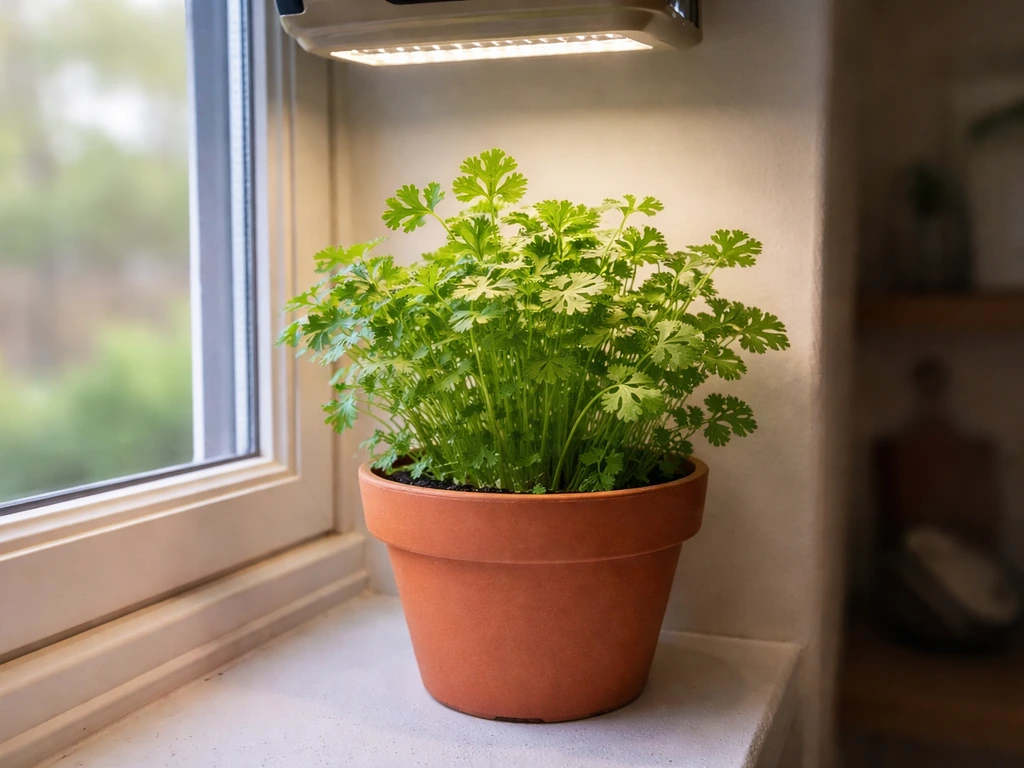
What coriander actually needs from light
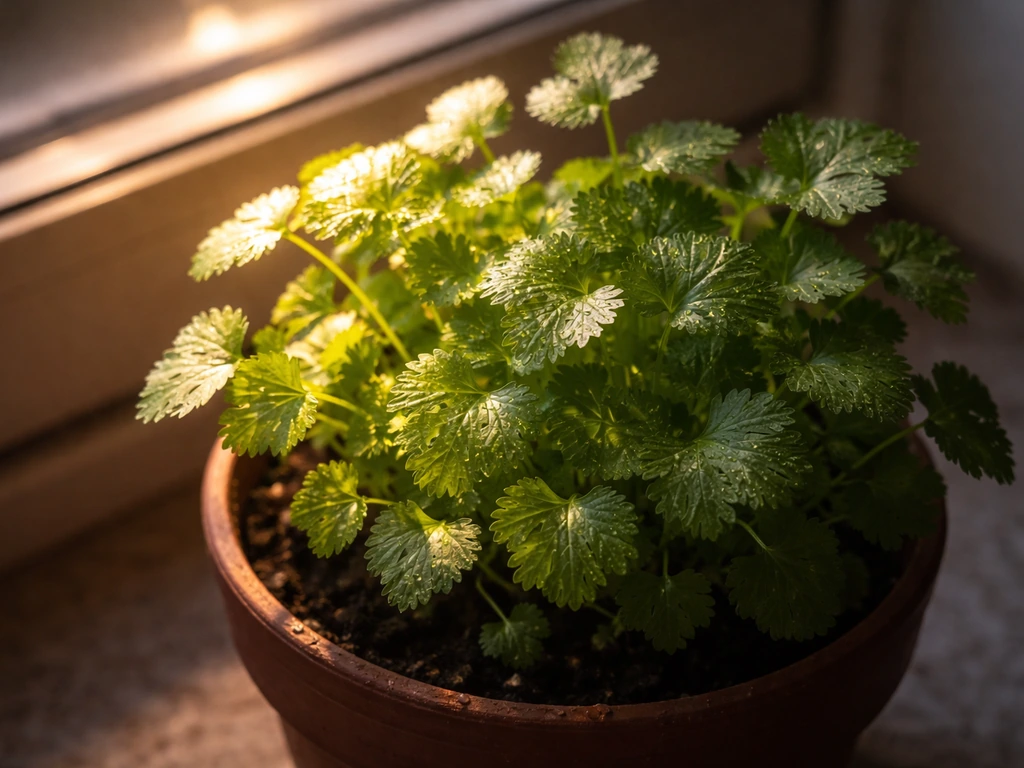
Coriander is a leafy herb that runs on photosynthesis like every other green plant, so light isn't optional, it's fuel. The practical target for indoor production is a Daily Light Integral (DLI) of around 15 to 20 mol per square meter per day, which translates to roughly 200 to 400 micromoles per square meter per second (PPFD) over a 12 to 14 hour photoperiod. That's the range where you get steady leaf growth, good flavor, and a plant that doesn't look like it's reaching desperately for the nearest window. Research using LED chambers found that 150 PPFD with a 16-hour light period supported measurable growth and photosynthetic activity in coriander, so you have some flexibility on the low end as long as you extend the hours. Below that, germination slows, seedlings get spindly, and leaves turn pale. The plant is alive, technically, but it's not producing anything worth harvesting.
The honest difference between low light and no light
There's a real distinction between "no direct sun" and "no light at all," and it matters for how you plan your setup. Plenty of indoor spaces get enough indirect or ambient light to support shade-tolerant plants, but coriander is not a shade plant. It sits somewhere in the moderate category: not as demanding as tomatoes or peppers, but far more light-hungry than something like pothos or mint. A window that gets bright indirect light for 6 or more hours can work for coriander in a pinch, though you'll get slower growth and smaller harvests than you would with full sun or a grow light. A window with only 2 to 3 hours of dim light won't cut it. Grass, like coriander, needs light energy to photosynthesize, so it won't grow in total darkness can grass grow without sunlight. And a room with no windows at all is a hard no unless you're adding artificial light.
The realistic goal for most indoor gardeners without a sun-drenched south-facing window is to use grow lights to make up the difference. This isn't expensive or complicated, and you don't need a full-on grow tent to make it work. A single LED panel or even a decent fluorescent strip positioned close to your container is genuinely enough to grow coriander indoors year-round.
Which indoor light setup actually works
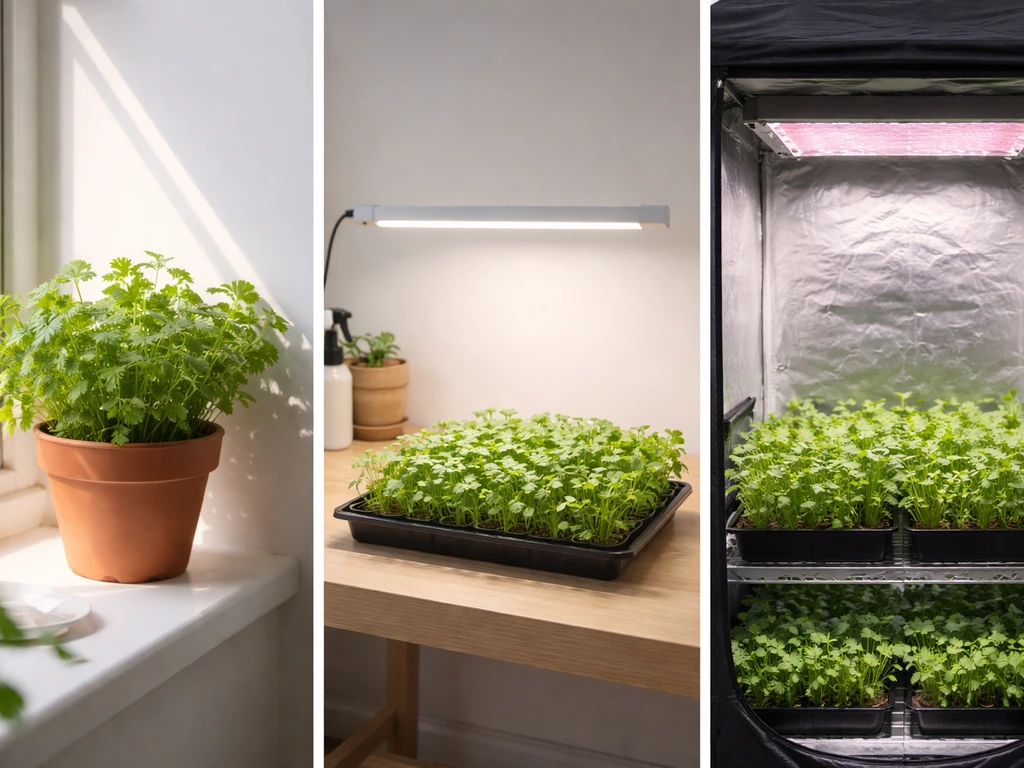
Here's a straight comparison of the three most common setups indoor gardeners use for coriander, along with what to expect from each.
| Light Source | Best For | PPFD Range | Practical Notes |
|---|---|---|---|
| South or west-facing window | Supplementing natural daylight | 100–300+ PPFD (varies by season) | Works well in summer; too dim in winter without boosting |
| Fluorescent (T5/T8) tubes | Budget grow setups, seedlings | 100–200 PPFD at 6–12 inches | Position close to plants; good for germination and small harvests |
| Full-spectrum LED grow light | Year-round indoor production | 200–500 PPFD adjustable | Most efficient; best spectrum control; recommended for no-sunlight setups |
If you have a bright south or west-facing window, start there and supplement with a grow light during winter months or on overcast days. If you have no useful window light at all, go straight to a full-spectrum LED panel. If you’re wondering whether can chia pets grow without sunlight, the same indoor light logic applies: they still need adequate light, usually from a grow light no useful window light at all. Aim to position it 12 to 24 inches above your coriander container (follow your specific light's instructions), and run it for 14 to 16 hours a day. A simple outlet timer costs a few dollars and removes the guesswork entirely. Fluorescent tubes work but require you to keep them very close to the plants, sometimes as near as 4 to 6 inches, to hit usable PPFD levels. LEDs are more forgiving on placement and more energy-efficient over time.
How to grow coriander indoors step by step
Coriander has a taproot, so the container depth matters more than most herbs. Use a pot that's at least 8 to 12 inches deep. Shallower containers will stress the roots and speed up bolting. A standard plastic window box or a deep terra cotta pot both work fine. Make sure there are drainage holes.
- Fill your container with a light, well-draining potting mix. A standard all-purpose mix works, though you can add a small amount of perlite if drainage feels slow.
- Sow seeds 1/4 to 1/2 inch deep, spaced about 1/4 to 1/2 inch apart in rows at least 3 inches apart. If you're growing for leaf harvest rather than seed, you don't need to thin, and keeping plants closer together actually gives you more early canopy coverage.
- Water gently after sowing and keep the soil consistently moist but not waterlogged. Germination takes 1 to 2 weeks at optimal soil temperatures around 60°F (15°C). Don't rush it with extra heat.
- Once seedlings emerge, place the container under your grow light or in your brightest window immediately. Delay here is where most people lose the plot and end up with leggy seedlings that never recover well.
- Run your grow light for 14 to 16 hours per day. Set a timer and forget about it.
- Begin harvesting outer leaves as soon as plants reach 4 to 6 inches tall, usually 3 to 4 weeks after germination. Cut from the outside in. Regular harvesting encourages bushier growth and delays bolting.
- Stagger new sowings every 2 to 3 weeks if you want a continuous supply. Coriander has a short productive window before it bolts, so succession sowing is the most reliable strategy indoors.
Care adjustments that matter in low light
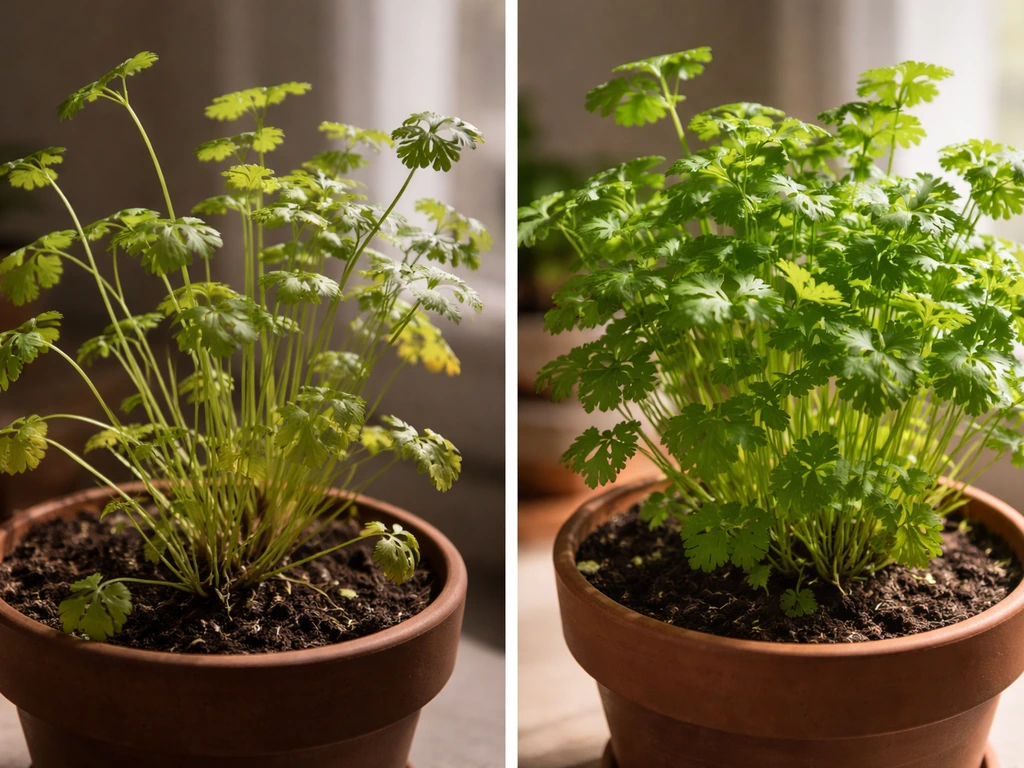
Growing coriander in lower light than ideal means a few things change about how you care for it. Photosynthesis is slower, so the plant processes water more slowly too. The most common mistake in low-light indoor herb growing is overwatering, because the soil stays wet longer and the plant isn't pulling moisture as fast. Check the top inch of soil before watering and only water when it feels dry. This is especially important during germination, when overwatering in cool, dim conditions is the main cause of damping-off, a fungal problem that kills seedlings at the soil line.
- Temperature: Keep your growing space between 60 and 70°F (15 to 21°C). Coriander actively dislikes heat, and warm rooms above 75°F (24°C) will trigger bolting much faster than light deficiency will.
- Airflow: Give plants a little breathing room and make sure the room isn't stagnant. A small fan on low, or just opening a window occasionally, dramatically reduces damping-off risk and fungal problems. Don't crowd pots together.
- Fertilizing: In low light, coriander grows slowly, so it doesn't need much feeding. A half-strength liquid fertilizer once every 3 to 4 weeks is plenty. Over-fertilizing in low light pushes leafy, watery growth that's more susceptible to pests.
- Pest watch: Aphids and fungus gnats are the two most common indoor herb pests. Fungus gnats are almost always a sign of consistently overwatered soil. Let the soil dry more between waterings and they'll largely disappear. Aphids show up on stressed, weak plants, so improving your light situation is the best prevention.
Bolting, yield, and what to realistically expect
Coriander bolts, meaning it sends up a flower stalk and shifts energy to seed production, and when it does that, the leaves get thinner, shorter, and less flavorful. Research has confirmed this morphological shift: bolted coriander produces measurably lower-quality foliage. Light plays a role in bolting, but so does heat, and indoors it's often the heat trigger that gets people first. In a coriander LED study examining blue-light qualities and intensities, a PPFD range around 120, 150 μmol·m−2·s−1 with specific blue/red ratios supported faster flowering and bolting behavior, suggesting that light intensity and spectral bandwidth can drive reproductive transitions Light plays a role in bolting. Soil temperatures above 75°F (24°C) reliably push coriander toward bolting, regardless of your light setup. Long photoperiods above 16 hours can also accelerate the process, so don't just crank your grow light to maximum hours thinking more is always better.
In a low-light setup, your yield will be lower than what you'd get outdoors or under a well-tuned grow light, and your plants will have a shorter useful window before bolting. That's just the reality. The way to manage it is succession sowing: start a new small pot every 2 to 3 weeks so you always have young plants in their productive phase. If you want a faster cycle with very limited light, growing coriander as microgreens is worth considering. Coriander microgreens can be ready in as little as 12 to 14 days, require less light than full-size plants, and can be grown on a kitchen counter under a simple fluorescent tube. It's a completely different use case from growing cilantro for salads, but it's worth knowing the option exists.
Solving common low-light coriander problems
If something's going wrong with your indoor coriander, here's how to read the symptoms and what to change right now.
| Problem | Most Likely Cause | What to Do |
|---|---|---|
| Seeds not sprouting after 2+ weeks | Too cold, too deep, or compacted soil | Check soil temp (aim for 60°F/15°C), resow at 1/4 inch depth, keep soil moist not wet |
| Leggy, pale, stretched seedlings | Not enough light, positioned too far from source | Move plants closer to light source or increase light duration to 14–16 hrs |
| Yellowing leaves | Overwatering or nutrient deficiency | Let soil dry out between waterings; if persisting, apply half-strength liquid fertilizer |
| Seedlings collapsing at soil line | Damping-off from overwatering and poor airflow | Improve drainage, reduce watering, add airflow with a small fan, don't crowd pots |
| Bolting too early (flower stalk appearing) | Heat stress or very long photoperiod | Lower room temperature below 70°F, reduce light to 14 hrs, harvest leaves immediately |
| Slow growth, small leaves | Below-minimum light levels | Upgrade to or add a full-spectrum LED grow light at 200–400 PPFD for 14–16 hrs/day |
The single most impactful thing you can do if coriander isn't thriving indoors is almost always to improve the light situation. Every other fix (watering, fertilizing, temperature control) helps at the margins, but if your plants aren't getting 200 PPFD or more for at least 12 to 14 hours a day, they're just surviving rather than growing. A basic LED grow light in the $25 to $60 range is genuinely enough for a couple of herb containers on a kitchen counter or shelf. It's a small investment compared to the frustration of replacing failing plants every few weeks.
If you've been exploring which plants can realistically handle low light conditions, coriander sits in the "manageable with artificial light" category, more demanding than some herbs but far from the most difficult. Other quick-growing edibles like beans also need more light than most people expect indoors, so the same grow light setup you use for coriander can do double duty for a range of culinary plants.
FAQ
If my window gets indirect light, how do I tell whether it is enough for coriander?
Use a simple yardstick: coriander typically needs many hours of genuinely bright conditions. If you cannot read comfortably in that spot without turning on a lamp during daytime, it is usually too dim. In practice, most people end up needing a LED grow light even with a bright north window, especially in winter.
Can I grow coriander in a closet or bathroom if I leave the door open a little?
Usually no. Even if the room is adjacent to a window, a closet or interior bathroom often does not receive consistent usable light. Place the plants where light reaches them directly, or treat it as a no-use-window-light situation and use a grow light on a timer.
What light height and duration should I use with an LED grow panel?
Position the LED close enough to deliver target intensity, commonly around 12 to 24 inches above the container, but follow the fixture’s own guidance because panels vary. Run it on a schedule that keeps coriander in a 12 to 14 hour photoperiod for steady leaf growth, and avoid guessing by “on all day” unless you also control temperature.
Is it better to run the grow light longer at a lower intensity?
Not always. Extending the hours can help on the low end, but very long photoperiods (beyond about 16 hours) can push coriander toward bolting. Aim for a practical balance, closer to the recommended PPFD range when possible.
How much should I water coriander under low light?
Under lower light, slow photosynthesis also slows water uptake, so overwatering is the most common failure. Water only after the top inch of soil dries, and make sure the pot drains well. If seedlings look pale and collapsed at the soil line, damping-off is a warning sign to reduce moisture and improve air circulation.
Does a fan or better airflow help coriander indoors?
Yes. Air movement helps prevent fungal issues like damping-off and can make the environment feel less hot near the foliage, which indirectly reduces bolting risk. Use gentle oscillation rather than blasting the plants.
Why is my coriander bolting indoors even though I added a grow light?
Heat and photoperiod both matter. If your room or soil stays above about 75°F (24°C), bolting becomes much more likely regardless of light. Also check that you are not running the light excessively long, and try keeping the plant cooler near the leaves.
Can I prevent bolting by trimming flowers or topping plants?
Topping and removing early stems can slow the transition somewhat, but once coriander shifts energy toward reproduction, leaf quality often already declines. The most reliable approach is succession sowing, start new pots every 2 to 3 weeks, and remove bolting plants once they start producing thin, less flavorful foliage.
Will microgreens of coriander work in lower light than full-size plants?
Yes, that is one of the most forgiving indoor options. Microgreens often require less light than producing full leaves and can be ready in about 12 to 14 days. They also let you harvest before bolting becomes a bigger issue.
How deep does the container need to be for coriander indoors?
Because coriander forms a taproot, shallow containers increase stress and can speed up bolting. Plan on at least 8 to 12 inches of depth with drainage holes, and avoid topping off with extra soil too late, since the root needs usable depth from the start.
Should I fertilize coriander grown without much sunlight?
Low light slows growth, so many people over-fertilize because they think the plant is “hungry.” Start with a light feeding only after seedlings establish, and avoid heavy fertilizer during cool, dim periods. If leaves stay pale and growth is slow even under the right light, then adjust feeding alongside light rather than replacing light with fertilizer.
What is the fastest way to troubleshoot if my indoor coriander is not growing?
Re-check the light first. Confirm your photoperiod schedule and that the fixture is close enough to be effective for your specific setup. If light is adequate, then investigate water habits (too wet is the main issue), and finally check temperature around the plants, since heat can override the benefit of improved lighting.