Trees can grow without direct sunlight, but they cannot grow without light entirely. Every tree needs some form of usable light to run photosynthesis, and if you strip that away completely, the tree will deplete its energy reserves and eventually die. What most indoor gardeners are really asking is: can I grow a tree indoors, away from a sunny window, using artificial light or low ambient light? The answer is yes, for certain species, with the right setup.
Can Trees Grow Without Sunlight Indoors? Practical Guide
Marcus Hartley
2 May 2026
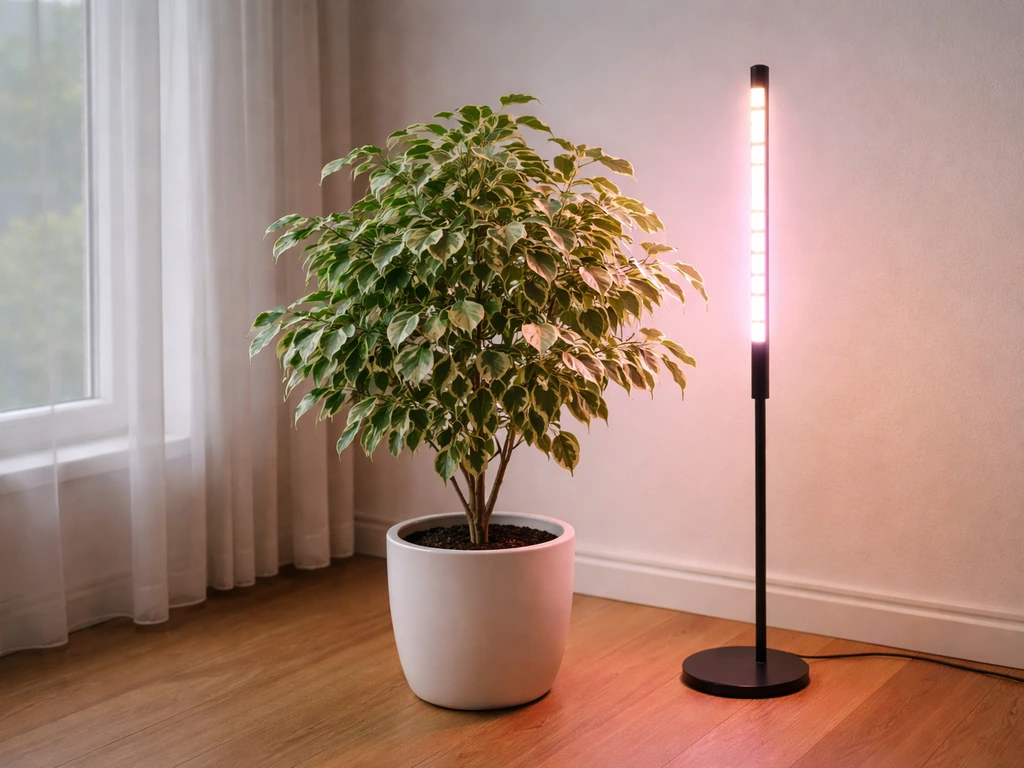
Some trees are genuinely shade-tolerant and will grow (not just limp along) under LED grow lights or in a bright indoor space. Others need more light than any practical indoor setup can deliver, and you'll lose the plant no matter what you try.
Can trees survive without direct sunlight: quick reality check
"Without sunlight" usually means one of two very different things. It could mean without direct sun beams hitting the leaves, which is totally workable for many trees. Or it could mean in actual darkness, which is not workable for any tree. No tree survives in total or near-total darkness long-term. Without adequate light, the plant cannot manufacture carbohydrates, energy reserves run dry, and the plant dies. That's not negotiable, it's just plant biology.
The more useful question is whether a tree can grow under indirect light, a north-facing window, or artificial grow lights. The honest answer: some can, and they can do it well. You won't be growing a 30-foot oak in your living room, but compact or naturally small tree species adapted to forest understories have evolved to handle low-light conditions. They're used to getting filtered light through a canopy, which isn't so different from what your home can offer with a bit of help.
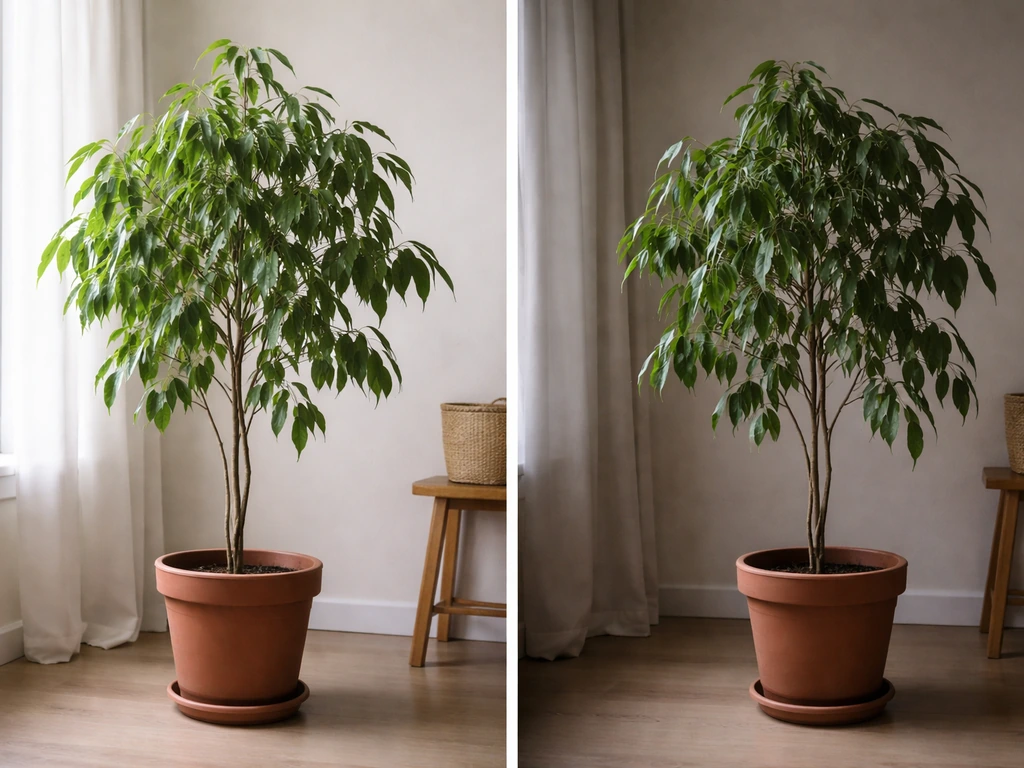
There's also an important distinction between surviving and actually growing. A tree in insufficient light might hold on for months, staying alive but producing no meaningful new growth. You'll see it in the symptoms: small, pale new leaves, older leaves dropping, stems stretching toward any available light source. That's survival mode, not healthy growth. If your goal is a tree that puts out new leaves, fills in, and looks good, you need to clear the bar for that specific species, not just the bare minimum for keeping it alive.
How trees use light: photosynthesis needs vs shade tolerance
Trees use light to power photosynthesis, the process of converting carbon dioxide and water into the sugars they need to grow. Chlorophyll in the leaves absorbs light, primarily in the red and blue wavelengths, and that energy drives the whole system. Less light means less sugar production, which means slower growth, weaker structure, and eventually a plant that can't sustain itself.
Shade tolerance is a spectrum. Some trees evolved in dense forest understories where they might receive only 10 to 20 percent of the light hitting the treetops. These species have larger, thinner leaves to capture as much light as possible, and their photosynthetic machinery is tuned to work efficiently at low light levels. Other trees, like most fruit trees or full-sun species, need high light intensities to hit their photosynthetic potential and simply can't compensate at lower levels.
One thing that surprises people: plants actually respond to darkness as a signal, not just to light. Darkness triggers different physiological pathways, including processes related to leaf and flower development, and how the plant manages leaf drop. This is why photoperiod (the balance of light and dark hours in a day) matters as much as raw light intensity. A tree getting 12 hours of decent light followed by 12 hours of dark is in a very different physiological state than one getting dim light all day with no clear dark period.
Options for growing trees indoors in low light
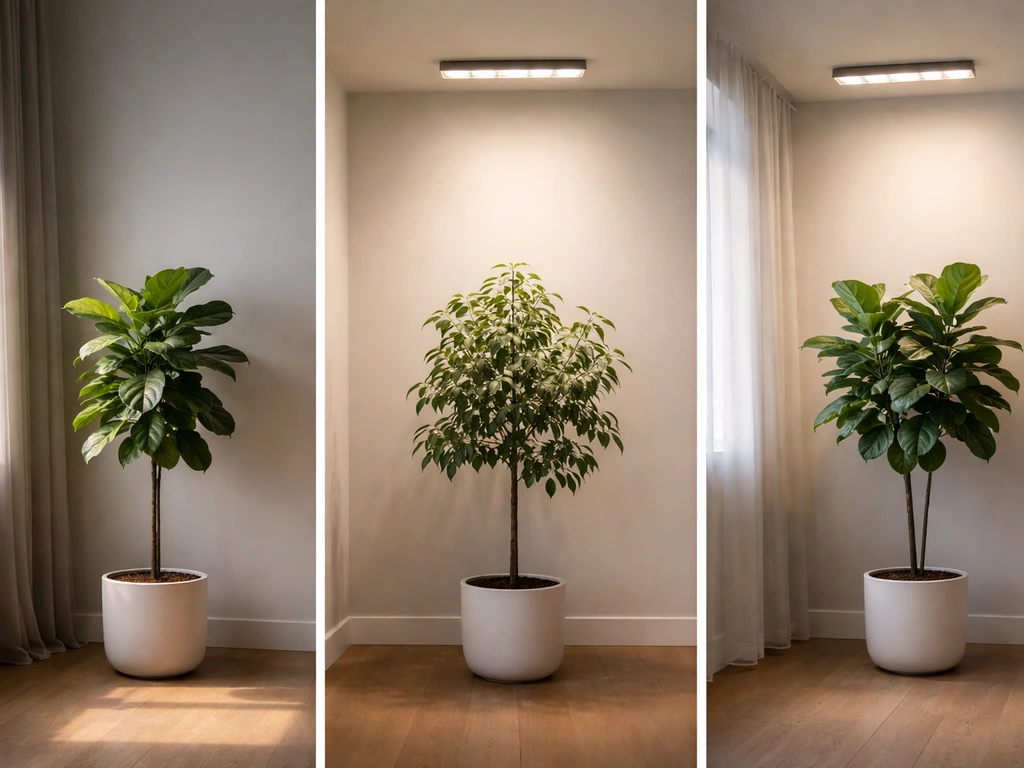
If your space doesn't get much natural light, you have three realistic options: optimize what natural light you have, use LED grow lights, or combine both. Each has trade-offs.
Natural window light
A bright south- or west-facing window is your best free resource. Even indirect bright light from a large window can be enough for shade-tolerant tree species. Even though direct sun is limited indoors, some plants can still grow well with the right low-light setup what plants don't need sunlight to grow. North-facing windows are genuinely low light, and very few trees will thrive there without supplemental help. If you're relying solely on window light, position the tree as close to the glass as possible (within a foot or two), rotate it every couple of weeks for even growth, and keep the glass clean.
LED grow lights
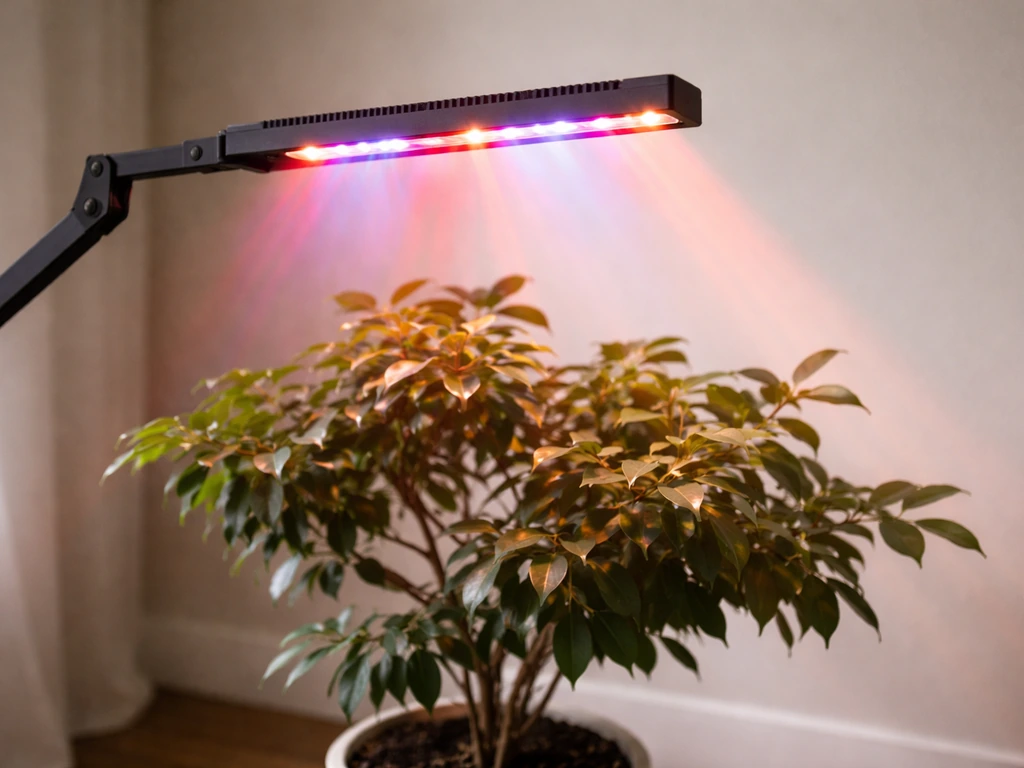
Full-spectrum LED grow lights are the most practical tool for indoor tree growing. Modern LEDs cover the red and blue wavelengths that chlorophyll actually uses, they run cool enough to place relatively close to the canopy, and they're energy-efficient enough to run for 12 to 14 hours a day without a shocking electricity bill. For a single tree, a quality panel-style or bar-style LED in the 100 to 300 watt range is usually sufficient, depending on canopy size and target species.
Fluorescent lights
T5 fluorescent grow lights still work, especially for smaller tree species or seedlings, and they're cheaper upfront than LED panels. The downside is they're less energy-efficient over time and produce a narrower intensity range. They work best when placed very close to the plant (within 4 to 6 inches for seedlings, up to 12 inches for established plants). For a mature tree with a larger canopy spread, a single fluorescent fixture won't cover you as well as a properly sized LED.
Combining natural and artificial light
This is what I'd recommend for most people. Put the tree near a window and supplement with a grow light during the darker months or whenever natural light dips. You don't need to replace the sun entirely, just fill the gap. Even a modest LED supplementing a north or east window can push a shade-tolerant tree into a genuinely healthy growth range.
Minimum light requirements: distance, intensity, and photoperiod
Before spending money on lights, it helps to understand the units that actually matter for plant growth. Forget lumens, watts, and lux for this purpose: those measure light as human eyes perceive it, not as plants use it. Iowa State University Extension notes that [PPFD is a more accurate measurement for indoor supplemental light than human-centric measures](https://yardandgarden. extension.
iastate. edu/how-to/growing-indoor-plants-under-supplemental-lights/important-considerations-providing-supplemental-light-indoor-plants), and it can be used to calculate DLI by multiplying PPFD by the photoperiod hours. The measurements you want are PPFD (Photosynthetic Photon Flux Density), measured in micromoles per square meter per second (μmol·m⁻²·s⁻¹), and DLI (Daily Light Integral), which combines intensity with time to give you total photons delivered per day. DLI is measured in mol·m⁻²·d⁻¹.
A value of 1 mol·m⁻²·d⁻¹ is considered very low for plant growth. Most shade-tolerant indoor plants do well somewhere in the 6 to 15 range.
PPFD drops significantly as you move a light further from the canopy, so distance matters a lot. A light reading 400 μmol·m⁻²·s⁻¹ at 12 inches might drop to 200 μmol·m⁻²·s⁻¹ at 24 inches. Manufacturer PPFD maps (some call them photon flux maps) show you exactly what intensity to expect at different distances, and they're worth looking at before you decide on placement. As a general rule: keep LED grow lights 12 to 24 inches above the canopy for most indoor shade-tolerant trees, adjusting based on the specific light's output.
For photoperiod, the practical target is 12 to 14 hours of light per day for most indoor trees under artificial lighting. You can go as low as 10 hours if you're combining with decent window light, and you can push to 16 hours for particularly light-hungry plants, but do not exceed 16 hours. Most plants need some daily darkness to develop properly, and running lights around the clock can actually disrupt growth cycles and cause problems. A simple outlet timer solves this completely: set it and forget it.
| Light Metric | What It Measures | Why It Matters for Trees |
|---|---|---|
| PPFD (μmol·m⁻²·s⁻¹) | Photosynthetically active photon intensity at a given point | Tells you if your light is intense enough at canopy level |
| DLI (mol·m⁻²·d⁻¹) | Total photons delivered over a full day | Integrates intensity and hours; the real measure of daily light dose |
| Photoperiod (hours/day) | How many hours of light per 24-hour cycle | Affects growth cycles, leaf development, and abscission |
| Lux / Foot-candles | Human-visible brightness | Not reliable for plant decisions; avoid using these to choose lights |
Best tree species for low-light indoor growing
Not all trees are realistic for low-light indoor spaces. Fruit trees, conifers, and most outdoor deciduous trees need far more light than a typical indoor setup can provide. Focus on species that naturally grow in shaded understories or that have proven track records as indoor trees. Here are the ones I'd actually recommend:
- Parlor palm (Chamaedorea elegans): one of the best low-light trees you can grow indoors. It tolerates genuinely low-light conditions while still putting out new growth, and it stays at a manageable size. It does prefer bright indirect light when you can provide it, but it won't collapse without it.
- Areca palm (Dypsis lutescens): does well in bright indirect indoor light but is sensitive to very low light, which can stress it and leave it vulnerable. A decent LED or a good south-facing window makes a real difference here.
- Fiddle-leaf fig (Ficus lyrata): technically a tree, works indoors with bright indirect light, and responds well to LED supplementation. It's finicky but rewarding if the light is consistent.
- Dragon tree (Dracaena marginata): very tolerant of lower light levels, slow-growing but reliable, and one of the easiest tree-like plants for dim indoor spaces.
- Money tree (Pachira aquatica): handles moderate to bright indirect light well, tolerates some variation, and does fine under full-spectrum grow lights.
- Schefflera (umbrella tree): reasonably shade-tolerant and adapts well to indoor conditions with consistent artificial lighting.
- Norfolk Island pine (Araucaria heterophylla): needs more light than the others on this list but can be managed under a decent LED setup; a good option if you want something that looks like a real tree.
If you're also curious about specific plants for windowless or near-windowless spaces, the family of plants that grow indoors without sunlight is broader than just trees: many ferns, pothos, ZZ plants, and cast iron plants can handle very low light. Trees are generally more demanding than those options, which is worth knowing before you commit to a particular species.
How to set up a working light plan and troubleshoot problems
Building your light plan
- Identify your natural light: spend a day noting how many hours of real light hit your tree's location, and from which direction. South and west windows give the most; north gives the least.
- Calculate your light gap: if your tree gets 4 hours of decent window light but needs a DLI of around 10 mol·m⁻²·d⁻¹, you need to make up the difference with artificial light. A grow light running at 200 μmol·m⁻²·s⁻¹ for 8 hours adds roughly 5.8 mol·m⁻²·d⁻¹, which combined with your window light gets you close.
- Choose your light and set distance: for most compact indoor tree species, a full-spectrum LED panel positioned 18 to 24 inches above the canopy is a solid starting point. Adjust closer if growth is slow and the light can handle it thermally.
- Set your photoperiod: use a timer. For most trees, 12 to 14 hours on, 10 to 12 hours off is the target. If you're combining with window light, count that time as part of your light hours.
- Reassess after 4 to 6 weeks: new leaf color, growth rate, and stem thickness will tell you whether the setup is working.
Troubleshooting common light problems
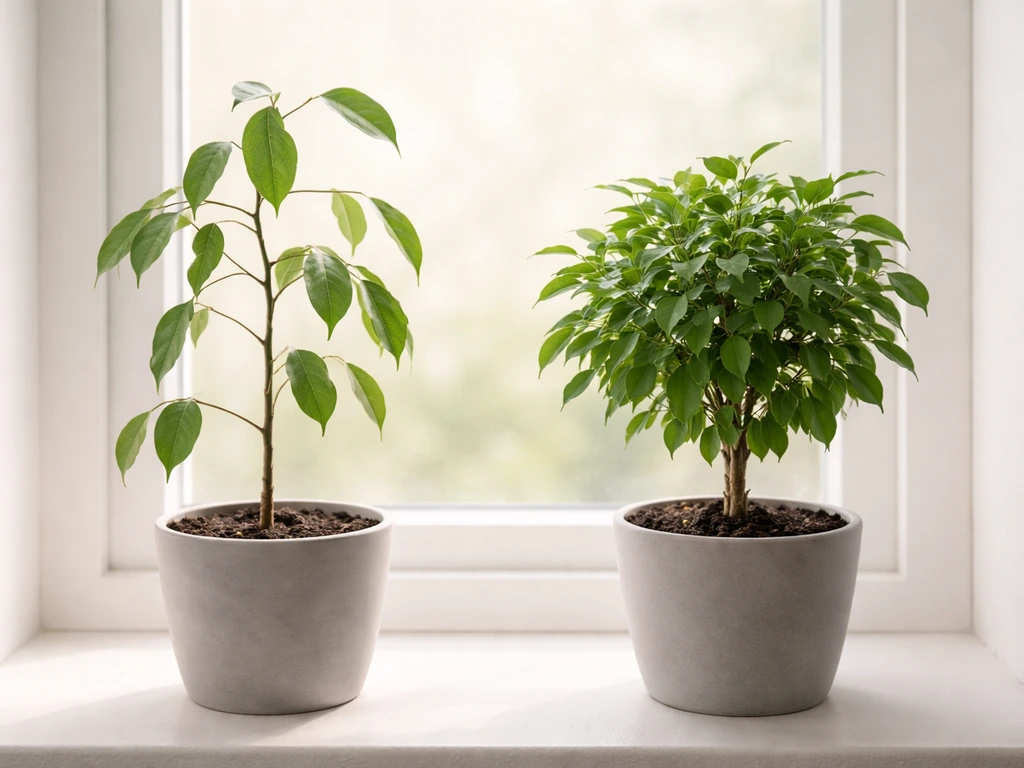
Most indoor tree problems trace back to too little light, and the plant tells you clearly if you know what to look for.
| Symptom | Likely Cause | Fix |
|---|---|---|
| Leggy growth, long gaps between nodes | Light intensity too low | Move light closer or upgrade to higher-output fixture |
| Older leaves yellowing and dropping | Insufficient light or poor light duration | Increase photoperiod to 12-14 hours; check PPFD at canopy level |
| New leaves smaller and paler than normal | Not enough light reaching growing tip | Raise light intensity or reduce distance between light and canopy |
| Leaves dropping on shadier side | Uneven light distribution | Rotate tree 90 degrees weekly; consider a second light or reflective surface |
| No new growth for months | DLI too low overall | Calculate actual DLI and compare to species minimum; likely need more hours or higher intensity |
| Leaf tips browning or bleaching | Light too intense or too close | Raise the light or reduce photoperiod slightly; check for heat stress |
Severe or prolonged light deficiency leads to chlorosis (the leaves lose their green color as chlorophyll breaks down), and if that goes on long enough, you'll see branch dieback and eventually lose the tree. Catching it early, when you first notice yellowing or leggy stems, and adjusting the setup quickly makes the difference between a recoverable situation and a lost plant.
Your next steps today
- Honestly assess your current light: measure or estimate how many hours of usable light your tree is actually getting each day, and from what source.
- Match your species to your realistic light level: if you can't hit the minimum for your current tree, either upgrade the light or swap to a more tolerant species like parlor palm or dragon tree.
- If you're buying a grow light, prioritize full-spectrum LED with published PPFD data, and pick one sized for at least 1.5 times your canopy area to avoid dim edges.
- Set a timer for 12 to 14 hours and leave it: consistency matters more than occasional bursts of intense light.
- Check back in 4 to 6 weeks and use the symptom table above to fine-tune distance, intensity, or duration.
Growing a tree indoors without natural sunlight is genuinely doable, but it rewards the people who pay attention to the details early rather than waiting for obvious problems. If you are wondering what flowers can grow without direct sunlight, the same shade-tolerant logic that applies to trees often holds for flowering plants too. So if you're asking what crops can grow without sunlight, the same basic rule applies: plants need some usable light, even if it's artificial.
Areca palms can be grown indoors as long as you provide enough usable light, usually by placing them near a bright window or using a grow light can areca palm grow without sunlight. For algae, growing without sunlight depends entirely on whether you provide an alternative light source they can photosynthesize with algae grow without sunlight. Get the species right, get the light intensity close enough, and set a consistent photoperiod.
After that it's just watching and adjusting, which is the best part of growing plants anyway.
FAQ
If I use a grow light, do I need to worry about “direct sun” versus “full spectrum” for trees indoors?
Yes, but “full spectrum” is mostly shorthand for providing enough usable PAR (the red and blue wavelengths chlorophyll uses) at the right intensity. If the light is strong enough and stays close enough to the canopy, many shade-tolerant trees do well even if the lamp is not perfectly balanced across the entire spectrum.
How do I tell whether my indoor tree is in survival mode versus healthy growth?
Track new growth quality over 2 to 4 weeks. Survival mode usually shows slow, pale, smaller leaves plus leggy or stretched stems, and older leaves may drop. Healthy growth shows steady new leaf expansion, shorter internodes (less stretching), and leaves that hold their green color while the canopy slowly thickens.
What’s a good light schedule if my household is dark at night?
Use a consistent photoperiod with a timer, typically 12 to 14 hours of light. Avoid overnight “leaks” from lights meant for living areas, because irregular dark periods can affect growth patterns. If the room is heavily dark at night, the timer-controlled grow light becomes even more important.
Can I grow an indoor tree in a closet or completely windowless room if I put it under LEDs?
It can work if you provide adequate PPFD across the whole canopy and enough daily light integral (DLI). Windowless spaces require accurate fixture sizing and placement, because distance loss is real and a small light can leave much of the canopy underpowered. If you cannot cover the canopy area well, choose a smaller tree or a multi-bar/large-panel setup.
Do I need to measure PPFD for one indoor tree, or is “distance and watts” enough?
For best results, measure or at least estimate using manufacturer PPFD maps, because PPFD drops quickly with distance and depends on the fixture design. Watts and lumens can mislead for plant growth since they do not reflect how many photosynthetic photons reach the leaves.
What should I do if my tree stretches toward the light even though it has a grow light?
Increase effective light first: raise the PPFD by moving the light closer (within safe heat and distance guidelines for that fixture), extend the light coverage area, or reduce the height gap between light and canopy as the tree grows. Also rotate the pot regularly, since uneven light angles can worsen “one-sided reaching.”
Is it better to run the grow light for longer each day or to increase brightness?
Usually start by matching the daily light duration to a safe range (about 12 to 14 hours). If the tree still shows deficiency signs, adjust brightness or coverage to raise PPFD rather than extending to extreme photoperiods. Over time, pushing beyond the typical 16-hour cap can disrupt normal development.
How close can I place LED or fluorescent lights to an indoor tree?
Distance is species- and fixture-dependent. LED grow lights are often placed around 12 to 24 inches above the canopy for shade-tolerant trees, but seedlings need closer placement with fluorescent fixtures (commonly only a few inches). If leaves curl or bleach, lower the light intensity or increase the distance, then re-check growth response after a week.
Does using a grow light mean I should stop rotating the tree?
No. Even with artificial lighting, you can get uneven growth if the fixture is not perfectly centered or if coverage is limited across the canopy. Rotate the pot every couple of weeks to help maintain a more balanced structure.
Will my indoor tree need fertilizer differently if it is growing under low light?
Often yes. If light is limited, the tree’s carbohydrate production is limited, so it cannot use as much fertilizer effectively. Use a lighter feeding approach than you would for high-light growth, and prioritize stabilizing light first, because excess nutrients under weak light can increase stress or cause salt buildup.
What are the most common mistakes that kill indoor trees trying to grow without sunlight?
The big ones are total darkness, insufficient light coverage across the canopy, wrong light duration (especially 24/7), and waiting too long after early deficiency symptoms like pale leaves or leggy growth. Another frequent issue is assuming lumens or watts guarantee plant-ready intensity, instead of verifying PPFD or using proven fixture placement.