
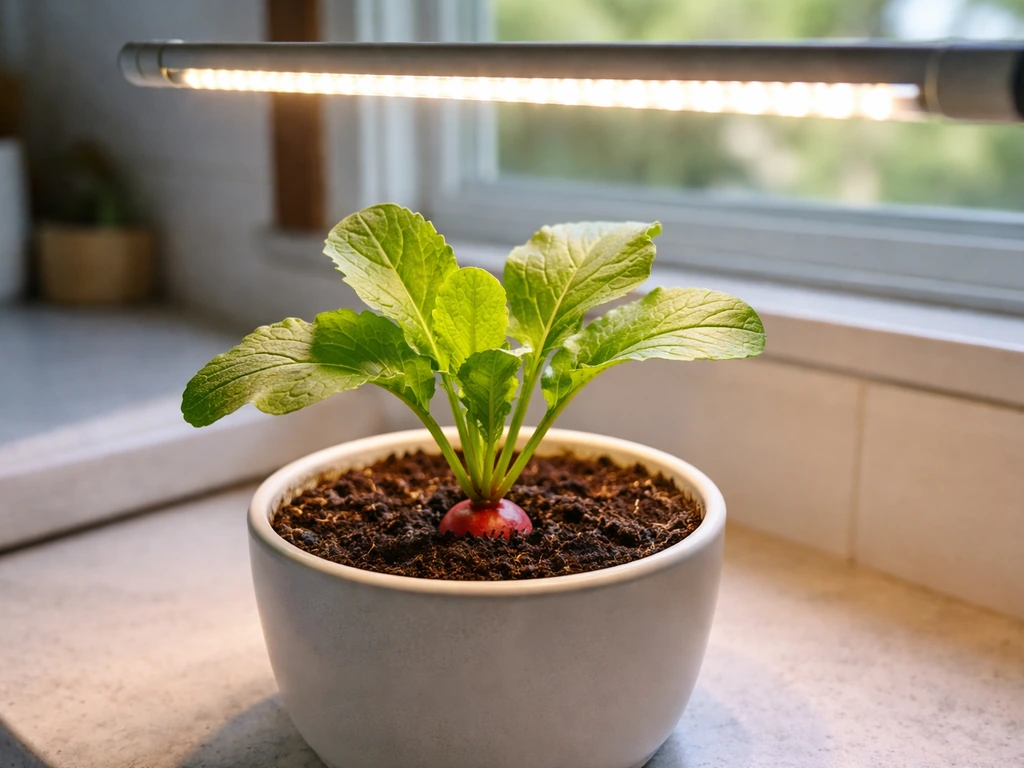
Radishes need at least 6 hours of direct light per day to grow well, and they genuinely prefer 8 to 10 hours. They do best in full sun, but they can tolerate partial shade down to about 4 to 6 hours if you accept slower growth and smaller roots. Indoors, that usually means your sunniest south or west-facing window, or a grow light running 12 to 16 hours a day to compensate for lower intensity.
Do Radishes Need Sunlight to Grow? Indoor Light Guide
Marcus Hartley
12 May 2026
Do radishes need full sun, or can they get by with less?
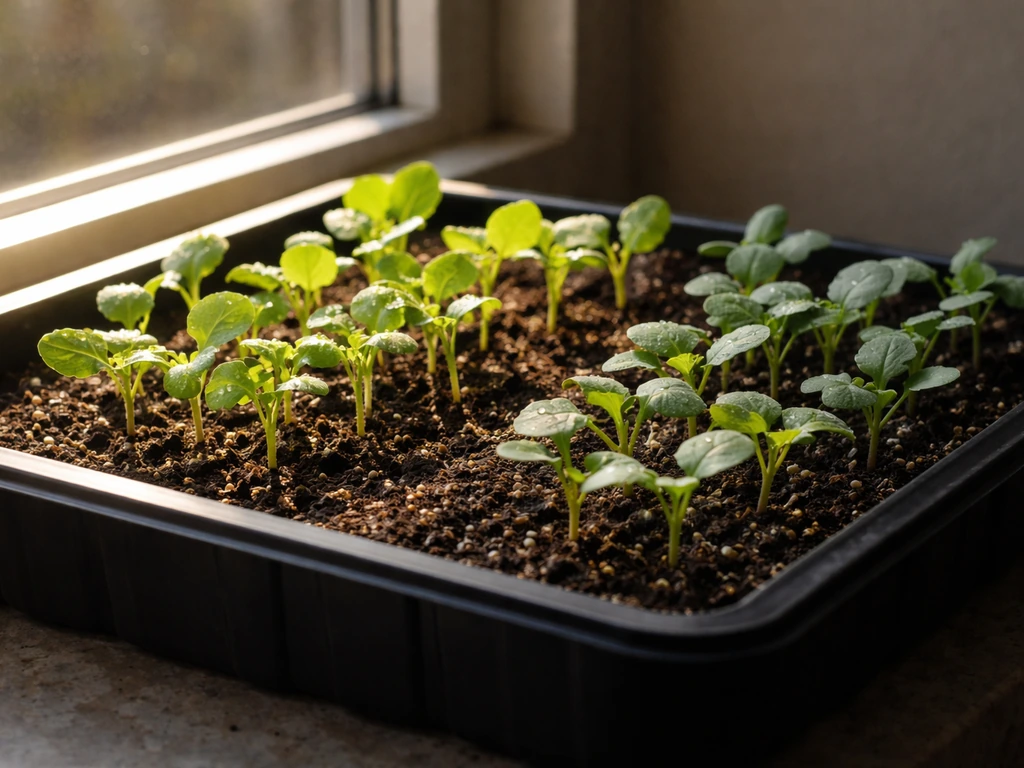
Technically, yes, radishes are classified as a full-sun crop. Full sun means at least 6 hours of direct light per day, and the University of Maryland Extension notes that radishes prefer 8 to 10 hours for the best results. But here is the nuance that matters for indoor growers: radishes are one of the more forgiving vegetables when it comes to light. They can survive and still produce edible roots in partial shade, which is 4 to 6 hours of direct sun daily, though you will get smaller roots and slower growth.
The key word there is "direct." Bright indirect light through a sheer curtain is not the same as direct sun hitting the leaves. Radishes need actual photons reaching the canopy with enough intensity to drive photosynthesis and fuel root development. When they don't get it, they put their energy into stretching toward whatever light exists rather than swelling that bulb underground. So while radishes are more shade-tolerant than, say, tomatoes or peppers, they still have a real minimum threshold you need to meet.
One thing working in your favor: radishes grow fast. Most round varieties are ready to harvest in 22 to 30 days. Because the growing window is so short, getting the light right from day one matters more than with slower crops like carrots. do carrots need sunlight to grow slower crops like carrots. If the light is marginal for even part of that window, you'll notice it in the final root size.
How much light radishes actually need: hours, intensity, and DLI
Let's break this down into numbers you can actually use. The extension-based guidance for radishes translates to three practical tiers:
| Light Level | Hours per Day | Expected Result |
|---|---|---|
| Full sun (ideal) | 8–10 hours direct | Fast growth, full-sized roots, best flavor |
| Minimum full sun | 6 hours direct | Good growth, slightly smaller roots |
| Partial shade (tolerable) | 4–6 hours direct | Slower growth, noticeably smaller roots |
| Below 4 hours | Under 4 hours direct | Spindly tops, little to no root development |
If you're using a grow light, intensity matters just as much as hours. Controlled research on cherry radishes has used a canopy-level PPFD (photosynthetic photon flux density, basically the intensity of usable light) of around 180 μmol/m²/s for normal growth conditions. A reasonable indoor target is 150 to 250 μmol/m²/s at the canopy level. Some indoor growers aim higher, around 500 μmol/m²/s, but that's more than you need for a fast-maturing root vegetable and can increase your electricity costs without a proportional benefit.
To tie hours and intensity together, think in terms of DLI, or daily light integral. DLI is the total amount of usable light your plants receive over a full day, and it's calculated by multiplying PPFD by hours and a conversion factor. Running a light at 200 μmol/m²/s for 14 hours gives you a DLI of around 10 mol/m²/day, which is a solid target for radishes.
Virginia Tech’s Extension guidance for indoor microgreens production includes a lighting regime that lists “cabbage and radish” at 8 hours photoperiod and 200 µmol·m−2·s−1 PPFD, with DLI depending on those light settings [8 hours photoperiod and 200 µmol·m−2·s−1 (cabbage and radish)](https://www. pubs. ext. vt.
edu/SPES/spes-756. html). If your light is weaker, run it longer. If you can measure your setup using an app like Photone or an online DLI calculator, that's the most reliable way to know if your radishes are actually getting what they need.
Signs your radishes aren't getting enough light
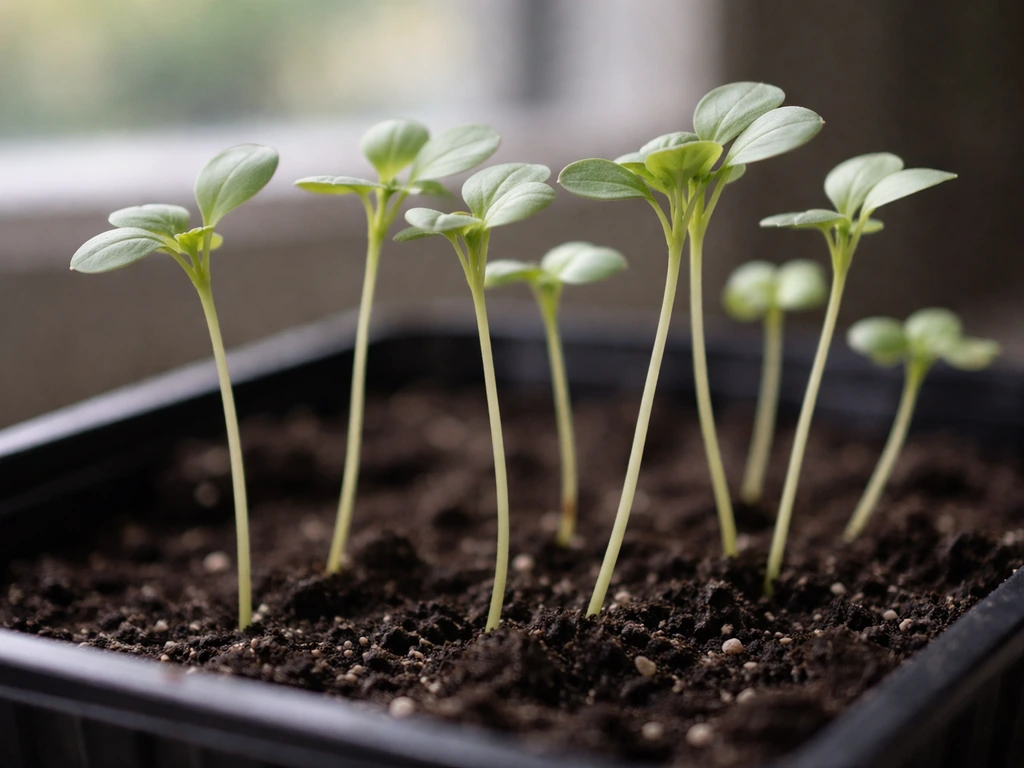
Radishes are pretty honest about light stress. Here's what to look for, roughly in the order you'd notice them:
- Leggy, elongated stems: The seedlings stretch toward the light source, producing thin, weak stems with wider-than-normal gaps between leaf sets. This is called etiolation, and it's the plant burning stored energy to reach more light.
- Pale green or yellowish leaves: Chlorophyll production depends on adequate light. Low light means less chlorophyll, which means leaves that look washed out instead of a healthy deep green.
- Small or nonexistent bulbs at harvest time: This is the most frustrating symptom because you don't see it until the end. If you pull your radishes at 28 days and find pencil-thin roots with barely any swelling, insufficient light is a top suspect.
- Slow overall growth: Radishes should germinate in 3 to 7 days and grow quickly from there. If your seedlings seem to stall and show almost no new leaf growth over a week, light is worth checking first.
- Tops flopping over: Weak stems can't support themselves. If your radish greens are falling sideways rather than standing upright, they haven't built enough structural tissue, which is often a light problem.
One thing worth noting: some of these symptoms overlap with other issues like overwatering, overcrowding, or heat stress. Radishes that are packed too tightly will shade each other and show light-deficiency symptoms even if the overall light level is fine. Keep plants spaced about 2 inches apart, or aim for 4 to 6 plants per square foot. Temperature also plays a role: radishes perform best around 60 to 70°F (roughly 21°C during the day), and a warm, dim spot will accelerate leggy growth compared to a bright, slightly cooler one.
Setting up radishes indoors: windows, containers, and placement
Window growing is entirely doable for radishes, but you need to be realistic about what your windows actually deliver. A south-facing window in a mid-latitude apartment can provide 4 to 6 hours of direct sunlight in spring and fall, which puts you in the tolerable partial-shade zone. If you are also wondering about leafy plants, the related question do vegetables need direct sunlight to grow is a useful comparison point. A west-facing window might give you 3 to 4 hours of afternoon direct sun. North-facing windows almost never provide enough direct light for radishes on their own.
If you're window-growing, place the container as close to the glass as possible without letting leaves touch the cold pane in winter. Every foot of distance from a window cuts the available light significantly. Rotating the container every couple of days helps prevent the plants from leaning heavily to one side.
For containers, depth matters. Most round radish varieties need at least 6 inches of depth for the root to develop properly. Longer varieties like daikon need at least 18 to 24 inches. Width isn't as critical, but wider containers let you grow more plants without crowding. A standard 8 to 10 inch pot works for a small batch of round radishes.
If you're trying to pick the most forgiving variety for a lower-light indoor setup, smaller, faster-maturing round varieties like Cherry Belle or French Breakfast tend to cope better than large or slow-growing types. They finish fast enough that light deficiency has less time to compound.
Using grow lights for radishes: LED vs fluorescent and how to set them up
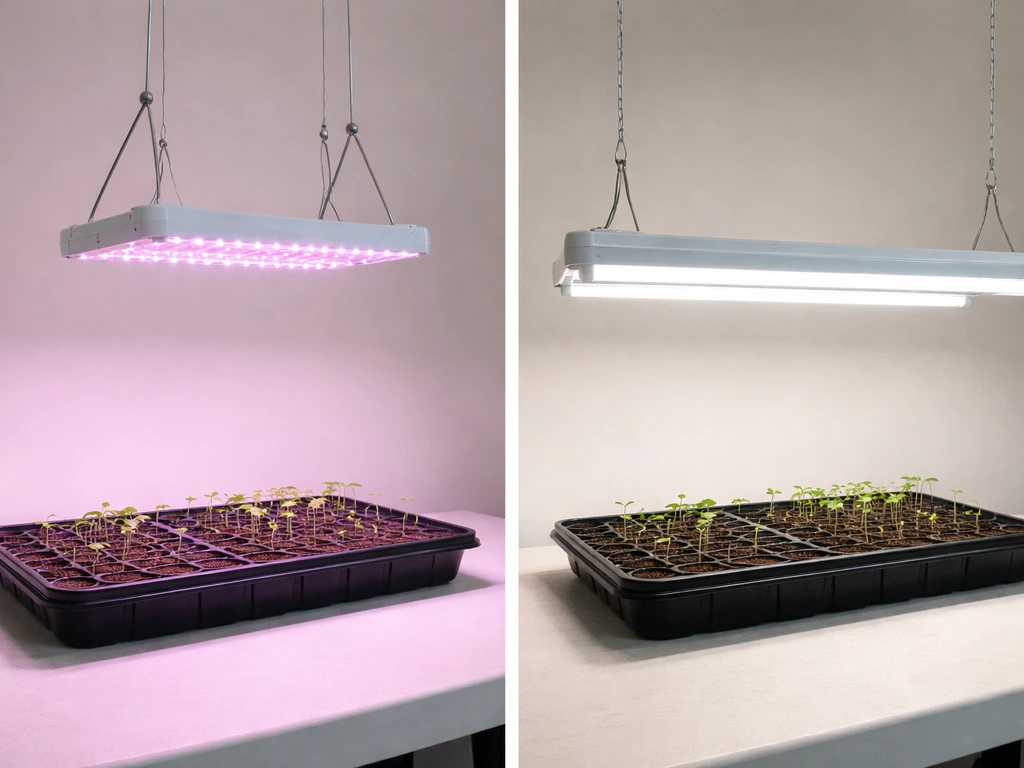
If your windows can't reliably deliver 6 or more hours of direct sun, a grow light is the practical fix. The good news is that radishes don't need a high-end setup. They're low-growing, fast-maturing plants that respond well to modest light levels.
LED vs fluorescent: which one to buy
| Feature | LED Grow Lights | Fluorescent (T5/T8) |
|---|---|---|
| Energy efficiency | High — lower running costs | Moderate — decent but less efficient than LED |
| Heat output | Low — safe close to plants | Moderate — can warm the canopy if too close |
| Upfront cost | Higher | Lower |
| Lifespan | 50,000+ hours typical | 10,000–20,000 hours typical |
| Light spectrum | Full spectrum available; check for broad PAR coverage | Good for seedlings and fast crops like radishes |
| Best for radishes | Yes, especially full-spectrum LED panels | Yes, T5 fluorescents work well for low-growing crops |
For radishes specifically, either a quality T5 fluorescent or a full-spectrum LED panel will work. If you're already growing other plants indoors and want something versatile long-term, go with LED. If you're just starting out and want a low-cost option for a quick radish crop, a T5 shop light setup gets the job done without much fuss.
How to position your grow light
Placement is where most indoor growers go wrong. Too far away and your plants are still light-starved. Too close and you risk bleaching or heat damage, though this is more of a concern with powerful LED panels than with fluorescents.
- T5 fluorescent tubes: Position 2 to 4 inches above the canopy. Because they produce moderate heat and moderate intensity, staying close is important to deliver enough PPFD.
- LED grow light panels (mid-range, 100–300W): Start at 12 to 18 inches above the canopy and adjust based on how the plants respond. Check the manufacturer's recommended distance for seedlings.
- Timer settings: Run the light 12 to 16 hours per day. Research on radish microgreens from Virginia Tech suggests 8 hours is enough at higher intensities, but for full radish root development with lower-intensity home setups, 12 to 14 hours is a safer target.
- Consistency matters: Plug your light into a timer. Irregular photoperiods stress plants and can slow development.
If you want to actually measure what your setup is delivering, the Photone app (available for iOS and Android) uses your phone's camera sensor to estimate PPFD and DLI. It's not lab-grade accurate, but it's close enough to tell you if you're in the right ballpark. Aim for a reading of 150 to 250 μmol/m²/s at canopy level.
Troubleshooting slow growth and poor bulb formation
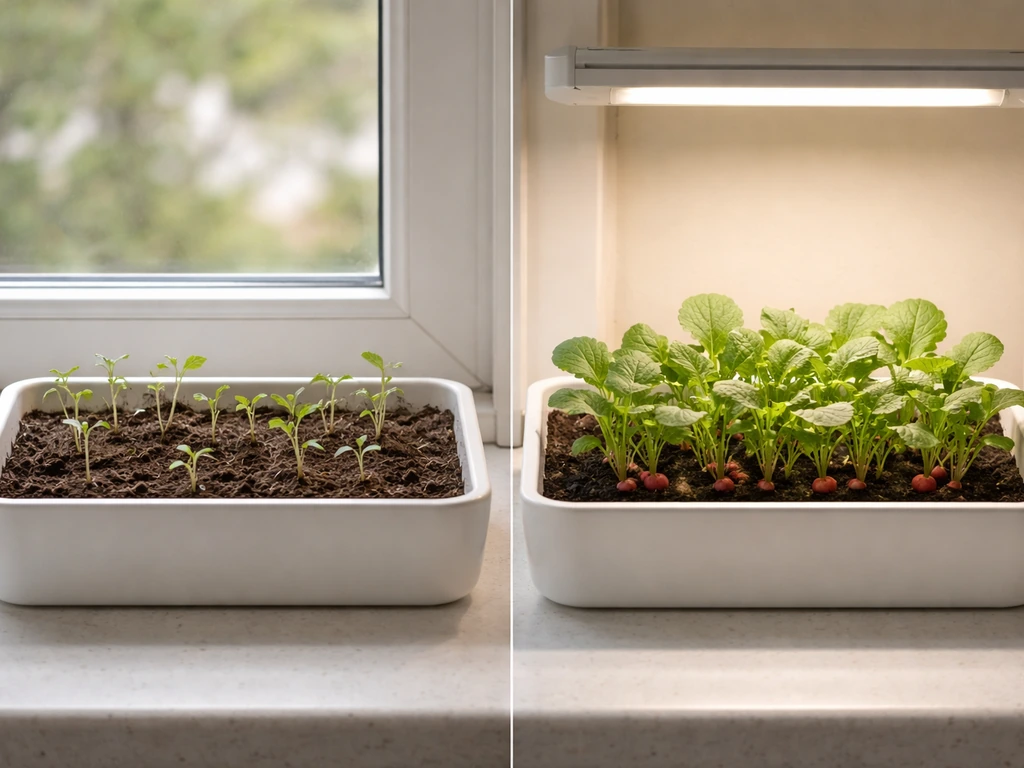
If your radishes aren't growing the way they should, work through this checklist before assuming the worst. Most indoor radish failures come down to one of a handful of fixable issues:
- Check your light hours: Are you actually hitting 6 hours minimum of direct light or 12 to 14 hours under a grow light? Count it honestly. An hour here and there of indirect glow doesn't count.
- Check your light intensity: If you're using a grow light, measure the PPFD at the canopy with an app or meter. If you're relying on a window, assess whether the sun actually hits the leaves directly or just illuminates the room.
- Check plant spacing: Plants crowded together shade each other's lower canopy. Thin to 2 inches apart. Crowding looks like a light problem but is solved with scissors.
- Check your sowing depth: Seeds planted too deep can struggle to emerge and then immediately face light stress. Radish seeds should be sown about 1/4 to 1/2 inch deep.
- Check the temperature: Radishes in a warm spot (above 75°F) bolt quickly or grow spindly even with decent light. Try to keep them in a cooler location, ideally 60 to 70°F.
- Check how old the seedlings are: In the first 5 to 7 days, radishes grow slowly by nature. Don't panic too early. If they're still stalled after 10 to 14 days, that's when you start troubleshooting.
- Check for bolting: If the plant is sending up a flower stalk rather than forming a bulb, it's likely responding to heat or an overly long photoperiod, not a light deficiency. This is a different problem with a different fix: cooler temperatures and possibly a shorter light cycle.
Growing radishes indoors is one of the more rewarding quick-win crops you can try, especially if you're newer to indoor gardening. They're fast, they tell you quickly whether your setup is working, and they're genuinely useful in the kitchen. If you're curious how light needs compare across root vegetables, radishes sit somewhere between carrots (which are a bit more demanding) and peas (which tolerate lower light better than most people expect).
Getting your radish setup dialed in is a great foundation for understanding what other edibles you can grow in your available light conditions. Peas have different light needs than radishes, so once you know your setup, it helps to also check how much sunlight peas need to grow how much sunlight do peas need to grow.
FAQ
Can I grow radishes with less than 6 hours of sunlight a day indoors?
You can sometimes get usable roots under very low light, but expect thin, slow growth and smaller bulbs, especially if the light is weak throughout the whole day. If you are below the 6 hour direct-light minimum, the most reliable fix is adding a grow light and targeting the canopy level PPFD range (about 150 to 250 μmol/m²/s) rather than extending time arbitrarily.
Does “bright light” through a window count as direct sunlight for radishes?
Not really. Radishes respond to direct, high-intensity light hitting the leaves. Bright indirect light can keep plants alive, but it often results in stretching and poor root swelling, so confirm your window actually provides direct sun hours rather than relying on ambient brightness.
How do I know if my radish problem is from low light versus watering issues?
A low-light sign is leggy growth with pale, thin leaves, while overwatering more often shows consistently droopy plants plus soggy soil or yellowing that may come with rot risk. Also, if you correct spacing and keep soil evenly moist but the roots stay small, light is the first suspect.
If my radishes are stretching, should I increase hours or increase intensity?
Increase intensity first, then adjust hours. Stretching usually means the light intensity is too low for the stage of growth. Running a low-output light longer may help, but beyond a point heat, electricity costs, and uneven coverage can become issues.
How close should a grow light be to avoid bleaching while still giving enough intensity?
Start with a moderate distance and re-check at canopy level if you can (aim roughly 150 to 250 μmol/m²/s). As a practical rule, if leaves appear washed out or tips bleach, raise the light slightly or shorten the photoperiod. Fluorescents generally tolerate closer setups better than strong LEDs.
What photoperiod works best, 12, 14, or 16 hours indoors?
Use hours to reach the daily light integral goal, not a fixed number. For many indoor setups, 12 to 16 hours is workable, but the right choice depends on PPFD. If your light output is low, longer runtime is better than giving the same short time at higher intensity.
Do radishes need darkness at night or can I leave the lights on all day?
They do best with a regular dark period. Leaving lights on continuously can stress plants and encourage weak growth patterns, plus it complicates natural cues. A common approach is an 8 to 16 hour light window, then off for the remainder of the day.
Does the container size or depth change how much sunlight radishes need?
Depth affects root development, so shallow containers can limit growth even if light is adequate. If your pots are too shallow, you may think light is the limiting factor because roots stay stunted. Keep round varieties at least about 6 inches deep (and deeper for daikon-type roots).
Why do my radishes look shaded even though I placed them near the light?
Crowding causes self-shading. If plants are too close, taller ones block light from others, leading to uneven root sizes and light-deficiency symptoms on the lower or more crowded plants. Spacing around 2 inches apart for many round varieties helps prevent that.
Do different radish varieties need different amounts of light?
They do in practice, because slower or larger varieties have a longer window to accumulate light, and that makes low-light effects compound. Faster-maturing, smaller round types tend to tolerate marginal light better, since they finish sooner.
If I only get morning sun from my window, is that enough?
It can be, but the key is total direct hours and intensity. Morning sun may deliver fewer total direct hours than afternoon sun depending on your orientation and season, so measure the actual direct-light window. If you land under about 6 direct hours, supplement with a grow light to stabilize performance.