
Yes, grass needs light to grow. Without it, photosynthesis stops, and the plant can't produce the energy it needs to build roots, shoots, or anything else. But here's the part that actually matters for most people asking this question: grass does not require direct sunlight specifically. It needs enough light intensity and enough hours of it. Ginger similarly needs enough light intensity and daily exposure to support healthy growth enough light to support healthy growth. If you can supply that through a bright south-facing window or a decent LED grow light, you can grow grass indoors without a single ray of direct sun.
Does Grass Need Sunlight to Grow Indoors? Light Guide
Marcus Hartley
20 Apr 2026
Does grass actually need light at all
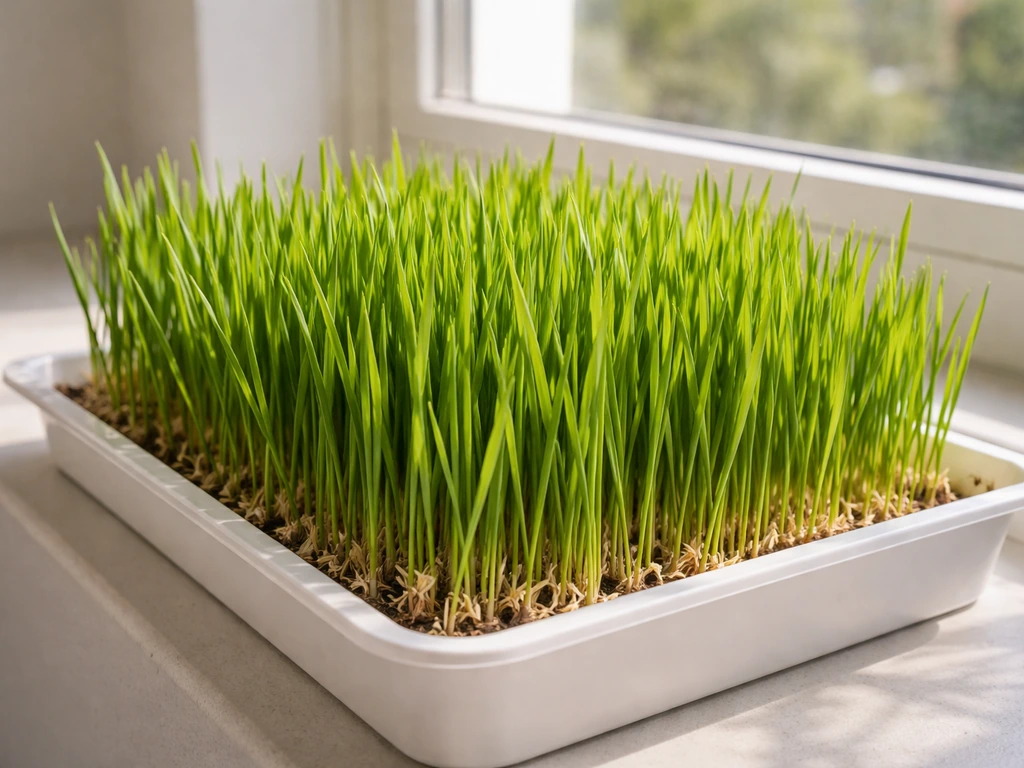
Grass is a plant, and like all plants it runs on photosynthesis. Chlorophyll in the leaf blades absorbs light and converts it into sugars the plant uses to fuel root growth, new shoot production, and general survival. Take away the light and that engine shuts down. So yes, light is non-negotiable for grass. Yes, seaweed relies on enough light for photosynthesis, but it does not necessarily need direct sunlight.
What's less obvious is how much light grass actually needs. Turf researchers measure this using a metric called DLI, or daily light integral, which is basically the total dose of photosynthetically useful light a plant receives in a day. Warm-season grasses like bermudagrass need roughly 16 to 25 mol per square meter per day in spring to maintain acceptable quality. That's a lot, and it puts into context why grass is notoriously hard to grow under shade trees or in low-light indoor spaces. It's not being fussy for the sake of it. It genuinely needs a higher photon dose than most houseplants.
Grass-like houseplants, such as sedges, mondo grass, or liriope, are a different story. Many of those are shade-tolerant by nature. But if you're growing actual turf grass (think lawn grass, cat grass, or wheatgrass indoors), the light demands are real and you'll need to plan for them.
Sunlight vs direct sunlight: what "direct" actually changes
This is where people get tripped up. "Sunlight" and "direct sunlight" are not the same thing, even though we use them interchangeably in everyday conversation. Direct sunlight means the sun's rays hit the plant without any obstruction, like placing a pot right in a south-facing window where the sun shines straight on it for several hours. Bright indirect light means the space is well-lit but the sun isn't hitting the plant directly, maybe it's a few feet back from the window, or the window faces east and gets morning brightness without harsh afternoon rays.
For grass, the difference is mostly about intensity and heat, not some magical quality that only direct sun provides. What matters is total light dose. A south-facing window that floods a room with light can deliver enough brightness to support grass growth even if the blades aren't sitting right in the beam. An east or west-facing window gives partial sun and partial shade, which may work with supplemental lighting added in. A north-facing window is genuinely low-light and is going to struggle with grass without grow lights. It's worth being honest with yourself about which situation you're actually in, because "bright indirect light" covers a wide range and not all of it will cut it for grass.
One more thing worth knowing: terms like "bright indirect" and "medium light" are gardening shorthand, not scientific measurements. Weather, season, neighboring buildings, and window glass all affect how much light actually reaches your plants. In December in the northern US, an unassisted window might deliver a DLI of only 2 to 4 mol per square meter per day, far below the 10 to 12 that most crops need as a minimum, and nowhere near what turf grass wants. Knowing this helps you stop blaming yourself when a windowsill-only setup fails in winter. The light just isn't there.
What happens when grass doesn't get enough light
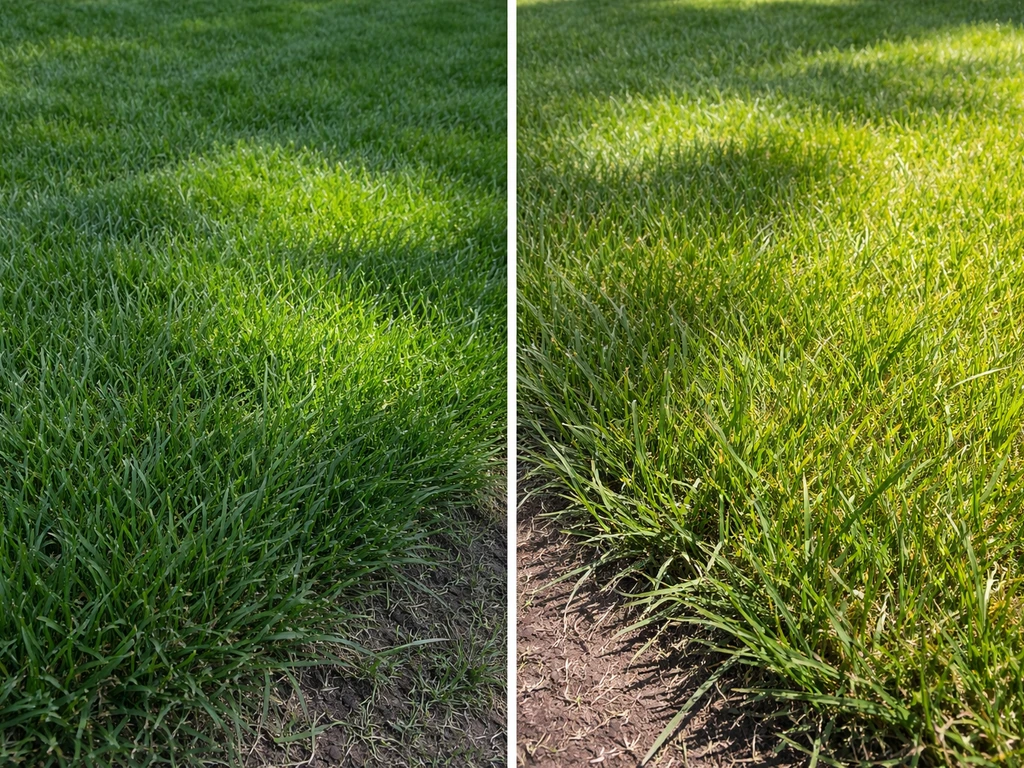
I've grown wheatgrass in my apartment and let me tell you, the difference between a well-lit tray and an underlit one is obvious within a week. Grass under low light doesn't just grow slowly. It changes shape. The blades get tall and thin and floppy as the plant stretches upward trying to reach more light. Researchers call this etiolation or leggy growth. At the same time, roots get shorter, the overall density of shoots thins out, and the grass loses that lush, upright look you're going for.
Over time, the color shifts too. You'll notice the blades going from a healthy deep green to a pale, yellowish green. The grass just doesn't have enough light energy to maintain full chlorophyll production. Vigor drops, and the plant becomes more vulnerable to disease. In shaded outdoor turf, overwatering a low-light lawn compounds the problem because less light means less evaporation, which means higher humidity and wetter soil, conditions that invite fungal diseases like Pythium blight that cause further thinning and off-color patches.
The practical takeaway: if your grass is growing tall and spindly, pale green or yellowish, and thinner than it should be, light is almost certainly the issue. Not water, not fertilizer, not the pot. Light first.
Growing grass indoors with a window
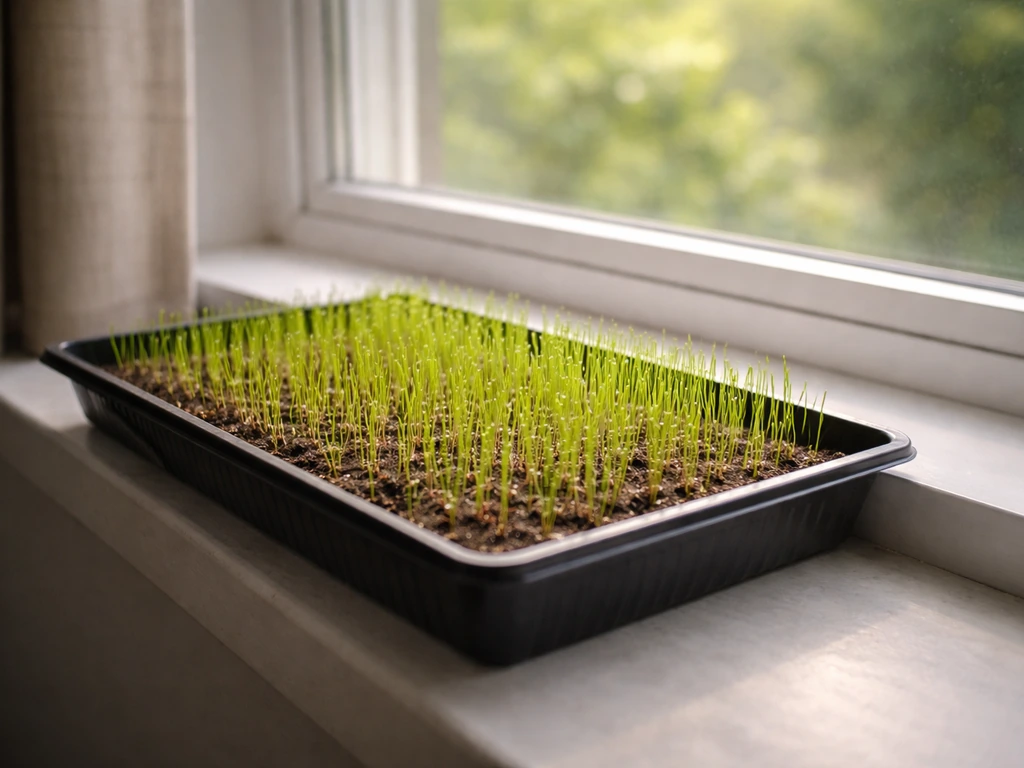
Window-only growing can work for grass, but you have to be strategic about which window you use and what time of year it is. A south-facing window is your best bet in the northern hemisphere. It gets the most consistent light across the day and can support grass growth year-round, especially in spring through fall.
East or west-facing windows work reasonably well in summer when days are long and the sun angle is higher, but they may need supplemental light in winter. North-facing windows don't provide enough light for grass on their own, full stop. For sprouts, the same rule applies: they need enough light for photosynthesis, and they can be grown indoors under proper light if you avoid keeping them in the dark.
Placement matters too. Light intensity drops dramatically as you move a plant away from the window. Set your grass container as close to the glass as you can get it. Rotate the tray every couple of days so all sides get even exposure and you don't end up with blades leaning dramatically in one direction.
- Use a south-facing window if at all possible, especially in winter months
- Place the container right on the windowsill or within 12 inches of the glass
- Rotate the tray every two to three days for even growth
- Clean the window glass to maximize light transmission (dusty glass blocks more light than you'd think)
- In winter or cloudy climates, plan to add a grow light even if you have a good window
Best artificial lighting for growing grass indoors
If your window situation isn't ideal, or you just want consistent results year-round without worrying about seasons, a grow light is the way to go. The two main options for home growers are LED grow lights and fluorescent grow lights, and both can work well for grass. Here's how they compare.
| Feature | LED Grow Lights | Fluorescent Grow Lights |
|---|---|---|
| Energy efficiency | High (less heat, lower electricity use) | Moderate (produces more heat per watt) |
| Upfront cost | Higher | Lower |
| Lifespan | Long (often 50,000+ hours) | Shorter (typically 10,000–20,000 hours) |
| Light spectrum | Broad or targeted (full-spectrum LEDs available) | Broad white light, decent for general growth |
| PPFD output | High for size | Lower per fixture |
| Best for | Serious setups, long-term use, tight spaces | Budget setups, wide trays, beginner use |
For grass specifically, you want a full-spectrum LED panel or a T5 fluorescent fixture. Full-spectrum LEDs are the better long-term investment because they're more efficient, run cooler, and deliver a higher usable photon output per watt. A T5 fluorescent strip works fine for a small tray of cat grass or wheatgrass and costs less upfront, which matters if you're just experimenting. What you want to avoid is a single low-output incandescent or decorative LED bulb. Those are not grow lights. They won't cut it.
When evaluating grow lights, look at blank" rel="noopener noreferrer">PPFD (micromoles of light per square meter per second) rather than watts or lumens. Watts measure electricity consumption and lumens measure brightness as humans perceive it. Neither is the right metric for plant growth. PPFD tells you how much photosynthetically active radiation is actually hitting your plants. A target of around 200 to 400 µmol per square meter per second at canopy level is a reasonable starting range for grass grown indoors. Pair that with enough daily hours and you'll hit an adequate DLI.
Light placement, timing, and how to tell if your grass needs more
How to position your grow light
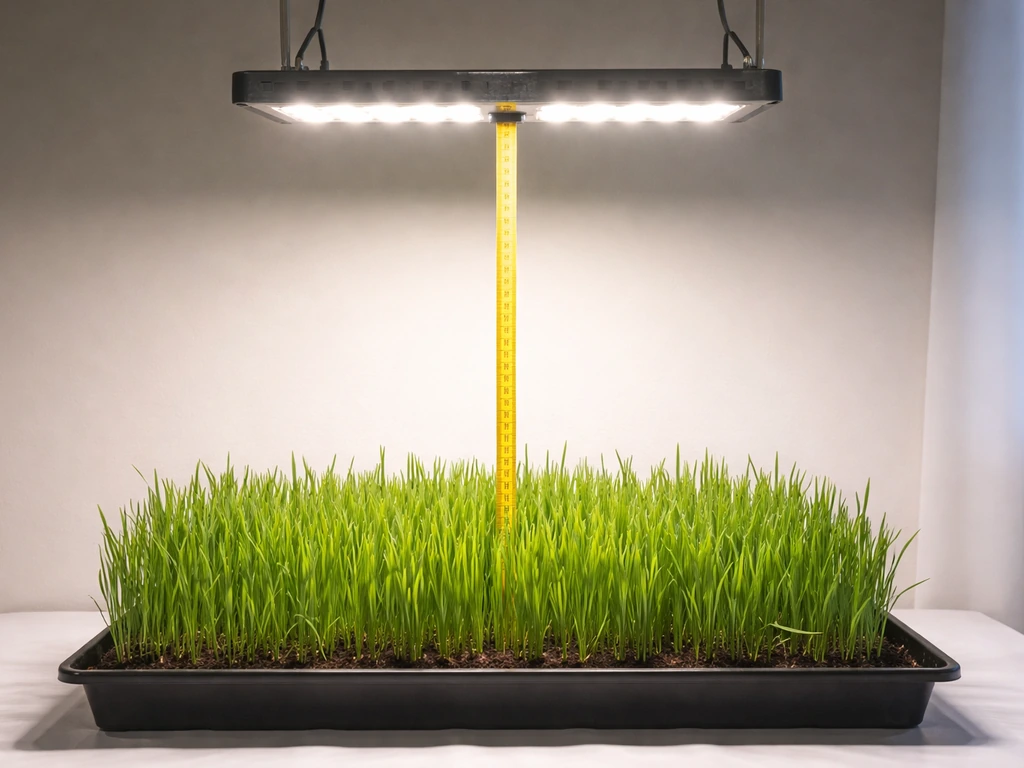
Most grow lights need to be positioned 6 to 18 inches above the grass canopy, though this varies by fixture strength. A high-output LED can hang higher; a weaker fluorescent strip needs to be much closer. Start at 12 inches above the tops of the blades and adjust based on how the grass responds. If the tips start to look scorched or bleached, raise the light. If growth is still leggy after a week, lower it or extend your daily duration.
How many hours per day
For grass, aim for 14 to 16 hours of light per day under artificial lighting. This mimics a long summer day and keeps the DLI high enough to support healthy growth. You can use a basic outlet timer to automate this. Set it and forget it. One thing worth knowing: you can compensate for lower light intensity by running the light longer. If your fixture isn't the strongest, bumping from 14 to 16 hours per day adds meaningful photon dose without any extra equipment.
Signs your grass isn't getting enough light
- Blades are tall, thin, and floppy rather than upright and dense
- Color is pale green or yellowish instead of rich, deep green
- Growth feels slow or the tray looks sparse even after a week or two
- Grass leans strongly toward the light source
- The base of the grass feels damp and looks thin at soil level
If you're seeing any of these, try increasing either the intensity or the duration of light before changing anything else. Move the light closer, add another fixture, or extend the daily timer by two hours. Give it five to seven days after making the change before evaluating again. Grass responds pretty quickly, so if you've made a real improvement you'll see it within a week.
A quick checklist for improving grass light conditions right now
- Move the container to the brightest window in your space, ideally south-facing
- Clean the window glass to remove dust and grime that filters light
- If using a grow light, confirm it's positioned 6 to 18 inches above the canopy
- Set a timer for 14 to 16 hours of light per day
- Check PPFD at canopy level if you have a meter or lux meter with conversion, aim for 200 to 400 µmol/m²/s
- Rotate trays every two to three days for even coverage
- In winter, assume window light alone is insufficient and add supplemental lighting
- Reassess in five to seven days after any change
Growing grass indoors is genuinely more demanding than growing most houseplants in terms of light, and that's the honest truth. Plants like ferns, bird's nest ferns, or even cress can get by on far less light than turf grass needs. Bird's nest fern, for example, only needs enough light intensity to support photosynthesis, so it does not strictly require direct sunlight like some people assume.
Cress also relies on enough light for photosynthesis, so under low-light conditions it will grow slowly or get leggy. But with the right window or a solid grow light setup, it's absolutely doable. Ginger is another photosynthesizing plant, so it will need adequate light to grow well. The key is understanding that it's not about direct sun versus indirect sun.
It's about total light dose, delivered consistently, day after day. Once you stop chasing "direct sunlight" as a requirement and start thinking about intensity and duration instead, the whole thing becomes a lot more manageable.
FAQ
Can grass grow indoors with a window that gets sun only part of the day?
Yes, as long as the total light dose is high enough. A window that delivers direct sun for only morning or only late afternoon can work, but you may need to move the tray closer to the glass and rotate it more often to prevent uneven, leggy growth on the shaded side.
Why does my grass look pale or yellow even though I think it’s near the window?
Pale, yellowish blades usually point to insufficient light energy (not fertilizer or watering). In practice, winter window light can be too weak even if the room feels bright, so the fix is usually adding a grow light or extending the light hours rather than changing nutrients.
How do I know whether the problem is too little light versus overwatering?
Low light and overwatering often look similar, but overwatering usually shows soggy, staying-wet soil and sometimes foul smell. If the blades are also getting tall, thin, and floppy, that points to light first (etiolation). Reduce water only after confirming the light level is truly sufficient.
Does cat grass or wheatgrass need the same light as lawn grass?
They generally need similarly high light for dense, steady growth, but the exact requirement varies by the species and your goal. Wheatgrass grown for short harvest cycles can tolerate slightly lower light for a while, yet you’ll still get thinner, paler blades if intensity is too low.
How close should I keep the grass to the grow light, and what should I watch for?
Start with the light positioned roughly 6 to 12 inches above the canopy, then adjust based on response. If tips look bleached or scorched, raise the light; if growth is still spindly after about a week, lower it or extend daily hours.
What’s better for grass indoors, more hours of light or higher intensity?
Either can work, but if you can’t increase intensity (a weak fixture), extending the photoperiod by a couple of hours is often the easiest way to raise your daily light dose. If you can increase intensity, you can usually keep the schedule shorter and still avoid leggy growth.
Is 24/7 light harmful for indoor grass?
It’s not a good idea. Grass needs a dark period for normal daily rhythms, and running lights continuously can also make it harder to manage humidity and temperature. For most home setups, sticking to a consistent 14 to 16 hours per day is a safer baseline.
Do I need full-spectrum LEDs, or will any bright LED bulb work?
A standard “bright” bulb usually won’t deliver enough photosynthetically usable light. For turf grass, look for a real plant grow light setup (for example, full-spectrum LED panels or a T5 fixture), and verify performance using PPFD at canopy level rather than trusting wattage or lumens.
Why does my grass lean toward one side near the light source?
Uneven exposure causes that. Even if the average light is adequate, intensity drops across the tray, so one side grows faster and the blades lean. Rotate the tray every couple of days and keep it as close to the light source or window as practical.
Can grass be grown indoors without any natural light at all?
Yes, completely artificial light works if you provide enough light dose consistently. The key is meeting both the intensity (PPFD at canopy) and the daily duration (hours per day), since “no natural light” is only a problem when your fixtures are too weak or on too short of a schedule.
My grass is growing but seems thin and sparse. Should I fertilize more?
Try light first. If growth is thin, pale, and leggy, extra fertilizer usually won’t fix the root cause because photosynthesis is limiting energy supply. Once you confirm the light is adequate and growth density improves, then you can fine-tune nutrients and watering.