
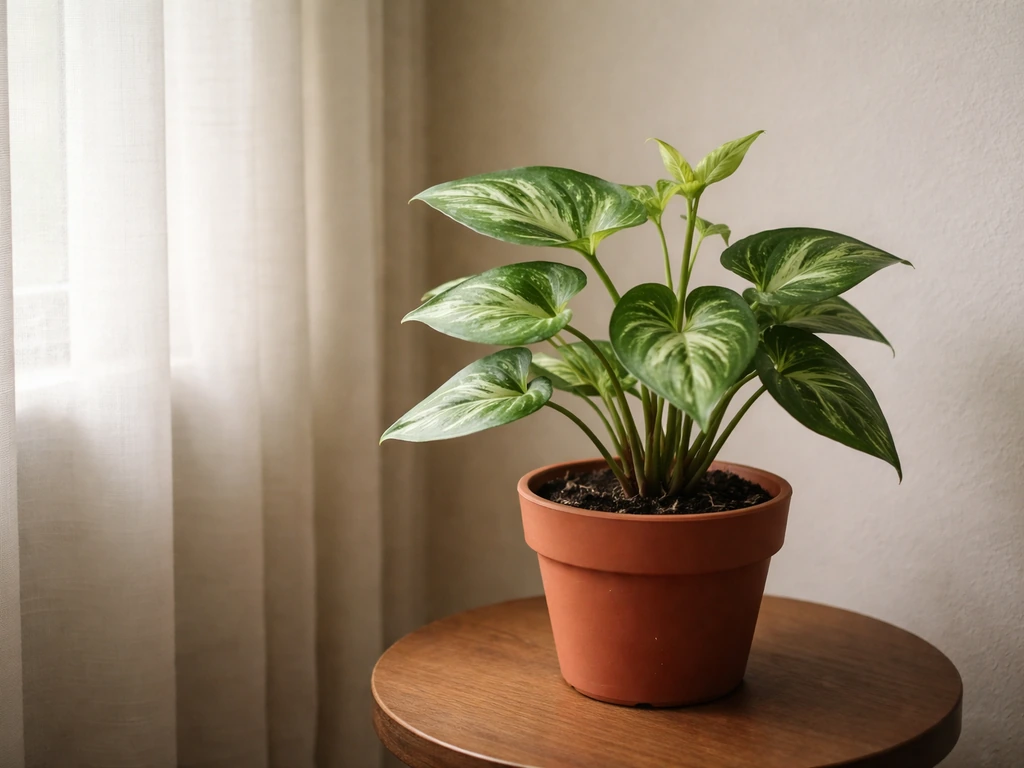
Yes, syngonium can grow in low light. It's one of the houseplants that researchers and commercial growers explicitly list as suitable for low-light rooms, and it genuinely tolerates dimmer conditions better than most tropical foliage plants. That said, tolerating low light and thriving in it are two different things. In very dim spaces, your syngonium will survive but it'll stretch toward any available light, produce smaller leaves, and if you have a variegated cultivar, those creamy or pink markings will fade toward plain green. Understanding that trade-off upfront saves a lot of frustration.
Can Syngonium Grow in Low Light? What to Expect and Fix
Marcus Hartley
19 May 2026
What low light actually does to your syngonium
Light is what drives photosynthesis, so when there's less of it, everything slows down. Your syngonium produces less energy, which means less new growth, smaller leaves, and longer internodes (the stretches of bare stem between each leaf node). That stretched, reaching look is called legginess, and it's the plant physically trying to find more light rather than a sign something is catastrophically wrong.
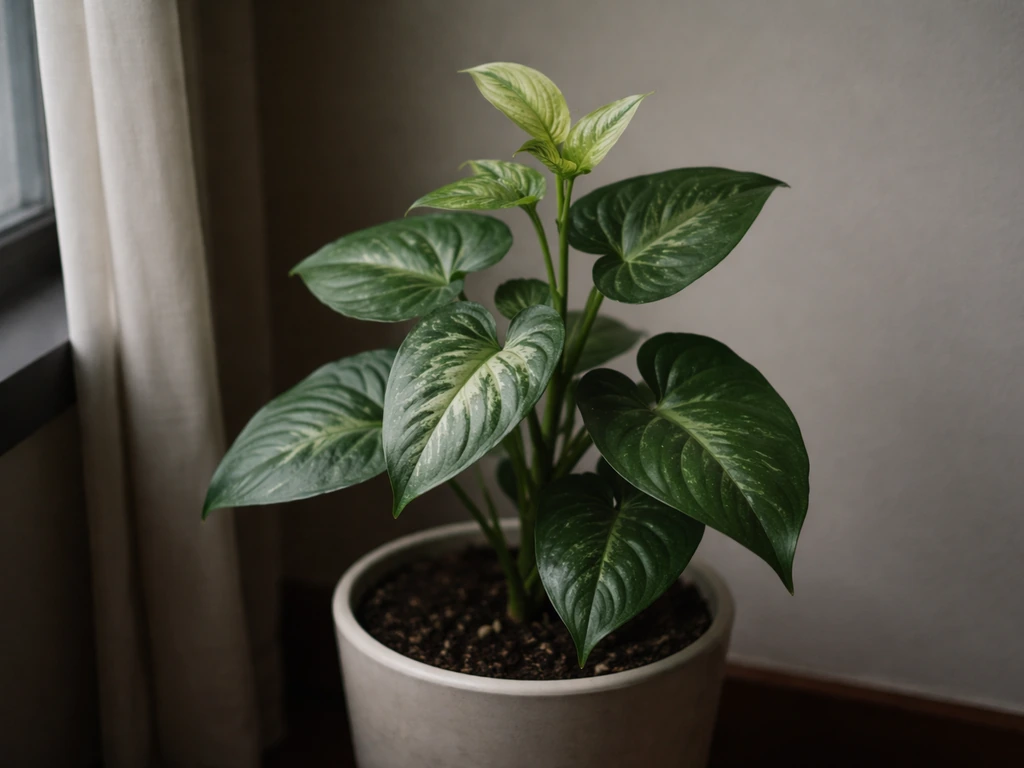
Here's what you'll typically see as light drops below the plant's comfortable range. New leaves come in noticeably smaller than established ones. The stems get long and floppy instead of compact and bushy. For variegated cultivars like 'Albo Variegatum' or 'Pink Allusion,' the variegation fades because the plant reduces the non-green tissue that can't contribute to photosynthesis when energy is already scarce. Leaf color overall shifts to a duller, lighter green. None of this is instant, but over several months in a genuinely dark corner, the decline becomes obvious.
Growth also slows significantly, which has a knock-on effect for watering and feeding. A plant that's barely photosynthesizing isn't drinking much water or pulling nutrients from the soil quickly, so the same care routine you used in a brighter spot will lead to overwatering and fertilizer buildup in low light.
What 'low light' actually means in your home
People throw the phrase 'low light' around loosely, so let's get specific. In measurable terms, plant growers use foot-candles or lux to describe light intensity. Better Indoor Houseplants also offers a practical conversion so you can translate a light meter reading: 1 foot-candle is approximately 10.7 lux. One foot-candle is roughly 10.7 lux. For reference, the sweet spot for syngonium in production settings runs around 100 to 250 foot-candles (about 1,070 to 2,675 lux) for healthy foliage growth. A genuinely low-light spot in your home, like a north-facing room or a corner several feet from any window, typically delivers less than 50 foot-candles.
You don't need a light meter to make a reasonable judgment, though. Here's how common home situations translate in practice:
| Spot in your home | Approximate light level | Good for syngonium? |
|---|---|---|
| Within 3 feet of an east-facing window | 150–400 foot-candles | Yes, this is ideal |
| 3–5 feet from a north-facing window | 50–150 foot-candles | Survives, watch for legginess |
| 6–8 feet from an unshaded south/west window | 100–200 foot-candles | Yes, with sheer curtain if needed |
| Shaded corner, no direct window view | Under 50 foot-candles | Struggles over time |
| Bright office with overhead fluorescents only | 50–100 foot-candles | Marginal, supplement if possible |
The bottom line: syngonium sits comfortably near an east-facing window or a meter or two back from a filtered south or west window. A north-facing room isn't a death sentence, but anything that feels dark to you probably is genuinely too dark for long-term health without a grow light.
Signs your syngonium is getting enough light (and signs it isn't)
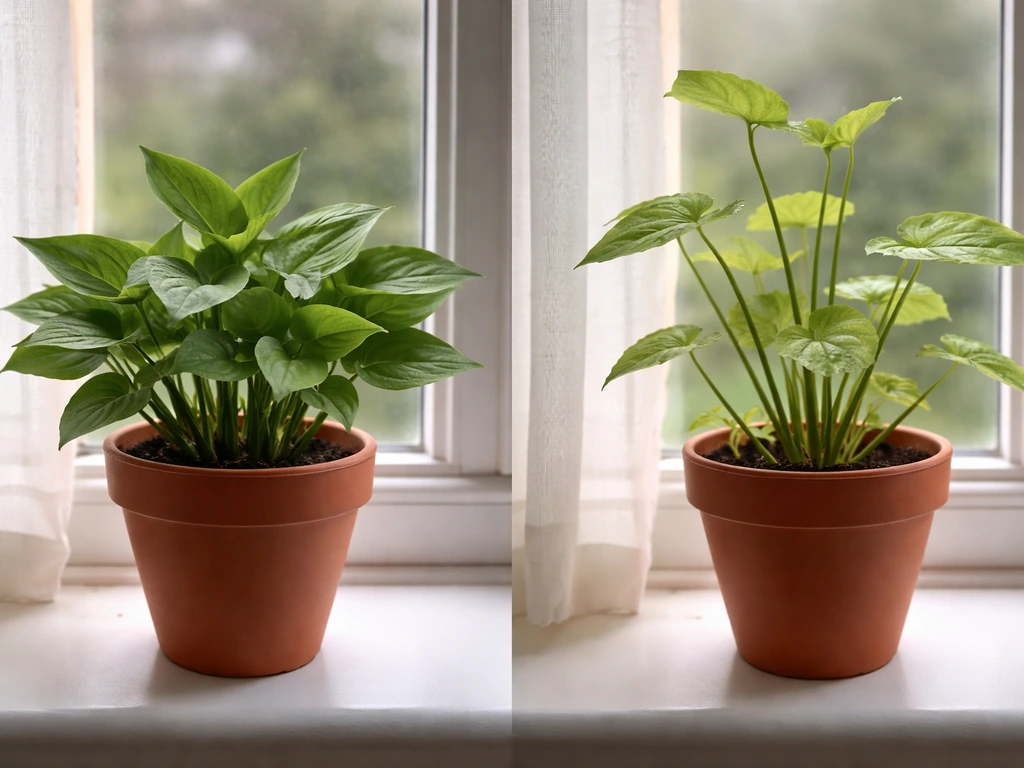
A syngonium that's managing fine in lower light looks compact-ish, puts out new leaves at a steady if slow pace, and holds its color reasonably well. It won't be a fast grower, but it won't look desperate either. Here's a simple checklist to read what your plant is telling you:
Signs it's doing okay
- New leaves are similar in size to older ones (or slightly larger as the plant matures)
- Stem internodes are reasonably short and the plant looks bushy rather than stringy
- Leaf color is consistent with what you'd expect for that cultivar
- Variegation, if any, is still visible and not fading toward plain green
- Soil dries out slowly but steadily between waterings
Signs light is too low
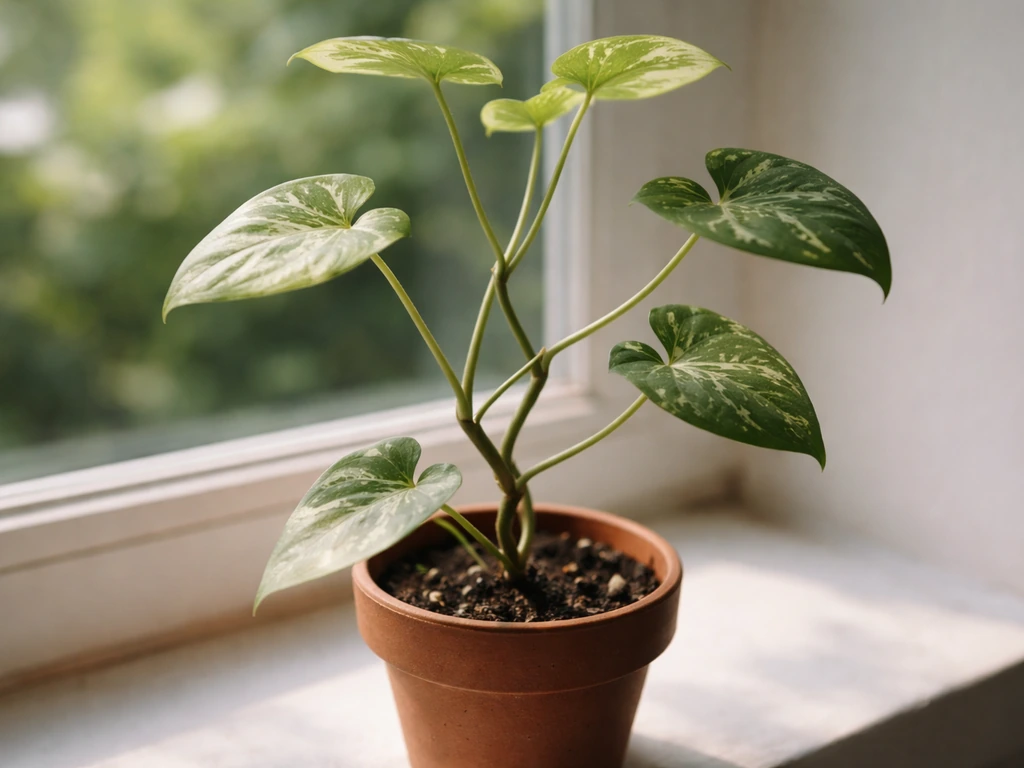
- Long, stretched stems between leaves (legginess)
- New leaves are noticeably smaller than older leaves
- Variegated areas shrinking, fading, or turning plain green
- Leaf color looks washed out or duller than before
- Soil is staying wet for weeks because the plant isn't actively growing or transpiring
- The plant leans sharply toward the nearest light source
If you're seeing two or more of those warning signs at the same time, your syngonium needs more light. Move it closer to a window or add a grow light before the decline continues.
Adjusting your care routine for low light
Most people kill low-light syngoniums not because the light itself is fatal, but because they keep watering and fertilizing at the same rate they would for a bright-spot plant. A syngonium in dim conditions is basically idling. It's photosynthesizing slowly, growing slowly, and drinking slowly. Push it with too much water or fertilizer and you'll get root rot and salt buildup fast.
Watering
Check the top 2 cm of soil and only water when it feels dry to the touch. In low light this might mean watering every 10 to 14 days instead of every week. Don't water on a schedule, water based on what the soil is actually doing. Err toward drier rather than wetter when the plant is in a dim spot.
Fertilizing
Cut back to once a month at most during the growing season, and skip it entirely in winter if the plant is in a genuinely low-light spot and barely growing. A plant that isn't actively growing can't use the nutrients, and they'll just accumulate in the soil as salts. If you're seeing yellowing leaves alongside dim conditions, check the roots for rot before adding more fertilizer, since nutrient deficiency is rarely the first problem in a low-light setup.
Rotation and pruning
Rotate your syngonium a quarter turn every week or two. In a low-light home, the plant will lean hard toward whatever window or light source is nearby, and one-sided growth gets ugly fast. Rotating keeps growth more even. If the stems are already leggy, don't be afraid to prune them back to a node. This encourages the plant to put out new, bushier growth rather than continuing down a stretched stem.
Grow lights for low-light spaces: what actually works
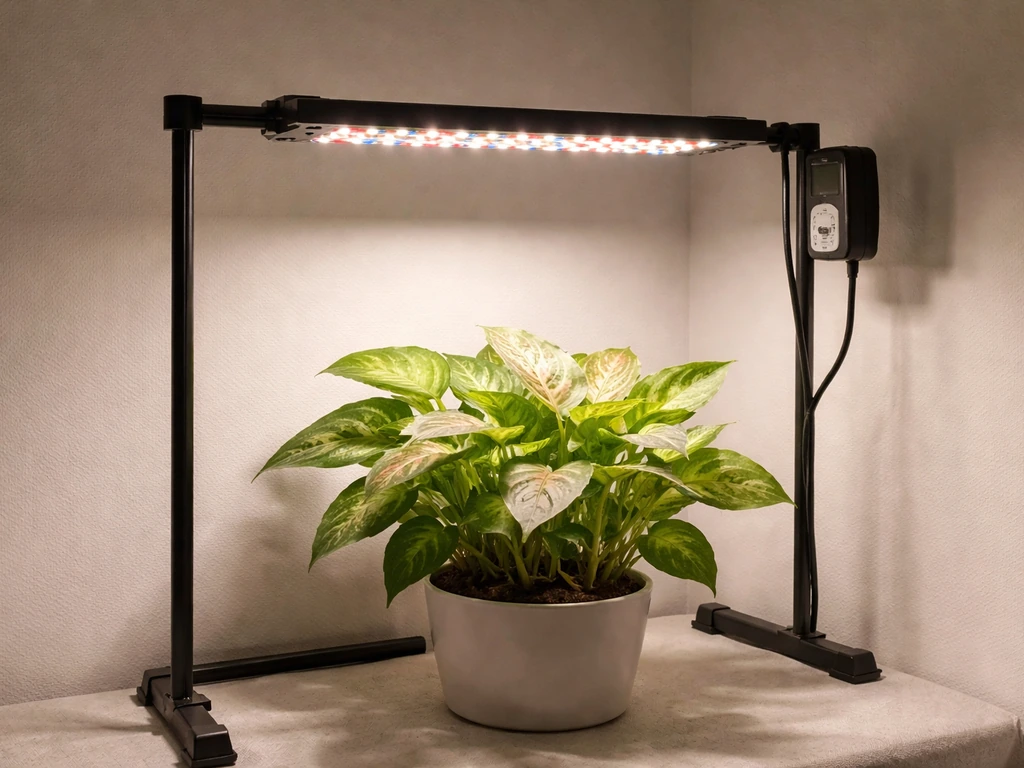
If your space is genuinely dim and you want your syngonium to look good rather than just survive, a grow light is the most reliable solution. This doesn't mean spending a fortune. A modest LED panel or a clip-on grow bulb is often enough.
LED vs. fluorescent
For most people growing syngonium in a home setting, a full-spectrum LED grow light is the better choice. LEDs are more energy-efficient, run cooler, and last longer than fluorescent tubes. A basic full-spectrum LED grow bulb (2,000 to 3,000 lux at the plant canopy) is sufficient for syngonium. Fluorescent grow lights (T5 or T8 tubes) do work and can be a good budget option if you already have a fixture, but they're bulkier and less efficient. Either will do the job if set up correctly.
Distance and duration
For most LED grow lights, placing the light 18 to 24 inches above the plant's canopy hits a useful intensity without risking heat stress or bleaching. Closer than 12 inches can cause light stress even on a low-wattage LED. As a baseline, run the light for 10 to 12 hours per day if your space gets some ambient daylight, or 12 to 14 hours per day in a room with essentially no natural light. Using a simple outlet timer takes the guesswork out of it entirely.
Ramping up safely
If your syngonium has been sitting in very low light for a while, don't blast it with 14 hours of bright grow light immediately. Start at 8 hours a day and at the maximum recommended distance for your light, then increase duration by an hour or two per week. This gives the plant time to adjust its leaf chemistry to the higher light levels without shock.
Getting the most light out of your indoor setup
Beyond choosing a grow light, how you position the plant in your space matters a lot. A few simple changes can meaningfully increase the light your syngonium receives without adding any gear.
- Place the plant as close to an east-facing window as possible. East windows deliver gentle morning sun that syngonium handles well without the scorching intensity of an afternoon west or south window in summer.
- If you only have a bright south or west window, position the plant 6 to 8 feet back or use a sheer curtain to filter the harshest midday light.
- Put light-colored or white surfaces near the plant. A white wall, a light-colored shelf, or even a sheet of white foam board propped nearby reflects ambient light back onto the plant and makes a noticeable difference in genuinely dim rooms.
- Keep leaves clean. Dust on leaves blocks light absorption. Wipe them down with a damp cloth every few weeks.
- If you're in a north-facing flat with no direct light at any time of day, that's the situation where a grow light stops being optional and starts being necessary for a syngonium that looks good long-term.
Your decision path for today
Here's the honest summary. Syngonium is one of the more forgiving tropical foliage plants for lower-light homes, comparable in adaptability to sansevieria and some pothos varieties, but it does have a floor below which it stops looking good. If you are also wondering about other tough foliage options, can swiss cheese plant grow in low light is a common related question to check alongside your syngonium setup low-light homes. If you're wondering whether can sansevieria grow in low light, the short answer is yes, with similar limits on how much it will truly thrive comparable in adaptability to sansevieria. If your space delivers at least 100 foot-candles consistently, a syngonium will grow there with adjusted watering and occasional rotation. If your room is so dim that even low-light conditions start to disappoint, you may also be wondering can air plants grow in low light, and the answer depends on how much indirect light they get. If it's dimmer than that, the plant will survive but gradually decline in appearance unless you add a grow light. If you are also wondering about other plants, like anubias, the answer depends on whether you can provide enough high light consistently can anubias grow in high light. In the same way that syngonium needs more light to avoid gradual decline, a can monstera grow in artificial light with the right brightness and hours.
- Assess your space honestly: is there a window the plant can get within 3 to 5 feet of?
- If yes, place it there, rotate weekly, reduce watering frequency, and cut fertilizer to once a month.
- Watch for the warning signs (legginess, fading variegation, small new leaves) over the next 4 to 6 weeks.
- If the signs appear or you have no usable window, add a full-spectrum LED grow light at 18 to 24 inches, running 10 to 14 hours per day on a timer.
- Adjust watering based on soil dryness, not a fixed schedule, especially in low light.
- If the plant is already leggy, prune it back before you move or supplement it so new growth comes in under better conditions.
Syngonium is genuinely one of the better picks for lower-light indoor spaces, and with a small grow-light investment it can look lush even in a dim apartment. The key is being honest about what your space actually provides and adjusting your care to match the plant's slower pace in those conditions rather than treating it like it's in a sunroom.
FAQ
How do I tell if my syngonium is in low light or just getting less-than-ideal light?
Use a quick behavior check. If the plant is producing new leaves regularly (even slower than normal), staying mostly compact, and keeping leaf color reasonably even, it is likely tolerating the light. If new leaves keep getting smaller over multiple months and stems become progressively longer and flopier, it is drifting into true low light.
Will variegated syngonium tolerate low light the same way as green varieties?
Variegated types usually handle low light worse, not because they cannot survive, but because they lose the non-green parts that cannot photosynthesize as effectively. In low light, expect slower growth and more fade. If you notice variegation dropping quickly, prioritize moving it closer to the brightest window you have or use a grow light.
Does low light affect watering frequency or root health differently for syngonium?
Yes. In dim conditions the soil dries much more slowly, so watering “by the calendar” is a common reason for root problems. In addition to checking the top 2 cm, consider lifting the pot to judge weight, and make sure excess water drains fully from the bottom to prevent constantly damp media.
If my syngonium is already leggy, should I wait for more light or prune right away?
You can do both, but prune first only if the plant is clearly stretching and looks unbalanced. Cut stems back to a node after you move it to better light or start a grow light schedule, then new growth typically forms from the nodes you left. This prevents the plant from continuing to invest energy in an already-stretched stem.
How long does it take for a syngonium to recover after moving from low light to a brighter spot or adding a grow light?
Recovery is gradual because new leaves reflect the new light conditions. Expect to see improved leaf size and sturdier growth over several weeks, with a clearer turnaround over 1 to 3 months. If color and leaf size do not improve after new growth appears, the light may still be too low or the plant may have root issues.
Can I use only ambient light at night to help a syngonium in a dark room?
Usually not in a meaningful way. Indoor ambient nighttime light is typically too weak for photosynthesis, and plants still need a proper daytime light period to grow. If the room stays dim for most of the day, a grow light is the reliable fix.
What grow-light mistakes cause problems for syngonium in a low-light home?
Two common mistakes are placing the light too high or too low, and running it too long. Too close can trigger light stress, too far or too weak will not stop legginess. Also, if you are adjusting from very dim conditions, increase duration gradually instead of jumping to the longest schedule right away.
Does fertilizer help a syngonium in low light, or does it just make things worse?
Fertilizer tends to be counterproductive in low light because uptake is slow, which increases the chance of salt buildup. If you add anything, keep it minimal and only when the plant is actively pushing new growth. If yellowing happens in low light, check roots for rot before assuming it needs more nutrients.
My syngonium is in low light but growing slowly, should I still rotate it?
Yes. Even when growth is slow, the plant will still lean toward the brightest direction. A quarter turn every 1 to 2 weeks keeps the silhouette more even and reduces asymmetrical stretching over time.