Yes, plenty of plants can grow under fluorescent light alone. Low-light houseplants like pothos, snake plants, peace lilies, ZZ plants, and Chinese evergreen do well under standard fluorescent fixtures. Leafy greens like lettuce, spinach, and herbs like parsley and chives can also thrive under fluorescent tubes if you run them long enough and keep them close enough.
Plants That Can Grow in Fluorescent Light: A Guide
Marcus Hartley
16 May 2026
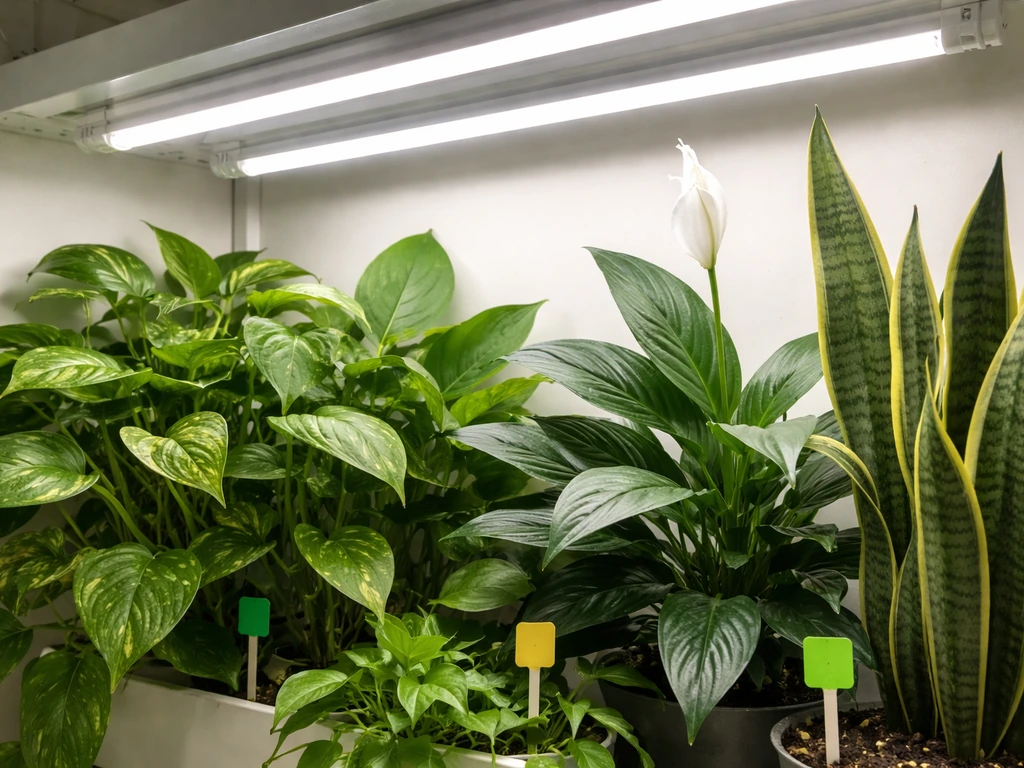
If you’re wondering about extreme photoperiods, can lettuce grow under 24 hour light, the answer depends on intensity and how well the plant can handle continuous light run them long enough. If you are wondering about tube lights specifically, the key is keeping them close and running them long enough for photosynthesis. What fluorescent light can't reliably do is support heavy fruiting plants like tomatoes, peppers, or flowering orchids when it's the only light source.
Grow Light Central’s fluorescent light guidance notes that fluorescent fixtures are generally not powerful enough for vigorous flowering or fruiting when used alone, compared with dedicated grow LEDs. Know that going in, and you'll set yourself up for success instead of frustration.
How fluorescent light affects plant growth
Fluorescent bulbs produce light by passing electricity through mercury vapor, which excites phosphor coatings inside the tube to emit visible light. The specific spectrum you get depends on those phosphor coatings, which is why a cool white tube looks bluish and a warm white looks yellowish. Plants use light in the 400 to 700 nanometer range for photosynthesis (called PAR, or photosynthetically active radiation), and fluorescent lights do hit most of that range. The catch is intensity.
Fluorescent tubes emit far fewer usable photons than either sunlight or dedicated LED grow lights. A tomato seedling sitting in full sun can meet its entire daily light need in about 5 hours. Under a standard fluorescent fixture, that same seedling [might need 22 hours of continuous light](https://extension. unh.
edu/resource/growing-seedlings-under-lights-fact-sheet) to match it. For sun-loving plants, that math simply doesn't work out. For shade-tolerant plants that are adapted to living under forest canopies, it's often more than enough.
There's also the distance problem. Fluorescent light intensity drops off fast as you move the bulb further from the plant. At 6 inches away, you're getting a reasonably useful amount of light. At 18 inches, you've lost a significant chunk of that intensity. This is why office plants directly under ceiling fluorescent fixtures can look okay, while a plant on a shelf three feet below those same lights often just barely survives. Understanding this helps you make smart placement decisions rather than wondering why your plants are struggling.
How much light your plants really need (and how to approximate it)
Plant scientists measure light exposure using Daily Light Integral (DLI), which is basically the total amount of photosynthetically useful light a plant receives in a day. You calculate it by multiplying the light intensity (measured in micromoles per square meter per second, or µmol/m²/s, called PPFD) by the number of hours you run the light, then multiplying by 0.0036. So if your fluorescent tube delivers 50 µmol/m²/s at plant level and you run it for 16 hours, your DLI is about 2.9 mol/m²/day. That's enough for low-light plants. Sun-loving plants generally want a DLI of 20 to 30 or higher, which is very hard to achieve with fluorescent alone.
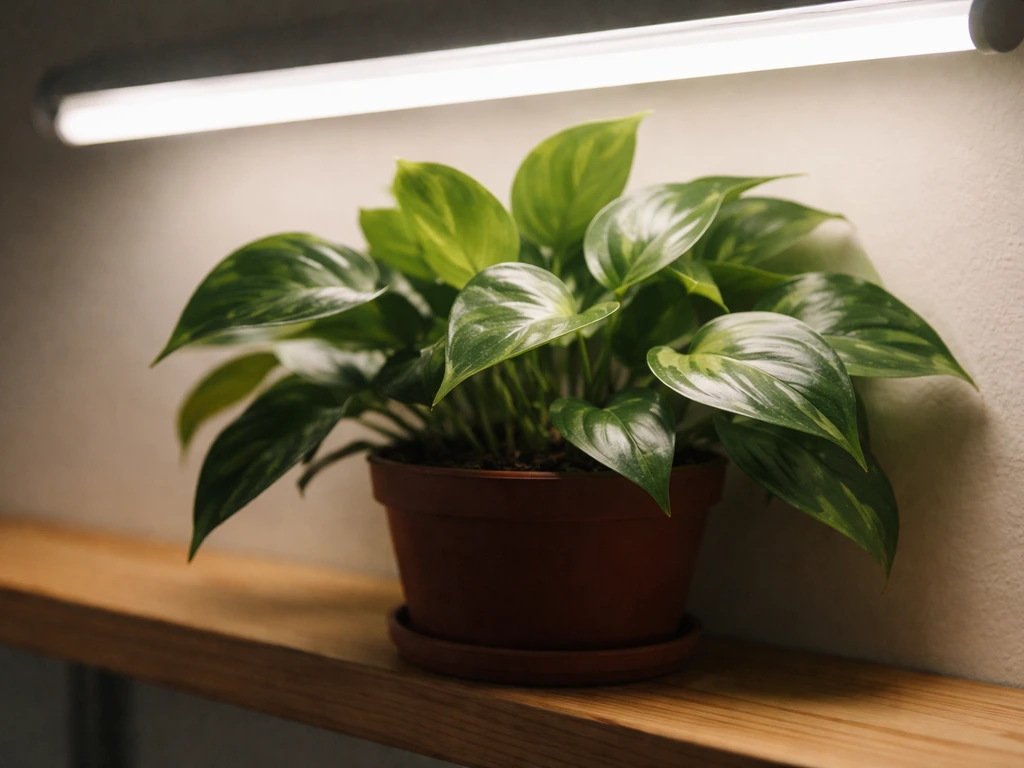
You don't need a light meter to get a rough sense of what you're working with. As a practical rule: position your fluorescent fixture 2 to 6 inches above low-light plants and run it 14 to 16 hours per day. For medium-light plants like herbs, push closer to 16 hours and keep the tube within 4 inches. If you don't have a way to measure PPFD, extending photoperiod is the easiest lever you have to compensate for lower intensity. This is why a simple timer is one of the best investments for a fluorescent setup.
Best plants for fluorescent light (low-light tolerant indoor picks)
These are plants that either naturally tolerate low light levels or have been commonly and successfully grown under fluorescent fixtures. I've organized them by use case so you can pick what fits your situation.
Great for windowless rooms or office fluorescent setups
- Pothos (Epipremnum aureum): almost indestructible under fluorescent light, will trail and grow even under weak fixtures
- Snake plant (Sansevieria/Dracaena trifasciata): extremely low light tolerance, very slow-growing but steady under fluorescents
- ZZ plant (Zamioculcas zamiifolia): thick rhizomes store water and energy, handles low-light fluorescent conditions well
- Chinese evergreen (Aglaonema): darker-leaved varieties in particular are adapted to low light and do fine under office tubes
- Cast iron plant (Aspidistra elatior): earns its name, genuinely tolerates dim fluorescent conditions
- Peace lily (Spathiphyllum): one of the few plants that can bloom under standard fluorescent light given enough hours
Edibles and herbs that work under fluorescent grow setups
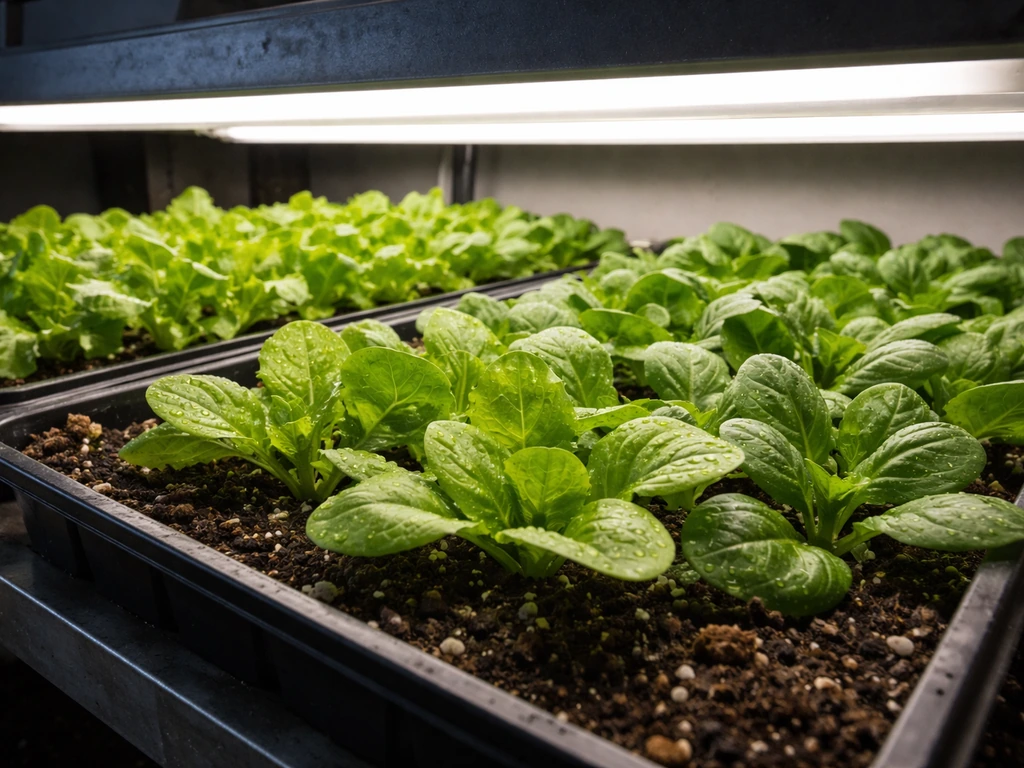
- Lettuce and salad greens: lower DLI requirement than most vegetables, very well-suited to fluorescent tubes kept 2 to 4 inches above the leaves
- Spinach: similarly low light needs, bolts less under fluorescent than under intense grow lights
- Arugula: fast-growing, low-light tolerant, great for a fluorescent herb shelf
- Parsley: slower to establish but grows well under fluorescent at 16 hours per day
- Chives: one of the most forgiving herbs for artificial light, handles fluorescent very reliably
- Mint: vigorous grower that doesn't need intense light, does well under standard tubes
- Microgreens (sunflower, radish, pea shoots): germinate and grow quickly, don't need high light levels
Ferns and tropicals that like filtered light
- Boston fern (Nephrolepis exaltata): appreciates humidity and moderate light, tolerates fluorescent well
- Heartleaf philodendron: similar profile to pothos, very tolerant of lower fluorescent light levels
- Dracaena (various species): most varieties adapt well to fluorescent office environments
- Bromeliad: can flower under fluorescent light if photoperiod is long enough, good for adding color
Plants to avoid under fluorescent-only setups (common disappointments)
This is where honesty matters. Some plants are popular and tempting, but fluorescent-only setups will leave you disappointed. It's not about skill. It's about physics. These plants need more photons than a fluorescent tube can realistically deliver.
| Plant | Why fluorescent falls short | What to try instead |
|---|---|---|
| Tomatoes | High DLI requirement for fruiting, needs strong direct light for many hours | LED grow lights with at least 200 µmol/m²/s at canopy level |
| Peppers | Similar to tomatoes, needs intense light for fruit set | High-output LED or HID lighting |
| Basil | Can survive but stretches badly, flavor suffers, prone to legginess | Supplement with LED or place directly under a T5 HO tube |
| Succulents and cacti | Native to intense desert sun, fluorescent causes etiolation (stretching) | South-facing window or LED grow light |
| Orchids (Phalaenopsis, Cattleya) | Need specific light intensity and spectrum cues for blooming | LED grow lights designed for orchids |
| Fiddle leaf fig | Needs strong, bright indirect light, deteriorates under weak fluorescent | Natural window light or high-output grow light |
| Monstera deliciosa | Can survive but grows very slowly and leaves stay small | Window light with occasional supplemental LED |
Basil is the one I hear people get frustrated by most often. It looks fine for a week or two, then goes completely leggy and starts flopping over. That's not user error, that's a plant telling you it needs more photons. If you love basil, a T5 high-output fluorescent placed 2 inches from the canopy and run for 16 hours can sometimes work, but you'll do much better with a small LED. If you love basil, a T5 high-output fluorescent placed 2 inches from the canopy and run for 16 hours can sometimes work, but you'll do much better with a small LED artificial light.
How to set up fluorescent lighting for better growth (bulb choice, placement, duration)
Picking the right bulb
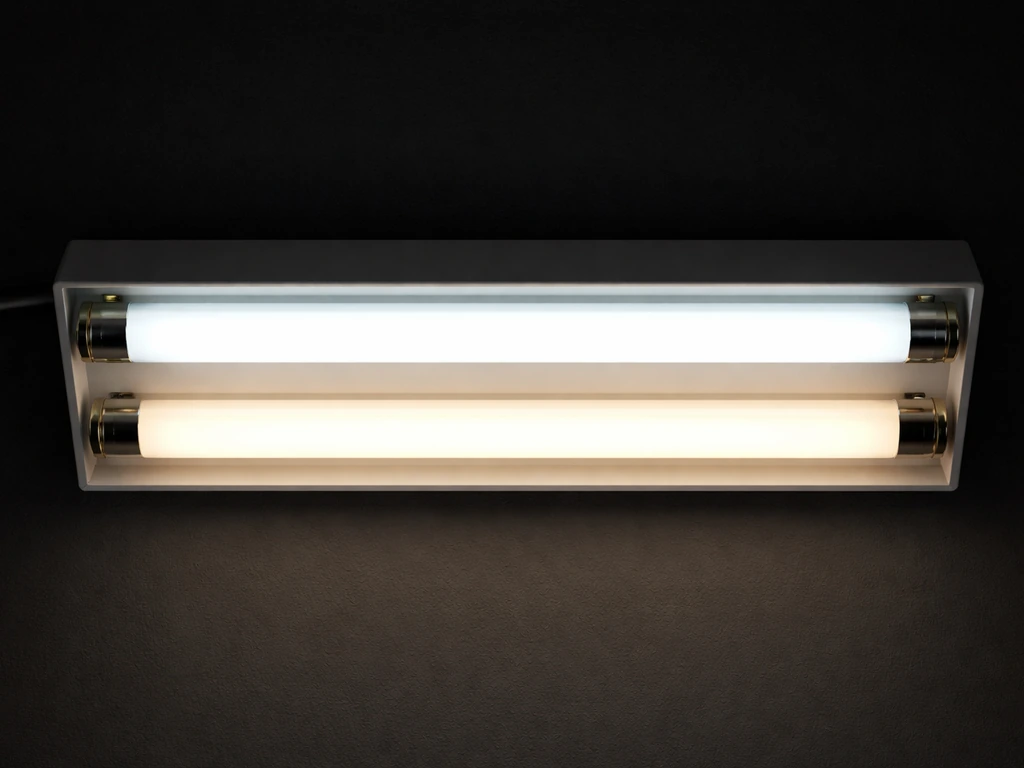
Not all fluorescent tubes are equal for plants. Here's what to look for when choosing bulbs for a plant setup.
- Color temperature: aim for 5000K to 6500K (daylight spectrum) for most plants. These bulbs deliver more blue wavelengths that drive vegetative growth. Cool white at around 4000K is okay but not ideal
- CRI (Color Rendering Index): look for bulbs rated 85+ CRI. Higher CRI bulbs tend to have more complete spectrum coverage, which is better for photosynthesis
- Tube type matters: T5 tubes are significantly more efficient and brighter than older T8 or T12 tubes. If you're buying new fixtures, choose T5 or T5 HO (high output). T5 HO fixtures produce roughly double the output of standard T5
- Full-spectrum fluorescent bulbs marketed for plants are worth the small premium if you're growing anything beyond the most shade-tolerant houseplants
- Avoid cheap cool-white shop light bulbs for anything beyond pure decorative foliage plants
Placement and distance
- Low-light houseplants (pothos, snake plant, ZZ plant): 6 to 12 inches from the tube is fine
- Medium-light plants and herbs: 2 to 6 inches is ideal, closer is almost always better with fluorescent
- Seedlings and salad greens: 1 to 3 inches from the tube, adjust upward as they grow
- Use a reflector (even a piece of white cardboard or aluminum foil behind the fixture) to redirect lost light back toward your plants. This can increase effective light delivery by 20 to 30 percent without changing anything else
- If your setup has multiple tubes, run them as a bank (several tubes side by side). The overlapping light from multiple tubes is more effective than a single tube
How long to run the lights
- Low-light houseplants: 12 to 14 hours per day is usually sufficient
- Herbs and greens: 14 to 16 hours per day gives them a better DLI to compensate for lower intensity
- Seedlings: 16 hours per day is a common recommendation and works well for most vegetable starts
- Do not run fluorescent lights 24 hours continuously. Plants need a dark period for proper physiological function, and constant light can cause stress or unusual growth patterns in many species
- A basic outlet timer is worth every dollar. Set it and forget it
Troubleshooting problems caused by weak light (leggy, yellow leaves, no growth)
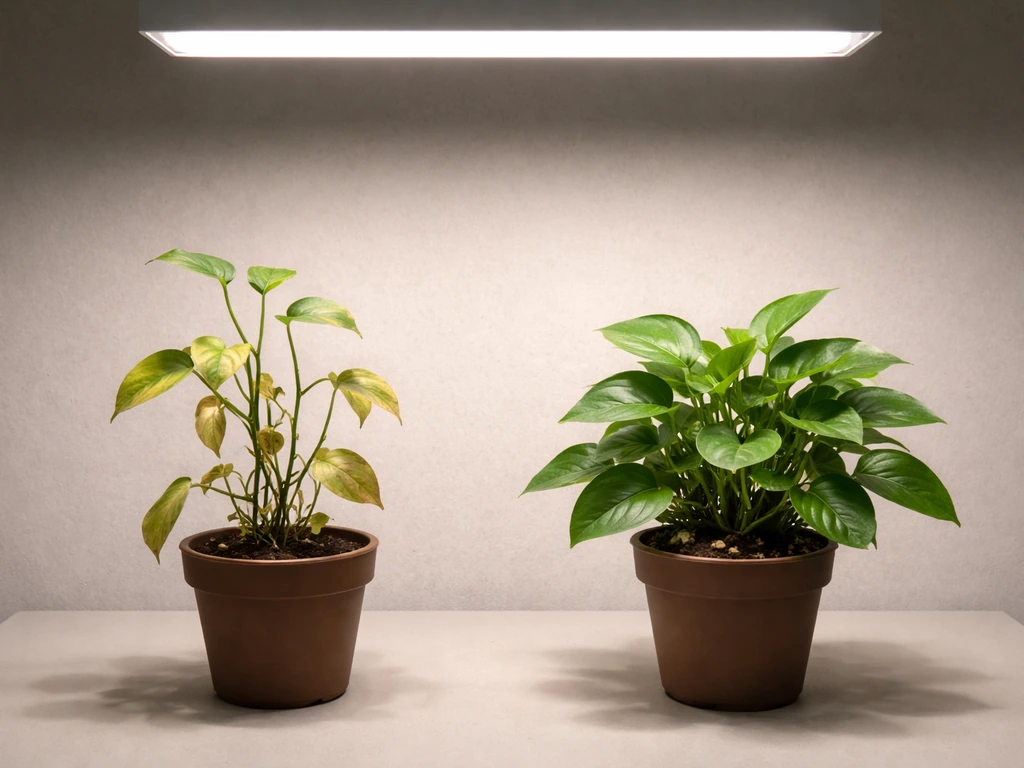
If your plants are struggling under fluorescent light, almost every common problem traces back to one of three things: not enough intensity, light placed too far away, or photoperiod too short. Here's how to diagnose what's happening.
| Symptom | Likely cause | What to adjust first |
|---|---|---|
| Leggy, stretched stems reaching toward the light | Light is too far away or too dim | Move the fixture 2 to 4 inches closer to the plant canopy |
| Small, pale new leaves | Insufficient light for normal leaf development | Increase photoperiod by 2 hours and move light closer |
| Yellowing lower leaves | Could be low light or nutrient issue; check if upper leaves are also pale | Increase light hours first; if no improvement in 2 weeks, check watering and nutrients |
| No new growth for weeks | DLI too low to support active growth | Closer placement plus longer photoperiod; consider upgrading to T5 HO if still no improvement |
| Wilting despite adequate watering | Unlikely to be a light problem; check roots and drainage | Inspect for root rot; improve drainage before changing light setup |
| Variegated leaves losing pattern | Likely insufficient light to support full chlorophyll expression | Increase light intensity by reducing distance or adding a second tube |
The number one mistake I see is placing fluorescent fixtures too far from plants and then wondering why growth is slow. Drop that fixture down. It feels uncomfortably close, but for most setups with fluorescent, closer is almost always the right answer. Give it two weeks after adjusting and you'll usually see a clear response from the plant.
Upgrade paths when fluorescent isn't enough (when to switch to LED grow lights)
Fluorescent lights have real limits. If you're growing plants that need more than a DLI of roughly 8 to 10 mol/m²/day, you're going to hit a wall with standard fluorescent fixtures no matter how well you set them up. LED grow lights are the practical next step, and they've dropped dramatically in price over the past few years. A decent LED panel for a 2-by-4-foot grow space now costs well under $100 and delivers two to four times the usable light output of a comparable fluorescent setup while using less electricity.
Here are the clearest signs it's time to consider upgrading your lighting setup beyond fluorescent.
- You want to grow fruiting plants like tomatoes, peppers, cucumbers, or strawberries indoors
- Your herbs (especially basil) consistently go leggy and weak despite being placed close to fluorescent tubes
- You're trying to get a plant to flower or bloom and it refuses, despite otherwise healthy foliage
- Your seedlings are tall and spindly at transplant time after being under fluorescent
- You want to grow succulents or cacti without a sunny window
- You've maxed out photoperiod (16+ hours) and moved tubes as close as physically possible, and growth is still disappointing
When you do upgrade, look for full-spectrum LED grow lights with a high PPFD rating at your intended growing distance, ideally with some independent testing data rather than just manufacturer claims. A bar-style or panel LED in the 100 to 200 watt range from a reputable brand will outperform even the best fluorescent fixture for most indoor food gardens. That said, if you're mainly growing low-light houseplants or a small herb shelf, a good T5 fluorescent setup can absolutely do the job without spending more. Start with what you have, adjust the setup using the guidance above, and only upgrade when you've genuinely hit the limits of what fluorescent can offer.
One more thing worth knowing: if you're curious about running your lights around the clock or exploring other artificial light sources like tube lights or SAD lamps for plant growth, the answer is nuanced and plant-specific. The core principle stays the same though: match the light source's real output to what the plant actually needs, not just what looks bright to your eyes.
FAQ
What is the easiest way to tell if my plants are getting enough light from fluorescent tubes?
Watch for outcomes that show up after 1 to 3 weeks: slow growth, pale or smaller new leaves, and stretching toward the bulbs. If you also see the soil drying slower than usual, it can be a light issue (reduced transpiration) rather than watering habits.
Is cool white or warm white fluorescent better for plants?
Both can work because fluorescent still covers the general photosynthesis range, but the difference you should care about is intensity at the plant level. If your fixture type lets you choose, pick the tube that runs at the highest usable output for your size (often labeled high-output or designed for plant growth) and keep it at the correct distance.
Can I run fluorescent light longer instead of buying stronger bulbs?
Yes, for low-light plants, extending the photoperiod is often the simplest lever. However, there is a ceiling because fluorescent intensity is low, so sun-lovers will still stall even with very long schedules. Also consider temperature, longer runtimes increase heat and can dry the setup unevenly.
How high should I mount the fluorescent fixture if my plants are on a shelf?
Aim for roughly 2 to 6 inches above low-light plants and no more than about 4 inches for medium-light plants like many common herbs. If you need a bigger mounting height for convenience, you usually need more light sources or a different fixture, not just patience.
Do I need a timer for fluorescent grow setups?
A timer is strongly recommended. Plants respond best to consistent daily light periods, and consistency also makes it easier to calculate your DLI using your estimated PPFD and runtime. Without a timer, day-to-day variation often looks like unexplained slow growth.
Is 24-hour light ever a good idea under fluorescent bulbs?
Sometimes for certain greens, but it is not automatically beneficial. Many plants need a dark period for normal behavior and energy balance, and continuous light can reduce vigor if intensity is marginal. If you try it, start with a shorter test window and compare growth rate and leaf color to a standard 14 to 16 hour schedule.
Why does my basil get leggy and flop under fluorescent light even when it looks alive?
Legginess usually means the light level is too low relative to the plant’s growth rate, causing stems to elongate between leaves. Basil’s rapid growth makes it especially sensitive to fluorescent intensity limits, so even if leaves stay green at first, the plant often fails once it ramps up.
What should I do if my plants are stretching toward the lights?
First, move the fixture closer, then verify your daily runtime with a timer. If you are already within the recommended distance and stretching continues after about two weeks, the intensity is likely insufficient and you may need higher-output tubes or an LED upgrade.
How can I estimate PPFD and DLI without buying specialized equipment?
You can do a rough approach by using fixture type and placement rules rather than exact PPFD. Practically, if your plant is not responding after you adjust distance and runtime, treat that as a signal you are below the needed DLI, especially for medium and high-light crops.
At what point does fluorescent become a losing battle?
If your target plants generally require something like 8 to 10 mol/m²/day or more, standard fluorescent setups often hit a wall. That includes many fruiting or full-sun crops and some flowering plants, where you will usually need LEDs or significantly more lighting power and fixture close placement.
Can fluorescent grow lights support flowering orchids or fruiting vegetables indoors?
Usually not reliably as the only light source. Many fruiting plants and flowering ornamentals need much higher daily light than typical fluorescent fixtures can deliver. If you attempt it, expect to supplement eventually, or use varieties bred for lower light and even then plan for limited yields.
Why do my plants look okay at first, then start declining after 1 to 2 weeks?
Often the early phase is stored energy and leaf reserves, then growth accelerates and the light shortfall becomes obvious. Basil is a classic example. Adjusting distance and runtime and then waiting about two weeks helps you judge whether changes are working.
Should I mix plant types on the same fluorescent fixture?
It depends on how different their light needs are. Mixing low-light houseplants with medium-light herbs under the same fixture can work, but place the more light-hungry plants closer or separate shelves. Otherwise the herb may get leggy while the shade plant may still look fine.