
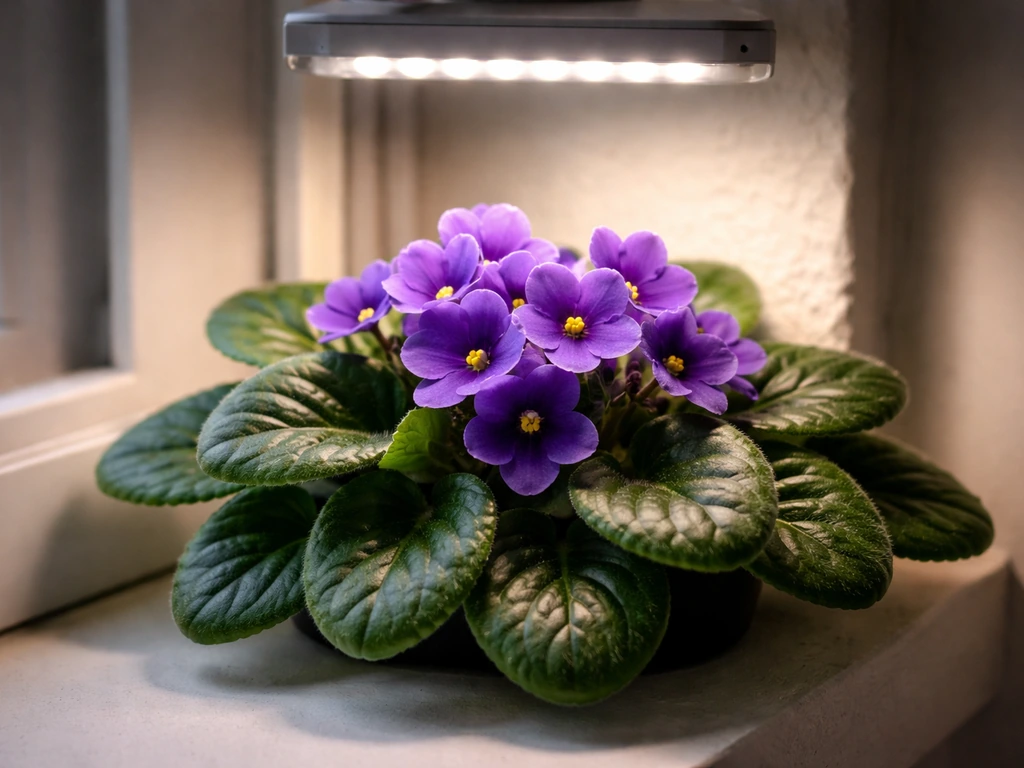
African violets love grow lights, and they actually do better under them than they do on most windowsills. These plants are native to the shaded forest floors of East Africa, so they want bright but gentle, indirect light, exactly what a well-placed grow light delivers without the harsh direct sun that can burn their velvety leaves. Whether you're using a simple LED strip, a full-spectrum bulb, or a fluorescent shop light, African violets are genuinely one of the best plants to grow under artificial lighting.
Do African Violets Like Grow Lights? LED Setup Tips
Marcus Hartley
1 May 2026
Why grow lights work so well for African violets
Most windowsills either give African violets too much direct sun or too little light entirely, especially in north-facing rooms or during winter. Grow lights solve both problems at once by putting consistent, controllable light exactly where you need it. You're in charge of the intensity, the spectrum, and the daily duration, which means you can dial in conditions that a window simply can't match on a cloudy day in January.
African violets can be grown entirely under artificial light with no natural sunlight at all. UNH Cooperative Extension notes that African violets can be grown entirely under artificial light using two 40-watt fluorescent tubes mounted in an industrial fixture. Research from UNH Cooperative Extension confirms this clearly, and African violet growers have been doing it successfully for decades. The key is getting the right brightness, the right spectrum, and the right schedule. Get those three things close to dialed in, and you'll have a plant that blooms reliably instead of just surviving.
The best bulb types for African violets: LED vs. fluorescent
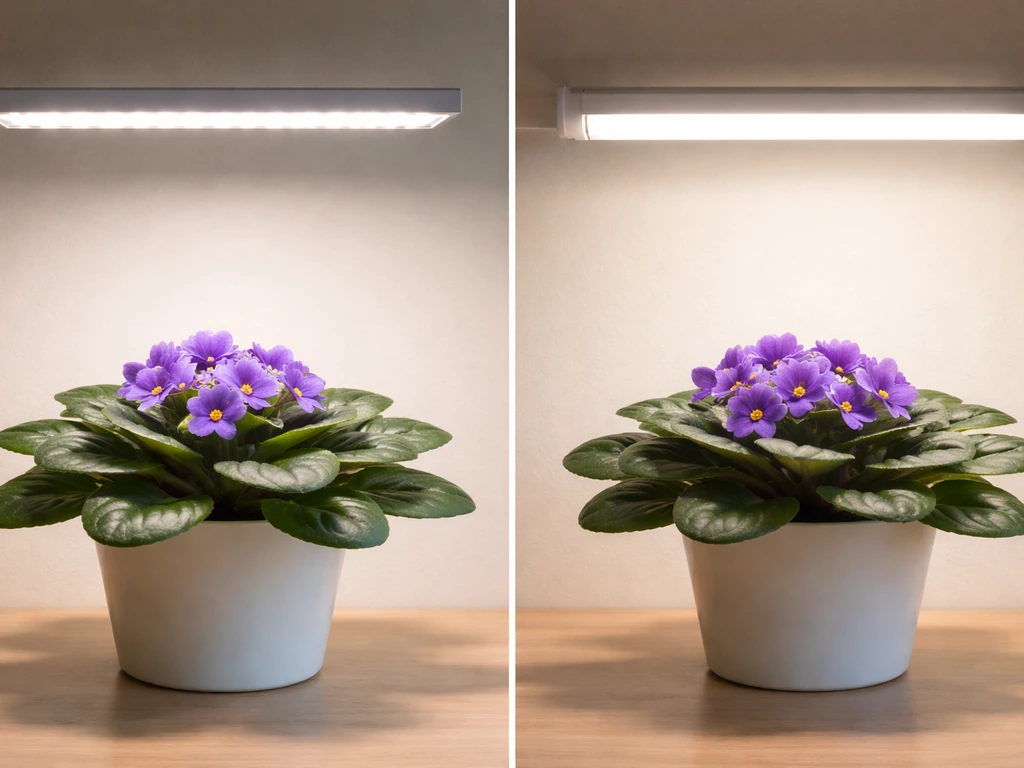
Both LEDs and fluorescent bulbs work well for African violets, but LEDs are the better choice for most home growers today. They use less energy, last much longer, and run cooler, which matters because heat stress at the canopy level is a real problem with older fluorescent setups positioned close to the plant. AVSA growers have reported that under correctly set up LEDs, African violets produce deeper green leaves and brighter blooms than under comparable fluorescent fixtures.
Choosing the right spectrum
African violets need a reasonably full spectrum to grow and flower well, which is where bulb color temperature comes in. The color temperature of a bulb is measured in Kelvin (K), and it tells you roughly where on the warm-to-cool spectrum a bulb falls. For African violets, you want to cover both the red/warm end (which drives flowering) and the blue/cool end (which drives foliage growth). A full-spectrum LED bulb rated around 5000K to 6500K is a practical, single-bulb solution that covers both ranges reasonably well.
If you're using fluorescent tubes instead, the traditional AVSA recommendation is to combine a cool white tube (around 5500K to 6500K) with a warm white tube (around 3500K). That combination approximates the fuller spectrum that a single quality full-spectrum LED bulb provides on its own. This is one reason LEDs have become the go-to choice: they simplify the setup without sacrificing results.
| Light Type | Spectrum Coverage | Heat Output | Energy Efficiency | Best For |
|---|---|---|---|---|
| Full-spectrum LED | Excellent (single bulb) | Low | High | Most home growers — easiest setup |
| LED grow light panel | Excellent | Low to moderate | High | Dedicated grow shelves, multiple plants |
| Cool + warm white fluorescent | Good (two tubes combined) | Moderate | Moderate | Existing shop light setups |
| Single cool white fluorescent | Incomplete (no red) | Moderate | Moderate | Not recommended alone for blooming |
How much light to give: brightness, distance, and daily hours
Brightness target
The practical brightness target for African violets is blank" rel="noopener noreferrer">around 1,000 foot-candles at leaf height. That's the figure consistently cited by Virginia Tech extension, UGA extension, and other reliable cultivation sources. In lux terms, that's roughly 10,000 lux (foot-candles ≈ lux divided by 10, so 10,000 lux ÷ 10 = 1,000 foot-candles). If you have a light meter app on your phone, measure at the level of the plant's crown during the brightest part of your grow light schedule. That number gives you an immediate reality check on whether you're in the right zone.
Distance from light to plant
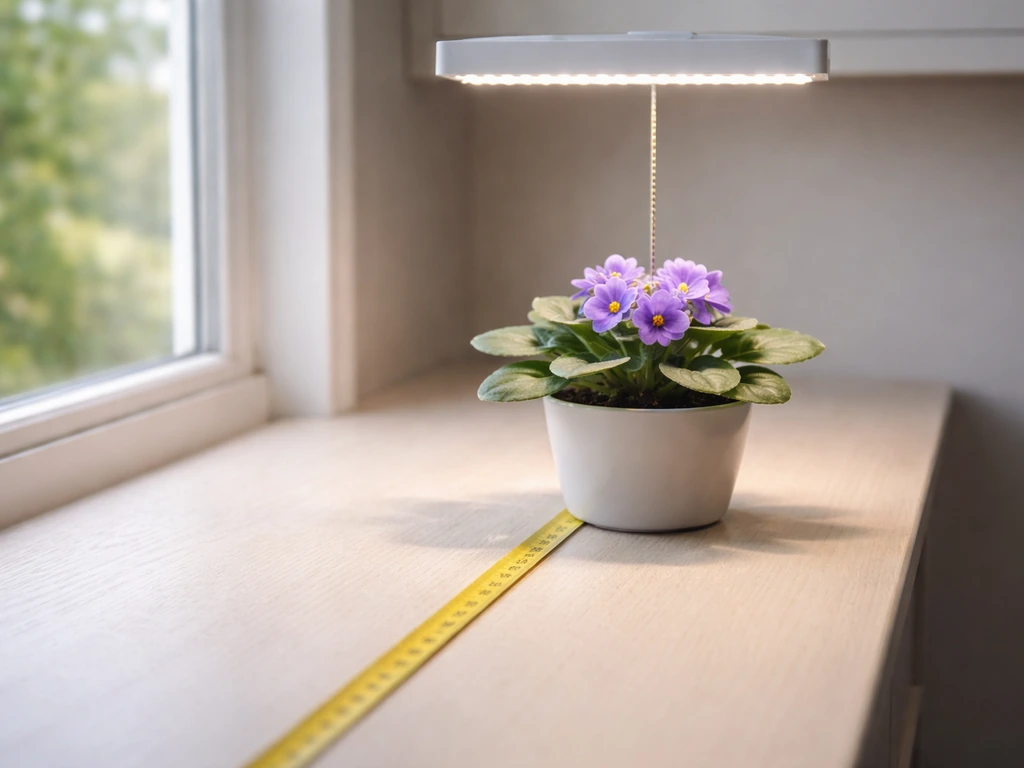
AVSA guidelines suggest keeping African violets somewhere between 10 and 30 inches from the light source, depending on the fixture's output. For most standard LED grow bulbs and shop-light-style setups, starting at around 12 inches above the crown of the plant is a reasonable default. From there you adjust based on how the plant responds. Smaller or younger plants may want to sit a bit lower (and thus farther from the light) to avoid stress, while compact mature plants can often sit closer to hit that 1,000 foot-candle target.
Daily light schedule
This is where African violets under grow lights get genuinely exciting. Because you control the schedule, you can push flowering in a way a windowsill can't match. Cooperative extension research supports at least 12 hours of light per day as the practical minimum, with 18 hours of light per day shown to increase both growth rate and flower production. A good starting point is 14 to 16 hours on, 8 to 10 hours off. The dark period matters too, plants use that time to process what they've taken in, so don't be tempted to run lights 24 hours a day.
One important nuance: intensity and duration work as a package. A slightly lower-intensity setup can compensate by running a bit longer, and a brighter setup can run for shorter periods. The UGA and Virginia Tech guidance frames it this way: 1,000 foot-candles for 6 to 8 hours works, but so does a lower intensity run for 12 or more hours, as long as the total daily light dose is adequate. If you can't hit 1,000 foot-candles, try extending your daily run time to compensate.
Signs your African violet needs more or less light
African violets are actually pretty communicative once you know what to look for. You don't need a degree in plant physiology, just check the leaves and the flowering behavior regularly, and the plant will tell you what it needs.
Signs of too little light
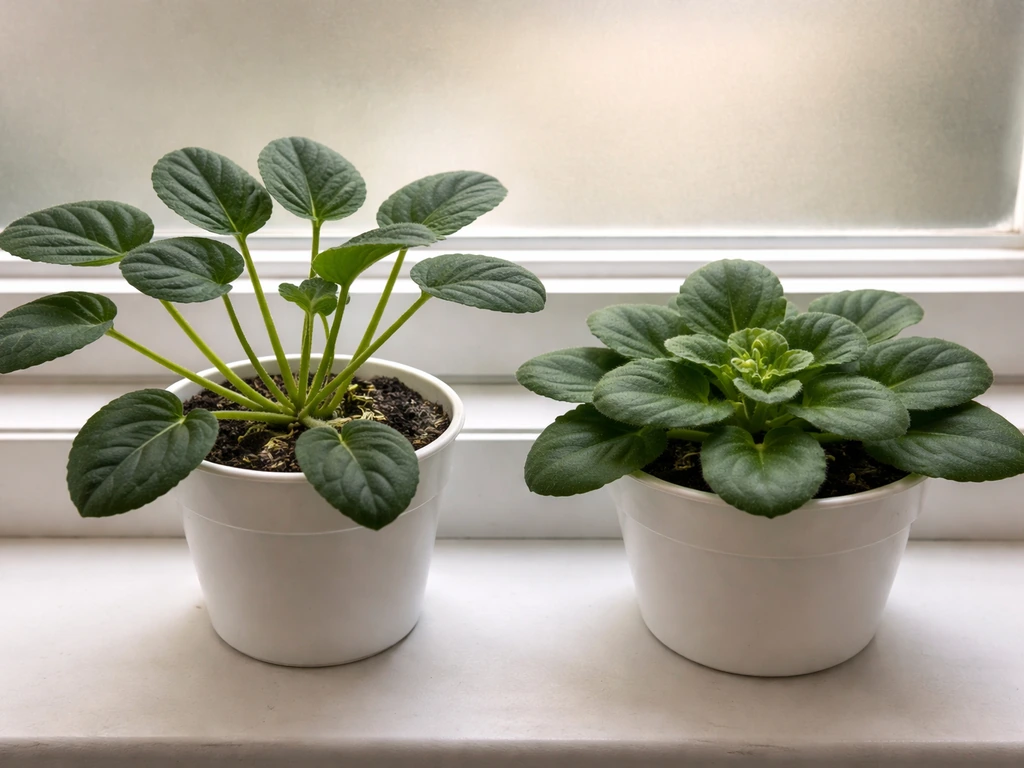
- Leggy, stretched growth — the plant reaches upward toward the light source with elongated leaf stems (petioles)
- Dark green but sparse foliage, with leaves spaced farther apart than normal
- Few or no flowers — this is the most immediate sign, and it's often the first complaint growers have
- Slow growth even with proper watering and feeding
If you're seeing leggy growth and no buds, move the plant closer to the light or increase your daily light duration. Both adjustments work, choose based on your setup. If you extend hours, add an hour or two at a time and give the plant a week to respond before adjusting again.
Signs of too much light
- Leaves curl downward and inward, sometimes described as a cupped look
- Pale, washed-out, or yellowing foliage — the plant is essentially getting bleached
- Crispy brown edges or tips on leaves, similar to a mild burn
- Variegated varieties may show accelerated color loss or bleaching of the white/cream sections
- Stunted, tight growth where the plant looks compressed rather than open
If you see bleaching or curling leaves, raise the light by a few inches or reduce your daily schedule by an hour or two. AVSA cautions that photo-bleaching can happen even under LEDs when intensity or duration is too high, particularly with variegated varieties. The fix is usually simple: more distance, less time, or both.
Practical setup tips for growing African violets under lights indoors
Getting the light source right is only half of setup. These practical details will make the difference between a plant that just survives and one that consistently blooms.
- Use a timer: This is non-negotiable if you want consistent flowering. A cheap plug-in outlet timer works perfectly. Set it and forget it — your plant doesn't care if it's midnight or noon, just that it gets its scheduled hours every single day.
- Keep the schedule consistent: Changing your light hours frequently disrupts flowering. African violets respond to reliable photoperiods, so once you find a schedule that works, stick with it.
- Use reflective surfaces if you can: Placing your light setup on a white shelf or lining the back of a grow shelf with white paper or foil dramatically increases how much of that light actually reaches the plant. It's free extra light intensity with no new hardware.
- Watch for heat at the canopy: LEDs run cooler than fluorescents, but any grow light positioned too close to the plant for too long will raise the local temperature. Hold your hand at leaf level under the light for 30 seconds — if it feels warm, raise the fixture.
- Rotate plants occasionally: Even under grow lights, plants often lean slightly toward the brightest part of a fixture. Rotating your pot a quarter turn every week or two keeps growth even and symmetrical.
- Give plants some air movement: A small fan running on low nearby helps prevent fungal issues, which African violets are prone to in still, humid air. It also helps manage any slight heat buildup from the light.
Don't blame the light for everything: a care checklist
One mistake I see constantly, and made myself in the beginning, is tweaking the grow light setup when the real problem is watering, temperature, or feeding. African violets under grow lights can look stressed for reasons that have nothing to do with light intensity or duration. Before you adjust your setup, run through this checklist.
Watering under grow lights
Grow lights dry out soil faster than ambient room conditions, especially if the fixture runs warm or airflow is involved. UGA extension is explicit that watering schedules should not be fixed: how often you water depends on your light level, temperature, humidity, and soil mix. Under grow lights, you'll likely need to water more frequently than you did before adding the light. Check the soil every couple of days rather than following a weekly schedule. The AVSA recommends bottom watering, setting the pot in room-temperature water for up to 30 minutes, which works well under grow lights and avoids getting water on the leaves, where it can cause spotting.
Temperature
African violets are comfortable in the same temperature range most people keep their homes: roughly 65 to 75 degrees Fahrenheit. Problems arise when grow lights raise the local temperature above that range, or when cold drafts from nearby windows or air vents conflict with the warmth of the light. Virginia Tech extension also notes that cold water on leaves or cold water used for bottom watering can cause the characteristic ring spots on foliage. Use room-temperature water and keep the plants away from cold glass in winter, even with a grow light running.
Fertilizing
African violets under grow lights are growing more actively than they would on a dim windowsill, which means they're pulling more nutrients from the soil. AVSA notes that increased light exposure can deplete nutrients more rapidly, so under a grow light setup, you'll likely need to feed more consistently than you would otherwise. A balanced fertilizer formulated for African violets, or any balanced 20-20-20 water-soluble fertilizer diluted to about a quarter of the recommended strength, applied with every watering works well. Avoid skipping feedings for weeks at a time if the plant is actively growing and flowering under lights.
Quick grow-light care checklist
- Light on for 14 to 16 hours per day via a timer, with a consistent dark period
- Light source positioned 10 to 12 inches above the crown to start, adjusted based on plant response
- Target approximately 1,000 foot-candles (roughly 10,000 lux) at leaf height
- Check soil moisture every 2 to 3 days — grow lights increase drying speed
- Bottom water with room-temperature water to avoid leaf spotting
- Keep plant in 65 to 75°F range — feel for heat buildup under the fixture
- Feed with diluted balanced fertilizer at every watering or weekly
- Rotate pot a quarter turn weekly for even growth
- Watch for leggy growth or lack of blooms (more light needed) and bleaching or curled leaves (less light needed)
If you've been struggling to get your African violet to bloom on a windowsill, switching to a dedicated grow light setup is often the single most effective change you can make. These plants reward consistency, and grow lights give you exactly that. Other low-light-tolerant plants like pothos and snake plants can also thrive under similar setups, but African violets are particularly responsive to the controlled conditions a grow light provides. Pothos can also do well under artificial light, as long as it gets enough brightness for consistent growth can pothos grow in artificial light. If you’re wondering about snake plants too, do snake plants like grow lights? In most cases, they tolerate them well and can grow better when the light is consistent. Pothos can also grow without sunlight when it gets enough bright indoor light, such as from a grow light or a sunny window. But if you are wondering about pothos specifically, yes, pothos can grow well under grow lights when the intensity and timing are set correctly do pothos like grow lights. If you are also growing pothos under a grow light, choosing the right light color helps support healthy, vigorous growth. Get the schedule dialed in, keep the other care variables stable, and most African violets will start showing buds within a few weeks.
FAQ
How close should I place an LED grow light to my African violet if I cannot measure foot-candles or lux?
Use distance and feedback instead of numbers. Start about 12 inches above the crown, then adjust in small steps (about 2 to 4 inches) every week. Aim for sturdy, compact growth with regular bud formation, not stretched stems or pale, washed leaves.
Do African violets need a timer, or can I just leave the grow light on?
A timer is strongly recommended. African violets need a real dark period for normal growth and flowering, running lights 24 hours a day often reduces flowering even if leaves keep growing.
What color temperature should I choose if my African violet still won’t bloom after a few weeks?
If you are using a single bulb, choose a full-spectrum LED around 5000K to 6500K. If your setup is fluorescent with separate tubes, make sure you have both a cooler tube (about 5500K to 6500K) and a warmer tube (about 3500K), since missing the warm/red end can delay flowering.
My leaves look fine but buds drop. Could the grow light schedule be the problem?
Yes, buds can fail when the schedule is inconsistent or the daily dark period is too short. Recheck that you are at least around 12 hours of light, with a stable on/off routine (for example 14 to 16 hours on daily), and avoid moving the plant right before buds form.
Should I increase light intensity or light duration first if I’m seeing leggy growth?
Choose based on your setup. If your light is already close to the recommended range, extend the photoperiod in 1 to 2 hour increments. If the fixture is far away and growth is stretched, move the plant closer first. Then reassess after about a week, since rapid back-and-forth changes confuse the plant.
Can African violets get sunburned under LED grow lights?
They can. Bleaching or leaf edge curling usually signals too much intensity or too long a daily duration, especially with variegated plants. The usual fix is raising the light by a few inches and trimming the schedule by about 1 to 2 hours.
Is it okay to grow African violets entirely under grow lights if my room is cool at night?
Often yes, but protect them from drafts and cold glass. Even if the light is adequate, nighttime temperature swings and cold air currents can cause stress and ring spotting, especially when combined with bottom watering using cool water.
Does using grow lights mean I should water more often, or just adjust the schedule?
Both care variables and timing may change, because grow lights increase drying. Instead of following a fixed routine, check soil moisture every couple of days. Bottom watering with room-temperature water helps prevent leaf spotting and ring spots from water that lands on foliage.
How do I know whether my plant needs fertilizer more under grow lights?
If growth is faster, buds appear more readily, or you’re watering more frequently, the plant often consumes nutrients faster too. A practical approach is feeding with a balanced fertilizer at reduced strength (about quarter strength) with every watering during active growth, rather than skipping for weeks.
Will the optimal light distance change as my African violet grows or when I repot it?
Yes. As the crown height changes, the same light distance can deliver different brightness at leaf level. When you repot or the plant grows noticeably, re-evaluate spacing and adjust by a few inches so the crown stays in the target brightness range.
Are grow lights helpful if I’m using a shelf or cabinet where airflow is limited?
They can be, but heat and humidity behavior can change. If the light runs warm or airflow is low, monitor for leaf stress and soil drying patterns. A cooler LED and a stable environment usually reduce stress compared with older fluorescent setups close to the canopy.