
Snake plants can survive in low light, but they grow slowly and stay small there. If you want actual growth, healthy new leaves, and a plant that looks good rather than just hanging on, you need to give it somewhere between 100 and 250 PPFD (a measure of usable light for photosynthesis) for 12 to 16 hours a day.
Snake Plant Grow Light Requirements: How Much Light and Setup
Marcus Hartley
20 May 2026
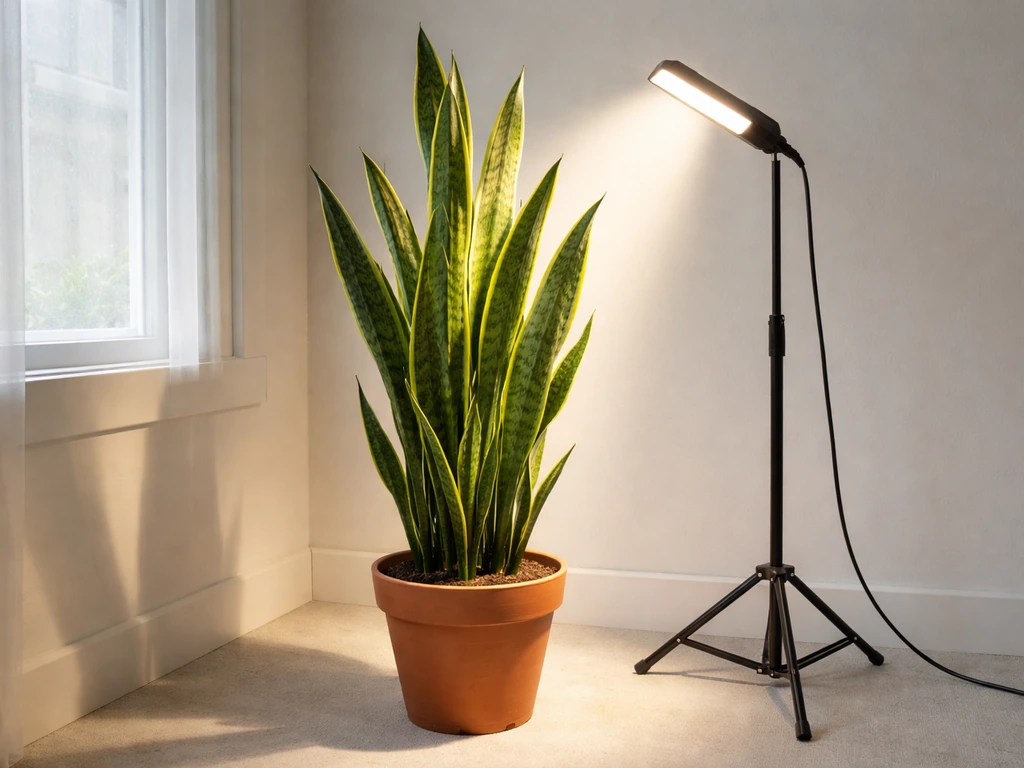
If your snake plant is getting leggy or showing etiolation, Tom's Guide recommends moving it to brighter indirect light and acclimating it gradually to avoid shock or sunburn leggy growth indicates insufficient light. A bright north-facing window will usually keep one alive.
A south or east window will help it thrive. And if you have no decent window at all, a basic LED grow light placed 12 to 24 inches above the plant on a timer will do the job reliably. Jade plants usually do best with a similar setup, using a grow light to deliver enough bright light for steady leaf and stem growth basic LED grow light.
Dwarf fiddle leaf figs generally respond well to brighter, more consistently positioned grow lights than snake plants, so PPFD and distance matter a lot LED grow light.
How snake plants actually use light (and what 'low light' really means)
Snake plants use a type of photosynthesis called CAM (Crassulacean Acid Metabolism), which is the same strategy used by cacti and many succulents. Instead of keeping their stomata open during the day, they open them at night to take in carbon dioxide and store it, then use light energy during the day to convert that stored carbon into sugars. It's an adaptation for surviving drought and low-resource environments, not for thriving in the dark.
The amount of light the plant receives during the day still directly controls how much energy it can produce, which determines how fast it grows and how strong its leaves are. In CAM photosynthesis, the amount of light received during the light period influences carbon assimilation and daily store dynamics, which supports the idea that day light quantity matters for growth and stored carbohydrates in these plants [CAM carbon assimilation depends on the amount of light during the day (photoperiod)](https://pmc.
ncbi. nlm. nih. gov/articles/PMC4242292/).
So when you hear 'blank" rel="noopener noreferrer">snake plants tolerate low light,' that's technically true but misleading. Low-light tolerance means it won't immediately die in a dim corner. It does not mean dim is what the plant wants. In practice, a snake plant parked six feet from a north-facing window will survive for years, but it may not push a single new leaf in that time. That's not thriving, that's just slow decline with a long timeline. If your goal is a healthy, actively growing plant, understanding this distinction changes everything about how you approach lighting. Corals have very specific lighting needs too, and the right intensity and spectrum depend on whether they are soft corals or hard SPS corals.
Minimum viable light: windows vs. grow lights
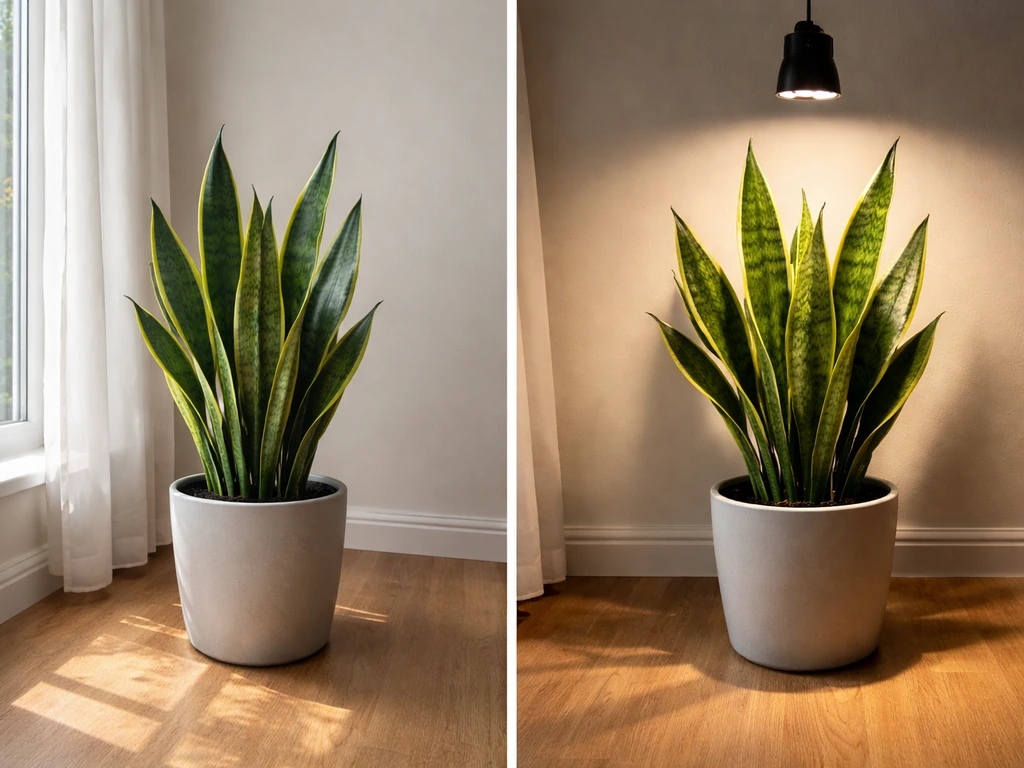
The light level your snake plant actually receives depends heavily on where you live, what direction your windows face, and the time of year. A south-facing window in a sun-belt apartment in May is a completely different environment than a north-facing window in a cloudy northern city in January. In foot-candle terms, which is still how a lot of extension guides describe indoor light, high-light indoor conditions are generally around 500 to 1,000 foot-candles (roughly 5,000 to 10,000 lux). Snake plants can grow reasonably well in the mid-range of that, roughly 250 to 500 foot-candles (about 2,500 to 5,000 lux), which corresponds to bright indirect light near a window.
If you have a bright east or west window, your snake plant is probably fine without a grow light as long as it's within a few feet of the glass. A south-facing window is even better. A north-facing window can work but is usually borderline in winter unless you're somewhere that gets strong natural light year-round. Beyond about six to eight feet from any window, natural light usually drops below what the plant needs for meaningful growth, and that's where a grow light becomes genuinely useful rather than optional.
Grow light specs that actually matter
Brightness: PPFD is your real target
When shopping for or setting up a grow light, ignore the watt rating as a quality indicator and focus on PPFD, which stands for Photosynthetic Photon Flux Density. It measures how many usable light photons (in the 400 to 700 nanometer range that plants actually use for photosynthesis) are hitting the plant surface per second. For a snake plant, you're targeting somewhere in the range of 100 to 250 PPFD at the leaf level.
Chaetomorpha typically does best under brighter grow lighting than low-light houseplants, so using a PPFD-focused LED setup will help it grow quickly best light to grow chaetomorpha. That's on the lower end compared to vegetables or flowering plants, which is actually good news: you don't need an expensive, high-powered fixture. A modest, affordable LED grow bulb or panel will hit that range comfortably.
Spectrum: full-spectrum LED is the easy answer
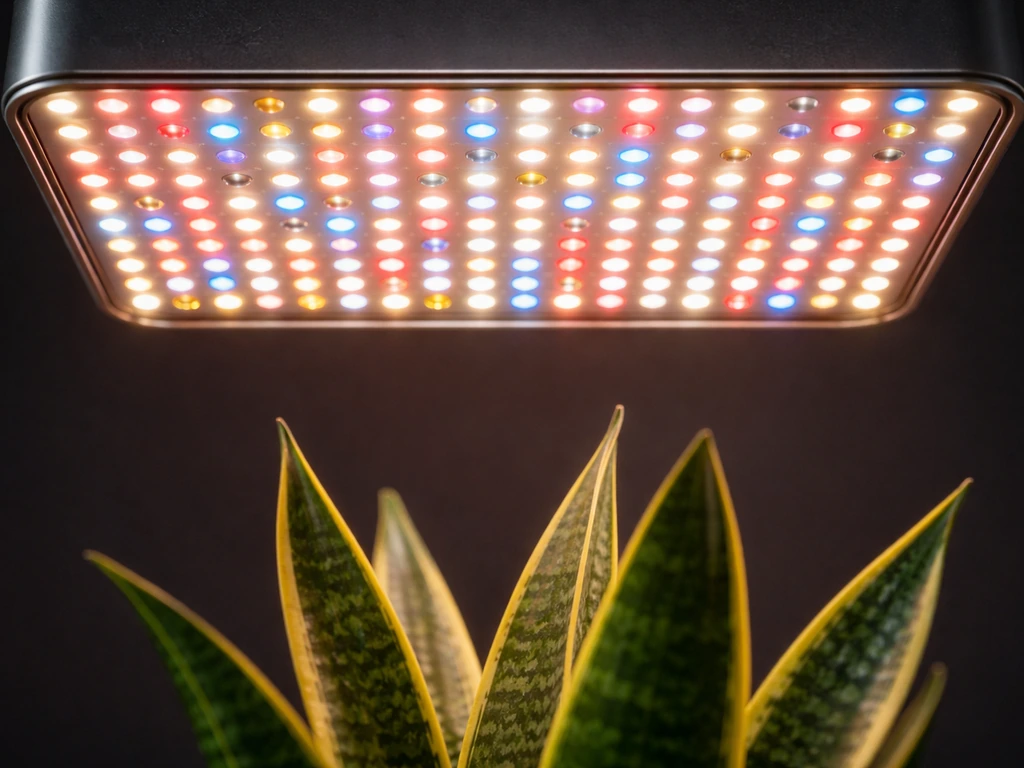
Snake plants, like most foliage plants, respond well to a broad spectrum that includes both blue light (around 400 to 500 nm, which drives compact, sturdy leaf development) and red light (around 600 to 700 nm, which supports photosynthesis and growth). A fixture marketed as 'full spectrum' that includes both blue and red wavelengths, often with a color temperature around 3000K to 6500K, will cover everything a snake plant needs. You don't need a specialized horticultural fixture. Many quality LED grow bulbs designed for houseplants will do the job well, and even a cool-white LED in the 5000K to 6500K range will support vegetative growth, though adding some warm/red spectrum helps efficiency.
Distance: closer than you think, but not too close
Light intensity drops off fast as distance increases, following what's roughly an inverse-square relationship. Double the distance from the bulb to the plant and you get about a quarter of the light. For a low-to-mid-power LED grow light or grow bulb, placing it 12 to 24 inches above the plant is a reasonable starting range.
For a fiddle leaf fig, the placement is similar in principle, but you should fine-tune the height and distance to match its higher light needs where to place grow light for fiddle leaf fig. A more powerful panel fixture might need to be 18 to 30 inches away to avoid giving the plant too much intensity and risking leaf burn. blank" rel="noopener noreferrer">Check the manufacturer's PPFD map if available, and aim for 100 to 250 PPFD at the leaf surface.
If you have a light meter app on your phone (they're imperfect but useful for ballpark readings), use it to confirm.
Duration: 12 to 16 hours per day
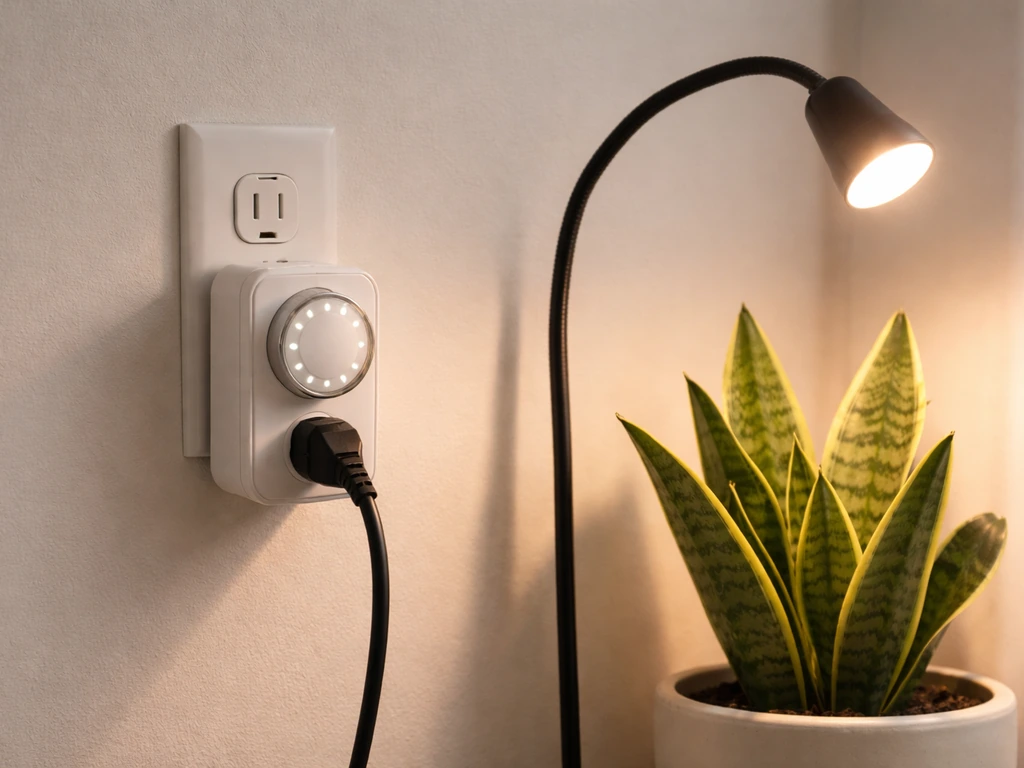
Run your grow light for 12 to 16 hours per day. That's the standard recommendation for houseplants from multiple university extension programs, and it works well for snake plants specifically. Twelve hours is a solid minimum and mimics a reasonable natural day length. Sixteen hours is the upper end and is useful when your fixture is on the lower end of the intensity range and you want to give the plant more total photon exposure.
Don't go beyond 16 hours regularly; plants need a dark period, and snake plants in particular use their nighttime hours for part of their CO2-collection process. Use a mechanical or smart plug timer so you're not guessing or manually turning the light on and off every day.
Setups for the situations most people are actually dealing with
| Situation | Best approach | Light target | Notes |
|---|---|---|---|
| No window or very dim room | Dedicated LED grow light on timer | 150–250 PPFD, 14–16 hrs/day | Use a full-spectrum LED panel or bulb; place 12–18 inches above plant |
| North-facing window | Grow light as supplement, especially in winter | 100–150 PPFD supplemental, 12–14 hrs/day | Position plant close to glass; run grow light during daylight hours to extend duration |
| Shelf or bookcase (away from windows) | Overhead or clip-on LED grow light | 150–200 PPFD, 14–16 hrs/day | Clip-on or bar-style lights work well; rotate plant quarterly to prevent leaning |
| Bright indirect window (east or west) | Usually no grow light needed | Natural light is sufficient in most cases | Monitor in winter; add supplemental light if growth stalls |
| South-facing window | No grow light needed; manage distance if scorching appears | Plenty of natural light | Move plant back 2–3 feet from glass if leaves bleach or tip-burn appears |
If you're growing a snake plant on a shelf with no window access, a clip-on or bar-style LED grow light mounted to the shelf above works really well. These are inexpensive, easy to position, and their low profile fits even tighter shelving setups. I've run snake plants this way in a basement apartment with zero natural light, and as long as the timer runs consistently and the fixture is close enough (I had mine about 14 inches above the tallest leaf), the plants pushed new growth consistently.
Signs your snake plant needs more light (or less)
Not enough light
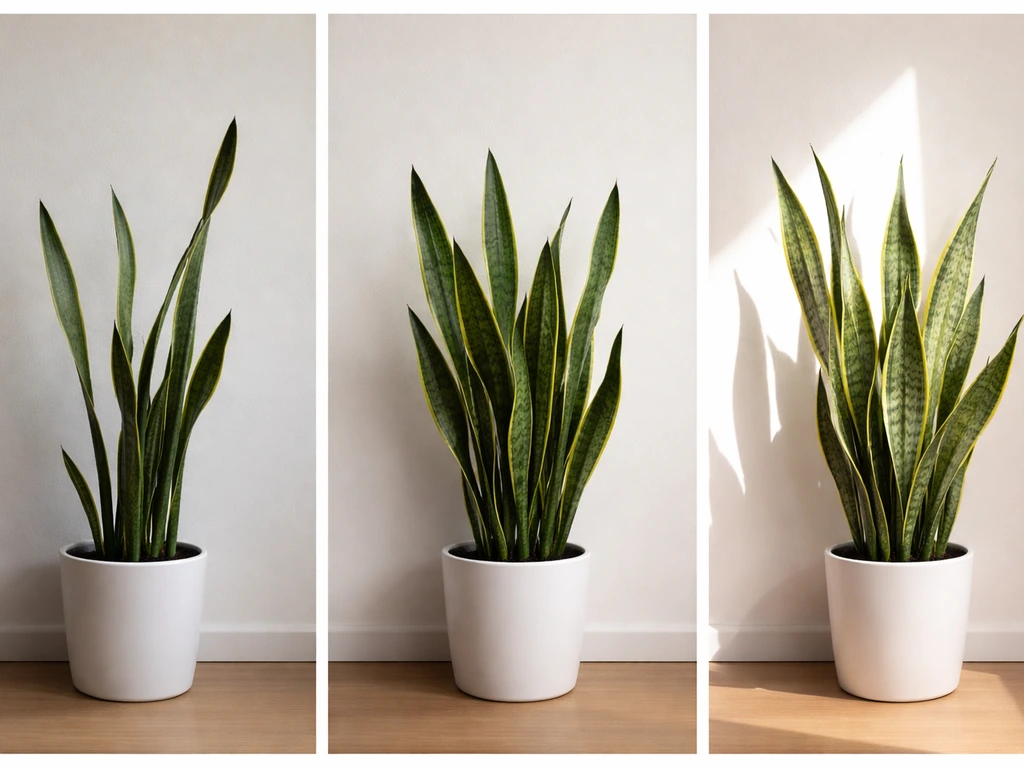
- Etiolation: new leaves grow taller but thinner and weaker than the older ones, sometimes leaning or falling over because the plant is stretching toward the light source
- No new growth for months, even during spring and summer when growth should be most active
- Leaves losing their variegation or looking washed out and duller than they used to
- Soil staying wet for unusually long periods because the plant isn't metabolically active enough to use water efficiently
Too much light
- Pale, bleached-out patches on leaf surfaces, especially where light hits most directly
- Brown, crispy leaf tips or edges that look scorched
- Leaves that were previously upright starting to look wrinkled or slightly soft (can indicate light-induced heat stress)
The fix for insufficient light is straightforward: move the plant closer to the window, add a grow light, increase the grow light duration, or move the fixture closer to the plant (in increments, not all at once). For too much light, increase the distance from the fixture by 4 to 6 inches at a time, or reduce the daily photoperiod by an hour or two. If a window is the culprit, move the plant back a foot or two from the glass or add a sheer curtain to diffuse direct sun. These adjustments don't need to be dramatic; small changes make a real difference.
Seasonal adjustments and light schedules
Snake plants aren't particularly photoperiod-sensitive in the way that some flowering plants are, but seasonal light changes still matter practically. In winter, natural light through windows is weaker, comes at a lower angle, and lasts fewer hours. If you rely on a north or east window and notice your plant slowing down noticeably from November through February, that's the light dropping off. The simplest response is to add a grow light running 12 to 14 hours per day during those months, then dial it back or remove it once spring daylight returns.
If you're running a grow light year-round (as in a room with no real window access), you can keep the schedule steady at 14 hours in summer and pull it back slightly to 12 hours in fall and winter if you want to loosely mirror natural cycles. Honestly though, snake plants don't strictly need that seasonal mimicry the way some tropical plants do. Consistent 12 to 14 hours year-round is completely fine. What matters more is that the schedule is consistent from day to day, which is why a timer is non-negotiable.
Common grow light mistakes (and how to avoid them)
- No timer: Leaving a grow light on manually means inconsistent schedules, and often it just stays on too long because you forget to turn it off. Get a basic plug-in timer. They cost a few dollars and remove all the guesswork.
- Light placed too far away: This is probably the most common issue. People set up a fixture at ceiling height or on a shelf above and assume it's close enough. At 36 to 48 inches from a moderate-power bulb, intensity can drop well below 50 PPFD, which is barely survival territory. Aim for 12 to 24 inches depending on fixture strength.
- Using a non-PAR bulb: Regular LED bulbs and warm ambient home lighting are not grow lights. They emit some light in PAR range but not enough intensity or in the right distribution to support plant growth reliably. Make sure what you're using is actually designed for plants or is confirmed to emit meaningful PPFD output.
- Leaving the light on 24 hours: More light is not always better. Snake plants are CAM plants and use their dark period metabolically. Running lights 24/7 can actually interfere with normal function and stresses the plant over time.
- Ignoring heat: Lower-wattage LED fixtures usually don't generate enough heat to worry about. But if you're using a higher-powered panel close to the plant, check that the air around the leaves isn't getting noticeably warm. Heat stress looks similar to light burn and can dehydrate the plant faster than usual.
- Not rotating the plant: If the grow light is positioned to one side rather than directly overhead, the plant will lean toward it. Rotating a quarter turn every two to four weeks keeps growth even and upright. This matters especially with clip-on lights or fixtures that aren't centered above the plant.
Getting snake plant lighting right is genuinely one of the easier plant-lighting problems to solve, which makes it a good starting point if you're new to using grow lights indoors. The intensity targets are modest, the equipment doesn't need to be expensive, and the plant is forgiving enough to give you time to correct course if something is off.
Once you have a timer set and a fixture at the right height, you can mostly leave it alone and let the plant do its thing. If you're already experimenting with grow lights for other plants like philodendrons or calatheas, which have similar or slightly higher light needs, many of the same setups will translate directly. Calatheas like grow lights too, so matching light intensity and distance is a good way to set both types up for healthy growth.
Philodendrons generally respond well to properly measured PPFD and consistent light duration, so you can apply the same grow light setup principles.
FAQ
If my snake plant is already “surviving,” how can I tell whether it’s getting enough light to actually grow new leaves?
Watch for more than just no yellowing. Active growth usually means new leaves emerge and unfurl without long delays, the plant keeps a compact form, and older leaves stay firm rather than slowly thinning out. If months pass with no new leaves or the center stays tight and dormant, your light is likely below the 100 to 250 PPFD target.
Do snake plants need a specific light color (blue vs red), or will any “daylight” LED work?
Most houseplant LEDs work if they provide both blue and red wavelengths. A “cool white” LED at 5000K to 6500K can support vegetative growth, but fixtures with a mix that includes some warm/red output tend to be more efficient for steady leaf growth, especially when you cannot place the light very close.
How do I know if I’m measuring the right thing when using a phone light meter or app?
Phone apps usually report lux or foot-candles, which only roughly correlate to PPFD and can mislead when the spectrum differs from the app’s assumptions. Use the app only as a ballpark check, then fine-tune by plant response. If you have access to true PPFD measurement, treat the 100 to 250 PPFD at leaf level as the primary target.
Is it okay to run a grow light longer than 16 hours to “make up for” low intensity?
Usually no. Snake plants need a dark period, and their nighttime CO2-collection is part of why they tolerate lower day-light intensity. If you need more growth, adjust intensity and distance first, then increase time only within the 12 to 16 hour range.
What should I do if my grow light seems to be bleaching or stressing the leaves?
Increase the distance in small steps (about 4 to 6 inches) and, if needed, reduce the daily photoperiod by about 1 to 2 hours. Also rotate the plant occasionally so one side is not receiving consistently higher intensity, which can create uneven color or stress.
Should the grow light be positioned directly above the plant, or can it be off to one side?
Ideally, place the light so it evenly covers the top surface and the central growing point. If the fixture is off-center, rotate the plant every 1 to 2 weeks to balance exposure, especially on shelves where the plant may lean toward the light.
How far from the window is “too far” for a snake plant without a grow light?
As a practical rule, beyond roughly 6 to 8 feet from a window, natural light often drops below what supports meaningful growth. This varies by latitude, season, and window orientation, but if you are that far out and expecting new growth, plan on adding a grow light or moving the plant closer.
Can I use one grow light setup for multiple snake plants and other houseplants on the same shelf?
Yes, but you still need to verify coverage and intensity at the leaf level for each plant. Taller plants can block light from shorter ones, and different species can have different PPFD needs. If the shelf has multiple heights, consider spacing the plants or using a fixture with a wider coverage area so everyone stays near the target intensity.
Do snake plants need to be watered differently when using grow lights?
Often, yes, because more light can increase how quickly the mix dries. If you move from low light to a 100 to 250 PPFD setup, check soil moisture more frequently at first, water only when the mix dries, and avoid staying on a fixed watering schedule.
What grow light distance should I start with, and how do I fine-tune it safely?
Start around 12 to 24 inches above the plant for typical low-to-mid power LEDs, targeting 100 to 250 PPFD at the leaf surface. Fine-tune in increments by moving the fixture closer or farther by a few inches, then reassess after a couple of weeks using both growth changes and any leaf stress.
Should I expect seasonal changes even if I keep a grow light on a timer year-round?
You might not need to mimic seasons, but consistent total daily light still matters. If you notice slower growth in winter when relying partly on windows, supplement for those months. If you fully rely on the grow light, a steady 12 to 14 hours year-round is usually sufficient, as long as intensity and distance remain stable.