
Roses can grow indoors without direct sunlight, but they really struggle to bloom. If your goal is flowers, you need to replicate the intensity of bright outdoor sun, either through a very bright south-facing window or a dedicated grow light. If you just want to keep a rose alive and leafy, lower light can work short-term, but expect slow growth, no flowers, and a plant that gradually weakens. The honest answer is: yes, survival is possible without direct sun, but thriving and blooming requires you to get serious about light.
Can Rose Plant Grow Without Sunlight Indoors? Light Guide
Marcus Hartley
17 May 2026
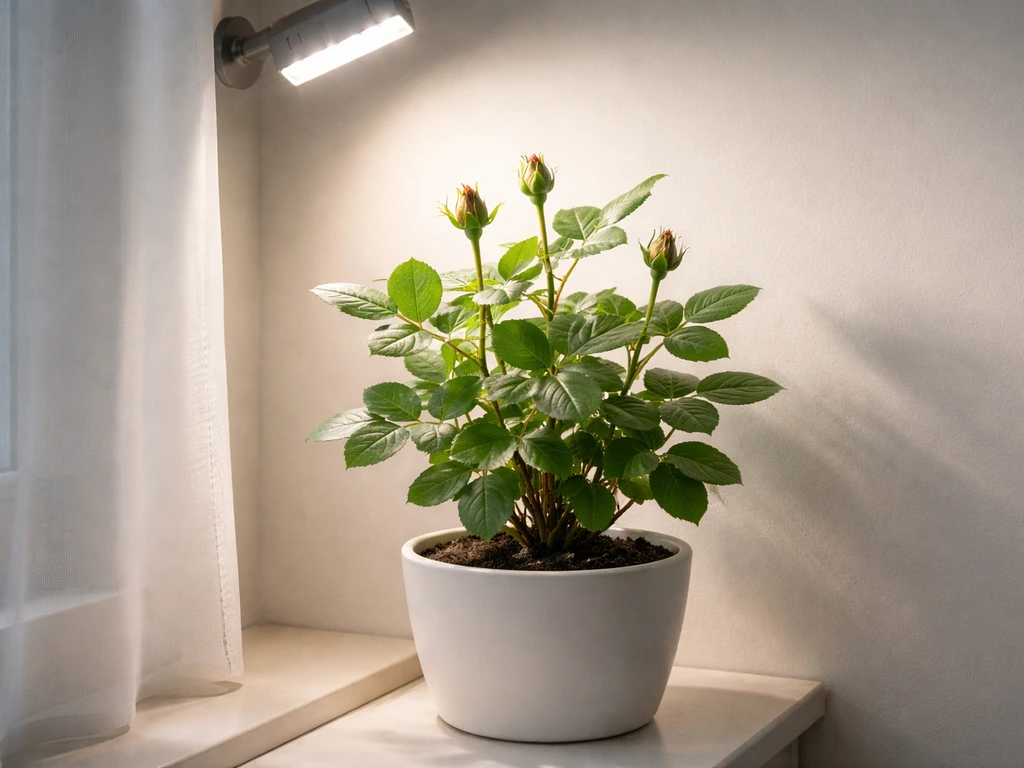
Can roses grow without direct sunlight? A quick reality check
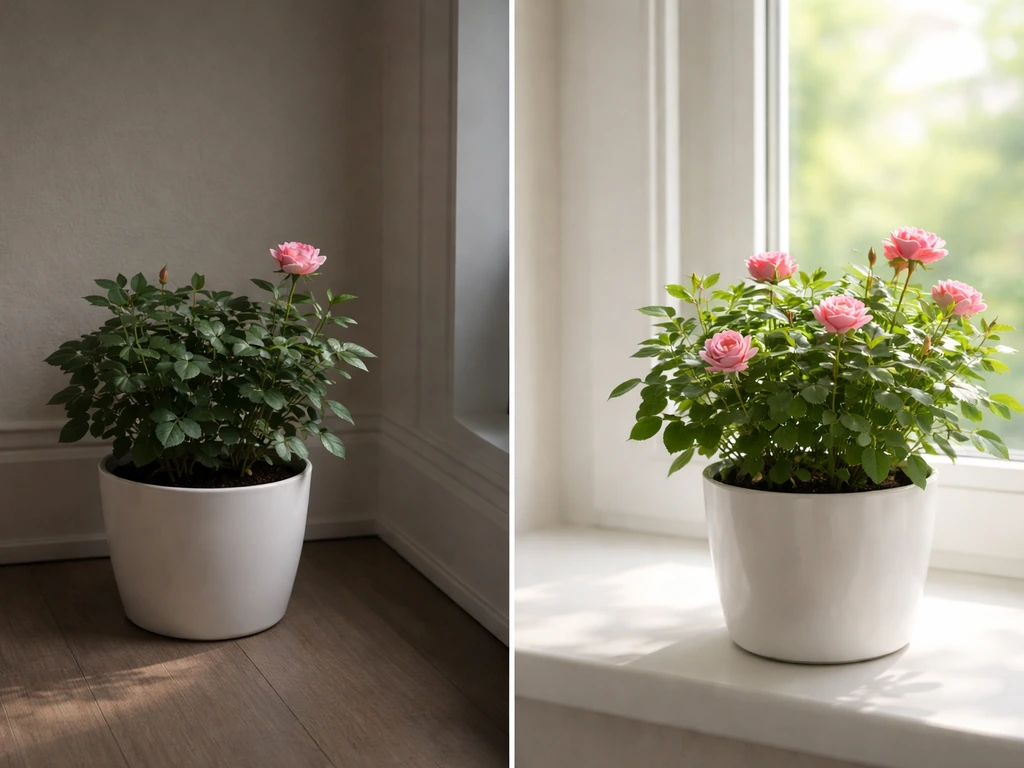
Most extension resources agree that roses need at least six hours of bright light daily. The New York Botanical Garden says miniature roses need at least six hours of direct sun, and Missouri Extension echoes that figure for outdoor planting guidance. That benchmark matters indoors because it tells you how high the bar actually is. Roses are not low-light plants. They are sun-loving shrubs that evolved in open fields, not forest floors. Putting one in a dim corner is a bit like asking a sunflower to grow in a closet.
That said, "without direct sunlight" covers a wide range of real situations. It could mean a bright north-facing window with good ambient light. It could mean a room with no windows at all. It could mean a south-facing window in winter when the sun angle is low and days are short. Each of those is a very different challenge, so the answer to "can my rose grow here?" depends heavily on what your specific space actually delivers.
How roses use light: the numbers that actually matter
Plants measure light in PPFD (photosynthetic photon flux density), expressed as µmol·m⁻²·s⁻¹. This is the number that tells you how many photons in the 400–700 nm range are hitting your plant's leaves per second. Lux or footcandle readings from a phone app are based on human eye sensitivity and don't translate cleanly to plant response, especially with LEDs. OSU Extension makes this point explicitly: lux measurements may not reliably predict plant photosynthesis across different light sources.
For roses, research from ISHS studied greenhouse cultivars at blank" rel="noopener noreferrer">supplementary PPFD levels up to around 370 µmol·m⁻²·s⁻¹, and a ScienceDirect study evaluated shoot development and flowering across levels from near zero up to 174 µmol·m⁻²·s⁻¹ for supplementary light. OSU Extension recommends 400–800 µmol·m⁻²·s⁻¹ for improved general plant growth. Taken together, this tells you roses want to be in the upper half of that range to reliably bloom. Anything below about 200 µmol·m⁻²·s⁻¹ and you're in survival territory, not flowering territory.
Duration matters just as much as intensity. The total daily light dose is captured in a metric called DLI (daily light integral), which combines your PPFD level with how many hours per day the light runs. Virginia Cooperative Extension explains it clearly: increase either the PPFD or the photoperiod, and you increase the DLI your plant receives. Roses generally need a photoperiod of at least 14–16 hours under artificial light to compensate for the lower intensity compared to outdoor sun. Research from MDPI's horticulturae journal found that under photoperiods shorter than 13 hours, flowering was not reliably induced in rose cultivars studied. A horticulturae (MDPI) study on rose responses to red/blue mixtures and photoperiod reported that under short-day conditions of less than 13 hours, flowering was not induced in the experimental context described short-day photoperiods shorter than 13 hours.
Light spectrum also plays a role. Red and blue wavelengths drive photosynthesis most efficiently. MSU Extension notes that red and far-red lamp types are most suitable for regulating flowering in long-day plants, and roses respond to these cues. A full-spectrum LED grow light that emphasizes the red/blue range is your best practical tool here. Warm-white or cool-white fluorescent bulbs can supplement ambient light but rarely deliver enough intensity for roses to bloom well.
Indoor light options compared: window light, grow lights, and everything in between
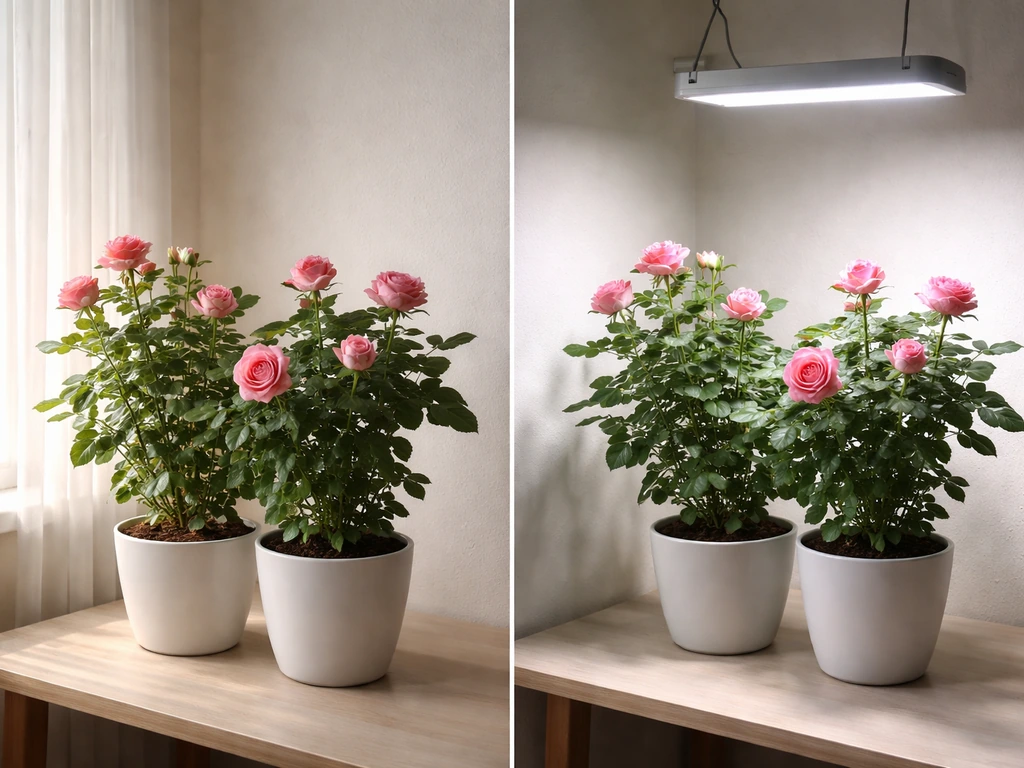
Before you buy anything, figure out what your space actually offers. A south-facing window in summer can push 300–500 µmol·m⁻²·s⁻¹ at the glass on a clear day, which is borderline workable for a miniature rose. Step back two feet from the glass and that number can drop by 50% or more, because PPFD falls off fast with distance. UMN Extension is explicit about this: the further a plant sits from any light source, the lower the PPFD it receives.
| Light source | Typical PPFD at plant | Realistic for blooming? | Best use case |
|---|---|---|---|
| South-facing window (summer, close to glass) | 200–500 µmol·m⁻²·s⁻¹ | Marginal to yes | Miniature roses right on the sill |
| North/east/west window | 20–150 µmol·m⁻²·s⁻¹ | No | Survival only, short-term |
| Quality LED grow light (6–12 inches above canopy) | 300–700+ µmol·m⁻²·s⁻¹ | Yes, with correct timer | Best reliable indoor option |
| T5 or T8 fluorescent (4–6 inches above canopy) | 100–250 µmol·m⁻²·s⁻¹ | Marginal | Better than nothing, add hours |
| Standard LED bulb or desk lamp | 10–50 µmol·m⁻²·s⁻¹ | No | Not suitable for roses |
If you're going the grow light route, placement is everything. Fluence's canopy distance guidance illustrates how dramatically PPFD changes as you raise or lower a fixture. With most mid-range LED panels designed for horticultural use, positioning the light 6–12 inches above the rose canopy is a reasonable starting point. Use a timer so the plant gets a consistent 14–16 hours of light and 8–10 hours of darkness. HGTV and other practical sources agree that roses need that regular dark period too: running lights 24 hours is not beneficial and can actually disrupt the plant's development cycles. UMN Extension recommends timers specifically so plants get consistent, repeatable photoperiods.
Signs your rose isn't getting enough light (or is getting too much)
Light stress shows up in the plant before it becomes a crisis, if you know what to look for. The tricky part is that some symptoms overlap with nutrient deficiencies or temperature stress, so you need to read a few signals together, not just one.
Signs of too little light
- Leggy, stretched stems: the plant is reaching toward any light source and producing long, weak internodes. Gardening Know How describes this etiolation as the clearest structural signal of insufficient light.
- New leaves are smaller and paler than older growth, or leaves are a washed-out yellow-green rather than a rich green.
- No new buds forming despite being in the active growing season (spring through summer).
- Existing leaves drop without obvious disease or pest cause. Potted roses indoors are frequently described as declining primarily from inadequate light, with leaf drop as an early warning.
- Very slow or completely stalled growth during months when you'd expect the plant to be active.
Signs of too much light or heat stress
- Leaf edges or tips are scorched, turning brown or crispy, especially on leaves closest to the light source or window glass.
- Leaves curl downward or wilt during the middle of the day even when the soil is adequately moist.
- Bleached or pale patches on the upper leaf surface where direct light hits, sometimes called sunscald. OSU Extension links this pattern specifically to heat stress rather than light excess alone.
- Rapid soil drying: intense light combined with warm air from a nearby fixture can pull moisture out of a pot much faster than expected.
One important note: yellow leaves are not automatically a light problem. The American Rose Society points out that nitrogen deficiency also causes yellowing and reduced shoot growth, and these symptoms look nearly identical to low-light chlorosis. If you've recently changed your light setup and leaves are still yellowing, check your fertilization routine before assuming light is the only culprit.
How to set up light for indoor roses right now, step by step
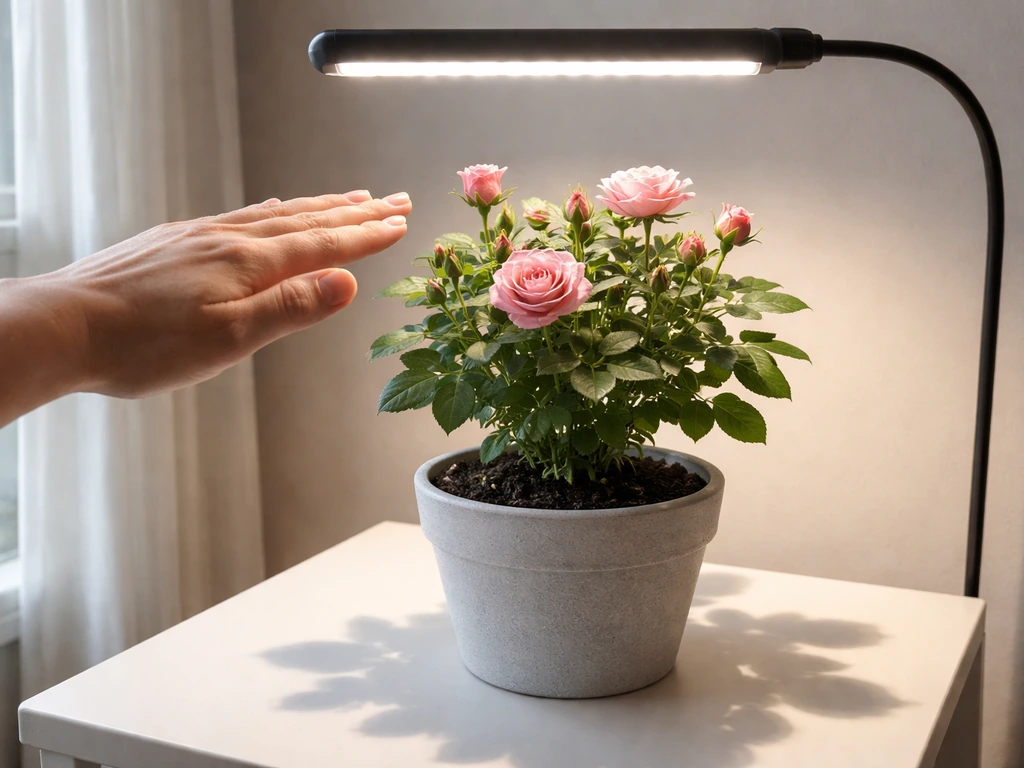
- Assess your window first. Hold your hand about 12 inches above the spot where the rose will sit. A sharp, clearly defined shadow means useful light intensity. A fuzzy or barely visible shadow means it's too dim for roses to thrive without supplemental lighting.
- If you have a bright south-facing window, place a miniature rose as close to the glass as possible (within 6–12 inches) and rotate the pot a quarter turn every few days so all sides get equal exposure.
- If window light is insufficient, choose a full-spectrum LED grow light rated for flowering plants. Look for one that delivers at least 300 µmol·m⁻²·s⁻¹ at canopy distance. Mid-range panels from horticultural brands will usually specify PPFD at various heights in their documentation.
- Position the grow light 6–12 inches above the top of the rose plant. If you notice leaf bleaching or heat stress after a week, raise it by 2–3 inches. If growth is slow and leggy, lower it slightly.
- Set a timer for 14–16 hours of light per day. Consistency matters more than hitting an exact number. A simple plug-in outlet timer costs under $15 and eliminates the guesswork.
- Measure or estimate your DLI to know if you're in the right ballpark. If your grow light delivers 300 µmol·m⁻²·s⁻¹ and runs for 16 hours, your DLI is approximately 17 mol·m⁻²·day⁻¹, which is in a workable range for roses. Virginia Cooperative Extension provides the formula: DLI = PPFD × photoperiod in seconds ÷ 1,000,000.
- Evaluate progress at two to three week intervals. Look for new bud development, healthy leaf color, and compact (not leggy) new growth as your success indicators. Adjust height, duration, or intensity if you're not seeing improvement.
What to expect from blooms, and when to consider a different plant
Even with a good grow light setup, indoor roses are not as easy as growing them outdoors in full sun. Miniature rose varieties are your best bet indoors because they're compact, bred for container culture, and more forgiving about lighting than hybrid tea or climbing types. With 14–16 hours of quality grow light at 300–500 µmol·m⁻²·s⁻¹, you can realistically expect periodic blooms, especially if you keep up with fertilizing, watering, and occasional pruning. Without a grow light and with only moderate window light, expect leaf growth and survival but probably no flowers.
If your space simply cannot support the light levels roses need and you don't want to invest in a grow light, that's completely okay. Some plants are genuinely better suited to low-light interiors. ZZ plants, pothos, spider plants, and rubber plants all manage with a fraction of the light a rose demands. Spider plants are often managed as low-light houseplants, so if you are wondering about growing them without sunlight, that tolerance is usually the reason. In the same way, ZZ plants can often grow without direct sunlight, making them a popular choice for bright-to-low-light rooms. Even jade plants, which love sun, are more forgiving than roses in lower-light conditions. If you've been curious about which species actually tolerate shade well, those are worth exploring before committing to a rose in a challenging space.
Roses reward the effort when you get the light right, but they're honest about when you haven't. If your rose is leggy, not budding, and dropping leaves despite your best efforts over four to six weeks, take that as clear feedback. Either upgrade the lighting setup or redirect your energy toward a plant that matches your actual conditions. There's no shame in that swap, and your indoor garden will be healthier for it.
FAQ
My rose is surviving in a dim room, does that mean it can grow without sunlight long-term?
Yes, but expect weak growth. If the room receives consistently low PPFD, the rose may survive for weeks to months, then gradually thin out. If you see slow, spindly shoots plus limited new leaves, that is usually your signal the light is not enough to support long-term health.
What window direction is best for a rose that is not getting direct sunlight?
If you can, orient for morning or direct south exposure when possible. A south window often works best overall, but a north window can still help only if the light is bright most of the day and you supplement with a grow light. In winter, a south window that seems sunny may drop PPFD too low at the leaf level.
Can I rely on a phone lux reading to know if my rose gets enough light?
Lux apps can mislead you because they are calibrated for human vision. For roses, use a PPFD meter if you have one, or choose a horticultural LED with a known PPFD output and follow the manufacturer’s recommended distance. If you must use an app, treat lux as a rough clue, not a decision tool.
Should I run the grow light 24/7 for an indoor rose?
Aim for a consistent daily light schedule, including a real dark period. For most setups, 14 to 16 hours under grow light with 8 to 10 hours off works better than running lights all day, because roses still need a night cycle for normal development.
How close should a grow light be to an indoor rose?
Yes, but distance changes everything. If your fixture is too high, PPFD at the canopy can fall below the flowering range. A practical approach is to start with the recommended placement (often 6 to 12 inches), then adjust by observing growth and, ideally, rechecking PPFD at the leaf level.
If my rose leaves turn yellow, how do I tell if it is low light or something else?
Look for combinations, not single symptoms. Leaf yellowing right after a light change can be nitrogen related, and low light can also cause pale leaves, slower growth, and leaf drop. If yellowing improves after you adjust fertilization and keep light timing steady, the cause was likely nutrients rather than light alone.
Are miniature roses more likely to bloom indoors without direct sun than other rose types?
Choose the plant type that matches your light budget. Miniature roses are usually the most forgiving indoors, while hybrid tea and climbing roses typically demand higher, more stable light to bloom reliably.
My rose is near a window, so why does it still not bloom?
Not necessarily. A rose can be near a bright window but still fail if it sits far from the glass, has curtains, or gets blocked by furniture. Since PPFD drops quickly with distance, move the plant closer to the light or supplement with a grow light.
What should I do if my space cannot reach the light levels roses need?
If you cannot reach at least the low end of the flowering range, switch goals. For non-flowering success, you can aim for survival and steady leafy growth with moderate light, or switch to a lower-light houseplant. Trying to force roses to bloom under truly low PPFD usually leads to recurring leaf drop.
How do photoperiod and intensity work together for indoor roses?
Use the daily light dose idea. Even if intensity is moderate, extending the photoperiod can raise DLI, but there is a practical ceiling and you still need enough intensity to trigger flowering. If the light cycle is shorter than about 13 hours, flowering is often unreliable in rose cultivars.