Quick answer: what "no sunlight" really means for plants
Yes, many plants can grow without direct sunlight, but that is not the same as growing without any light at all. This distinction trips up a lot of beginners, and it is worth getting clear on it before you put a plant in a dark corner and wonder why it is dying. When most people ask "will a plant grow without sunlight?" they really mean "will it grow without a sunny window?" and the honest answer is: plenty of species will do just fine. But when the question is "will it grow in complete darkness?", that answer is a flat no, for every green plant on earth.
The confusion comes from how loosely the word "sunlight" gets used. In plant care, "no direct sunlight" usually just means the plant is not sitting in a sunny beam, it can still be receiving bright ambient daylight, scattered light from a window across the room, or even decent artificial light from overhead fixtures. University of Missouri Extension helpfully breaks this down using foot-candles: low-light plants generally need about 50 to 250 foot-candles to stay alive and grow, which is a far cry from total darkness. So the spectrum you are actually dealing with looks like this: bright indirect light, low light, very low light, and then actual darkness, and each category requires a different game plan.
Can plants grow with no light at all (photosynthesis limits)
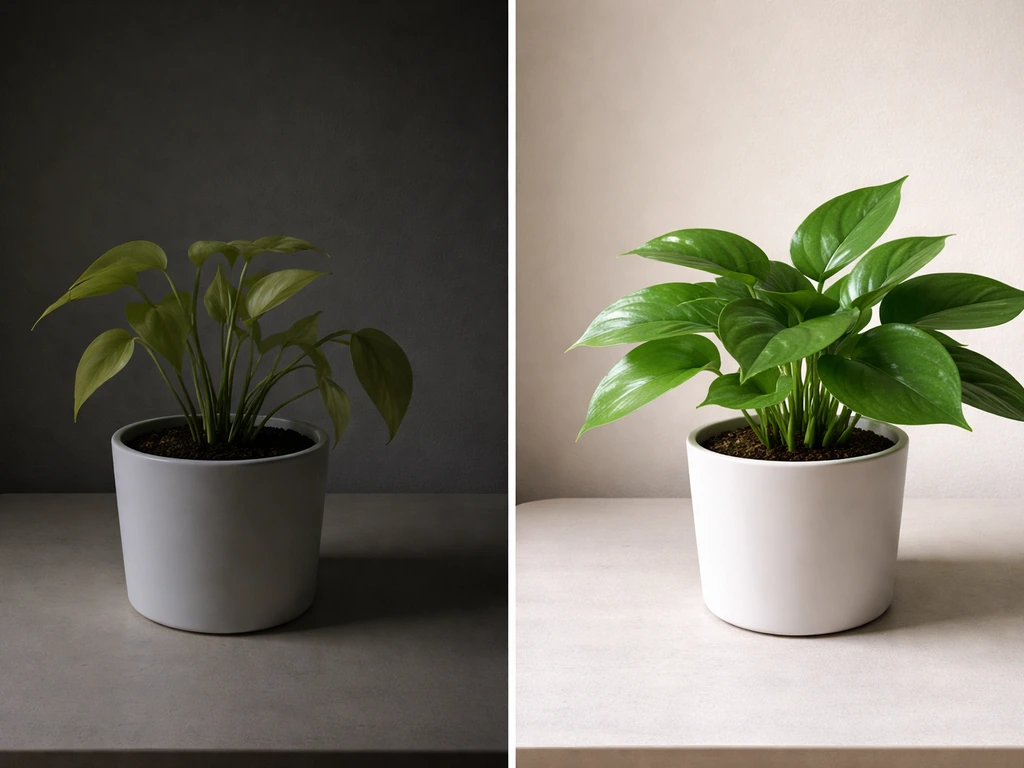
No. This is the hard biological limit. Plants make their food through photosynthesis, which requires photons in the 400 to 700 nm wavelength range, what scientists call photosynthetically active radiation, or PAR. Chlorophyll (the pigment that makes leaves green) absorbs those photons most efficiently at blue and red wavelengths, converts that light energy into chemical energy, and uses it to build sugars. Without any light, that process stops completely. The plant then has to burn through its stored carbohydrate reserves just to keep basic cell functions (cellular respiration) running, but it cannot restock those reserves because photosynthesis is offline.
What you will see in a plant that has been in total darkness for even a few days is a process called etiolation. Stems stretch out unnaturally long and pale (the plant is essentially reaching for a light source that is not there), leaves shrink, and chlorophyll production shuts down. This is called skotomorphogenesis, growth driven by darkness signals instead of light signals, and it is the plant equivalent of a survival panic response. Eventually, once the stored energy runs out, the plant dies. The timeline depends on species and how much energy it had banked, but no green plant makes it long-term in true darkness.
Seeds are a partial exception here, worth mentioning. Many seeds can sit dormant in the dark for months or even years. Whether a seed needs light to germinate depends on the species, a trait called photoblasticism. Some seeds (like lettuce) need a flash of red light to trigger germination via phytochrome receptors; others germinate best in darkness. In photoblastic lettuce, irradiation with red light (about 600 to 700 nm) triggers germination, and that red-light effect is cancelled by far-red light (about 700 to 750 nm) Some seeds (like lettuce) need a flash of red light to trigger germination via phytochrome receptors. But once a seedling emerges and needs to photosynthesize, the light requirement kicks in immediately.
Can plants grow without sunlight and without water (survival vs growth)
Remove both sunlight and water and you have removed two of the three core ingredients for photosynthesis (water, CO2, and light). At that point you are not talking about growth, you are talking about how quickly the plant dies. Water is needed for the light-dependent reactions of photosynthesis, for nutrient transport, and for basic cell structure (turgor pressure). Without it, cells deflate, stomata close, and the plant wilts. Without light, as we just covered, photosynthesis is already stopped. Without both, the only question is which failure mode gets the plant first.
Some plants have evolved tricks to buy time. Succulents and cacti store water in their tissues and can survive drought for weeks or months. ZZ plants have rhizomes that stockpile water and energy underground. A few specialized species go dormant when conditions are brutal. But "surviving temporarily" is very different from growing. No plant can grow without both light and water, full stop. If you are asking because you want to leave a plant unattended for a while, the realistic advice is to pick the most tolerant species you can find, give it a good drink before you leave, and accept some decline is possible.
Best plants for low light / no direct sunlight indoors
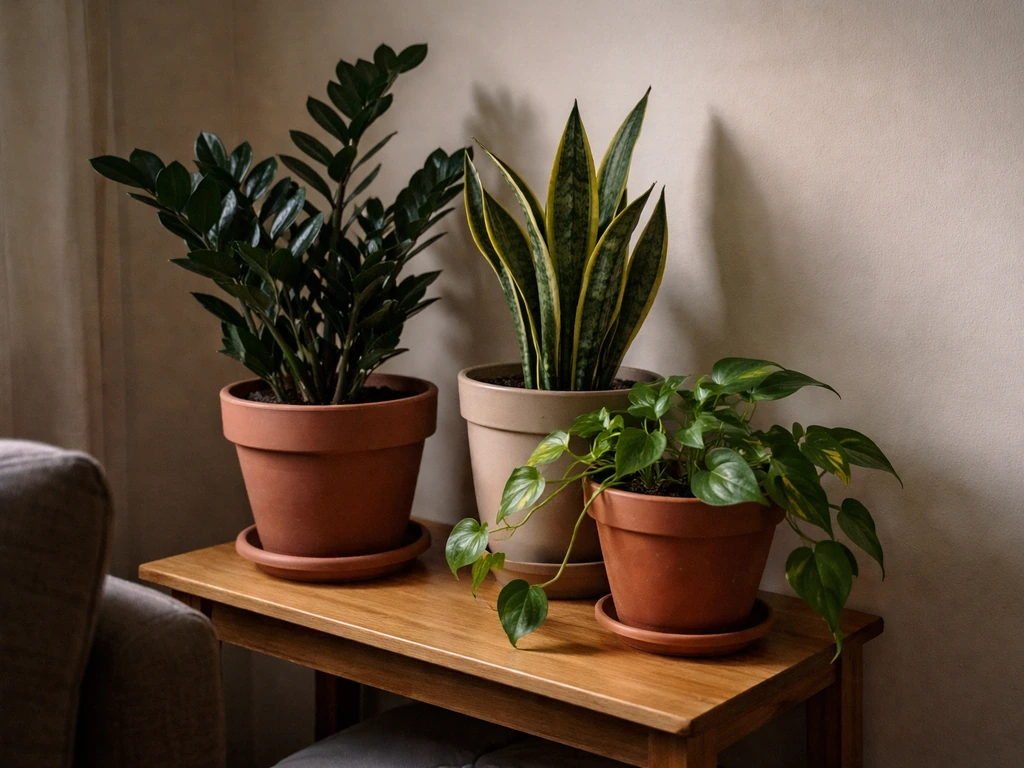
The good news is that quite a few popular houseplants evolved on forest floors or understories where they rarely (if ever) received direct sun. These are legitimately adapted to low-light conditions, not just tolerant of it in a grumpy, barely-surviving way. Here are the ones I have seen perform consistently well in genuinely dim indoor spaces:
- ZZ plant (Zamioculcas zamiifolia): One of the most forgiving houseplants for low light. Its thick rhizomes store water and energy, which helps it coast through dim conditions. It will not grow fast in low light, but it stays alive and looks good. If you want to understand exactly what "low light" means for this species, whether a ZZ plant can grow without sunlight is worth a deeper read.
- Snake plant (Sansevieria / Dracaena trifasciata): Extremely tough, handles low foot-candle levels, and stores water in its thick leaves. Probably the most common "dark corner" survivor.
- Pothos (Epipremnum aureum): Grows fast even in modest light, though variegated varieties lose their patterning in low light as chlorophyll maximizes to capture what little is available.
- Spider plant (Chlorophytum comosum): Handles indirect and low light well, and is forgiving about inconsistent watering. If you are considering one for a dim room, it helps to check out how spider plants do without direct sunlight before placing them in your lowest-light spot.
- Peace lily (Spathiphyllum): One of the few flowering plants that genuinely tolerates low light — though it blooms better with a bit more.
- Cast iron plant (Aspidistra elatior): Lives up to its name. Very slow-growing in low light, but incredibly durable.
- Rubber plant (Ficus elastica): Prefers bright indirect light but adapts to lower levels. How rubber plants handle low-light conditions is nuanced — they will drop leaves if things get too dim, so it is worth understanding the threshold.
- Jade plant (Crassula ovata): Surprisingly adaptable. Extension data shows jade can survive at around 25 foot-candles, though growth becomes thin and leaves stay small at that level. For a closer look, growing a jade plant without direct sunlight covers what to realistically expect.
One plant that does not make this list: roses. They are sun-hungry, typically needing six or more hours of direct light daily. If you are curious about the specifics, whether a rose plant can grow without sunlight gives an honest rundown, the short version is that it is very hard to pull off indoors without serious artificial lighting. Pick your battles.
How to grow plants without natural light (LED/fluorescent options)
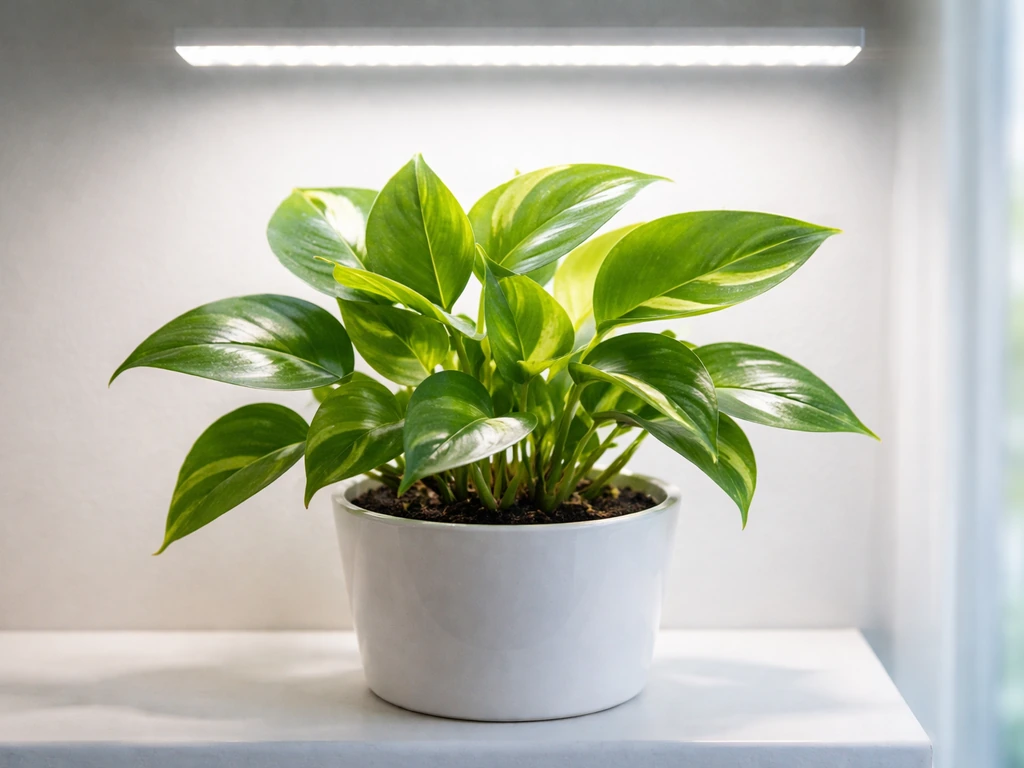
If your space has no windows, or your windows face the wrong direction and give you basically nothing, artificial lighting is not just helpful, it is the only option. The good news: it works really well when set up correctly. The key variables are light spectrum, intensity (measured in PPFD: photosynthetic photon flux density, in µmol·m⁻²·s⁻¹), and daily duration (which determines your daily light integral, or DLI).
LED grow lights
Full-spectrum LED grow lights are currently the best all-around choice for most indoor gardeners. They run cool, use less electricity than fluorescents or HIDs, and modern units deliver a solid PAR spectrum. For low-light plants like ZZ or pothos, a modest LED panel or even a good LED bar light hung 12 to 24 inches above the plant canopy will do the job. For more demanding plants or seedlings, you want to get closer and run longer photoperiods.
UNH Extension research found that LED light bars run about 8 hours per day at 8 inches above the crop reached adequate DLI for seedlings, but if you move those same lights up to 20 inches, you need about 16 hours per day to compensate for the reduced intensity. Distance matters more than most beginners expect.
Fluorescent lights
T5 and T8 fluorescent shop lights are inexpensive and widely available, and they work. The limitation is intensity, they need to be kept close to the plants (less than a foot away for seedlings) and run for long periods. UNH Extension guidelines suggest running T8 fluorescents for up to 22 hours per day when they are the sole light source for sun-loving seedlings. For low-light houseplants that threshold is much more forgiving, and a standard 14 to 16 hour photoperiod is usually plenty.
Practical setup checklist
- Choose a full-spectrum LED or T5/T8 fluorescent rated for plant growth (look for products that specify PAR output or PPFD at a given distance).
- Position the light at the manufacturer-recommended distance — typically 6 to 18 inches for LEDs depending on wattage, and under 12 inches for fluorescents.
- Set a timer for 12 to 16 hours of light per day for most low-light houseplants; bump to 16 to 18 hours for seedlings or more light-hungry species.
- Give plants a true dark period — do not leave lights on 24 hours. Most plants benefit from 6 to 8 hours of uninterrupted darkness.
- Adjust height as plants grow to maintain a consistent intensity at canopy level.
- Check intensity with a PAR meter or a phone app like Photone if you want measurable PPFD readings rather than guessing.
| Light source | Best for | Typical distance from plants | Daily hours needed (low-light plants) | Rough cost to start |
|---|
| Full-spectrum LED grow light | Most houseplants, seedlings, herb gardens | 6–18 inches | 12–16 hours | Moderate ($20–$100+) |
| T5/T8 fluorescent shop light | Seedlings, low-light houseplants | Under 12 inches | 14–22 hours | Low ($15–$50) |
| Standard LED bulb (warm/cool white) | Very low-light tolerant plants only | 6–12 inches | 14–16 hours | Very low (under $15) |
| HID / metal halide | High-demand crops, serious setups | 24–48 inches | 12–18 hours | High ($100–$300+) |
How to run a simple grow-without-sunlight science project (setup + what to measure)
This is a great experiment, and easy to set up at home or in a classroom. The core idea is to grow identical plants (same species, same age, same pot size, same soil) under different light conditions and compare outcomes. The most compelling version compares three groups: one under normal indirect natural light, one under artificial-only light, and one in near-total darkness. Here is a clean way to run it:
- Choose a fast-growing species with consistent seeds — bean, radish, or basil all work well and show results within two to three weeks.
- Plant seeds in identical containers with the same potting mix and water them equally from the start.
- Assign each group a light condition: Group A gets indirect natural light from a window, Group B gets a grow light or fluorescent on a 14-hour timer, and Group C is kept in a dark box or closet.
- Keep all other variables identical — same watering schedule (by weight if you want to be precise), same temperature, same pot size.
- Measure and record every two days: stem height, number of leaves, leaf color (use a color chart or simple descriptions), and stem diameter if possible.
- Note etiolation signs in the dark group: stem elongation, pale or yellow color, bent/hooked stem tip — these are your key visual data points.
- At the end of two to three weeks, compare total growth, leaf health, and overall plant appearance across the three groups.
What you will find: Group B (artificial light, done right) will track closely with Group A, sometimes outperforming it depending on your window conditions. Group C will germinate, seeds do not always need light for that step, but within days the seedlings will show classic etiolation: pale, leggy, reaching desperately. Within two weeks, Group C plants will be significantly smaller, weaker, and likely beginning to fail. That visual difference is what makes this experiment compelling. Photoperiod is also worth testing as a follow-up: run two artificial-light groups at different timer durations (say, 8 hours vs 16 hours) and measure how that alone changes DLI and growth outcomes.
How to tell if your plants are getting enough light (signs + adjustment checklist)
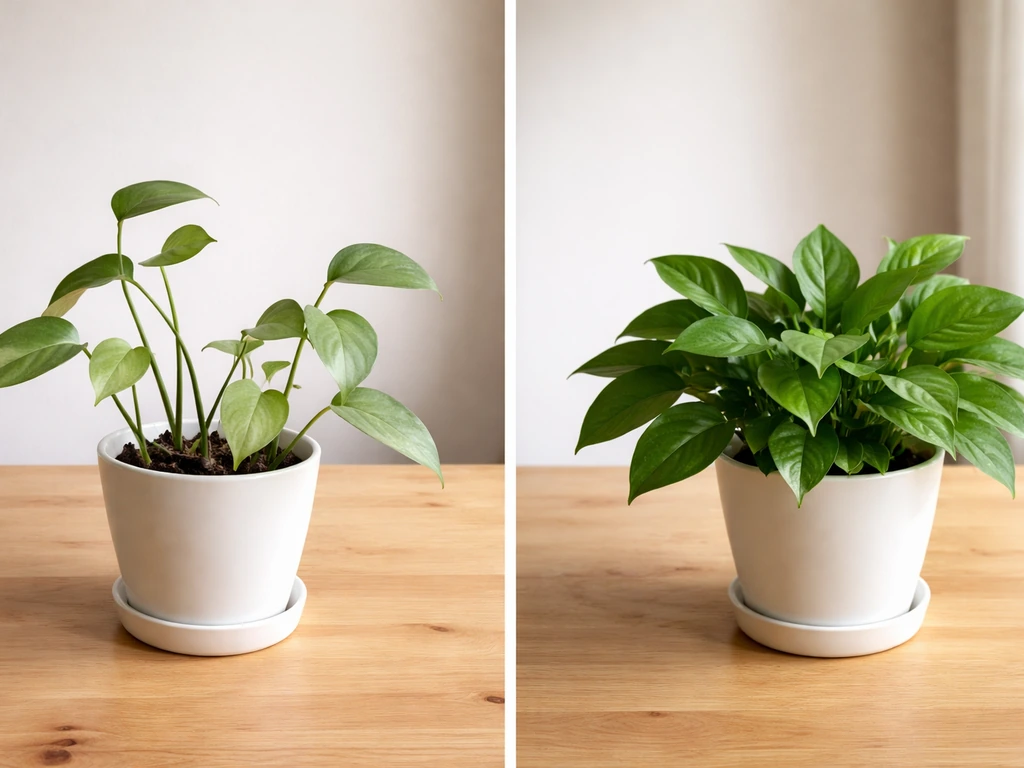
Plants are pretty communicative once you know what to look for. The tricky part is that light stress and other problems (overwatering, underwatering, nutrient deficiency) can look similar at first glance. Here are the specific signs that point to insufficient light rather than something else:
- Leggy, elongated stems with wide gaps between leaves (internode stretching — the plant is reaching for more light)
- Smaller-than-normal new leaves, especially compared to older growth on the same plant
- Pale green or yellowing leaves that are not associated with overwatering or age
- Variegated plants losing their pattern and going solid green (the plant is maximizing chlorophyll to capture more light)
- Slow or stopped growth over several weeks during the active growing season
- Flowering plants that refuse to bloom despite correct watering and fertilizing
- Soil staying wet for unusually long periods — low light slows metabolism and water uptake, so wet soil that does not dry out normally is an indirect clue
If you want to move beyond guessing, measure. Illinois Extension anchors "low light" at around 75 foot-candles, that is a concrete number you can verify. A dedicated PAR/PPFD meter is the most accurate tool, but it is not cheap. A phone app like Photone can give you a useful estimate if you understand it is an approximation. Hold the meter or phone at plant canopy height and take readings at different times of day to get a realistic average.
Adjustment checklist when light is not enough
- Move the plant closer to the nearest natural light source first — even a few feet can make a meaningful difference.
- Clean dusty or dirty windows: grime can cut light transmission significantly.
- Add a grow light or supplement with a fluorescent bulb on a timer if moving the plant is not an option.
- Reduce watering slightly to match the plant's lower metabolic rate in dim conditions — soggy soil in low light is a fast path to root rot.
- If you are already using artificial light, check your timer and bulb distance before assuming the light is the wrong type.
- Swap to a more genuinely low-light-tolerant species if the plant you have selected simply needs more than your space can provide.
The bottom line is that "no sunlight" does not have to mean "no plants." It means you need to be intentional: pick species that are genuinely adapted to lower light levels, understand what light they actually need in measurable terms, and fill the gap with a decent artificial setup if your space truly lacks natural light. Most indoor gardeners are working with more light than they think, and for those who are not, grow lights have become affordable and effective enough that a no-window plant setup is completely realistic today.