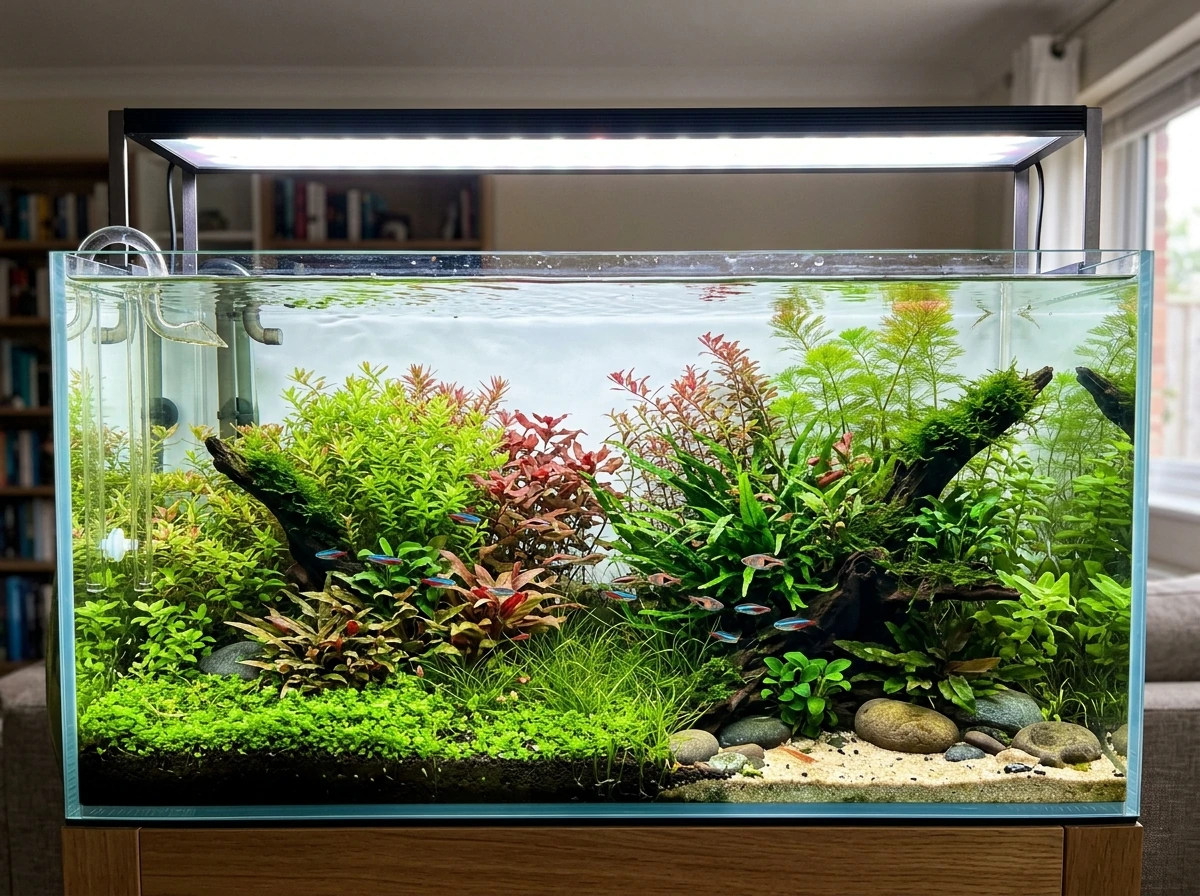
The reason LEDs have largely replaced fluorescent and T5 setups in planted tanks is practical: they're energy-efficient, run cooler, last longer, and many modern fixtures let you dial in spectrum, intensity, and scheduling far more precisely than older bulb types ever allowed. If you're sitting here wondering whether your LED strip can actually grow plants, the answer is almost certainly yes. The better question is whether it's the right LED for your specific tank and plant selection, and whether it's set up to deliver light where plants actually need it.
What actually makes LEDs work for aquatic plants
Three variables determine whether your LED setup supports real plant growth: Three variables determine whether your LED setup supports real plant growth: intensity, spectrum, and photoperiod. Understanding each one takes about two minutes, and it'll save you a lot of frustration.. Understanding each one takes about two minutes, and it'll save you a lot of frustration.
Intensity: how much light actually hits the plant
Intensity is the big one. The measurement that matters for planted tanks is PAR (Photosynthetically Active Radiation), which tells you how much usable light energy is reaching a given point. The key word here is 'at the plant,' not at the surface of the water. Light intensity decreases with distance, and it decreases fast. blank" rel="noopener noreferrer">According to the inverse square law, doubling the distance from a light source roughly quarters the intensity delivered. A 12-inch deep tank can reduce delivered light at the substrate to about one-quarter of what hits the water surface. That's why a light that looks plenty bright overhead can leave bottom-dwelling plants starved.
As a rough guide without needing a PAR meter: low-light plants like Java fern, Anubias, and most mosses can get by on 20 to 40 PAR at the plant. Medium-light plants like most stem plants and crypts want 40 to 80 PAR. High-light plants, including many carpeting species and red plants, need 80 PAR or more delivered at the substrate. If your light fixture includes PAR specifications from the manufacturer, check whether those values are measured underwater or in open air, and at what depth. The underwater PAR number is the one that matters.
Spectrum: red and blue are doing most of the work
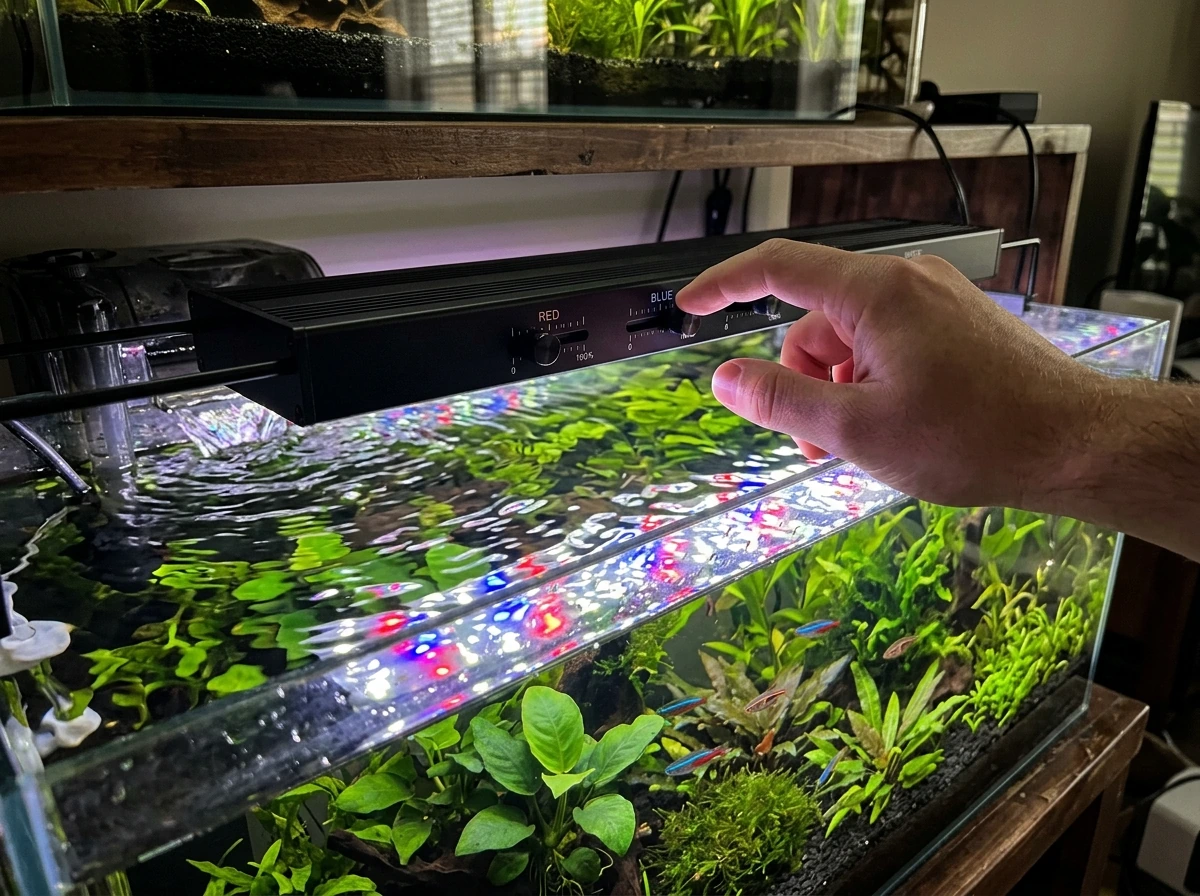
Plant chlorophyll absorbs light most efficiently in two ranges: blue light around 450 nm and red light around 660 nm. Research on LED lighting confirms that blue and red wavelengths promote photosynthesis and plant growth, while narrow amber light alone produces significantly slower growth.
For planted tanks, this means a light that only outputs a white or blue-white color temperature (like a plain 6500K LED) may still grow plants, but it can leave them with poor red pigmentation and less efficient photosynthesis compared to a full-spectrum fixture that includes a strong red channel. Many dedicated planted-tank LEDs include a red channel specifically for this reason. If your plants' red coloration looks washed out even under adequate intensity, insufficient red spectrum is usually the culprit.
Blue light also penetrates water more deeply than red, which matters in deeper tanks. A balanced fixture gives you the penetration of blue combined with the growth and color benefits of red, which is why planted-tank lights are designed to hit both peaks rather than just look good to the human eye.
Photoperiod: duration matters as much as intensity
Photoperiod is how many hours per day your lights run. This is where a lot of planted tank problems start, because more light time does not equal more plant growth if your intensity and nutrients aren't perfectly balanced. [Research and experienced aquarists consistently point to 8 to 9 hours per day as the sweet spot for most planted tanks. ](https://www.
reddit. com/r/PlantedTank/comments/15sepe7) Going longer than that, especially with high intensity, significantly increases algae risk. Diana Walstad's planted tank research specifically flags that intense light with daylengths beyond about 8 to 9 hours can trigger severe algae problems. If your tank is new or you're dialing in a new light, starting at 6 to 8 hours is genuinely safer than jumping straight to 10.
Aquarium Co-Op recommends starting planted tanks around 6, 8 hours per day and then fine-tuning, since both too much and too little light can drive algae starting at 6 to 8 hours is genuinely safer than jumping straight to 10.
Setting up your LED: placement, distance, and daily schedule
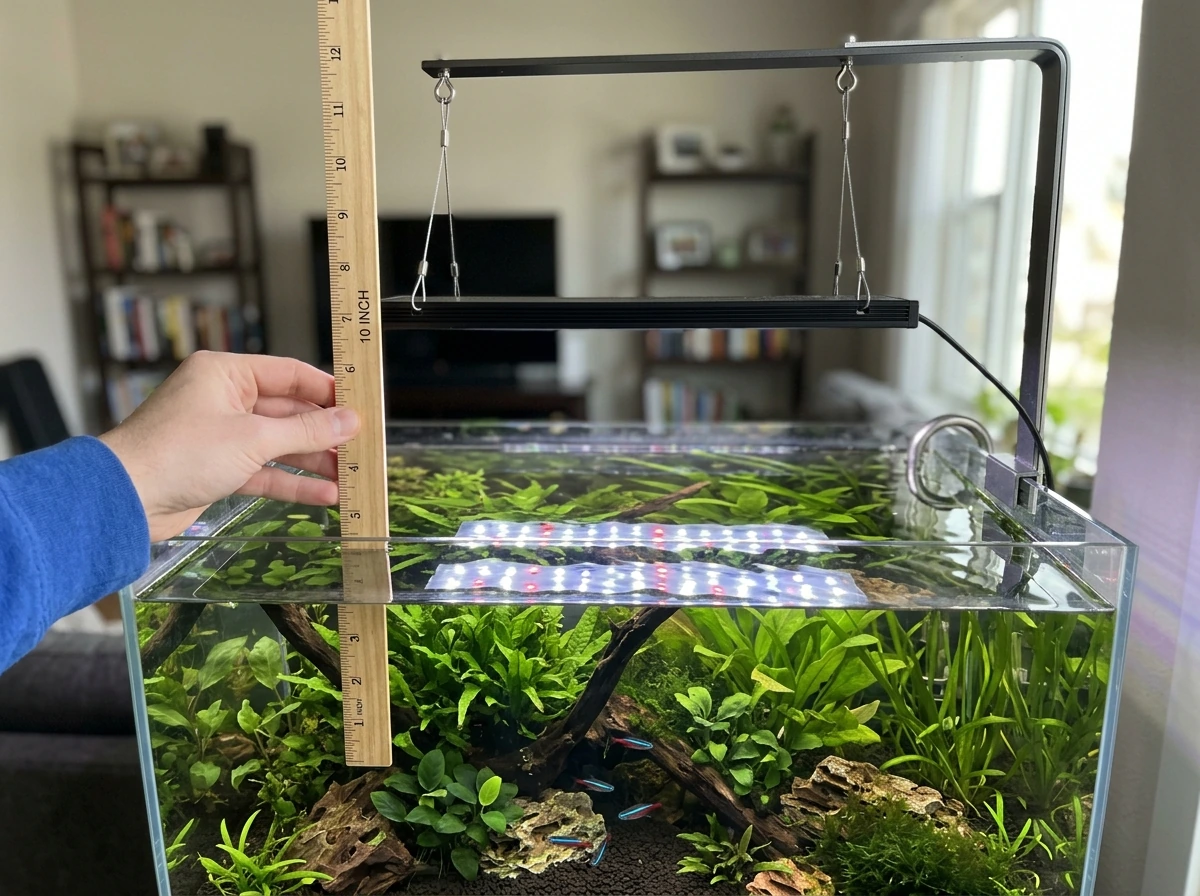
Most aquarium LED fixtures are designed to sit on top of or hang above the tank, which is exactly right (you don’t necessarily need plants directly under grow lights). You do not want to fully submerge a light fixture unless it's specifically rated and designed for submersion. Even lights rated IP68 (waterproof) are often not meant to run while fully submerged. Mount your light above the waterline, centered over the tank footprint, to maximize even coverage across the substrate.
Distance between the light and water surface affects how much light reaches the substrate. Closer generally means more intensity but also a smaller coverage area. Most planted-tank fixtures are designed to be used at a specific mounting height, and the manufacturer's PAR data is usually measured at that height. If you're hanging a fixture rather than resting it on the tank rim, follow the recommended mounting distance. If you notice strong light in the center and dim corners, spreading the fixture slightly higher or adding a second unit can even things out.
For scheduling, use a timer. Manual switching leads to inconsistent photoperiods, and inconsistency stresses plants and invites algae. If your fixture has app control or programmable scheduling, use it to ramp the light up gradually at the start of the day and back down at the end. Fixtures like the Fluval Plant 3.0 let you do this with independent channel control, which means you can run a dimmer 'sunrise' period before full intensity kicks in. This isn't strictly necessary, but it mimics natural light patterns and gives you more control over total daily light energy.
- Mount the light above the waterline, centered over the tank
- Start with a 7 to 8 hour photoperiod and adjust from there
- Use a timer for consistent daily schedules
- If your fixture supports ramping, use it to ease into full intensity
- Check manufacturer PAR specs at depth, not just at the surface
Choosing the right light: general aquarium LEDs vs planted tank fixtures
Not all LEDs are created equal, and this is where a lot of people run into trouble. A basic aquarium LED strip that came with a starter tank kit is designed primarily to make the fish look good and the water look clear. It may not deliver enough intensity at the substrate for live plants, and it's unlikely to have the red channel needed for strong photosynthesis and plant coloration. It might work for very low-light plants like Java fern or Anubias, but if you want to grow anything more demanding, you'll hit a ceiling quickly.
Dedicated planted-tank LED fixtures are engineered differently. They're built around PAR output and spectral balance rather than aesthetics, and they typically include both a strong red channel and enough intensity to reach the substrate in most tank depths. Many also include programmable scheduling, dimming, and multi-channel control. The Fluval Plant 3.0 and Finnex Planted+ are well-known examples in this category, and both have published PAR data measured at depth so you can actually plan your setup rather than guess.
| Feature | Basic Aquarium LED | Dedicated Planted-Tank LED |
|---|
| Primary design goal | Fish viewing, aesthetics | Plant growth, PAR delivery |
| Spectrum | White/blue-white, limited red | Full spectrum with red and blue peaks |
| Intensity at substrate | Often low, especially in deeper tanks | Higher, with PAR data at depth |
| Scheduling/control | Usually basic on/off | Programmable, often app-based with dimming |
| Price range | Budget to mid-range | Mid-range to premium |
| Best for | Low-light plants, fish-only tanks | Low to high-light plants, carpeting species, reds |
If you already have a basic LED and want to know whether it'll work, start by testing it with a low-light plant like Anubias or a Java fern. If those plants are growing (even slowly), your light is doing something. If they're yellowing or barely alive, it's likely not delivering enough intensity. The honest recommendation: if you're serious about a planted tank, invest in a purpose-built planted-tank LED. The difference in results is real, and you won't be fighting your equipment the whole time.
Different plants, different expectations
Aquatic plants vary enormously in their light needs, and matching your plant selection to your LED's actual output is the fastest way to get a healthy-looking tank. Trying to grow high-light carpeting plants under a basic strip light is a recipe for frustration. Choosing the right plants for your actual setup is just as important as the light itself.
Rooted plants (substrate or attached to hardscape)
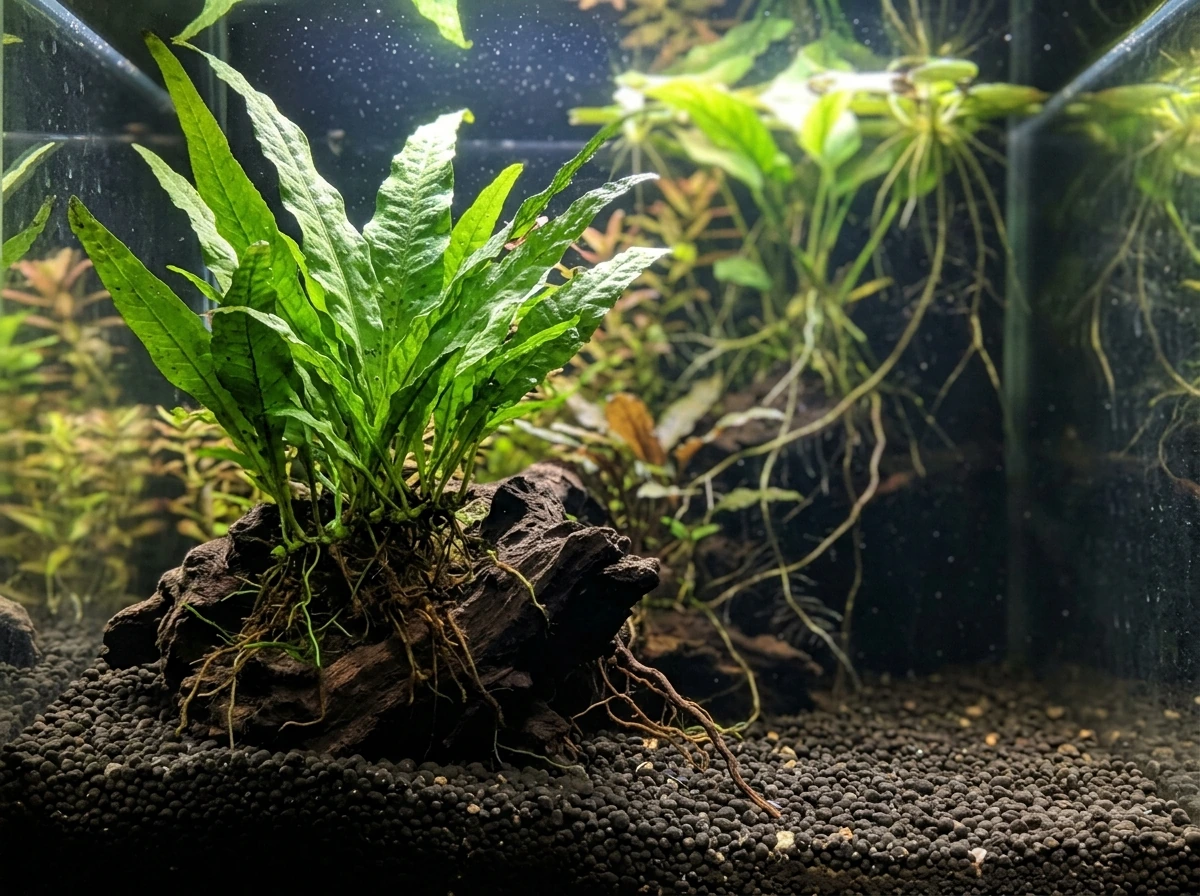
Rooted plants live at or near the substrate, which means they're the furthest from your light source. They depend on light penetrating the full depth of your tank. Low-light rooted plants like Anubias, Java fern, crypts, and most mosses are the most forgiving and will grow under a wide range of LED setups, including modest fixtures. Mid-light rooted plants like Vallisneria, Amazon swords, and many stem plants need more intensity at depth. High-light plants like Hemianthus callitrichoides (HC Cuba) or other carpeting species need strong PAR delivered all the way to the substrate, which usually means a dedicated planted-tank fixture over a tank no deeper than 18 inches, or two lights for wider/deeper tanks.
Floating plants
Floating plants like frogbit, Amazon frogbit, and water lettuce sit right at the surface, so they have no problem getting intense light. In fact, they often get too much and grow aggressively. The bigger issue with floating plants is that they shade rooted plants below them. A dense mat of floating plants can block enough light that rooted species underneath struggle or die. If you're growing both, keep your floating plant coverage intentionally sparse, or consider removing floaters from a planted tank where rooted growth is the priority.
Fast growers vs slow growers
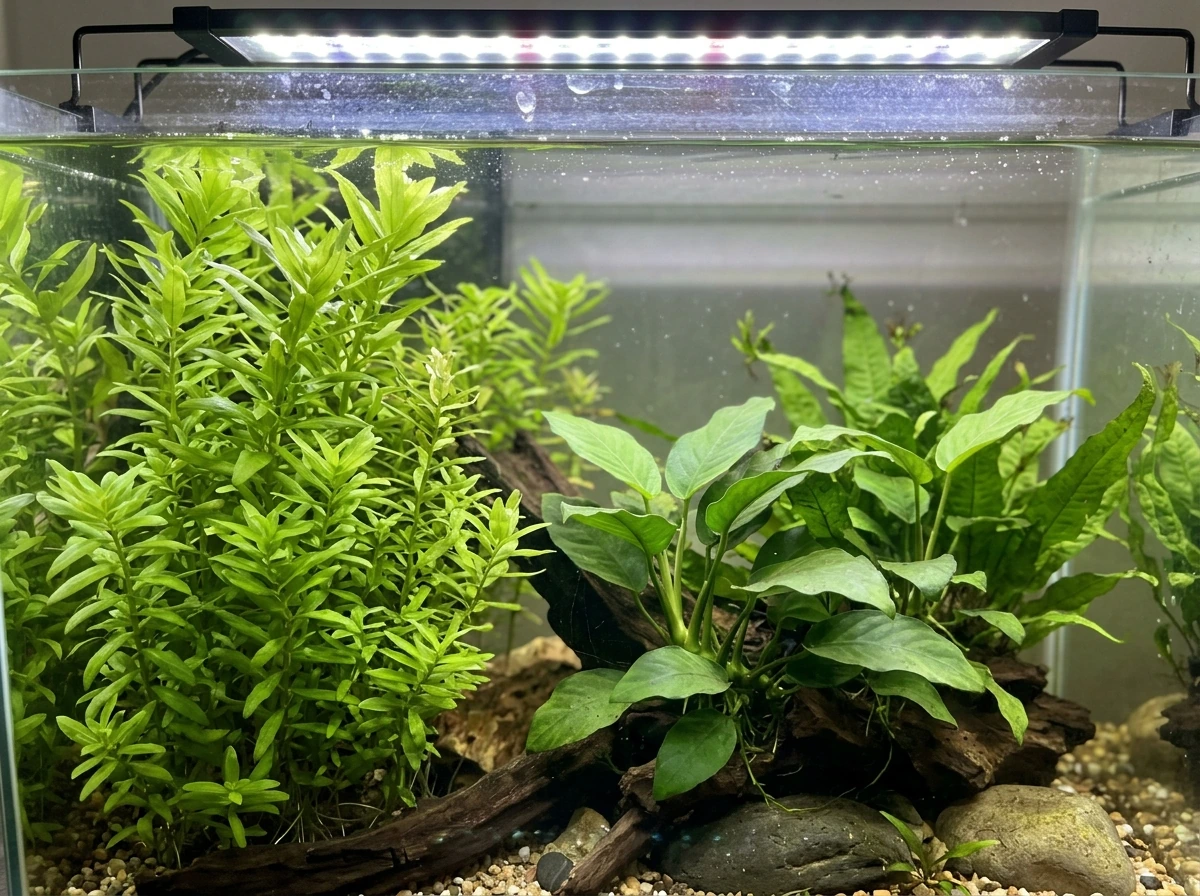
Fast-growing stem plants like hornwort, water wisteria, and rotala grow quickly under adequate light and consume nutrients rapidly. They can actually help outcompete algae in a well-balanced tank. Slow growers like Anubias and Java fern take their time regardless of light level. Don't interpret slow growth from an Anubias as a light problem; that's just how that plant grows. If your stems are growing slowly or becoming leggy (long internodes between leaves), that's a more reliable signal that light intensity is too low.
When plants aren't thriving: troubleshooting and algae control
Most planted LED problems come down to a mismatch somewhere in the intensity, spectrum, or photoperiod equation. Here's how to read what your tank is telling you.
Slow growth or leggy stems
If stems are reaching toward the light and growing long spaces between leaves, or if growth has basically stalled, you're likely dealing with insufficient intensity at the plant's level. Check whether your fixture is delivering enough PAR at substrate depth, whether your tank is too deep for the light, or whether something is blocking light (turbid water, floating plants, or a dirty light lens). Leggy growth in particular is a classic low-light symptom: the plant is literally stretching toward more light.
Poor red coloration
If red plants like rotala or ludwigia look green instead of red, the most common cause is insufficient red spectrum in your light, followed by insufficient intensity overall. A plain white LED without a strong red channel will often produce this result even if the plant is technically growing. Switching to a full-spectrum planted-tank fixture with a dedicated red channel usually fixes this.
Algae outbreaks
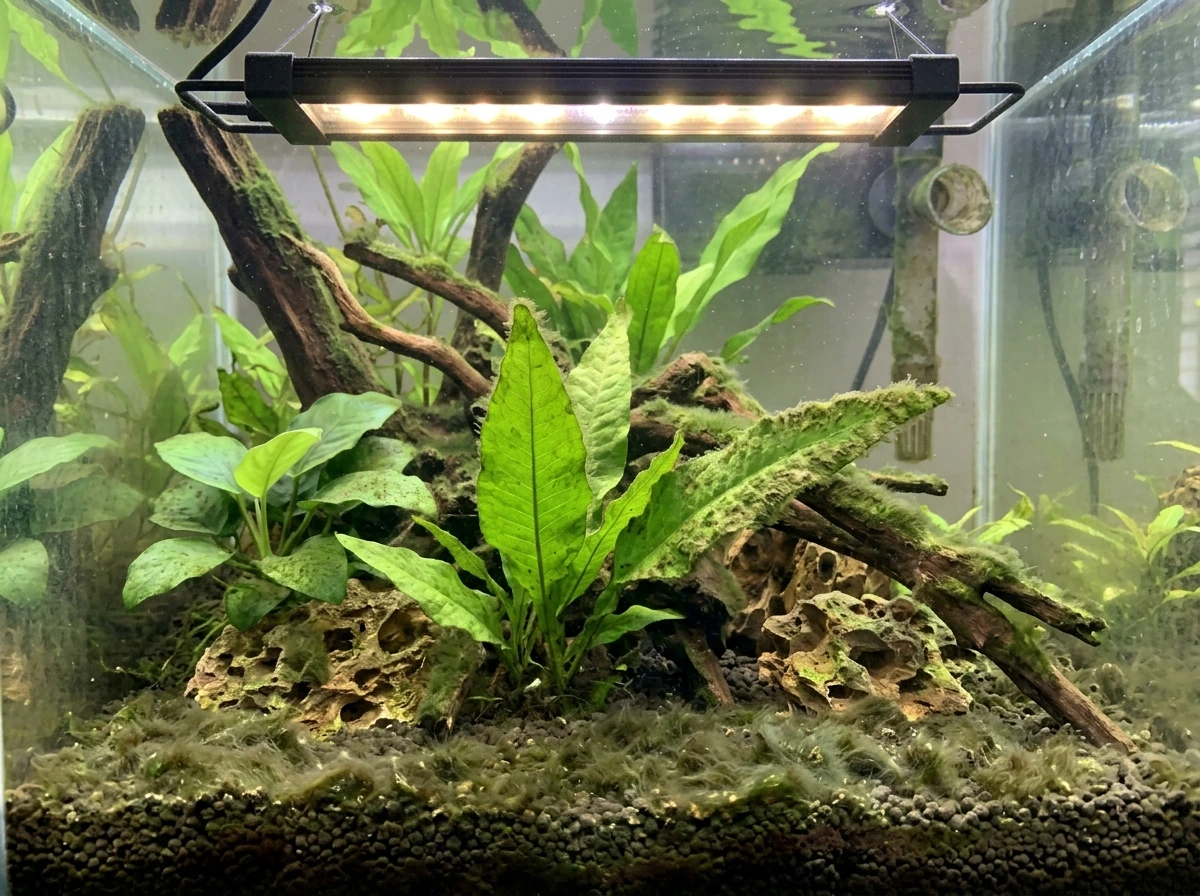
Algae is the most common sign that something is out of balance, and it's almost always tied to too much light energy relative to what your plants and nutrients can handle. The fix is usually simpler than people expect: reduce your photoperiod by an hour or two and see if the algae slows. If you're already at 8 hours and algae is still a problem, try dropping to 6 hours and gradually increasing as the tank stabilizes. Reducing intensity (if your fixture supports dimming) is another option. Do not extend the photoperiod trying to help plants outcompete algae. More light time without more plant growth capacity just feeds the algae.
Melting plants
Melting is common when plants transition from emersed (above-water) growth to submersed. Many aquarium plants are grown out of water commercially and then sold in a water-grown form. The old leaves die back as the plant adjusts. This is not a light problem, though inadequate light can slow recovery. Give a melting plant 2 to 4 weeks before assuming the light is the issue. As long as the growing tip or rhizome looks healthy, the plant is usually fine.
Water clarity
Turbid or tannin-heavy water absorbs light before it reaches the substrate. If your water has a yellow or brown tint, your effective PAR at depth is lower than your fixture's specs suggest. Keep water clear with appropriate filtration and consider activated carbon if tannins are an issue. Algae growth on the light lens or tank glass also reduces light transmission and is worth cleaning off regularly.
Your quick-start checklist and next steps
If you're starting fresh or troubleshooting an existing setup, here's a practical order of operations to dial in your LED planted tank. Work through these steps rather than changing everything at once, because changing too many variables simultaneously makes it impossible to know what actually helped.
- Confirm your fixture is a planted-tank LED or at minimum a full-spectrum light with red and blue peaks. If it's a basic blue-white strip, upgrade before expecting serious plant growth.
- Set your photoperiod to 7 to 8 hours using a timer. New tanks or newly lit tanks should start at 6 hours and increase by 30 minutes per week until you find the algae-free ceiling.
- Check your light's positioning: it should be above the waterline, centered over the tank, at the manufacturer's recommended mounting height.
- Match your plant selection to your actual light output. Low-light plants for modest fixtures, higher-demand plants only when you've confirmed your PAR at the substrate.
- If algae appears, reduce photoperiod by 1 to 2 hours before touching anything else. Give it 1 to 2 weeks to respond.
- If plants show leggy growth or stalled development, check whether intensity at substrate depth is adequate and whether floating plants are blocking light.
- Keep water clear. Clean the light lens and tank glass regularly. Clear water lets your LED do its job.
- Monitor for 4 to 6 weeks before making large changes. Planted tanks take time to stabilize, and early judgment calls are usually premature.
The most important thing to take away is that LED lighting genuinely works for aquatic plants, but it works best when you treat intensity, spectrum, and photoperiod as a system rather than independent switches. Start conservative on duration, pick a fixture built for plant growth, choose plants that match your actual light output, and adjust one variable at a time when things aren't going right. That approach gets you to a thriving planted tank faster than any expensive upgrade alone.
If you're also thinking about how LEDs work for houseplants or indoor plants more broadly, those same principles around spectrum and photoperiod apply there too, Start conservative on duration, pick a fixture built for plant growth, choose plants that match your actual light output, and adjust one variable at a time when things aren't going right. That approach gets you to a thriving planted tank faster than any expensive upgrade alone.
If you're also thinking about how LEDs work for houseplants or indoor plants more broadly, those same principles around spectrum and photoperiod apply there too, see whether can plants grow with indoor lights, and how different plant types respond to different light conditions indoors.