
Yes, most houseplants benefit from grow lights in winter, but not all of them actually need one. Whether yours do depends on what you're growing, which direction your windows face, and how far north you live. The short answer is this: if your plant is stretching toward the window, dropping leaves, or sitting there looking pale and sad from November through February, supplemental light will likely fix it. If it's a low-light plant sitting comfortably in a north-facing room and not showing any stress, you're probably fine without one. The rest of this guide helps you figure out exactly where your plants fall.
Do Plants Need Grow Lights in Winter? How to Decide
Marcus Hartley
24 Mar 2026
How winter changes the light inside your home
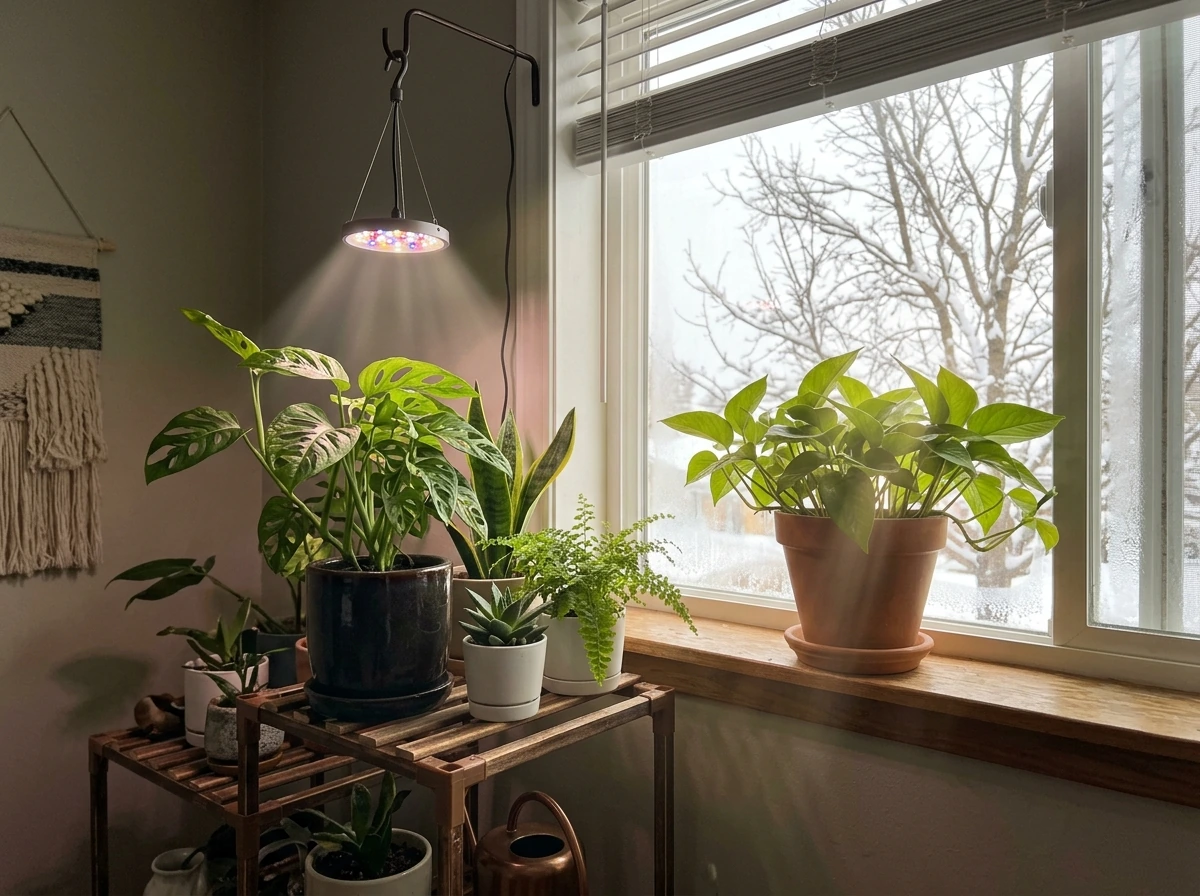
Winter isn't just about shorter days, though that's a big part of it. The sun also sits much lower in the sky, which means light hits your windows at a shallower angle and bounces off more before it reaches your plants. Even a south-facing window that floods your living room with light in July might only deliver a few hours of weak, indirect light in January. If you live above roughly 40 degrees latitude (think New York, Denver, or anywhere north of there), the drop in usable daylight between summer and winter is dramatic.
The practical result is that plants that thrived in a bright spot last summer may now be receiving just a fraction of the light they need. A south-facing window might go from delivering 6+ hours of direct sun in July to barely 3 hours of weak sun in December. East and west windows get even less. North windows, already the dimmest, may essentially stop delivering meaningful light for photosynthesis during the shortest days of the year. Your plants haven't moved, but their light environment has changed dramatically.
Do your plants actually need grow lights? A quick diagnosis
Before you buy anything, take a few minutes to assess what you have. The University of Maryland Extension classifies houseplants by light need (high, medium, or low) and that classification is the most useful starting point for deciding whether supplemental lighting is worth it in winter. Here's how to think through it:
- High-light plants (most succulents, cacti, herbs, citrus, fruiting plants, most flowering houseplants): These almost certainly need supplemental light in winter, especially if you're relying on anything less than an unobstructed south-facing window.
- Medium-light plants (pothos, peace lilies, snake plants in brighter spots, philodendrons): They may slow down significantly but often tolerate winter without supplemental light. Watch them closely. If they start stretching or dropping leaves, add light.
- Low-light plants (ZZ plants, cast iron plants, snake plants in dim spots, some ferns): These are the most forgiving. They genuinely can ride out winter on ambient light in most homes without showing serious stress.
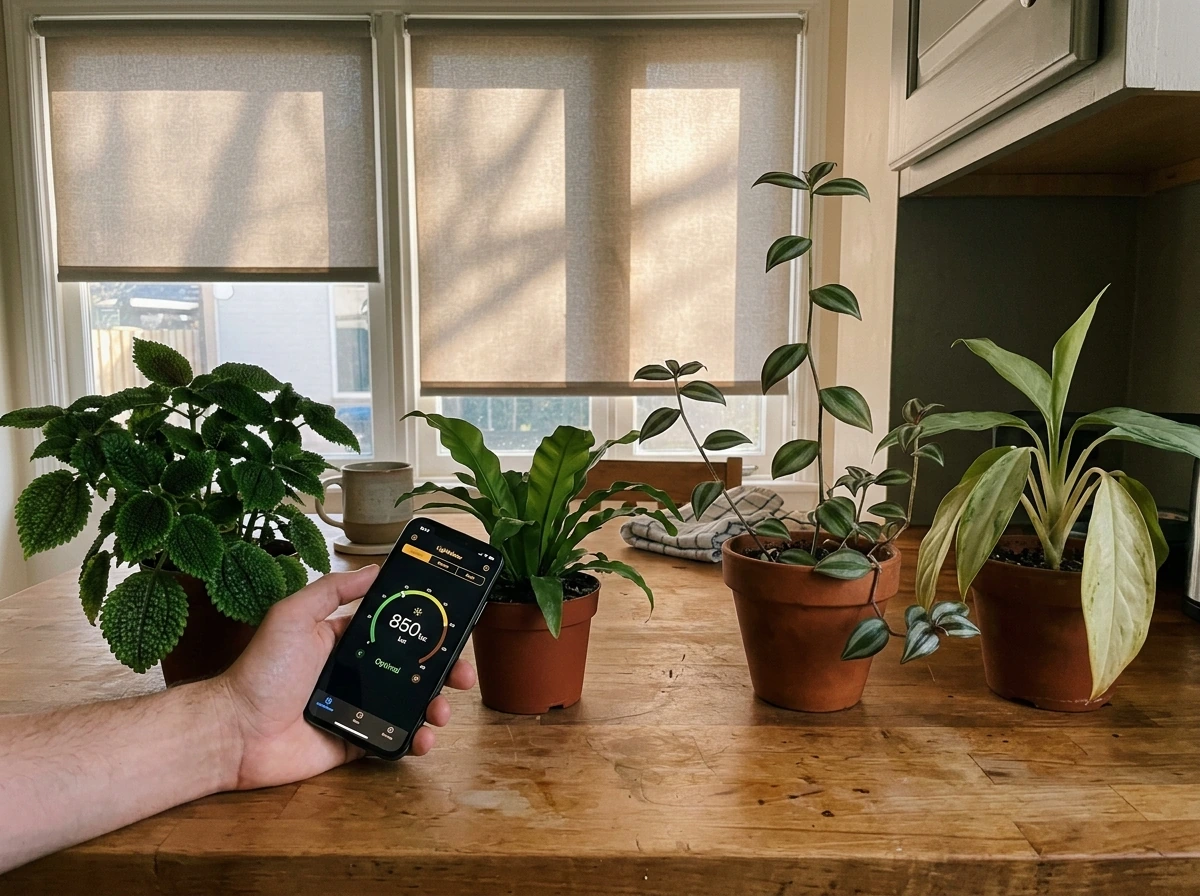
A practical test: hold your hand about a foot above a piece of white paper near your plant at midday on a clear day. If you see a sharp shadow, there's usable light. If the shadow is faint or barely there, your plant is struggling. This isn't a scientific measurement, but it's a reliable gut-check that takes about 10 seconds. For a more accurate reading, a basic light meter or a smartphone app that estimates foot-candles or lux can help you put a number to what your plant is actually receiving.
How much light do plants need in winter: window vs. household bulbs vs. grow lights
Not all light sources are equal, and this matters a lot when you're trying to make up for winter's shortfall. Here's the honest comparison:
| Light Source | Useful for Plants? | Typical Intensity at Plant | Best Used For |
|---|---|---|---|
| South-facing window (winter) | Yes, but reduced | Low to moderate, varies by weather | Low- and medium-light plants; supplement for high-light plants |
| Standard household LED or incandescent bulb | Marginally | Very low (wrong spectrum and intensity) | Ambient room use; not a substitute for plant light |
| Fluorescent shop light / CFL bulb | Somewhat | Low to moderate if placed 6–12 inches away | Seedlings, herbs, low- to medium-light plants on a budget |
| Full-spectrum or horticultural LED grow light | Yes, most effective | Moderate to high, adjustable with distance | All plant types; best option for high-light plants and winter gaps |
Standard household LED bulbs won't cut it. They're designed for human vision, not photosynthesis, so they emit very little in the red and blue wavelengths that plants actually use. Standard household LED bulbs won't cut it. Fluorescent shop lights are better and genuinely useful for herbs and seedlings if you keep them very close (6 to 12 inches from the foliage), but they fade quickly and cover limited area. Horticultural LEDs give you the right spectrum, last longer, run cooler, and are flexible enough to work for almost any indoor plant, including aquarium plants. If you're going to invest in anything, that's where I'd put the money.
The gold standard measurement for plant light is PPFD (Photosynthetic Photon Flux Density), which measures the amount of light actually usable for photosynthesis reaching your plant per second. Foot-candles and lux measure brightness as humans perceive it, which isn't the same thing. Most houseplants do well with a PPFD somewhere between 50 and 250 micromoles per square meter per second, depending on the species. can plants grow with indoor lights High-light plants like herbs and succulents want the higher end of that range; low-light plants can thrive at the lower end.
Common winter plant symptoms and what they're telling you
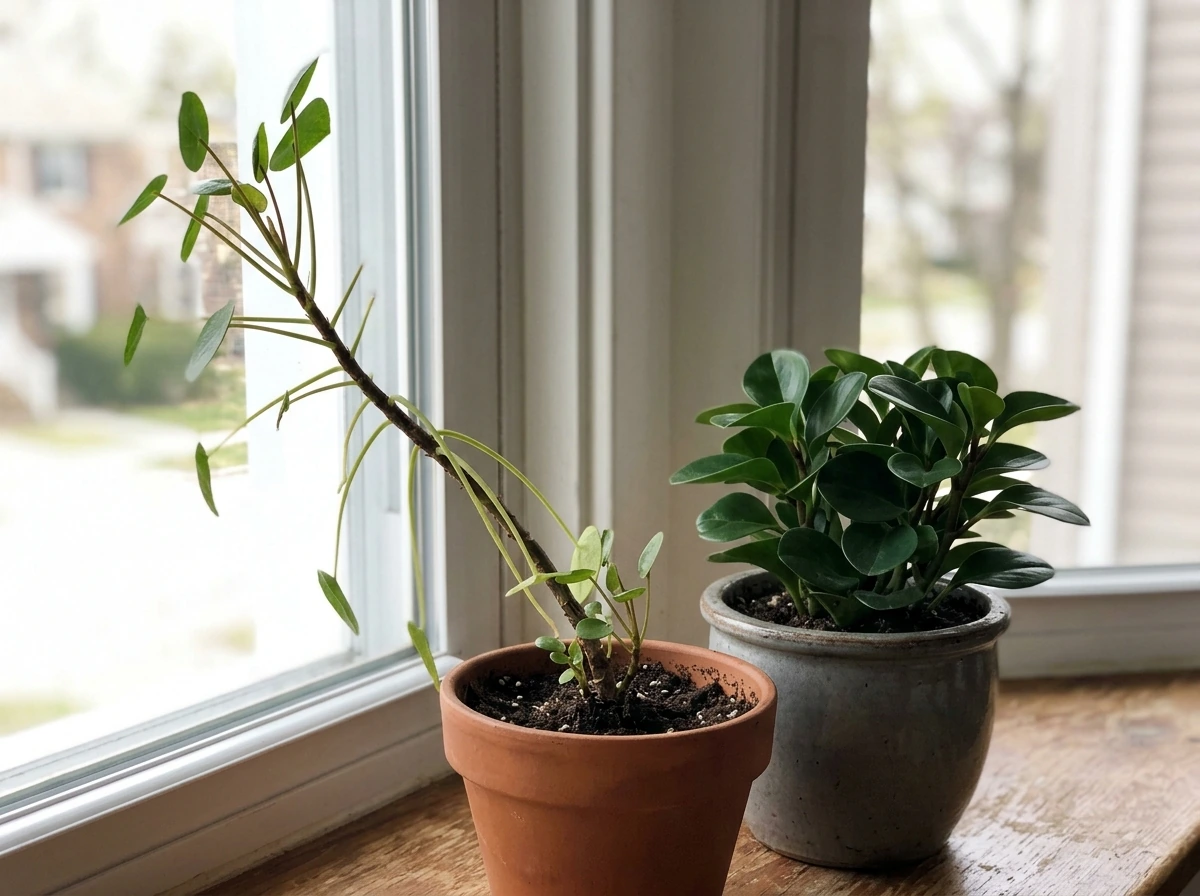
A lot of people end up searching for grow-light advice in winter because something looks wrong with their plant. Here's how to read the clues:
| Symptom | Most Likely Cause | What to Adjust First |
|---|---|---|
| Stems stretching long and thin toward the window (etiolation) | Not enough light | Move plant closer to window, add grow light, or extend light duration |
| Pale, washed-out, or yellowing new leaves | Low light (or possibly overwatering) | Increase light first; also check soil moisture |
| Leaves dropping, especially lower ones | Low light or draft/temperature stress | Improve light; check for cold drafts near windows |
| No new growth for weeks or months | Low light or normal winter dormancy | Add light if it's a growth-oriented plant; accept dormancy for cacti and succulents |
| Crispy brown leaf edges or bleached spots | Too much direct light or too close to grow light | Move plant back from light source; reduce intensity or duration |
| Small, progressively tinier new leaves | Insufficient light intensity | Increase light intensity or reduce distance to light source |
One thing that trips people up in winter: overwatering causes some of the same leaf symptoms as low light (yellowing, drooping). Before you add grow lights, make sure you've already pulled back on watering. Plants photosynthesize less in winter, which means they use water more slowly. If your soil is staying wet for more than a week after watering, that's the first thing to fix. Low light and wet roots together is a fast track to root rot.
Choosing grow lights for winter use
LED types and spectrum
Horticultural LEDs generally come in a few flavors. Purple/blurple lights combine red and blue diodes, which are the wavelengths most directly used in photosynthesis. Full-spectrum white LEDs mimic daylight more closely and are easier on the eyes in a living space. Some fixtures combine red, blue, and white channels for a balanced output. For typical houseplants, a quality full-spectrum LED works well and won't turn your living room into a nightclub. For herbs and vegetables where yield matters more than aesthetics, a red/blue-heavy fixture can push growth a bit harder.
What matters more than the color of the light is whether it's actually designed for plants. Look for fixtures marketed specifically as grow lights and check for PPFD data at a specified hanging distance. Manufacturers who publish PPFD maps are generally more trustworthy than those who only advertise wattage, because wattage alone tells you very little about how much usable light reaches your plant.
Wattage and coverage: what to look for
Don't obsess over wattage as the primary spec. A well-designed 20-watt LED grow light can outperform a cheap 45-watt one in terms of actual PPFD at the plant canopy. Instead, look at the coverage area the manufacturer lists at your intended hanging height, and cross-reference that with the PPFD map if one is available. For a shelf of houseplants or a small herb garden, a panel-style light covering roughly 2x2 feet is often enough. For a larger collection or a grow tent, you'll size up accordingly.
Placement and runtime: getting distance and schedule right
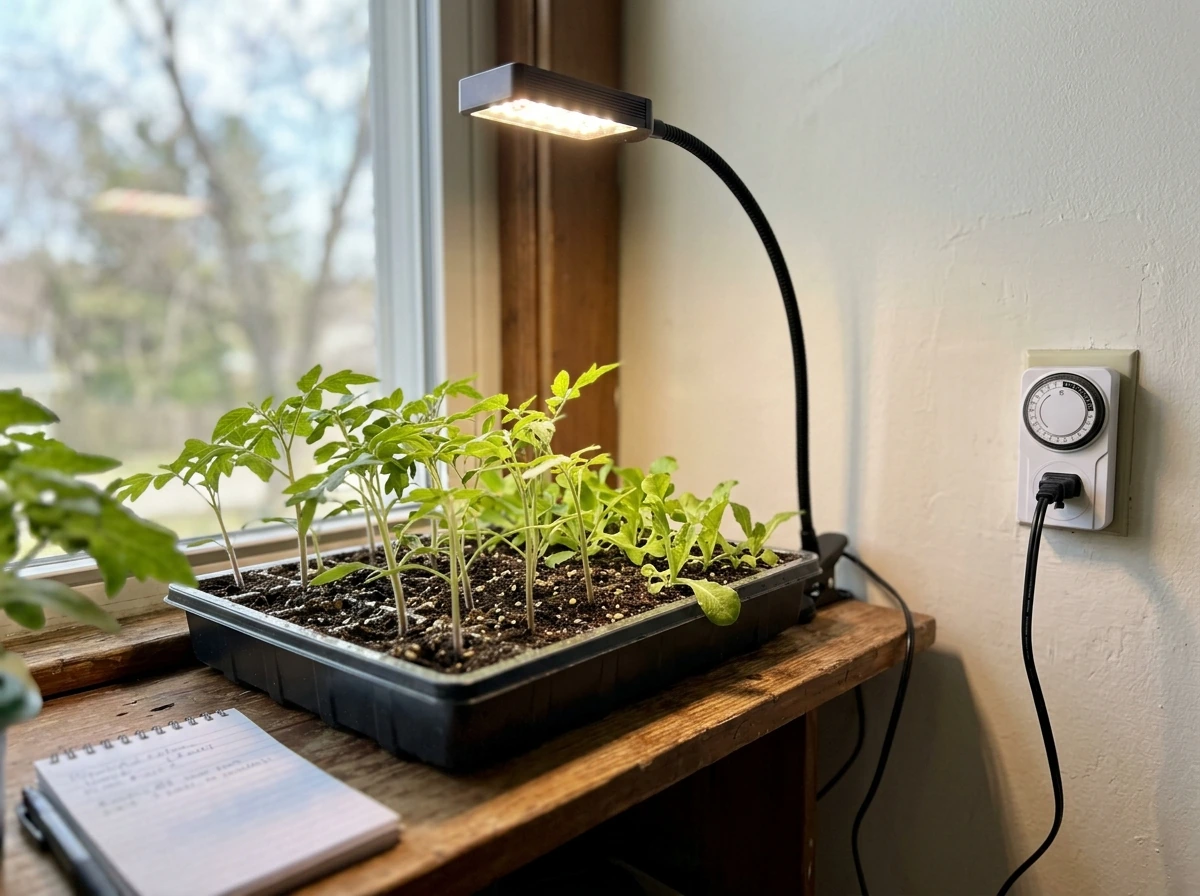
Distance from light to plant is one of the most important variables, and it's easy to get wrong. The University of Missouri Extension recommends keeping the tips of foliage 6 to 12 inches from the light source, and Iowa State University Extension echoes this for fluorescent fixtures specifically. For LEDs, you can follow a similar principle, so plants don’t have to be directly under grow lights. For LEDs, the right distance depends on the fixture's intensity, but a general starting range is 12 to 24 inches for most houseplant grow lights. Higher-intensity lights need more distance to avoid burning; lower-intensity ones can sit closer. Follow your fixture's PPFD map at the hanging height you choose rather than guessing.
Keep the fixture adjustable. As you change plants or move things around, being able to raise or lower the light quickly is more useful than you'd think. Many growers use simple rope ratchets or adjustable hanging clips for exactly this reason.
For duration, the University of Minnesota Extension and Iowa State University Extension both recommend aiming for 12 to 14 hours of total light per day for most houseplants in winter. That means supplementing whatever natural daylight your plants get to hit that total. A practical approach: if your plants get about 4 to 6 hours of window light, run your grow light for the remaining 6 to 8 hours. University of Minnesota Extension suggests turning lights on in the evening (around 5 to 8 p.m.) to extend the photoperiod naturally after the sun sets, rather than running lights all day.
Use a timer. Seriously, this is the single best $10 to $15 investment you can make alongside any grow light. Consistent photoperiods matter for plant health, and a timer removes the guesswork entirely. Plants also need a period of darkness each day. Don't run lights 24 hours a day thinking more is always better because it isn't. Darkness is part of the growth process, and running lights continuously can actually stress certain plants.
Avoiding leaf burn
Grow-light burn is real, especially with high-intensity LEDs placed too close. Symptoms look like bleached or crispy patches on the upper surface of leaves closest to the light. If you see this, raise the light a few inches at a time until it stops. Start new plants at the higher end of the recommended distance range and move the light closer only if growth seems slow after a few weeks. It's much easier to fix "not enough light" than to repair burned leaves.
Plant-by-plant guidance for winter light
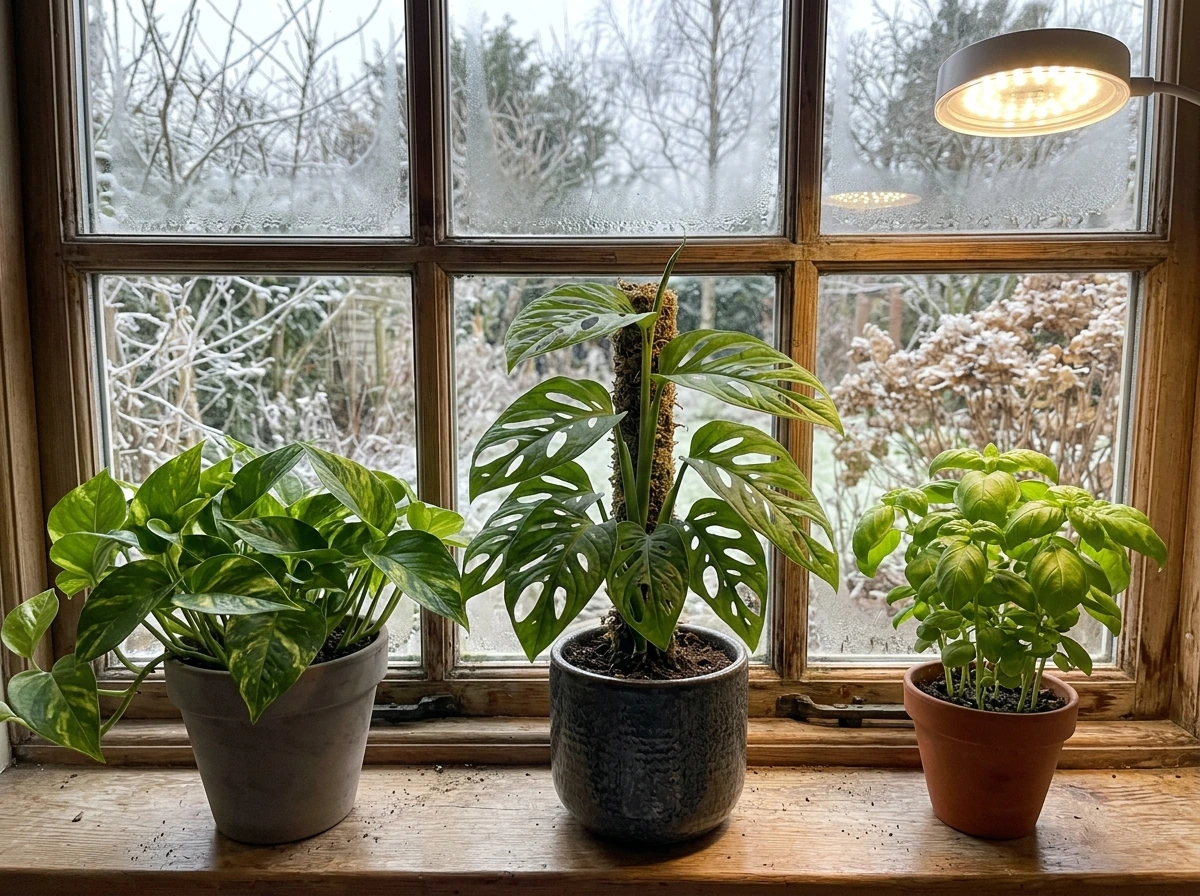
Low-light plants (pothos, snake plants, ZZ plants, peace lilies)
These plants are the most forgiving in winter. A north- or east-facing window usually keeps them stable, though growth will slow considerably, which is totally normal. You don't need a grow light for most of these unless you're seeing consistent etiolation or serious leaf drop.
University of Maryland Extension also notes that snake plants can tolerate low light better than many other houseplants, which is why they are often a good choice for dimmer rooms snake plants tolerate low light better than many other houseplants. If you do add supplemental light, keep it on the gentler end: 10 to 12 hours a day at a comfortable distance is plenty.
Iowa State University Extension’s store listing for lighting houseplants also advises leaving grow lights on for 12 to 16 hours per day for most houseplants keep it on the gentler end: 10 to 12 hours a day.
These plants aren't trying to push a lot of growth in winter and don't need to be coaxed.
Medium-light plants (philodendrons, monsteras, calatheas, dracaenas)
These are the ones that will show stress most visibly in winter if light drops too low. A bright indirect spot (east or south-facing window with a sheer curtain) is often enough, but in a dark apartment or on a cloudy winter stretch, supplemental light becomes worth it. Aim for the 12-hour mark with a moderate-intensity grow light. Rotating the plant every week or two helps ensure even coverage if you're relying on window light.
High-light plants: herbs and edibles
Basil, cilantro, parsley, mint, and most culinary herbs are almost impossible to keep thriving indoors in winter without a grow light. They want long days and strong light, and a window just won't cut it past October in most of the country. A grow light running 14 hours a day placed close (12 inches or so from the foliage) is the realistic path to actually harvesting herbs in February. Don't be surprised if growth still slows a bit compared to summer; that's normal, but with good light it should be steady and healthy.
Flowering and fruiting plants
Plants you're trying to get to bloom or fruit (African violets, citrus, tomatoes, peppers) need the most light of all, and winter is genuinely hard on them. African violets do well under fluorescent or full-spectrum LED light at the 12-to-14-hour mark and are actually great candidates for a dedicated grow-light shelf. Citrus and fruiting plants need high intensity for long periods, so a strong horticultural LED is the realistic choice. If you're just overwintering these plants and not expecting fruit or flowers until spring, you can back off a bit and just keep them alive rather than productive.
Succulents and cacti
This is the category that surprises people most. Succulents and cacti look tough and minimal, so it feels like they should coast through winter easily. The reality is they need a lot of light, and low winter light is one of the most common reasons they start stretching and leaning. The University of New Hampshire Extension notes that succulents prefer about 6 hours from a south-facing window.
If you can't offer that, a grow light is genuinely worth it. The silver lining is that most succulents and cacti naturally slow their growth in winter, so you don't need to push them hard. Keeping them in a cooler, bright spot (or under a gentle grow light for 10 to 12 hours) is enough to prevent etiolation without forcing growth they're not ready for.
If you already have a grow light: should you adjust it for winter?
If you've been running a grow light year-round, winter probably means extending the runtime by an hour or two to compensate for shorter days, not cranking up the intensity. If your light is already set to 12 hours and plants look healthy, hold there and just monitor. If you notice stretching or pallor, bump it to 14 hours before you change anything else. For plants that naturally go dormant in winter (many cacti, some bulb plants), you can actually reduce light duration and let them rest. Trying to push a dormant plant with extra light often just stresses it without producing meaningful growth.
The bottom line is that grow lights in winter aren't an all-or-nothing commitment. You can use one shelf-mounted fixture to help a small collection of herbs and light-hungry tropicals while letting your low-light plants coast on window light in another room. Start with the plants showing stress symptoms, add a timer, dial in the distance, and adjust from there.
Most of the time, two to three weeks of consistent, properly timed supplemental light will show you clearly whether it's making a difference. If you want to dig deeper into LED options specifically, it's worth reading up on how different LED types perform for houseplants, since not all grow lights are created equal and the right choice depends a lot on your specific plant mix and space. If you're choosing LED grow lights, it's also helpful to know whether aquarium plants can grow under LED lighting and what schedule to use LED options.
FAQ
Can I skip grow lights in winter if my plants still look green?
It depends on whether your plant is staying healthy without it. If a plant already holds its color, stays compact, and is not dropping leaves, you can usually pause supplemental lighting and reassess after 2 to 3 weeks. If you stop and notice stretching, paleness, or new leaf drop, resume and add more runtime gradually (for example, plus 1 to 2 hours) rather than doubling immediately.
Do plants need grow lights in winter if they get some window light?
Yes, but only if the rest of your setup is correct. Window light plus a grow light can be redundant if the plant already gets enough usable light, but it helps when the window drops too low for winter. A useful approach is to place the grow light over the same zone the plant sits in, then use signs (stretching, faded color) over 2 to 3 weeks to decide whether you should increase distance, runtime, or nothing at all.
How many total hours of light should I aim for in winter?
A good baseline for winter is 12 to 14 hours total daily light, including what comes from the window. If your windows get 6 hours in the middle of winter, that usually means running the grow light for about 6 to 8 additional hours. Avoid running the light late at night, use a timer, and keep at least a single uninterrupted dark period each day, since plants need darkness to regulate growth.
Is it better to run grow lights longer in winter?
For most houseplants, running a light too long is less useful than delivering the right intensity at the right distance. If you crank duration to 16 to 18 hours, you can see stressed growth, faster drying that leads to watering issues, or bleaching if the fixture is also too close. If you want to adjust, change one variable at a time, start by altering runtime by about 1 to 2 hours, and watch for signs within a couple of weeks.
What distance should a grow light be from my plants in winter?
Use a simple, repeatable placement. Start with foliage tips roughly 12 to 24 inches from the LED (closer for gentle fixtures, farther for higher intensity), then correct based on outcomes. If you see bleached or crispy patches on the top leaves, raise the light a few inches. If growth looks slow and the plant gets leggy, move it down gradually instead.
Do I need a grow light for every plant, or can one cover multiple?
Not necessarily. If a plant is near a bright south or east window, you might only need a small supplemental amount, and a shelf or overhead fixture that covers the whole collection may be overkill. For one or two stressed plants, a targeted light over just those plants can work better and costs less. Use the fixture coverage area at your hanging height so you are not lighting empty space.
Do I really need a timer for winter grow lights?
If you do not use a timer, it is easy to accidentally give uneven schedules, which can cause slow, uneven growth. A timer also prevents the common mistake of leaving lights on during the day only or forgetting weekends, which can shift the photoperiod. Set the schedule so the total daily light hits your target window-to-light plus grow-light total.
What are the most common mistakes people make when adding grow lights in winter?
Yes, winter-specific mistakes are common. One major issue is watering too frequently, since plants use water more slowly when light levels drop, which can mimic low-light symptoms. Another is choosing household LEDs that look bright to you but do not supply enough of the light plants actually use. Before buying, confirm you have a plant-care change plan: adjust watering first, then add the right spectrum fixture if symptoms persist.
What if my plant goes dormant in winter?
If your plant is in a dormant cycle, extra light may not help. Many cacti and some bulb plants naturally slow down or rest in winter, so you can reduce runtime and focus on keeping them healthy rather than pushing growth. If the plant is actively growing or leafing out, you generally do not want to cut light duration drastically.
How long should I wait to see results after starting grow lights in winter?
If you want a reliable decision, evaluate after a short adjustment period, usually 2 to 3 weeks, because leaf changes lag behind light changes. Look for improvements that match the symptom: reduced pale color, less leaning toward the window, tighter new growth, and less leaf drop. If nothing improves after that window, adjust distance or runtime before changing again.