Yes, plants can absolutely grow under indoor lights. The real question is whether the specific lights you already have are strong enough, and the honest answer is: probably not for most plants. Standard household bulbs and overhead room lighting are designed to make spaces comfortable for human eyes, not to drive photosynthesis. But a decent LED grow light changes everything. Once you understand what plants actually need from light, you can set up a simple, affordable system that keeps houseplants thriving year-round without a single window.
Can Plants Grow With Indoor Lights? LED and Setup Guide
Marcus Hartley
24 Mar 2026
What plants actually need from light
Plants use light to run photosynthesis, the process that converts light energy into sugars they use to grow. For that to happen, three things need to line up: the right spectrum (color of light), enough intensity (brightness), and enough hours per day (photoperiod). Miss any one of these and growth slows, stalls, or gets weird.
Spectrum matters because chlorophyll, the pigment that captures light, responds most strongly to red and blue wavelengths. That is why grow lights often have a slightly purple or pinkish tint. Broad-spectrum light, which covers the full range of wavelengths plants use, helps plants grow better than narrow or partial spectra. Regular warm-white LED bulbs in your ceiling fixture lean heavily toward yellow-green wavelengths that plants use least efficiently.
Intensity is measured a few different ways. You may see foot-candles (FC) referenced for general houseplant guidance: low-light plants need roughly 25 to 100 FC, medium-light plants need around 100 to 500 FC, and high-light plants want 500 to 1,000 FC or more. For grow lights, a more precise metric called PPFD (Photosynthetic Photon Flux Density, measured in micromoles per square meter per second) is more useful because it measures only the wavelengths plants can actually use. A PPFD between 400 and 800 µmol·m²·s⁻¹ supports solid growth for most houseplants. Wattage alone tells you almost nothing useful about a grow light's actual output, which is why you should look for PPFD numbers when shopping.
Photoperiod is simply the number of light hours per day. Most houseplants do well with 12 to 14 hours of light daily. If your plant is getting little or no natural light in winter, bump that toward 14 to 16 hours. One important note: plants need a period of darkness too. Running lights for more than 16 hours a day can actually disrupt some plants' growth cycles and stresses others. Darkness is not wasted time, it is part of the plant's biology.
There is also a useful concept called Daily Light Integral (DLI), which combines intensity and duration into a single number representing the total amount of photosynthetically useful light a plant receives each day. You can calculate it with: DLI = PPFD × hours × 0. Using DLI = blank" rel="noopener noreferrer">PPFD × hours × 0.0036 (with PPFD in µmol·m⁻²·s⁻¹) puts the result in mol·m⁻²·d⁻¹. 0036. It sounds technical but it is just a way of confirming that a dimmer light running longer can sometimes match a brighter light running fewer hours, up to a point.
Can regular household lights do the job?
In most cases, no. Standard incandescent bulbs are inefficient and produce too much heat relative to useful light output. Regular LED bulbs used in homes are designed to render colors accurately for humans, not to emit the spectrum plants prefer. Even a brightly lit room with recessed lighting typically delivers well under 100 FC at plant level, which only keeps the most shade-tolerant species alive, not actively growing well.
I learned this the hard way in my own apartment. I had a pothos on my desk under what felt like a well-lit ceiling light, and for months it just sat there. can aquarium plants grow with led lights New leaves were small and the stems were stretching toward the window across the room. Once I swapped in a dedicated LED grow light on a timer, the same plant put out two or three new leaves per month. Same spot, totally different results. will plants grow under normal led lights will plants grow under normal led lights
That said, some very forgiving plants can survive and even slowly grow under standard ambient light if the room is reasonably bright. Survive is the operative word. For real, healthy, sustained growth, a purpose-built grow light is almost always the better answer.
Choosing and using an LED grow light
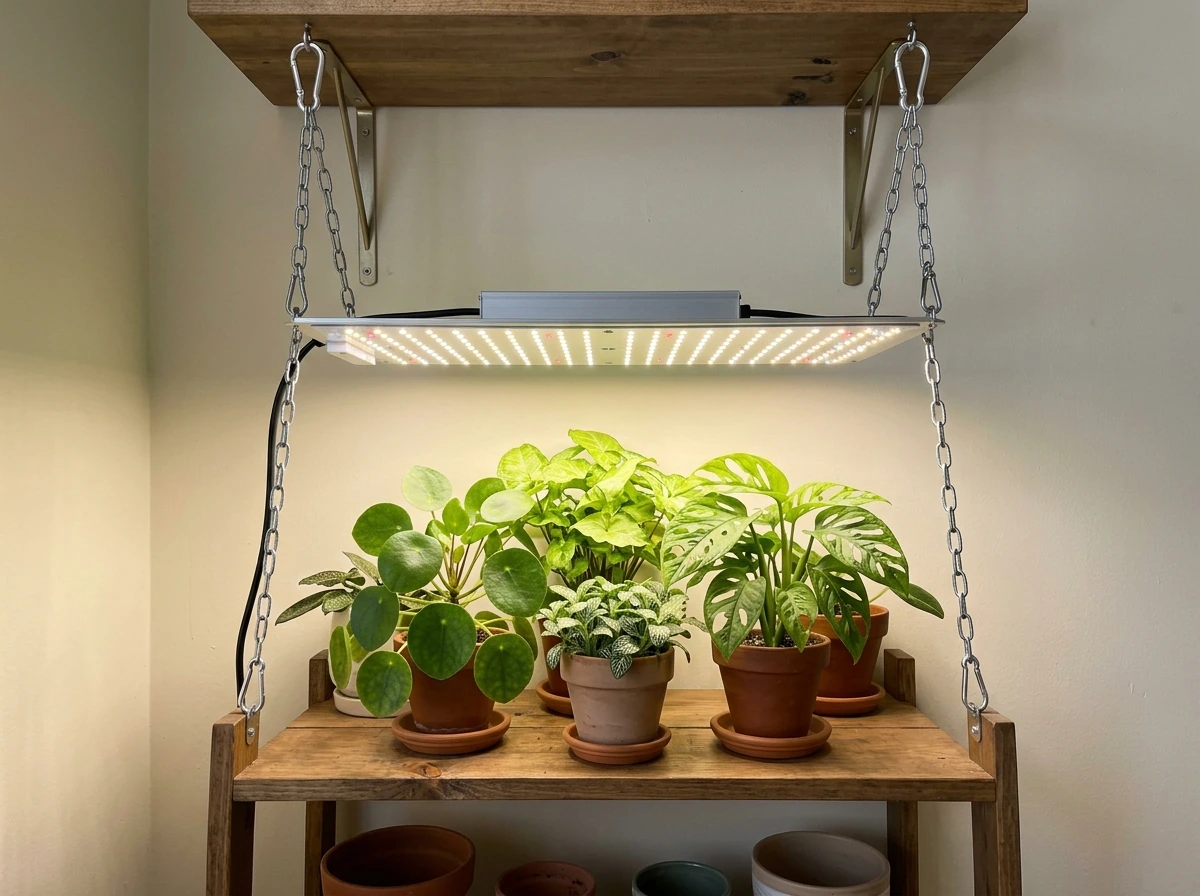
LED grow lights have become genuinely affordable and effective, and they are the best option for most indoor gardeners today. They run cool, use less electricity than older fluorescent or HID setups, and last a long time. Here is what to actually look for when buying one.
What to look for on the spec sheet
- PPFD at a given distance: Look for a light that delivers 200 to 400 µmol·m²·s⁻¹ at the distance you plan to hang it for low-to-medium-light houseplants, or 400 to 800 µmol·m²·s⁻¹ if you are growing herbs, vegetables, or high-light plants.
- Spectrum: Full-spectrum or broad-spectrum LEDs that cover both blue (400 to 500 nm) and red (600 to 700 nm) wavelengths are ideal. Some lights also include a small amount of far-red and UV for more complete coverage.
- Coverage area: Manufacturers list the area the light covers at a recommended hanging distance. Match this to your actual grow space.
- Dimmability: Nice to have. A dimmable light lets you adjust intensity as plants grow or as you move them closer or farther away.
- Brand transparency: Reputable brands publish actual PPFD charts or data, not just wattage claims. If a brand only talks about watts, skip it.
For a single houseplant or a small shelf of low-to-medium-light plants, you do not need to spend a lot. A clip-on or bar-style grow light in the 15 to 45 watt range from a brand that publishes real output data will handle most common houseplants well. If you are growing herbs or starting seeds, you will want something that can deliver PPFD closer to 400 to 600 µmol·m²·s⁻¹ at the canopy. You might also want to look deeper into whether house plants grow specifically under LED lights, since the answer depends on spectrum and intensity, not just the fact that it is an LED.
Timers: just use one
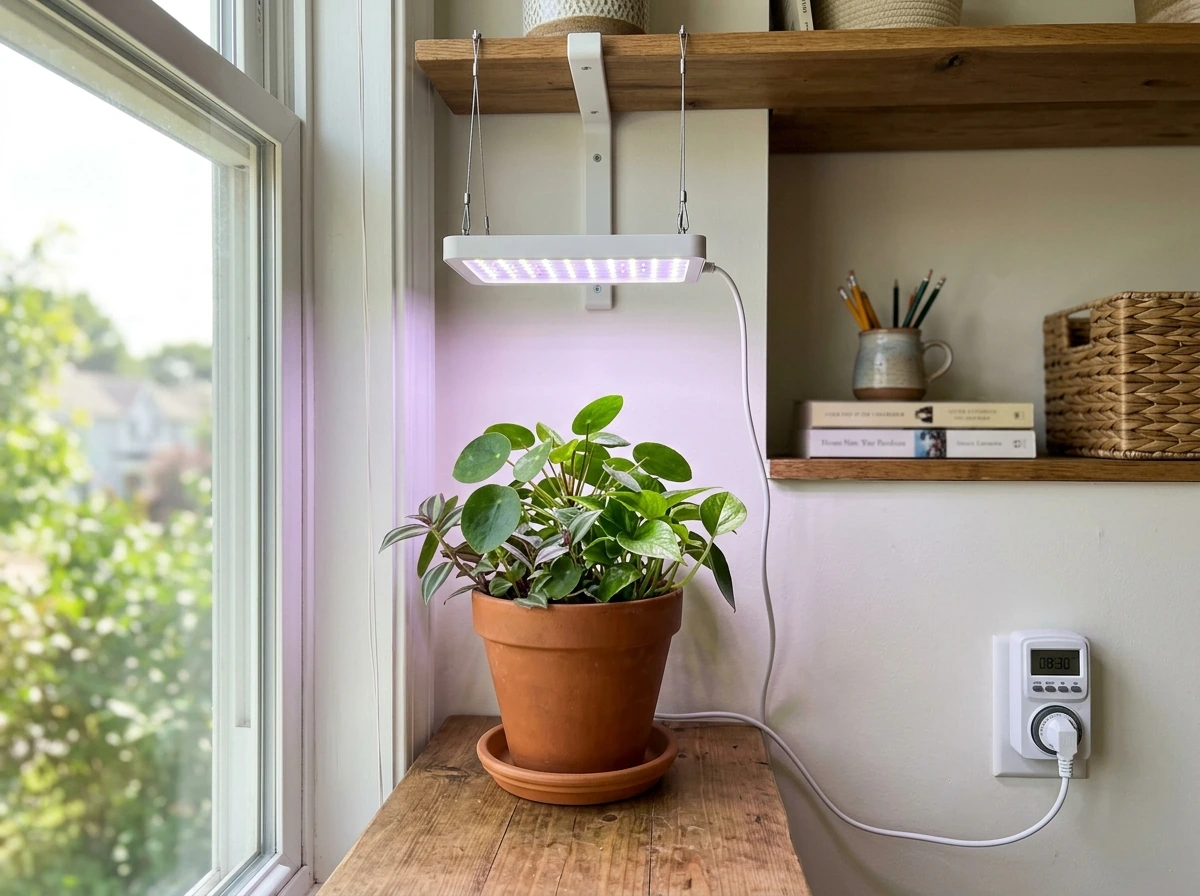
A basic 24-hour mechanical or digital outlet timer is one of the best investments you can make for indoor plant lighting. Set it and forget it. Consistency matters for plants, and manually remembering to turn a grow light on and off every day just does not happen reliably. Aim for 12 to 14 hours on for most houseplants, 14 to 16 hours if you have no supplemental natural light coming in. Timers cost a few dollars and take about 30 seconds to program.
Getting placement and distance right
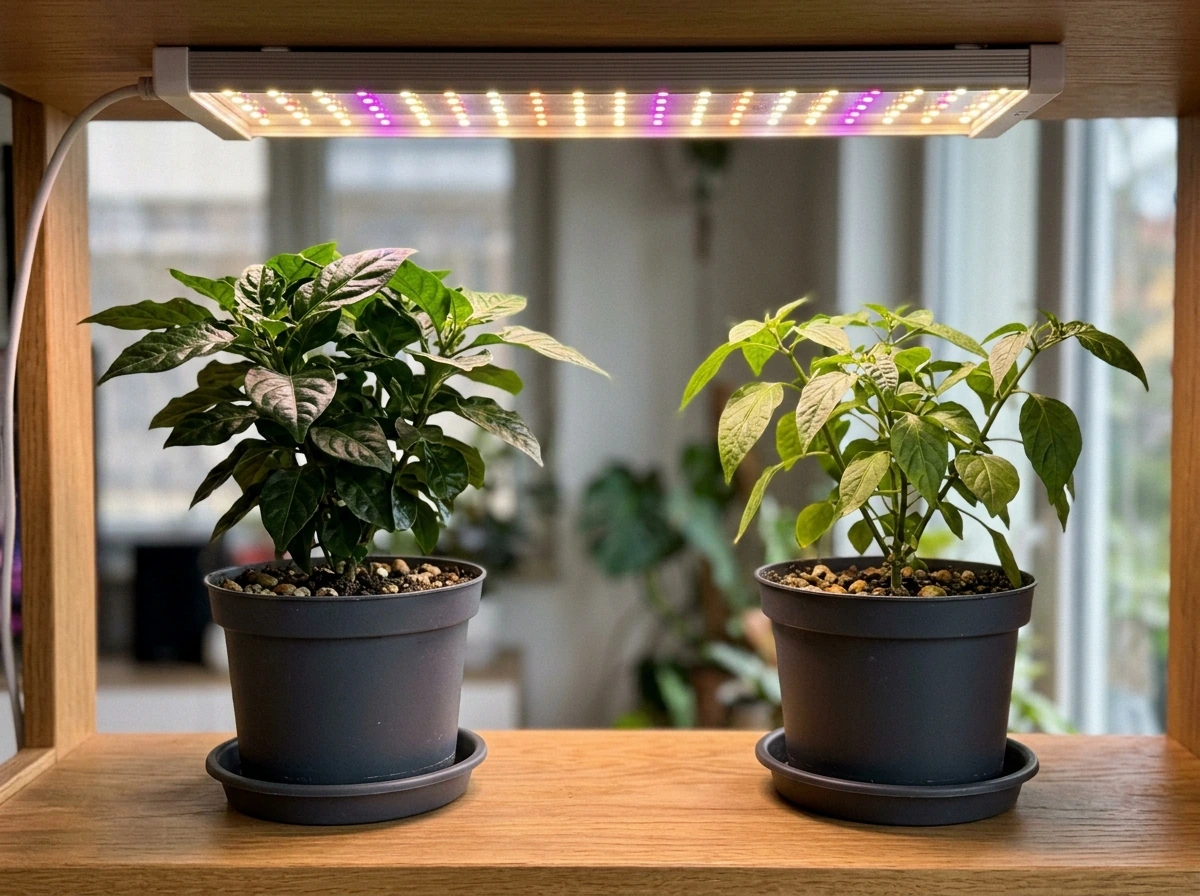
Distance is everything with grow lights. Light intensity drops off dramatically as you move away from the source, so placing your light too high is one of the most common reasons people do not see results. As a general rule, most full-spectrum LED grow lights work best at 6 to 24 inches above the plant canopy, depending on the light's intensity and the plant's needs.
| Plant Type | Recommended PPFD | Suggested Distance from Light | Daily Hours |
|---|---|---|---|
| Low-light houseplants (pothos, ZZ, snake plant) | 100–200 µmol·m²·s⁻¹ | 18–24 inches | 12–14 hours |
| Medium-light houseplants (peace lily, philodendron, ferns) | 200–400 µmol·m²·s⁻¹ | 12–18 inches | 12–14 hours |
| High-light houseplants and herbs (succulents, basil, peppers) | 400–800 µmol·m²·s⁻¹ | 6–12 inches | 14–16 hours |
| Seedlings and cuttings | 100–300 µmol·m²·s⁻¹ | 18–24 inches | 14–16 hours |
Start at the higher end of the distance range and watch your plants for a week or two. If growth is slow and stems are stretching upward, move the light closer. If leaf edges look bleached or crispy, pull the light back. Plants will tell you when the placement is off. You do not need a meter to dial this in, though a cheap lux or PPFD meter (available for under $30) makes it much faster.
Reflective surfaces like white walls, white shelving, or a simple piece of reflective material behind and around your plants can meaningfully boost light reaching lower and outer leaves without changing the light itself. It is a free efficiency gain worth taking advantage of.
One thing worth knowing: plants do not have to be directly under the grow light to benefit from it, but they do need to be close enough for the light to reach them at adequate intensity. The center of the light beam is strongest; intensity falls off toward the edges. If you are growing multiple plants under one fixture, arrange the light-hungry ones directly below center and the more tolerant ones toward the edges.
Which plants do well under artificial light (and which don't)
Not all plants are equally happy under grow lights. The good news is that many of the most popular houseplants are naturally adapted to low and indirect light conditions, which makes them great candidates for indoor artificial lighting. Others, especially sun-loving fruiting plants and most cacti, want intensity levels that are genuinely hard to replicate indoors with typical grow light setups.
Plants that do well under indoor grow lights
- Pothos and philodendrons: very adaptable, happy with medium-light setups at modest PPFD levels
- Snake plant (Sansevieria): thrives even at low light levels and is nearly impossible to over-stress with standard grow light setups
- ZZ plant: another low-light champion that responds well to consistent artificial light
- Peace lily: medium-light plant that flowers readily under grow lights with 12 to 14 hours of consistent coverage
- Ferns: do well under moderate artificial light with higher humidity; avoid high-intensity direct light
- Pepperomias: compact, low-to-medium-light plants that are practically made for shelf grow light setups
- Potted herbs (basil, mint, parsley): need higher PPFD (400+) but grow enthusiastically under a good LED grow light
- Lettuce and greens: fast-growing, relatively low-light crops that are ideal starter plants for anyone new to grow lights
- African violets: bloom well under fluorescent or LED grow lights with 12 to 14 hours of medium intensity light
Plants that struggle with only artificial light
- Most fruiting vegetables (tomatoes, cucumbers, squash): need very high PPFD levels and long photoperiods that most home grow light setups cannot sustain efficiently
- Cacti and most succulents: need intense, direct light for many hours; they survive under grow lights but rarely thrive the same way they do in a sunny south-facing window
- Fiddle-leaf fig: needs strong, consistent bright light; artificial-only setups often leave it dropping leaves
- Bird of paradise: a high-light tropical that rarely performs well without substantial natural or very powerful supplemental light
- Most orchids: specific about spectrum and intensity; some varieties do okay, but it takes careful setup
The pattern here is straightforward. Low and medium-light plants that evolved under forest canopies are naturally suited to the kind of light a good LED grow light produces indoors. High-light plants that evolved in open, sunny environments want more intensity than most home grow light systems realistically deliver. That is not a failure of your setup, it is just a mismatch of plant and environment. Choose your plants to fit your space and setup, and you will have a much better time.
When things go wrong: fixing common light problems
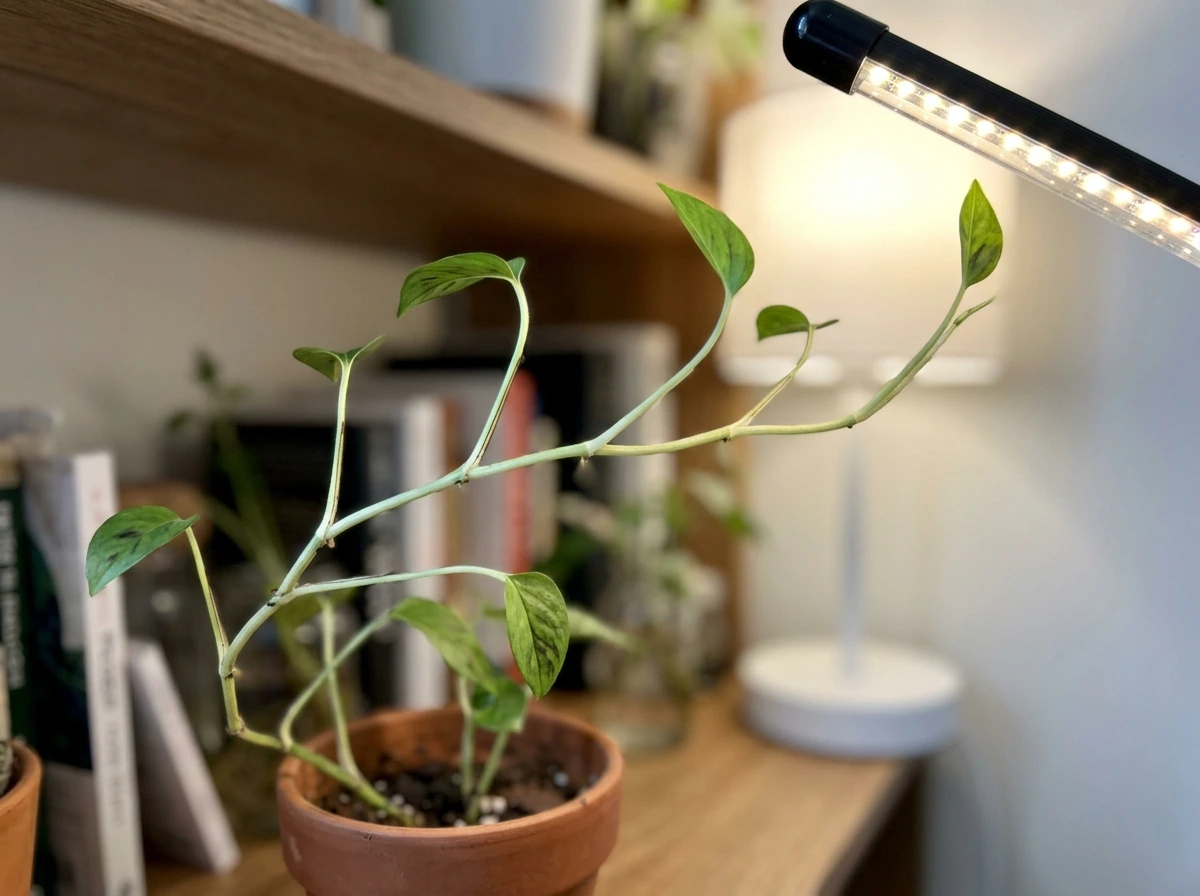
Most light-related plant problems fall into a handful of recognizable patterns, and most of them are fixable once you know what to look for.
Leggy, stretched stems
Long, spindly stems with wide gaps between leaves are the clearest sign of insufficient light. The plant is stretching toward any light source it can find. Fix this by moving the grow light closer (try reducing the distance by 4 to 6 inches), increasing your daily light duration by 2 hours, or upgrading to a brighter light. This is also the main thing that happens when seedlings are started under standard household bulbs: they get leggy fast without supplemental grow light.
Slow or stalled growth
If your plant looks basically fine but is not putting out new leaves, the most likely culprit is either insufficient light intensity or too few hours per day. Check your light distance first, then review your timer schedule. If you are only running the light for 8 to 10 hours, try bumping to 12 to 14. If it is a plant that genuinely needs high light (succulents, herbs, high-light tropicals), you may also just need a more powerful light.
Yellowing leaves
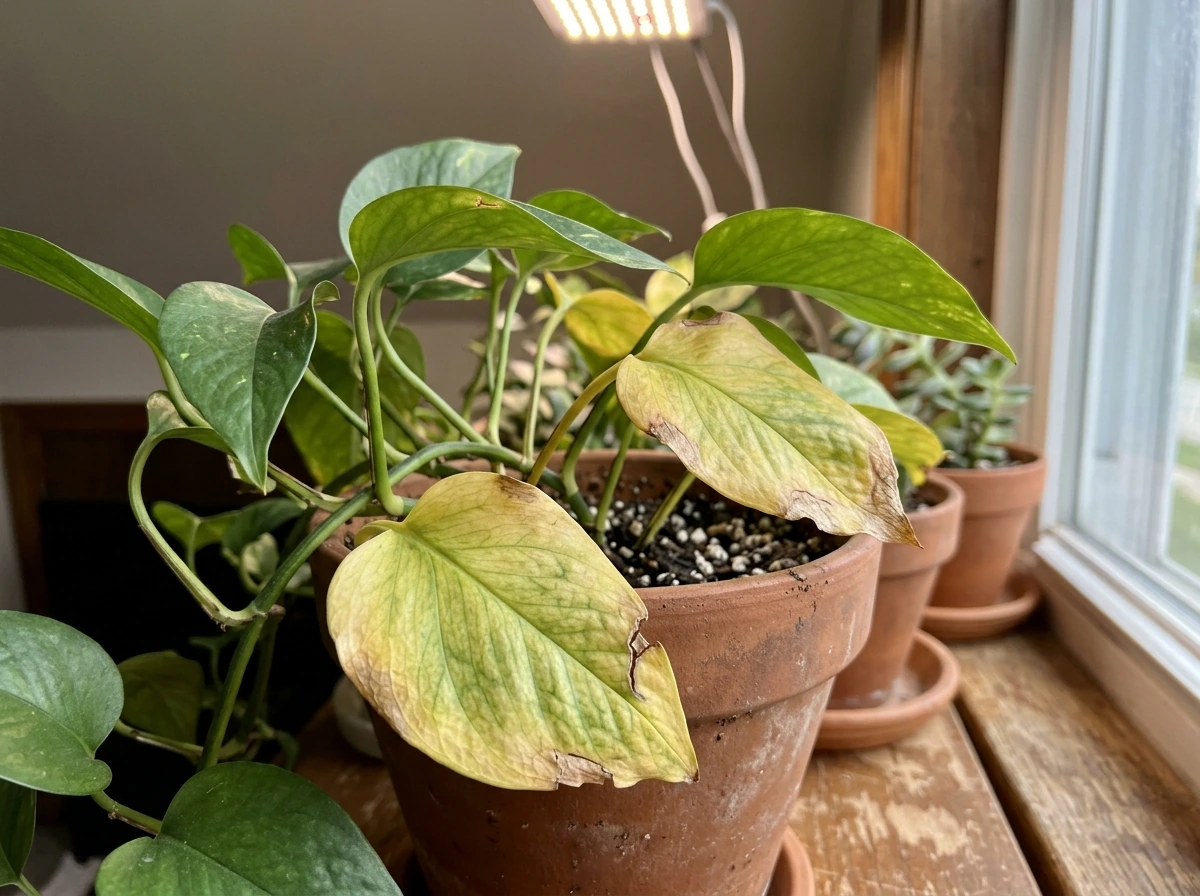
Yellow leaves have several possible causes, but light is often part of the picture. Lower leaves yellowing on a plant that is not getting enough light is common, since the plant redirects resources to leaves closer to the light source and drops older, less efficient ones. Increase light intensity and duration and see if the plant stabilizes over 3 to 4 weeks. Note that yellowing can also come from overwatering, so rule that out before blaming the light entirely.
Bleached, faded, or crispy leaf tips
This one usually means too much light or a light placed too close. Move the light 4 to 6 inches farther from the canopy, or reduce the daily duration by an hour or two. If you have a dimmable light, try dropping the intensity by 20 to 30 percent. This is more common when moving a shade-adapted plant under a high-output grow light without giving it time to acclimate.
No flowers or fruit set
Flowering requires more energy than just keeping leaves alive, and insufficient light is a top reason indoor plants that should flower simply do not. African violets, peace lilies, and herbs that flower before going to seed all need consistent, adequate light to bloom. Boost intensity, check your spectrum (make sure you are using a true broad-spectrum grow light, not a plain warm-white bulb), and ensure the plant is getting a proper dark period every night. Some plants are also photoperiod-sensitive, meaning the ratio of light to dark hours actually triggers or prevents flowering. Sticking to a consistent timer schedule matters more than most people realize.
The bottom line is that indoor lighting for plants is a solvable problem. You do not need a greenhouse or an expensive setup to grow healthy, happy plants without relying on a window. A purpose-built LED grow light, a simple timer, the right plant choices for your light level, and a little patience add up to a genuinely productive indoor garden. Start with one forgiving plant like a pothos or some lettuce, get your light distance and schedule dialed in, and you will have a working system you can build from there.
FAQ
Can plants grow with regular indoor LED bulbs if the room is bright?
Yes, but “normal” LED bulbs still usually fall short for most plants. If your goal is steady leaf growth, look for either much higher light at the canopy (not just a bright room) or a purpose-built grow light that targets red and blue efficiently. A practical test is to watch for legginess, smaller new leaves, and slow growth over 2 to 4 weeks.
How many hours per day should I run indoor lights for plant growth?
You can, but it is easy to overdo it. Starting with 12 to 14 hours per day for most houseplants, increase by about 1 to 2 hours only if growth is clearly sluggish, and keep a consistent daily schedule. If you see stress like crispy edges or unusual color fading, reduce hours first, then adjust distance.
Do plants need complete darkness at night under indoor lights?
A true darkness period matters even when using indoor lights. Many houseplants do best with a full off window each day, so avoid leaving lights on around the clock. If you have a timer, double-check it is not accidentally starting earlier or later after you change outlets or power strips.
Is grow light wattage enough to know if it will work?
Usually no, wattage alone cannot tell you whether a light is strong enough. Two lights with the same wattage can produce very different PPFD. If the packaging does not publish output in a plant-relevant way (PPFD or photon output), treat it as a weak sign and expect you may need to place the light very close or upgrade.
Do plants have to be directly under the grow light to benefit?
It can, and it often helps, but only if the light reaches plant surfaces at sufficient intensity. Plants do not need to sit directly under the center of the fixture, but those at the edges receive less. If the outer plants stretch or stall first, rotate plants weekly or reposition to put the more light-hungry ones toward the brightest zone.
Will using white walls or reflective surfaces improve indoor plant lighting?
Yes, reflective surfaces can noticeably improve results because they bounce usable wavelengths back toward leaves. Use white walls, white shelving, or a simple reflective sheet behind the setup, but keep the fixture at the correct distance, since reflections cannot fully replace low output.
How do I know if my light is too far or too close?
Yes, and it prevents common problems. If you see stretching with wide gaps, move the light closer by a few inches first. If you see bleaching or crispy leaf edges, move it farther back or cut the daily hours. The key is to make one change at a time and reassess after about a week.
Why does my plant look underlit even though the room is bright?
In most apartments, it is often easier to get the “bright room” feeling without enough canopy intensity. The easiest workaround is to use a timer and position the light so the measured or effective output is high at the leaf level, not just at eye level. If you can, measure at the canopy, since ceiling lighting spreads and drops off fast.
What indoor light spectrum issues cause pale or slow growth?
It can, especially with bulbs that run at a spectrum skewed toward yellow-green. A common symptom is slow growth with paler or inconsistent leaf coloration, even if the plant seems to survive. Switching to a broad-spectrum LED grow light that provides stronger red and blue output typically improves both speed and sturdiness.
Can indoor lights help trigger flowering, not just keep plants alive?
Yes, especially for plants that rely on consistent light cues to flower. Make sure your timer schedule is stable, since fluctuations can interfere with flowering for photoperiod-sensitive species. Also confirm you are using a grow light type intended for plant growth, not only a warm-white “house” LED.
How can I troubleshoot when a plant is not growing new leaves?
Accurate timing helps more than people expect, especially when you have a blackout window or schedule changes. If you accidentally run only 8 to 10 hours, plants may stall. After you install a timer, verify it matches your actual daily start and end times for at least a few days.
How do I tell if yellow leaves are from light or from overwatering?
Overwatering can mimic light problems, particularly with yellowing lower leaves. Before changing your lighting plan, check soil moisture, drainage, and whether the yellowing pattern fits low-light (older leaves first) versus general stress from wet roots. If you correct watering and the problem continues, then revisit light intensity and distance.
Can I use a high-brightness LED desk or shop light as a grow light?
Yes, but do not assume “LED” automatically means “plant-ready.” Some LED shop lights or work lights have enough intensity but lack the plant-friendly spectrum or proper photon output at the canopy distance. When shopping, prioritize brands that publish plant-relevant output (like PPFD) or clear spectrum info rather than generic brightness claims.
Should I acclimate a plant when switching from window light to an LED grow light?
You can acclimate by starting slightly farther away or using a lower intensity setting if the light is dimmable, then adjusting over 1 to 2 weeks. This reduces the shock that can cause bleaching or stress when a shade-adapted plant suddenly gets stronger light. After acclimation, fine-tune distance based on leaf response.