
Lion's mane mushroom (Hericium erinaceus) does not need light to grow mycelium, but it does need some light to fruit reliably. You can run the entire colonization phase in complete darkness, and the mycelium will do just fine. The moment you want actual mushrooms to form, a modest daily dose of indirect light, somewhere in the 400–1200 lux range, acts as a developmental cue that nudges the fungus toward producing fruiting bodies. Think of it less like a plant needing sunlight to photosynthesize and more like a signal that tells the mycelium 'conditions outside are right, time to fruit.'
Does Lion’s Mane Need Light to Grow Indoors?
Marcus Hartley
17 May 2026
Does lion's mane actually require light to grow
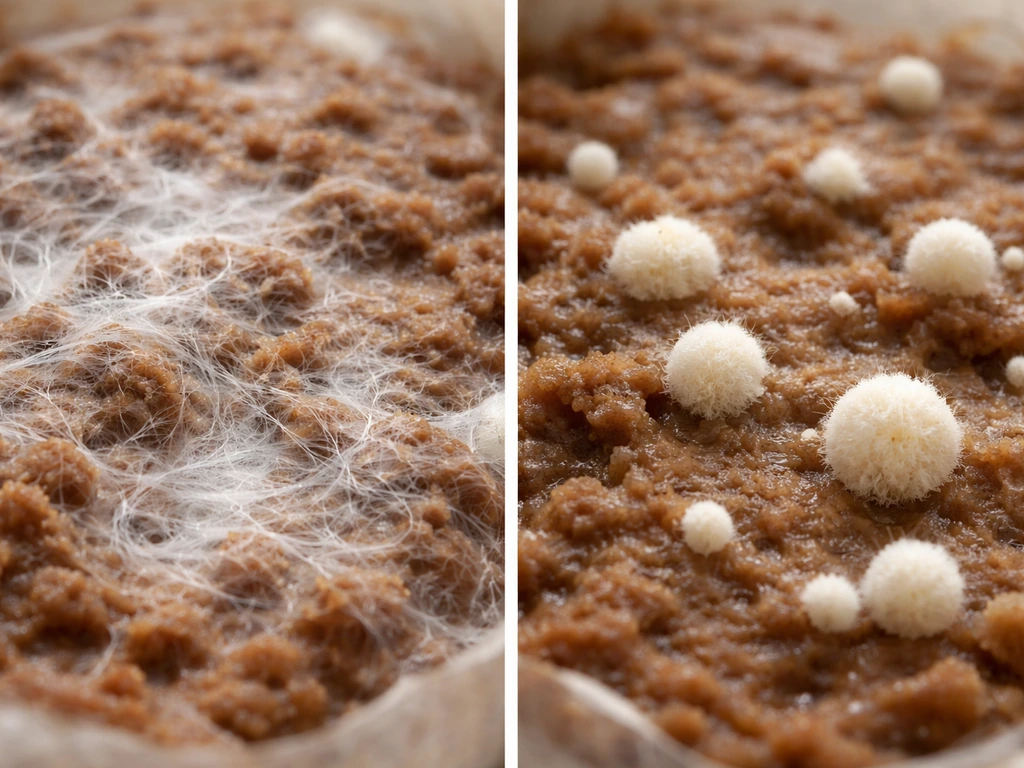
The honest answer depends on what you mean by 'grow.' Mycelium, the white thread-like network that colonizes your substrate, grows perfectly well in the dark. In fact, some research suggests that blank" rel="noopener noreferrer">hericene A, one of the bioactive compounds in H. erinaceus, actually accumulates at higher levels when the fungus is grown in darkness compared to light conditions. So darkness is not the enemy of mycelial growth at all.
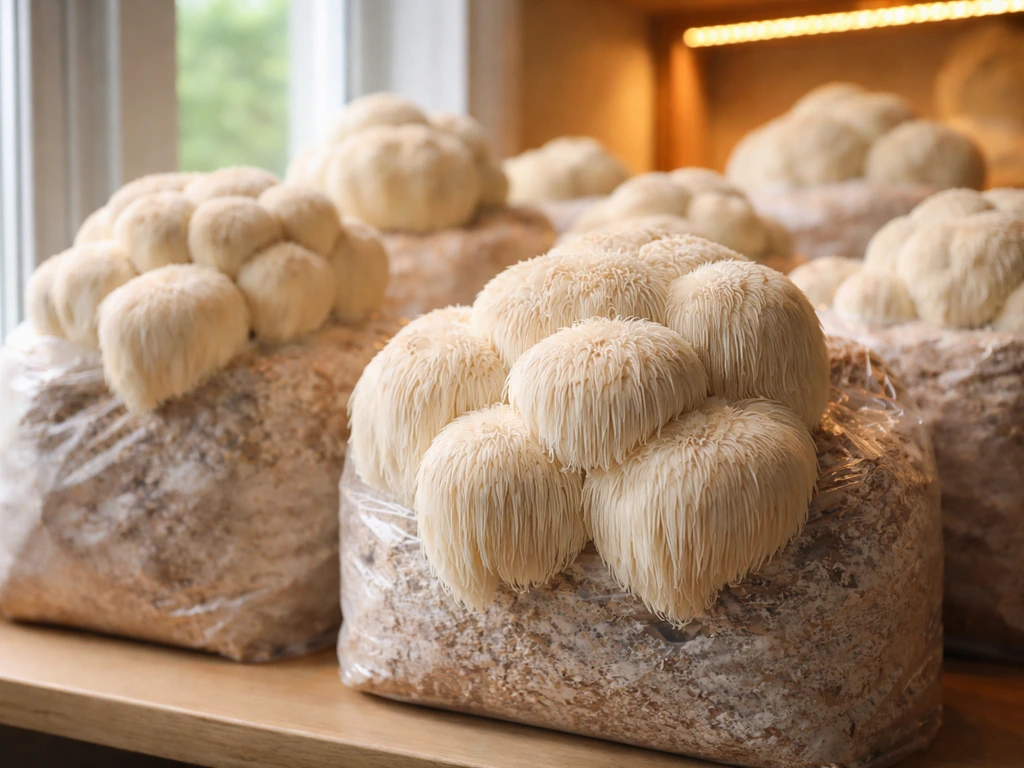
Where light starts to matter is at the fruiting stage. Commercial kit instructions from established producers consistently specify a fruiting-stage light target of 400–1200 lux (some narrow it to 500–1000 lux), paired with fresh air exchange and high humidity. That is not a lot of light. It is roughly the brightness of a well-lit room, not direct sun through a south-facing window. But that gentle cue, combined with the right CO2 levels and humidity, is what typically pushes primordia (the tiny pin-like early fruiting bodies) to form and then expand into the shaggy white pom-poms you are after.
One UNESP study did find that under their specific test conditions, light was not the statistically significant driver of productive performance, suggesting other variables like CO2 concentration, humidity, and substrate quality can outweigh light when those factors are optimized. So light is not an absolute requirement in the way water is for a plant, but for most home growers who are not dialing in every other variable perfectly, giving lion's mane a predictable light cycle is simply the easiest lever to pull to get consistent fruiting.
What light does (and doesn't) control in mushroom fruiting
Unlike plants, mushrooms do not photosynthesize. Light does not feed them, and more light does not make them grow faster the way it might push a tomato plant. What light actually does in H. erinaceus is act as an environmental cue, much like a temperature drop or a seasonal shift, that signals the organism to change developmental mode. Research published in Frontiers (2025) showed that different LED light spectra, including blue, green, red, and RGB combinations, produced measurable differences in mycelial colony morphology and early differentiation after just 15 days. Blue light in particular has been shown (including in closely related Hericium coralloides) to stimulate fruiting body development more effectively than red light alone.
What light does not control is the overall biomass or the basic colonization process. You are not going to get more mycelium by shining a grow light on a colonizing block. And you will not kill a fruiting kit by having a dim room. What you will likely see without any light cue is slower or irregular primordia initiation, meaning pins form erratically or not at all, even when everything else looks right. That is the main practical problem a no-light setup creates for home growers.
It is also worth noting the darkness-rest connection. If you are curious whether lighting matters after recovery, the related topic "do crystals grow better in the dark" is a useful comparison point for how darkness can change outcomes in different systems darkness-rest connection. For glow berries, people generally ask whether they need darkness to grow, but the growth process still depends on how light and rest are managed darkness-rest connection. Between flushes, kit producers actually recommend putting lion's mane back into darkness for 4–7 days. So the cycle looks like: light cue during fruiting, dark rest during recovery. Light is a stage-specific tool, not a constant need.
Best indoor light conditions for lion's mane
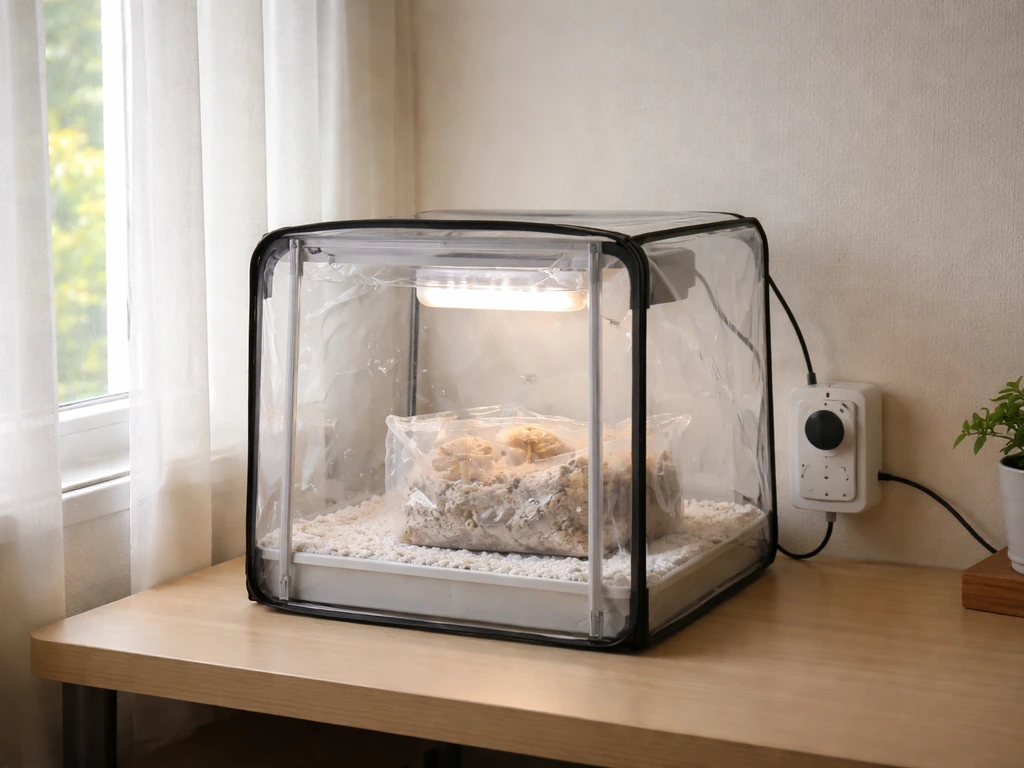
For most home setups, you have two practical options: a north or east-facing window with consistent indirect daylight, or a simple LED grow light on a timer. Either works. Here is what the numbers look like in practice:
| Light Source | Typical Lux Output | Good for Lion's Mane? | Main Caveat |
|---|---|---|---|
| Bright indirect window light | 300–1500 lux | Yes, if consistent | Varies with season and weather |
| Direct sunlight through glass | 10,000+ lux | No, too intense | Dries out the kit, overheats surface |
| LED grow light (low setting) | 400–1200 lux at distance | Yes, ideal | Keep 30–60 cm away to avoid heat/drying |
| Standard indoor room lighting | 100–300 lux | Marginal | May be enough but results are inconsistent |
| Fluorescent shop light | 500–1000 lux | Yes | Works well; position 30–45 cm above |
For photoperiod, a 12-hour light and 12-hour dark cycle is what NCAT/ATTRA recommends as a baseline, and it mimics the kind of seasonal day-length signal that would trigger outdoor fruiting. You do not need to run light all day. In fact, running light continuously is not going to help and might contribute to drying out your fruiting chamber. Set a timer and walk away.
If you are using an LED grow light, aim to keep it at a distance where the surface of your fruiting block or kit does not feel noticeably warmer than room temperature. Heat and light together are the combination that dries out pins before they can develop, and that is one of the most common failure modes I have seen. A simple clip-on LED on a 12-hour timer, positioned about 40–50 cm from the kit, will land you right in that 400–1200 lux sweet spot without causing heat stress.
Light vs no-light setups: how to tell if it's working
The clearest sign that your light setup is working is primordia appearing at the incision sites (or wherever you have opened the bag or block) within 7–14 days of introducing fruiting conditions. Most strains initiate primordia within 2–4 weeks under well-managed conditions, and if you are in week three with no pins at all, something in your environment is off. Light is one variable to check, but it is rarely the only one.
Here is a quick comparison of what you typically see with and without consistent light:
- With proper light (400–1200 lux, 12-hour cycle): Primordia appear relatively evenly at incision sites, expand into recognizable pom-pom shapes within 5–10 days of pinning, and have good density.
- With no light or very dim light (<100 lux): Primordia may still form, especially if CO2 is low and humidity is high, but they tend to be sparse, irregular in placement, and slower to expand. You might see etiolated or elongated growth reaching toward any available light source.
- With too much light or direct sun: Surface dries out, pins shrivel before expanding, and you may see yellowing or browning on the fruiting surface. Contamination risk also increases as the moisture balance is disrupted.
If pins are forming but not expanding much, check humidity first, then light duration. If the kit looks healthy but nothing is pinning after two weeks, check CO2 (is the space well-ventilated?), then consider whether the ambient light is consistent enough to register as a day-night signal.
How to set up your grow area
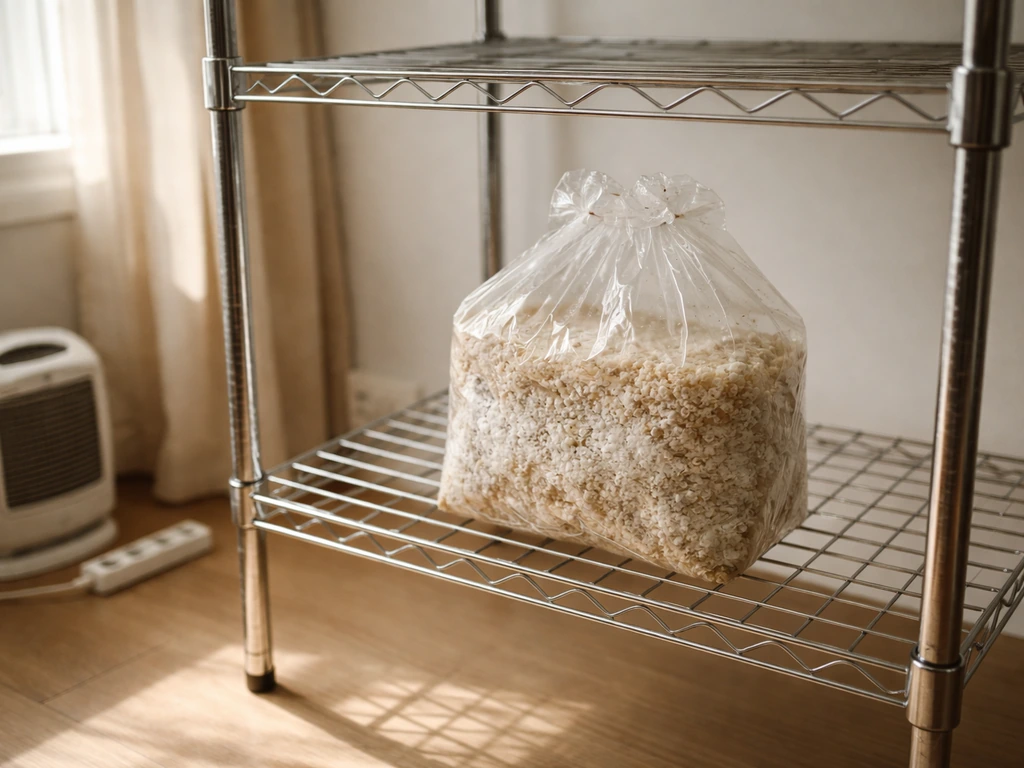
Light only does its job when the rest of the environment supports it. Here is how to put together a setup that actually works in a home or apartment, without needing a dedicated grow tent or expensive equipment.
Placement
Keep your lion's mane kit away from heaters, south-facing windows with direct afternoon sun, and any spot where air blows directly on it from a fan or vent. A kitchen counter near a north or east window, a shelf near a bright but shaded window, or any indoor spot with stable temperature (18–24°C is the sweet spot for most strains) works well. If you are using an LED, mount it above the kit rather than to the side, since lion's mane tends to fruit toward the light source and you want even upward growth.
Photoperiod and light timer
Set a simple plug-in timer for 12 hours on, 12 hours off. Run the light during the daytime hours you will actually be around, partly for convenience and partly because you want to check on your kit regularly during the fruiting stage. This is why rhubarb may look like it is doing its best in low light conditions, because it still benefits from blanched, tender growth rather than relying on full sun rhubarb grow in the dark. This light cycle is enough to register as a consistent environmental cue without overexposing the surface.
Humidity
Target 85–95% relative humidity during fruiting. This is the single most important variable after substrate quality. A small ultrasonic humidifier near the kit works well, or you can mist the air around (not directly onto) the kit two to three times a day. Once you see the first primordia forming, you can ease humidity down just slightly, but do not let it drop below around 80% or pins will stall.
Airflow and CO2
Fresh air exchange is just as important as light for triggering and sustaining fruiting. A CO2 concentration under 1000 ppm is the general target. In a small room with a window cracked open, you are probably fine. In a sealed grow tent or closet, you will need active ventilation, around 5–8 fresh air exchanges per hour. A small computer fan on a timer cycled every few hours can handle this without drying out the kit. High CO2 is one of the most reliable ways to stall pinning, so if you are doing everything else right and still not getting results, ventilation is the first thing I would improve.
Common mistakes and how to fix them
Etiolation and weak or leggy fruiting bodies
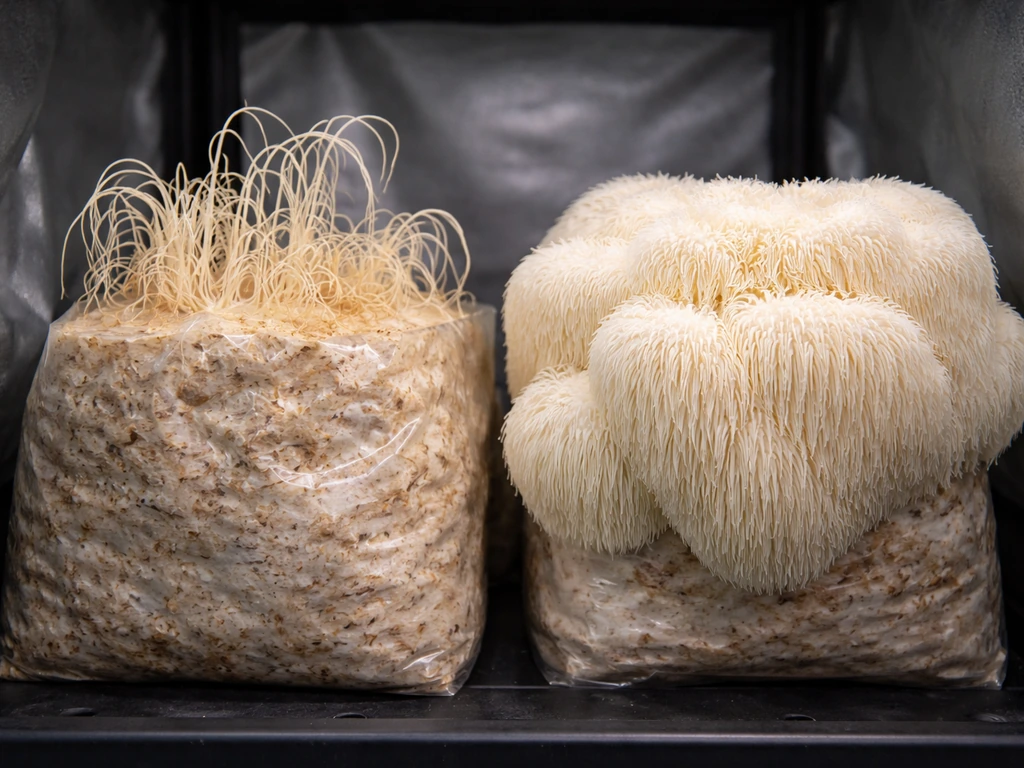
If your lion's mane is producing thin, elongated, or sparse fruiting bodies that look more stringy than full and shaggy, the most common causes are insufficient light and high CO2. These two factors often work together: a dim, poorly ventilated space gives you etiolated growth that reaches toward any available light while being stunted by CO2 buildup. Fix both at once by increasing light to the 500–1000 lux range and improving ventilation. Etiolated growth is usually reversible within a flush or two once conditions are corrected.
Pins forming then stalling or browning
Pins that appear but then stop growing or turn yellow-brown are almost always a humidity problem. Check that your ambient humidity is actually in the 85–95% range with a hygrometer (not just a guess), and make sure your light source is not creating a warm dry zone around the kit. If you are misting the fruiting surface directly, stop: mist the air around the kit or the walls of your grow space instead. Direct misting can introduce contamination and cause uneven moisture on the surface.
No pins at all after two or more weeks
Run through this checklist in order before assuming the kit is a loss. Most lion's mane blocks will pin if conditions are actually met, and the fruiting stage can sometimes take patience, especially with strains that run on the slower end of the 2–4 week range.
- Check CO2 first: is the space ventilated? A stuffy closet with no air exchange is the most common reason pins simply never form.
- Check humidity: use a hygrometer, not a finger-test. It is almost impossible to eyeball 85–95% accurately.
- Check light: are you giving at least a few hours of 400–1000 lux daily? Even indirect window light helps.
- Check temperature: lion's mane prefers 18–24°C during fruiting. Above 25°C slows everything down significantly.
- Check your incisions: if the bag or block is sealed, primordia have nowhere to emerge. Make clean incisions or remove the top of the bag to give the mycelium an exit point.
- Consider a cold shock: a brief drop in temperature (moving the kit to a cooler spot for 12–24 hours) can sometimes trigger pinning by mimicking a seasonal shift.
Contamination
Green, black, or pink patches on your substrate mean mold contamination, and unfortunately there is usually no saving a heavily contaminated block. The good news is that contamination is almost always a hygiene or airflow problem, not a light problem. Avoid misting directly onto exposed mycelium, keep your hands clean when handling the kit, and make sure air is moving through your grow space rather than sitting stagnant. High humidity combined with zero airflow is the perfect environment for competing molds, so getting your FAE right protects against contamination just as much as it helps fruiting.
Lion's mane is genuinely one of the more beginner-friendly mushrooms to grow indoors, partly because its light needs are modest and flexible. You do not need a specialized grow light or a perfectly dialed environment. What you need is a consistent indirect light cue, high humidity, decent ventilation, and a bit of patience. Get those four things working together and you will almost certainly see those distinctive white pom-poms forming within a few weeks.
FAQ
If I keep my lion’s mane in total darkness the whole time, will it still eventually fruit?
No. During colonization you can store the kit or block in complete darkness, then introduce light only when you switch to fruiting conditions.
How strict does the light schedule need to be for fruiting (exact hours vs “some light during the day”)?
Aim for a consistent day night cue, not high intensity. A timer is best, because “on whenever I remember” often results in irregular primordia initiation.
Is it okay to put lion’s mane near a south-facing window for the light boost?
Don’t rely on direct sun through a window. Afternoon sun can create heat and uneven drying, which can cause aborted or stunted pins even if lux readings look high.
Can I use a bright LED grow light if I move it closer to hit 400 to 1200 lux?
Yes, but keep the surface from warming. If the kit feels noticeably warmer than the room or you see rapid drying, increase the distance or reduce the intensity, then recheck humidity.
Does the color of light matter (blue vs red) for lion’s mane indoors?
If you are using an LED, blue content often helps fruiting cues, but the practical win is still the correct lux at the kit plus a stable photoperiod. RGB or mixed-spectrum is usually fine if temperature and humidity are controlled.
Will leaving the light on all day make my lion’s mane grow faster?
Use a timer that creates a real dark period, and avoid leaving light on 24/7. Continuous light can increase drying and disrupt the seasonal cue that fruiting typically responds to.
How can I estimate light level if I do not have a lux meter?
You do not need to measure lux perfectly, but you do need consistency. Start with indirect daylight or an LED on a timer, then adjust based on outcomes like pinning timing and pin expansion.
What should I troubleshoot first when I see pins but they stop growing?
If pins form then stall, re-check humidity with a hygrometer first, and only then revisit light. Light usually does not cause pins to yellow or stop if humidity is already in range.
Can I mist the kit directly to increase humidity if my pins are not forming?
Do not mist directly onto the block or bag surface. Mist the air or chamber walls, and increase fresh air exchange if humidity is high but pins still fail to develop.
Should I keep the light on between flushes or put the kit back into darkness?
During recovery between flushes, many producers recommend returning kits to darkness for about 4 to 7 days. Then reintroduce the light cue at the next fruiting stage.
At what point should I start adding light, right after setup or only after the block is fully colonized?
Light cues are usually stage-specific. If you are still colonizing, don’t waste effort dialing light, instead focus on keeping contamination risk low and only switch to fruiting conditions when the substrate is ready.
What if my light is on a timer and still no pins appear after 14 days, what else could it be besides light?
A lack of pins after about two weeks in fruiting usually means something broader is off, commonly CO2 or airflow. If CO2 is high, light can look “correct” but primordia still won’t start.
Should I place the light above the kit or from the side to make fruiting more even?
To prevent uneven development, mount the light above and position it so the whole opening gets the cue. Side lighting can create uneven, lopsided growth toward the light source.