
Yes, bromeliads can grow in low light, but how well they grow depends on just how low you're talking. Most bromeliads will survive in dim conditions for weeks or even months, but they won't really grow, and they almost certainly won't bloom. A few genera, especially Guzmania and Vriesea, genuinely tolerate lower light and can stay healthy and attractive in a bright-ish interior room. Others, like stiff-leaved Aechmea and Tillandsia, need more intensity and will slowly decline in a dim corner. The honest answer is: low light is workable for the right bromeliad, but there's a meaningful difference between surviving and thriving, and that gap is worth understanding before you pick a spot.
Can Bromeliads Grow in Low Light? Indoor Care Guide
Marcus Hartley
29 May 2026
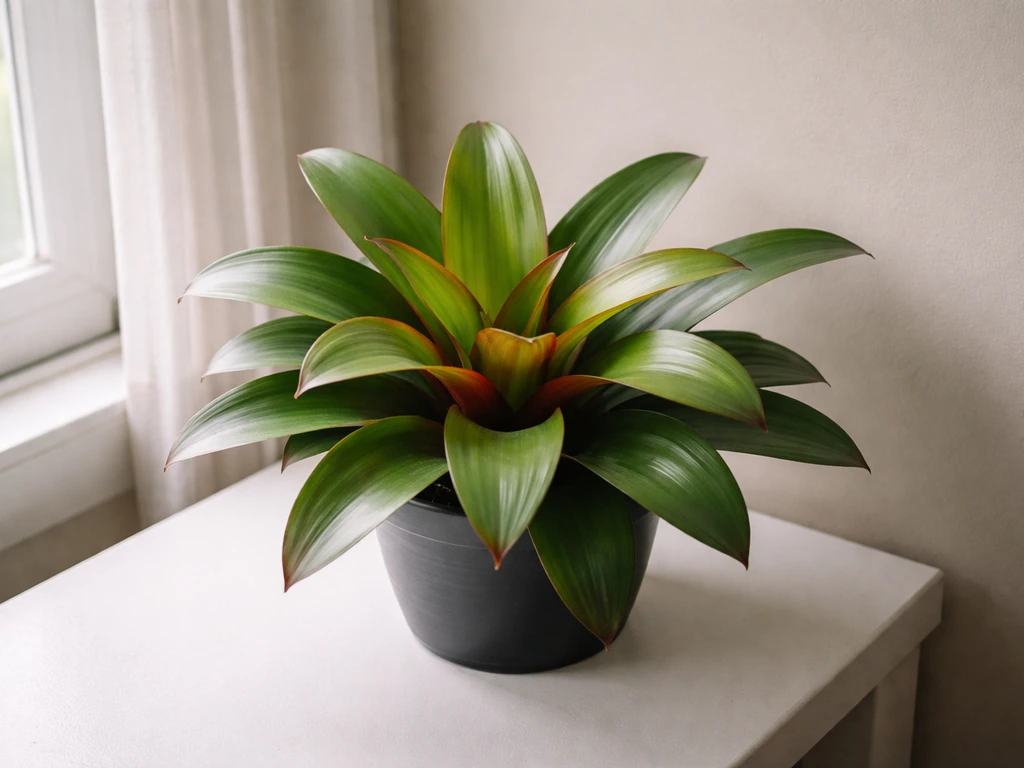
Bromeliads in low light: can they survive and still thrive?
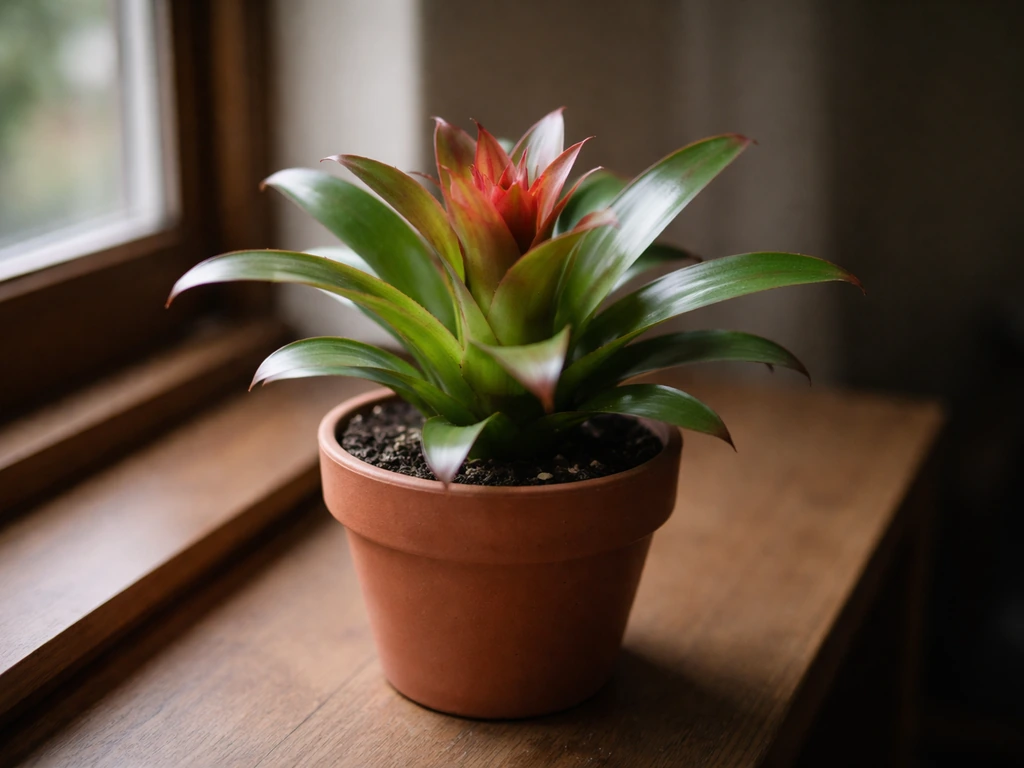
Bromeliads are not true low-light plants in the way some ferns or pothos are. They come from environments where light levels shift dramatically by season and canopy cover, so they've evolved some tolerance for shade, but there's a floor. UF/IFAS research puts it plainly: bromeliads will survive (but not grow) for many weeks under very low light. Survival and thriving are genuinely different outcomes here. Survival looks like a plant that holds its rosette shape, doesn't drop leaves dramatically, and just sits there. Thriving looks like new leaves forming from the center, colors staying rich and vivid, and eventually, a flower spike emerging. For most indoor setups, you can land somewhere between those two outcomes depending on the genus you choose and how much light you can realistically provide or supplement.
The good news is that bromeliads compensate for lower light in a biologically clever way: they produce more chlorophyll, which is why a low-light bromeliad often turns a noticeably darker green. That's the plant trying to catch every photon it can. It's not a disaster signal on its own, but it does tell you the plant is working harder than it should. If you want color, patterning, and eventual blooming, you'll need to push the light level up from pure survival mode.
How much light bromeliads actually need (and what counts as "low")
The numbers help here. Most bromeliads need around 2,000 footcandles to grow well, and they hit their best color and most compact rosette shape between 3,000 and 4,000 footcandles. A general starting target from bromeliad culture guides is around 1,500 footcandles, which is roughly where orchids do well. Now here's the reality check: the interior of a well-lit home often measures less than 100 footcandles. Outdoor light on a clear day can top 10,000 footcandles. That gap is enormous, and it's why so many houseplants struggle in real-world rooms.
In practical terms, 'low light' for a bromeliad means anything significantly below 1,000 footcandles, and 'insufficient light' for most species kicks in around or below 500 footcandles. A north-facing room with no direct sun, a spot more than 8 feet from any window, or a room with small windows blocked by trees or buildings will almost certainly fall into that insufficient range. That doesn't mean you can't grow bromeliads there, but it does mean you'll need to supplement with grow lights or set your expectations accordingly.
Photoperiod matters too. Bromeliads grown as houseplants do best with 12 to 16 hours of light per day. Even moderate intensity becomes more effective when delivered consistently over that window, which is exactly why a simple timer on a grow light can make a real difference in a dim room.
Best bromeliad types for dim rooms (and which struggle)
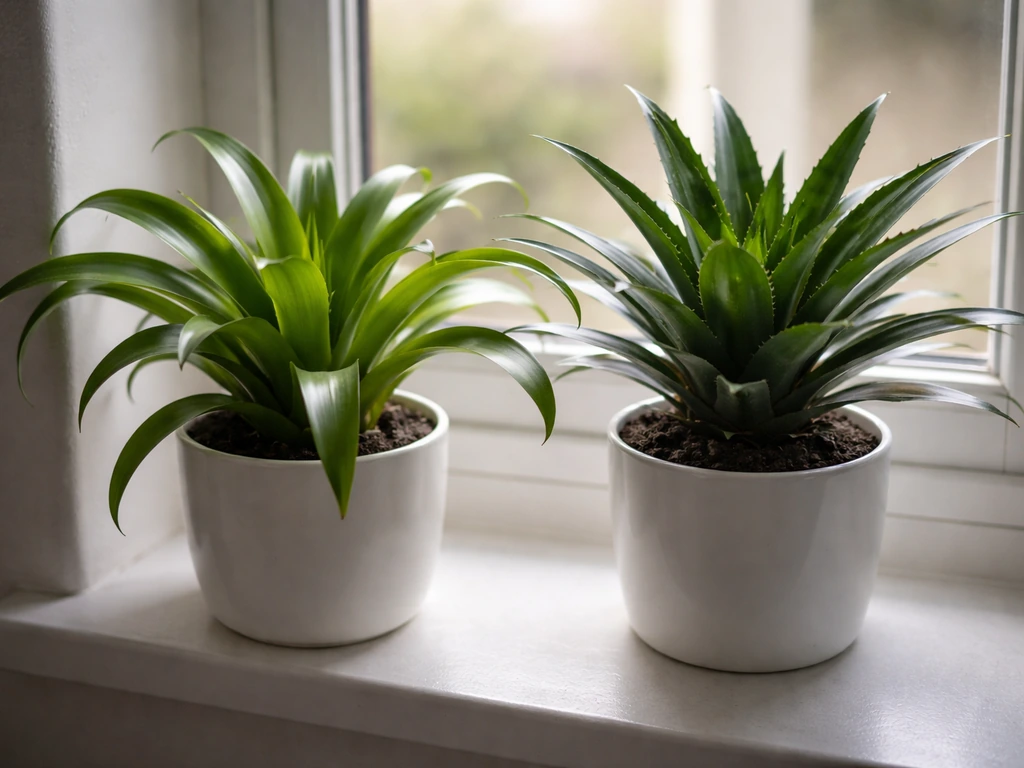
Leaf texture is your best shortcut for predicting low-light tolerance. Bromeliad Plant Care similarly links low-light tolerance to leaf type, noting that soft, flexible-leaved genera like Guzmania and Vriesea tend to do well in lower light while stiff-leaved types prefer brighter, indirect light Leaf texture is your best shortcut for predicting low-light tolerance.. Soft, flexible leaves (think Guzmania and Vriesea) are generally adapted to lower light and do better in interior rooms. Stiff, leathery, or spiny leaves (Aechmea, Neoregelia, Tillandsia) evolved in brighter, more exposed environments and want more intensity to stay healthy and hold their patterning. That said, Neoregelia is interesting because some cultivars actually color up beautifully even in lower light, though they're usually described as preferring bright indirect light for best results.
| Genus | Low-Light Tolerance | Best Use in Dim Spaces | Blooming in Low Light |
|---|---|---|---|
| Guzmania | Good | North-facing rooms, supplemented fluorescent light | Possible with adequate duration |
| Vriesea | Good | Interior rooms, 6–8 ft from window | Possible with supplemented light |
| Neoregelia | Moderate | Bright indirect or supplemented LED | Unlikely without extra light |
| Aechmea | Low–Moderate | Needs bright indirect; struggles in dim corners | Unlikely in low light |
| Tillandsia | Low | Needs bright indirect or direct sun; poor low-light candidate | Very unlikely in low light |
If you're shopping specifically for a dim room, Guzmania is the most forgiving choice I'd recommend. They're widely available, reasonably priced, and genuinely adapted to lower interior light. Vriesea is a close second and offers some gorgeous leaf patterning even without strong sunlight. If you're already committed to an Aechmea or Tillandsia, plan on supplemental grow lighting rather than relying on a low-light window.
Signs your bromeliad needs more light
Your bromeliad will tell you it's struggling before it actually starts declining, if you know what to look for. Light affects leaf color, leaf shape, and growth rate in measurable ways, so most of these signals are visible to the naked eye.
- Leaves turning uniformly dark green: the plant is producing extra chlorophyll to compensate for low light. It's a sign of stress, not health.
- Leggy or stretched rosette: leaves leaning outward and away from the center rather than forming a tight cup shape means the plant is reaching for more light.
- Slow or stopped growth: bromeliads are already slow-growing, but if nothing is happening over several months, insufficient light is a likely culprit.
- Fading or dull leaf coloration: variegated patterning and vivid colors require enough light intensity to develop. Low light flattens the palette.
- Failure to bloom: this is the clearest signal. Bromeliads that don't receive enough light simply won't flower. If yours has been sitting for more than a year without a bloom or offset (pup), light is worth investigating first.
- Soft, limp leaves: when combined with other signs, this can indicate the plant is not photosynthesizing enough to maintain healthy cell pressure.
One useful diagnostic: if you suspect light rather than water or root issues, move the plant to a brighter spot for 4 to 6 weeks and watch for a response. New growth coming in tighter and more colorful confirms light was the problem. Just don't jump from a very dim corner straight into direct sun. A sudden jump to high light can actually sunburn a bromeliad that adapted to shade, even if that same species typically prefers bright light.
How to increase light in practice (window placement and rotation)
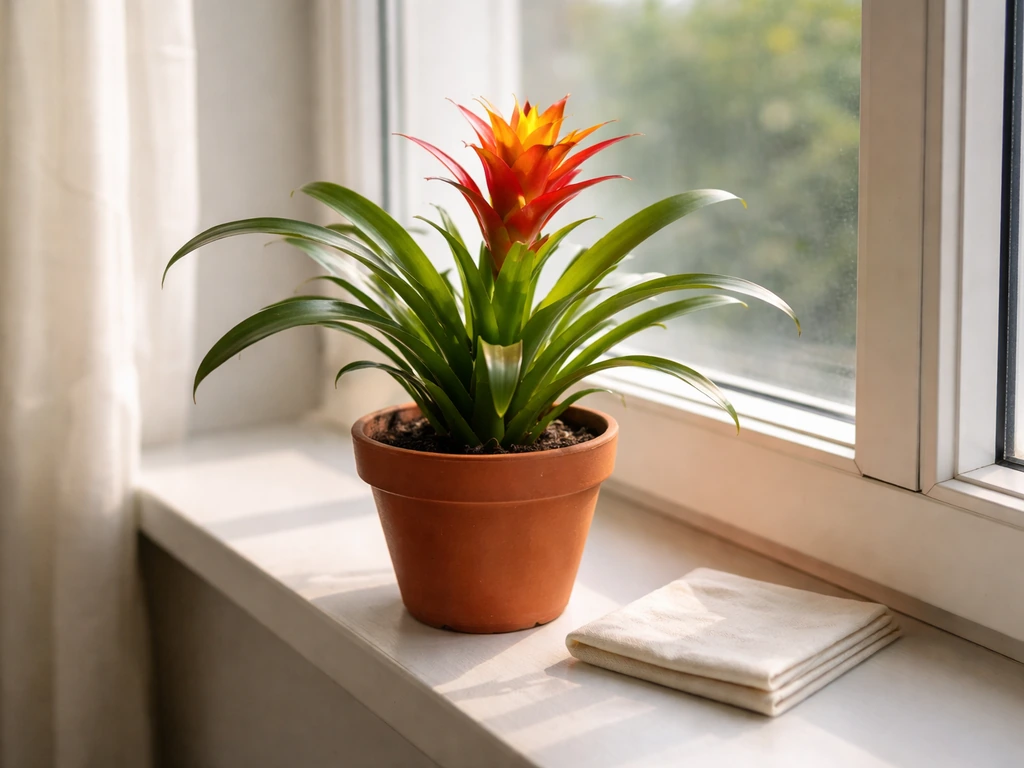
Before buying any equipment, work with what you have. Window direction matters enormously. East and west windows give you useful soft morning or afternoon light. South-facing windows are your best natural option in the northern hemisphere, offering the longest daily light duration and highest intensity. North-facing windows are the hardest to work with for bromeliads, providing diffuse light that rarely tops 500 footcandles even on a bright day.
- Move the plant as close to the window as possible without putting it in direct midday sun. Within 3 to 4 feet of a south or east window is meaningfully better than 6 to 8 feet away.
- Rotate the plant a quarter turn every week or two so all sides receive equal light exposure and the rosette develops symmetrically.
- Clean your windows. Dirty glass can cut light transmission by 20 to 30 percent, which is not trivial when you're already working with marginal levels.
- Remove or sheer obstructions. Sheer curtains diffuse direct sun nicely but also cut intensity. If you're not getting direct sun anyway, pull them back.
- Use light-colored walls and surfaces near the plant. Reflective surfaces (white walls, mirrors, light-colored pots) can meaningfully bounce ambient light back onto the plant.
If your best window still isn't enough, the next step is artificial lighting, which gives you much more control than trying to optimize a dim room around natural light alone.
LED and fluorescent grow light options for low-light homes
This is where a lot of indoor gardeners unlock plants that just wouldn't work otherwise, and it doesn't have to be complicated or expensive. The core principle is straightforward: light intensity drops dramatically with distance from the source. Doubling the distance between your plant and a grow light reduces the light it receives to roughly one quarter the original level. That inverse-square relationship means where you place your light matters far more than which brand you buy.
For bromeliads, you're aiming to hit around 1,500 to 2,000 footcandles (or roughly 150 to 200 PPFD in the photosynthetically active range) at the plant canopy. Most modern LED grow lights aimed at houseplants can achieve this easily at a distance of 12 to 18 inches. A full-spectrum LED panel or even a simple clip-on LED grow bulb in a standard reflector lamp will work. You don't need an expensive horticultural setup unless you're growing dozens of plants.
- Full-spectrum LED grow bulbs (available at most hardware stores for $15–30): screw into a standard lamp, position 12–18 inches above the bromeliad, and run on a timer for 12–16 hours per day.
- T5 or T8 fluorescent shop lights: a very cost-effective option for a shelf or growing area. Position tubes 6–12 inches above the plant canopy. Two 40-watt T8 tubes over a small shelf provide enough intensity for Guzmania and Vriesea.
- LED grow light panels: more efficient long-term and produce less heat. Good for a dedicated growing shelf or windowless room. Look for panels rated for 2x2 ft or 2x4 ft coverage.
- Timers: plug your grow light into an outlet timer set for 14 hours per day. Consistency matters more than peak intensity for bromeliad health, and a timer removes the guesswork entirely.
Spectrum matters less than intensity for bromeliads, but full-spectrum white light (or a balanced red/blue mix) is better than warm white alone. Avoid novelty purple 'blurple' lights; they work but make it hard to see your plant's color accurately, which matters when you're monitoring for the signs described above. For most people in a low-light apartment, a $20 LED grow bulb on a timer next to the closest window is a completely adequate starting point.
Care tweaks for low light: watering, humidity, and fertilizer
Low light changes how you should care for a bromeliad, and ignoring that interaction is one of the most common ways people lose these plants. In lower light, the plant is photosynthesizing less, growing slower, and using far less water. Overwatering in low light is a genuine risk.
- Water less frequently in low light: expect to water significantly less than you would in a bright spot. Let the potting mix dry out more between waterings. The Sill puts it directly: water more often in brighter light, less often in lower light.
- Keep the central cup partially filled, but not packed: for tank-type bromeliads (Guzmania, Aechmea, Vriesea), maintaining water in the central cup is important, but in low-light and cooler conditions, WSU Extension recommends keeping it only about one-quarter full to avoid stagnation and rot.
- Flush the cup weekly: regardless of light level, flush the central cup with fresh water once a week to prevent mineral salt buildup, which can cause leaf tip dieback.
- Fertilize very little or not at all in low light: bromeliads are light feeders even in good conditions. UF/IFAS research is clear that under low light or in winter, they require little to no fertilizer. Feeding a plant that isn't growing just pushes salts into the soil and cup without benefit.
- Maintain humidity around 40–60%: bromeliads appreciate humidity, and dry indoor air (especially in heated winter rooms) combined with low light stresses the plant. A pebble tray with water or a small humidifier nearby helps without adding moisture to the soil.
- Keep temperatures above 55°F: bromeliads are tropical and don't like cold. Avoid cold windowsills in winter if night temperatures near the glass drop significantly.
The most common mistake I see in low-light bromeliad care is continuing to water and fertilize at a 'bright light' schedule even after moving the plant to a dimmer spot. Slow everything down when the light goes down.
What to expect: growth and blooming timelines, and when to change strategy
Bromeliads are genuinely slow growers even in ideal conditions, so don't use speed as your only benchmark. In low but adequate light (think 1,000 to 1,500 footcandles from a bright window or supplemented grow light), a healthy Guzmania or Vriesea will maintain its rosette, hold color, and might eventually produce a pup or bloom over 12 to 18 months. In very low light (under 500 footcandles), it will survive but growth will be extremely slow to nonexistent, and blooming is unlikely.
Bromeliads bloom once from the center of the rosette, then the mother plant slowly declines while producing offsets (pups) at the base. If flowering is your goal and you're not seeing a bloom spike after more than a year, light is the most likely limiting factor. There's an interesting workaround: placing a ripe apple inside a sealed bag around the plant for a week or two releases ethylene gas, which can trigger flowering in bromeliads. It's worth trying before concluding your plant is a lost cause, but it works best when the plant is otherwise healthy, not just barely surviving.
Here's my honest recommendation for when to change strategy: if your bromeliad has been in a low-light spot for 6 months and shows none of the positive signs (new leaf growth, good color, upright posture), add a grow light before moving on. A $20 LED bulb on a 14-hour timer is a genuinely low-stakes experiment. If things improve within 6 to 8 weeks of adding light, you have your answer. If they don't, assess watering and root health next. And if you've tried both and the plant still isn't responding, it may simply be the wrong species for your space. Guzmania in a dim room with a grow light is a much better bet than trying to force a Tillandsia to live on ambient light from a north window.
If you're exploring other plants for low-light spaces, it's worth knowing that some ferns and certain herbs can also handle similar dim indoor conditions, and the same logic around supplemental lighting, reduced watering, and realistic expectations applies across the board. Boston ferns are a common choice for dim corners, but you still need to match their light and moisture needs to keep them growing well. If you're wondering about ferns too, can ferns grow in low light depends on the species and how much supplemental light you can provide. Hornwort can also manage in low light, but it will grow much more slowly than under stronger lighting low-light spaces. If you want herbs that can grow in low light, focus on species that naturally tolerate shade and plan for supplemental lighting when needed certain herbs. The principles you use to manage a bromeliad in low light translate directly to other shade-tolerant houseplants.
FAQ
What counts as “low light” for a bromeliad, and how can I estimate it at home?
A practical rule is that many bromeliads need roughly 1,000 footcandles to do more than just survive, and they thrive closer to 1,500 to 2,000 at the leaf level. If you do not have a light meter, use your phone only as a rough hint, then rely on behavior, new central growth, and leaf color changes after relocating or adding light.
Can I keep a bromeliad alive in low light if I stop watering completely?
Not always. Bromeliads still need moisture, but in low light they use less. Instead of “no water,” reduce watering frequency and be careful that water does not sit in the rosette too long if airflow is poor. The aim is consistently hydrated tissues without creating chronic soggy conditions.
How do I avoid overwatering when my bromeliad is in a dim corner?
Treat low light as a cue to slow the whole routine. Use a larger drying margin between waterings, keep the base from staying wet, and improve airflow around the plant. If you mist, do it briefly and not as a substitute for proper drying between waterings.
Will a bromeliad grow in low light if I use fertilizer?
Fertilizer usually will not fix a light shortage and can worsen problems when growth is stalled. In dim conditions, use little to none, and only fertilize at reduced strength when you see active new growth. Otherwise salts can build up in the medium and at the tank/rosette.
Does rotating my bromeliad help when it is in low light?
It can help prevent uneven leaning and make growth more symmetrical, but it will not raise overall light intensity. Rotate every 1 to 2 weeks so the plant is not always “reaching” the same direction, especially if it is near one window.
Is a north-facing window enough for bromeliads year-round?
Often it is not enough for growth, especially in winter, because intensity stays low and day length changes. If you try it, expect slow or no new leaves. If you cannot supplement, choose more tolerant types like Guzmania or Vriesea and accept that blooming may take longer.
What is the safest way to switch from low light to grow light without burning the plant?
Increase light gradually. Start by moving the plant closer to the light or raising the photoperiod in steps, then watch for bleaching or browned tips. A sudden jump from a very dim spot to high intensity can damage shade-adapted bromeliads.
If I see darker green leaves, does that automatically mean my bromeliad is failing?
Not automatically. Darker green is often a low-light adaptation, but the key is whether the center produces new leaves and whether the rosette stays upright and stable. If new growth stops for months or the plant looks shrunken, you likely need more light or better airflow.
How long should I wait after adding a grow light before concluding low light is the problem?
A good decision window is 4 to 8 weeks. Look for new leaves emerging from the center, tighter rosette growth, and more typical coloration. If there is no response after about 2 months, reassess water habits, medium health, and whether the species fits your room.
Will ethylene gas from an apple bag reliably trigger flowering in low light?
It can trigger flowering when the plant is otherwise healthy, but it will not compensate for very low light over the long term. If your plant is only barely surviving, prioritize adequate light first, then consider the ethylene workaround once you see stable new growth.
Can bromeliads grow in low light if they are mounted (no pot or soil)?
Yes, but low-light mounting can dry out quickly depending on your setup, airflow, and humidity. You will need a different watering rhythm, typically more frequent short soaks or misting, while still allowing the plant to dry adequately. Watch the rosette and roots for dehydration cues.
Why does my bromeliad rot in low light even when I water less?
Low light plus poor airflow and prolonged moisture in the rosette or at the base is a common cause. Ensure drainage where applicable, do not keep the base continuously wet, and increase airflow. If rot starts, remove affected material promptly.