
Most ficus can survive in low light, but there's a big difference between surviving and actually growing. Ficus elastica (rubber plant) is genuinely tolerant of lower light and can hold its own in dimmer spots. Ficus benjamina (weeping fig) is more sensitive and will punish you with a dramatic leaf drop if the light drops too low for too long. Neither one thrives below about 50 foot-candles, and at that level you're really just keeping them alive. With smart placement, a grow light, and some adjusted care habits, you can keep both healthy in a low-light home. If you are wondering about an Ivy option instead, you may be asking whether can English ivy grow in low light low-light home.
Can Ficus Grow in Low Light? Care, Symptoms, and Grow Lights

Marcus Hartley
31 May 2026
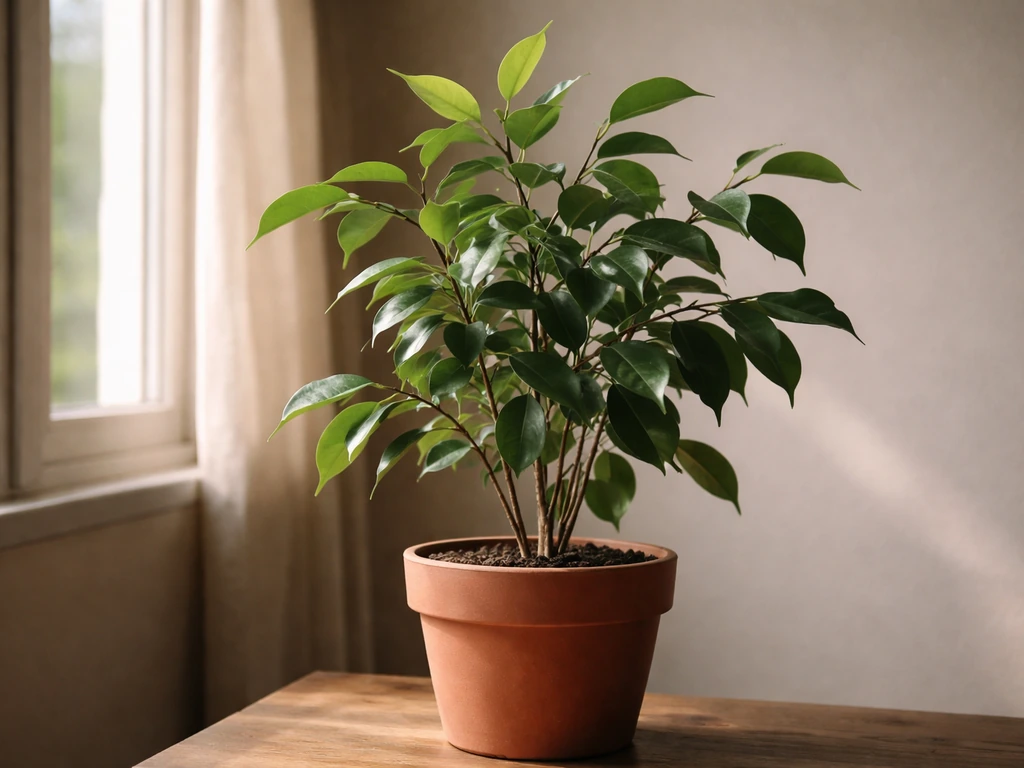
Which ficus types actually tolerate low light
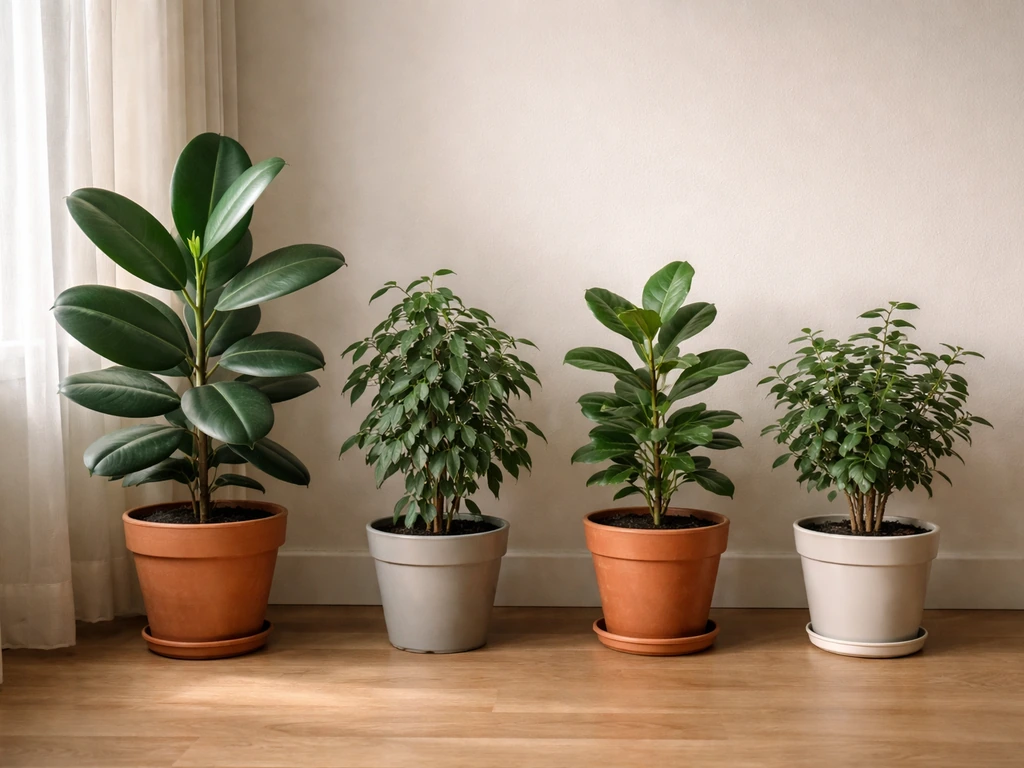
Not all ficus are created equal when it comes to light tolerance, and knowing which species you have matters a lot before you decide where to put it.
Ficus elastica (rubber plant) is your best bet in a lower-light situation. It has large, waxy leaves with plenty of surface area for photosynthesis, and it's generally more forgiving than its cousins. It can hold steady in indirect light that would cause other ficus to collapse. The dark green varieties handle shade better than the variegated or burgundy-tinged cultivars, which need more light to maintain their color.
Ficus benjamina (weeping fig) is more demanding. University of Arkansas Extension research confirms it can tolerate light levels down to about 40 foot-candles, but at that threshold it will drop a significant number of leaves and push new growth mainly toward the branch tips, leaving the interior sparse. It's not dead, but it's not happy either. If you have a weeping fig and a genuinely dim space, plan on supplementing with a grow light.
Other popular indoor ficus like Ficus lyrata (fiddle leaf fig) are even more demanding. Fiddle leaf figs really want bright indirect to some direct sun and tend to struggle in low light much faster than rubber plants do. If you're working with a truly dim space, the rubber plant is your most practical choice in this genus.
What low light actually means in your home
The phrase "low light" gets thrown around a lot, and it means something pretty specific when you translate it to real measurements. University of Florida IFAS notes that the terms “low light” and “bright indirect” can be vague, and it provides foot-candle ranges for different light categories including low to bright/direct blank" rel="noopener noreferrer">Light for Houseplants. Most indoor gardening research puts low light at roughly 25 to 250 foot-candles (fc), depending on the source. Penn State Extension uses 100 fc as a practical baseline for low-light houseplants. University of Maryland Extension defines low light as 25 to 100 fc, while Missouri Extension stretches the "tolerable" low-light range to 50 to 250 fc. Mississippi State University Extension describes typical indoor light categories as low = 50, 500 foot-candles, medium = 500, 1,000 foot-candles, and high = 1,000+ foot-candles blank" rel="noopener noreferrer">low = 50–500 foot-candles, medium = 500–1,000 foot-candles, and high = 1,000+ foot-candles. For reference, one foot-candle equals about 10.76 lux, so 100 fc is roughly 1,076 lux.
In real home terms, these numbers translate like this: a north-facing window delivers roughly 25 to 100 fc. A spot 8 to 10 feet away from any window is usually in that same range. An east or west-facing window bumps you into the medium range of 100 to 500 fc. South-facing windows with direct sun can push past 1,000 fc. For ficus, you want to target at least 100 to 200 fc on average. Below 50 fc, even low-light-tolerant plants start to struggle, and ficus will show it quickly.
If you want to stop guessing, a cheap lux meter or the free PPFD/lux app on your phone will give you an actual reading in seconds. Take readings at different times of day, because light in your space changes dramatically from morning to afternoon. A spot that hits 200 fc in morning sun might drop to 40 fc by evening.
Low-light stress vs normal ficus behavior
Ficus are dramatic plants by nature. They drop leaves when you move them, when there's a draft, when you look at them wrong. So before you panic about low light, it helps to know what's a normal quirk versus a real distress signal.
Normal ficus behavior
- Leaf drop when first moved to a new location (this can last a few weeks and is not a light issue)
- Slower growth in winter even in good light (natural dormancy response)
- Slightly smaller new leaves compared to older ones
Signs the light is genuinely too low
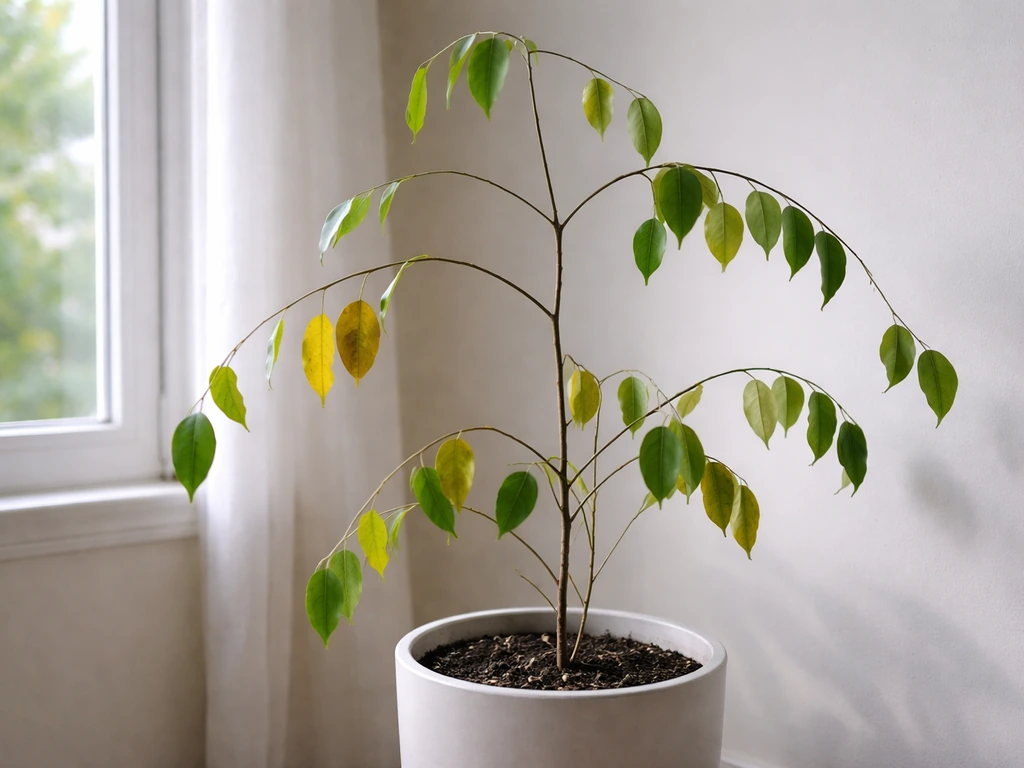
- Leggy, stretched growth with long bare stems reaching toward the nearest light source
- New leaves coming in noticeably smaller than existing leaves
- Yellowing leaves, starting with older interior leaves and working outward
- Prolonged, ongoing leaf drop that doesn't slow after the first few weeks
- Color loss in variegated or dark-leaf varieties (rubber plants losing their deep burgundy or cream markings)
- Drooping leaves combined with dry, slow-drying soil (the plant is barely transpiring because it can't photosynthesize efficiently)
- Sparse, tufted growth where new leaves only appear at branch tips (classic weeping fig low-light pattern)
Clemson HGIC also notes that Ficus benjamina leaf drop can result from overwatering, drafts, or nitrogen deficiency, so if you're seeing yellowing and drop, rule those out before blaming light alone. Low light often compounds watering mistakes because the soil dries so much slower.
Practical steps to help your ficus thrive in low light
Placement and rotation
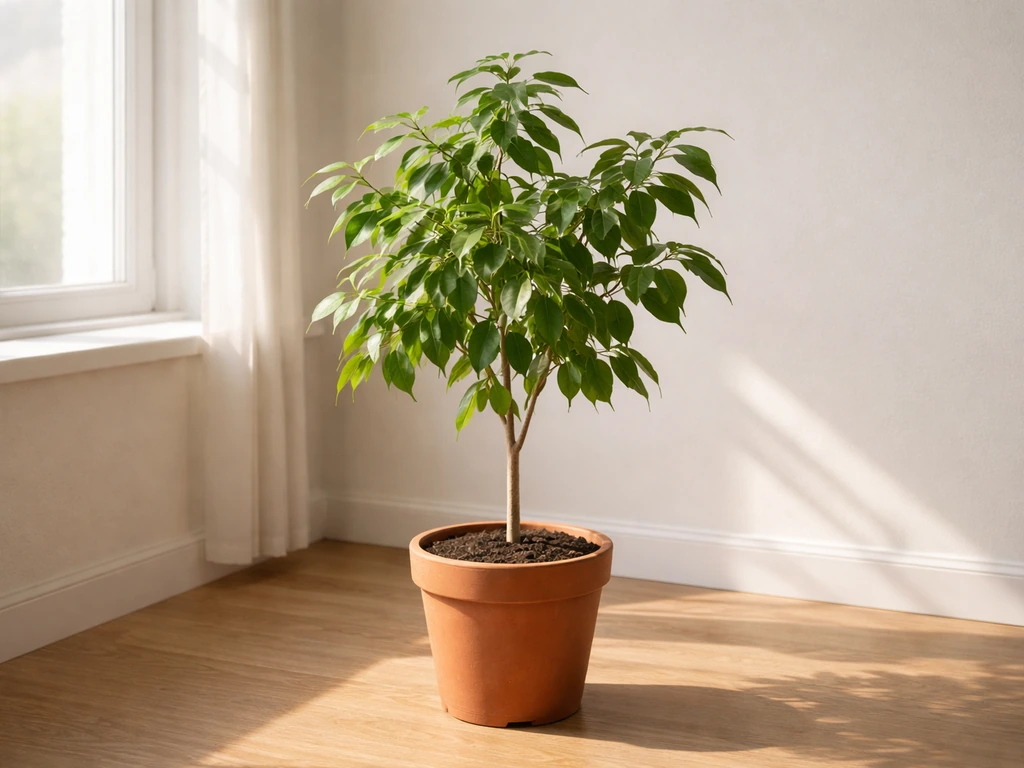
Put your ficus as close to your brightest available window as possible. Even if that window is north-facing, being 2 feet from it is far better than being 8 feet away. Light intensity drops off fast with distance, so every foot closer to the glass makes a real difference. Avoid corners and interior walls, which are typically the darkest spots in any room.
Rotate the pot a quarter turn every week or two. Ficus will lean hard toward the light source, and rotating keeps growth more even and ensures all sides of the canopy get some exposure. It also prevents the plant from developing a lopsided root structure over time.
Adjusting watering for low light
This is the one most people get wrong. In low light, your ficus uses water much more slowly because photosynthesis is running at a reduced rate. The soil will take significantly longer to dry out than it would in a bright spot. If you keep watering on the same schedule you used in a sunnier location, you will almost certainly overwater, which leads to root rot and accelerates leaf drop. Always check the soil before watering: stick your finger 2 inches in, and only water when that depth is dry. In a genuinely dim space, you may be watering less than half as often as you would near a bright window.
Other care adjustments
- Hold off on fertilizing while light is very low. The plant isn't growing actively enough to use nutrients, and excess fertilizer salts will build up and stress the roots.
- Keep the leaves clean. Dust on large ficus leaves (especially rubber plant) physically blocks light absorption. Wipe them gently with a damp cloth every few weeks.
- Avoid cold drafts from windows, AC vents, or exterior doors. Weeping figs in particular will drop leaves in response to temperature swings even if light is adequate.
- Skip repotting until light improves. A stressed plant in low light doesn't need the added shock of a new pot.
Using grow lights to fix a low-light ficus situation
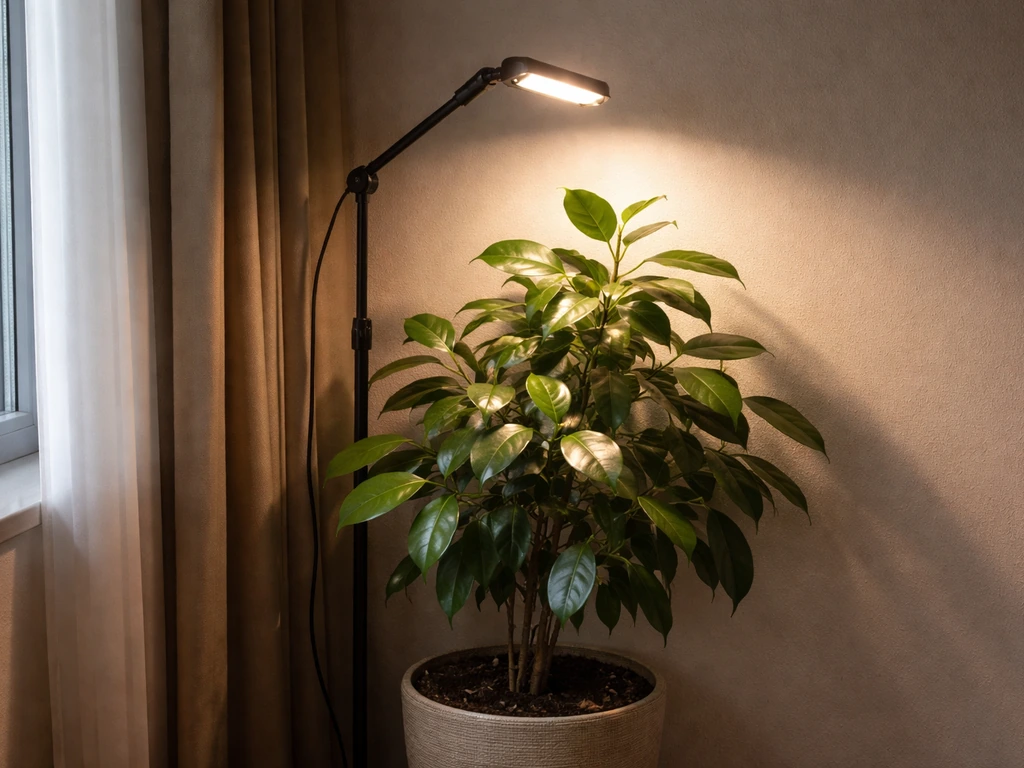
If your space genuinely can't deliver enough natural light, a grow light is the most reliable fix. The good news is you don't need anything expensive or complicated for a ficus. You just need the right spectrum, the right distance, and a consistent schedule.
LED vs fluorescent
| Feature | LED Grow Lights | Fluorescent (T5/T8) |
|---|---|---|
| Energy efficiency | High: uses 40–60% less power for equivalent output | Moderate: more heat generated per watt |
| Spectrum | Full spectrum options widely available; look for 3000K–6500K or broad-spectrum "grow" chips | Good spectrum from full-spectrum T5 bulbs; standard cool white works reasonably well |
| Heat output | Low, can be placed closer to plants | Moderate, keep 12–18 inches away to avoid heat stress |
| Lifespan | 50,000+ hours typical | 10,000–20,000 hours typical |
| Cost | Higher upfront, lower long-term running cost | Lower upfront cost, higher running cost over time |
| Best for ficus | Best choice overall, especially for larger rubber plants | Fine for smaller plants or compact setups |
For most people with a ficus in a low-light apartment or office, a full-spectrum LED panel or a clip-on LED grow bulb in a standard lamp socket is plenty. You don't need a dedicated grow tent or anything elaborate. Look for a light rated at least 1,000 to 2,000 lux at the distance you'll be placing it, and prioritize full-spectrum options over "blurple" (red-blue only) lights, which work but don't look pleasant in a living space and aren't meaningfully better for foliage plants like ficus.
Distance and timing
For LED grow lights, a good starting distance is 12 to 24 inches above the top of the plant's canopy. Closer than 12 inches with a high-output LED can bleach or burn leaves. For fluorescent T5 or T8 fixtures, stay 12 to 18 inches away. Adjust based on how the plant responds over 2 to 3 weeks: if new growth looks pale or bleached, move the light farther; if the plant is still stretching toward it, bring it closer.
Run your grow light for 10 to 14 hours per day, which is the standard range most houseplants do well with. University of Maryland Extension recommends no more than 16 hours of total light per day (natural plus artificial combined), because plants need a dark period. A simple outlet timer takes all the guesswork out of this and ensures consistency, which matters more than any single day's duration.
How long recovery takes and when to rethink your setup
If you improve light conditions for a stressed ficus, either by moving it closer to a window or adding a grow light, don't expect overnight results. Plants respond on a plant timeline. Here's roughly what to expect:
- Weeks 1 to 2: Leaf drop may slow or stop. The plant is stabilizing, not recovering yet.
- Weeks 3 to 6: New growth should begin to appear. This is your first real confirmation the change is working.
- Months 2 to 4: The plant fills out, new leaves reach normal size, and color improves in variegated types.
- 6+ months: Significant recovery in a heavily stressed plant, with fuller branching and restored density.
If you've improved light meaningfully (measured with a meter, not estimated) and you're still seeing ongoing leaf drop, yellowing, and no new growth after 6 to 8 weeks, there's likely another issue at play: root rot from previous overwatering, a pest problem (spider mites love stressed ficus), or the space is simply too dark even with your light source. At that point, move the plant to a genuinely brighter spot, even if it's less convenient, and treat for pests proactively.
It's also worth knowing that some spaces are just not suitable for ficus long term, especially weeping figs. If your brightest spot is still under 50 fc and you can't realistically supplement with a grow light, you'd honestly be better served by a pothos, a ZZ plant, or a cast iron plant, which are genuinely designed for very low light. Fittonia can handle dimmer conditions better than many ficus, so it may be a smarter choice if your space struggles to reach 100 to 200 fc. Dieffenbachia and fittonia are also worth considering for dim rooms where ficus struggles. Dieffenbachia is one of those plants that can often handle dimmer conditions than ficus, so it’s a good option to consider for low light.
Mistakes that make low-light ficus problems worse
- Watering on a fixed schedule instead of checking soil moisture. In low light, ficus soil stays wet for weeks. Overwatering is the fastest way to kill a struggling plant.
- Placing the grow light too far away. A clip-on bulb 4 feet above the plant barely adds anything useful. Distance matters enormously with grow lights.
- Using a light that runs for only 4 to 6 hours. Short light cycles don't give the plant enough photosynthesis time. Aim for 10 to 14 consistent hours.
- Expecting the plant to acclimate instantly. Moving a ficus from low to high light (or the reverse) without a gradual transition causes shock and leaf drop. Increase light slowly over 2 to 3 weeks.
- Fertilizing a stressed plant. Adding fertilizer when a plant can't photosynthesize properly doesn't help. It builds up salt in the soil and adds root stress.
- Ignoring drafts and temperature. A ficus near a cold north window in winter is dealing with low light AND cold air stress at the same time. That combination is very hard to recover from.
- Choosing the wrong ficus for the space. If you love the look of a weeping fig but have a dim apartment, get a rubber plant instead. It looks great, handles lower light, and is much more forgiving.
FAQ
If I put my ficus in a brighter spot, will it stop dropping leaves right away?
Yes, but the timeline is longer than most people expect. If you have the light levels you need (ideally measured around 100 to 200 fc for ficus) you may still see leaf drop for several weeks because ficus can shed older leaves during the adjustment. New growth is the real indicator, look for firmer leaf stems and steady bud development rather than immediate changes to existing leaves.
Can ficus thrive in a north-facing window without a grow light?
A north window can work for rubber plants, but for weeping figs it often ends up too close to the survival range unless you use supplemental lighting. Measure at canopy height at different times, because north light can be consistently low, and “bright indirect” labeling in listings often overstates what the plant actually receives.
Do variegated ficus need more light than plain green ficus?
Variegated rubber plant cultivars usually need more light than plain green types to keep their pattern. If color fades or leaves look greener and smaller over time, it usually means light is too low, not that the soil is “weak.” In low light, prioritize green varieties first or be prepared to add a grow light consistently.
Where should I measure light for my ficus, and when should I measure it?
Use the meter or app readings at the plant’s canopy height, not at desk height. Light can change dramatically over a few feet, so “this corner looks bright” is not reliable. Also check multiple times of day, because evening indoor lighting can differ from morning natural light.
Will leaving a grow light on intermittently or only during evenings work for low-light ficus?
Avoid relying on bathroom lighting or short periods under strong lamps as a substitute. Grow lights are most effective when the plant gets a stable daily photoperiod (often 10 to 14 hours for most homes), and you should prevent long dark gaps in the middle of the day that mimic low-light stress.
What’s the most common mistake people make when moving ficus to low light?
Yes, and it can make things worse. In low light, the plant needs a smaller watering dose and less frequent watering because evaporation and drying slow down. A good rule is to only water after the top couple inches are dry, and in very dim rooms you may water less than half as often as you would for the same plant in brighter light.
Should I rotate my ficus in low light, and does it help enough to matter?
It depends on the direction the light comes from. If you rotate regularly, you reduce lopsided growth, but you still need enough total light. If the space is truly under 50 fc and you are not supplementing, rotation cannot fix the core issue, it just improves symmetry while the plant still struggles.
How can I tell the difference between low-light stress and other causes of leaf drop?
Often, yes. If light is marginal, ficus may show pale new leaves, leggy stretching, or reduced leaf size before it starts dropping older leaves. Leaf drop can also be caused by drafts, overwatering, and nutrient issues, so treat symptoms like a checklist: check soil moisture first, then look for cold air or ventilation blasts.
Can I trust a phone lux meter reading for deciding if my ficus has enough light?
A lux meter reading is useful, but phone apps can be inaccurate depending on the sensor and lighting spectrum. If you can, confirm with a second reading source or use consistent measurements from the same device and location. What matters most is whether you are consistently hitting your target range, not the exact number to the decimal.
How do I know if my grow light is too close or too far for a ficus?
Start with the distance guidance, then adjust based on the plant’s response. If you see bleaching or crisping at the leaf edges, move the light farther. If the plant is stretching or staying dull with weak new growth, move it closer, and reassess over 2 to 3 weeks rather than after a single day.
Can I keep a ficus alive in very low light if I water less and add a grow light occasionally?
Sometimes, but it is usually a temporary rescue, not a long-term solution. If you must use low light, pair it with a consistent grow-light schedule and a watering plan that matches slower drying. If even the grow light cannot bring your canopy into the workable range, switching to a low-light plant is more successful than trying to force ficus.