Several scientists across different centuries pieced together the story of why plants need light. Jan Ingenhousz is the most important name here: in 1779, he showed that plants only produce oxygen when exposed to light, and that this happens in the green parts. Before him, Joseph Priestley had demonstrated that plants could "restore" air that animals had depleted, but Ingenhousz figured out that light was the essential trigger.
Which Scientists Showed Plants Need Light to Grow
Marcus Hartley
15 May 2026
Later, Julius von Sachs in the 1860s linked light directly to the production of starch inside leaves, cementing the connection between light and the carbon-building work plants do. That chain of discoveries is the foundation of what we now call photosynthesis, and it explains exactly why your pothos struggles in a dark corner.
The key historical experiments, explained simply
These weren't abstract lab exercises. Each experiment isolated light as the specific variable that drove plant growth and function, which is exactly the kind of thinking you need when you're troubleshooting a struggling houseplant today.
Joseph Priestley (1771): plants clean the air
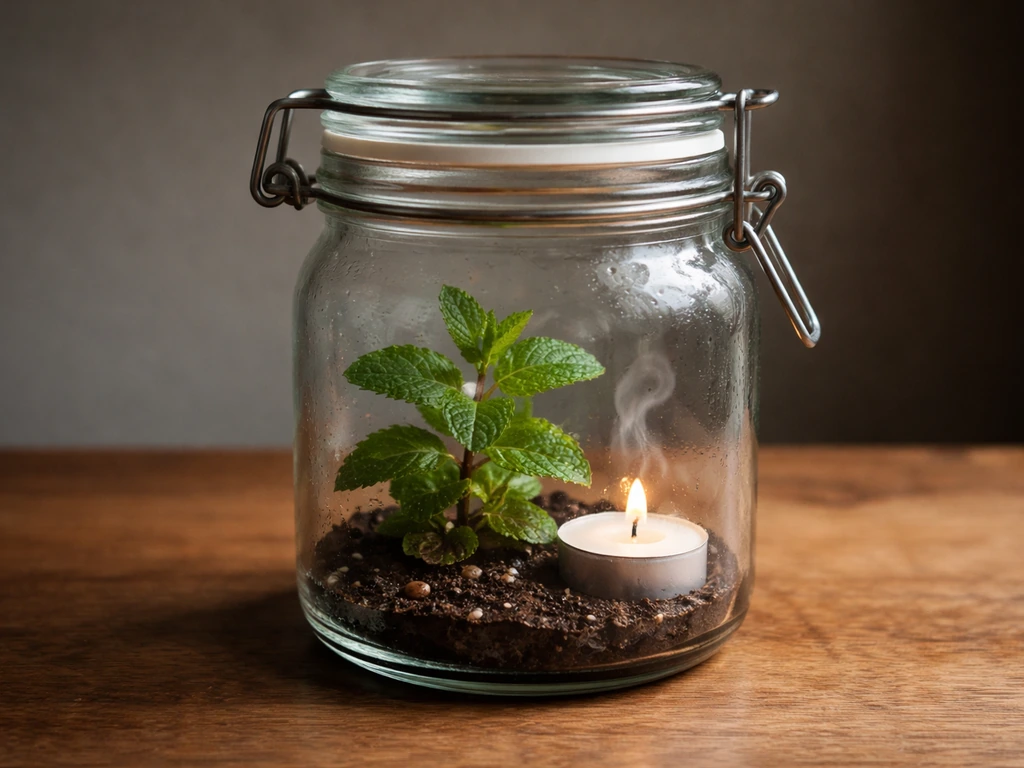
Priestley placed a mint plant inside a sealed jar with a candle. The candle eventually went out (used up the oxygen), but after some time with the plant in there, the air became breathable again. He didn't know about oxygen yet, he called it "restoring" the air. What he proved was that plants actively change their environment in a way animals cannot. It was a huge deal, but it left the big question open: what made the plant do it?
Jan Ingenhousz (1779): light is the trigger
Ingenhousz answered Priestley's question within a decade. He submerged aquatic plants in water and watched for oxygen bubbles. The bubbles only appeared when the plants were in light. He also noticed that only the green parts of the plant produced bubbles, not roots or brown stems. Cover the plant, stop the bubbles. Bring the light back, bubbles return. He ran this test repeatedly and the result was always the same: light was the on/off switch for the process. That's the experiment that most directly answers the question of which scientist showed plants need light to grow.
Julius von Sachs (1860s): light builds the carbohydrates
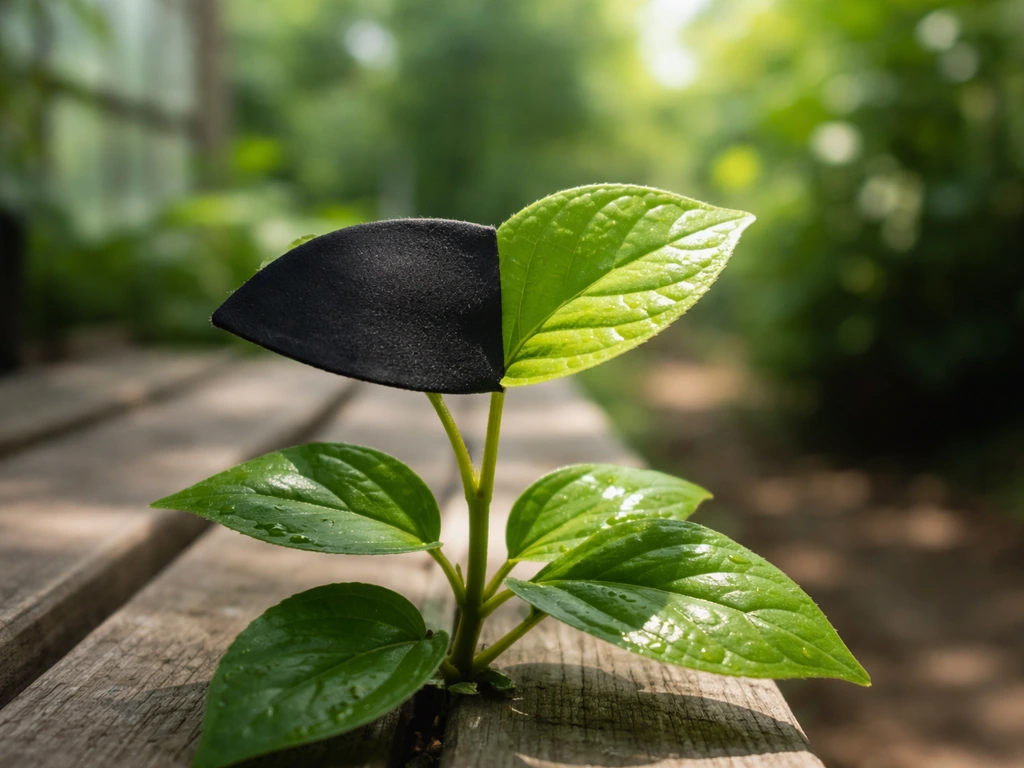
Sachs took things further by tracking what actually accumulates inside leaves when light hits them. He covered parts of leaves with opaque material, let the plant grow in light, then stained the leaf with iodine to reveal where starch had formed. Starch appeared only in the uncovered, light-exposed sections. This tied light directly to the physical output of photosynthesis: the sugars and starches that plants use to build every new cell. Without light, no starch. Without starch, no real growth.
20th-century scientists: phytochromes and the light-sensing system
The story didn't stop with photosynthesis. In the 1950s and 1960s, researchers at the USDA including Sterling Hendricks and Harry Borthwick discovered phytochromes, light-sensitive proteins inside plant cells that act almost like a switch toggled by red and far-red light. This was a breakthrough because it showed plants don't just use light for energy. They also use it as information.
Phytochromes regulate when seeds germinate, when seedlings open their leaves, and when plants flower. Later work identified additional photoreceptors: cryptochromes and phototropins that respond to blue light, and UV-B receptors. Each of these tells the plant something different about the light environment around it. [Major photoreceptor families](https://www.
frontiersin. org/articles/10. 3389/fpls. 2016.
00480/full) include red and far-red phytochromes, blue and UV-A cryptochromes, phototropins, and UV-B receptors that regulate light-dependent growth and photomorphogenesis. That question gets at how plants use different wavelengths as both energy and information would a plant grow well in only green light.
The scientists and what each one proved
| Scientist | Era | What the experiment showed |
|---|---|---|
| Joseph Priestley | 1771 | Plants restore air depleted by animals and candles, suggesting they produce something animals need |
| Jan Ingenhousz | 1779 | Light is the specific trigger for oxygen production in green plant parts; no light, no output |
| Julius von Sachs | 1860s | Light exposure in leaves produces starch; covered sections produce none, linking light to carbon-building |
| Sterling Hendricks & Harry Borthwick | 1950s–60s | Discovered phytochromes: plant proteins that sense red/far-red light to regulate germination, development, and flowering |
| Later photobiologists (20th–21st c.) | Ongoing | Identified cryptochromes and phototropins (blue-light sensors) that control leaf orientation and additional growth responses |
What "plants need light" actually means inside the plant
There are really two separate reasons plants need light, and conflating them causes a lot of confusion for indoor gardeners. A related idea, sometimes called the white light hypothesis, proposes that plants can also respond to the overall light quality, not just the presence of light. The first is energy. Photosynthesis uses light to drive electron transport in chloroplasts, producing ATP and NADPH.
For example, pure yellow light is unlikely to drive photosynthesis as effectively as the broader red and blue wavelengths plants are adapted to use. Those molecules power carbon fixation, which is the process of pulling CO2 out of the air and converting it into sugars and starches. That's the fuel for every new leaf, root, and stem. No light means no fuel, and eventually the plant burns through its reserves and stops growing.
The second reason is information. Through phytochromes and other photoreceptors, plants read the light around them to decide what to do developmentally. Red and far-red light ratios tell a plant whether it's under a forest canopy or in open sun. Blue light from cryptochromes and phototropins tells it where the light source is and regulates stomata opening. These signals shape how the plant grows, not just whether it grows. That's why the color and spectrum of your grow light matters, and why questions about what color light plants grow best in are genuinely worth digging into.
What happens when plants don't get enough light
The technical term is etiolation, and once you know what it looks like, you'll spot it everywhere. A plant growing in too little light stretches toward any available source, producing long, pale, spindly stems with wide gaps between leaves. The color washes out because chloroplasts don't fully develop without light. They form etioplasts instead, which are essentially underdeveloped chloroplasts waiting for a light signal to mature. The whole growth pattern shifts into a "find the light" emergency mode rather than the normal compact, vigorous development you want. Different colors and spectra of light can also change how plants grow by shifting which light-sensing signals they receive.
Practically, insufficient light shows up as: leaves that are lighter green or yellowish, new growth that looks weak and leggy compared to older growth, soil that stays wet much longer than normal (because the plant isn't actively transpiring much), and a plant that just sits there and doesn't seem to do anything for months. University of Maine Extension identifies insufficient light as the main reason most houseplants grow poorly, develop light-colored foliage, and produce spindly new stems. If you see those signs, the light is the first thing to fix, before fertilizer, before watering adjustments.
How to actually measure the light your plants are getting
Lux meters and phone apps that measure lux are better than nothing, but for plants you really want PPFD (photosynthetic photon flux density), which counts only the photons in the 400 to 700 nm range that plants actually use for photosynthesis. Iowa State University Extension makes a clear point about this: lux measures light as human eyes perceive it, not as plant chlorophyll processes it, so a lux reading can be misleading. A warm-white bulb might score high in lux but deliver relatively little useful PAR light.
The most useful metric for daily plant light needs is DLI (daily light integral), which is the total amount of photosynthetically useful light a plant receives over a full day. Virginia Tech Extension defines it as a time-integrated metric based on PPFD measured in micromoles per square meter per second, accumulated over the day. A low-light houseplant like a pothos might be happy at a DLI of 4 to 6, while herbs and vegetables want 20 to 30 or more.
Practical tools for measuring light at home
- PAR meter: the gold standard. Measures PPFD directly in the wavelengths plants use. More expensive but accurate.
- Smartphone apps like Photone: use the phone's camera sensor to estimate PPFD, DLI, lux, and color temperature. Not lab-accurate but genuinely useful for comparing spots in your home.
- Simple shadow test: hold your hand about a foot above a white paper in the spot where you plan to put your plant. Sharp, clear shadow means decent light. Fuzzy, faint shadow means low light.
- Window orientation: south-facing windows (in the northern hemisphere) get the most total daily light. East gets gentle morning sun. West gets afternoon sun. North gets almost no direct light.
Choosing the right light source for indoor plants
You have three real options for indoor plant lighting: window light, fluorescent bulbs, and LED grow lights. Each has a practical place depending on what you're growing and what your space looks like.
| Light Source | Best For | Practical Notes | Rough Cost |
|---|---|---|---|
| South/east window | Low-to-medium light houseplants, succulents near glass | Free, full spectrum, but highly seasonal and position-dependent | Free |
| Fluorescent (T5/T8) | Seed starting, herbs, leafy greens, budget setups | Good blue spectrum for vegetative growth, runs cool, widely available | Low upfront |
| LED grow lights (full spectrum) | All plant types, tight spaces, year-round growing | Most efficient long-term, best spectrum control, minimal heat | Medium to high upfront, low running cost |
For most indoor gardeners, a full-spectrum LED grow light is the best investment if you're serious about growing plants in rooms without strong natural light. Oklahoma State University Extension notes that red light promotes growth and flowering while blue light drives compact vegetative growth, and modern full-spectrum LEDs cover both. For power, OSU Extension gives a practical rule of thumb: around 25 watts per square foot for high-light plants and around 16 watts per square foot for low-light plants. Those numbers assume efficient LED fixtures, not old incandescent bulbs.
Fluorescent T5 fixtures are still a solid budget option, especially for seed starting and herbs. They run cool enough to place within a few inches of seedlings and provide a decent blue-spectrum output. They're not as efficient as LEDs over time, but the upfront cost is lower and they're easy to find. Plain window light works beautifully for low-light plants like pothos, ZZ plants, snake plants, and peace lilies, especially near south or east-facing windows. But if you're trying to grow herbs, vegetables, or flowering plants in a north-facing apartment, no amount of wishful thinking will replace a proper grow light.
Getting light placement, timing, and distance right
Even a great grow light won't help if it's placed wrong or run on the wrong schedule. Here's what actually matters in practice.
Distance
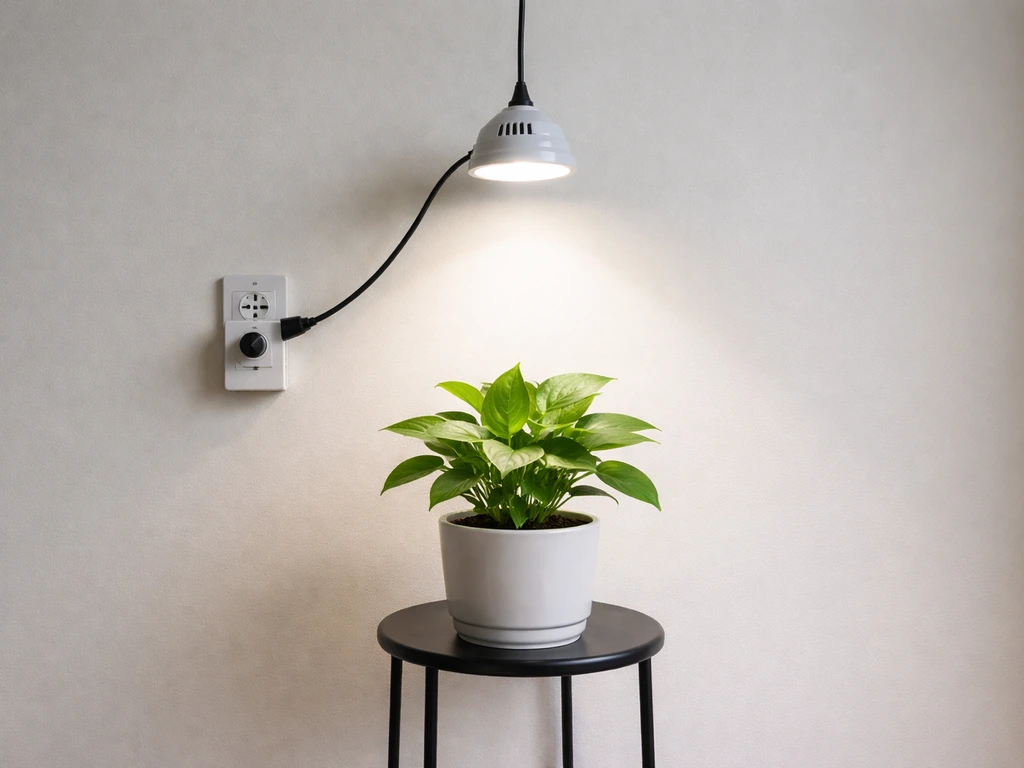
PPFD drops off fast as you move a light source farther from the plant. Most LED grow lights for houseplants work well at 12 to 24 inches from the canopy, but check the manufacturer's PPFD chart if you have one. UMN Extension specifically recommends maintaining proper fixture distance to ensure healthy growth without light burn. For seedlings, you can usually go closer (6 to 12 inches) because young plants need intensity but aren't as vulnerable to heat from modern LEDs. For older HID-style lights (less common now), University of Maine Extension suggests keeping at least 3 feet of distance to avoid heat stress.
Timing and photoperiod
Plants need a dark period, not just light. Running grow lights 24 hours a day doesn't help most plants and can actually disrupt flowering cycles. For most foliage houseplants, 12 to 16 hours of light per day is plenty. Herbs and vegetables do well at 14 to 16 hours.
If you're trying to trigger flowering in specific plants, the red and far-red light ratio matters more than most people realize. Research on elongation responses in plants showed that about 4 hours of high-energy light in a cycle made a measurable difference in growth responses, which is why light duration isn't just about "more is better. " A timer is one of the most useful and inexpensive tools you can add to your grow setup.
Troubleshooting common light problems
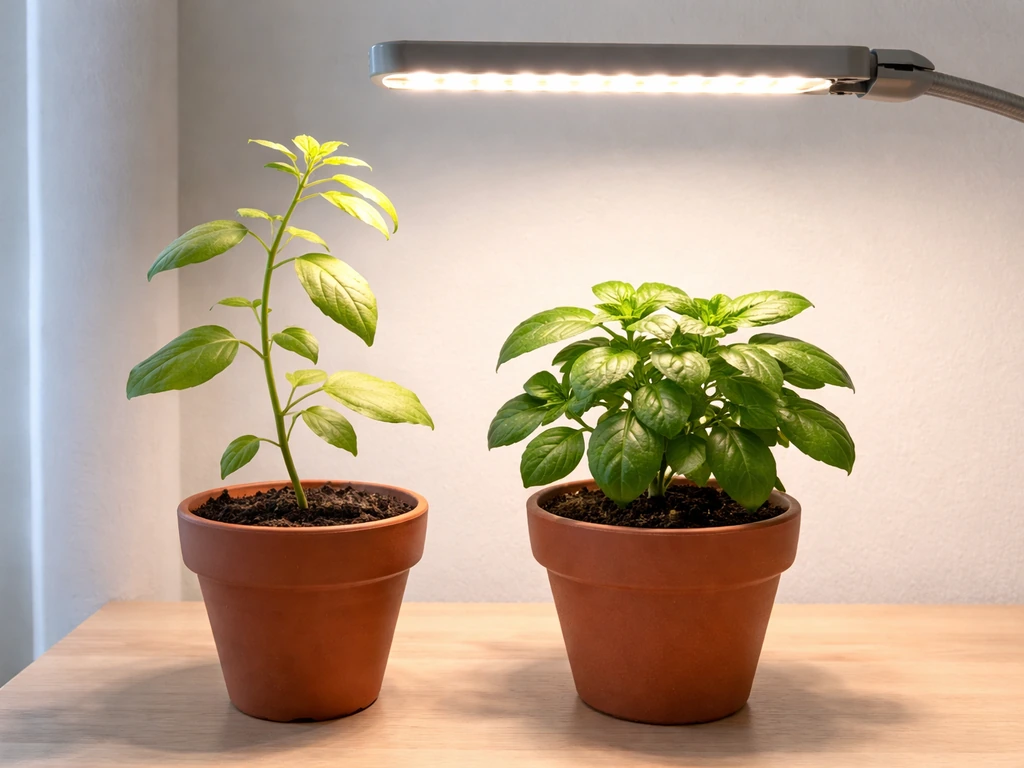
- Leggy, stretched growth with pale leaves: almost always too little light or light that's too far away. Move the light closer or add more lumens.
- Leaf curl or bleaching near the top of the plant: light is probably too close or too intense. Raise the fixture a few inches at a time.
- Plant leaning heavily toward one side: it's chasing the light source. Rotate the pot 90 degrees every week, or reposition the light above the plant.
- No new growth for months: check the DLI, not just whether the light is on. The plant may be getting hours of light but not enough intensity.
- Soil stays wet for weeks: low light reduces transpiration and water uptake. Reduce watering frequency and increase light before assuming a root problem.
The scientists who proved plants need light, from Ingenhousz watching bubbles in a bowl of water to Hendricks and Borthwick identifying the phytochrome switch, were essentially doing what every indoor gardener does when they move a plant from a dark shelf to a bright window and watch it come back to life. The biology they discovered is exactly what you're working with every time you adjust a grow light or pick a spot for a new plant. Understanding the history makes the practical side make more sense, and it's a reminder that even small adjustments to light, distance, duration, and spectrum can make a real difference.
FAQ
Which experiment most directly proves that light is the on/off trigger for photosynthesis in plants?
Ingenhousz’s setup with submerged aquatic plants. He found oxygen bubbles appeared only when the plants were in light, and they showed up in green tissue rather than roots or non-green stems.
How can I tell whether my plant’s problem is “not enough light” versus “too much fertilizer” or “watering issues”?
Look for growth pattern clues first. Low light typically causes pale or yellow-green new leaves, weak leggy growth with wide gaps, slow overall progress for weeks, and soil that stays wet longer because transpiration slows. If those show up together, adjust light before changing fertilizer.
If my grow light is bright to my eyes (high lux), will it still be inadequate for plant growth?
It can be. Lux is based on human vision, not the usable 400 to 700 nm photons plants need. A lamp can score well on lux while delivering relatively low PPFD, so you may need PPFD or DLI-based assessment instead of relying on brightness alone.
What’s a practical way to estimate whether a plant is getting enough daily light without buying expensive meters?
Use schedule and distance as your main levers, then aim for a realistic daily exposure. Start by setting a timer for 12 to 16 hours for foliage houseplants, keep the light at the manufacturer’s recommended distance range, and adjust based on how quickly growth responds over 2 to 4 weeks (etiolation usually shows faster).
Why do plants sometimes stretch even when there’s some light in the room?
They can still stretch when intensity is too low at the canopy. Partial light often triggers the “reach for light” response, producing long pale stems and immature chloroplast development (etiolation) even if the plant is not totally dark.
Is it safe to run grow lights 24 hours a day if I want faster growth?
Usually no. Most plants need a dark period for normal development. Continuous lighting can disrupt flowering or development signals, so it’s better to use 12 to 16 hours for many foliage plants, then adjust by crop if you are growing flowering species or vegetables.
Do plants need only red and blue light, or does “full spectrum” matter?
Full spectrum is helpful because different photoreceptors respond to different wavelengths, and those signals affect both energy capture and development. While red and blue drive major growth responses, missing wavelengths can change form and behavior, so a balanced full-spectrum LED generally reduces trial and error.
How close should I place a grow light to avoid burning plants?
For most LED grow lights used indoors, 12 to 24 inches is a common starting range, but the safest approach is to follow the fixture’s PPFD chart or distance guidance. Seedlings can often be placed closer because they need intensity, yet they are not as tolerant to heat issues, so monitor for stress and adjust gradually.
How do I use photoperiod changes to manage flowering, and what should I watch for?
For flowering control, it’s not just “more hours.” Many plants depend on light quality and timing, especially red and far-red ratios and the day length cycle. If your plant is leggy and not flowering, you may need both more appropriate spectrum and a defined dark period rather than simply increasing daily light.
What DLI should I aim for if I’m growing a low-light houseplant versus herbs or vegetables?
Low-light foliage plants like pothos are often comfortable around 4 to 6 DLI, while herbs and many vegetables typically need far more, commonly 20 to 30 or more. If you are not measuring, raise light intensity gradually and increase exposure time within the recommended daily ranges, then watch for leaf color and compactness changes.