
Yucca can survive in low light, but it won't really grow there. If your room sits below about 150 foot-candles of brightness, a spineless yucca (Yucca elephantipes) will go into a kind of holding pattern: no new leaves, slow decline, and eventually drooping, yellowing foliage that a lot of people mistake for other problems. It's a tough, forgiving plant, but it's a desert native at heart, and light is the one thing you can't fake for long without a plan.
Can Yucca Grow in Low Light Indoors? What to Expect
Marcus Hartley
28 May 2026
What 'low light' actually means for indoor plants
The phrase 'low light' gets thrown around loosely, but it has a real, measurable meaning. Light indoors is measured in foot-candles (fc), and most extension resources draw the low-light line at under 75 foot-candles. That's the kind of dimness you'd find in the middle of a room, well away from any window, or right next to a north-facing window in winter. It feels perfectly bright to your eyes because human vision adjusts automatically, but plants can't adjust, and photosynthesis stalls when light drops that far.
To put it in concrete terms: a north-facing window gives you somewhere around 50 to 100 fc a few feet back. An east-facing window gives you decent morning light, typically in the 100 to 500 fc range at 3 to 5 feet away. A south-facing window in direct sun can reach thousands of foot-candles, but even 15 to 20 feet back from that south window, you're still getting workable medium-to-bright indirect light. Distance destroys light intensity fast, which is why where you place your plant within a room matters enormously.
The plants you typically see recommended for 'low light' spaces, things like pothos, snake plants, or calathea, are adapted to forest floors or dense canopy understories. Yucca is not. It evolved in full sun and open landscapes. That context matters when you're deciding where to put it.
Yucca indoors: surviving dim rooms vs actually growing
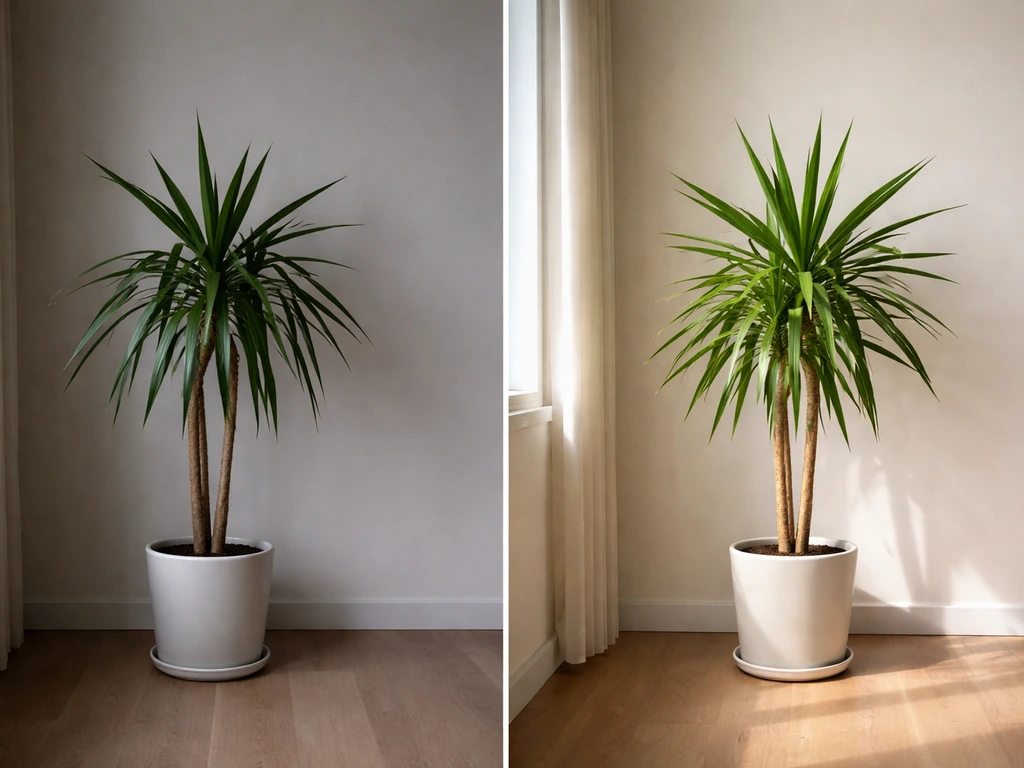
UF/IFAS yucca production guidelines are pretty direct: indoors, yucca needs at least 150 foot-candles to maintain its health and appearance. That's not a lot compared to what it prefers outdoors (where it thrives at thousands of fc), but it is meaningfully more than what most people call 'low light.' Below that 150 fc threshold, yucca shifts from growing into surviving, and eventually into declining.
Here's what that decline looks like in practice. First, growth slows to almost nothing. Then the new growth that does appear is etiolated: spindly, stretched toward any available light source, with pale green or washed-out leaves instead of the plant's normal deep green. Older leaves start drooping and eventually drop. The trunk can weaken over months if the light deficit persists. None of this happens overnight, which is part of the trap. Yucca is stoic enough to look fine for weeks or even a couple of months in a dark corner before the symptoms become obvious.
The honest answer, then, is this: yes, yucca will survive in low light for a while, but no, it won't grow in a meaningful way, and the clock is ticking. If you're okay treating it as a 'survive only' plant for a season and then moving it somewhere brighter, that's a workable approach. If you want it to actually put out new leaves and stay healthy long-term, you need either better window placement or a grow light setup.
How to check your light before you commit to a spot
The best thing you can do before placing your yucca is actually measure the light in the spot you have in mind, at the height where the leaves will sit. Not on the floor, not on the windowsill. At canopy height, where the plant will actually be doing its photosynthesis.
Phone light-meter apps are tempting because they're free and instant, but they have a real accuracy problem, especially with LED grow lights or any non-standard spectrum. Testing has shown that many lux meter apps produce readings that don't reliably translate to plant-relevant light levels. They can still give you a rough relative comparison between spots in your home, which is useful. Just don't take the numbers as gospel, especially if you're trying to evaluate grow light output.
A dedicated PAR meter or quantum light meter is far more accurate and measures PPFD (micromoles of light per square meter per second), which is the unit actually relevant to photosynthesis. They're an investment, but if you're serious about growing plants in tough spaces, they pay off fast. For most home gardeners, though, the practical approach is to use the window-distance rules as a starting guide and then watch the plant's behavior over 4 to 6 weeks.
A simple shadow test gives you a quick sanity check: hold your hand about a foot above a white piece of paper in your chosen spot on a bright day around noon. A sharp, clear shadow means bright light. A soft but visible shadow means medium light. No discernible shadow at all means you're in genuine low light, and yucca will struggle there.
Best placement near windows to maximize what you have
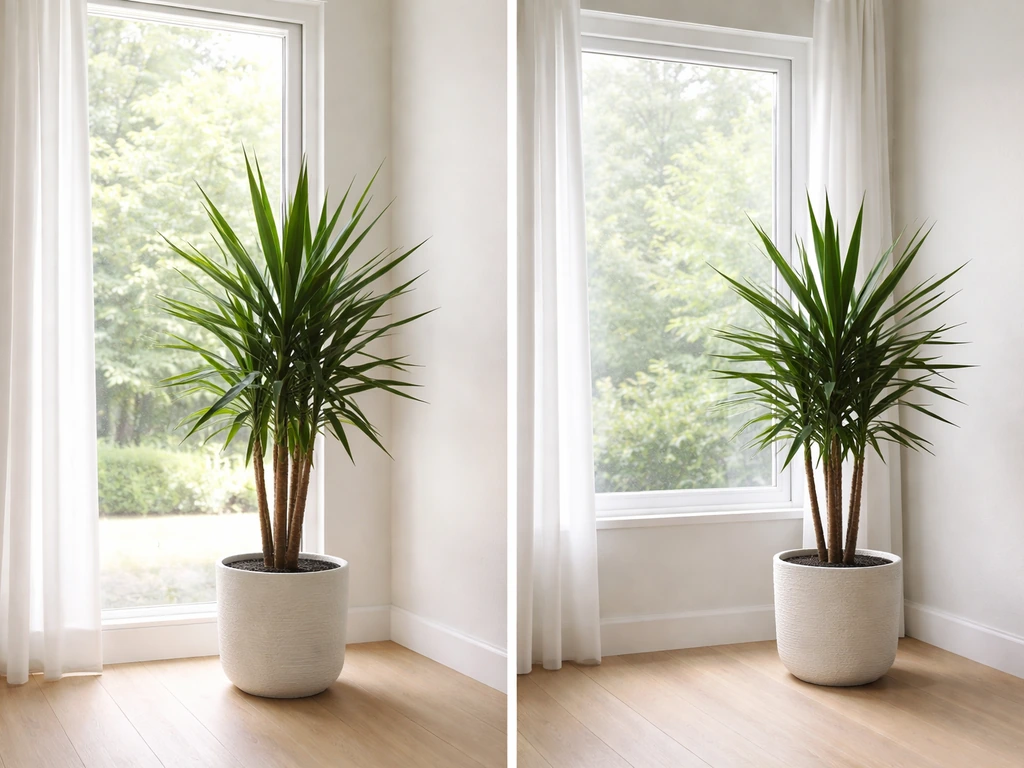
For yucca indoors, window choice and distance are everything. Here's how to think about it by window type, using real-world placement guidelines:
| Window Type | Best Distance from Window | Light Quality for Yucca | Verdict |
|---|---|---|---|
| South-facing | As close as possible (within 1–5 ft) | Bright direct/indirect, highest fc | Best option |
| West-facing | Within 3–5 ft | Strong afternoon direct light | Very good |
| East-facing | Within 3–5 ft | Gentle morning direct, medium indirect | Acceptable minimum |
| North-facing | As close as possible (1–2 ft) | Dim indirect only, often under 75 fc | Not enough; use grow light |
If you have a south or west window, place the yucca as close to it as your layout allows. Yucca can handle some direct sun through glass, especially in the morning or during winter months when sun angle is lower. If you're working with an east window, sit the plant right at the sill or within a couple of feet. That morning direct light, even for just 2 to 3 hours, makes a real difference. North-facing windows alone won't cut it for long-term yucca health without supplemental lighting.
One thing that's easy to overlook: sheer curtains, window tinting, exterior awnings, and nearby trees can cut the light reaching your plant by 30 to 70 percent even when the window looks bright to you. If any of those are in play, move the plant as close to the glass as possible or reconsider your lighting strategy.
Using grow lights to make up the difference
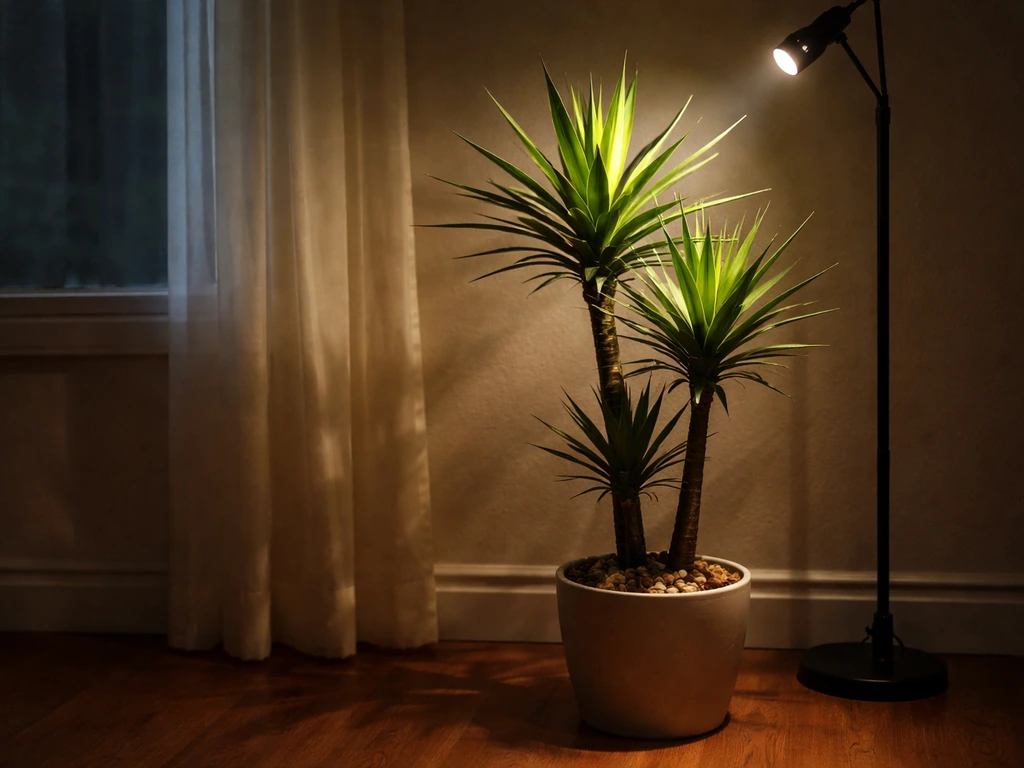
If you're dealing with a north-facing room, a basement apartment, or a windowless office, a grow light is really the only way to keep yucca genuinely healthy. The good news is that you don't need anything industrial.
LED vs fluorescent: which works for yucca?
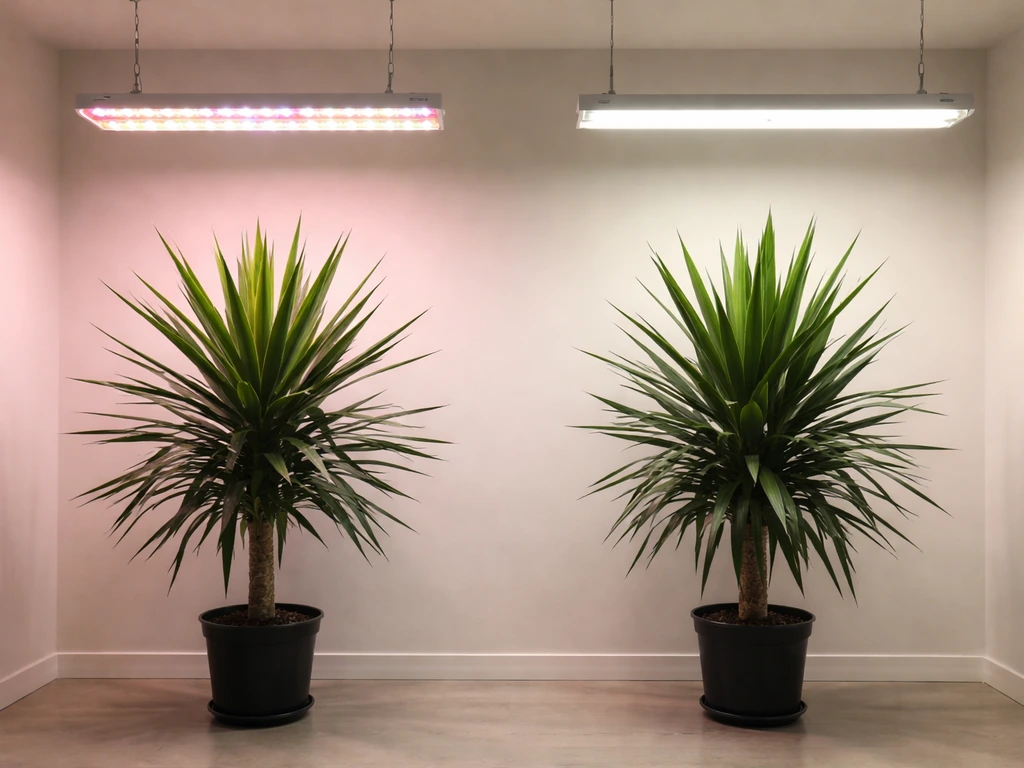
Modern full-spectrum LED grow lights are the clear choice for yucca. They're energy-efficient, run cool enough to place reasonably close to the plant, and produce the right spectrum of light for photosynthesis. Fluorescent tubes (T5 or T8 grow lights) can work, but yucca's relatively high light needs mean you'd need several tubes positioned quite close to the canopy, often within 6 to 12 inches, to deliver meaningful intensity. A horticulture supplemental-lighting reference notes that yucca has very high light needs under controlled environments, which is why fluorescent setups often require tubes close to the canopy to achieve meaningful intensity blank" rel="noopener noreferrer">yucca's relatively high light needs mean you'd need several tubes positioned quite close to the canopy. That's practical for low, sprawling plants but awkward for a tall yucca trunk. LEDs give you more flexibility in placement and intensity.
Distance, hours, and daily light targets
For a yucca in a low-light room, aim to position a quality LED panel so the canopy receives a PPFD of at least 100 to 200 micromoles per square meter per second during the light period. Most mid-range LED grow lights specify PPFD at different distances in their specs, so check those numbers. A rough starting point for many fixtures is 12 to 18 inches above the top leaves, but follow your specific light's guidelines because output varies a lot between products.
Run the grow light for 12 to 14 hours per day. This is enough to deliver a meaningful daily light integral (the total amount of light the plant accumulates over a full day) without pushing into territory that stresses the plant. Cap it at 16 hours maximum, which is the threshold multiple extension sources cite for keeping plants healthy. Plants need darkness to regulate their internal chemistry, and running lights around the clock actually backfires.
A simple plug-in timer is a worthwhile investment here. Set it and forget it. Inconsistent light schedules are harder on plants than steady moderate light.
Adjusting the schedule by season
In winter, when natural light is weakest and day length is shortest, run your grow light closer to 14 hours. In summer, if your plant gets any natural light at all, you can scale back supplemental hours to 8 to 10, letting the natural light carry more of the load. The goal is consistent total daily light, not necessarily consistent artificial light hours year-round.
Symptoms people blame on low light (and what's actually causing them)
This is where a lot of yucca owners go wrong. Several common problems look like light issues but are actually caused by water, temperature, or soil problems. Getting this diagnosis right matters because the fixes are completely different.
| Symptom | Likely Low-Light Cause | More Likely Other Cause | How to Tell the Difference |
|---|---|---|---|
| Pale, stretched new growth | Etiolation from insufficient light | Fertilizer deficiency (less common) | Etiolated growth leans toward light source and looks spindly, not just pale |
| Drooping leaves | Chronic low light over weeks/months | Overwatering or root rot | Soft, mushy base or yellowing with wet soil = root issue; firm base + dim room = light issue |
| Yellowing leaves (older) | Low light + poor energy production | Overwatering, root rot | Check soil moisture: soggy after 2+ weeks = water problem |
| Brown leaf tips | Sometimes low light, but rarely alone | Low humidity, drafts, fluoride in water | Crisp brown tips without other symptoms usually not a light issue |
| Leaf drop | Prolonged low light (months) | Cold drafts, sudden temperature change | Check proximity to AC vents, cold windows in winter |
| No new growth for months | Insufficient light for photosynthesis | Dormancy (normal in winter) | If happening in summer with dim conditions, light is the culprit |
The most common mistaken diagnosis is overwatering being called a light problem, or vice versa. Yucca in low light needs far less water than yucca in bright light because it's barely photosynthesizing and its soil stays wet longer. If you're watering on a fixed schedule regardless of conditions, low light dramatically increases your overwatering risk. Yellowing leaves with any soft, mushy tissue at the base of the trunk or at soil level are a root rot warning, not a light symptom. With root rot, cutting back water and improving drainage matters far more than moving the plant to a brighter spot.
Care adjustments to keep your yucca going
If your yucca is living in less-than-ideal light, adjusting your care routine is just as important as adjusting the light itself. Here's what to change:
- Water less frequently. In low light, yucca's metabolism slows and it uses water more slowly. Let the top 2 to 3 inches of soil dry out completely before watering again, and in winter, extend that to the top half of the pot. Err on the dry side rather than the wet side.
- Skip the fertilizer in dim conditions. Without enough light to drive growth, fertilizer just builds up as salt in the soil and can burn roots. Hold off until you've improved the light situation.
- Rotate the plant every 2 to 4 weeks. Even near a window, yucca will lean noticeably toward the light source. A quarter turn each rotation keeps growth even and prevents a lopsided plant.
- Watch for pests more carefully. Stressed, low-light plants are more vulnerable to spider mites and scale. Check the undersides of leaves every couple of weeks.
- In winter, reduce watering further and accept that growth will essentially stop. This is normal and not a cause for alarm as long as the plant looks otherwise stable.
- Don't repot a struggling low-light yucca into a larger pot. More soil means more moisture retention, which increases root rot risk when the plant isn't actively growing.
One honest question worth asking yourself: is this the right plant for your space? Yucca is a striking, architectural plant, but it genuinely needs more light than many other popular houseplants. Can areca palm grow in low light? Can peperomia grow in low light? The short answer is it can tolerate dim conditions, but it typically grows best with brighter, indirect light. If you are wondering can mint grow indoors without sunlight, that same issue of insufficient light applies, so plan for bright conditions or supplemental lighting can it mint grow indoors without sunlight. They usually struggle in true low-light rooms and do best with brighter, indirect light yucca is a striking, architectural plant. If you're working with a consistently dim room and don't want to invest in grow lights, plants like pothos, snake plants, or even a money tree or calathea will reward you with actual growth rather than slow survival. If you're wondering can calathea grow in low light, it depends on how dim the space really is and whether you can meet its moisture and humidity needs. If you are testing how well a plant tolerates low light, money trees are often a better starting point than yucca. Yucca in deep shade is fighting its nature every single day. That's worth knowing before you commit.
That said, if you're near a south or west window, or you're willing to set up a decent LED grow light on a timer, yucca is absolutely manageable indoors. Plenty of people grow healthy spineless yucca in apartments. The key is being honest about what your space actually offers and closing the gap with smart placement or supplemental light rather than hoping the plant will just adapt.
FAQ
What happens if my yucca is in low light and I don’t move it or add a grow light?
It may keep its leaves for a while, but expect little to no new growth, etiolation (stretched, pale growth), and a gradual decline. If light stays low long enough, the trunk can weaken and lower leaves drop, even if watering and soil are perfect.
Can I rotate a yucca to keep it from leaning or growing lopsided in dim rooms?
Rotation helps with uneven stretching, but it cannot replace missing total light. Turn the pot every week or two, and use rotation as a support for shape only, not as a substitute for reaching the needed brightness.
How close should a grow light be if my yucca is tall or the leaves sit high?
Measure and target at canopy height, not at the floor. For taller trunks, you may need to mount the fixture higher and still keep enough PPFD at the top leaves, or use a taller/stronger panel rather than just lowering one light.
Will yellow leaves always mean the yucca is getting too little light?
No. Pale, washed-out growth and consistent stretching point to light stress, but yellowing with soft, mushy tissue at the base or near the soil strongly suggests rot. Check the trunk and roots, because the fixes for rot (watering and drainage changes) are different from the fixes for light.
If I’m using an LED grow light, do lux readings from a phone tell me enough to adjust it?
Usually not for fine-tuning, because many apps can misread LED output and spectrum. Use lux only for comparing spots in your home, then rely on the fixture’s PPFD specs at your working distance and confirm by plant response over 4 to 6 weeks.
What light schedule is safest if I forget to turn the grow light on sometimes?
Try to keep the schedule consistent, but missing a day occasionally is less harmful than erratic timing over weeks. A plug-in timer is the best safeguard, since day-to-day fluctuations can stress plants even when average light seems “close enough.”
My yucca sits near a window but in a corner, will it still get enough light?
Corners often receive much less than people expect due to distance from the glass and reduced angle to the light source. If you can’t move it closer to the window, you’ll likely need supplemental light to reliably maintain the needed intensity.
Can sheer curtains or blinds make a big difference for yucca?
Yes. Even when the window looks bright to your eyes, filtering can cut usable intensity substantially. If you keep the plant behind a screen, tint, or heavy blind, expect you may need to place the yucca closer to the glass or add a grow light.
How often should I water a yucca in low light, compared with brighter spots?
Less often. Low light reduces photosynthesis, so the soil dries more slowly. Use soil dryness as your guide, and water only after the root zone dries out, to reduce rot risk.
Is yucca a good choice for a windowless office if I can run a grow light?
It can be, but you must provide enough light intensity at the canopy and a proper day-night cycle. Aim for the targeted PPFD range at leaf height and keep the light on roughly 12 to 14 hours in winter (less in summer), using a timer so it stays consistent.
What’s an easy “sanity check” before buying a grow light for my yucca?
Do a shadow test in the intended spot on a bright day at midday. If you see almost no shadow at all, that spot is genuinely dim, and you should plan on grow light supplementation rather than expecting the yucca to adapt.
If my yucca starts stretching in dim light, should I prune the stretched growth right away?
Usually wait. First improve the light, then reassess. Pruning without fixing the underlying light issue can leave the plant in recovery while it still cannot produce enough new, compact growth.