
A rubber plant (Ficus elastica) can survive in low light, but it won't thrive the way it would near a bright window. Think of it as tolerant rather than shade-loving: it can handle dimmer conditions without dying on you, but you'll notice slower growth, smaller new leaves, and eventually some leaf drop if the light stays too weak for too long. If your space hovers around 75 to 150 foot-candles, you're in survivable territory. Much below that, and you're asking the plant to run on empty.
Can Rubber Plant Grow in Low Light? What to Expect
Marcus Hartley
8 Jun 2026
The low-light reality check for rubber plants
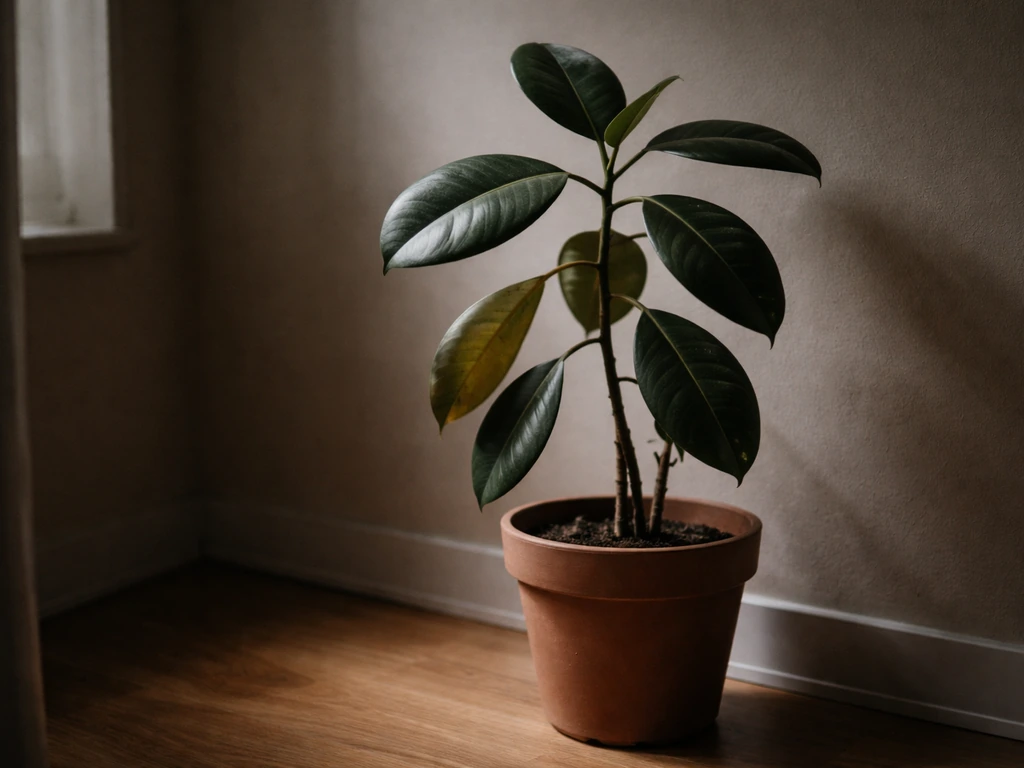
"Low light" is one of those terms that gets thrown around loosely, so let's put a number on it. University of Illinois Extension categorizes low light as roughly 75 foot-candles, and University of Nebraska-Lincoln Extension flags anything under 75 foot-candles as a zone where most houseplants start struggling. For context, the corner of a room with no window nearby can easily drop below 50 foot-candles. A spot a few feet back from a north-facing window might land around 75 to 100. That's the bottom edge of what a rubber plant can work with.
In commercial greenhouse production, Ficus elastica is grown at 2,500 to 6,250 foot-candles under shade cloth. That sounds wildly different from your apartment, and it is. But those numbers reflect what the plant wants for fast, lush growth. What you're asking in a low-light home situation is much more modest: can it hold its own and look decent? Anthuriums are similar in that they can survive in lower light, but you will usually need to keep the conditions bright enough to avoid very slow growth and leaf problems can anthurium grow in low light. Yes, if you keep it above that 75 foot-candle floor and make a few care adjustments. Can it grow vigorously and push out big new leaves regularly? Probably not without some help.
What happens when a rubber plant doesn't get enough light
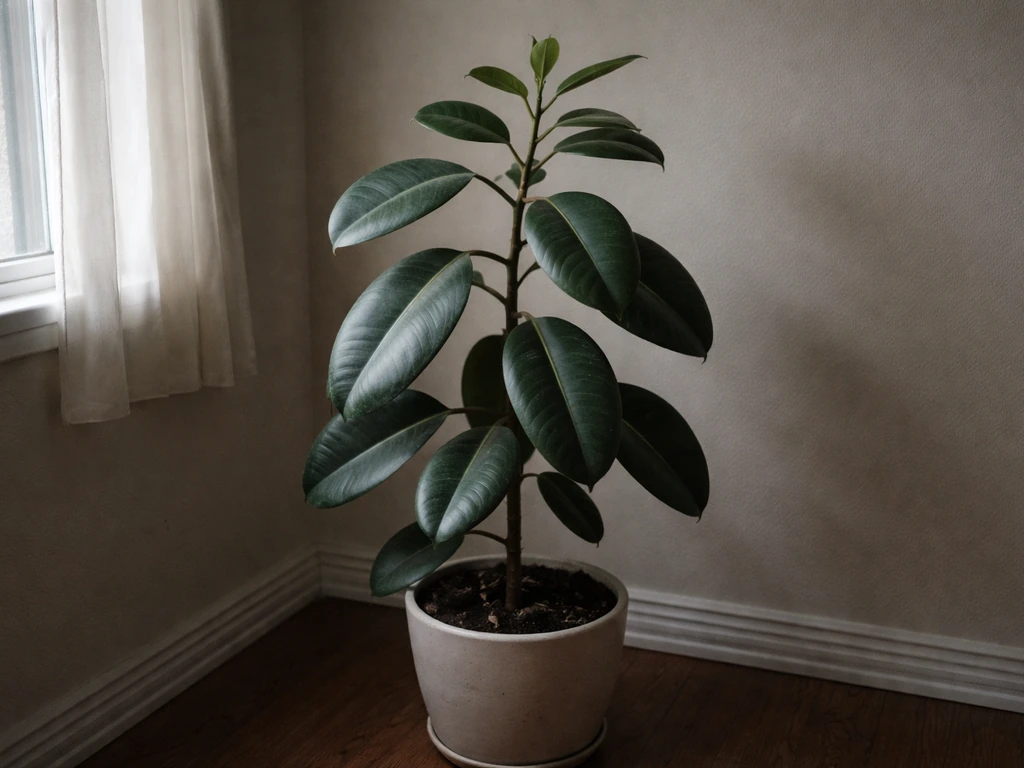
Rubber plants are pretty communicative. When light is too weak, the plant slows its photosynthesis, which means it produces less energy for new growth. Here's what you'll actually see, roughly in the order they tend to appear:
- Slower growth or a complete halt in new leaf production, especially in winter when natural light drops even further
- New leaves that are noticeably smaller and paler than older ones, because the plant is rationing resources
- Leggy, stretched stems as the plant literally reaches toward whatever light it can find
- Lower leaves yellowing and dropping, which happens because the plant redirects what little energy it has to the top growth nearest the light source
- Dull, less glossy foliage on established leaves, as the leaf surface stops reflecting the same vibrant light it was used to
One thing worth knowing: yellowing and leaf drop in rubber plants can also be caused by overwatering, which is extremely common and gets worse in low-light conditions (more on that in a moment). University of Maryland Extension calls overwatering the number one reason indoor plants fail, and it causes the same yellow-leaf-drop pattern as light stress. So before blaming the light, check the soil.
Where to actually put the plant in a low-light space
Your best move is to get the rubber plant as close to your brightest available window as possible, even if that window isn't great. Here's how to think about placement:
- North-facing windows provide the least natural light of any orientation. A rubber plant directly in front of a north-facing window is about as far as you should push it. More than 4 to 5 feet back from that window and you're likely below the survival threshold.
- East-facing windows get gentle morning sun, and a rubber plant within 3 to 5 feet of one will generally do okay. University of Minnesota Extension describes east-facing windows as suitable for medium-light plants, which puts a rubber plant right at that borderline.
- West and south-facing windows are better. A rubber plant sitting 5 to 8 feet back from a south or west-facing window can still get adequate indirect light.
- Avoid placing it in a dark corner, a hallway with no windows, or a room where you'd need to turn on lights during the day to read comfortably. Those environments are below what even a tolerant rubber plant can handle long-term.
- Use a light meter app or an inexpensive physical light meter to actually measure the spot. Ohio State University Extension recommends this as the most accurate way to know what you're working with. Guessing by eye is notoriously unreliable.
The goal is to keep the plant at or above 75 to 100 foot-candles (roughly 10 to 15 PPFD in grow-light terms) as a bare minimum. More is better. If you can get it to 150 to 200 foot-candles with natural light, you'll see much better results.
Supplementing with artificial light: LED, fluorescent, and photoperiod
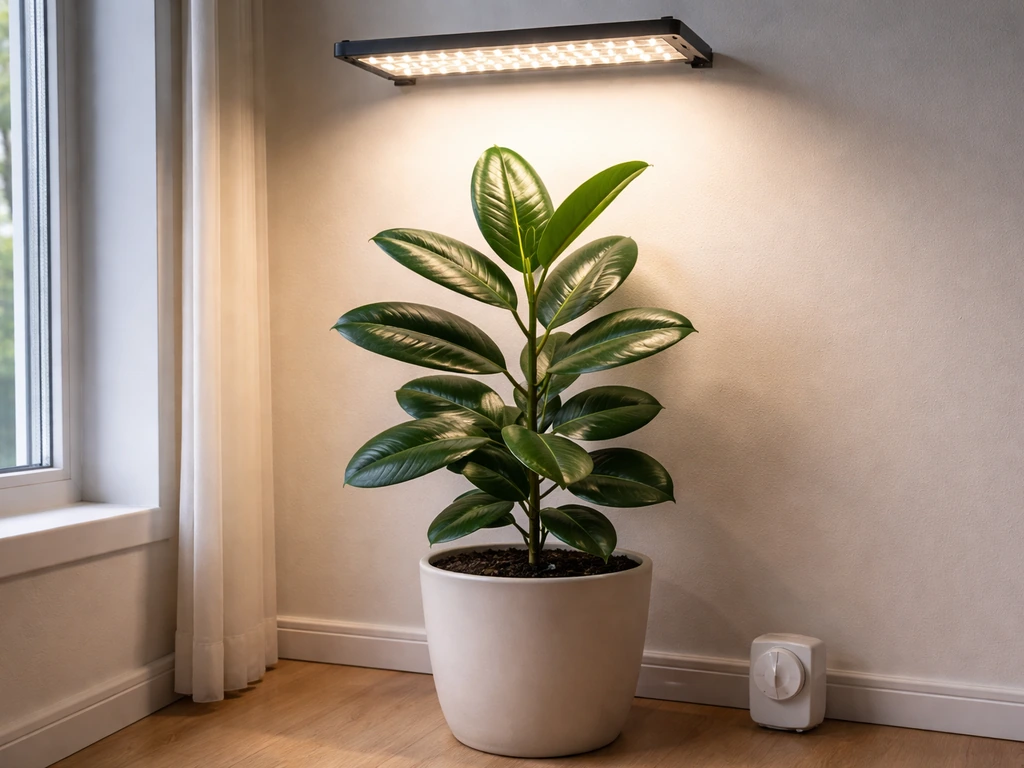
If your natural light is borderline or clearly insufficient, a grow light is a practical and affordable fix. You don't need a commercial setup. A basic full-spectrum LED panel or even a decent fluorescent shop light can bridge the gap for a rubber plant that's just trying to maintain itself in a dim room.
LED vs fluorescent: which one to use
| Factor | Full-Spectrum LED | Fluorescent (T5/T8) |
|---|---|---|
| Energy use | Very efficient, low heat output | Moderate efficiency, some heat |
| Light quality | Broad spectrum including red/blue wavelengths plants use most | Good spectrum, slightly less targeted than LED |
| Lifespan | 50,000+ hours typically | 10,000–20,000 hours |
| Distance from plant | 12–24 inches for maintenance light | 6–12 inches for similar output |
| Cost | Higher upfront, lower operating cost | Lower upfront, slightly higher running cost |
| Best for | Long-term supplemental lighting in any room | Budget-friendly option, works well for smaller plants |
For a rubber plant in low light, either option works. LED is the better long-term investment. If you already have a fluorescent shop light, use it. The rubber plant isn't demanding enough to require specialized horticultural LEDs, though a full-spectrum bulb will always outperform a standard warm-white household bulb.
How long to run the light (photoperiod)
Plants need a dark period to complete their metabolic cycles, so running grow lights 24 hours is actually counterproductive. Illinois Extension advises not exceeding 16 hours of light per day. For a rubber plant in a dim room with some ambient natural light, 12 to 14 hours of supplemental light per day is a solid target. Soltech's grow-light guidance puts most houseplant setups at 10 to 14 hours depending on how much natural light the room receives. Use a simple outlet timer so you're not relying on remembering to switch it on and off. Set it and forget it.
In terms of intensity, you're aiming for at least 100 to 200 PPFD at the plant's canopy level. University of Maine Extension's grow-light guidance puts vegetative houseplant growth in the 100 to 500 PPFD range. A rubber plant in maintenance mode sits on the lower end of that. Iowa State University Extension emphasizes thinking about light delivery in terms of PPFD at the canopy rather than just raw bulb wattage, so position the light based on what the plant actually receives, not what the package claims.
Care adjustments that actually matter in low light
A rubber plant in low light is a plant in slow motion. Its metabolism is running at a reduced rate, and your care routine needs to reflect that. The biggest mistake people make is continuing to water and fertilize on the same schedule they'd use for a bright-light plant.
Water less, and check the soil first
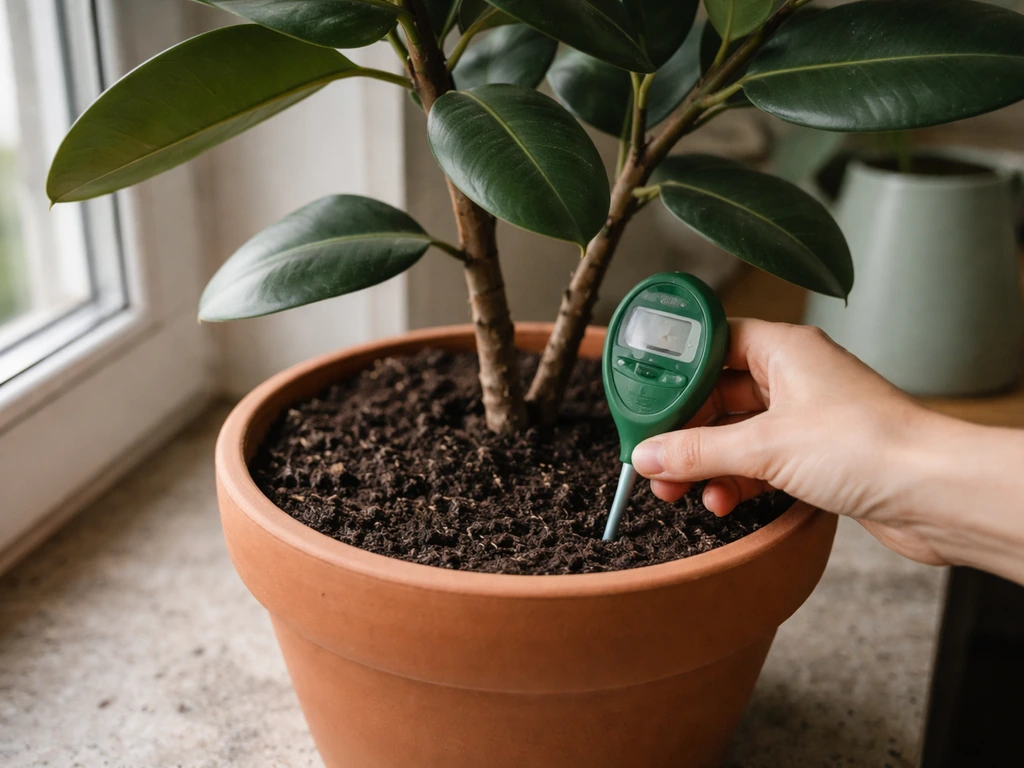
In low light, the plant uses less water because photosynthesis (and therefore transpiration) is slower. The soil stays wet longer. This is where overwatering becomes a real danger. University of Missouri Extension advises discarding any water that remains in the saucer after about an hour, and checking the top inch or two of soil before watering at all. For a rubber plant in dim conditions, you may only need to water every 10 to 14 days in cooler months, compared to every 7 days near a bright window. Always let the top couple of inches dry out before watering again.
Cut back on fertilizer
If the plant isn't growing much, it doesn't need feeding. Fertilizing a low-light rubber plant on a regular schedule leads to salt buildup in the soil, which stresses the roots and can make symptoms worse. Hold off on fertilizer entirely in winter or in very low light conditions. In spring or summer when growth picks up even slightly, a diluted balanced fertilizer once a month is plenty.
Temperature and humidity
Rubber plants prefer warmer temperatures, ideally between 60 and 85°F indoors. Cold drafts from windows in winter, especially in low-light setups where the plant is already stressed, can trigger leaf drop fast. UF/IFAS Extension's interiorscape Ficus guidance uses a temperature range of 70 to 95°F and humidity of 60 to 100% for optimal conditions, which is obviously higher than most homes. For practical home purposes, keeping the plant away from cold drafts and air conditioning vents, and maintaining at least moderate indoor humidity (40% or above), helps buffer the effects of limited light.
When to change your approach entirely
There's a point where you have to be honest with yourself about whether the setup is working. Here are the signals that tell you it's time to try something different:
- The plant is losing more leaves than it's producing over a 4 to 6 week period, despite correct watering
- New growth is consistently tiny, pale, or deformed
- The stems are visibly leaning hard toward a light source and the plant looks lopsided and stretched
- You've checked watering and drainage and those aren't the issue, but symptoms persist
At that point, your three options are: move the plant to a brighter spot, add a grow light if you haven't already (or upgrade the one you have), or swap the rubber plant for a species that genuinely thrives in low light. Plants like dracaena and anthurium also get discussed for low-light situations, and some species in those groups handle truly dim conditions better than a rubber plant will. If you want a dramatic foliage plant for a genuinely dark corner, there are more forgiving options available. If you want other plants that can grow in low light, look for similarly forgiving foliage options more forgiving options available.
If you do decide to add a grow light, do it now rather than waiting for the plant to deteriorate further. A rubber plant that's been in low light for months and is already weakened will recover slowly. Getting it to 12 to 14 hours of supplemental full-spectrum light at 150 to 200 PPFD at canopy level is a reasonable starting point. Give it 4 to 6 weeks before expecting visible improvement.
Common mistakes and how to fix them
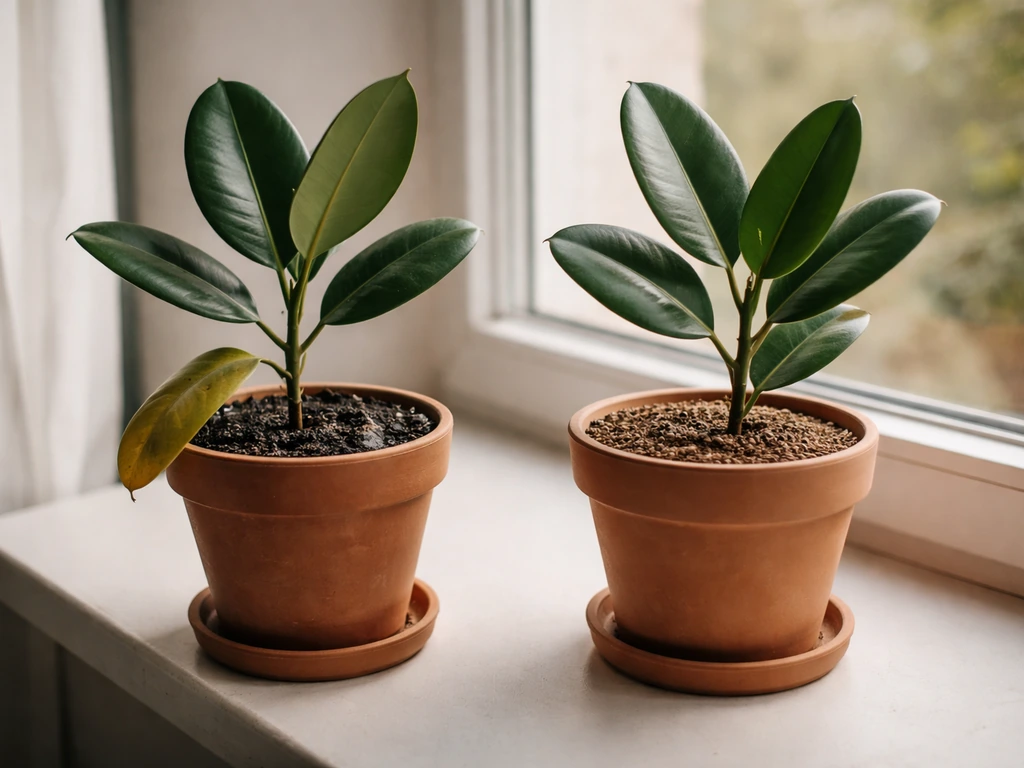
Most of the problems people run into with low-light rubber plants come down to a handful of repeatable errors. Here's what to watch for and what to do about each one:
- Overwatering: This is the most common issue, and low light makes it worse. If you see yellowing lower leaves and the soil feels wet, stop watering immediately. Let the soil dry out significantly before watering again. Check drainage holes to make sure water isn't pooling at the roots.
- Assuming any window counts as "enough light": A north-facing window in winter may drop below 50 foot-candles a few feet back. Measure before assuming. If you're relying on ambient room light without a direct window view, it's almost certainly not enough.
- Running a grow light for too few hours: Many people run a supplemental light for 4 to 6 hours and wonder why it isn't helping. You need at least 10 to 12 hours of quality light per day for a meaningful contribution. Use a timer.
- Using a regular warm-white bulb as a grow light: These bulbs don't provide the blue and red wavelengths plants need for photosynthesis. A full-spectrum LED or fluorescent bulb is necessary if you want actual results.
- Fertilizing a struggling plant: If your rubber plant is already stressed from low light and losing leaves, adding fertilizer won't help it grow. It often makes things worse by burning stressed roots. Pause fertilizing until the plant stabilizes and shows new healthy growth.
- Placing the plant too far from any light source and not adjusting: If the plant is stretching toward a window from across the room, it's telling you it needs to be closer. Move it. Even shifting a plant 2 to 3 feet closer to a window can meaningfully increase the foot-candles it receives.
The bottom line: a rubber plant in low light is a plant doing its best under constraint. Respect that by watering carefully, skipping the fertilizer when growth is slow, keeping it as close to your best light source as possible, and supplementing with a simple grow light on a timer if the natural light isn't cutting it. It's a resilient plant, but it will be happiest if you meet it halfway.
FAQ
What light level counts as “too low” for a rubber plant, and how can I check without a lux meter?
If your spot stays below about 75 foot-candles for most of the day, the rubber plant is likely to survive but not do well long term. Without measuring, a practical proxy is to hold your phone flashlight and see if you can read easily with the room lights as-is at typical daytime hours, if not, expect growth slowdown and eventual leaf drop. If you want accuracy, a basic smartphone lux-meter app plus a real-time reading at plant height is better than guessing from distance to the window.
Will a rubber plant in low light still lose leaves even if I water correctly?
Yes. Light stress can cause older leaves to yellow and drop even when watering is controlled. Overwatering and low light also look similar, so check the soil first, then watch the pattern: light problems often affect multiple older leaves while overwatering often coincides with consistently damp soil or foul smell. If leaves drop continues after watering adjustments for a few weeks, increase light before changing anything else.
How do I tell whether leaf yellowing is from overwatering or from insufficient light?
A useful decision rule is soil condition. If the top inch or two stays wet and the pot drains slowly, suspect overwatering. If the soil dries out appropriately but the plant is still getting dim conditions, suspect low light. Also note that low light usually brings slower overall change, while overwatering can produce a faster deterioration if the roots stay oxygen-starved.
Should I rotate my rubber plant in low light to keep growth from getting lopsided?
Rotating helps even in low light, but do it gradually. Turn the pot about a quarter turn every 1 to 2 weeks so the plant does not experience constant reposition shock. If you use a grow light, align it so rotation is optional, but rotating still helps maintain symmetrical leaf orientation as the plant stretches toward the light.
Can I use a weak grow light and still expect it to work?
A small or dim light can help, but rubber plants need enough intensity at the canopy level to actually move out of “maintenance mode.” If you cannot reach at least the low end of the recommended PPFD range, you may see some improvement but still slow growth and leaf drop. When in doubt, increase distance carefully and use a timer so you deliver consistent daily light rather than sporadic bright bursts.
Is it better to run grow lights longer in low light or increase the brightness?
Increase intensity first if you can. Extending photoperiod has diminishing returns, and too much light without plant response can lead to stress from other factors like uneven watering. The article already recommends limiting total daily light, so aim for a reasonable 12 to 14 hour window and focus on placing the light and bulb output so the canopy receives enough light.
How often should I water a rubber plant in low light if I don’t want to keep track of the schedule?
Go by dryness, not calendar days. In dim conditions, wait until the top couple of inches dry out before watering, and keep in mind it may become watering every couple of weeks in cooler months depending on pot size and airflow. If water remains in the saucer after about an hour, dump it and adjust the next watering amount. Using a moisture meter can reduce mistakes, but confirm with finger-test consistency.
Do I still fertilize in low light if the plant is losing leaves but hasn’t stopped growing completely?
Usually no, because the plant’s slower metabolism uses less fertilizer and salt buildup can worsen root stress. If you see any meaningful new growth in spring or early summer, use a diluted balanced fertilizer about once a month, and only when you are confident light is adequate enough to support growth. If growth is minimal, skip fertilizer and concentrate on fixing light and watering.
What temperature and humidity matter most for low-light rubber plants?
Temperature and drafts often matter more than people expect, especially when the plant is already energy-limited by low light. Avoid cold window drafts and direct blasts from air conditioning or heating vents. Humidity helps buffer stress, but you do not need tropical humidity, staying at moderate indoor humidity (around 40% or higher) reduces the risk of extra leaf problems while you improve light.
Can a rubber plant in low light recover, and how long does it take?
Recovery is possible, but it is slow if the plant has already been weakened. If you correct the light with a brighter window or a properly set grow light, expect visible improvement in roughly a month, then more gradual gains over subsequent months. Leaves that already dropped will not regrow, so measure success by new leaf production and less frequent drop.
What type of potting setup reduces problems when keeping a rubber plant in low light?
Use a pot with good drainage and a well-aerated mix so the roots do not stay waterlogged between infrequent watering. In low light, the same watering mistake lasts longer, so ensure excess water can exit and that the pot is not sitting in water. If your current pot drains poorly or compacts easily, repotting into a chunkier, breathable mix can prevent chronic yellowing and drop even after you adjust light.
When is it time to replace the plant instead of trying to fix the light?
If the plant has extensive leaf loss with little to no new growth after several weeks of improved lighting and corrected watering, it may be too far gone to justify extended troubleshooting. At that point, moving forward with a better low-light-suited plant species for that specific corner is more reliable than repeatedly adjusting the same setup.