
A handful of plants can genuinely survive in a dark bathroom: ZZ plant, cast iron plant, pothos, blank" rel="noopener noreferrer">snake plant, Chinese evergreen (Aglaonema), and peace lily are your most reliable options. If you place a snake plant in a truly dark room, it may struggle, but it can often acclimate if you give it some light. None of them thrive in true darkness, but they can hold on and stay decent-looking in the 25–75 foot-candle range that dim bathrooms typically offer, especially if you add even a basic grow light for a few hours a day. The key is being honest about how much light you actually have, picking a plant matched to that level, and adjusting your watering way down compared to what you'd do near a sunny window.
Plants That Can Grow in a Dark Bathroom: Best Picks
Marcus Hartley
4 Jun 2026
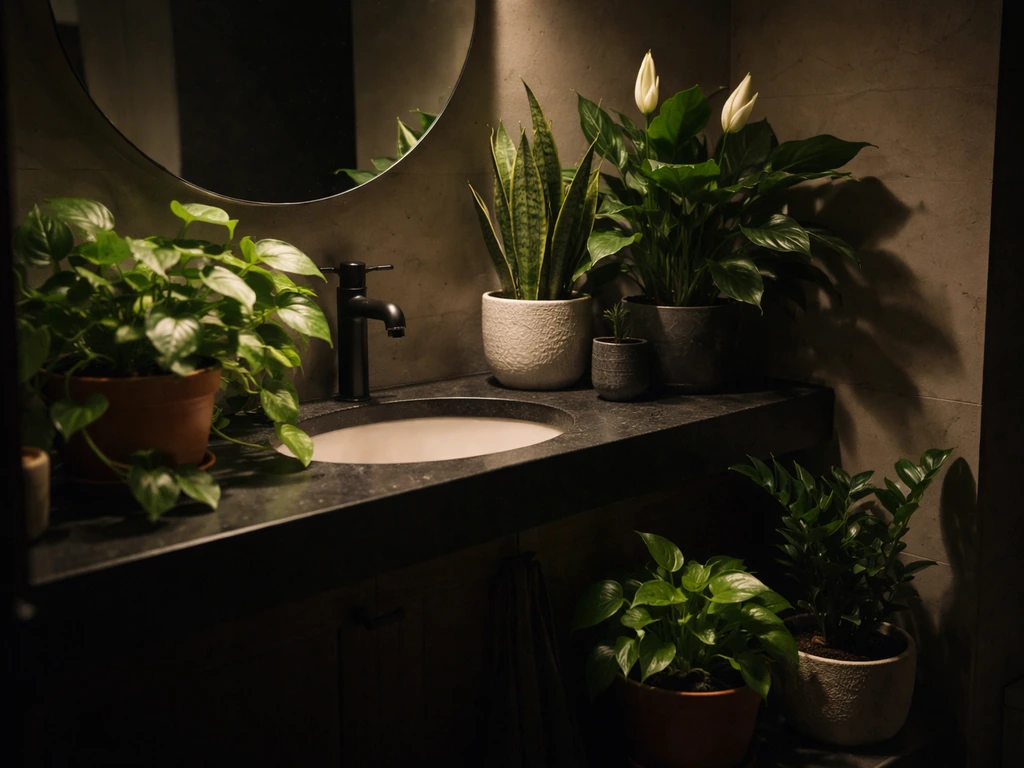
Best low-light bathroom plants for near-dark corners
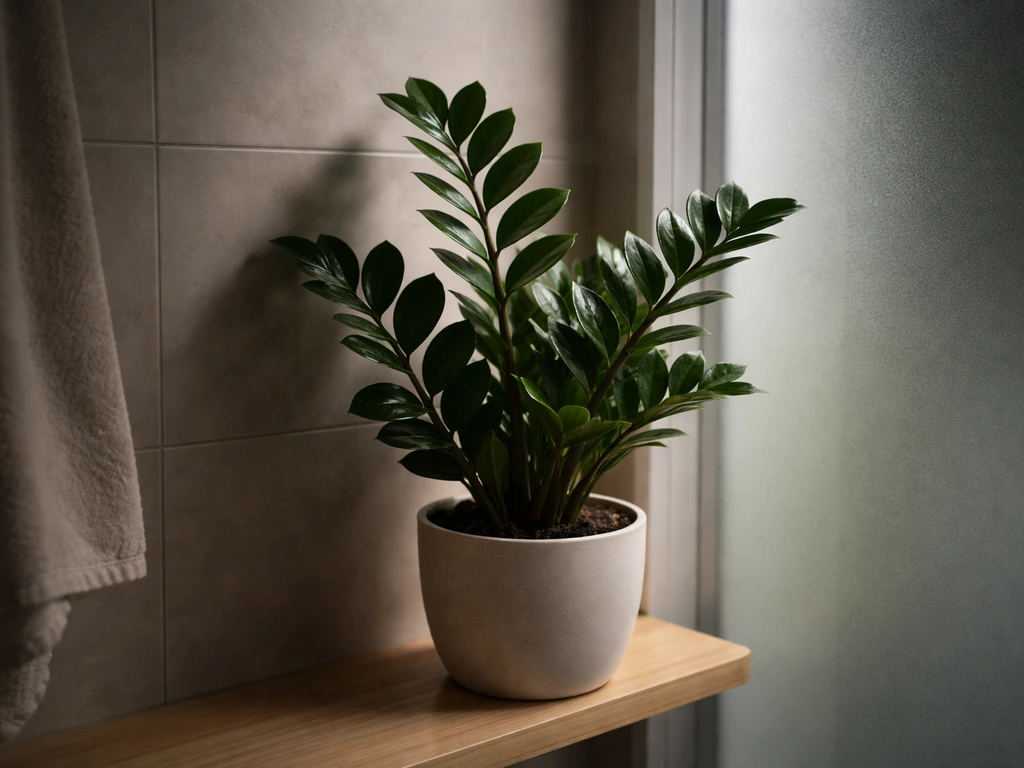
These plants have been tested (including in my own windowless bathroom corner) and consistently perform better in low light than almost anything else you can buy. Here's what each one actually needs to stay alive, not just survive technically.
| Plant | Minimum light (fc) | Best bathroom trait | Watch out for |
|---|---|---|---|
| ZZ Plant (Zamioculcas zamiifolia) | 25–50 | Tolerates fluorescent-only light; drought-tolerant rhizomes | Overwatering in low light is the #1 killer |
| Cast Iron Plant (Aspidistra elatior) | 15–25 | Handles low light, temperature swings, and irregular watering | Slow grower; don't expect fast results |
| Pothos (Epipremnum aureum) | 25–50 | Trails nicely in small spaces; very forgiving | Goes leggy fast without any light source |
| Snake Plant (Dracaena trifasciata) | 25–50 | Survives near-dark; handles dry air and humidity alike | Root rot if pot has poor drainage |
| Chinese Evergreen (Aglaonema) | 25–75 | Gorgeous foliage; genuine shade performer | Avoid cold drafts; likes warmth |
| Peace Lily (Spathiphyllum) | 25–75 | One of few flowering plants for low light | Droops dramatically when thirsty (helpful signal) |
| Dracaena (various species) | 25–100 | Architectural look; tolerates neglect | Brown tips from fluoride in tap water |
ZZ plant deserves special mention because it's genuinely windowless-office and dark-bathroom tested. Its thick rhizomes store water and energy, letting it coast through long stretches of near-darkness. Pothos is the easiest to find and the hardest to kill, but it will stretch toward any light source it can find, which can look messy fast. Cast iron plant is the one I'd bet money on if your bathroom gets almost no natural light at all. It earned that name for a reason.
Peace lily is worth adding if your bathroom stays reasonably warm (above 60°F). It's one of the only low-light plants that will actually flower indoors, and its drooping habit when thirsty makes it almost impossible to accidentally kill from underwatering because it tells you exactly when it needs a drink.
How much light bathrooms actually provide (and how to measure it)
Most bathrooms fall into one of three light buckets: dim (50–150 foot-candles near a frosted window), low (25–75 fc in the middle of the room), or near-dark (under 25 fc, typical of interior bathrooms with no window at all). A foot-candle, by the way, is simply the amount of light hitting a one-square-foot surface one foot away from a single candle. That's the unit plant scientists and extension services use, and it's far more useful than vague terms like 'bright indirect' or 'low light.'
To actually measure your bathroom's light, you have two easy options. A dedicated handheld lux meter costs $15–30 and is the most reliable tool. Convert lux to foot-candles by dividing by 10.76 (so 500 lux equals about 46 fc). Alternatively, download a smartphone app like Photone, which can measure both lux and PPFD (the metric grow-light users care about). Phone apps are less precise than a calibrated meter, but they're accurate enough to tell you whether you're at 20 fc or 100 fc, which is all you really need to make a plant decision.
Measure at the spot where the plant will actually sit, not near the window. Light drops off fast with distance. A frosted bathroom window might deliver 500 fc right at the glass, but only 50 fc two feet back on the vanity. Take readings at a few times of day and average them. If you're consistently under 25 fc, you're in near-dark territory and your plant list shortens to the cast iron plant, ZZ plant, and honestly, a grow light.
What the numbers mean for plant choice
| Light level | Foot-candles | What it feels like | Best plant matches |
|---|---|---|---|
| Near-dark | Under 25 fc | You can read but it feels dim; no window or heavily frosted | Cast iron plant, ZZ plant (with supplemental light recommended) |
| Low light | 25–75 fc | Comfortable ambient light; small or frosted window | ZZ, pothos, snake plant, Aglaonema, peace lily |
| Dim/moderate | 75–200 fc | North-facing window or bright artificial overhead lights | All of the above plus ferns, dracaena, philodendron |
Choosing between 'shade tolerant' and true 'low-light' plants
This distinction matters more than most plant care articles admit. 'Shade tolerant' means a plant survives with less light than it prefers. It won't die quickly, but it will grow slowly, look a little dull, and stop producing new leaves at a normal rate. 'Low-light adapted' plants, like the ones on this list, have actually evolved for dim understory conditions and run their photosynthesis machinery more efficiently at low foot-candle levels. They genuinely do better at 25–75 fc than a shade-tolerant plant that prefers 200 fc.
Where people get into trouble is buying plants labeled 'low light tolerant' at a garden center when those plants are really medium-light plants that can survive briefly in a dark corner. Fiddle leaf figs, bird of paradise, and most succulents fall into this trap. They won't die in a week, but they'll decline slowly over months until you wonder what went wrong. Stick to the species on the table above if your bathroom light is genuinely dim or near-dark.
Snake plant is an interesting middle case. It's genuinely low-light adapted and can acclimate to very dim conditions, but 'acclimate' is the key word. If you move a snake plant from a bright window directly to a near-dark bathroom, it will struggle during the adjustment period. Transition it gradually over two to three weeks if you can, and it will settle in much better.
For example, UF/IFAS notes that Aglaonema can be grown in shade and may tolerate levels around 25 foot-candles, but it also cautions that you should not treat that as a “never go lower” threshold Aglaonema should be grown in shade and can be as low as around 25 foot-candles, but the source warns this is not a “never” limit.
Plant care tips in low light: watering, humidity, airflow, and temperature
The biggest mistake people make with bathroom plants isn't the wrong species. It's watering on the same schedule they'd use in a brighter room. Mississippi State University Extension emphasizes that watering should be adjusted based on environmental conditions like light, temperature, humidity, and pot size, and it recommends using soil moisture indicators to know when to water It's watering on the same schedule they'd use in a brighter room.. In low light, a plant's metabolism slows down. It uses water more slowly, the soil dries out more slowly, and if you keep watering on a fixed schedule, you'll waterlog the roots. Root rot in low-light bathrooms is extraordinarily common, and it's almost always a watering problem, not a plant problem.
Watering in low light
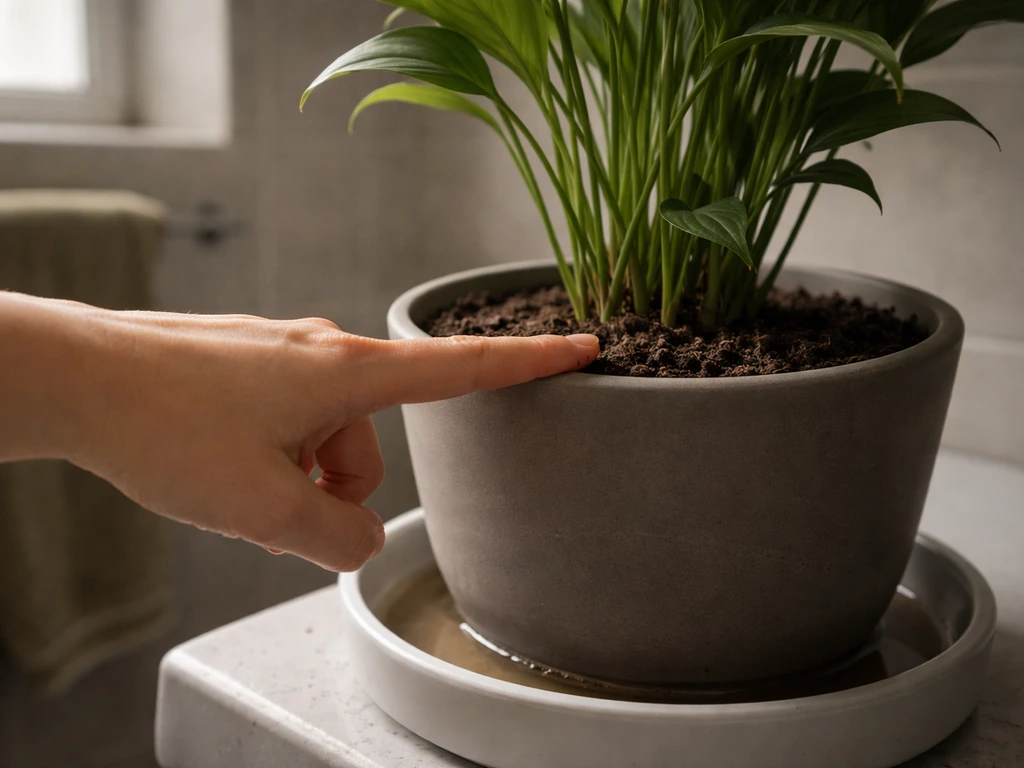
- Always check soil moisture before watering. Stick your finger two inches into the soil. If it's still damp, wait.
- In a dim bathroom, most low-light plants need water roughly half as often as they would near a bright window. A ZZ or snake plant might only need water every 2–4 weeks in winter.
- A soil moisture meter (the cheap probe kind) is genuinely useful here. It removes the guesswork and costs about $10.
- Never leave any plant sitting in standing water in a saucer. Drain saucers after watering and check that your pot has drainage holes. Bathroom floors and enclosed vanities trap moisture, making root rot even more likely.
- When in doubt, underwater. Most low-light bathroom plants evolved to handle drought far better than flood.
Handling bathroom humidity
High humidity from showers is actually a benefit for some plants, especially peace lily, pothos, and ferns. But it creates real problems if your bathroom has poor air circulation. Stagnant humid air sitting around plant leaves encourages fungal issues and mold on the soil surface. Run the exhaust fan during and after showers, crack the door when possible, and don't push plants into the far back corner behind the toilet where air never moves.
Airflow and temperature
- Aim for at least some air movement after showers. A small USB fan set on low for 30–60 minutes post-shower makes a meaningful difference.
- Most bathroom-friendly plants prefer temperatures between 60–80°F. Cold drafts from windows in winter can stress plants more than the low light does.
- Avoid placing plants directly above a heat vent or radiator. Sudden warm dry blasts stress foliage even when overall room humidity is high.
- Cast iron plant handles temperature swings better than almost anything else. If your bathroom gets cold in winter, it's your safest pick.
Soil and pot setup
In a low-light bathroom, drainage is more critical than it would be in a bright room. Use a well-draining potting mix with added perlite (a 3:1 ratio of potting mix to perlite works well) rather than a dense, moisture-retaining mix. Terracotta pots help because they wick moisture through the walls, reducing waterlogging risk. Glazed ceramic or plastic pots are fine too, but you'll need to be even more careful about overwatering with those.
Using grow lights in a bathroom: LED and fluorescent placement and schedules
If your bathroom gets under 25 fc naturally, a small grow light is the most practical fix you can make. This doesn't mean buying an expensive setup. A single LED grow bulb in a clip-on fixture or a plug-in LED grow strip can completely change what's possible in a dark bathroom. The goal is to get your plants into that 75–200 fc range during the light-on period, which turns a near-impossible situation into an easy one.
LED vs. fluorescent for bathrooms
LED grow lights are the better choice for bathrooms right now. They run cooler than fluorescent tubes, use less electricity, last longer (often 25,000+ hours), and full-spectrum LEDs put out the right wavelengths for plant growth. Compact fluorescent (CFL) grow bulbs still work and are cheap and widely available, but they generate more heat and have a shorter lifespan. If you're adding light to a small bathroom and want the simplest setup, a full-spectrum LED bulb in a standard lamp fixture (around 10–15 watts, 1000–1500 lumens) is all you need.
Placement and distance
- Position an LED grow light 6–18 inches above the plant canopy for low-light species. Closer delivers more intensity, but check that leaves don't show stress (bleaching or curling) from heat or intensity.
- Light intensity drops sharply with distance. A fixture delivering 200 fc at 12 inches might only deliver 50 fc at 24 inches. Use your light meter app to verify the actual reading at leaf level.
- For a shelf or vanity setup, clip-on LED grow lights or under-shelf LED strips work well and don't take up floor space.
- Bathrooms with moisture in the air require fixtures rated for damp or wet locations. Check the IP rating on any fixture before installing it in a bathroom.
Light schedules
For low-light bathroom plants, 10–14 hours of grow light per day is the target. Plants need a dark period too (they actually process carbon and do repair work at night), so don't run lights 24 hours. A simple plug-in timer set to run the grow light from 7 AM to 8 PM is a set-it-and-forget-it solution that costs about $10 and makes managing the schedule completely automatic. This is especially useful in windowless bathrooms where ambient light never changes.
Troubleshooting when nothing grows
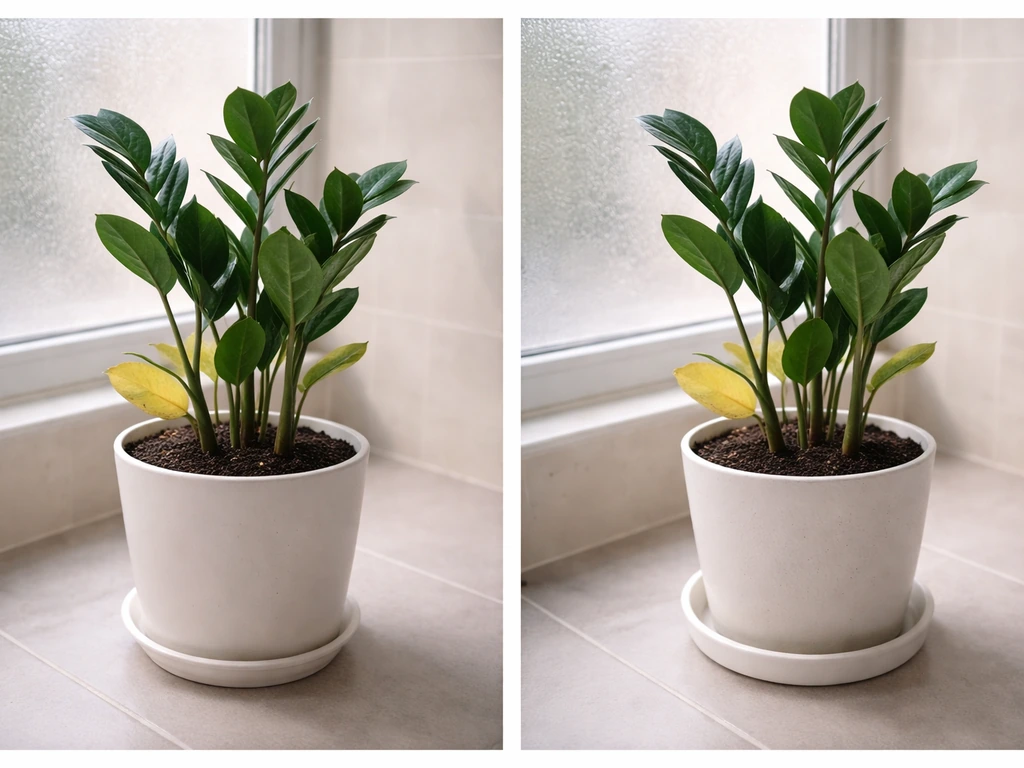
If your bathroom plant is struggling, the cause is almost always one of five things: too little light, overwatering, poor drainage, cold stress, or inadequate airflow. Here's how to read the symptoms and fix them.
| Symptom | Most likely cause | Fix |
|---|---|---|
| Yellow leaves (lower, older leaves) | Overwatering or root rot | Check roots; trim rotten ones; reduce watering frequency; improve drainage |
| Yellow leaves (new growth) | Too little light or nutrient deficiency | Add a grow light or move plant closer to window; use diluted liquid fertilizer monthly in growing season |
| Leggy, stretching stems | Insufficient light | Add or move grow light closer; consider a higher-lumen bulb |
| Pale, washed-out foliage | Grow light too intense or too close, or overwatering | Move light farther back; check soil moisture |
| Mold on soil surface | Stagnant air + overwatering | Improve airflow; reduce watering; top-dress with dry perlite |
| Soft, mushy stem base | Root rot (advanced) | Unpot immediately; remove rotted roots and stems; repot in fresh dry mix; reduce watering sharply |
| Tiny flies around soil (fungus gnats) | Overwatered, organic-rich soil | Let soil dry out fully between waterings; use sticky traps; consider a gnat barrier layer of sand on top |
Leggy, stretching growth is the most common complaint I hear from people growing pothos and snake plants in dark bathrooms. The plant is reaching for light it can't find. This is a clear signal that you've crossed from 'low light' into 'not enough light.' Either move the plant, add a grow light, or swap it for a cast iron plant or ZZ, which stretch less aggressively in dim conditions.
Mold on the soil surface looks alarming but is usually just a cosmetic issue caused by damp, stagnant conditions. Scrape off the top layer of soil, improve airflow in the room, and reduce watering. If mold keeps returning, it's a sign something is off with your drainage or watering frequency. The same conditions that encourage surface mold are the ones that lead to root rot if left unchecked, so take it seriously as an early warning sign.
One final note worth keeping in mind: if you've got other dark spots in your home beyond the bathroom, the same plant logic applies there too. Many of the same plants that can grow in a dark bathroom also do well in other near-dark rooms when you match the species to the light level plants that can grow in dark room.
The light rules for a dark bathroom corner aren't much different from those for a dark interior room or a gloomy corner in the living room. For example, can money plant grow in a dark room depends on whether it gets enough measurable light or whether you supplement with a grow light. With that in mind, choosing true low-light plants is the easiest way to get plants that can grow in dark corners to stay healthy.
The bathroom just adds the humidity and airflow variables on top. Get those right, pick the correct species, and you've got a genuinely workable indoor garden in one of the least obvious spots in your home.
FAQ
I have almost no natural light. How do I know if I need a grow light or just a different plant?
Measure light at the exact plant location, then match the plant to your bucket. If you are below 25 foot-candles (near-dark), skip “low light tolerant” varieties that you know are medium-light, and rely on ZZ plant, cast iron plant, or add a grow light to reach a 75 to 200 foot-candle target during the light-on period.
Can I run a grow light all day or 24/7 in a bathroom?
Use a timer and keep the light cycle consistent, aim for 10 to 14 hours on, and include a real dark period. Leaving a grow light on 24/7 may reduce flowering and can stress some plants, even if they keep growing.
Why does my bathroom plant look okay at first but decline after a couple months?
Yes, but only if you control the water. A plant might look “fine” because it slows down, then declines later. In low light, water based on how dry the pot becomes, not a calendar schedule. If unsure, wait longer than you think, and verify drainage with a slow pour test.
What soil and pot setup prevents root rot in a dark bathroom?
Most low-light bathroom failures come from staying too wet. Switch to a well-draining mix (for example, potting mix plus perlite around 3:1), use a pot with drainage holes, and consider terracotta to add extra protection against waterlogging.
My bathroom is humid, but my plants get moldy. What’s going on?
If your bathroom exhaust fan is weak, the issue is usually stagnant humid air, not the plant’s ability to handle humidity. Run the fan during and after showers, crack the door when possible, and avoid placing plants where air never moves (like behind the toilet).
My peace lily isn’t flowering in my dark bathroom. How can I troubleshoot?
Peace lily can tolerate low light, but flowering depends heavily on light availability and stable conditions. If it is not blooming, first check that you are not actually in “near-dark,” then confirm you are not letting it dry out too long or staying constantly waterlogged.
I bought a snake plant for a dark bathroom. How should I acclimate it?
Snake plants often need a transition period. Move them gradually from brighter light to dimmer conditions over two to three weeks, or keep them close to the brightest spot you can find before relying on grow-light supplementation.
My pothos or snake plant is getting leggy. Does that mean it’s dying?
Leggy growth usually means the plant is reaching for light that it cannot get consistently. If stretching is happening, either move the plant closer to the light source, add a grow light and set it on a timer, or replace with a plant that stretches less aggressively (like ZZ plant or cast iron plant).
Are garden center “low light tolerant” plants reliable for true dark bathrooms?
The “low light” labels at stores can be misleading. Look for plants that are truly adapted to low foot-candle conditions, and avoid species that are typically medium-light, like fiddle leaf fig, bird of paradise, and most succulents, unless you will supplement with a grow light.
Can cold temperatures be the reason my low-light bathroom plant struggles?
Cold stress can slow growth and make problems harder to recover from. If your bathroom drops near or below the mid-50s°F, keep plants away from direct drafts and cold vents, and consider using a grow light to stabilize conditions and raise warmth slightly.
Is mold on the soil surface deadly for dark-bathroom plants?
If you see surface mold, treat it as a warning sign for damp conditions. Remove only the top layer of affected soil, improve airflow, and reduce watering frequency. If mold keeps returning, reassess drainage, potting mix, and whether the plant is sitting in too little air circulation.
How can I tell if my potting mix is too dense for low light?
A fast “sanity check” is to confirm water behavior: if water sits for a long time, runs out slowly, or the top stays wet for many days, drainage is likely inadequate. In dark bathrooms, fix the drainage first before adding fertilizer or changing plant type.