Mars does not receive enough sunlight to grow most plants on its own. At best, the Martian surface gets roughly 400 W/m² of solar energy on a clear summer day, which is already less than half of what Earth's surface typically receives. Once you translate that into the photon currency plants actually use (PPFD, measured in µmol m⁻² s⁻¹), you're looking at light levels that might sustain a few low-light leafy greens at a bare minimum, but absolutely won't get you fruiting crops, flowering plants, or reliable food production. The realistic conclusion: Martian sunlight can contribute meaningfully, but you'd need supplemental LED grow lights to run a functional plant habitat on Mars.
Is There Enough Sunlight on Mars to Grow Plants?
Marcus Hartley
5 Jun 2026
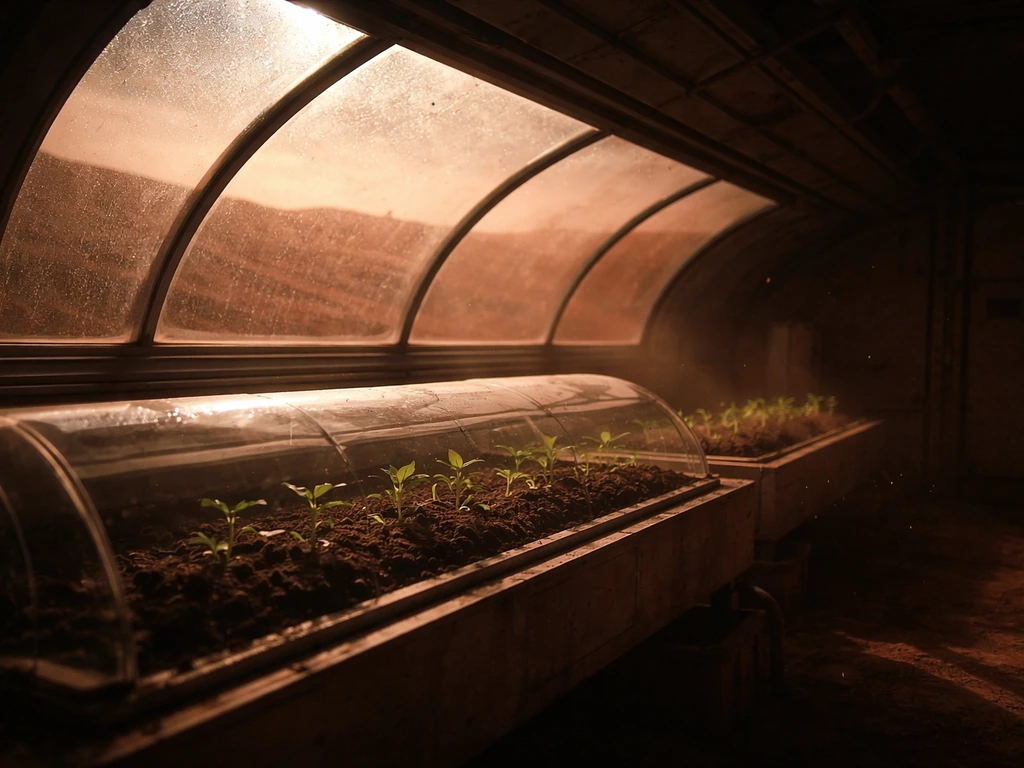
How much sunlight Mars actually gets (and why it's so much weaker)
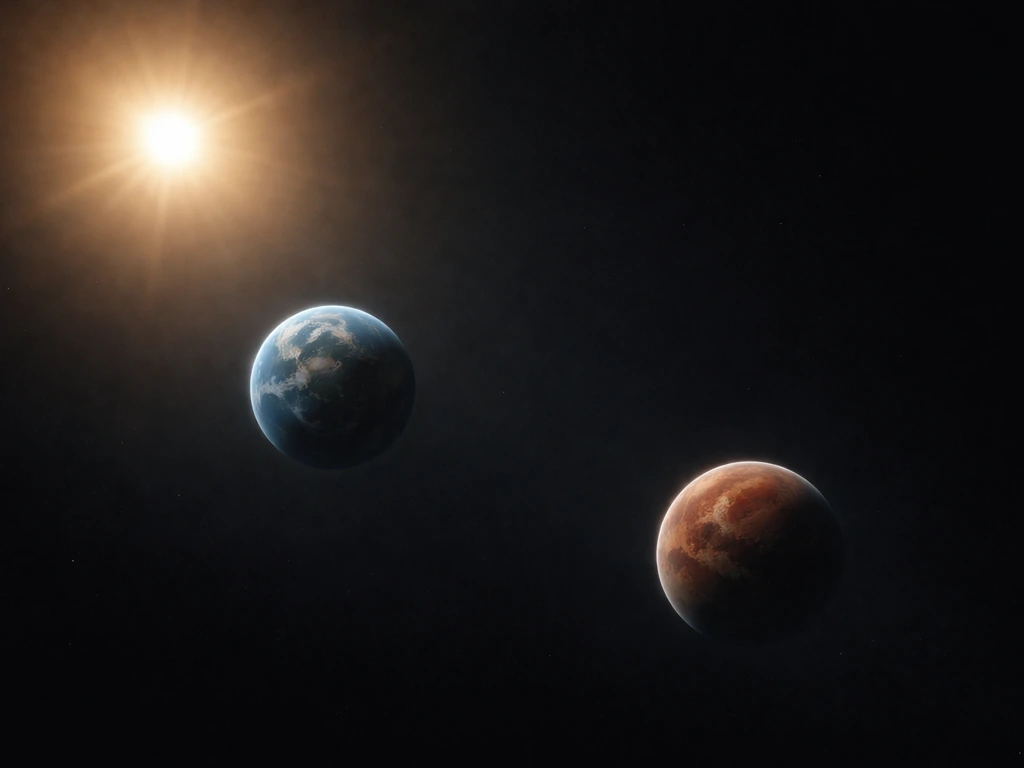
Mars sits about 1.5 times farther from the Sun than Earth does, and that distance makes an enormous difference. Earth's atmosphere receives roughly 1,361 W/m² of solar energy at the top. Mars, by comparison, receives about 590 W/m² on average at the top of its atmosphere, which works out to around 57% of Earth's value. And that's at the top of the atmosphere, before anything else gets in the way.
Mars also has an elliptical orbit, so that number swings quite a bit depending on where Mars is in its year. At its closest point to the Sun (perihelion), TOA irradiance reaches about 715 W/m². At its farthest (aphelion), it drops to around 492 W/m². That's a 45% swing just from orbital position alone, before you account for anything happening in the atmosphere.
Now here's what makes Mars tricky: once you get down to the surface, the situation gets worse. On a clear Martian summer day, the surface receives roughly 400 W/m² of total solar radiation. During a global dust storm, that number can collapse to around 80 W/m². For reference, a typical bright outdoor day on Earth delivers 1,000 W/m² or more at the surface. So even on Mars's best day, you're working with less than half of what you'd get outside on Earth.
What plants actually need from light
Plants don't care about all sunlight equally. They only use light in the 400–700 nm wavelength range, which plant scientists call Photosynthetically Active Radiation, or PAR. Within that band, chlorophyll is most efficient at absorbing red light (around 600–700 nm) and blue light (400–500 nm). Green light in the middle is used less efficiently, which is why leaves look green: they're reflecting most of it back.
To measure how much useful light a plant is getting, growers use PPFD (Photosynthetic Photon Flux Density), expressed in µmol of photons per square meter per second (µmol m⁻² s⁻¹). To understand the total dose of light a plant receives over a full day, you use DLI (Daily Light Integral), expressed in mol m⁻² day⁻¹. Think of PPFD as the flow rate from a tap, and DLI as how full the bucket is at the end of the day. Both matter.
Here's what those numbers mean in practice. Lettuce and other leafy greens grown in controlled experiments use PPFD around 150–215 µmol m⁻² s⁻¹ with a 16-hour photoperiod. Tomatoes and fruiting crops want 400–600 µmol m⁻² s⁻¹ or more. Low-light houseplants like pothos or peace lilies can survive at 50–100 µmol m⁻² s⁻¹. Those numbers give you a benchmark for comparing what Mars can actually deliver.
Photoperiod also matters. Plants use the length of light and dark periods to regulate flowering, dormancy, and growth cycles. Mars has a day (called a sol) that's about 24 hours and 37 minutes, so close enough to Earth's that photoperiod management isn't a fundamental barrier. That's actually one of the few things Mars has going for it in terms of plant growing.
Can plants grow with Martian sunlight alone? Realistic expectations
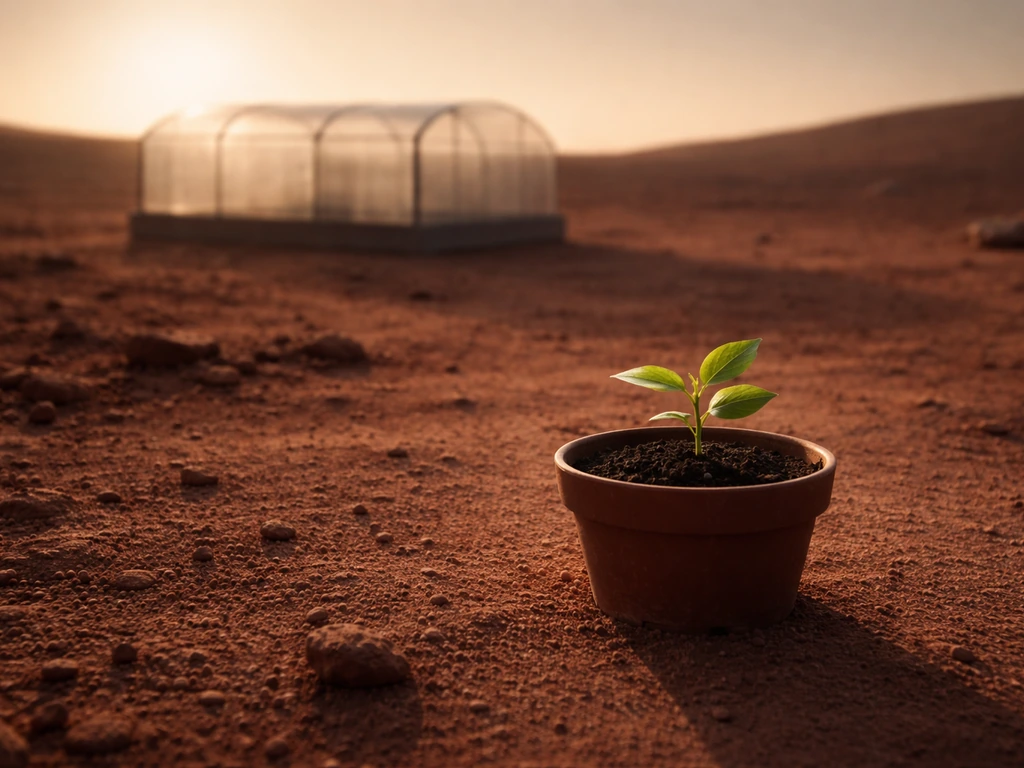
Technical modeling of PAR availability at the Martian surface suggests that on a good clear day at certain latitudes, the PAR portion of sunlight could reach levels in the ballpark of 150–300 µmol m⁻² s⁻¹. That's genuinely not nothing. Some research, including a Mars inflatable greenhouse analog study, concluded that light intensities might be sufficient for hydroponic crops if you're using an engineered habitat that concentrates or transmits sunlight efficiently. So under ideal conditions, stubborn leafy greens might technically photosynthesize.
But the keyword there is ideal. Clear days on Mars are not guaranteed. Dust is always present in the atmosphere to some degree, and it absorbs and scatters PAR significantly. Seasonal variations mean that in southern winter, light availability drops further. And the moment a regional or global dust storm rolls through, you could be looking at a 75–80% reduction in surface light for weeks or months. Planning a food supply around light levels that might evaporate for a quarter of the year is not a viable strategy.
The practical conclusion: Martian sunlight alone is not reliable enough or intense enough for most food crops. You'd be able to keep some low-light plants alive, maybe grow lettuce slowly, but you would not be fruiting tomatoes, growing wheat, or producing calorie-dense food without supplemental lighting. Purely Martian sunlight is a contributor, not a solution. A NASA NTRS “blank" rel="noopener noreferrer">Mars Greenhouse Experiment Module” concept describes using a space-crop setup to experimentally validate plant development, including under Mars-relevant constraints like available light. Most food crops need reliable light intensity, so if you're putting together a science fair project you can compare this with do plants need sunlight to grow science fair project and test the difference between natural and supplemental lighting.
Dust, atmosphere, and seasons: how light changes day to day on Mars
Mars's atmosphere is thin (about 1% of Earth's air pressure), but what's in it matters enormously for plant light. The main culprit is dust. Martian dust storms range from small regional events to planet-wide blackouts. The 2018 global dust storm is a well-documented example: atmospheric optical depth (a measure of how much light gets blocked) reached values of τ = 5 on average, with local spots hitting τ = 10 or higher. At τ = 5, only a small fraction of sunlight reaches the surface. NASA's Opportunity rover, which relied on solar power, was effectively killed by that storm.
Optical depth on Mars follows a seasonal pattern. It tends to be lower and more stable during Martian fall and winter in the northern hemisphere, with dust storm peaks during southern spring and summer. So if you were planning a growing season around natural light, you'd be timing it around these seasonal patterns, much like how gardeners on Earth think about cloudy winters or intense summer heat.
Beyond dust, the Martian atmosphere doesn't have an ozone layer filtering UV radiation the way Earth's does. Because of this, do plants need UV light to grow on Mars is a different question than simply providing any light at all UV exposure at the surface. This means UV exposure at the surface is significantly higher, which is actually harmful to plants and one of the reasons any Mars greenhouse would need a UV-filtering habitat shell. That filtering would also reduce the total PAR that gets through, trimming your already-marginal light budget further.
Which plants might cope in low Martian light (and which won't)
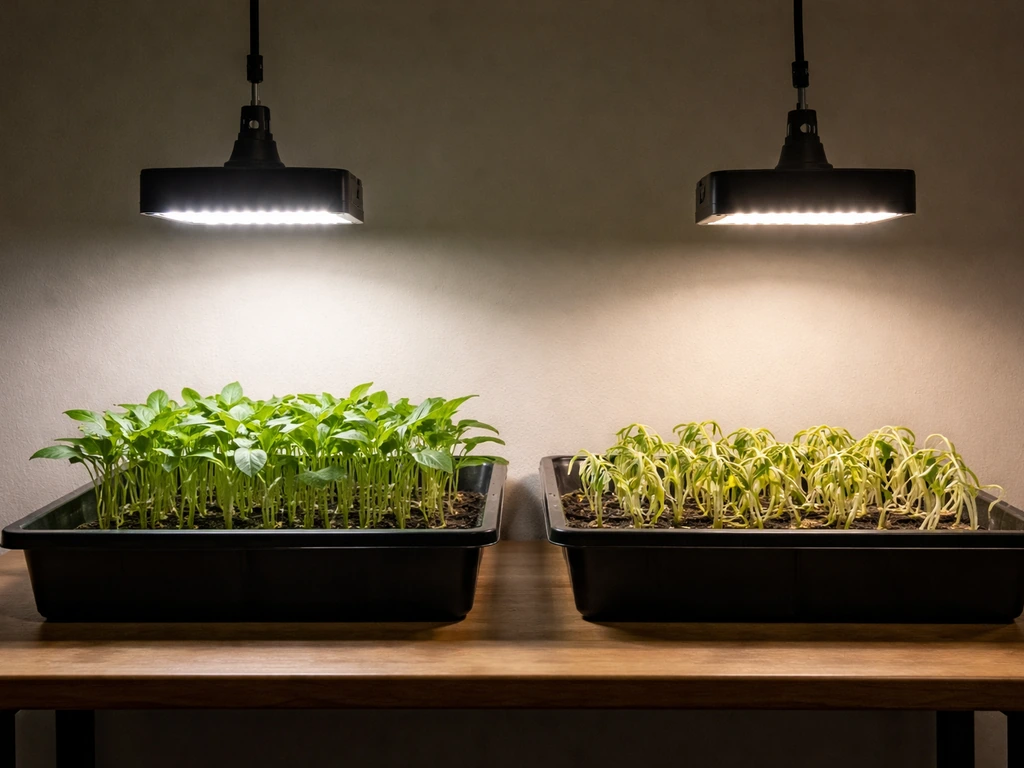
If you're thinking about this from an indoor gardening perspective, it's a lot like setting up a grow space in a room with one small north-facing window, except the window might randomly go dark for months. For a does money plant need sunlight to grow answer, you can treat it like a typical houseplant and provide brighter light for faster growth. You'd be shopping specifically for low-light tolerant plants.
Research on low-light photosynthesis shows that under PPFD at or below 200 µmol m⁻² s⁻¹, quantum yield (how efficiently each photon is used) is actually highest under red light. This means that if you're working with weak light, spectrum optimization becomes even more critical. Plants in dim conditions need their light to be the right colors.
| Plant type | Minimum PPFD needed | Likely outcome with Martian sunlight alone |
|---|---|---|
| Lettuce, spinach, chard | 100–200 µmol m⁻² s⁻¹ | Possible on clear days, slow growth, vulnerable to dust storms |
| Herbs (basil, cilantro) | 150–250 µmol m⁻² s⁻¹ | Marginal at best, likely leggy and weak without supplementation |
| Tomatoes, peppers | 400–600 µmol m⁻² s⁻¹ | Not viable without significant LED supplementation |
| Wheat, root vegetables | 300–500 µmol m⁻² s⁻¹ | Not viable for reliable caloric production |
| Low-light houseplants (pothos, ferns) | 50–100 µmol m⁻² s⁻¹ | Could survive, but limited practical food value |
| Microgreens | 100–150 µmol m⁻² s⁻¹ | Probably the most realistic short-cycle crop with minimal supplementation |
The takeaway is that if you were constrained to Martian sunlight with minimal supplementation, you'd be focusing on fast-growing, low-light leafy crops and microgreens, and accepting that fruiting crops are off the table. NASA has also explored the concept of engineering plants specifically suited to harsh Martian conditions, recognizing that off-the-shelf Earth crops aren't well matched to the environment.
How to supplement with LEDs: the practical lighting plan
This is where the approach aligns closely with what indoor growers already do. The ISS Veggie plant growth system uses red, blue, and green LEDs to grow lettuce and other crops in orbit, completely independent of sunlight. That same logic applies to a Mars habitat: LEDs can deliver precise spectrum and intensity regardless of what the sun is doing outside. The Veggie program has already demonstrated multiple successful lettuce harvests using this approach in a space environment.
For a Mars-inspired LED lighting plan, the principles are straightforward. Research on space crop lighting shows that a ratio heavily weighted toward red with a fraction of blue works well: something like a 95:5 red-to-blue ratio placed close to the plant canopy was found effective for lettuce at Purdue. NASA's own LED recipe testing for space crops has explored various red/green/blue ratios to optimize growth under spacecraft constraints.
Here's how you'd approach building a supplemental lighting plan for a Mars-style grow setup:
- Set your PPFD target based on your crop. Leafy greens: aim for 150–200 µmol m⁻² s⁻¹. Herbs: 200–300. Fruiting crops: 400+.
- Use DLI as your daily check. Multiply your PPFD target by your photoperiod in seconds, then divide by 1,000,000 to get mol m⁻² day⁻¹. Lettuce typically wants 12–17 mol m⁻² day⁻¹.
- Choose LED fixtures that specify their output in µmol m⁻² s⁻¹ at the canopy distance you'll be using, not just wattage.
- Weight your spectrum toward red (600–700 nm) with meaningful blue (400–500 nm) content. At low intensities especially, red delivers the best quantum yield.
- If Mars sunlight is contributing at all, measure or estimate it and use that as your baseline, then top up with LEDs to hit your target. Don't ignore the free photons.
- Plan for dust storm contingency. During a storm that cuts surface light by 80%, your LEDs need to cover the full PPFD target alone. Size your system for that worst case.
Power is the big constraint on Mars, just as it is in a small apartment where you're watching your electricity bill. LEDs are the right choice precisely because they're the most efficient way to convert watts into plant-usable photons. Full-spectrum or red/blue LED panels used close to the canopy will always outperform trying to capture and focus weak Martian sunlight through a complicated optical system.
How to measure, plan, and iterate for a Mars-style grow setup
Whether you're actually thinking about Mars or just dealing with a really dim grow space here on Earth, the process for dialing in your light plan is the same. Start with measurement. A PAR meter (quantum sensor) tells you the actual PPFD hitting your canopy in µmol m⁻² s⁻¹. If you don't have one, many LED grow light brands now publish PPFD maps for their fixtures at different mounting heights, which gets you close enough to start.
From there, calculate your DLI. If your PAR meter reads 180 µmol m⁻² s⁻¹ and you're running lights for 16 hours, your DLI is roughly 10.4 mol m⁻² day⁻¹. That's enough for lettuce to grow but on the low end. Bump to 200 µmol m⁻² s⁻¹ or extend to 18 hours and you'll see better results. On Mars, you'd do the same math but start by estimating the PAR contribution from outside and fill the rest with LEDs.
Iteration is the honest part. Your first crop will teach you things no calculation will. Plants stretch toward light (etiolation) if PPFD is too low. Leaves bleach or show stress if intensity is too high or spectrum is off. Watch your plants the way you'd watch any experiment and adjust. Lettuce that's growing slowly but not stretching is telling you the light is almost right. Lettuce flopping sideways is telling you it needs more.
For a Mars-analog setup specifically, the practical steps would be: test your crop under LED-only conditions first to establish a baseline, then introduce simulated weak sunlight (or move your setup somewhere with indirect light) and see whether growth improves or stays the same. If natural light isn't moving the needle, it's not worth the engineering complexity to harvest it. Put your energy budget into reliable LEDs. That's essentially what NASA's approach with the Veggie system on the ISS concluded: controllable artificial lighting beats dependence on variable natural light in space environments.
If you want to go deeper on the underlying plant physiology, the relationship between light intensity and plant growth, or how to choose the right light levels for specific species, those topics connect directly to how plants use sunlight in general and how much light different species actually require. If you want the deeper biology of why do plant need sunlight to grow in the first place, it helps to understand how plants convert light into energy. Understanding those fundamentals will make you a much sharper troubleshooter, whether you're growing lettuce on Mars or in your apartment under a grow light.
FAQ
Why can’t I use the W/m² numbers to decide if Mars sunlight is enough?
You can get a rough sense, but you should not treat W/m² like a plant-ready metric. Plants respond to PPFD or DLI (photon flux), so two locations with the same total irradiance can still deliver very different usable PAR due to dust, clouds, and spectral changes.
Is there any crop that could realistically grow on Mars with sunlight alone?
It depends on the specific crop and what you mean by “grow.” Leafy greens and microgreens can potentially photosynthesize at low PPFD, but reliably producing fruit, flowers, or large biomass usually requires much higher DLI over multiple weeks, which Mars sunlight cannot guarantee during dust events.
Could a Mars greenhouse “store” enough sunlight for later when dust storms hit?
Yes, but only for limited, tightly defined conditions. If you design a system that buffers dust-related dropouts (for example, a light-collecting and transmitting shell plus always-on LED backstop), you can survive periods of low solar input, but the LEDs are still doing the heavy lifting for food production.
If Mars gets brighter during some periods, will plant growth automatically improve?
Not necessarily. Martian dust can reduce PAR and shift spectra, which changes how efficiently plants use each photon. That means a crop can show “enough light” by wattage while still underperforming because the photons that arrive are fewer or less effective.
Do plants need UV light on Mars, or is it harmful?
UV is not the same as visible PAR. Mars has higher surface UV exposure without an Earth-like ozone shield, which can damage plant tissue and also force any protective habitat shell to absorb some radiation. In practice, that often means you must filter UV while supplementing visible light.
How do I plan lighting for the worst-case dust storm, not just average sunlight?
More than people expect. If you size LEDs only for average conditions, a dust-storm weeks-long reduction can starve plants unless you keep a safety buffer in your DLI target. A practical approach is to design for the worst-case PPFD you can tolerate, then confirm with measurements.
How much do photoperiod and day length matter on Mars plant growth?
Yes. Even if you have similar PPFD, changing photoperiod changes DLI and can alter growth patterns. For many leafy crops, staying within a proven photoperiod range matters, and on Mars you would likely keep the light schedule under your control using LEDs rather than relying on sunlight timing.
Does Mars having a sol similar to Earth make lighting planning easy?
It can, if you rely on window- or skylight-like designs. Mars has a sol that is close to Earth’s day, but dust-driven shading is unpredictable. If you want consistent growth rates, you still need an internal light control system that delivers stable PPFD.
What spectrum should I prioritize if I’m only getting weak light from the environment?
Spectrum management becomes more important at low light. With weak PPFD, red photons often drive higher photosynthetic efficiency, and you may need a stronger red-to-blue emphasis and close canopy placement to avoid slow growth and stretching.
Where should I measure PPFD to know if my Mars-style setup is working?
Measure at the plant canopy, not in the air or at a fixture. PPFD changes with mounting height, angle, and enclosure materials, so you should validate what your plants actually receive using a PAR/PPFD meter or calibrated mapping.
What plant signs tell me the light is too dim or too intense in a Mars-like habitat?
Watch for stretch, leaf color changes, and recovery behavior after you adjust. Stretching (etiolation) suggests too low PPFD, while bleaching or stress can indicate excessive intensity or an imbalanced spectrum, so your iteration cycle should adjust one variable at a time (intensity, spectrum, or photoperiod).
What’s the most practical way to test whether Mars-like natural light is worth it in an experiment?
You should still test “LED-only baseline” first. That tells you the crop’s expected performance under ideal spectrum and stable DLI, then you can add simulated weak daylight and quantify whether natural light provides any measurable benefit beyond what the LEDs already achieve.