Yes, colored lights absolutely affect how plants grow, and the differences are meaningful enough to change whether your seedlings stay compact or get leggy, whether your tomatoes flower on time, and whether your herbs stay bushy or bolt toward the ceiling. If you are doing a science fair experiment on plant growth, focus on matching a common blue-red grow-light setup and test how different wavelengths change seedling height and leafiness.
Can Colored Lights Affect How Plants Grow Indoors?
Marcus Hartley
22 May 2026
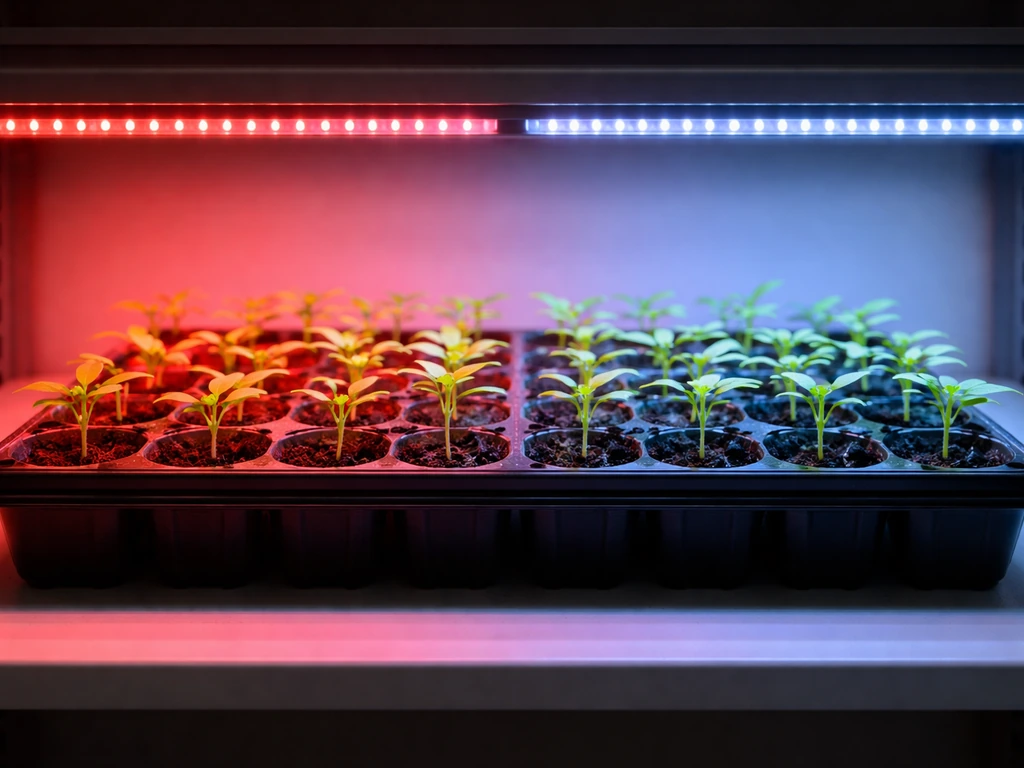
Researchers also showed that light is essential for plant growth, which is why seedlings kept in darkness fail to develop properly light to grow. The short version: blue light (400–500 nm) keeps growth compact and drives leafy development; red light (600–700 nm) powers photosynthesis and promotes flowering; far-red (700–750 nm) can trigger flowering and stretch stems depending on how much other light is present; green and yellow light contribute more than people think but aren't your primary tools.
Most indoor growers do best with a full-spectrum or red-plus-blue LED that covers the key bands, dialed in at the right intensity and distance for their current growth stage.
Why the color of light matters to your plants
Plants don't just absorb light, they read it. They have specialized photoreceptors that detect specific wavelengths and trigger completely different responses depending on what they sense. The two main families you need to know about are phytochromes, which detect red and far-red wavelengths, and cryptochromes and phototropins, which detect blue light and UV-A. These aren't passive pigments sitting in a leaf, they're active molecular switches that regulate everything from how fast a seedling stretches to whether a plant decides it's time to flower.
Phytochromes work by toggling between two states depending on the ratio of red to far-red light hitting the plant. A high red-to-far-red ratio (like direct sunlight or a good grow light) tells the plant it has plenty of light and can grow compact and bushy. A low red-to-far-red ratio (like the light filtering through a canopy of other leaves, or a dim incandescent bulb) signals shade, and the plant responds by stretching upward fast, reducing branching, and sometimes flowering early.
This is called the shade-avoidance response, and it's why plants grown under the wrong light turn into tall, floppy, unproductive versions of themselves. If you are wondering why plants grow taller with less light, the shade-avoidance response under insufficient effective light is a key reason they stretch upward why do plants grow taller with less light.
Blue light receptors (cryptochromes and phototropins) respond almost instantly. Research on cucumber seedlings showed that blue light was suppressing stem elongation within about 30 seconds of exposure. These receptors also govern phototropism (why your plant leans toward a window), stomatal opening, and generally whether a plant invests energy in compact leaf growth versus reaching for more light. More blue in your spectrum means more compact, stocky plants with good leaf development. Less blue and you'll often see plants that stretch and lean even when total brightness seems adequate.
What each color actually does in practice
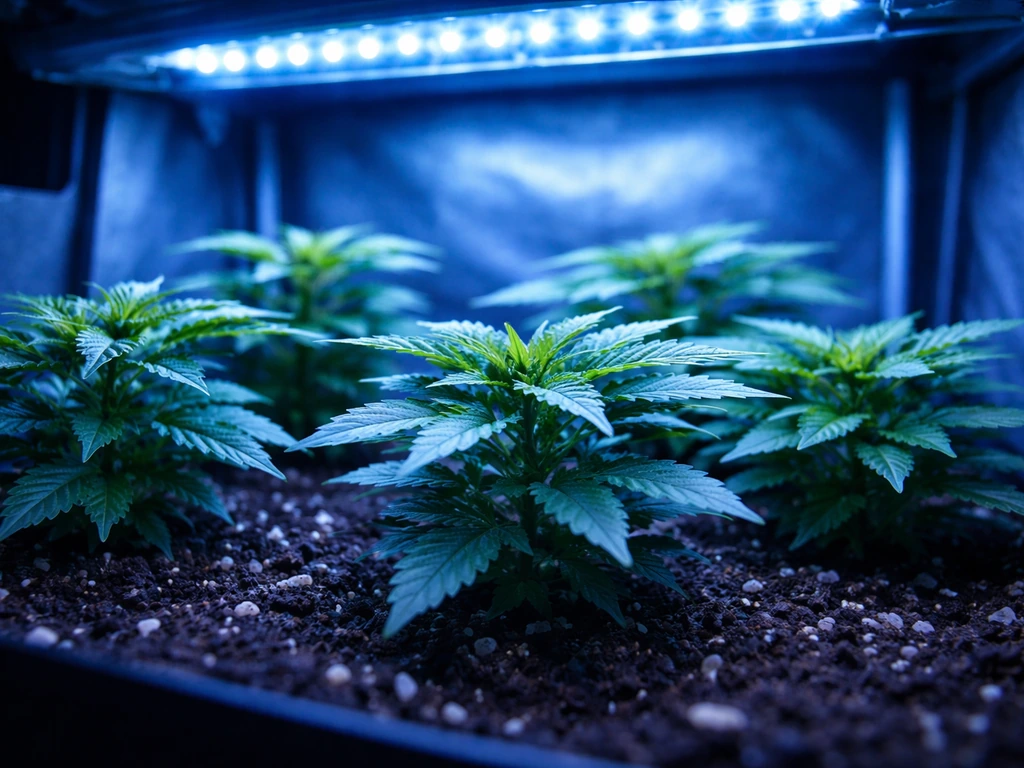
Understanding the theory is one thing, but here's what you'll actually observe with each part of the spectrum when you're growing indoors.
Blue light (400–500 nm)
Blue is the compactness signal. It suppresses internode elongation, which means shorter distances between leaf nodes and a stockier, bushier plant. It's essential during the seedling and vegetative stages. If you're starting seeds under lights and they're getting leggy even though the light is on for 16 hours, the most common culprit is not enough blue, or not enough total intensity (more on that distinction shortly).
A spindly or [leggy](https://www. ufseeds. com/on/demandware. static/Sites-UrbanFarmer-Site/Sites-UrbanFarmer-Library/default/images/Spindly-Plants.
pdf) seedling is commonly linked to insufficient light, and the PDF explains the light-based causes and practical fixes for improving seedling growth. Blue-only lights, though, can actually cause stress or slow growth if the intensity is too low, because the plant gets the suppression signal without enough total photons to actually photosynthesize well.
Red light (600–700 nm)
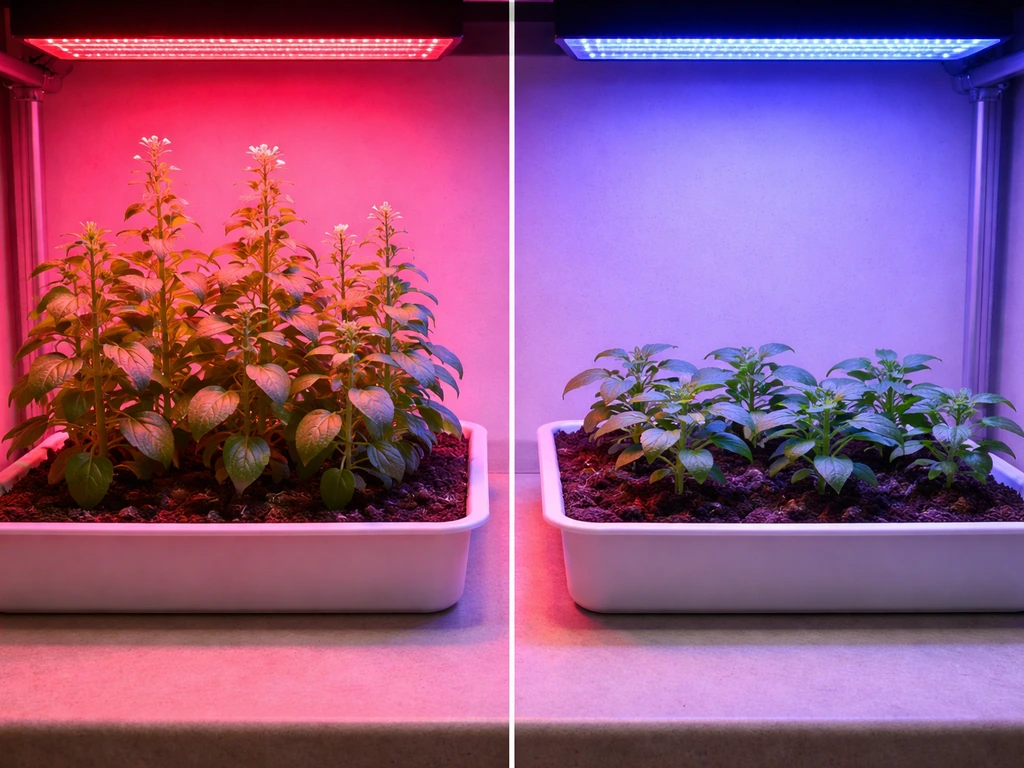
Red is the photosynthesis workhorse. Chlorophyll absorbs red light very efficiently, making it the most productive wavelength for driving carbon fixation and plant growth. Red alone, however, can lead to plants that grow tall and don't branch well, because without the balancing effect of blue, the plant architecture can get loose and floppy. Red light also plays a key role in triggering flowering in many species by setting the phytochrome ratio in the plant's favor. The classic 660 nm hyper-red LED is specifically used in horticulture because it's at the peak of chlorophyll absorption and phytochrome photoconversion.
Far-red light (700–750 nm)
Far-red is the trickiest band to work with because its effects depend heavily on how much other light is present. At low light intensities, far-red tends to push stem elongation and direct biomass toward stems rather than leaves. At higher light intensities, it instead promotes leaf expansion and can meaningfully increase overall photosynthesis because the plant can use those extra photons productively. Far-red also strongly influences flowering: a pulse of far-red light at the end of the photoperiod can flip phytochrome states and trigger (or delay) flowering depending on the plant species. Purpose-built far-red LEDs around 730 nm are sometimes added to flowering-stage setups specifically for this effect.
Green and yellow light (500–600 nm)
Plants reflect a lot of green light, which is why they look green, but they don't ignore it. Green light can penetrate deeper into the leaf canopy than red or blue, reaching lower leaves that would otherwise be shaded. Some research suggests green light can drive photosynthesis more efficiently than red or blue under certain canopy conditions.
Yellow and amber light (around 580–620 nm) sit between the main absorption peaks and contribute less directly to photosynthesis, which is why pure yellow light is a poor choice as your only light source. That said, full-spectrum white LEDs include green and yellow naturally, and this is part of why they often outperform pure red-plus-blue purple lights in practice, especially for diverse houseplant setups.
The USU Extension poster also reports that green light can drive leaf photosynthesis more efficiently than red/blue comparisons under certain conditions, with about a 5, 30% efficiency advantage outperform pure red-plus-blue purple lights.
This is also why the plants grow best in white light hypothesis is often compared against pure red-blue setups when people test grow lights.
Color matters, but intensity and photoperiod matter just as much
Here's where a lot of indoor growers go wrong: they swap in a colored grow light, expect magic, and then wonder why their plants still struggle. The color (spectrum) is one variable, but two others are equally important: PPFD (photosynthetic photon flux density, measured in µmol/m²/s) which tells you how many usable photons are actually hitting your plant per second, and photoperiod, which is simply how many hours of light your plant gets each day. Together, these determine your Daily Light Integral (DLI), which is the total photon dose your plant receives over 24 hours.
A plant under the perfect red-blue spectrum but at only 50 µmol/m²/s will still grow poorly. If you increase light intensity enough, plants can grow taller and stronger, but only when the spectrum and photoperiod are also appropriate. The photons just aren't there to sustain real photosynthesis.
On the flip side, a full-spectrum LED running at the right PPFD for the right number of hours will outperform a fancy specialized fixture that's mounted too far away or run for too few hours. When you're shopping for or evaluating grow lights, look for PPFD ratings at a specific distance, not just wattage. A 45-watt LED panel from one brand might deliver twice the PPFD at canopy level compared to another 45-watt light with poor optics.
As a practical rule: if your total PPFD at canopy level is too low, no spectrum tweak will save you. Get intensity right first, then optimize spectrum for your growth stage.
Which light spectrum to use at each growth stage
Different growth stages genuinely benefit from different spectral emphasis. Here's how to think about it practically, with rough PPFD targets to go alongside the spectrum advice.
| Growth Stage | Recommended Spectrum | PPFD Target (µmol/m²/s) | Photoperiod |
|---|---|---|---|
| Germination / sprouting | Warm white or full-spectrum; low blue is fine | 100–200 | 16 hours |
| Seedlings (cotyledon to first true leaves) | Full-spectrum with good blue content | 200–400 | 16–18 hours |
| Vegetative growth | Full-spectrum or blue-weighted; 3:1 to 5:1 red:blue ratio | 300–600 | 16–18 hours |
| Flowering / fruiting | Red-weighted full-spectrum; add far-red if possible | 400–1,200 | 12–14 hours (for short-day plants) or 18 (for long-day) |
| Low-light houseplants (maintenance) | Full-spectrum white; modest blue | 50–150 | 12–14 hours |
For seedlings in particular, a DLI of around 12 mol/m²/day is a commonly cited target for healthy early growth. If your fixture delivers 300 µmol/m²/s at canopy level and you run it for 16 hours, you're right in that zone. The spectrum during seedling stage should lean toward blue to prevent legginess, but full-spectrum white LEDs usually have enough blue baked in to do this job without buying a specialized blue-only light.
For flowering and fruiting plants like tomatoes, peppers, or strawberries, you want a higher proportion of red and can benefit from a far-red supplement (730 nm) to help trigger and sustain flowering. Some full-spectrum LED panels marketed for flowering already include far-red diodes. If yours doesn't and your fruiting plants seem slow to flower, a supplemental far-red LED bar is an inexpensive addition.
How to set up your colored lights today
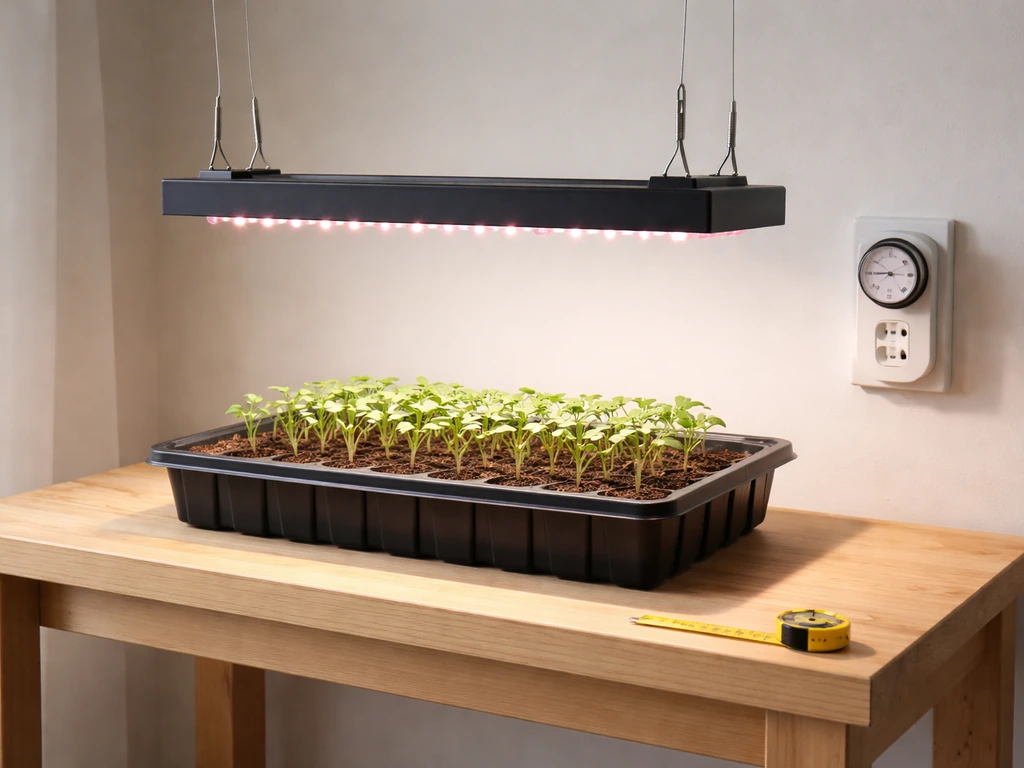
Setup is where the theory becomes real. Here's a practical checklist for getting your lighting right from day one.
Distance from the canopy
Most LED grow lights for seedlings should sit 8–12 inches above the canopy. For more mature, light-hungry plants, 12–18 inches is common depending on the fixture's output. Start on the higher end and move the light closer if you see stretching, or further away if leaves show bleaching or curling. Fluorescent tubes (like T5s) can get as close as 4–6 inches from seedlings without heat stress. High-output LEDs need more distance or they can bleach the top leaves while lower leaves stay starved for light.
Timer setup
Get a basic mechanical or digital outlet timer. Set it for 16–18 hours on for seedlings and vegetative plants, and 12–14 hours for flowering species that need a dark period to bloom (most fruiting vegetables and many flowering houseplants). Consistency matters more than perfection: plants are sensitive to the dark period being disrupted, especially during flowering. Even a brief light leak during the dark cycle can reset flowering signals in sensitive species.
Avoiding heat stress
LEDs run much cooler than HPS or metal halide fixtures, but they still generate heat. Hold your hand at canopy level: if it's uncomfortable after 30 seconds, it's too hot for your plants too. Keep the growing area between 65–75°F. If you're in a small tent or enclosed space, add a small fan for airflow. This matters for both heat management and for strengthening stems (the slight movement from airflow makes stems thicker and more self-supporting).
Measuring what your light actually delivers
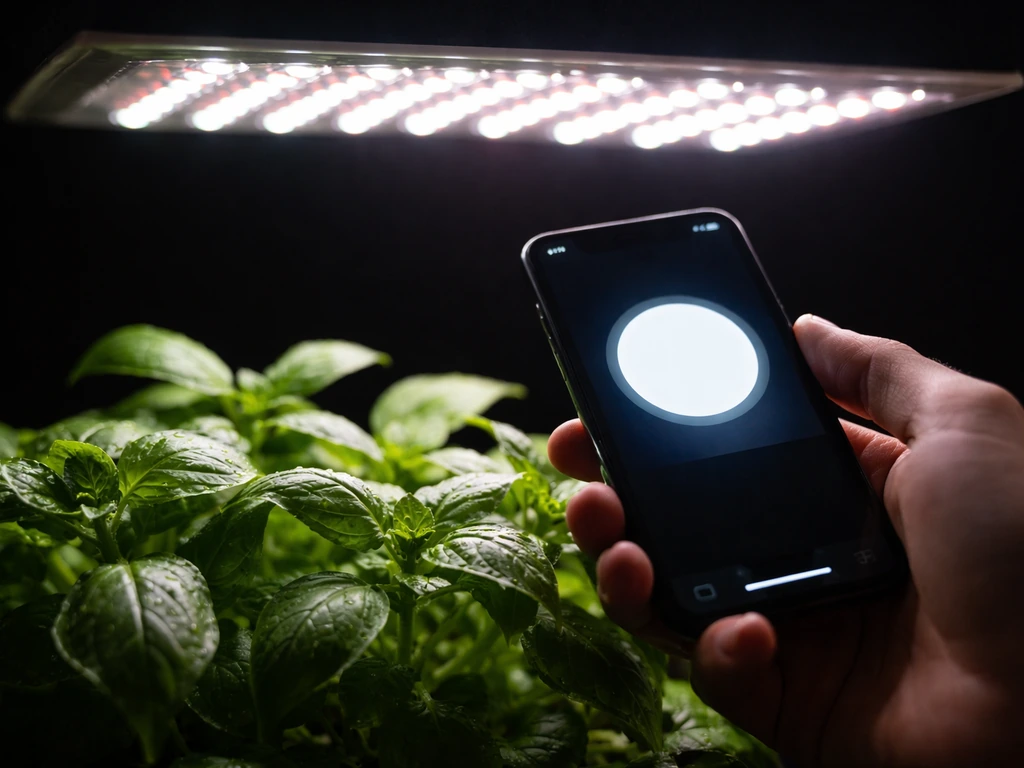
You can download a lux meter app on your smartphone to get a rough sense of relative intensity across your growing space. It's not PPFD-accurate, but it will tell you if one corner is dramatically dimmer than another and help you position plants or adjust fixture height. For a more accurate reading, clip-on PPFD meters have come down in price significantly and are worth the investment if you're running multiple lights or growing anything that needs to flower and fruit.
Reading your plants: what's going wrong and why
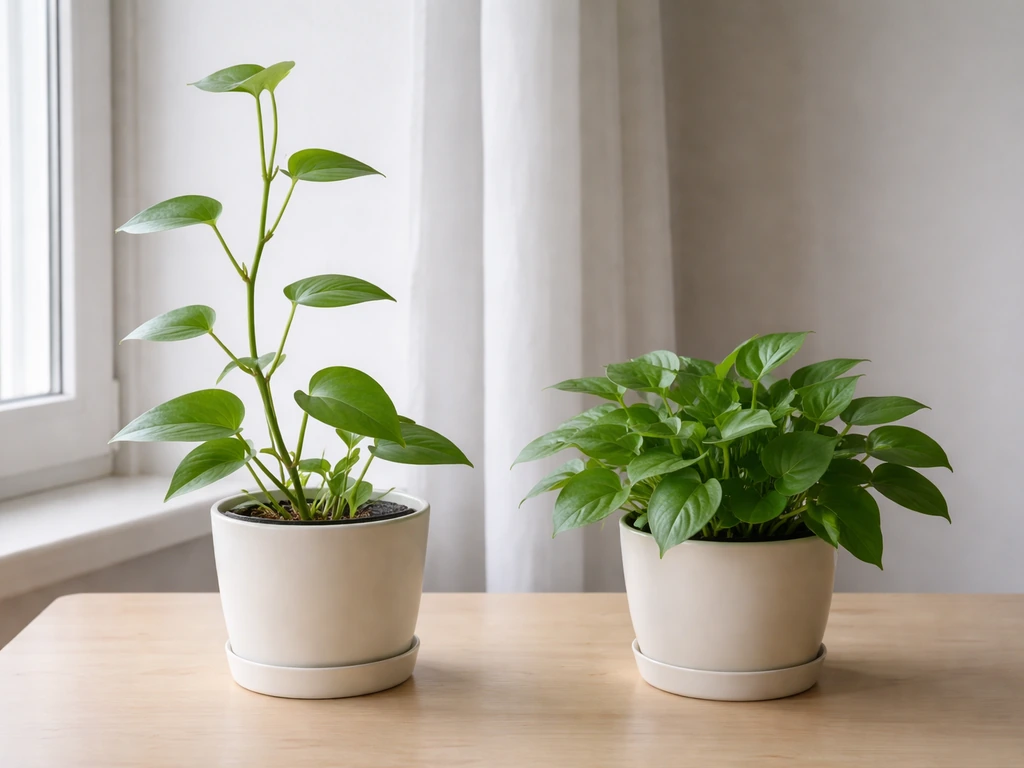
Your plants will tell you when something is off with your lighting. Here's a quick troubleshooting guide for the most common symptoms.
- Leggy, stretched stems with wide gaps between nodes: Almost always a light intensity problem (PPFD too low) or light is too far away. Can also be a blue-deficiency issue if you're using a purely red or warm-white light. Move the light closer, or add a blue-weighted LED to the mix.
- Pale or yellowing leaves under a grow light: Could be light intensity too high (bleaching) if leaves closest to the light are worst, or too low overall (the plant can't produce enough chlorophyll without enough photons). Check distance and PPFD.
- Slow or stalled growth despite lights running all day: Check your actual PPFD at canopy level. A cheap grow light may only deliver 50–80 µmol/m²/s at 18 inches, which is maintenance territory, not growth territory. You either need a stronger fixture or to move the light much closer.
- Plant leans hard toward one side: Classic phototropism, the plant is reaching for light. Either center the fixture above the plant or rotate the pot every few days. Also a sign the light intensity may be uneven across the canopy.
- Won't flower despite being old enough: For short-day plants (like petunias, chrysanthemums, or cannabis), they need an uninterrupted dark period of 12+ hours. Any stray light during the dark period can prevent flowering. Also consider adding far-red light at the end of the photoperiod to enhance the phytochrome transition signal.
- Leaves curling downward or showing bleached patches at the top: Light too close or too intense. Raise the fixture 4–6 inches and reassess after a few days.
Choosing and combining real lights for your space
With so many light options out there, here's how to think about what to actually buy or use with what you already have.
Full-spectrum LED panels
For most indoor gardeners, a quality full-spectrum LED panel is the best single investment. These combine white LEDs (which span the full visible spectrum) with additional red and sometimes far-red diodes to cover all the key bands. They're energy-efficient, run cool, and work well from seedling through flowering. Look for panels that publish PPFD maps at specific distances rather than just wattage claims. Brands that provide this data are being honest about real-world performance.
Red-blue "blurple" LED panels
The purple-looking panels that only emit red and blue LEDs were popular a few years ago and do work, but they have limitations. They can feel unnatural to work under (everything looks wrong in purple light, making it hard to spot plant health issues), and they often skip the green wavelengths that help with canopy penetration. They're fine for dedicated grow rooms where you're not trying to assess plant color, but for most home setups, a full-spectrum white-dominant panel is more versatile and easier to use.
Fluorescent tubes (T5, T8, CFL)
Fluorescent lights, especially T5 high-output fixtures, are still excellent for seedlings and herbs. They run cool, can be placed very close to plants, and the 6500K cool-white spectrum has plenty of blue for compact vegetative growth. Their main limitation is that they don't have enough red output for serious flowering or fruiting crops, and they're less energy-efficient than modern LEDs. If you already have a T5 setup for seedlings, keep it. If you're starting from scratch and want one light that does everything, go LED.
LED strips and supplemental bars
LED strip lights are great for supplementing existing natural light or adding light under shelves. A warm white (3000K) strip under a grow shelf helps herbs and low-light plants stay productive. If you want to supplement for flowering, a dedicated 660 nm red or 730 nm far-red bar mounted alongside your main fixture is an inexpensive and targeted approach.
Comparing your options
| Light Type | Best For | Spectrum Coverage | Limitations |
|---|---|---|---|
| Full-spectrum LED panel | Seedlings through flowering, all-in-one | Excellent (full visible + red/far-red) | Higher upfront cost than fluorescent |
| Red-blue LED panel | Dedicated veg/flower rooms | Red and blue only | Hard to assess plant health visually; skips green |
| T5 fluorescent (6500K) | Seedlings, herbs, leafy greens | Good blue, decent green | Weak red; not ideal for fruiting plants |
| CFL (cool-white) | Seedlings, small herb setups | Decent blue | Low output; needs to be very close to plants |
| LED strips (warm white) | Supplemental shelf lighting | Decent full-spectrum | Low PPFD; not sufficient as sole source for most plants |
| Far-red LED bar (730 nm) | Flowering supplement | Far-red only | Must be combined with a main light source |
If you're starting with a limited budget, a pair of cool-white T5 bulbs or a basic full-spectrum LED bar gets seedlings going reliably. Once you're growing plants that need to fruit or flower, upgrading to a proper full-spectrum LED panel with red diodes is where you'll see the biggest jump in results. You don't need to spend hundreds to get a light that works, but you do need to spend enough to get one that publishes honest PPFD numbers and covers the full spectrum.
Quick next steps based on your setup
Not everyone is in the same situation, so here's what to do first depending on where you are right now.
- Starting seeds under colored LEDs: Make sure you have enough blue (cool white or full-spectrum, not warm-only), position the light 8–12 inches above the tray, set a timer for 16–18 hours, and check for legginess in the first week. Leggy seedlings at day 7 mean you need the light closer or a stronger fixture.
- Low-light room with no direct sun: Supplement with a full-spectrum LED bar or panel running 14–16 hours. Even modest LEDs can keep low-light houseplants healthy if run long enough each day. Aim for at least 50–100 µmol/m²/s at canopy level.
- Balcony or indirect natural light: Natural light, even indirect, often provides better spectral balance than cheap grow lights. Use grow lights to extend the day length in winter or supplement a north-facing window, rather than replacing natural light entirely.
- Established houseplants that seem stalled: Check distance from your light source first. If a plant is more than 3 feet from a window or more than 18 inches below an LED, it's probably light-starved. Move it closer before buying new gear.
- Flowering plants that won't bloom: Make sure short-day plants get an uninterrupted 12-hour dark period. Consider adding a far-red LED bar timed to run for the last 15 minutes of your photoperiod to enhance the phytochrome signal for flowering transition.
The most important thing is to treat your light setup as something you actively manage, not just plug in and forget. Move the fixture as your plants grow, watch how the plants respond, and adjust. The science is real and the tools are accessible. Getting the spectrum right is genuinely useful, but it works hand-in-hand with getting intensity and photoperiod right, and those three things together are what turn a struggling indoor garden into one that actually thrives. Most plants grow best under a full-spectrum white LED that includes strong red and blue, then is tuned for the right intensity at the canopy what color light do plants grow best in.
FAQ
If I switch from a red-blue grow light to a full-spectrum LED, will plant growth automatically improve?
It can, but most “light color” problems are actually intensity or timing problems. If you keep the spectrum the same and increase PPFD at canopy level, plants usually improve even if the colors are not perfect. If PPFD and DLI are already adequate, then spectrum tweaks for blue, red, or far-red can fine-tune compactness and flowering.
Can colored lights make plants look compact even if they are not actually getting enough light?
Sometimes. Blue can suppress elongation, but blue-only or blue-heavy setups often under-serve total photon delivery if the intensity is low, leading to slow growth. The practical check is your canopy PPFD and DLI, not just the visible color of the LEDs.
What does too much red light do, and how can I tell if my plants are getting a red-heavy spectrum?
Yes, and it usually shows up as poor branching, floppy stems, or delayed flowering even when brightness seems similar. Red-heavy light can push photosynthesis, but without enough blue, plants may develop a looser architecture. Balancing red with sufficient blue, or using a full-spectrum panel, is the simplest fix.
Should I always add far-red (730 nm) to my grow lights?
Far-red can trigger shade-avoidance effects and influence flowering signals, so it is not universally beneficial. Use far-red mainly when the plant stage calls for it, for example when flowering is lagging in a system that already meets your intensity and photoperiod needs.
How can I shop for grow lights if the product only lists watts and “colors” but not PPFD?
The best targets are usually described as DLI and PPFD at the canopy, but many products only show wattage or marketing color. If a fixture does not publish PPFD at a stated distance, you may need a clip-on PPFD meter to verify you are actually delivering enough photons for your growth stage.
Do I need to re-measure PPFD and adjust distance during the grow cycle?
Yes. LEDs shift output with temperature and with driver performance over time, and the distance between the fixture and canopy matters a lot. Recheck height and PPFD mid-grow, especially if you move lights, prune heavily, or notice bleaching or new legginess after a change.
Can small light leaks during the dark cycle affect flowering?
It can be risky. Many flowering plants need an uninterrupted dark period, and even brief light leaks can interfere with flowering cues. Use a timer plus a covered, fully enclosed setup during the dark phase, and avoid opening grow tents at random during lights-off hours.
Why do plants sometimes seem “fine” in purple grow light but look worse later under normal light?
Yes, from the practical side, color can change how you perceive plant health. Purple-only lighting can make true leaf color issues (chlorosis, nutrient problems) harder to diagnose visually, even if growth is technically happening. If you troubleshoot often, full-spectrum white helps you spot problems sooner.
Does green light actually help, or is it mostly irrelevant compared with blue and red?
Yes. Green light can penetrate deeper into dense canopies, which matters for multi-layer plants like tomatoes or dense herb stands. If your plants have lower leaves staying pale, adding a full-spectrum source (which includes some green) can help even if blue and red percentages look similar to another setup.
My seedlings are leggy even though the lights are on 16 hours, what should I check first?
Yes. If your seedlings stretch within the first 1 to 2 weeks under a 16-hour schedule, the fastest diagnostic steps are, measure PPFD at canopy level, verify the timer is truly consistent, then confirm your spectrum includes enough blue. Only after those checks should you change bulbs, because “more hours” or “different color” rarely fixes low photon delivery.
How does timing of different colors (like far-red near the end of the day) change results?
Yes, because photoreceptors respond to the ratio and duration of wavelengths, not just total “brightness.” For example, using a far-red pulse near lights-off can shift flowering behavior, but the effect depends on your overall light level and the plant species. If you add far-red, keep everything else constant to know whether it is helping.
Are warm-white LED strip lights enough for growing herbs under shelves?
Sometimes, especially for herbs and low-light houseplants. Warm-white (around 3000K) strips can supplement natural light effectively for vegetative growth, but they may lack enough red-blue balance for heavy flowering or fast fruiting unless intensity and DLI are sufficient. If you switch to warm-white only, verify PPFD and watch for slower growth.