
Yes, philodendrons can grow in low light, and the heartleaf philodendron (Philodendron hederaceum) is genuinely one of the better houseplants for dimmer rooms. But there's a gap between surviving and actually looking good, and that gap matters a lot depending on what you're hoping for. In a low-light spot, a heartleaf philodendron will stay alive and push out occasional new leaves. In a brighter indirect-light spot, it grows quickly, produces large glossy leaves, and actually looks like the plant you bought. Knowing which outcome to expect from your current setup is the whole point of this guide.
Can Philodendron Grow in Low Light? Heartleaf Guide
Marcus Hartley
23 Apr 2026
Low-light reality check for philodendrons
"Low light" gets thrown around a lot in plant marketing, and it almost never means what people think it means. For indoor plants, low light is typically defined as roughly 25–100 foot-candles (FC) by University of Maryland Extension, which corresponds to conditions like north-facing windows or rooms lit mainly by overhead artificial lights. Missouri Extension stretches the low-light usable range for tropical houseplants to about 50–250 FC, noting that growth is always better with more light. A foot-candle is a measure of light intensity at the plant's surface, and what feels reasonably bright to your eyes can still be surprisingly dim from the plant's perspective.
Philodendrons as a group are tropical understory plants, which means in nature they're used to growing under a forest canopy with filtered, indirect light. That background does make them genuinely more shade-tolerant than something like a cactus or a fiddle-leaf fig. University of Maine Extension puts the practical PPFD target range for philodendrons at roughly 50–250 µmol/m²/s, which covers both the dim-but-survivable end and the brighter-indirect-light sweet spot. University of Maine Cooperative Extension also lists philodendrons at about 50, 250 µmol/m²/s PPFD and notes that when light is too low, growth slows and the plant can become leggy blank" rel="noopener noreferrer">50–250 µmol/m²/s PPFD. The RHS recommends growing Philodendron hederaceum in bright but diffused light, which is a useful anchor point: that's what "thriving" actually requires. RHS (Royal Horticultural Society) states that Philodendron plants thrive in bright, indirect light blank" rel="noopener noreferrer">bright but diffused light. Low light is a compromise, not a preference.
So the honest answer is: a heartleaf philodendron will survive low light better than most houseplants, but it won't thrive in it the way it would in bright indirect light. If you're asking "will it die?" the answer is probably not, as long as you're not in total darkness. If you're asking "will it look amazing?" you'll need either a better window or a grow light to get there.
Heartleaf philodendron specifics: what to actually expect
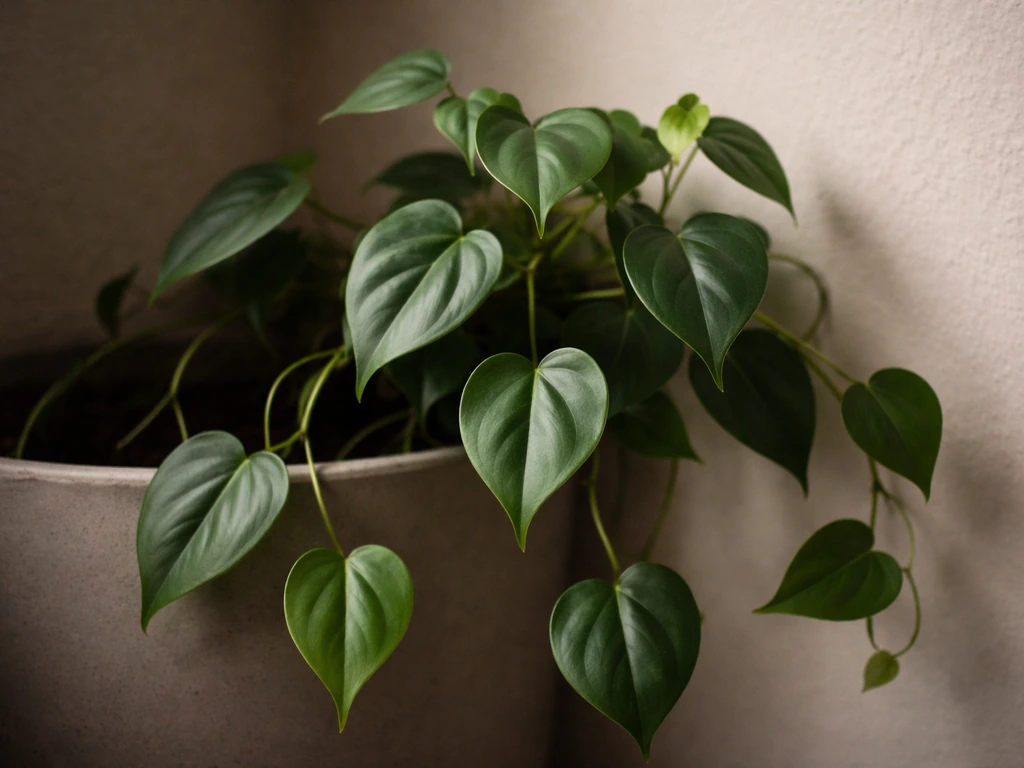
The heartleaf philodendron is one of the most forgiving houseplants you can own, and I say that from experience. I've kept one going in a north-facing apartment bedroom for over a year. It was alive. It had leaves. It was not impressive. The leaves that grew in that spot were noticeably smaller than the ones on the same plant near an east-facing window, and the vines got leggy, meaning longer stretches of bare stem between each leaf. That's the trade-off in real life.
Here's what low light does to a heartleaf philodendron over time. Growth slows dramatically, sometimes almost stopping in winter. New leaves come in smaller and sometimes paler than the rich green you'd see in better light. The internodes, which are the stretches of stem between leaves, get longer as the plant stretches toward any available light source. This is the "leggy" look that UC IPM identifies as a key sign of inadequate light. None of this is immediately fatal, but it does mean the plant is running on minimum. Over many months in very dim conditions, you may also see older leaves yellowing and dropping as the plant essentially sacrifices them to keep the newer growth going.
The good news is that heartleaf philodendron adapts reasonably well to lower light compared to many tropical plants. It won't throw a tantrum and drop all its leaves overnight the way some plants do. You get a gradual shift in growth habit rather than a crisis, which gives you time to diagnose and adjust.
How to tell if your plant is getting enough light
You don't need a light meter to get a decent read on whether your philodendron is light-stressed, though a basic foot-candle meter app on your phone can help. The plant itself is usually your best diagnostic tool. Here are the signs to watch for:
- Leggy stems with long gaps between leaves: this is the clearest signal that your plant is stretching for light. UC IPM specifically calls out excessively long internodes as a primary visual symptom of inadequate light.
- Smaller new leaves than older leaves: if the leaves coming in are noticeably tinier than the ones that grew when the plant was in better light, it's not getting enough energy to build full-sized leaves.
- Pale or washed-out leaf color: heartleaf philodendron should be a deep, glossy green. If new leaves are coming in lighter or yellowish-green, that's often a light (and sometimes nutrient) signal.
- Yellowing older leaves: University of Maryland Extension notes that leaf yellowing is an early stress symptom, and low light is one of the abiotic causes. A few lower leaves yellowing occasionally is normal, but if it's steady and progressing up the plant, check your light first.
- Very slow or stopped growth: in good conditions, a heartleaf philodendron pushes out new leaves regularly. If yours hasn't unfurled a new leaf in 6–8 weeks (outside of winter), light is likely the bottleneck.
- The shadow test: hold your hand 12 inches above a white piece of paper in the spot where your plant sits. A sharp, clearly defined shadow means decent light. A faint, fuzzy shadow means low light. No shadow at all means it's likely too dim even for a philodendron long-term.
If you want a number, the target range for philodendrons sits between roughly 50 and 250 µmol/m²/s in PPFD, or 50–250 foot-candles for practical placement. A free lux meter app on your phone isn't perfectly accurate, but it can give you a ballpark. Readings consistently below 200 lux (about 18–20 FC) in your plant's spot are a sign that even a tolerant philodendron will struggle over time.
Best low-light setups: windows, distance, and seasonal shifts
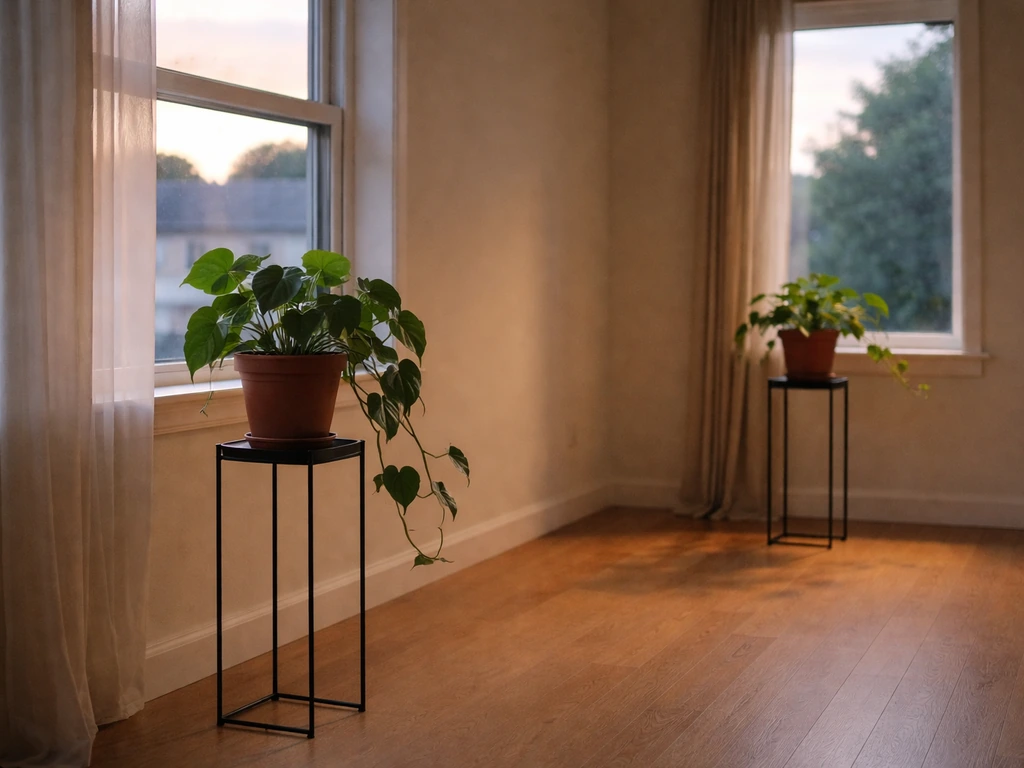
Window placement is still your first and most important tool, even before you think about grow lights. Not all "low-light" spots are created equal, and small changes in positioning can make a meaningful difference.
Window direction matters a lot
| Window Type | Typical Light Level | Philodendron Outcome |
|---|---|---|
| North-facing | 25–100 FC (low light) | Survives, slow growth, may get leggy |
| East-facing | 100–500 FC (low to medium) | Grows steadily, decent leaf size |
| West-facing | 150–500 FC (medium, afternoon) | Good growth, watch for direct afternoon sun |
| South-facing (with sheer curtain) | 200–1000+ FC (bright indirect) | Thrives, best leaf size and color |
| Interior room, no window nearby | 10–25 FC (very low) | Barely survives, needs a grow light |
For a north-facing window, place your heartleaf philodendron as close to the glass as possible, ideally within 1–2 feet. Light intensity drops off rapidly with distance from the source, so a plant sitting 6 feet back from a north window is getting a fraction of what it would get right on the sill. University of Maryland Extension recommends increasing distance from a window (or using a sheer curtain) to manage excessive sun, which is the same logic in reverse: distance reduces intensity, so keep low-light plants close to whatever window they have.
Seasonal changes catch people off guard. A spot that worked fine for your philodendron in July may not be bright enough by November in most of North America, because the sun is lower in the sky and day length shortens. If your plant was doing well and starts showing leggy growth or yellowing leaves heading into fall and winter, the season is probably the culprit. This is when moving the plant closer to the window or adding a grow light makes the biggest difference. In spring, do the reverse: check that your previously fine north window spot hasn't suddenly become too intense as the sun's angle shifts. Penn State Extension notes that plants acclimate to their light conditions over time, so gradual moves are always easier on the plant than sudden ones.
Grow lights for low-light rooms: LED vs fluorescent vs other options
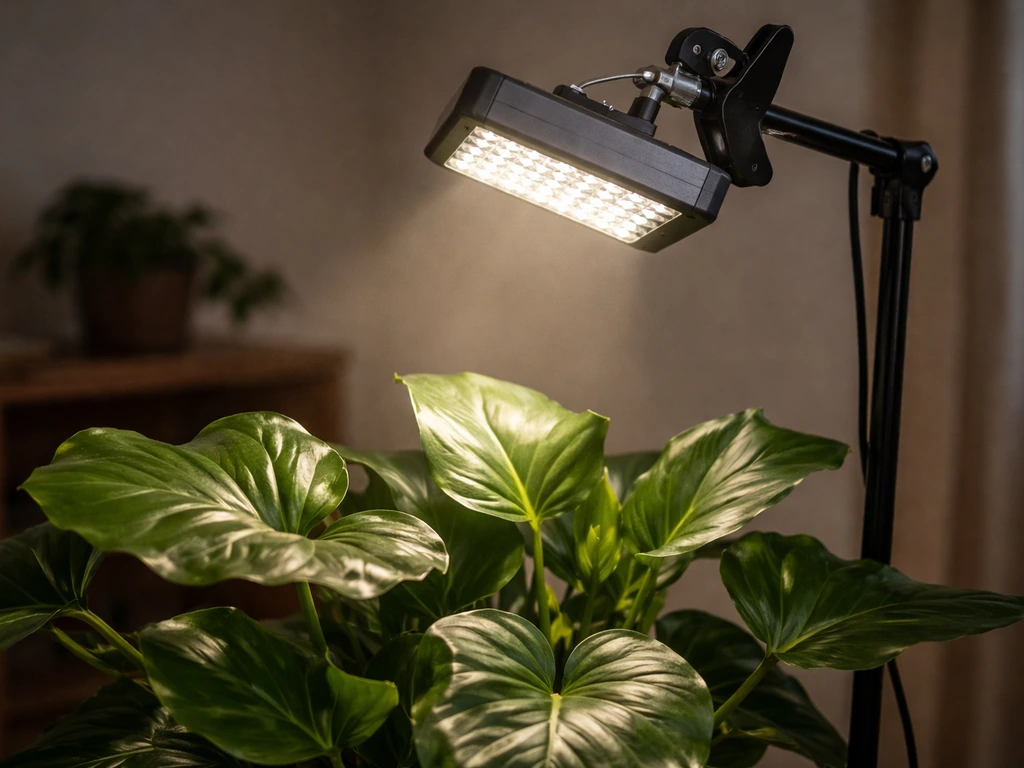
If your space genuinely doesn't have a window that delivers enough light, a grow light is the practical fix. They've gotten much more affordable and less ugly in recent years, and you don't need anything elaborate to supplement light for a heartleaf philodendron.
LED grow lights
LED grow lights are the best all-around choice for most indoor plant parents right now. They run cool, use less electricity than older fluorescent or HID options, and the better ones are tuned to the wavelengths plants actually use for photosynthesis (red and blue light). For a heartleaf philodendron in a low-light room, a small- to medium-sized LED panel or a clip-on LED grow bulb positioned 6–12 inches above the plant will typically get you into the lower end of the 50–250 µmol/m²/s PPFD range the plant needs. Run it for 12–14 hours a day to compensate for the dimmer ambient conditions. Most modern LED grow lights come with a timer, which makes this easy to set and forget.
Fluorescent lights
Fluorescent bulbs, especially T5 high-output tubes, are a solid and often cheaper upfront option. They've been used for indoor growing for decades and work fine for low-to-medium light plants like philodendrons. The downside is that they run warmer than LEDs, have a shorter lifespan, and are less energy-efficient over time. If you already have fluorescent shop lights or a tube fixture, they can absolutely work. Position them 4–8 inches above the foliage for best results and run them on the same 12–14 hour schedule. Standard T8 or T12 office-style fluorescent lights (like overhead ceiling fixtures) are usually not intense enough to substitute for a proper grow light, though they can add supplemental light in a room that already has some ambient natural light.
Other options: grow bulbs and smart bulbs
Screw-in LED grow bulbs (the kind that fit a standard lamp socket) are a genuinely beginner-friendly and low-cost option. A single grow bulb in a floor lamp or desk lamp placed close to your philodendron can make a real difference in a dim corner. They're not as powerful per dollar as a dedicated LED panel, but for one or two plants in a spot with some ambient light, they often do the job without requiring any special setup. Just make sure the bulb is labeled as a "full spectrum" or "grow light" bulb rather than a standard warm-white LED, since regular household bulbs don't deliver the right spectrum for plant growth.
| Light Type | Upfront Cost | Energy Use | Ease of Use | Best For |
|---|---|---|---|---|
| LED grow panel | Medium–High | Low | Easy (timer included) | Dedicated low-light room setup, multiple plants |
| T5 fluorescent tube | Low–Medium | Medium | Moderate | Shelf growing, budget setups |
| Screw-in LED grow bulb | Low | Low | Very easy | Single plant, casual supplementing |
| Standard fluorescent (office/ceiling) | Already installed | Medium | No adjustment needed | Supplemental only, not a standalone solution |
One thing to keep in mind: distance matters with grow lights just as much as it does with windows. A grow light that's 24 inches away delivers roughly a quarter of the intensity it would at 12 inches. Keep your philodendron within 6–18 inches of a grow light for meaningful supplementation, adjusting based on how the plant responds. If leaves start to bleach or curl away from the light, move it back a few inches. If growth stays slow and leggy, move the light closer or add more run time.
Care adjustments to make in low light
Moving or keeping a philodendron in low light isn't just about the light itself. The rest of your care routine needs to shift too, because light level directly affects how fast the plant grows and processes water and nutrients. Getting this wrong is actually one of the more common ways people accidentally harm a plant they think they're helping.
Water less than you think you need to
In low light, a philodendron's growth slows down significantly, which means it's using less water. The soil will stay moist for longer than it would in a bright window. Missouri Extension notes that how quickly a pot dries depends on light level, among other factors, so a plant in low light needs less frequent watering than the same plant in bright indirect light. Overwatering is the number one killer of philodendrons in low-light setups, because people keep watering on a schedule that made sense when the plant was in better light. Instead, check the soil: let the top 1–2 inches dry out before watering, and if the pot still feels heavy, wait another day or two. This is especially important in winter, when both light and temperature drop and growth nearly stops.
Pull back on fertilizer
Oklahoma State University Extension makes the connection clearly: fertilizer frequency should vary with light level. A plant in low light isn't growing fast enough to use a regular fertilizing schedule, and feeding it as if it were in bright light leads to salt buildup in the soil and nutrient imbalances that can stress or damage the plant. During low-light periods (or in a permanently dim spot), cut your fertilizing down to once every 6–8 weeks with a diluted balanced fertilizer, or stop altogether in winter. When you move the plant to better light or add a grow light and see growth pick back up, you can return to a monthly schedule.
Rotate the plant regularly
In low light, a philodendron will lean hard toward whatever light source it has, and that one-sided reaching will make an already leggy plant look uneven. Give the pot a quarter turn every week or two to encourage more even growth. This is a simple habit that pays off over time, especially when the plant is trailing from a shelf or climbing a moss pole.
Trim leggy stems to encourage bushier growth
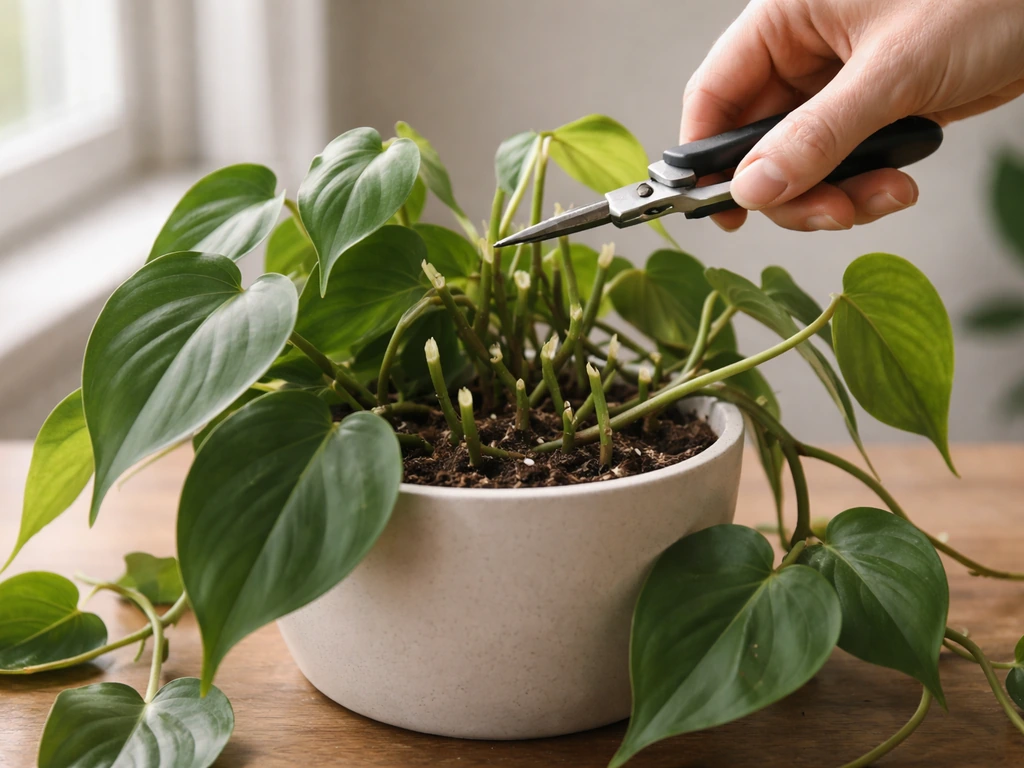
If your plant has already gotten leggy from a period of low light, don't just leave those long bare stems. University of Minnesota Extension recommends trimming leggy stems just above a leaf node to encourage new branching and a fuller shape. Cut just above a node (the little bump where a leaf meets the stem), and the plant will typically push out new growth from that point. You can propagate those cuttings in water if they have a node and a leaf, so nothing goes to waste.
The broader pattern here is that low light changes the entire pace of the plant's life. Everything slows down: growth, water uptake, nutrient cycling. Your job as a plant parent is to slow down your inputs accordingly. Less water, less fertilizer, more patience. If you do that, a heartleaf philodendron can live for years in a low-light spot, especially once you've dialed in the light with a window placement or a grow light. It won't look like the plants you see in bright-light Instagram photos, but it will be healthy, trailing, and genuinely satisfying to grow.
If you're comparing philodendrons to other low-light houseplants, they sit in similar territory to pothos and spider plants: forgiving enough to survive dim conditions but better-looking with more light. Snake plants and ZZ plants tend to tolerate even lower light levels with less visible decline, so if your spot is genuinely very dark (under 50 FC with no supplementation), one of those might be a more realistic fit. ZZ plants are also known for tolerating low light, though growth will be slower than in brighter conditions can zz plant grow in low light. Snake plants can also grow in low light, but their growth may still slow if the light is extremely dim can snake plants grow in low light. But for most low-light indoor spaces with even a modest window or a grow light, a heartleaf philodendron is an excellent choice. If you want to know whether aloe can handle the same kind of dim room conditions, check can aloe grow in low light.
FAQ
Can I keep a heartleaf philodendron alive in a room with no window at all?
Yes, but only if the light is not near total darkness. If your low-light room lacks a window and you cannot provide supplemental light, a heartleaf philodendron may survive for months but usually declines slowly (smaller, paler leaves and leggy growth). For very dark corners, consider adding a small grow light or choosing a plant known for extreme low light tolerance, because “survival” and “steady growth” are very different outcomes.
How do I tell the difference between winter slowdown and true low-light stress?
It’s normal for growth to slow or pause in winter, but you should still check for light stress signs. If leaves keep yellowing and dropping while new growth stays small and pale, that often points to insufficient light rather than just seasonal slowdown. A practical test is to watch whether the plant improves after moving it closer to a window or adding light for 3 to 4 weeks.
What’s the safest way to increase light if my plant is currently in low light?
Don’t wait for the plant to “look bad” to respond. Start by adjusting one variable at a time, usually by moving the plant closer to the light source or raising the grow light run time slightly, then reassess after a couple of weeks. If you see bleaching or leaf curling away from the light, move the light farther or reduce daily hours, because sudden increases can shock a plant that has been dimly lit.
Is overwatering always the problem in low-light philodendron care, or can other watering habits cause issues?
Watering frequency should be reduced, but also your watering method matters. In low light, water thoroughly only when the top 1 to 2 inches are dry, then drain any excess from the cache pot or saucer. Avoid partial “sips,” because they can leave salts near the surface and keep the deeper mix too wet, which increases the risk of root issues even when the surface feels dry.
What should I do if I fertilized my philodendron like it was in bright light?
Yes, in low light fertilizer can become a hidden problem. Because the plant grows slowly, nutrients build up in the potting mix. If you’ve been feeding on a bright-light schedule, flush the soil by running water through the pot until it drains freely, then resume only light feeding (or stop in winter).
Why does my philodendron look lopsided in low light, and what should I do about it?
Check the plant’s direction toward the brightest source. If it’s leaning, give the pot a quarter turn every 1 to 2 weeks, and rotate again after moving the plant to a new spot. This prevents uneven leaf spacing and reduces the “one-sided” look that often happens when low light comes mainly from a single window direction.
If my philodendron is leggy, should I prune, or will it just keep doing the same thing?
Pruning can help, but it won’t fix the root cause. If you cut off leggy stems while the plant remains in low light, new growth often remains smaller and still extends unevenly. For best results, trim just above a node to encourage branching, then improve light conditions gradually so the new shoots can fill in.
How can I tell if my grow bulb is strong enough for a low-light philodendron?
Some “full spectrum” bulbs sold for plants still vary widely in strength, especially cheap screw-in bulbs. If your philodendron is not improving after 3 to 4 weeks, increase distance consistency (keep it within the recommended range) or switch to a higher output LED panel. Watch for healthy signs like steady new leaves and shorter internodes, not just leaf survival.
Can I propagate a heartleaf philodendron in low light?
Yes, but expect slower results. In low light, propagation in water can take longer because cuttings root more slowly and may use stored energy without pushing new leaves. Use a node and a leaf, keep water clean, and once roots form, pot into a mix that drains well and keep light at least moderate or supplement if the original spot is very dim.