
Yes, Peperomia can survive in low light, and it's one of the more forgiving houseplants you can keep in a dim room. Can Calathea grow in low light too? In most cases, it will struggle without brighter, indirect light, so plan on giving it more illumination than Peperomia. That said, there's a real difference between surviving and actually growing well.
Can Peperomia Grow in Low Light? Care Tips and Light Levels
Marcus Hartley
9 Jun 2026
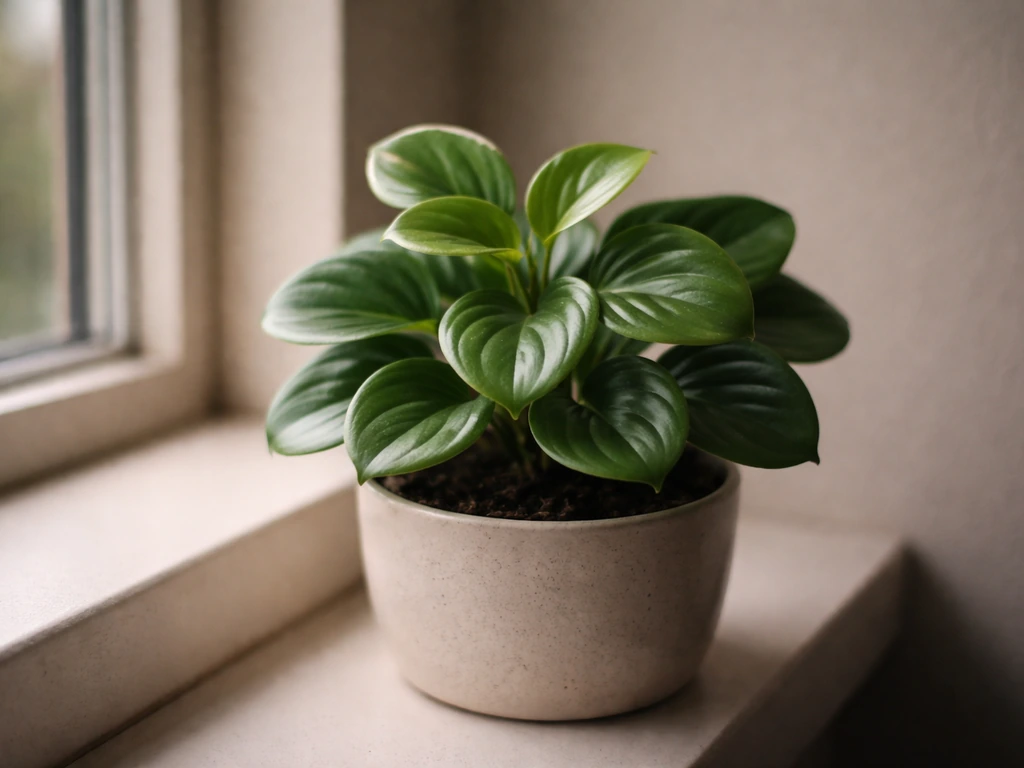
In genuinely low light, most Peperomia will stay alive but slow down noticeably, and some varieties, especially variegated ones, will start looking worse over time. If your space gets at least a little indirect light from a window, you're in decent shape. If you're in a windowless room or a dark corner with zero natural light, you'll need a grow light to keep things healthy long-term.
With a proper grow light, Peperomia can still grow indoors even if you don't have sunlight coming through windows.
What "low light" actually means indoors
The phrase "low light" gets thrown around a lot in plant care, but it's genuinely vague without numbers to back it up. In practical terms, low light indoors is roughly 50 to 500 lux, or about 5 to 50 foot-candles measured at the plant itself. A foot-candle is simply the amount of light hitting a surface one foot away from the source, and it's how University of Illinois Extension frames low light for houseplants, pegging it at around 75 foot-candles. That's the dim corner of a room, a spot more than 6 feet from any window, or anywhere near a north-facing window in a typical apartment.
To put that in real-world terms: standing next to a bright south-facing window on a clear day might give you 2,000 to 5,000 lux. The middle of your living room in the afternoon might be 200 to 400 lux. A corner away from all windows can drop below 100 lux, and a hallway or bathroom with no windows can be under 50 lux. That last range is where even low-light-tolerant plants start struggling.
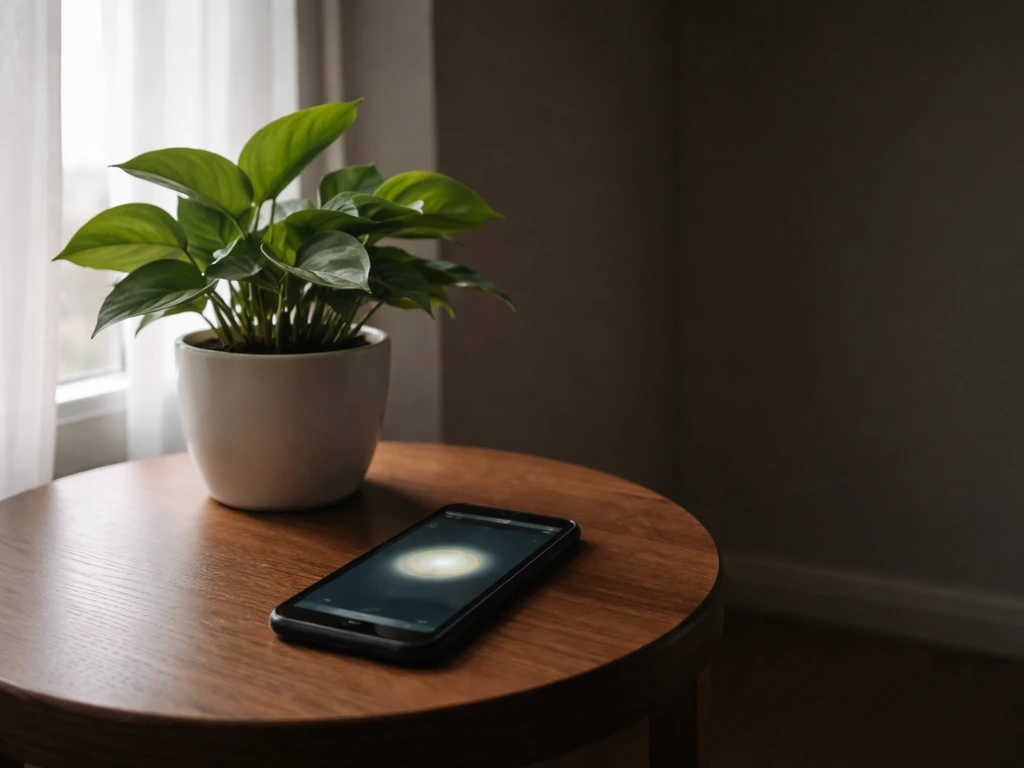
The easiest way to actually measure this is with a lux meter app on your phone. They're not perfectly accurate compared to a calibrated instrument, but they give you a useful ballpark. Hold your phone at plant level, point the camera toward your light source, and take a reading at different times of day. That number tells you much more than guessing based on how the room feels to your eyes, since human eyes adapt to low light far better than plants do.
Surviving vs. thriving: what Peperomia actually needs
Peperomia genuinely prefers bright, indirect light. Most care guides, including guidance from Clemson's extension program and Soltech's species-specific pages, put Peperomia caperata (ripple peperomia) at medium to bright indirect light rather than low. For the genus overall, bright indirect light is where you'll see the best leaf production, the most compact growth, and the strongest colors.
That said, Peperomia as a group does tolerate medium to low light better than many other popular houseplants. In lower light, you'll see slower growth, which isn't automatically a problem if you just want a stable, low-maintenance plant in a dim spot. The issue is when light gets too low, because that's when things start going wrong: leaves thin out, new growth stops or barely appears, stems start reaching toward any light source they can find, and the overall plant starts declining rather than just pausing.
Think of it this way: medium-low light (roughly 200 to 500 lux) is the realistic floor for keeping most Peperomia healthy without supplemental lighting. Below that, you're asking the plant to run on less energy than it needs for basic maintenance, and you'll see the results within a few months.
Not all Peperomia handle low light the same way
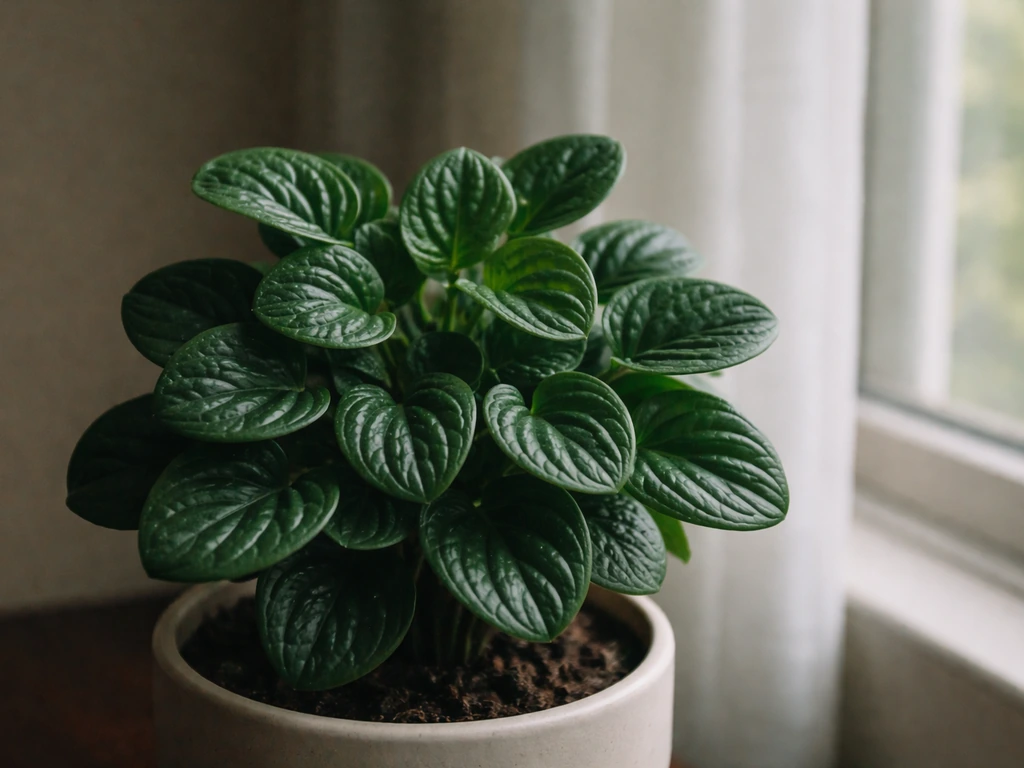
This matters a lot. The Peperomia genus has over 1,000 species and a huge range of cultivars, and they don't all have the same light tolerance. The biggest split is between solid green varieties and variegated or patterned ones.
Solid green and darker-leaved types
Solid green Peperomia, like Peperomia obtusifolia (baby rubber plant) in its plain green form, or darker-leaved species, tend to handle lower light better. They have more chlorophyll packed into their leaves, which means they can capture light more efficiently in dimmer conditions. They'll still slow down, but they're less likely to dramatically deteriorate in a moderately dim spot.
Variegated and light-colored varieties
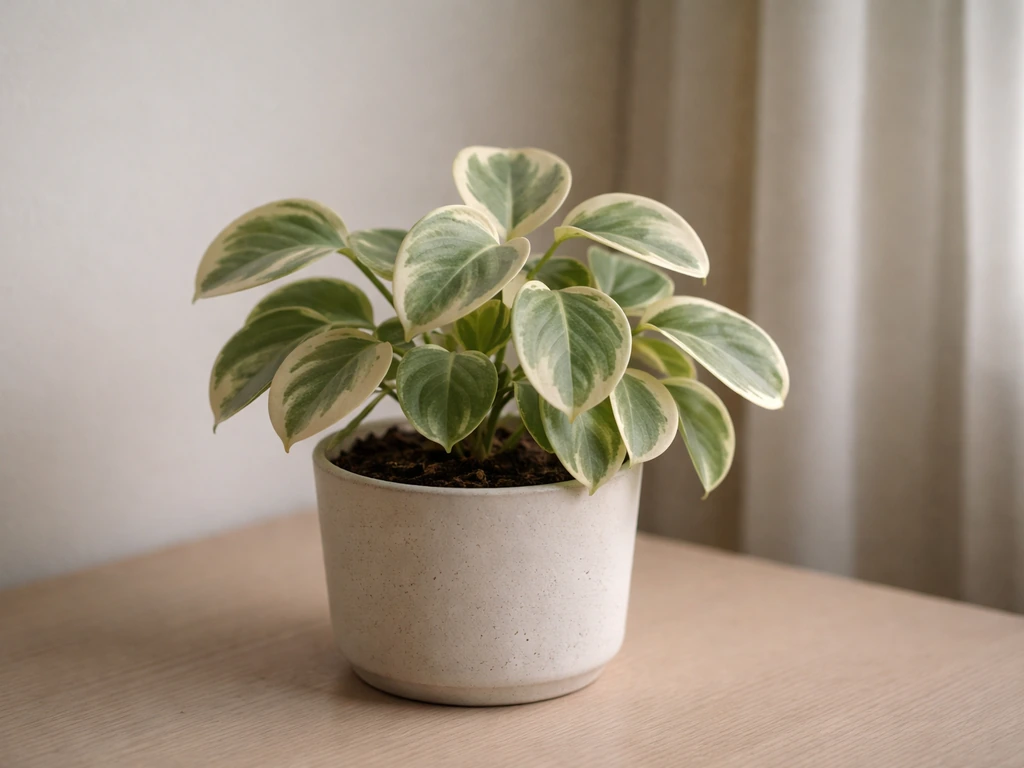
Variegated Peperomia are noticeably less tolerant of low light. The white or cream portions of their leaves contain little to no chlorophyll, which means the plant has fewer cells doing the actual photosynthesis work. Varieties like Peperomia obtusifolia 'Variegata' and P. obtusifolia 'Alba' don't adapt well to low light at all.
In dim conditions, these plants tend to lose their variegation as leaves revert to solid green, the pattern fades, and the plant may start dropping leaves. Homes & Gardens notes that insufficient light can cause problems such as fading variegation and leaf drop in peperomia.
What looks like a health problem is actually the plant doing its best to survive by making more chlorophyll where it can. If you want to keep a variegated Peperomia looking the way it did in the shop, you need brighter indirect light, not a dim corner.
Thick-leaved and succulent-like types
Some Peperomia have thicker, more succulent leaves, like Peperomia graveolens or Peperomia columella. These types store more water, which actually makes them a bit more resilient to the low-light, slow-drying soil situation you'll often encounter in dim rooms. They're less prone to rotting quickly if you accidentally water a little too soon. That said, they still need some decent indirect light and shouldn't be treated as true low-light plants.
Signs your Peperomia is not getting enough light
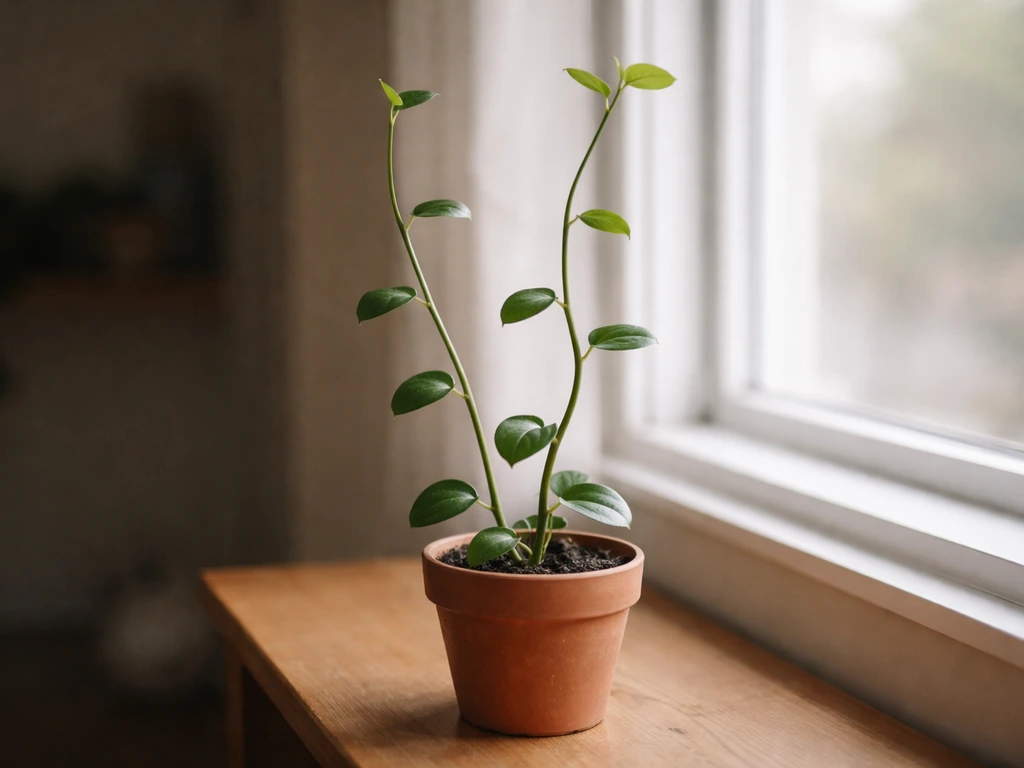
Plants are pretty honest about what they need if you know what to look for. Here are the most common signs that your Peperomia is struggling in low light:
- Stems stretching long and leggy toward the nearest window, with wide gaps between leaves (this is called etiolation, and it means the plant is physically reaching for more light)
- New leaves coming in noticeably smaller than older leaves on the same plant
- Variegated varieties losing their pattern, with new growth coming in mostly or entirely green
- Leaves dropping, especially older lower leaves
- No new growth for weeks or months during the growing season (spring and summer), even when temperature and watering seem fine
- Colors fading or looking washed out on varieties that should have deep, rich tones
- Overall soft, limp appearance despite normal watering
If you're seeing one or two of these things, try moving the plant to a brighter spot first before changing anything else. Many of these symptoms are easy to reverse in early stages by simply improving the light situation. If you've already let it go for several months in a very dim spot, recovery takes longer, but most Peperomia are resilient enough to bounce back.
Finding the right spot near a window (practical distances)
Window placement is your best free option, and the specifics matter more than most people realize. Light drops off fast as you move away from a window, not gradually. A plant sitting 2 feet from a bright window might receive 5 to 10 times more light than a plant sitting 8 feet away in the same room.
For Peperomia specifically, here's how to think about window placement in practical terms:
| Placement | Approximate Light Level | Good For Peperomia? |
|---|---|---|
| 1–3 feet from a south or west window (no direct sun) | 1,000–3,000+ lux / bright indirect | Yes, ideal for most varieties including variegated |
| 3–5 feet from a south or west window | 400–1,000 lux / medium indirect | Yes, solid growth for most solid-green types |
| 5–8 feet from a sunny window or right next to a sunless window | 150–400 lux / low-medium | Acceptable for solid green types; variegated will decline slowly |
| More than 8 feet from any window or north corner | 50–150 lux / low | Survival only; most types will stall or decline over time |
| No window access | Under 50 lux | Not suitable without a grow light |
East and west-facing windows are a sweet spot for Peperomia. They provide good indirect light without the intensity of a south-facing window that could scorch thin-leaved varieties. If you only have a north-facing window available, place your plant as close to the glass as possible, and consider a grow light as backup during winter months when natural light drops significantly.
One easy thing a lot of people skip: rotate your plant a quarter turn every week or two. Peperomia will lean toward the light source over time, and rotating keeps growth even and prevents one side from getting leggy while the other stays compact.
Using grow lights to fill the gap
If your space genuinely doesn't have enough natural light for Peperomia, a grow light is a straightforward fix and doesn't have to be expensive. The key is picking the right type and setting it up correctly so you're actually solving the problem rather than just adding a light that does nothing.
What kind of grow light to choose
LED grow lights are the best option for most indoor plant setups right now. They run cool, use less electricity than older fluorescent or HID setups, and come in a wide range of sizes and intensities. For Peperomia in a low-light situation, you don't need a high-powered setup. Look for a light with a PPFD (photosynthetic photon flux density) rating in the 100 to 300 range at the distance you'll be placing it. PPFD is the number that actually tells you how much usable light is reaching the plant, which is more useful than wattage alone. For a Peperomia that just needs supplemental support, something in the 150 to 250 PPFD range at plant level is plenty.
Full-spectrum LED panel lights or clip-on grow lights with adjustable arms both work well. You don't need a whole grow tent setup. A single clip-on LED positioned above or beside your plant shelf is usually enough to supplement dim natural light for a few Peperomia.
Distance and placement
Keep lower-wattage LED grow lights (under 300W) about 12 inches away from the plant to avoid any risk of heat or light stress. For small clip-on desk lights or panel lights rated under 50W, you can go a bit closer, around 6 to 10 inches, but watch the leaves for any signs of bleaching or browning at the edges, which means the light is too intense at that distance. When in doubt, start further away and move closer if the plant isn't responding.
How long to run it
For Peperomia in a low-light supplemental setup, aim for 12 to 14 hours of light per day. Use a simple plug-in timer so you don't have to remember to turn it on and off. Consistency matters here: plants use photoperiod (the daily light-dark cycle) to regulate their internal processes, and irregular light schedules are more stressful than stable ones. Keep nights fully dark, ideally 8 to 10 hours of uninterrupted darkness, so the plant can complete its rest cycle properly.
Care adjustments that matter most in low light
Light doesn't exist in isolation from the rest of your care routine. When you move a Peperomia into lower light, the biggest mistake people make is keeping the same watering schedule. In low light, the plant is photosynthesizing less, growing more slowly, and using up water much more slowly. Soil that dried out in five days near a bright window might take ten or twelve days to dry out in a dim corner. If you water on the same schedule regardless, you're on a fast track to root rot.
Peperomia is already susceptible to root rot under normal conditions. In low light, that risk goes up significantly. The standard advice from Clemson and other plant science sources is to let the soil dry out between waterings. In a low-light situation, that means checking before you water rather than watering on a schedule. Push your finger about 3 to 4 cm (roughly 1.5 inches) into the soil. If it still feels damp at that depth, wait. For more succulent Peperomia types, you can wait until the soil is dry 2 inches down before watering again.
Pot type also matters. Plastic pots hold moisture longer than terracotta, so if you're using plastic in low light, you'll need to water even less frequently. A well-draining cactus or houseplant mix is ideal because it prevents water from sitting around roots. If your current mix feels dense or stays soggy for a long time after watering, consider repotting into something with better drainage.
Your low-light Peperomia checklist
- Light: Aim for at least 200–500 lux at plant level from a window or grow light; measure with a lux meter app to confirm
- Placement: Position within 5 feet of an east or west window if possible, or as close to any window as you can manage
- Grow light: Add a full-spectrum LED on a 12–14 hour timer if natural light is under 200 lux
- Watering: Check soil moisture by touch (1.5 to 2 inches deep) before every watering; skip if still damp
- Soil: Use a well-draining houseplant or cactus mix to prevent water retention around roots
- Pot: Choose terracotta over plastic if your space is especially dark and slow-drying
- Rotation: Turn the plant a quarter turn every week or two for even growth
- Airflow: Keep air gently circulating; stagnant humid air in a dim room encourages fungal problems
- Temperature: Avoid cold drafts and keep temperature stable; wide swings stress plants that are already light-limited
- Fertilizing: Cut back or stop fertilizing in very low light, since the plant can't use nutrients it can't photosynthesize with; resume when light improves
If you're also comparing Peperomia to other low-light candidates for your space, it holds up well against many popular options. If you're comparing other low-light options too, can areca palm grow in low light is a common question to check before committing. Plants like Calathea and Areca palm have stricter humidity and light requirements that can make them trickier in dim rooms, while money trees and similar plants often need more consistent light to stay healthy long-term. Peperomia sits in a genuinely practical middle ground: not as bulletproof as a pothos in deep shade, but more adaptable and forgiving than a lot of the plants that get marketed as low-light-friendly.
The honest summary: if you have a spot that gets some indirect natural light, even modest light from a north window or filtered light in a bright room, Peperomia is a solid choice and will do fine with the care adjustments above. If you're working with a truly dark space, add a simple grow light and a timer and you're in good shape. Just don't ask a variegated variety to hold its pattern in a dim corner, because it won't.
FAQ
If my room is “low light,” how do I tell whether my specific spot is too dim for Peperomia to actually thrive?
Measure at plant height. If you can, aim for at least around 200 lux (about 20 foot-candles) for steady growth. Below roughly 50 lux, Peperomia may survive but will usually stall, and any variegation is likely to fade without supplemental light.
Can I use a south-facing window for Peperomia without risking sunburn?
Usually yes if the light is indirect. Put it back from the glass or use a sheer curtain, because Peperomia leaves can scorch if they get strong direct rays, especially thin-leaved and light-colored varieties.
Will Peperomia recover if it has been in low light for months?
Often yes, but recovery is slower. Move it to brighter indirect light, then wait and adjust watering to the new light level. Expect thicker, better-formed leaves on new growth first, while older leaves may never fully “reenrich.”
Do variegated Peperomia always fail in low light?
Not always, but they are the most likely to lose pattern. If the white or cream areas start turning more green or leaves drop, that is usually a light issue, and the fix is brighter indirect light (often with a grow light during winter).
How should watering change when moving Peperomia into low light?
Water less often and check moisture more carefully. In low light, the soil stays wet longer, so use the “finger depth” check (about 1.5 inches/3 to 4 cm) before watering, and only water when that depth is dry.
Should I still rotate my Peperomia in low light?
Yes. Even in dim rooms, plants will lean toward the brightest direction. Rotating a quarter turn every week or two helps prevent lopsided, leggy growth and keeps leaves closer to even light exposure.
Do I need to change the pot or soil mix for low-light setups?
If your mix stays soggy, yes. Choose a well-draining potting mix (often with added perlite or grit) and make sure the pot has drainage holes. In low light, poor drainage is a common path to root rot because the soil dries too slowly.
What grow light setup works best for Peperomia in a dark room?
Use an LED with a measurable output target such as PPFD. For many Peperomia, starting around 150 to 250 PPFD at plant level is usually enough for supplementation, and then adjust distance if you see edge browning or bleaching (too intense) or no new growth (too weak).
How long should I run a grow light for Peperomia in low light?
Aim for about 12 to 14 hours per day, with uninterrupted darkness at night. A simple plug-in timer matters, because inconsistent schedules can stress the plant even if the total daily light seems adequate.
Can I put Peperomia in a bathroom with no window?
It’s generally risky if there is no natural light at all. Bathrooms can have humidity, but without light the plant’s growth will stall and watering can become trickier. If there is no window, plan on a grow light and still avoid watering on a fixed schedule.
My Peperomia is stretching toward the light. Is that always a sign of low light?
Stretching usually means it is reaching for light, yes. In low light it is common, but also check for overwatering or low nutrition, since weak growth can look similar. If stems elongate and leaves thin out together, increase light first before changing anything else.