
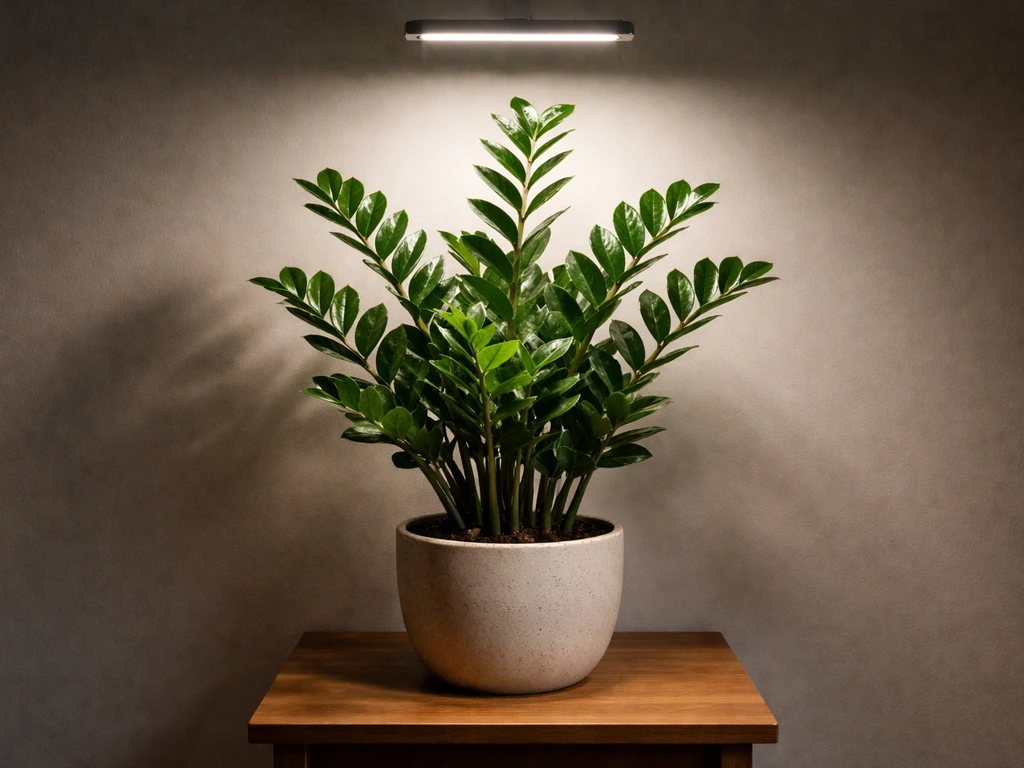
A ZZ plant can survive in very low light, but it cannot grow in complete darkness. It will stay alive longer than most houseplants in a dim room, but without some source of usable light, it will slowly decline rather than put out new leaves. The good news: a basic grow light or even a standard fluorescent tube is genuinely enough to keep a ZZ plant not just alive but actively growing in a room with zero natural sunlight.
Can ZZ Plant Grow Without Sunlight? How to Use Light Indoors
Marcus Hartley
6 Jun 2026
Can a ZZ plant survive with no sunlight at all?
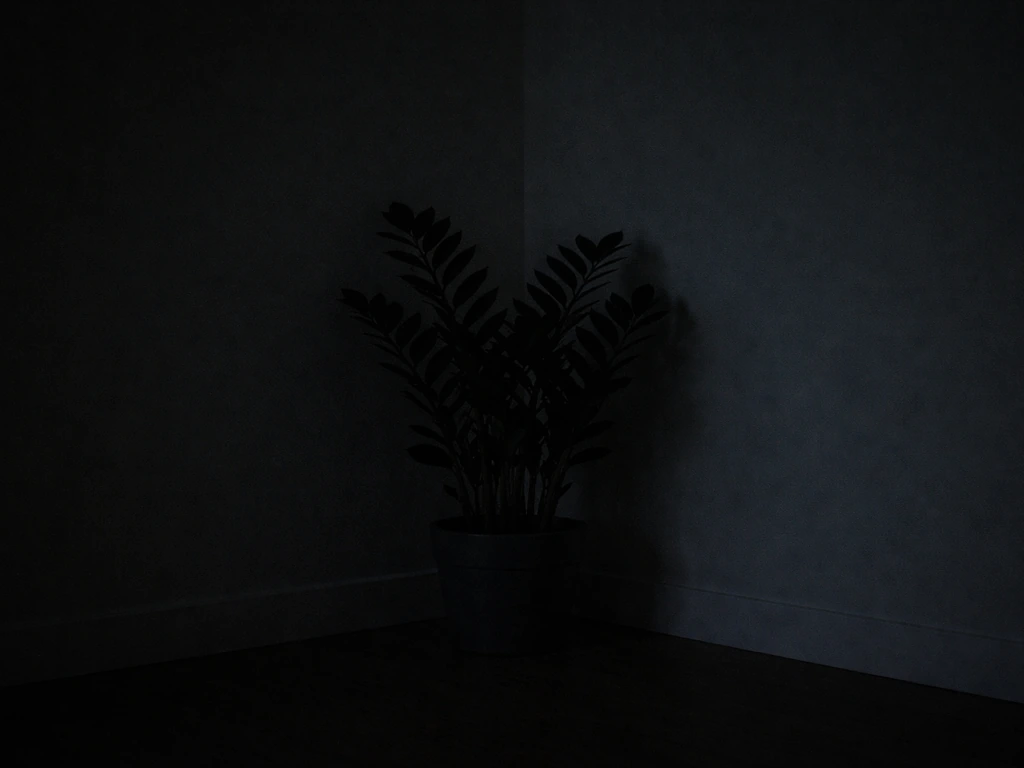
Here's where ZZ plants are genuinely interesting. They use a type of photosynthesis called CAM (Crassulacean Acid Metabolism), which allows them to take up some CO₂ in the dark. That's a real physiological trick, and it's part of why ZZ plants handle neglect so well. But research from the Smithsonian shows that this dark CO₂ uptake contributes less than 1% of daily carbon gain under normal, well-watered conditions. So while it's a neat survival mechanism, it is not remotely enough to sustain healthy growth. Complete, indefinite darkness will eventually kill a ZZ plant. It'll just take longer than it would kill most other plants.
The practical upshot: if your room has zero natural light and zero artificial light, your ZZ will coast on its stored energy (those thick rhizomes are essentially a food reserve) for weeks or even months. But it won't grow, and it will eventually start to deteriorate. What you need is some light, not necessarily sunlight, but some light. And the threshold for "enough" is actually pretty achievable.
How a ZZ plant actually uses light
Like every other plant, a ZZ needs light to run photosynthesis, which is how it turns carbon dioxide and water into the sugars it uses to grow. The chlorophyll in its leaves captures light energy to drive that process. No light means no photosynthesis, no new sugars, no growth. The ZZ's CAM adaptation and its thick underground rhizomes make it unusually good at surviving dry spells and dim conditions, but they don't eliminate the need for light. Think of the rhizomes as a savings account: the plant can draw on them for a while, but it can't refill them without photosynthesis.
ZZ plants are described as low-light tolerant, and that's true, but "low light" means something specific. Extension specialists from Purdue put the ideal range at 1,000 to 1,500 foot-candles for best performance. The University of Maryland Extension places the tolerable low-light range for plants like ZZ at 25 to 100 foot-candles, and anything below about 500 lux (roughly 46 foot-candles) is considered genuinely low light. So there's a real gap between "surviving" and "thriving," and light level is the main variable.
What low-light conditions ZZ plants can actually handle
Distance from a window
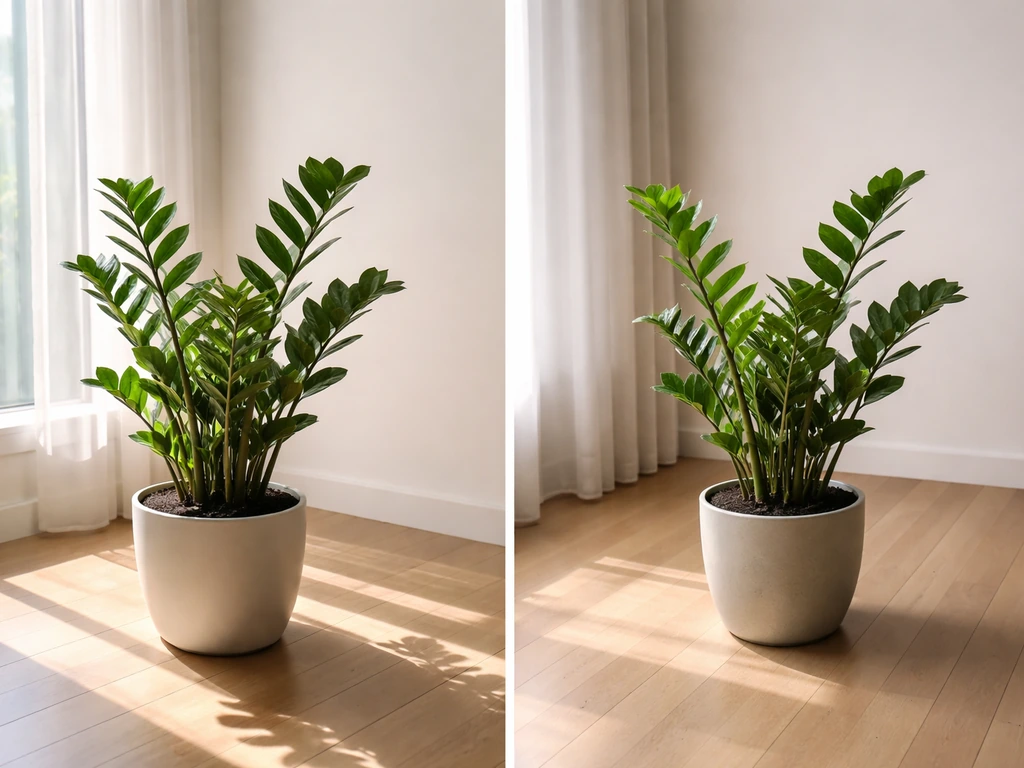
Light drops off fast as you move away from a window. A spot right next to a bright window might measure 2,000 to 5,000 foot-candles on a sunny day, but 8 to 10 feet away it can drop below 50 foot-candles. ZZ plants can technically function at that lower end, but growth will be very slow. A north-facing window or a spot a few feet from an east- or west-facing window is a reasonable low-light natural setup. Direct summer sun through an unobstructed south window is actually too harsh and can scorch the leaves.
Duration: how many hours matter
Even in a low-light position, duration matters. ZZ plants benefit from 12 to 16 hours of light when light intensity is low, because longer exposure compensates somewhat for lower brightness. If you're relying on a small north-facing window, you might be getting 4 to 6 hours of usable indirect light in winter, which is genuinely insufficient for active growth. This is exactly where artificial lighting steps in and makes a real difference.
Seasonal shifts
Winter is the period when most indoor ZZ plants in dim rooms quietly stall. Days are shorter, the sun is lower in the sky, and even a south-facing window delivers far less light than it does in June. If you've noticed your ZZ seems stuck in winter but picks up in spring, that's why. Supplementing with a grow light during October through March can make the difference between a plant that stagnates and one that keeps producing new stems.
The best artificial lighting to replace sunlight for a ZZ plant
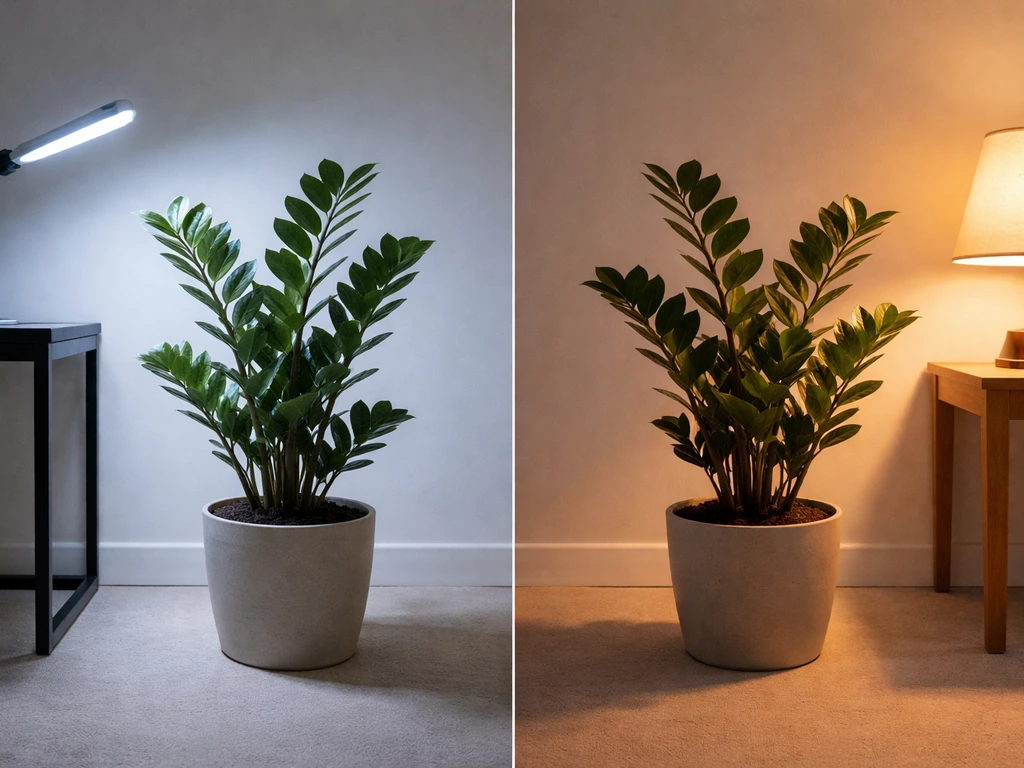
The good news here is that ZZ plants are not demanding when it comes to artificial light. Gardening Know How specifically notes that ZZ plants can thrive in windowless rooms that receive fluorescent light. You don't need an elaborate setup. Here's how to think through your options:
| Light Type | Effectiveness for ZZ | Cost | Best Use Case |
|---|---|---|---|
| Full-spectrum LED grow light | Excellent — covers the red and blue wavelengths plants use most | Moderate upfront, low running cost | Dedicated grow light for windowless rooms or low-light corners |
| Standard LED shop light / bulb (daylight 5000–6500K) | Good — broad spectrum with adequate PAR output | Low | Budget option; works well when placed close enough to the plant |
| T5 or T8 fluorescent tube | Good — reliable and proven for low-light houseplants | Low to moderate | Shelving setups, offices, basements |
| Standard incandescent bulb | Poor — mostly heat, very little usable plant light | Very low | Not recommended; wastes energy and can overheat leaves |
| Red/blue-only LED grow light | Decent — targeted spectrum, but harsh purple light indoors | Low to moderate | Works if aesthetics don't matter; less pleasant in living spaces |
Placement and timing
- Position a LED grow light or fluorescent tube 6 to 18 inches above the top of the plant for low-to-medium light output fixtures. Larger, higher-output grow lights can sit 18 to 24 inches away.
- Run the light for 12 to 14 hours per day in a windowless room. A simple plug-in timer (a few dollars at any hardware store) makes this effortless and consistent.
- If using a daylight LED bulb in a standard lamp, place it within 12 inches of the plant and keep it on for the same 12 to 14 hour window.
- Avoid placing lights directly above leaves touching them — if the leaves feel warm to the touch near the light, move the fixture further away.
- Rotate the plant a quarter turn every two to three weeks so all sides get even exposure, especially if the light source is directional.
One thing worth mentioning: blank" rel="noopener noreferrer">plant science uses PPFD (micromoles per square meter per second) to measure photosynthetically useful light, not just lux or lumens. You don't need to measure this precisely for a ZZ, but it's worth knowing that a "1000 lumen" bulb rating tells you very little about whether a plant can photosynthesize under it. A cheap daylight LED in the 5000K to 6500K range placed close to the plant will outperform an expensive incandescent with higher lumen output.
Signs your ZZ plant isn't getting enough light
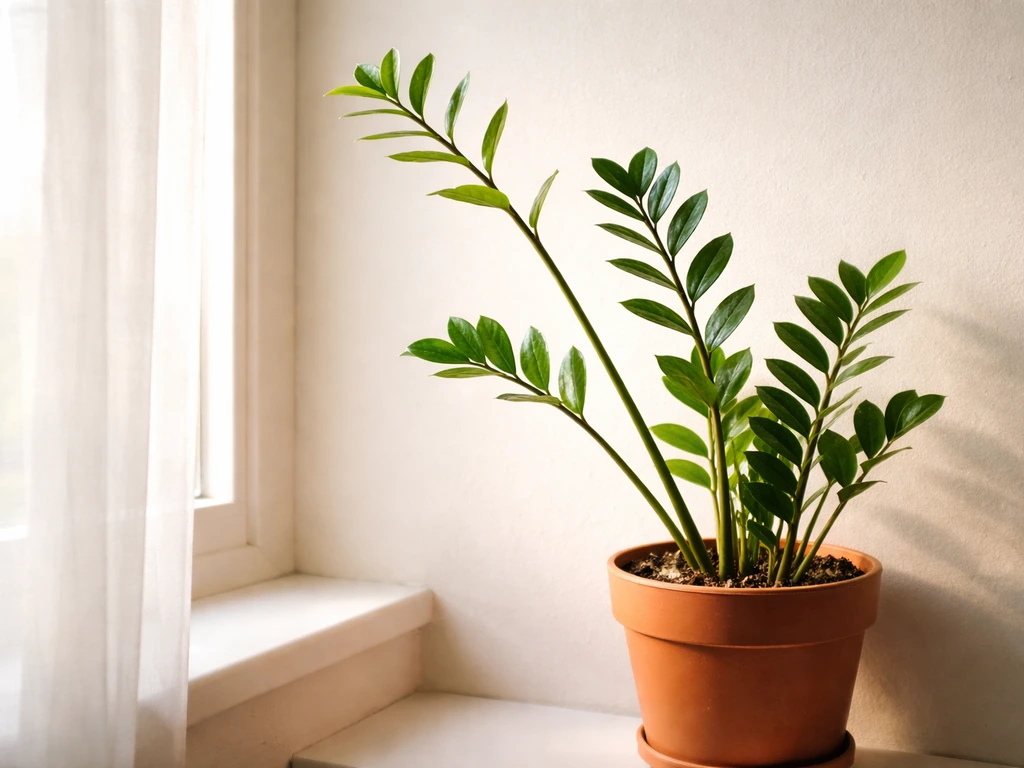
ZZ plants are slow growers even in ideal conditions, so it can take a few months before you notice something is wrong. These are the signals to watch for:
- Leggy, stretched stems: new growth reaches toward the light source and the stems look thin and elongated rather than compact and upright
- Smaller new leaves: the newest leaves are noticeably smaller or paler than older growth
- Yellowing leaves (chlorosis): older leaves turn yellow and drop, which can also indicate overwatering, but in a dim room it's often both problems compounding each other
- No new growth for more than three to four months during spring or summer (winter stalling is normal)
- Stems leaning heavily to one side toward any available light
How to fix it
Move light first, then adjust everything else. If you add a grow light or reposition the plant to a brighter spot, give it four to six weeks before expecting visible improvement. ZZ plants respond slowly. Once you've sorted out the light, you can reassess watering and feeding. Don't just add fertilizer hoping it will stimulate growth in a dim room; without adequate light to drive photosynthesis, the plant can't use the nutrients and you risk fertilizer burn on the roots.
Care adjustments when light is low
Growing a ZZ plant in low light or under artificial light isn't just about the light itself. Everything else in the care routine needs to shift too, because a plant growing slowly in dim conditions processes water and nutrients much more slowly than one in a bright spot.
Watering
This is where most people accidentally kill a ZZ in a low-light room: they keep watering on the same schedule they'd use for a brighter spot. In low light or winter, the soil stays wet far longer because the plant isn't actively growing or transpiring much. The Fairfax Gardening extension guide recommends watering only once a month or when needed during winter or low-light conditions. Let the soil dry out almost completely before watering again. ZZ's rhizomes store water, so underwatering is a much smaller risk than overwatering in these conditions.
Soil and drainage
Use a well-draining potting mix, ideally one amended with perlite (a 3:1 ratio of potting mix to perlite works well). Good drainage is even more important in low-light setups because the soil will stay damp longer. Make sure the pot has drainage holes. A soggy ZZ rhizome in a dim room is a recipe for root rot.
Temperature
ZZ plants are comfortable in typical indoor temperatures between 60°F and 80°F (15°C to 27°C). In low-light setups, avoid placing them near cold drafts from windows or air conditioning vents. Cold air combined with low light and slow-drying soil is a stressful combination.
Fertilizing
Iowa State University Extension recommends fertilizing once or twice a month in spring and summer with a dilute solution. In a low-light or windowless setup where growth has genuinely slowed, cut that back to once every six to eight weeks during the active season, and skip fertilizing entirely in winter. A half-strength balanced liquid fertilizer is plenty. Overfeeding a slow-growing plant in dim light causes more harm than good.
Growth expectations
Be honest with yourself about what to expect. UF/IFAS Extension notes that ZZ plants are slow growers even under favorable conditions. In a low-light or artificial-light-only setup, you might see two to four new stems per year, and each one will emerge slowly. That's normal and fine. The goal in a genuinely dim room isn't lush rapid growth; it's a healthy, stable plant that looks good and doesn't decline. ZZ plants deliver on that better than almost any other species, which is part of why they're a top recommendation for offices, hallways, and windowless spaces (unlike, say, a rose plant or jade plant, which need far more light to do anything useful). A rose plant needs much brighter light than a ZZ, so it typically cannot grow well without sunlight.
Quick setup checklist for a no-sunlight or low-light room
- Choose your light source: a full-spectrum LED grow light or a daylight (5000K to 6500K) LED bulb or T5/T8 fluorescent tube. Any of these works.
- Position the light 6 to 18 inches above the plant canopy (closer for lower-output bulbs, further for high-output grow lights).
- Set a timer for 12 to 14 hours of light per day. Consistency matters more than intensity for a ZZ.
- Plant in a well-draining mix with perlite added, in a pot with drainage holes.
- Water only when the soil is almost completely dry, roughly once every three to four weeks in low-light conditions (check with your finger 2 inches into the soil before watering).
- Skip fertilizer for the first month while the plant adjusts, then use half-strength balanced fertilizer once every six to eight weeks during spring and summer only.
- Rotate the plant a quarter turn every two to three weeks for even growth.
- Watch for leggy stems or yellowing as early warning signs, and increase light duration or move the fixture closer if you see them.
- Keep the plant away from cold drafts and temperature extremes, especially in winter.
- Be patient: new growth may take two to three months to appear, and that's completely normal for a ZZ.
The ZZ plant genuinely earns its reputation as one of the best plants for low-light and artificial-light spaces. It won't perform miracles in complete darkness, but give it a decent grow light and a consistent schedule and it will reward you with slow, steady, reliable growth even in a room that's never seen the sun. Among low-light-tolerant plants, it's one of the most forgiving options available, and setting it up correctly takes less effort than you'd think.
FAQ
Can a ZZ plant grow without sunlight if there is absolutely no light at all?
No. ZZ plants can survive for a limited time with no light, but they cannot photosynthesize, so they will eventually decline and die in complete darkness.
What kind of light schedule should I use indoors if my ZZ is not near a window?
If your goal is growth, set up artificial light. A practical rule is to provide 12 to 16 hours per day at a reasonably bright intensity close to the plant, since longer hours help compensate for lower brightness.
If I keep my ZZ in a windowless room, how do I choose between different grow lights?
Windowless rooms can work, but placement and bulb choice matter. Put the light close enough that the plant receives strong usable light, and choose a daylight LED (about 5000K to 6500K) rather than relying on lumens alone.
If I add a grow light, how long will it take before I can tell it is working?
Don’t expect fast results. ZZ plants often take four to six weeks to show noticeable changes after you increase light, and even longer to create new stems because their growth rate is naturally slow.
My ZZ looks unhealthy in low light. Should I adjust fertilizer or watering first?
Use a simple light-first troubleshooting approach: first move or brighten the light, then wait several weeks before changing watering. If you fertilize or water more before light improves, the plant may suffer (especially from overwatering).
How should my watering routine change if my ZZ is in low light?
For low-light setups, reduce watering frequency because the soil stays wet longer. Let the potting mix dry out until it is mostly dry before watering again, and avoid frequent small waterings.
Can I fertilize a ZZ plant that’s grown under artificial light?
Yes, but only with careful lighting and drainage. In low light, heavy fertilizing or frequent feeding can stress the slow-growing plant, so use half-strength fertilizer and reduce frequency (for example once every six to eight weeks in the active season).
Can cold weather or air conditioning affect my ZZ plant’s success in low light?
Yes, temperature and airflow can create problems even when the light is adequate. Avoid cold drafts from windows or air vents, because cold plus slow-drying soil increases the risk of decline and root issues.
What is the biggest mistake people make when growing a ZZ plant in low light?
Overwatering is the most common failure mode in dim rooms. Make sure the pot has drainage holes and use a well-draining mix (perlite mixed in helps), because ZZ rhizomes can rot if kept constantly wet.
Is a south-facing window in summer good for a ZZ plant, or will it burn?
A north-facing window or a spot a few feet away from an east or west window can be a workable natural low-light option, but direct summer sun through a south window can scorch leaves.
Does CAM photosynthesis mean my ZZ can grow without light for long periods?
CAM helps the plant survive longer, but it does not eliminate the need for light. The dark CO2 uptake is too small to support healthy growth, so you still need usable light for new stems and leaves.