Plants in caves survive because "no sunlight" rarely means "zero photons." Cave openings, crevices, reflected light, and even the artificial lamps in tourist caves all deliver tiny but real amounts of light that certain plants, mosses, algae, and cyanobacteria can use. When you're trying to replicate that kind of extreme low-light environment indoors, the same principle applies: you need to identify every scrap of available light, supplement it smartly with the right grow light, and choose plants that are already wired to work at near-darkness levels.
How Do Plants Grow in Caves Without Sunlight? Practical Guide
Marcus Hartley
31 May 2026
Why "no sunlight" still means plants can get some light
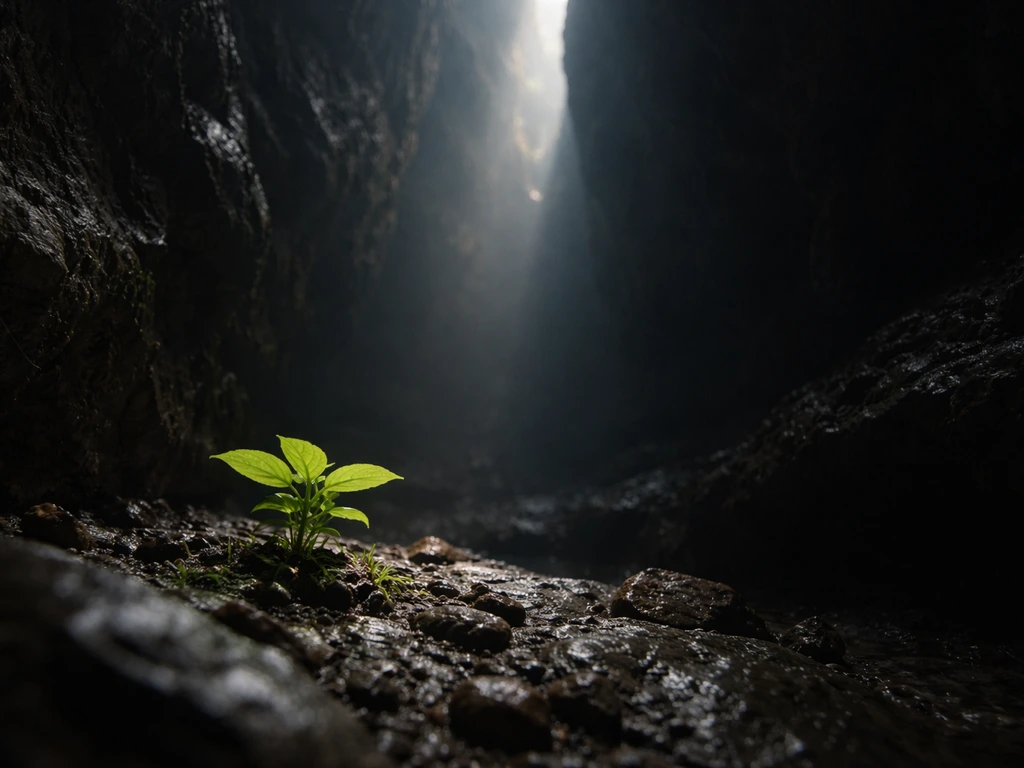
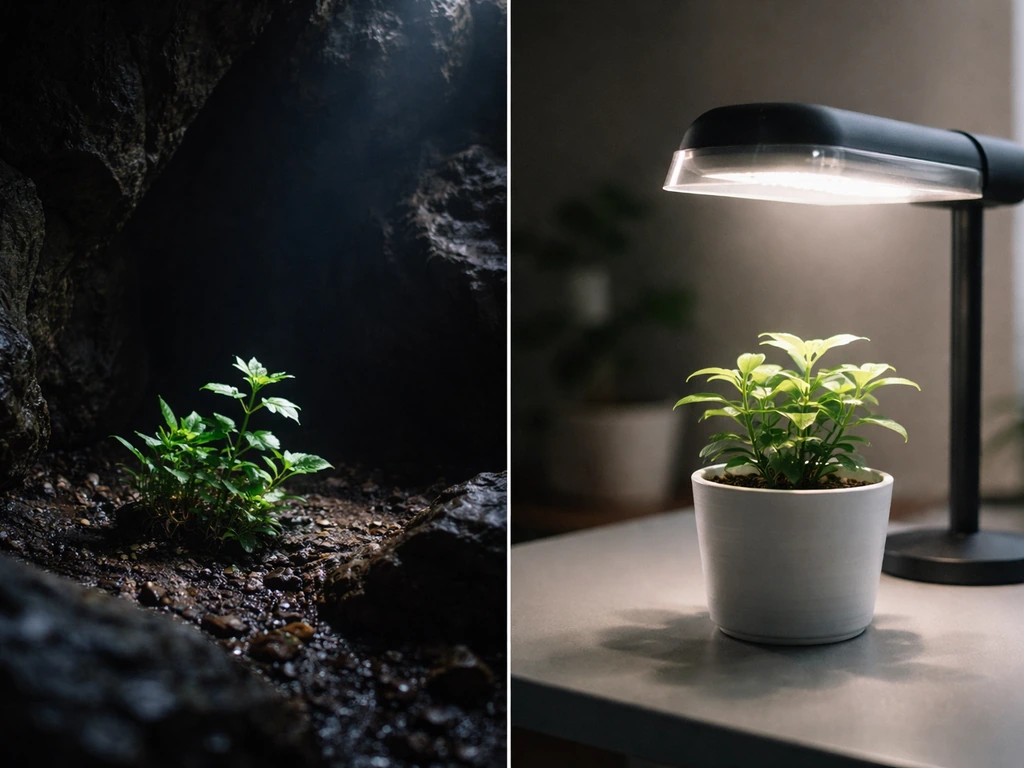
True zero-photon darkness is actually rare in caves, and it matters for understanding what plants are really dealing with. Even deep cave systems receive faint residual daylight filtering through entrances, cracks, and sinkholes. Light intensity drops off fast with distance from an opening, but photons still make it surprisingly far in. There's also a more exotic source: physicist Giovanni Badino has noted that cosmic-ray muons passing through rock produce Cerenkov radiation, a faint glow that scales roughly with the size of the cave chamber. It's not enough for most plants, but it illustrates that "dark" is a spectrum, not a switch.
For your indoor low-light space, the lesson is the same. A room with no window isn't necessarily in total darkness once you account for light leaking under doors, reflected light from pale walls, and the ambient glow of screens or overhead bulbs. None of that replaces a proper grow light, but measuring what you actually have before assuming the worst is always a smart first step.
Where light actually comes from in caves
Real cave light comes from a handful of sources, and understanding them helps explain which organisms manage to hang on underground.
- Cave openings and crevices: Entrances and ceiling fractures funnel daylight inward. The light level collapses with distance, but even 1–5 µmol m⁻² s⁻¹ of photosynthetically active radiation (PAR) is enough for the most light-efficient organisms.
- Reflected and scattered light: Pale limestone walls and water surfaces bounce photons deeper into a cave than you'd expect. High humidity and smooth speleothem surfaces act like a natural diffuser.
- Bioluminescence and microbial mats: Some cave environments support bioluminescent fungi and bacteria. More practically, cyanobacteria and algae form photosynthetic biofilms wherever even trace light exists, creating localized "oases" of organic activity that larger organisms like mosses can eventually colonize.
- Artificial lighting in show caves: This one is well-documented. The lamps installed for tourist visibility in show caves deliver enough energy to trigger colonization by photosynthetic algae and cyanobacteria (collectively called lampenflora). Research at Carlsbad Cavern documented that these biofilm communities can eventually support larger organisms including ferns and mosses in later successional stages.
- Cerenkov radiation: Faint, physics-level photon emission from cosmic-ray muons passing through the cave volume. Not practically useful for plant growth, but a real reminder that total darkness is almost never absolute.
How cave plants are built for near-darkness
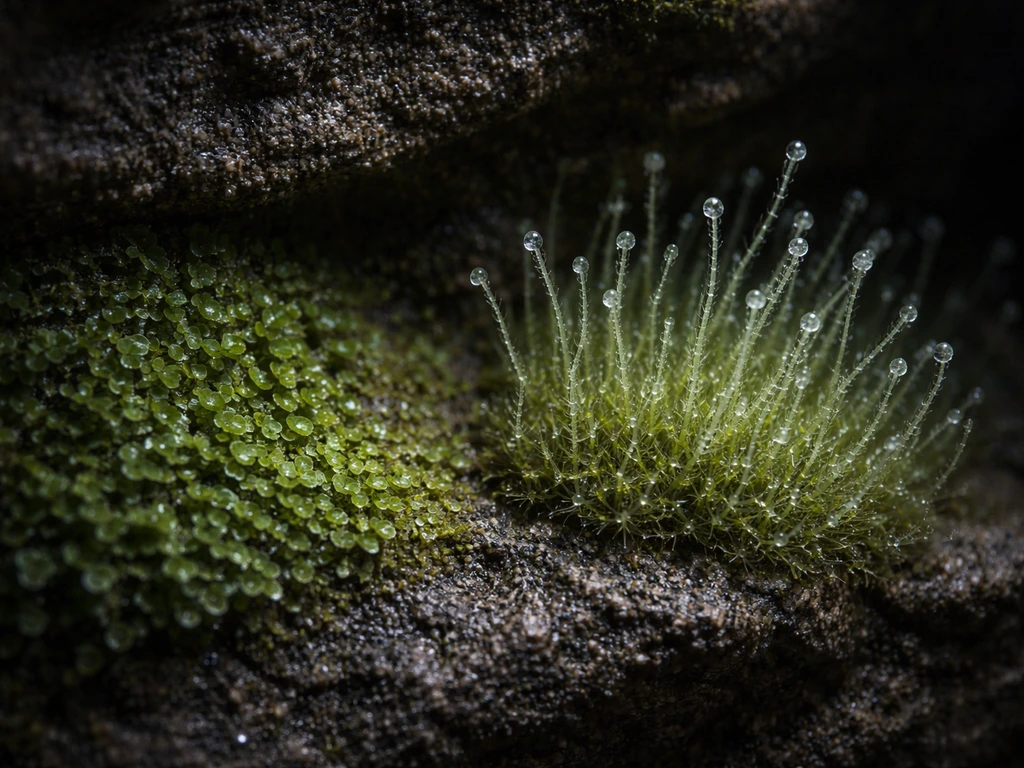
The plants and plant-like organisms that persist in caves aren't just tolerating low light, they've evolved specific strategies to squeeze every usable photon out of their environment.
The most effective strategy is enlarging the light-harvesting antenna. Under light-limited conditions, plants expand the antenna cross-section around each Photosystem II reaction center, essentially making a bigger "net" to catch more photons. Electron transport rate and carbon assimilation stay low until enough light is available, but the plant can stay alive and photosynthetically viable at intensities that would leave a sun-loving plant completely stalled.
Bryophytes (mosses and liverworts) take a particularly clever approach: they compensate for low photon flux density (PPFD) by spending more time under whatever light is available. Research on Slovenian show-cave mosses confirmed that extending the duration of light exposure is a real physiological adaptation, not just patience. The photosynthetic saturation point for most mosses has a median around 583 µmol m⁻² s⁻¹, well below what a typical houseplant needs, which is exactly why mosses and ferns show up near cave lamp installations.
Cave microenvironments also help. Nerja Cave monitoring recorded temperatures around 18–20°C, relative humidity averaging near 89%, and CO₂ levels running roughly double outdoor ambient (around 679 ppm on average). High CO₂ and stable humidity reduce water stress and can improve photosynthetic efficiency at low light, giving cave plants a metabolic assist that purely dark conditions wouldn't provide.
Algae and cyanobacteria lean on symbiosis and community. They form biofilm mats that share resources, modify their local microenvironment, and create organic material that feeds the rest of the food web, including the root zones of any mosses or ferns that establish on top of them. It's the same principle that makes a healthy soil microbiome so valuable for indoor plants in low-light conditions.
The best low-light plants and what to realistically expect
If you want cave-like low-light success indoors, plant choice is everything. These are the species that actually perform at the low end of the light spectrum, roughly 50–250 µmol m⁻² s⁻¹ PPFD. For comparison, a well-lit room corner without a grow light often delivers 10–50 µmol m⁻² s⁻¹, so even "low-light" plants may need a small supplemental source.
| Plant | Workable PPFD Range | What to Expect at Low Light | Cave-Level Survival (10–30 µmol m⁻² s⁻¹) |
|---|---|---|---|
| Pothos (Epipremnum aureum) | 50–150 µmol m⁻² s⁻¹ | Slow growth, smaller leaves, stays alive | Survives; will not thrive |
| Philodendron (heartleaf) | 50–250 µmol m⁻² s⁻¹ | Minimal new growth, holds color well | Survives with some light |
| ZZ plant (Zamioculcas zamiifolia) | 50–150 µmol m⁻² s⁻¹ | Very slow but resilient; stores energy in rhizomes | One of the best survival candidates |
| Cast iron plant (Aspidistra elatior) | 25–100 µmol m⁻² s⁻¹ | Stays dormant-looking but won't die easily | Strong candidate for cave-like rooms |
| Mosses (various) | 10–100 µmol m⁻² s⁻¹ | Slow colonization, stays green with humidity | Closest thing to a true cave plant indoors |
| Peace lily (Spathiphyllum) | 50–150 µmol m⁻² s⁻¹ | Survives, rarely flowers without more light | Survives; no blooms |
| Ferns (various) | 50–200 µmol m⁻² s⁻¹ | Needs humidity; fronds stay small at low light | Some species persist near cave lamp levels |
| Orchids (low-light varieties) | 40–200 µmol m⁻² s⁻¹ | Foliage stays healthy; flowering needs more | Survives; flowering unlikely |
Ivy is worth a mention here too. Field research on Hedera helix shows it's built for understory life, where PPFD can drop below 100 µmol m⁻² s⁻¹, and it adjusts its stomatal and photosynthetic behavior accordingly. It won't give you explosive growth in a dark room, but it will hang on longer than most vining plants. If you've been reading about whether ivy can grow without sunlight, the short answer is it can persist at low light but will need at least some supplemental source to keep growing actively.
How to set up a cave-like low-light environment indoors
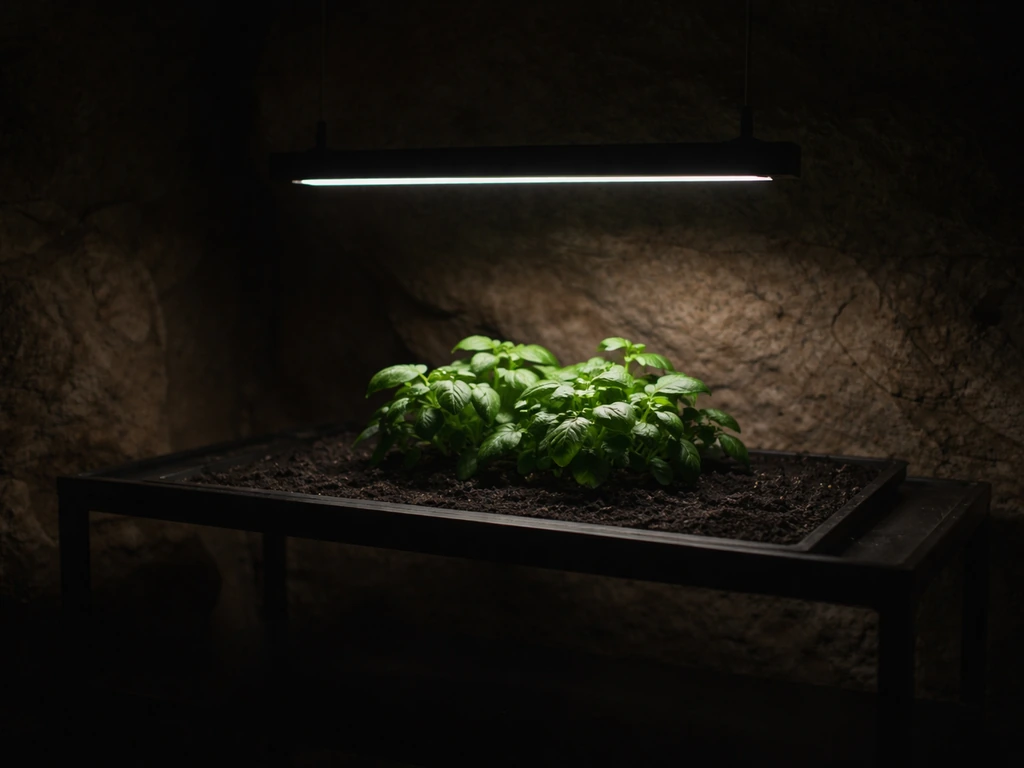
The cave analogy is genuinely useful here. Show-cave lampenflora research found that photoperiod matters just as much as intensity: a cave in NW Italy recorded higher lampenflora growth under longer lighting durations, even at low lux levels. That means you don't always need to blast your plants with high-intensity light. Consistent, extended exposure at a modest level often works better for low-light species than short bursts of bright light.
Light placement basics
- Keep grow lights close: PPFD drops fast with distance. A light delivering 200 µmol m⁻² s⁻¹ at 12 inches may only deliver 50 µmol m⁻² s⁻¹ at 24 inches. Low-light plants don't need high intensity, but they still need the light to actually reach the leaves.
- Use reflective surfaces: Pale or white walls, silver reflective panels, and even foil-lined grow tents multiply usable light without adding any watts. This is essentially what cave limestone walls do naturally.
- Run longer photoperiods: For species operating near their light compensation point (the minimum needed to break even on photosynthesis), running your grow light 14–16 hours a day compensates for low intensity the same way cave mosses extend their exposure time.
- Avoid deep shadow stacking: Don't put low-light plants behind other plants or in corners where surfaces absorb rather than reflect. Map your room the same way cave researchers map illuminance gradients, by measuring at regular intervals from the light source.
Humidity and CO2 as a boost
Cave conditions include high humidity and elevated CO₂, both of which help plants photosynthesize more efficiently at low light. Indoors, you can't easily raise CO₂ without a dedicated system, but you can raise humidity cheaply with a pebble tray or small humidifier. For moss terrariums or fern setups, a closed or semi-closed container creates a cave-like microclimate that genuinely improves survival at minimal light.
Choosing the right grow lights for low-light spaces
You don't need an expensive high-powered rig for cave-like conditions. The plants you're targeting don't want intense light. What they need is the right spectrum delivered consistently and at the right distance. Here's how the main options compare.
| Light Type | Best For | PPFD Output (Typical) | Energy Efficiency | Practical Notes |
|---|---|---|---|---|
| Full-spectrum LED grow light | Any low-light plant; best overall choice | Adjustable; 50–300+ µmol m⁻² s⁻¹ at 12–24 inches | Excellent | Low heat, long lifespan, dimmable options available; best value for most setups |
| T5 fluorescent tube | Seedlings, mosses, ferns, herbs | 50–200 µmol m⁻² s⁻¹ at 6–12 inches | Good | Cheap to start; bulbs degrade after ~10,000 hours; warm spectrum variants good for foliage |
| T8 fluorescent tube | Very low-light tolerance plants | 20–100 µmol m⁻² s⁻¹ at 6–12 inches | Moderate | Budget-friendly; works for survival-level light; not great for active growth |
| Incandescent / halogen | Not recommended | Low PAR output relative to heat | Poor | Produces too much heat for the light delivered; wastes energy |
| Small LED desk grow lamp | Single plants, moss terrariums | 30–100 µmol m⁻² s⁻¹ close up | Good | Convenient and cheap; ideal for one or two cave-condition plants on a shelf |
For a true cave-inspired setup, a dimmable full-spectrum LED panel positioned 18–24 inches above your plants, set to its lower output range and running 14–16 hours a day, is the most practical and affordable approach. University of Minnesota Extension guidelines suggest targeting 50–150 µmol m⁻² s⁻¹ PPFD for low-light plants, which most budget LED grow lights can hit easily at that distance. You don't need to spend a lot to get this right.
One thing worth knowing from the cave research: the wavelength of light matters to what grows. The Carlsbad Cavern lampenflora study found that light wavelength affects which photosynthetic communities develop. For home use, a full-spectrum LED that covers both the red (630–660 nm) and blue (430–450 nm) bands gives you the most flexibility across different plant types, from mosses and ferns to philodendrons and ZZ plants.
Measure your light, fix slow growth, and give your plants a real chance
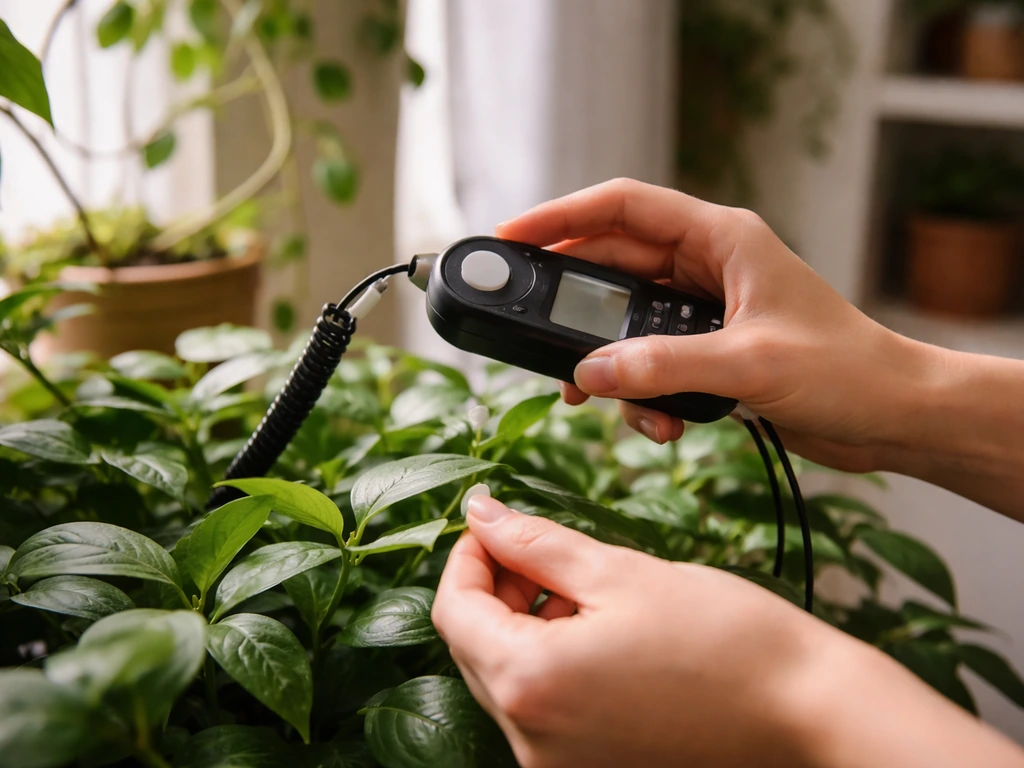
The biggest mistake people make with low-light plants isn't choosing the wrong species, it's guessing at light levels and getting it wrong. Here's how to actually troubleshoot and improve your setup.
Measure what you have
- Get a PAR meter or light meter app: Dedicated PAR meters are accurate and now available for under $50. Smartphone apps using the camera sensor are less precise but give a useful ballpark. Take readings at the leaf level, not at eye level.
- Map your space systematically: Measure PPFD at 6-inch intervals from your light source outward, the same approach used in cave illuminance research. You'll immediately see where the usable light zone ends.
- Check foot-candles if that's what your meter measures: 50 foot-candles is roughly 270 lux and translates to about 50 µmol m⁻² s⁻¹ PPFD, the minimum for most low-light houseplants. Below that, you're in survival-only territory.
- Measure at multiple times of day: If you have any natural light contribution, it varies. Knowing your light floor (the minimum at any point in the day) tells you how much your grow light needs to compensate.
Troubleshoot slow or stalled growth
- Yellowing lower leaves: Usually light deficiency combined with overwatering (low-light plants need less water because they're not photosynthesizing fast). Reduce watering frequency first, then check PPFD.
- Leggy, stretched stems: The plant is reaching for more light. Move the grow light closer or increase the output slightly.
- No new leaves for months: At survival-level light, some plants simply pause. If your PPFD is above 50 µmol m⁻² s⁻¹ and growth is still stalled after 6–8 weeks, extend the photoperiod before increasing intensity.
- Pale or washed-out leaves: Possible light burn if you've recently increased intensity, or a nutrient issue amplified by low light (plants can't process fertilizer they can't use). Back off on feeding in low-light conditions.
- Moss or algae growing on soil surface: Actually a good sign that light is reaching the soil and photosynthesis is happening at some level. It mirrors what happens in caves around lamp installations.
Set realistic expectations
Caves support mosses, algae, ferns near light sources, and a handful of exceptionally tough vascular plants. Because ferns are among the low-light cave survivors, they can tolerate very limited light as long as you provide a modest grow light or consistent ambient light. They don't support tomatoes, citrus, or most fruiting plants. If you are wondering which fruit plant can grow without sunlight, the honest answer is that fruiting plants usually need meaningful light. If you're working with a genuinely dark room, your best outcomes are going to be with survival-specialist plants like ZZ plants, cast iron plants, pothos, and peace lilies, kept intentionally small and slow-growing with consistent low-level light. That's not a failure; it's matching your plant choice to your reality, which is exactly what cave organisms do. If you want to know what other plants can manage with minimal sun, many of the same low-light principles apply to species like ferns and certain fruiting plants, where the limiting factor is always the same: getting enough usable photons to the leaves, however you manage to deliver them.
FAQ
If my cave-like spot has “no sunlight,” how do I know it is truly dark enough to mimic cave conditions?
No. “No sunlight” can still include stray photons from doors, window light leakage, reflective walls, screens, or tiny gaps. If you can, measure PPFD at plant height with a light meter, because room brightness (lux) does not reliably predict what plants actually receive.
Should I prioritize stronger light or longer light hours for cave-style low-light plant growth?
Use PPFD, not just a timer. For low-light species, keep a consistent photoperiod (for example, 14 to 16 hours) rather than short bright bursts, and aim for roughly 50 to 150 µmol m⁻² s⁻¹ at the canopy, then adjust the LED height to hit that range.
What spectrum matters most when trying to grow plants under very low light indoors?
Full-spectrum LEDs are helpful, but you should not assume every “grow light” behaves the same. Look for coverage of both blue (around 430 to 450 nm) and red (around 630 to 660 nm), and run it dimmed rather than cranked up, then confirm results by checking for slow, steady new growth rather than stretching.
How does grow-light height affect whether low-light plants actually thrive?
Distance changes everything. If the panel is too far, you might get warm-looking ambiance but insufficient PPFD at leaf level; if it is too close, you can exceed the low-light range and cause stress. Start with the recommended height band (about 18 to 24 inches for many panels) and fine-tune using a PPFD reading.
Can I just crank up humidity to mimic cave conditions, or will that backfire?
For mosses and ferns, leave the soil mix or terrarium surface breathable, not waterlogged. High humidity helps, but stagnant, oxygen-poor conditions can shift the microbial community toward rot and biofilm that suffocates plants.
Why do my low-light plants struggle even when I think my light is in range?
Cave plants are often adapted to stable conditions, so frequent swings matter. Sudden changes in humidity, temperature, or watering schedule can trigger leaf yellowing or browning even if light levels are correct. Keep a stable routine and adjust gradually.
What should I expect if I put a low-light plant in a dim corner without a grow light?
Many “low-light” houseplants still need some usable light to maintain growth. If you only get 10 to 50 µmol m⁻² s⁻¹ in a corner, plan on a supplemental light or expect survival, not active growth.
Is it good if algae or biofilm appears in my moss terrarium, or can it harm the plants?
Biofilm and algae mats are part of cave ecology, but you should manage them deliberately indoors. If you see uncontrolled green films, gently remove excess and improve airflow at the container level, because overgrowth can block light from reaching moss and can reduce oxygen exchange.
Can ivy grow without sunlight, and how can I tell whether it will just survive or actually grow?
Yes, if you provide at least some consistent light. Hedera helix can persist under low PPFD (often below 100 µmol m⁻² s⁻¹), but it will usually slow drastically. If you want continued growth, increase photoperiod or slightly raise PPFD rather than relying on a “nearly dark” placement.
Where exactly should I measure light for low-light plant setups?
Measure at the leaf canopy, not at the bulb or at floor level. Also account for reflective surfaces, because pale walls can boost usable light. Two setups that look identical visually can differ a lot in PPFD depending on reflections and how plants are positioned.
Do low-light plants need precise photoperiod timing, or is any schedule fine?
Because cave-like environments favor extended exposure, a simple on/off timer works well, but avoid too many interruptions. If you notice instability, run a longer schedule and keep the light on a predictable daily pattern, like a consistent 14 to 16 hour window.