Strawberries, dwarf citrus, tomatoes, and peppers are the most realistic fruit plants to grow indoors with little or no direct sunlight, but only if you replace that missing sun with decent artificial light. No fruit plant can survive in complete darkness. What most people mean when they say 'no sunlight' is no direct sun through a window, and that's a very solvable problem with the right LED or fluorescent setup. If you have even a dim room and a grow light, you have more options than you think.
Which Fruit Plant Can Grow Without Sunlight Indoors?
Marcus Hartley
12 Jun 2026
What 'no sunlight' actually means for fruit plants
There's an important distinction to make upfront. 'No sunlight' usually means no direct rays coming through a south-facing window, not literally zero light. True darkness, like a windowless closet, will kill any fruit-bearing plant. Every plant needs light for photosynthesis, the process that converts light energy into sugars the plant uses to grow, flower, and ripen fruit. Without enough of it, the plant just sits there and slowly declines.
What makes fruiting particularly demanding is that it needs more light than just keeping a plant alive. A pothos or fern can survive on 50–100 µmol·m⁻²·s⁻¹ of light (the unit used to measure the photosynthetically useful portion of light, called PPFD). But to actually flower and set fruit, most plants need somewhere between 400 and 1,200 µmol·m⁻²·s⁻¹ depending on the species. The good news is that artificial light can absolutely cover this gap. The site you're on is built around exactly this question: how do you use grow lights to replace or supplement sunlight for real results? If you're also wondering how plants can grow deep in the ocean without sunlight, the key idea is that light availability drives what adaptations and systems are possible how do you use grow lights to replace or supplement sunlight.
It's also worth knowing that light duration matters just as much as intensity. Plants use photoperiod (the length of the light and dark cycle each day) to decide when to flower. Some plants need long days, some need short days, and some, called day-neutral varieties, don't care much either way. Choosing a day-neutral variety when growing indoors is often the simplest path to fruit.
Best fruiting plants for low light or no window sunlight
These four are the most practical choices for indoor growing under artificial light. Each has a realistic ceiling for what you can expect without a sunny window.
| Plant | Min. PPFD for Fruiting | Photoperiod Need | Difficulty | Realistic Yield Indoors |
|---|---|---|---|---|
| Strawberries (day-neutral) | 200–450 µmol·m⁻²·s⁻¹ | Day-neutral (12–16 hrs works) | Easy | Moderate, consistent small harvests |
| Cherry tomatoes | 400–700 µmol·m⁻²·s⁻¹ | Long day (14–18 hrs) | Easy–Medium | Good with consistent light |
| Dwarf citrus (Meyer lemon, calamondin) | 300–500 µmol·m⁻²·s⁻¹ | 6–12 hrs bright light needed | Medium | Occasional fruit, mostly ornamental |
| Peppers (compact varieties) | 400–700 µmol·m⁻²·s⁻¹ | Long day (16–18 hrs) | Medium | Good with strong LED |
Strawberries
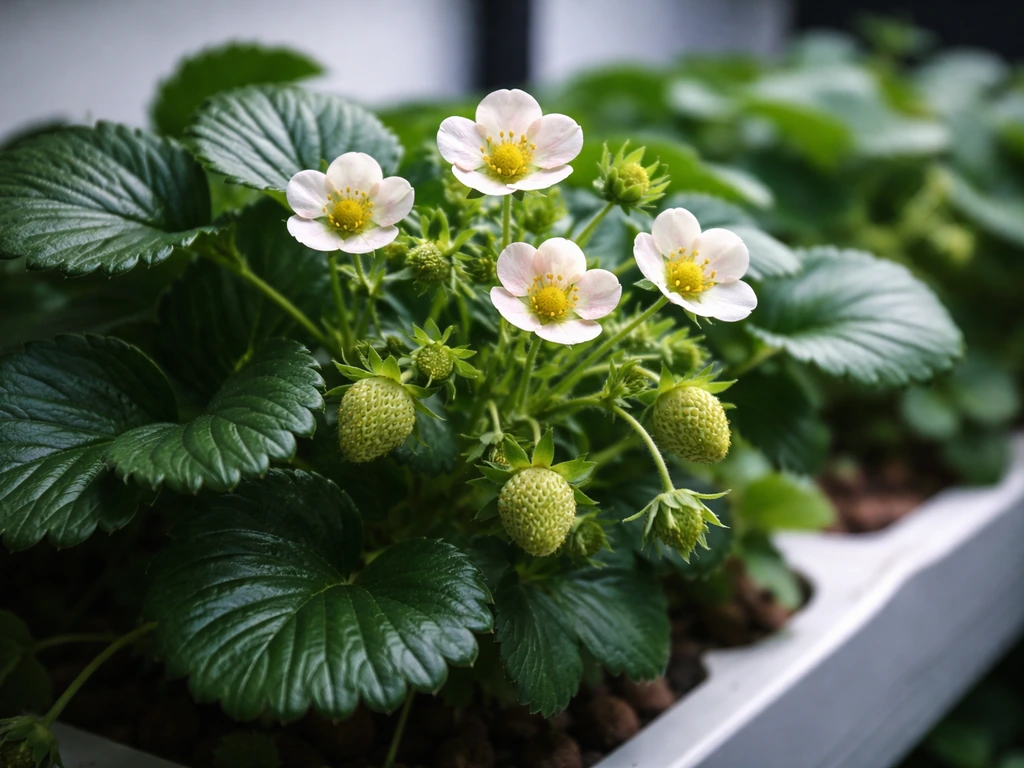
Day-neutral strawberry varieties like 'Albion' are the best starting point for anyone growing without a window. Research using sole-source LED lighting showed that 'Albion' flowered and fruited well at 200–450 µmol·m⁻²·s⁻¹ PPFD over 12–16 hour photoperiods, in about 94–115 days from transplant to harvest. Unlike June-bearing types that need specific short-day conditions to initiate flowers, day-neutral varieties just keep going as long as light and temperature are decent. OSU's controlled environment research suggests that even very low supplemental light around 100–200 µmol·m⁻²·s⁻¹ can support strawberry growth, though fruit yield increases meaningfully at the higher end of that range.
Cherry tomatoes
Cherry tomato varieties bred for compact indoor growth (look for 'Tumbling Tom', 'Tiny Tim', or 'Red Robin') are forgiving and rewarding. Tomatoes are self-pollinating, meaning each flower has both male and female parts, so you don't need bees. A little hand vibration (tapping the stem or using a small fan nearby) is enough to shake pollen loose and set fruit. The main challenge is getting enough light intensity. Under a weak bulb, tomatoes will grow tall and leggy but won't fruit reliably.
Dwarf citrus
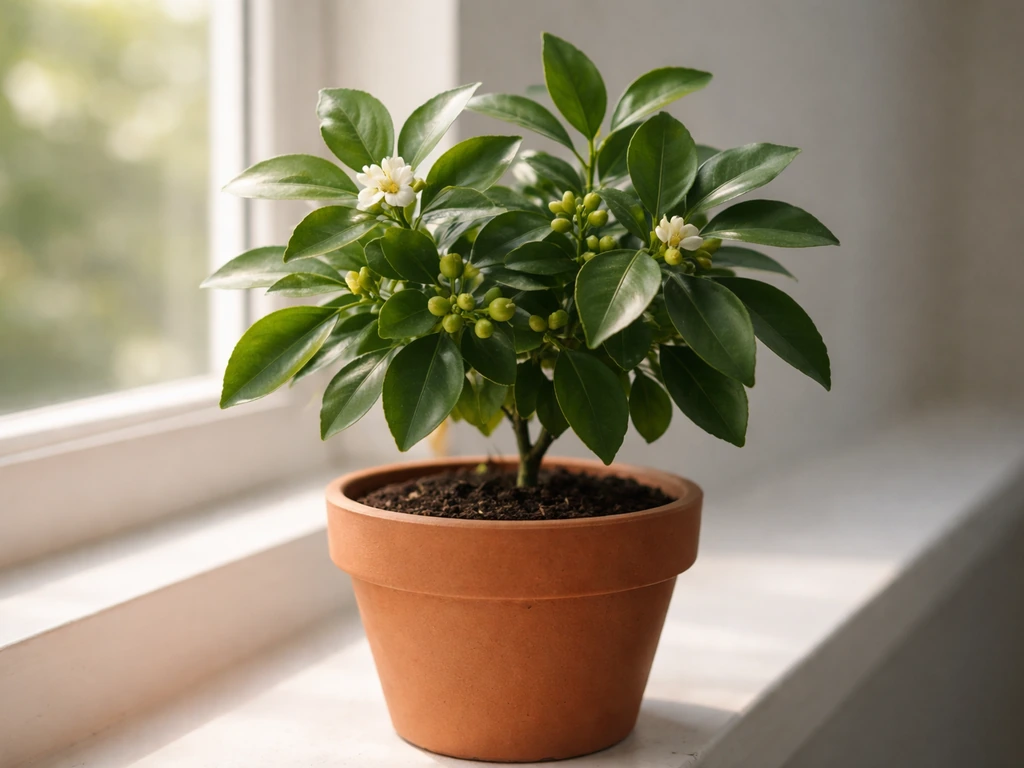
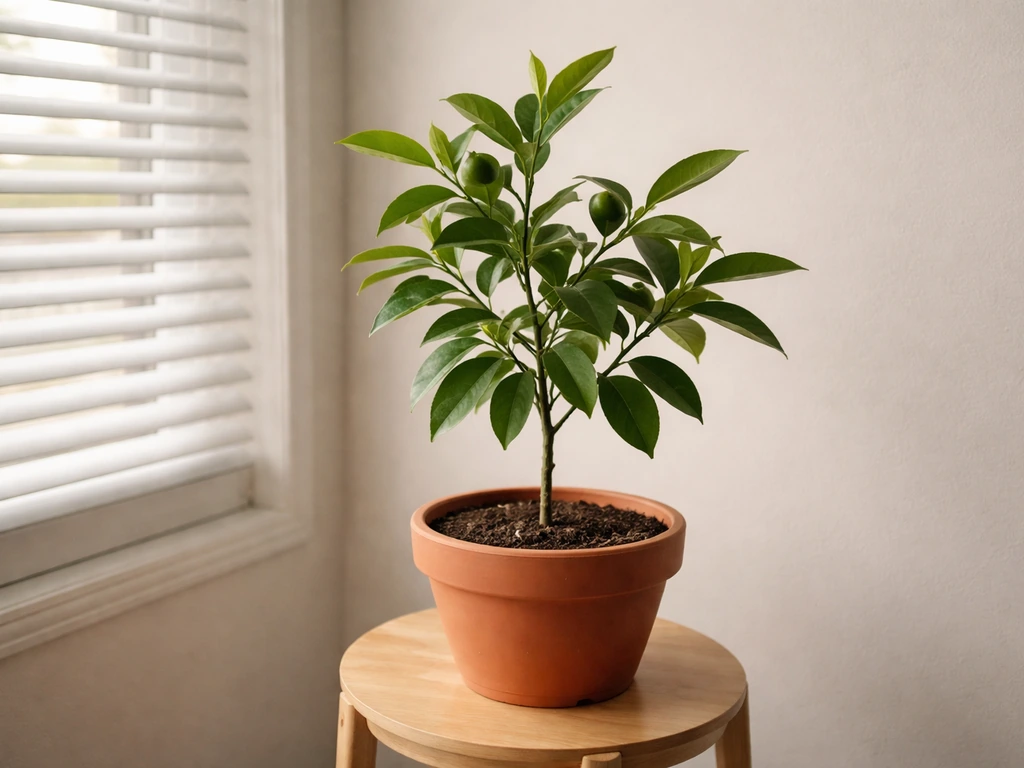
Meyer lemon and calamondin orange are popular for indoor growing, but be honest about expectations. University of Maryland Extension recommends at least 6 hours of bright light and ideally 8–12 hours for citrus to do well. Young plants won't fruit for a few years regardless of light. They're beautiful plants and the scent of blooms is genuinely wonderful, but if your goal is fruit production in the next season, start with strawberries or tomatoes instead.
Peppers
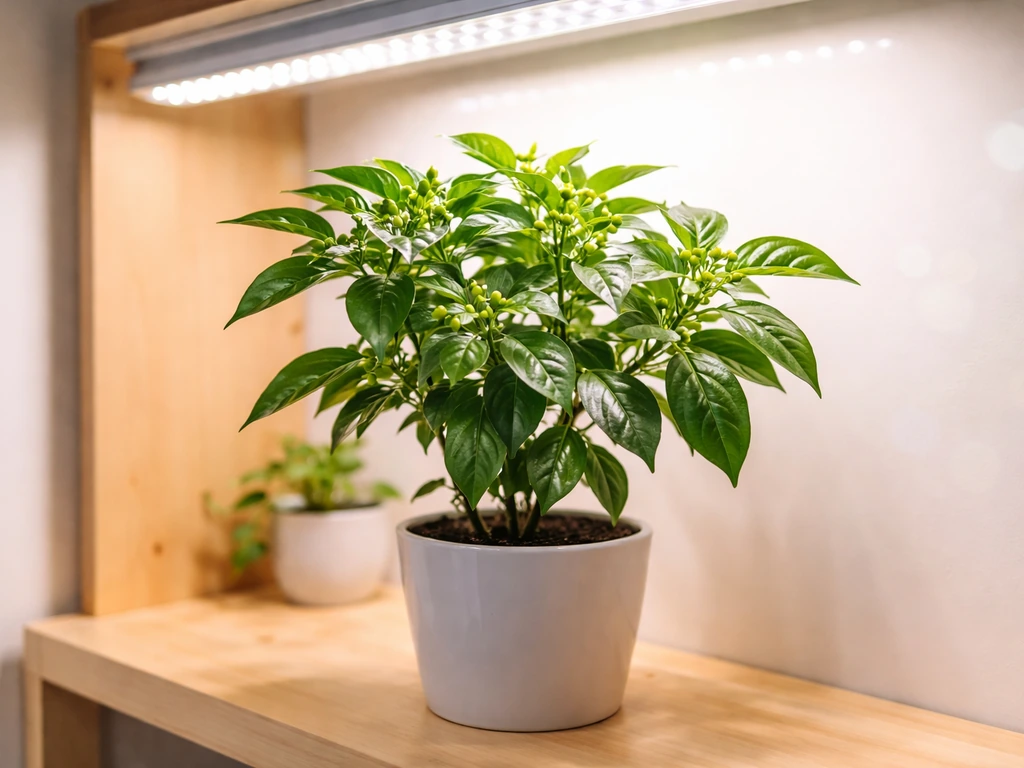
Compact hot peppers and ornamental pepper varieties do surprisingly well indoors. They love long photoperiods, around 16–18 hours of light per day, and respond well to LED supplementation. An LED panel positioned 30–45 cm above the plants can deliver around 400–500 µmol·m⁻²·s⁻¹ to a small growing footprint, which is enough to get peppers flowering and fruiting consistently.
How to set up artificial light so fruiting is actually realistic
The two main options are LED grow lights and fluorescent (T5 or T8) grow lights. Both work, but they behave differently and suit different situations.
| Feature | LED Grow Lights | Fluorescent (T5/T8) |
|---|---|---|
| Energy efficiency | Excellent | Good |
| Heat output | Low | Moderate |
| PPFD at fruiting range | High (with quality panels) | Lower, better for seedlings/low-light plants |
| Spectrum control | Full spectrum or tunable | Fixed spectrum, usually cool white |
| Coverage area | Good with quality panels | Best close to canopy (within 15–30 cm) |
| Cost | Higher upfront, lower running cost | Lower upfront, higher running cost |
| Best for fruiting? | Yes, especially for peppers, tomatoes, strawberries | Adequate for strawberries at lower PPFD targets |
For fruiting plants specifically, LED grow lights are the better investment. Red light is particularly important for flowering and fruit set, with research and grower experience pointing to red-dominant spectrums (roughly a 3:1 red to blue ratio) as effective for bloom and fruit formation. UMN Extension notes that red light is ideal for flowering and fruit set Red light is particularly important for flowering and fruit set. That said, a full-spectrum white LED panel also works well and is easier to live with in a home environment since it doesn't cast that purple-pink glow.
PPFD drops fast with distance from the light source. A panel that delivers 600 µmol·m⁻²·s⁻¹ at 20 cm might drop to 200 µmol·m⁻²·s⁻¹ at 50 cm. For fruiting, keep your lights closer than you might think necessary, typically 20–45 cm above the canopy depending on the fixture's intensity. Always check the manufacturer's PPFD chart at different distances if available.
For photoperiod, use a simple timer. Strawberries and tomatoes do well at 14–16 hours of light per day. Peppers like 16–18 hours. Dwarf citrus needs at least 6 hours of bright light but ideally 8–12 hours. These timers cost a few dollars and take the guesswork out of it completely.
Real-world placement, containers, temperature, and watering
Getting the setup right beyond just the light makes a big difference in whether your plants actually fruit or just sit there looking healthy but doing nothing.
Containers
Use containers with good drainage. For strawberries, a 6–8 inch pot per plant works well. Cherry tomatoes in containers need at least a 3–5 gallon pot per plant to support root development and consistent fruiting. Dwarf citrus needs a pot sized to the plant but with room to grow, typically 12–16 inches for a mature indoor tree. Avoid dark-colored plastic pots if your room gets warm, as roots can overheat.
Temperature and airflow
Most indoor fruit plants are happy at the same temperatures comfortable humans live in, roughly 65–80°F (18–27°C). What trips people up is airflow. Stagnant air encourages fungal problems and also limits pollination for tomatoes and peppers, where the flower needs some movement to release pollen. A small clip fan running a few hours a day solves both problems. It mimics a light breeze, strengthens stems, and helps pollen move.
Watering
Inconsistent watering is one of the fastest ways to kill fruit set. Dry soil stress causes flower drop in citrus and peppers, a point that comes up specifically in extension guidance on indoor citrus. The general rule is to water when the top inch of soil is dry, and then water thoroughly until it drains from the bottom. Don't let containers sit in standing water.
Fertilizer and fruiting triggers
Switch from a balanced fertilizer to a low-nitrogen, higher-phosphorus and potassium formula once plants start flowering. Too much nitrogen at the flowering stage pushes leafy growth instead of fruit. For strawberries and tomatoes under grow lights, a weekly liquid feed at half strength during the fruiting period keeps plants producing without burning roots.
Common failures and why your fruit won't set
If your plants are flowering but not fruiting, or not even getting to the flowering stage, the cause is almost always one of these:
- Light intensity too low: This is the most common issue. Vegetative growth needs 100–500 µmol·m⁻²·s⁻¹, but flowering and fruiting typically need 400–1,200 µmol·m⁻²·s⁻¹. If you're using a weak bulb or have your light too far away, the plant doesn't have the energy budget for fruit.
- Wrong spectrum: Grow lights heavy on blue light are great for leafy growth but suboptimal for fruiting. Shift to a red-dominant spectrum or switch to a full-spectrum LED panel with a warm white output for the fruiting stage.
- Pollination failure: Tomatoes and peppers need some physical movement to release pollen from their flowers. No fan, no breeze, no vibration, and you get flowers that open and drop without setting fruit. Gently shake the stem or tap each open flower cluster every couple of days.
- Temperature extremes: Tomatoes drop flowers when night temperatures fall below about 55°F (13°C) or daytime temperatures exceed 85°F (29°C). Peppers are similar. Check your actual room temperature, not just the thermostat setting.
- Dry soil stress: One drying-out event during flowering is often enough to cause the plant to abort its flowers. Flower drop in citrus and peppers is a classic sign of inconsistent watering.
- Nutrient imbalance: Too much nitrogen or a lack of calcium can cause blossom end rot in tomatoes and peppers, and prevent fruit from fully developing. Use a fertilizer formulated for fruiting crops.
- Wrong variety or photoperiod mismatch: June-bearing strawberries and short-day varieties won't flower properly under the long photoperiods used in most indoor setups. Always choose day-neutral strawberry varieties for indoor growing.
How to pick the right fruit plant for your exact light situation
The honest answer is that your light situation determines your realistic options more than any other factor. Use this as a quick guide to match your setup to the right plant.
| Your Light Situation | Best Fruit Plant Option | What You'll Need |
|---|---|---|
| Bright indirect light (near window, no direct sun) | Strawberries (day-neutral), dwarf citrus | Supplement with a basic T5 or small LED for 12–16 hrs total |
| Dim room, one small window | Day-neutral strawberries only | A dedicated LED panel at 200–300 µmol·m⁻²·s⁻¹, 14–16 hrs/day |
| No window, but can add grow lights | Cherry tomatoes, peppers, strawberries | Quality LED panel, 400–600 µmol·m⁻²·s⁻¹ at canopy, 14–18 hrs/day |
| No window, budget grow light only | Day-neutral strawberries (lower yield) | T5 fluorescent close to canopy, 16 hrs/day; expect modest harvests |
| No window, no grow light possible | None for fruiting | Fruiting is not realistic; consider non-fruiting low-light plants instead |
The most important step you can take today is measure or honestly estimate the light level in your growing space before buying a plant. A basic lux meter (under $20) can give you a rough reading to translate into PPFD. A lux reading of around 10,000–20,000 lux in the growing zone is roughly equivalent to the 200–400 µmol·m⁻²·s⁻¹ you need to get strawberries going. If you're seeing 2,000–3,000 lux from a window on a cloudy day, you're not going to get fruit without a grow light supplementing it.
If you're also curious about which non-fruiting plants thrive in genuinely dark spaces, it's worth exploring what can grow without sunlight more broadly, including shade-tolerant foliage plants and ferns, which have much lower light demands than anything that flowers or fruits. What can grow without sunlight also includes non-fruiting plants like shade-tolerant foliage and ferns, which need far less light than fruiting crops. But for anyone determined to grow actual edible fruit indoors without a sunny window, the combination of a day-neutral strawberry or compact tomato variety plus a decent LED panel on a timer is the most reliable path forward available right now. Ivy is a good example of a plant that can grow without sunlight as long as you provide a suitable indoor light level.
FAQ
If I only have a window that gives weak light, can I still grow fruit indoors without a “real” grow light?
You might grow leaves, but reliable fruit usually needs light intensity you can only reach with supplemental lighting. A cloudy-day window reading around 2,000 to 3,000 lux generally will not get you into the PPFD range needed for flowering. If you insist on window-only, treat it as a leafy-plant experiment and be prepared for little to no fruit.
What’s the difference between “no direct sunlight” and “no light” for fruiting plants?
Fruit plants can handle no direct rays, as long as the area still receives enough total light for photosynthesis. True darkness, like a closet with the lights off, removes virtually all photoperiod, so flowering never develops. Even with a low-glow room, you still need consistent lighting hours or a grow light on a timer.
How do I avoid overbuying light, or underbuying it, for indoor fruit?
Choose based on the PPFD at plant height, not the bulb marketing. Because PPFD drops quickly with distance, a fixture that looks strong at the top can be far too weak at the canopy. Use the manufacturer’s PPFD vs distance chart when available, then plan to mount within about 20 to 45 cm for fruiting targets.
Can I grow fruit with fluorescent lights instead of LEDs, and will the results be the same?
Fluorescents can work, but they’re less efficient and typically harder to place at the right intensity over a fruiting canopy. LEDs usually deliver higher usable PPFD with less heat and easier spectrum control. If you use T5 or T8, expect to buy more fixtures or run them closer to the plants to maintain flowering-level light.
Do fruiting plants need red light specifically, or will “full-spectrum” be enough?
Red output helps with flowering and fruit set, but a full-spectrum white LED panel can still perform well because it includes enough of the needed wavelengths. The key is meeting the PPFD and photoperiod requirements. If you only change spectrum but keep intensity too low, fruiting still won’t happen reliably.
How many hours per day do I actually need the lights on, and should it be exactly the same every day?
Aim for a consistent daily photoperiod, using a timer, because plants use the day length cue for flowering. Strawberries and tomatoes often do well around 14 to 16 hours, peppers closer to 16 to 18, and dwarf citrus at least 6 hours of bright light (ideally more). Try to keep it steady, especially during the weeks when plants are forming buds.
My plants flower but don’t fruit, what’s the first thing to troubleshoot?
Start with light intensity and pollination support. Low PPFD can produce blossoms without enough energy for fruit development, and poor airflow can prevent pollen release for tomatoes and peppers. A small fan on a schedule and, for tomatoes, gentle stem vibration can fix many “flower but no fruit” cases.
For tomatoes indoors, do I need to do anything besides turning on the grow light?
Beyond light, you usually need to help pollen move. Tap the stem or run a small fan nearby to create light movement around the flowers. Without it, flowers may not set properly even when plants look healthy and green.
How can I tell whether my soil watering routine is harming fruit set?
Look for flower drop and slow development after buds appear. Drying out too much between waterings increases stress and commonly reduces fruiting in citrus and peppers. Use the “top inch dry” check, then water thoroughly until excess drains, and never leave containers sitting in runoff.
When should I change fertilizer, and what’s the most common mistake?
Switch when the plant starts flowering, because high nitrogen can push leaves instead of fruit. A common mistake is continuing a balanced feed at the same rate through fruiting, which can lead to lush growth but poor harvest. Use a lower-nitrogen, higher-phosphorus and potassium formula during the fruiting period.
How much space and pot size do I need for indoor fruiting, and does it affect light needs?
Pot size affects root development, water stability, and how quickly the plant can support fruit. Cherry tomatoes generally need at least 3 to 5 gallons per plant, dwarf citrus often needs a wider pot around 12 to 16 inches for a mature size, and strawberries do best in smaller pots per plant. If the pot is too small, the plant can struggle to maintain steady moisture and fruiting performance, even with good lighting.
Will my indoor fruit plant eventually fruit if I keep it alive but don’t hit the target light level exactly?
Sometimes, but usually inconsistently. Underpowered light often delays flowering, shortens the time buds have energy to develop, or leads to lots of vegetative growth. If you’re near the lower end of the needed PPFD, you can improve results by lowering the light distance and extending photoperiod within the plant’s preference range.