nasa. gov/science-research/astrophysics/electromagnetic-spectrum/april-6-2015-luminous-life-plants/). Most standard office fluorescent setups will keep low-light tolerant plants alive and moderately healthy. A few will genuinely flourish.
But if you're hoping to grow flowering plants, fruiting vegetables, or anything that needs high light intensity, office fluorescent alone will almost certainly leave you disappointed. If you're comparing options like can plants grow from light bulbs, that's a sign you might need a stronger light source for those high-light goals If you're hoping to grow flowering plants, fruiting vegetables, or anything that needs high light intensity, office fluorescent alone will almost certainly leave you disappointed. .
The honest answer is: it depends entirely on which plant you choose and how you manage the setup.
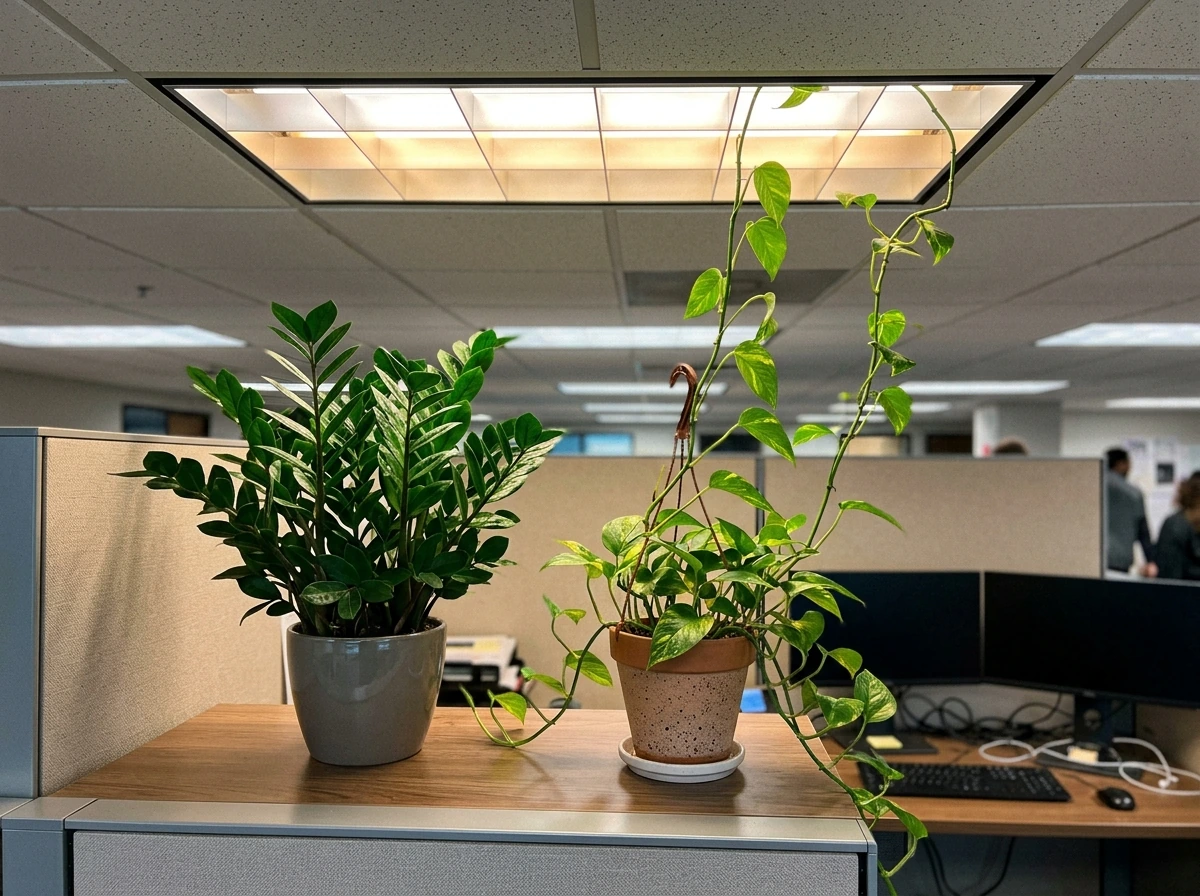
I've grown pothos, ZZ plants, and peace lilies on an office windowsill supplemented only by overhead fluorescent tubes, and they did fine. I've also watched a basil plant slowly yellow and stretch itself toward the fixture before giving up entirely. The difference wasn't luck, it was choosing the right plant for the light available. This guide will help you do exactly that.
What your office fluorescent lights are actually delivering
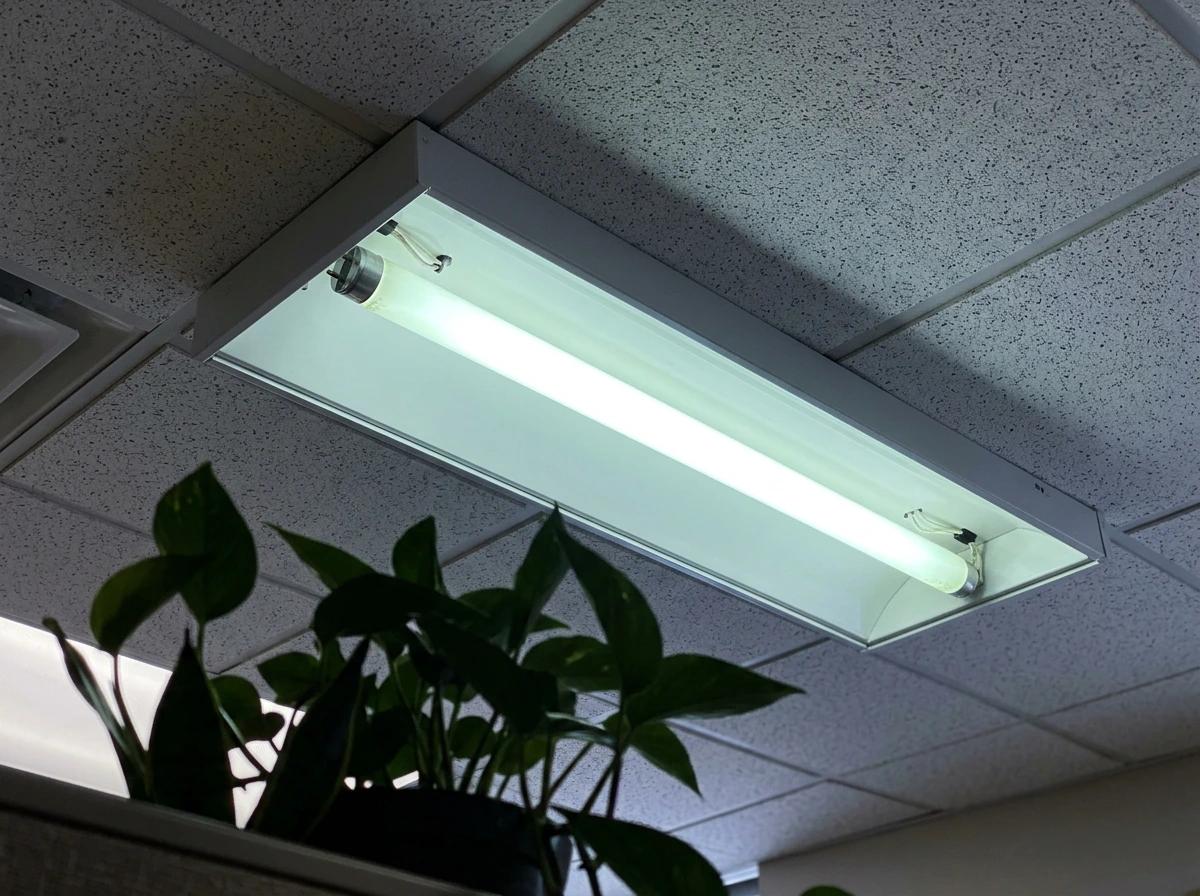
Before you pick a plant, it helps to know what you're actually working with. A standard T8 fluorescent tube, the 4-foot 32W kind you'll find in most office ceilings, puts out roughly 2,900 lumens at peak. That sounds like a lot, but by the time that light disperses across a room and reaches your desk, the intensity drops significantly. Typical office lighting is designed to deliver around 300 to 500 lux at desk level, which is plenty for reading but not particularly generous for photosynthesis.
Spectrum matters too. Many office fluorescents are rated at 6500K (daylight), with a Color Rendering Index of around 80.
The 6500K range does cover some of the blue spectrum that plants use for vegetative growth, which is why low-light plants can manage reasonably well under it. But most fluorescent tubes are weak in the red spectrum (around 630 to 700 nanometers), the range that drives flowering, fruiting, and robust stem growth. So office fluorescent is a partially useful spectrum, not a complete one.
can plants grow from light bulbs If you're curious about how artificial light sources compare more broadly, it's worth reading about the differences between grow lights and standard bulbs before you buy can plants grow with regular light bulbs.
Then there's duration. In a typical office, lights are on for 8 to 10 hours a day during work hours and off evenings and weekends. Many plants need 12 to 16 hours of light to support healthy growth. So even if the intensity and spectrum were perfect, the photoperiod in most offices is too short for demanding species. You're essentially giving your plants a short winter day, every single day.
Plants that will actually work, and ones that won't
The good news is that quite a few popular houseplants evolved under forest canopies where they naturally receive low, filtered light. These species have adapted to make the most of limited photons, and office fluorescent is genuinely enough for them. Others, especially anything you'd grow for food, flowers, or sun-loving outdoor vibes, will struggle and eventually decline.
Plants that handle office fluorescent well
- Pothos (Epipremnum aureum): nearly indestructible, tolerates low intensity and inconsistent duration
- ZZ plant (Zamioculcas zamiifolia): slow grower, but stable and unfazed by weak light
- Snake plant (Sansevieria / Dracaena trifasciata): one of the most light-flexible plants you can own
- Peace lily (Spathiphyllum): will even flower occasionally under decent fluorescent if it's close enough to the fixture
- Cast iron plant (Aspidistra elatior): earns its name in office conditions
- Chinese evergreen (Aglaonema): dark-leaf varieties especially, these were practically bred for office lobbies
- Heartleaf philodendron: grows steadily, trails beautifully, asks very little
- Dracaena varieties (Janet Craig, Marginata): reliably tolerant of office-level light
- Lucky bamboo: thrives in fluorescent, though it's technically more of a Dracaena than a true bamboo
- Spider plant (Chlorophytum comosum): handles fluorescent well, especially near the fixture
Plants that will struggle or fail
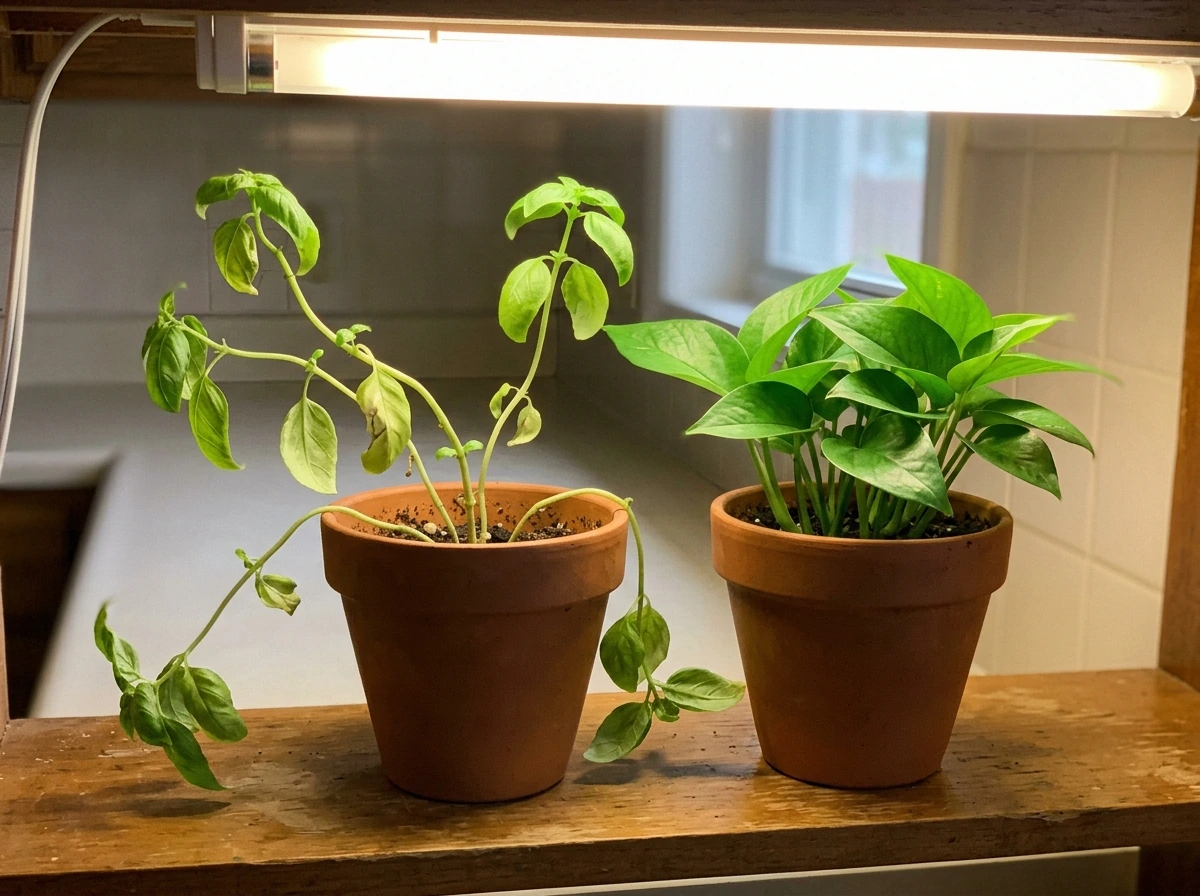
- Herbs (basil, rosemary, thyme): need high intensity and long photoperiods, will get leggy and weak
- Succulents and cacti: require bright, direct-equivalent light for compact growth; fluorescent makes them etiolate fast
- Fiddle-leaf fig (Ficus lyrata): needs strong light to maintain leaf health, slow decline under office fluorescent
- Most flowering houseplants (anthuriums, orchids in bloom): insufficient red spectrum for sustained flowering
- Vegetable seedlings: will stretch and become weak almost immediately
- Monstera deliciosa (in low-intensity setups): can survive but won't fenestrate (develop leaf holes) or grow at a satisfying pace
| Plant | Survives Office Fluorescent | Grows Healthily | Notes |
|---|
| Pothos | Yes | Yes | One of the best choices overall |
| Snake plant | Yes | Yes | Very forgiving of short photoperiods |
| ZZ plant | Yes | Yes | Slow but steady; very low maintenance |
| Peace lily | Yes | Yes (with some caveats) | May flower if placed within 1–2 ft of fixture |
| Chinese evergreen | Yes | Yes | Dark varieties best |
| Basil | Briefly | No | Gets leggy quickly, then declines |
| Succulents | Short term | No | Etiolates fast without high-intensity light |
| Fiddle-leaf fig | Yes (barely) | No | Slow, progressive decline |
| Orchids | Yes | No (won't rebloom) | Insufficient red spectrum for flowering |
Getting the most out of what you have: placement, distance, and photoperiod
Even with the right plant, placement makes or breaks the setup. Light intensity drops sharply with distance, following the inverse square law. Practically speaking, a plant sitting two feet below a fluorescent fixture receives dramatically more usable light than one sitting four feet below. If you can get your plant within 12 to 24 inches of the tubes, you'll be working with meaningfully better conditions than a plant sitting on the floor across the room.
If your desk sits directly under the overhead fixtures, use that to your advantage. Put plants on the desk surface rather than on a shelf or floor. If fixtures are mounted high on the ceiling (8 feet or more), you'll see better results by placing plants on elevated surfaces like desks, shelves, or filing cabinets to close the distance gap.
Photoperiod matters more than most people realize. If the office lights are only on for 8 hours during the workday, that's genuinely limiting. The minimum recommended light duration for most low-light houseplants is around 10 to 12 hours per day. If you can arrange for a small supplemental light on a timer to extend the photoperiod before or after office hours, even a simple LED desk lamp, you'll see noticeably better results. If you want a practical comparison between natural sun and added light sources, see do plants grow better with sunlight or artificial light for how different lighting stacks up. I cover this more in the upgrade section below.
Legginess (technically called etiolation) is the most common complaint with fluorescent-grown plants. This is when stems stretch long and thin between leaves as the plant reaches for more light. To reduce it: place the plant as close to the fixture as safely possible, rotate the pot a quarter turn every week or two so all sides get even exposure, and don't fertilize heavily since excess nitrogen in low-light conditions encourages weak, fast growth instead of compact, healthy growth.
Signs your plant isn't getting enough light
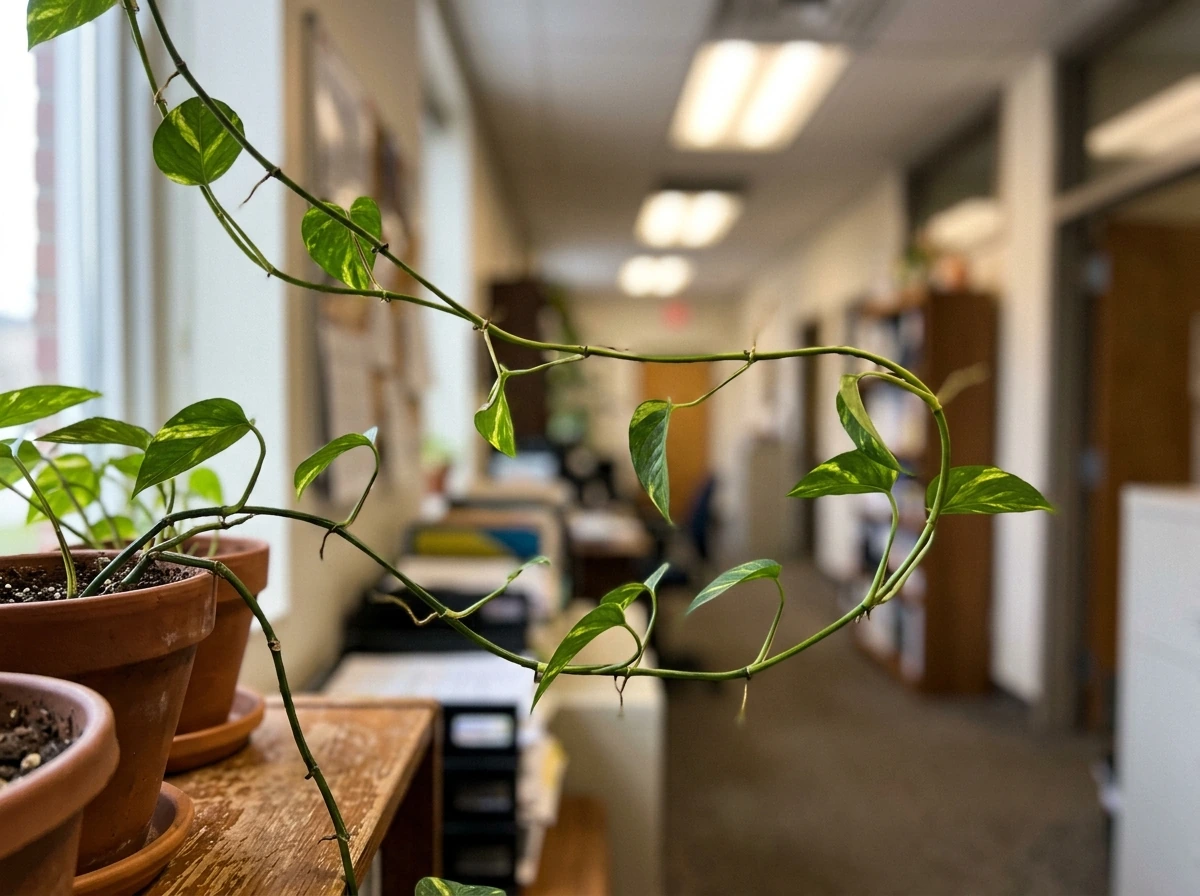
Plants are pretty transparent about their unhappiness, once you know what to look for. The tricky part is that light stress can look similar to other problems like overwatering or nutrient deficiency, so context matters.
- Legginess or etiolation: long, spindly stems with large gaps between leaves, often leaning toward the light source
- Pale or washed-out leaves: the plant is producing less chlorophyll because it's not receiving enough light to justify the energy investment
- Yellowing lower leaves: often the first leaves to go when light is insufficient, as the plant sacrifices older tissue
- No new growth (or extremely slow growth): a plant that hasn't pushed a new leaf in several weeks in a warm room is probably light-limited
- Small new leaves: newer leaves noticeably smaller than mature leaves, a sign the plant is rationing resources
- Drooping despite adequate watering: less common, but very low light can reduce transpiration and cause subtle turgor issues
If you're seeing any of these signs, the first things to check are distance from the fixture and daily light duration. Move the plant closer to the light source first. If it's already close and still struggling, you're either working with the wrong plant for the space or it's time to consider a small supplemental light.
When office fluorescent isn't cutting it: simple upgrades and switching to LED grow lights
Office fluorescent lighting has real limits, and there's no shame in acknowledging that. If you want to grow more than a handful of low-light species, or if you're working with a space that has particularly dim fixtures or high ceilings, the smart move is to supplement or replace the light source rather than fight the conditions.
Easy, low-cost improvements to try first
- Add a simple timer: if lights are on a manual switch, a programmable outlet timer (around $10 to $15) can extend the photoperiod before or after regular hours, bringing your plants up to 12 to 14 hours of light daily
- Use a reflective surface: placing a small piece of white foam board or reflective mylar behind or below your plant bounces stray light back toward the leaves, improving efficiency without any additional power draw
- Reposition the fixture or plant: in offices where you have some control over layout, even shifting a plant to be directly under a tube rather than between tubes can make a measurable difference
- Add a single LED desk lamp with a daylight or full-spectrum bulb: not a grow light, just a positioned lamp, can meaningfully extend both duration and direction of light exposure
When to switch to an actual LED grow light
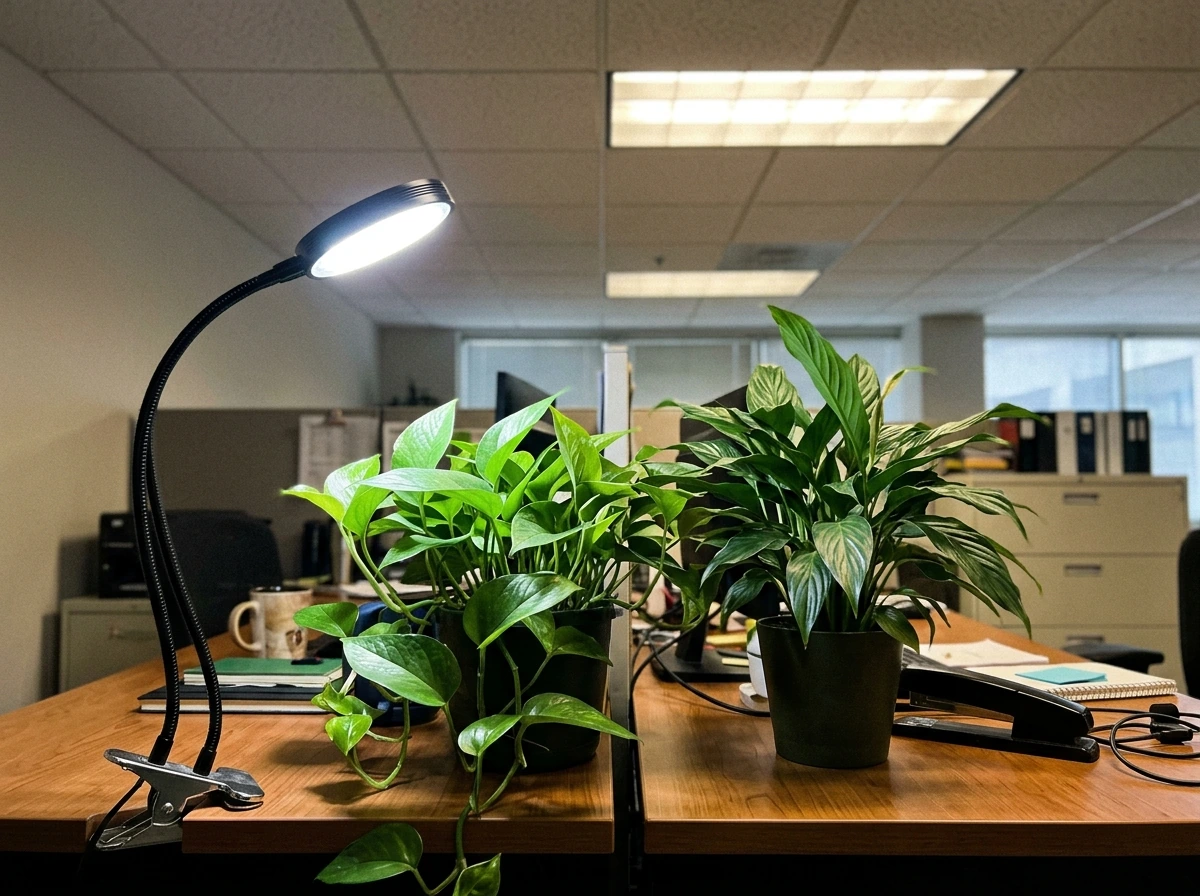
If you've optimized placement, extended the photoperiod, and you're still seeing legginess or stalled growth, that's the signal that office fluorescent simply isn't enough for your goals. LED grow lights have dropped dramatically in price and have become genuinely practical for desk or shelf setups. A small full-spectrum LED grow light (look for one that covers both blue and red spectrum, around 400 to 700 nanometers) mounted 12 to 18 inches above your plants will outperform any office fluorescent fixture for plant growth. It's also worth knowing that LED grow lights use significantly less electricity than equivalent fluorescent tubes while delivering more targeted photosynthetically active radiation (PAR), the light measurement that actually matters for plant growth.
You don't need to spend a lot. A clip-on or gooseneck LED grow light in the $25 to $60 range is more than sufficient for a small desk or shelf garden. Position it 6 to 18 inches above the plant canopy (closer for low-light plants, a bit further for more sensitive foliage), set a timer for 12 to 14 hours per day, and you'll have genuinely better growing conditions than most offices can provide naturally.
You don't need to spend a lot. A clip-on or gooseneck LED grow light in the $25 to $60 range is more than sufficient for a small desk or shelf garden. Position it 6 to 18 inches above the plant canopy (closer for low-light plants, a bit further for more sensitive foliage), set a timer for 12 to 14 hours per day, and you'll have genuinely better growing conditions than most offices can provide naturally.
If you're curious about how artificial light sources compare more broadly, it's worth reading about the differences between grow lights and standard bulbs before you buy.
Your plan for today: pick a plant and test your setup
Here's how to go from reading this article to actually doing something useful today. This doesn't have to be complicated.
- Measure your light duration: note what time the office lights come on and when they go off. If it's less than 10 hours, flag that as your first problem to solve.
- Estimate your distance from the fixture: stand at your plant's location and look up. If the fixture is more than 3 feet overhead, plan to elevate the plant or add a supplemental light.
- Choose a plant from the 'handles office fluorescent well' list above: pothos, snake plant, or ZZ plant are the safest starting points if you're new to this. Chinese evergreen or heartleaf philodendron if you want something with a bit more visual interest.
- Place the plant as close to the fixture as reasonably possible: on the desk directly below the tube, not on the floor in the corner.
- Wait 3 to 4 weeks and observe: look for new leaf growth, check stem length between leaves, note leaf color. Healthy growth or stable maintenance means your setup is working. Legginess or yellowing means you need to adjust.
- If growth is poor after a month: try extending photoperiod with a timer first (the cheapest fix), then consider adding a small LED grow light targeted directly at the plant.
- Adjust and repeat: plant care under artificial light is iterative. You'll learn more from one real plant in your actual space than from any amount of reading.
The bottom line is that office fluorescent lighting is a legitimate growing environment for a reasonable selection of plants, as long as you match the plant to the conditions rather than forcing the wrong plant into the space. Start with something tolerant, get it placed well, and build from there. Once you've got a few low-light plants doing well, you'll have a much better intuitive sense of what your space can actually support, and whether it's worth investing in better lighting for more ambitious growing goals.