Yes, plants will grow under artificial light. Not just survive, but genuinely grow, flower, and produce food, provided the light delivers the right spectrum, enough intensity, and runs for enough hours each day. I've grown herbs, leafy greens, and tropical houseplants entirely under LEDs in apartments with zero south-facing windows, and the results were better than I expected once I understood what plants actually need from light. The short version: artificial light works, but 'any old bulb' does not.
Will Plants Grow in Artificial Light? Complete Indoor Guide
Marcus Hartley
24 Mar 2026
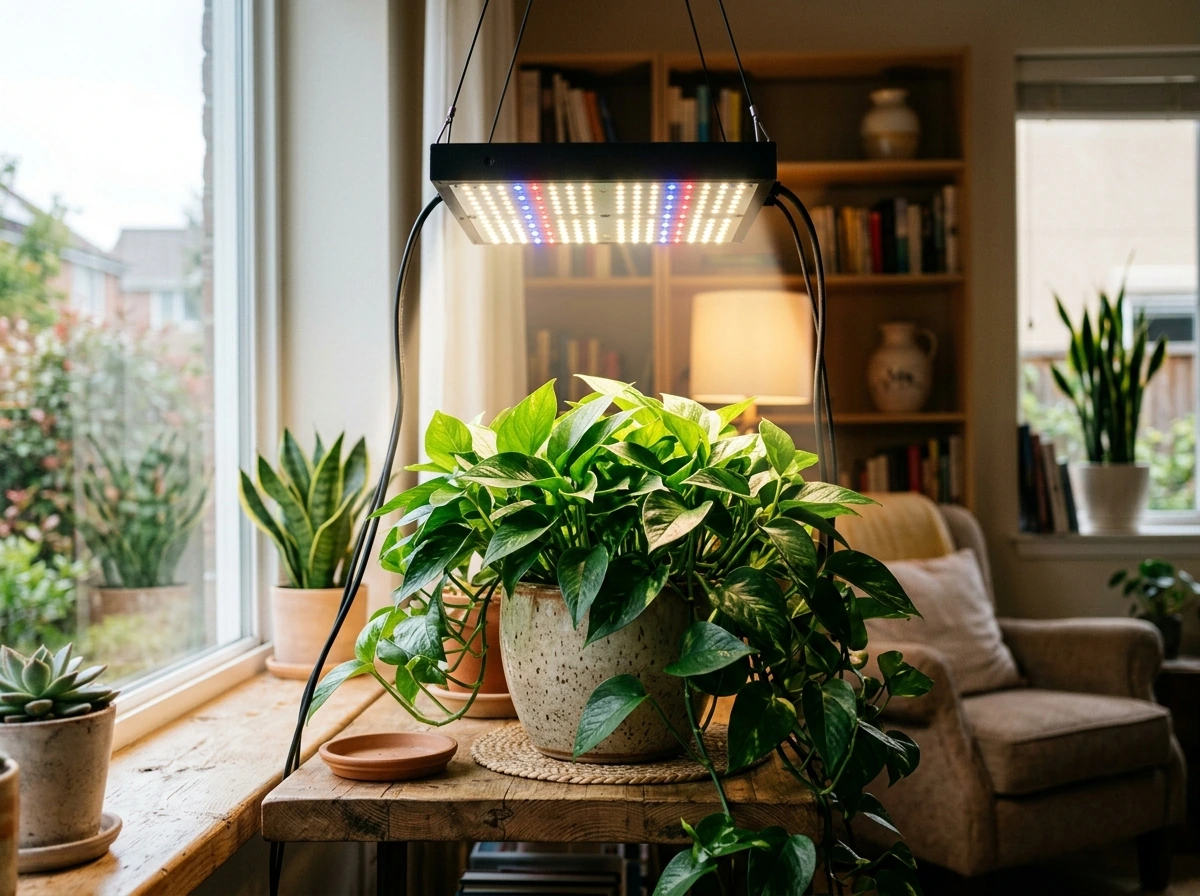
Yes, plants can grow with artificial light, here's what makes it work
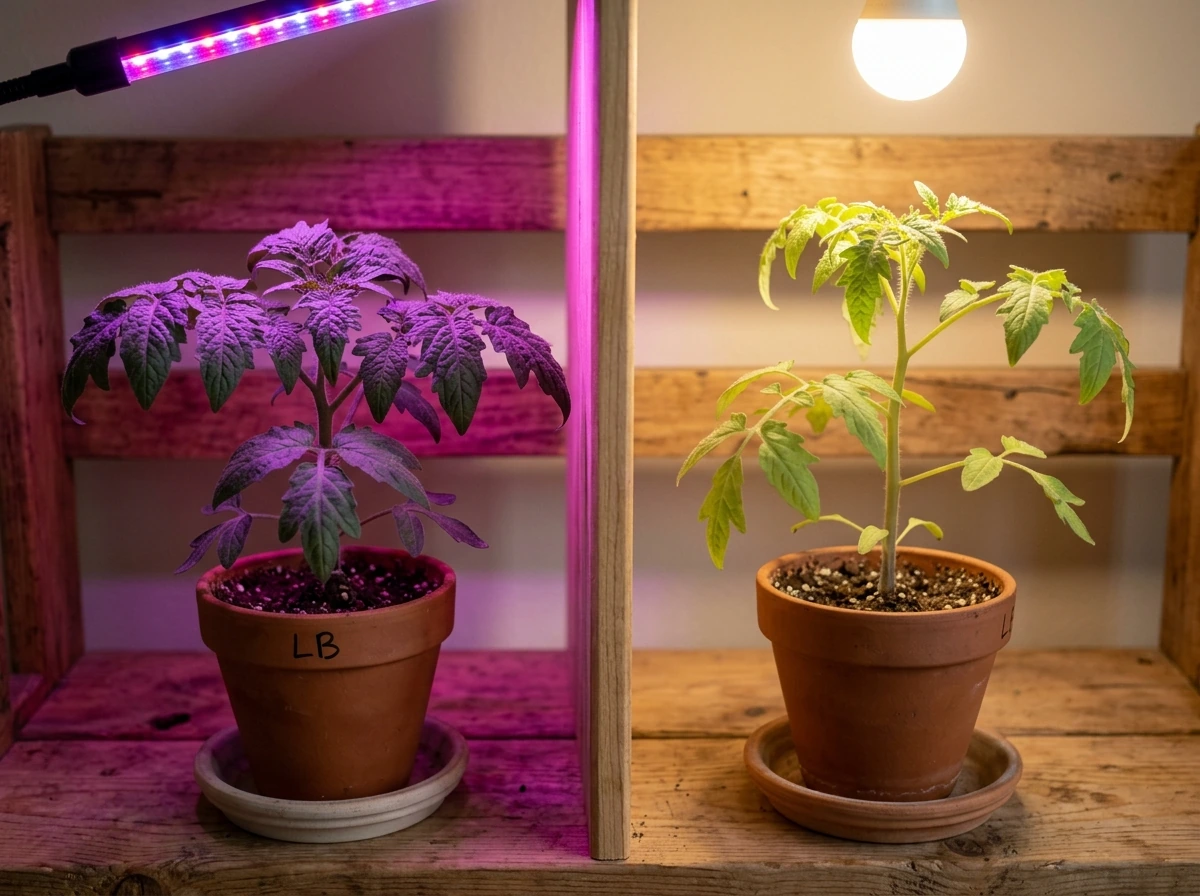
The key conditions are spectrum, intensity, and duration. Get all three right and your plants will not notice the sun is missing. Miss any one of them and growth will stall, stretch, or look sickly no matter how expensive your setup is.
- Spectrum: Plants use light in the 400–700 nm range, called photosynthetically active radiation (PAR). Blue light (around 450 nm) drives compact, leafy growth. Red light (around 630–660 nm) powers flowering and fruiting. A grow light that covers this range gives plants what they need.
- Intensity: Measured as PPFD (photosynthetic photon flux density, in µmol·m⁻²·s⁻¹), this tells you how many usable photons are hitting the plant per second. Lux, the number on most phone light meters, is calibrated to human vision, not plant vision, so it can mislead you. PPFD is the number to pay attention to.
- Duration: Plants need a daily quota of light, not just bright light in bursts. The metric is DLI (daily light integral), which combines PPFD and hours. A plant that needs a DLI of 12 mol·m⁻²·d⁻¹ can get there with moderate intensity over 14–16 hours, or higher intensity over fewer hours.
NASA has been growing plants under fully artificial light for years. Their Advanced Plant Habitat on the International Space Station uses configurable LED recipes with blue (~450 nm), red (~630 nm), green (~525 nm), far-red (~730 nm), and broad-spectrum white diodes. NASA also explains that its plant-growth hardware uses LEDs across those red, green, blue, and far-red or white wavelengths to create controlled lighting conditions in microgravity configurable LED recipes with blue, red, green, far-red, and broad-spectrum white diodes. If plants can complete their entire life cycle in orbit under LEDs, they can certainly grow in your spare bedroom.
How artificial light actually powers plant growth
Photosynthesis is essentially a factory that runs on light. Chlorophyll in plant cells absorbs photons, mostly from the blue and red parts of the spectrum, and uses that energy to convert carbon dioxide and water into sugars. Those sugars are what the plant builds leaves, roots, stems, and fruits from. When you swap sunlight for a grow light, the factory keeps running as long as the photons keep arriving in the right quantities and wavelengths.
Light also controls more than just photosynthesis. It regulates photoperiodism, the plant's internal clock that tells it when to flower, when to go dormant, and how to pace its growth. Day length (or more precisely, night length) is the trigger. Long-day plants flower when nights are short; short-day plants flower when nights are long. Under artificial light you can actually control this deliberately, which is something the sun does not let you do. That said, for most home growers just trying to keep herbs alive or grow some lettuce, getting the photoperiod in the right ballpark matters more than dialing it to the minute.
Choosing the right light source
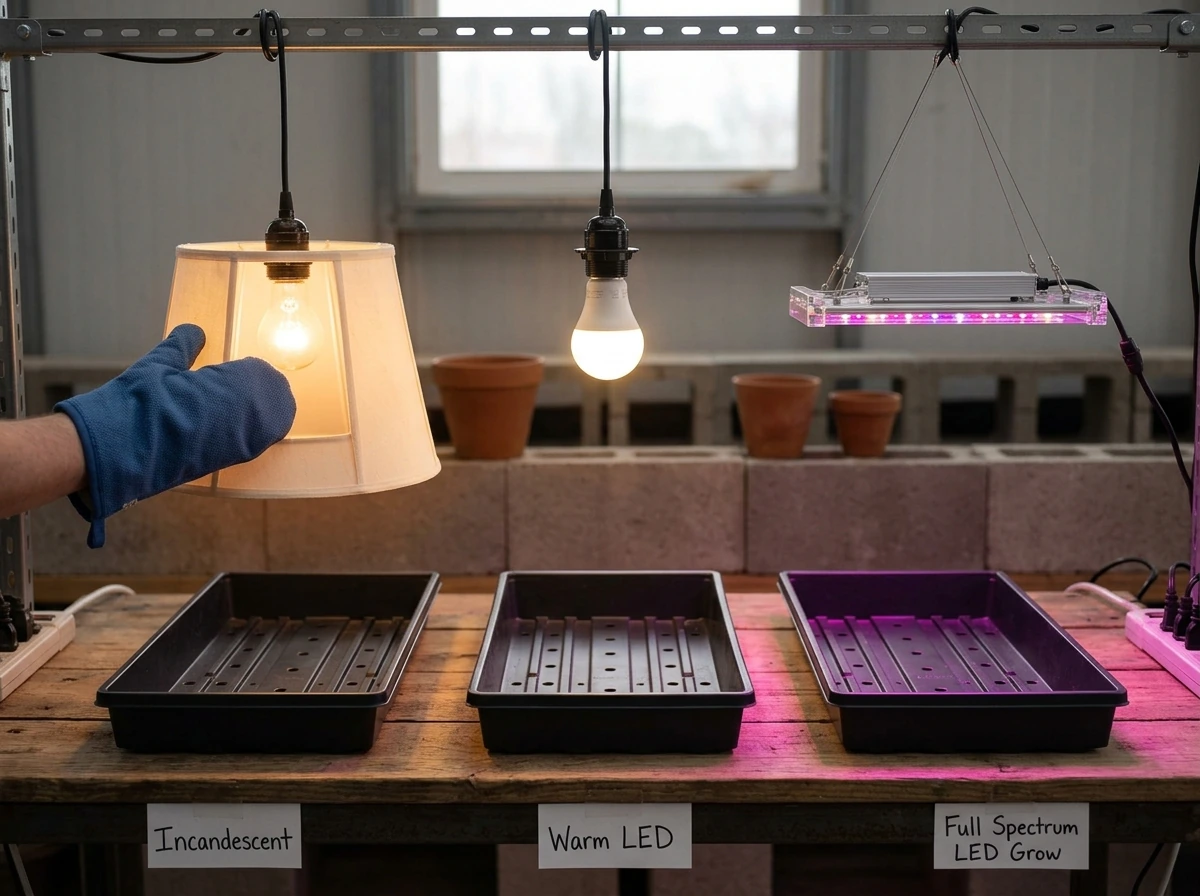
Not every electric light is a grow light. A standard incandescent bulb wastes most of its energy as heat, runs hot enough to burn leaves if placed close enough to be useful, and skews so far toward red/infrared that the spectrum is lopsided. Here is how the main options compare:
| Light Type | Spectrum for Plants | Energy Efficiency | Heat Output | Best Use Case |
|---|---|---|---|---|
| Full-spectrum LED grow lights | Excellent (tunable, covers PAR range) | Very high | Low | Any indoor plant, from seedlings to fruiting crops |
| Fluorescent (T5/T8) | Good (cool-white/daylight tubes cover PAR reasonably well) | Moderate | Low-moderate | Seedlings, herbs, low-to-medium light plants |
| Compact fluorescent (CFL) | Decent for low-light plants | Moderate | Low | Small setups, succulents, propagation |
| Standard LED bulbs (non-grow) | Variable, often missing key PAR wavelengths | High | Very low | Very low-light tolerant plants only |
| Incandescent / halogen | Poor (heat-heavy, red-skewed) | Very low | High | Not recommended for plants |
My recommendation: full-spectrum LED grow lights are the best choice for nearly everyone growing indoors today. They are more energy-efficient than fluorescents, run cool enough to place close to plants, last tens of thousands of hours, and the price has dropped dramatically in the last few years. You do not need to spend a fortune. A decent LED panel in the $40–$80 range can cover a 2x2 foot grow area adequately for herbs and leafy greens. If you are already curious about whether regular household bulbs can pull double duty, that question gets into nuance worth exploring separately, but the short answer is: sometimes, for the most tolerant plants, but not reliably.
A note on spectrum labels
When shopping for grow lights, you will see terms like 'full spectrum,' 'red/blue blurple,' and 'white LED.' Full-spectrum white LEDs that include both blue and red peaks are generally the most practical for home growers because they also make it possible to see your plants' true color (blurple lights make everything look purple, which makes it hard to spot yellowing or disease). For flowering and fruiting plants, look for lights that include red wavelengths around 630–660 nm. Blue around 450 nm is especially useful during vegetative, leafy growth stages.
Setting up your artificial lighting: distance, duration, and intensity
Distance
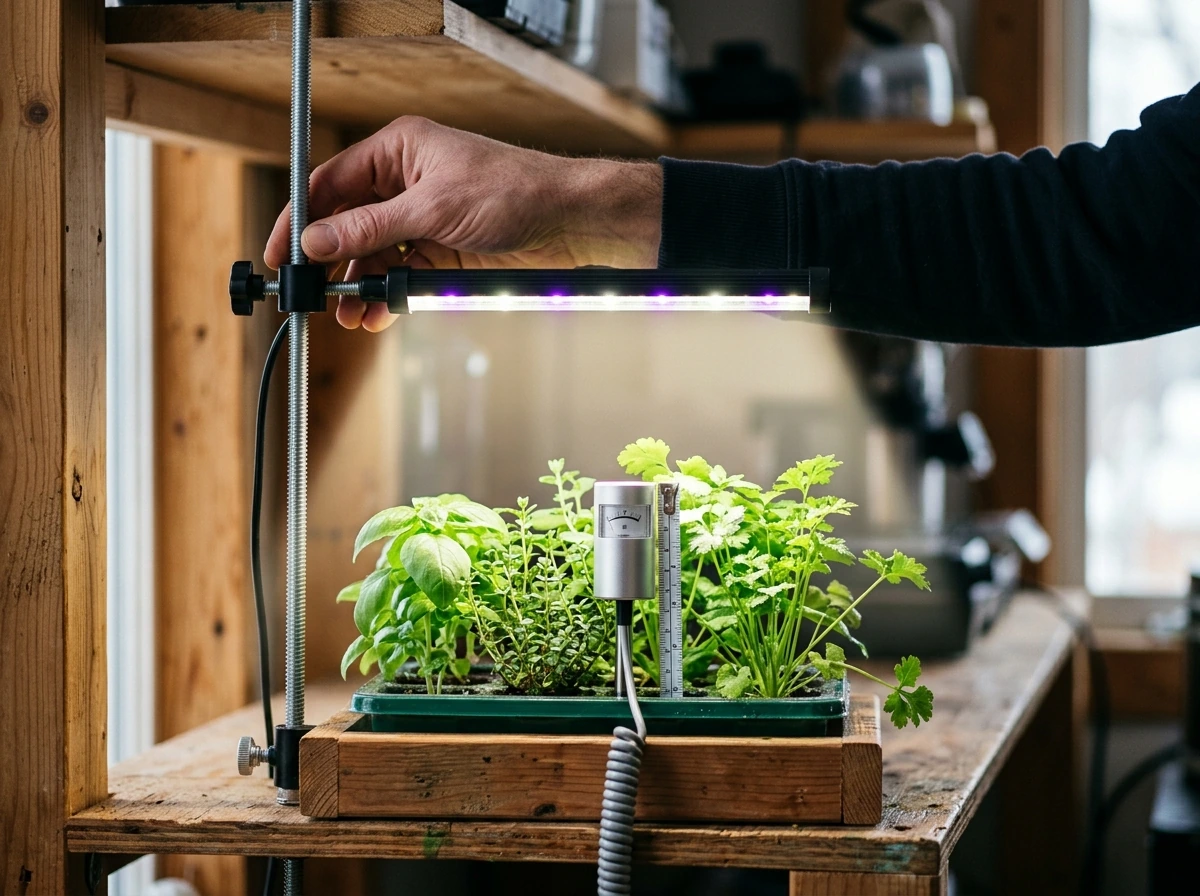
Light intensity drops off fast as you move the fixture away from the plant. A rough rule of thumb for LED grow lights: 12–24 inches above the canopy for most herbs and leafy greens, closer for seedlings needing intense early-stage light (6–12 inches for some setups), farther for shade-tolerant plants. But rather than relying on rules of thumb alone, using an inexpensive PPFD meter (or a smartphone app that measures PAR, with its limitations in mind) to verify what your plants are actually receiving is the more reliable approach. Different fixtures drop off at different rates.
Duration (photoperiod)
Most foliage plants, herbs, and vegetables do well with 14–16 hours of light per day under artificial conditions. Seedlings often benefit from the higher end of that range. Flowering plants vary: long-day plants need 14+ hours of light to bloom, while short-day plants (like poinsettias and chrysanthemums) need 12 hours or fewer. For most kitchen herb gardens and leafy green setups, running lights for 14–16 hours and then giving plants 8–10 hours of darkness covers all the basics. A simple outlet timer makes this effortless and removes one of the most common mistakes: forgetting to turn the lights off.
Intensity and DLI
DLI (daily light integral) is the total amount of PAR photons a plant receives over an entire day. The formula is: DLI = 0.0036 × PPFD × light hours per day (when PPFD is constant). Low-light plants like pothos or peace lily are happy with a DLI around 4–6 mol·m⁻²·d⁻¹. blank" rel="noopener noreferrer">Herbs like basil and lettuce want 12–20 mol·m⁻²·d⁻¹. Fruiting crops like tomatoes and peppers can need 20–30 or more. If your fixture delivers a PPFD of 200 µmol·m⁻²·s⁻¹ at plant height and you run it 16 hours, your DLI is roughly 11.5 mol·m⁻²·d⁻¹, which covers most herbs and leafy greens comfortably.
One important misconception to clear up: running lights for more hours does not automatically fix inadequate intensity. If your PPFD is too low, extending the photoperiod helps somewhat, but there is a ceiling. A dim light run for 20 hours still cannot replace a properly bright light run for 14 hours. More total photons delivered at sufficient intensity is what matters, not just more hours of dim light.
Which plants grow best under artificial light
The easiest wins are low-to-medium light plants and fast-growing edibles. High-light plants like full-sun tomatoes and peppers can be grown under artificial light, but they demand more powerful and expensive fixtures and are less forgiving of setup mistakes. Here is a practical breakdown:
Easiest options (great for beginners)
- Pothos, philodendron, and peace lily: naturally low-light tolerant, thrive under even modest artificial light setups
- Snake plants (Sansevieria): incredibly forgiving, will grow steadily under fluorescent or LED light
- Lettuce, spinach, and salad greens: fast-growing, relatively low DLI requirements, great for countertop LED setups
- Basil, parsley, chives, and mint: respond well to 14–16 hours of LED light at moderate intensity
- Pothos and heartleaf philodendron: practically indestructible under artificial light
Moderate difficulty
- African violets: flower beautifully under fluorescent or LED light, need about 12–14 hours
- Orchids (Phalaenopsis): do well under grow lights at moderate intensity, around 12–16 hours
- Ferns and calatheas: prefer indirect, consistent light that artificial setups can replicate reliably
- Microgreens and sprouts: extremely fast turnaround, very achievable under any decent LED grow panel
More challenging (doable but requires a stronger setup)
- Tomatoes, cucumbers, and peppers: need high PPFD and long photoperiods; possible but requires a serious grow light
- Cannabis and other high-light crops: achievable indoors but require purpose-built high-intensity setups
- Succulents and cacti: counterintuitively tricky under artificial light because they need very high light intensity to stay compact and avoid etiolation (stretching)
University of Missouri Extension makes a useful point: plants that need high light intensity in general are less satisfying to grow under artificial light in a typical home setup. That is not a reason to avoid trying, but it is worth going in with realistic expectations. A pothos will flourish. A full-sun pepper plant will need a genuinely powerful fixture and careful management.
Artificial light only vs. supplementing sunlight
Plants can absolutely grow with artificial light as their only light source, but the real question, do plants grow better with sunlight or artificial light, is whether your setup delivers enough. The NASA examples make this impossible to argue against. The practical question is whether your setup delivers enough. In a room with no windows, a good LED grow light running 14–16 hours a day can fully replace sunlight for most foliage plants, herbs, and greens. That same setup will struggle with high-light crops unless the fixture is powerful enough to hit the required PPFD.
If you have a room with some natural light, even a north-facing window, supplementing with artificial light is often the easier and more effective path. The natural light handles some of the baseline needs, and the grow light fills in the gaps. You can also use supplemental lighting to extend the photoperiod into the evening, essentially giving plants a longer day without needing a fixture powerful enough to substitute for the sun entirely. This hybrid approach is forgiving and works well in most urban apartments.
One real difference worth noting: under natural sunlight, plants experience gradual intensity shifts through the day (morning softness, midday intensity, afternoon warmth), which influences how they develop. Artificial light tends to be constant and uniform, which is actually an advantage for consistency and control but can sometimes produce slightly different plant habits. In practice, for most home-grown plants, this difference is negligible. Quality comes down to meeting the DLI target, not replicating every subtlety of solar light.
Troubleshooting: signs your light isn't cutting it
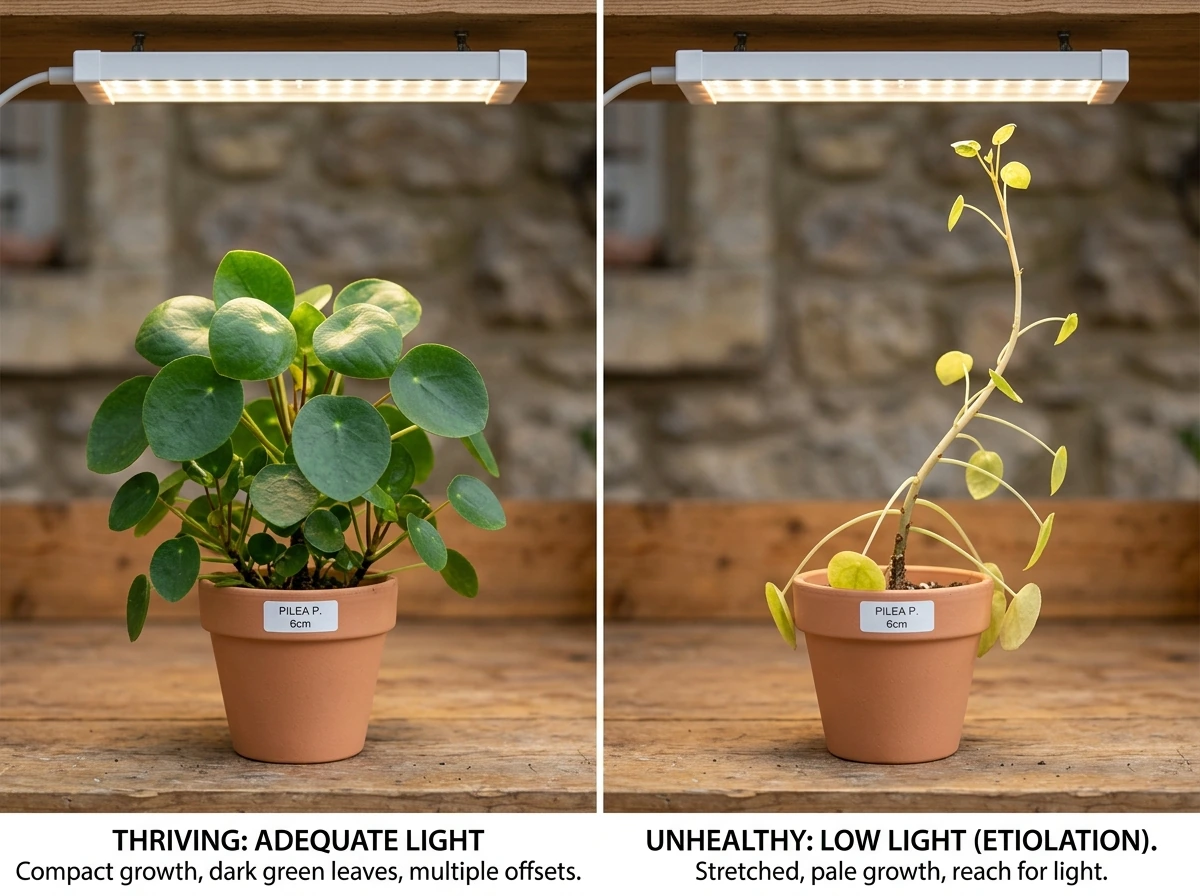
Insufficient light is the most common reason plants underperform indoors. University of Maine Extension identifies it as a leading cause of pale foliage, poor blooming, and weak growth in houseplants. Here is how to read the signs and fix them:
| Symptom | Likely Cause | Fix |
|---|---|---|
| Long, stretched stems reaching toward the light (etiolation) | Light intensity too low | Move the fixture closer or upgrade to a higher-output light |
| Pale, washed-out, or yellowing leaves | Insufficient total light (DLI too low) | Increase intensity, extend photoperiod, or both |
| Leaves smaller than normal | Low light or wrong spectrum | Check PPFD at plant level; switch to full-spectrum LED if using a basic bulb |
| No flowers despite plant being old enough | Wrong photoperiod for the plant type | Research your plant's photoperiodic type and adjust light hours accordingly |
| Leggy growth and dropping lower leaves | Light not reaching lower canopy | Add a second light, lower the fixture, or rotate the plant regularly |
| Good growth early, then decline after a few months | Light output degrading (common with cheap LEDs) or seasonal changes in ambient light | Test PPFD again; replace bulbs or upgrade fixture if output has dropped |
A practical troubleshooting checklist to run through before assuming the plant is the problem:
- Measure actual PPFD at the canopy level, not just estimate based on fixture distance
- Calculate your approximate DLI and check it against your plant's known requirements
- Confirm your timer is working correctly and lights are actually running the full intended photoperiod
- Check that nothing is blocking the light (other plants, shelves, or reflective surfaces are absent when they would help)
- Verify the light spectrum: if using a non-grow LED or fluorescent, check whether it covers the PAR range adequately
- Rule out other causes: water, nutrients, root health, and pests can all mimic light-deficiency symptoms
The good news is that most artificial lighting problems are fixable without starting over. Moving a fixture six inches closer to the canopy can double the PPFD at plant level. Adding a few more hours to your photoperiod (up to about 16 hours for most plants) costs almost nothing. And if you are using a basic household LED bulb rather than a grow light, switching to an actual grow light is often the single change that transforms the results. Getting into the habit of verifying light levels with a meter rather than guessing will save you months of frustration and help you build a reliable indoor garden that actually performs.
FAQ
How do I know if my plants are getting enough light without buying a PPFD meter?
Watch for consistent patterns, not one-off leaves. If new growth stays small, leaves look pale or washed out, plants stretch, or flowering never comes, light is usually insufficient. The most practical DIY substitute is using a phone PAR app only as a rough guide, then adjusting distance and hours while you verify improvement over 2 to 3 weeks.
Can I leave indoor grow lights on 24/7 to speed up growth?
Usually no. Plants need a true dark period for their internal timing and stress recovery. For most foliage, herbs, and greens, 14 to 16 hours on with 8 to 10 hours off is a better baseline, and you should not exceed what your target plant and stage can handle.
Do plants need far-red or green light for indoor growth, or is red and blue enough?
Red and blue are the core for photosynthesis, but far-red and broader wavelengths can improve regulation of growth and “plant appearance” because they affect photoreceptors beyond chlorophyll. For most home setups, a quality full-spectrum LED is the simplest path, especially if you want reliable health and easier troubleshooting.
How close should I place a grow light to avoid stretching but not damage leaves?
Distance is a trade-off between higher PPFD and heat or light stress. With LEDs running cool, the main risk is too much intensity at close range, which can cause leaf tip burn or bleaching. Start near the manufacturer’s height guidance, then adjust in small steps (like 2 to 3 inches) and recheck plant response after about a week.
What’s the difference between photoperiod and DLI, and which one matters more?
Photoperiod is how many hours the light runs, DLI is the total daily “dose” of usable photons. Both matter, but DLI wins when light is marginal. If your PPFD is too low, adding hours helps only up to a ceiling, while increasing intensity directly raises DLI.
Can I use fluorescent or compact bulbs instead of LEDs successfully?
Sometimes, especially for low-to-medium light plants, but the practical hurdle is intensity and coverage. Fluorescents can work for seedlings and greens, but you often need more fixtures or closer placement to reach the PPFD targets, which increases clutter and heat management even if the bulbs are cooler than incandescent.
My plants are growing but they look leggy, what should I check first?
Check light intensity and uniformity first. Legginess usually means the plant is reaching toward insufficient PPFD, or only part of the canopy is getting strong light. Move the fixture closer, increase coverage so edges are not dim, and rotate trays so each side receives similar output.
If I’m growing herbs, do I need different light timing for basil versus lettuce?
Often, yes. Lettuce and many leafy greens generally do well at 14 to 16 hours, while herbs like basil may respond well to the same range but can grow slower in cooler or dimmer conditions. Also consider growth stage, seedlings often benefit from the higher end of the photoperiod or slightly higher intensity.
How do I handle flowering plants under artificial light so they actually bloom?
Treat photoperiod as a trigger, not just a comfort setting. Long-day plants typically need nights short enough to stay in bloom mode, short-day plants often require nights long enough to initiate flowering. If you do not control dark hours, the plant may keep vegetative growth even with strong lighting.
Is natural window light plus a grow light enough, or do I still need to match the DLI targets?
Hybrid lighting is usually forgiving, but you still need to hit the total daily dose. Window light quality and duration vary by season, so the safest approach is to aim for the same DLI target you would use indoors, then use the grow light to fill the shortfall, especially in winter or cloudy periods.
What are common mistakes people make with artificial light setups?
The biggest ones are using regular bulbs instead of grow lights, incorrect fixture height, assuming more hours fixes low intensity, and not accounting for rapid falloff across the canopy. Another frequent issue is forgetting the dark period by leaving lights on too long, which can disrupt normal growth timing.
Do I need to worry about power costs when running grow lights 14 to 16 hours a day?
Yes, but you can keep it predictable. Focus on fixture wattage and efficiency (LEDs typically cost less to run for the same usable light), then estimate daily energy use from watts times hours. If you plan to expand the grow area, using one properly sized high-output panel often costs less than multiple dim fixtures.