Here's the short answer: sunlight is usually stronger, but artificial light can absolutely match or outperform it for indoor plants when you set it up correctly. Which one is 'better' depends less on the source itself and more on how much light actually reaches your plant, what spectrum it delivers, and how consistently it does so. A south-facing window in January in Minnesota is not competing with a quality LED grow light on a timer. But a bright California windowsill in summer? That's harder to beat. The real question isn't sun versus artificial in some abstract sense, it's what your plant is actually getting right now, and whether that's enough.
Do Plants Grow Better With Sunlight or Artificial Light?
Marcus Hartley
24 Mar 2026
Sunlight vs. Artificial Light: the Direct Answer
Plants don't care whether photons come from the sun or a grow light. What they care about is how many photons arrive at their leaves, what wavelengths those photons are, and how long that exposure lasts each day. Sunlight delivers all of that in spades outdoors, but the moment you bring a plant inside, you lose a significant chunk of intensity, especially if you're more than a few feet from the window. Most indoor spaces, even bright ones, measure somewhere in the range of 50 to 500 foot-candles at plant level. That's often not enough for fruiting vegetables, herbs, or flowering plants to thrive.
Artificial light, specifically modern LED grow lights, can be dialed in to deliver consistent intensity, the right spectral mix, and a predictable photoperiod every single day. That consistency is actually an advantage sunlight can't offer. Cloudy weeks, short winter days, and poor window placement all disrupt natural light delivery. A grow light on a timer doesn't have those problems. For indoor growers, this is the real case for artificial light: not that it's inherently superior to the sun, but that it's reliable and controllable in ways sunlight isn't once you're working inside four walls.
How Much Light Your Plant Is Actually Getting (PPFD Explained)
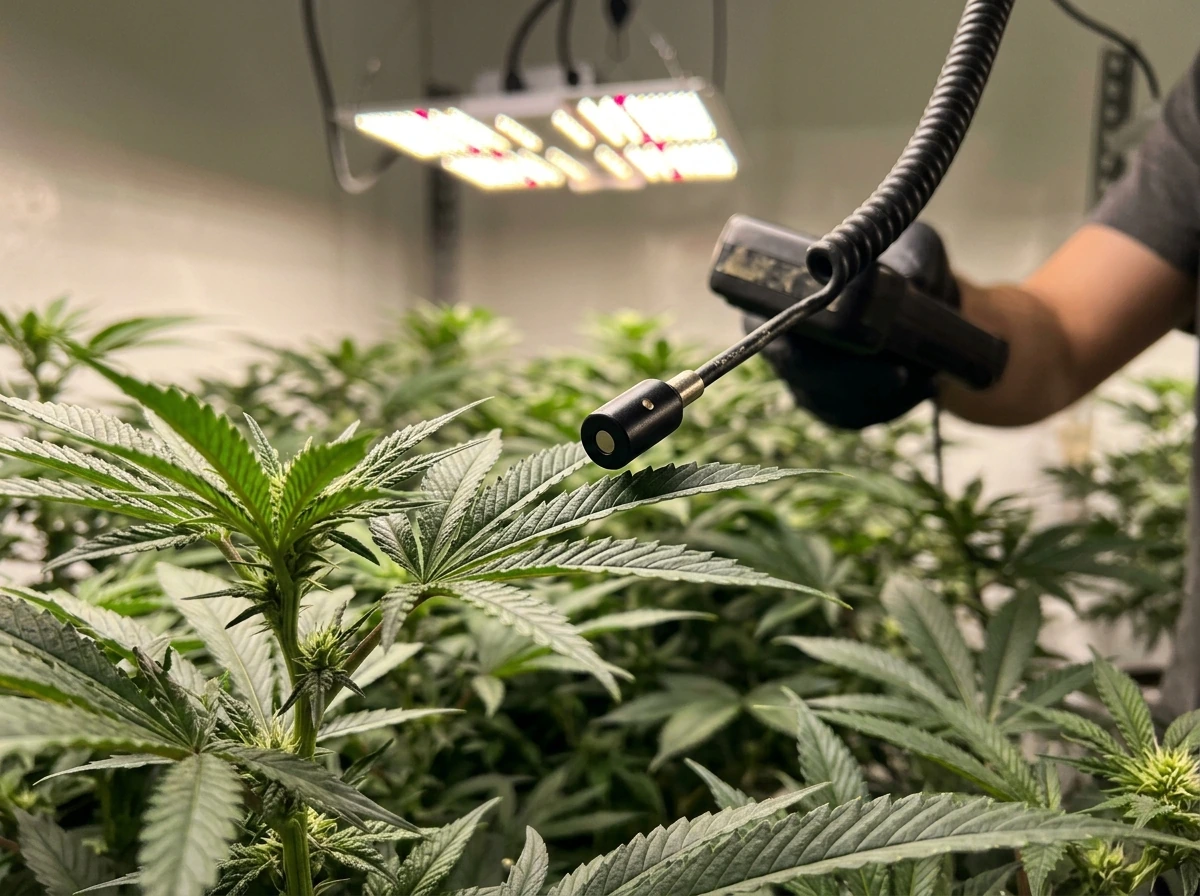
The measurement that matters most for plant growth is PPFD, which stands for photosynthetic photon flux density. It tells you how many light particles (photons) in the wavelengths plants can use are hitting a square meter of leaf surface every second. The unit is micromoles per square meter per second (μmol·m⁻²·s⁻¹). IES defines PPFD (photosynthetic photon flux density) with units of micromoles per second per square meter (μmol·s⁻¹·m⁻²) and ties a definition update to ANSI/IES RP-16-17 Addendum 4 micromoles per square meter per second (μmol·m⁻²·s⁻¹). You'll see this on grow light spec sheets, and it's worth paying attention to.
For most leafy greens and herbs, a PPFD around 200 to 300 μmol·m⁻²·s⁻¹ supports solid growth. Research on crops like lamb's lettuce (Valerianella locusta) found that growth rate peaks around 250 μmol·m⁻²·s⁻¹ and actually starts to decline above roughly 350 μmol·m⁻²·s⁻¹ under controlled conditions. That's a useful ceiling to keep in mind. More light is not always better, especially for lower-light species.
The other piece of the puzzle is DLI, or Daily Light Integral. This is the total number of photons your plant receives across the full day, combining intensity with photoperiod length. A plant getting moderate PPFD for 16 hours can accumulate the same DLI as one getting higher intensity for fewer hours. Research comparing fixed versus temporally increasing light intensity found that delivering photons more efficiently across the photoperiod can achieve similar growth outcomes while using less energy. The practical takeaway: you can compensate for a slightly lower-intensity grow light by running it a bit longer each day, up to a reasonable limit.
Spectrum: What the Sun Has That Most Bulbs Don't
Sunlight contains the full visible spectrum plus ultraviolet and infrared wavelengths. Plants use primarily red (around 630 to 700 nm) and blue (around 400 to 500 nm) light for photosynthesis, which is why grow lights focus heavily on those ranges. But there's more to it than just red and blue.
Far-red light, which sits just beyond the visible red range, influences a family of light-sensitive proteins called phytochromes. These proteins help plants regulate flowering, stem elongation, and developmental timing. Sunlight naturally includes far-red wavelengths. Many basic grow lights and most regular household bulbs don't. This is one of the reasons plants under cheap or poorly designed artificial light can behave differently from plants in a sunny window, even if the raw intensity is similar. Modern full-spectrum LEDs address this by including far-red and broader spectral coverage.
The ratio of red to blue light also matters for plant shape and behavior. Studies on lettuce with red and blue LED treatments show that altering the red-to-blue ratio changes not just photosynthetic output but also leaf morphology, plant compactness, and even nutritional content. Research on amaryllis (Hippeastrum) found that red and blue ratios from LEDs affected both vegetative growth and flowering outcomes. Blue-heavy light tends to produce stockier, more compact plants. Red-heavy light pushes faster stem elongation and can promote flowering. A good full-spectrum LED gives you both, plus the far-red that plants in a sunny window naturally receive.
| Feature | Direct Sunlight | Full-Spectrum LED | Standard Fluorescent | Regular Incandescent/LED Bulb |
|---|---|---|---|---|
| PPFD at plant level | High outdoors, variable indoors | Controllable, consistent | Low-moderate | Low, often inadequate |
| Spectrum coverage | Full, including far-red and UV | Broad, includes red, blue, far-red | Mostly blue-green, limited red | Skewed toward yellow/green, poor for plants |
| Consistency | Weather and season dependent | Stable with timer | Stable with timer | Stable but weak |
| Heat at canopy | Can be high near glass | Low with quality LEDs | Moderate | High (incandescent), low (LED bulb) |
| Cost to run | Free | Moderate electricity | Low-moderate electricity | Low electricity, poor results |
| Best use case | Bright window for sun-lovers | Vegetables, herbs, flowering plants | Seedlings, low-light plants | Not recommended for most plants |
If you're wondering whether regular household bulbs can fill in for grow lights, the short answer is they generally can't do much for most plants. If you want reliable results with bulbs, focus on using a light that delivers the right spectrum and enough intensity, not just “brightness.” can plants grow with regular light bulbs.
Run Your Own Comparison Test at Home
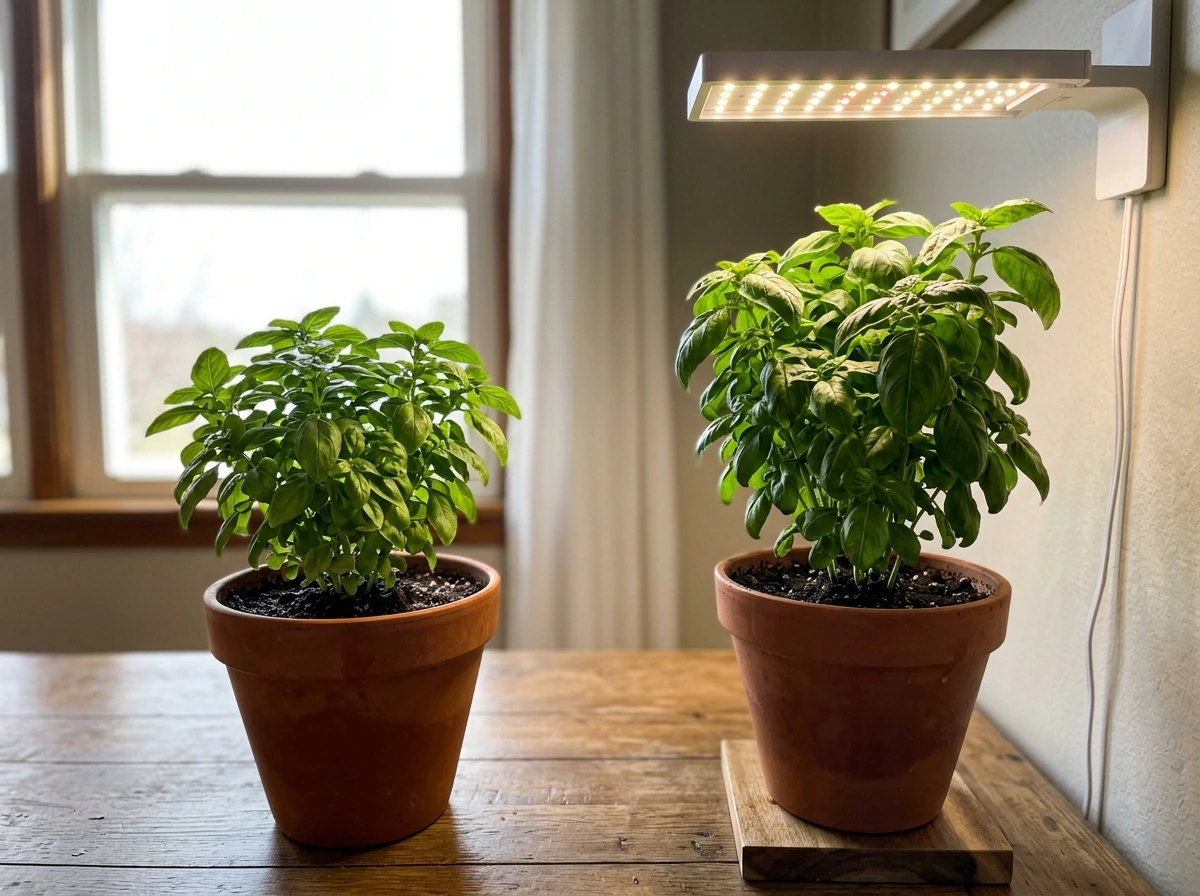
You don't need a lab to figure out whether your window or your grow light is doing more for your plants. Here's a simple setup you can run right now with what you probably already have or can grab cheaply.
- Pick two identical plants, same species, same pot size, same soil. Herbs like basil or small lettuces work well because they grow fast enough to show differences within a few weeks.
- Place one plant at your best window (south or west-facing is ideal in the Northern Hemisphere). Measure how far the plant's leaves are from the glass. Note the time of year, since winter light is dramatically weaker than summer.
- Place the second plant under a grow light, set at 6 to 12 inches above the canopy depending on the light's output specs. Put it on a timer for 14 to 16 hours per day.
- Optional but useful: grab a cheap lux meter or use a free phone app like Photone to measure light at leaf level in both spots. Convert to foot-candles by dividing lux by 10.76. This tells you actual intensity, not just 'bright' or 'dim.'
- Keep everything else identical: same watering schedule, same fertilizer, same room temperature. The only variable should be the light source.
- Check weekly for four weeks. Measure stem height, count new leaves, and note leaf color and size. Photograph both plants on day one and every seven days.
- At the end of the trial, compare. A plant that's leggier but faster-growing may be light-starved even if it looks okay. A compact, deep-green plant with steady new growth is your benchmark for 'doing well.'
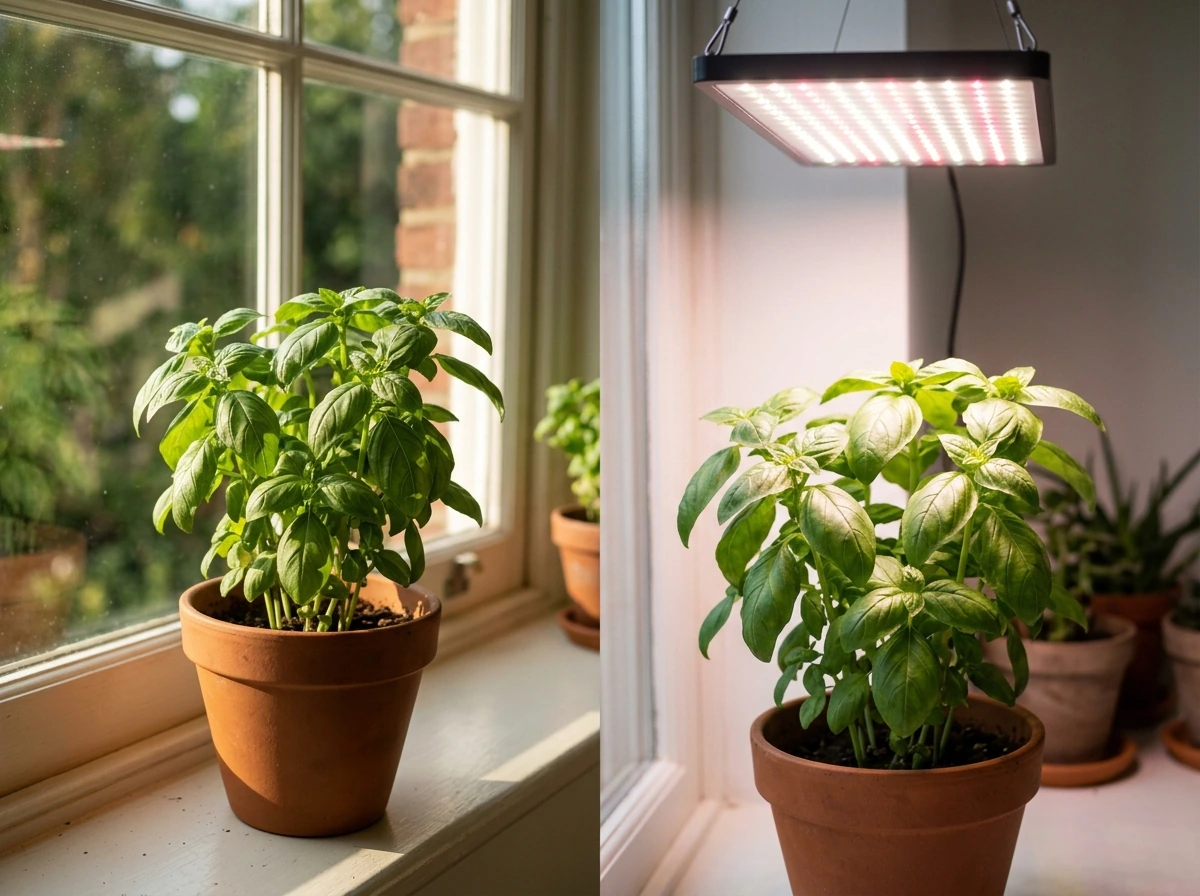
In my own apartment, I ran a version of this with basil: one pot on my east-facing windowsill and one under a 40-watt equivalent LED grow bar. The window plant grew fine through July but got thin and pale by October. The grow light plant kept going strong through winter. That's the seasonal reliability problem with windows in a nutshell.
Setting Up Artificial Light That Actually Works
Distance from the canopy
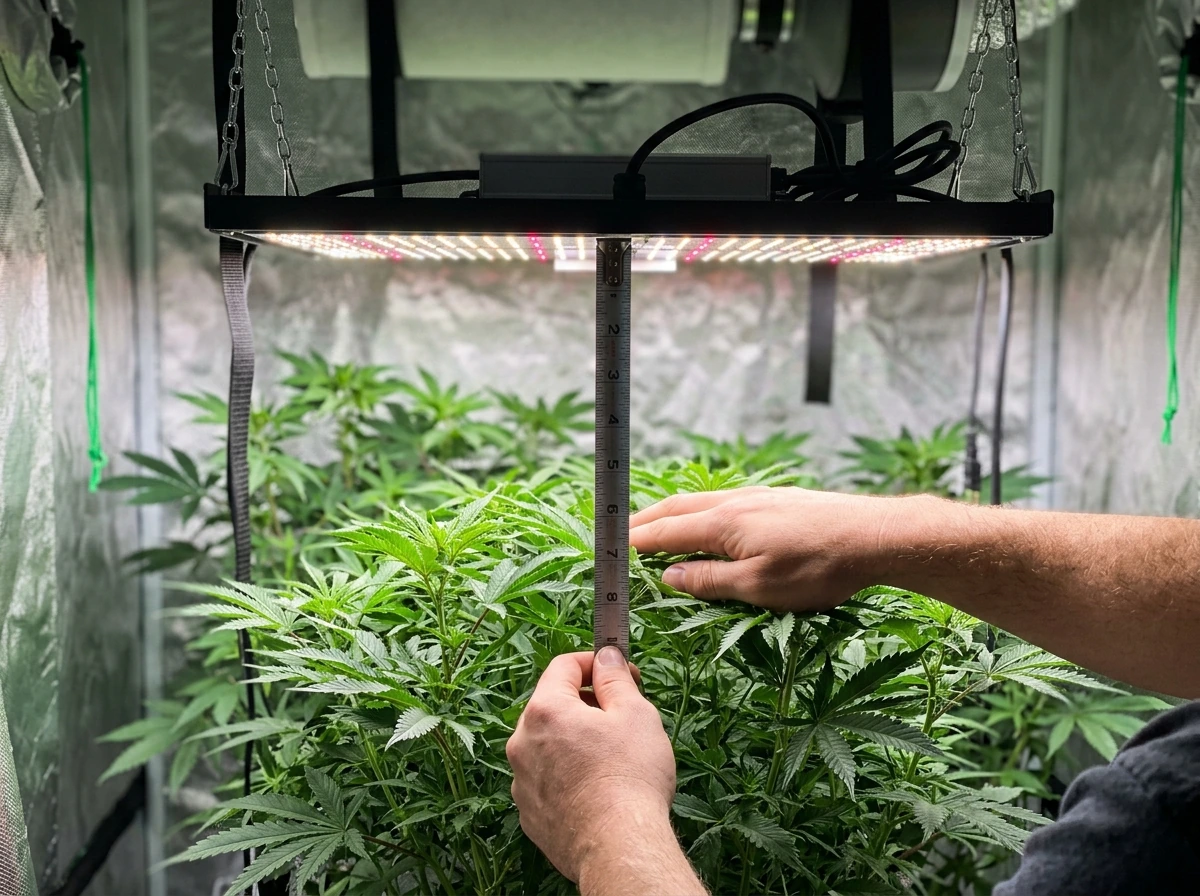
Light intensity drops off fast as you move away from the source. Most LED grow lights are designed to run 6 to 18 inches above the plant canopy. Check your specific light's specs, but a general starting point is 12 inches for leafy greens and herbs, and slightly closer (6 to 10 inches) for seedlings that need high intensity to avoid stretching. Shade-tolerant houseplants like pothos or snake plants can sit farther away, 18 to 24 inches, under lower-output fixtures. Distance is one of the most important adjustments you can make, and it costs nothing.
Photoperiod and timers
Most indoor edibles and flowering plants do well with 14 to 16 hours of light per day under artificial sources, so if you’re considering whether plants can grow with 24 hour light, it helps to use a timer and include a dark period. Houseplants kept for foliage are usually fine with 12 to 14 hours. Use an outlet timer. It's a few dollars and removes the guesswork entirely. Don't leave grow lights on 24 hours a day thinking more is better. University of Illinois Extension advises keeping the light about six inches above plants and leaving it on 14, 16 hours each day blank" rel="noopener noreferrer">keeping the light about six inches above plants and leaving it on 14–16 hours each day. Plants need a dark period for rest and development, and some flowering plants are specifically triggered by night length. If you're growing something that flowers, check whether it's a short-day or long-day plant before setting your timer.
Heat management
Modern LEDs run cool enough that heat is rarely a serious issue, but it's still worth checking. Hold your hand at canopy level after the light has been running for an hour. If it feels genuinely warm, raise the fixture. Leaf scorch from heat looks like bleached or tan patches, often on the parts of the leaf closest to the light source. This is different from the gradual yellowing you'd see from low light. Older fluorescent tubes and especially any incandescent-style bulbs generate much more heat and need to be kept farther away. can plants grow in office fluorescent light
Troubleshooting: What Your Plant Is Trying to Tell You
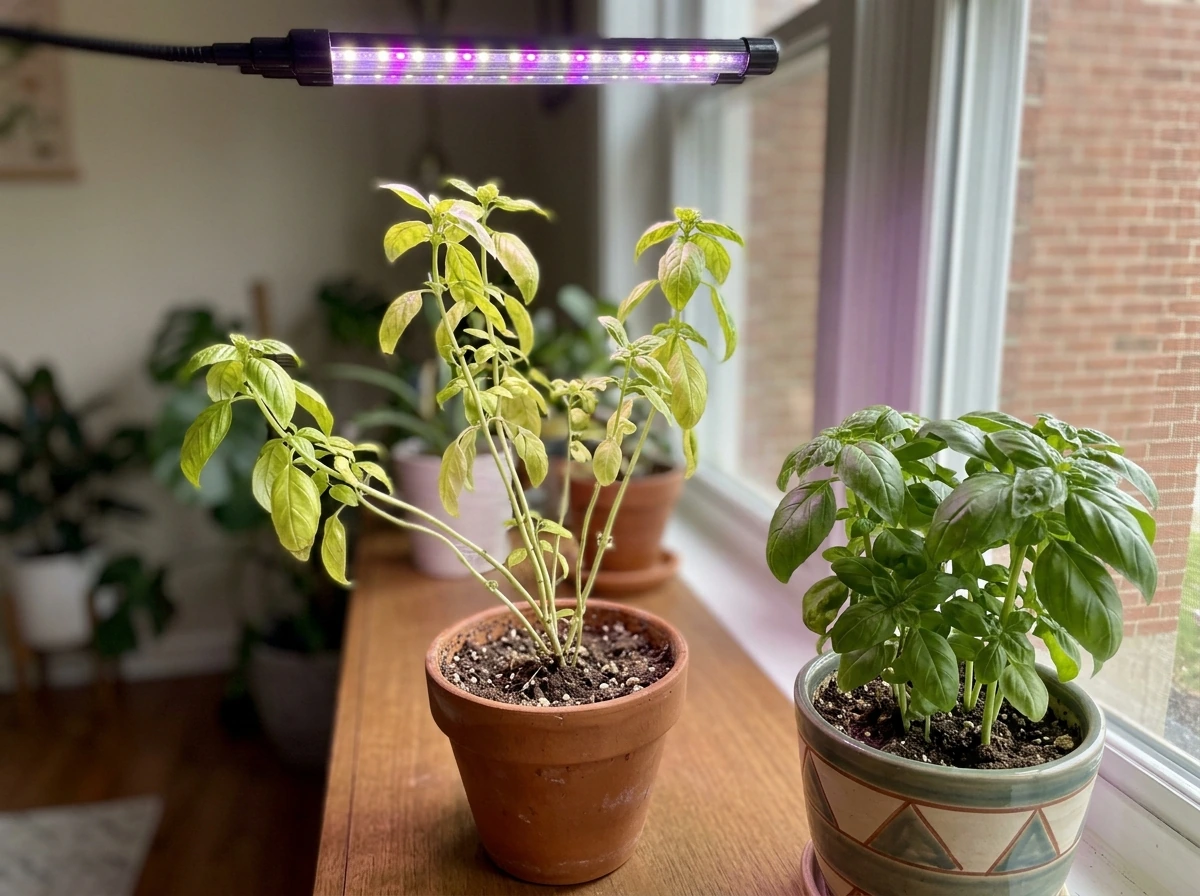
Most light problems show up in predictable ways once you know what to look for. The tricky part is that some light symptoms can look like overwatering or nutrient issues, so it helps to check light first before changing anything else.
- Leggy, stretching stems with wide gaps between leaves: This is a classic low-light response. The plant is reaching toward more light. Move it closer to the window or lower your grow light. This is one of the most common problems with seedlings started too far from a light source.
- Pale or washed-out leaves on a plant that was previously deep green: Often a sign of light that's too intense or too close, especially if the bleaching is on the top leaves or the parts facing the light directly. Raise the fixture or move the plant back from the window.
- Overall yellowing of lower leaves with slow growth: This can be low light, but also check watering and soil drainage first. If the soil is fine and you're in a dim spot, adding light often fixes this.
- Brown, crispy patches on leaf surfaces: Scorch. Usually from too much direct sun or a grow light placed too close. Shade-tolerant plants like ferns, peace lilies, and calatheas are especially vulnerable. Move them back and the new growth should come in normal.
- Leaf drop after moving a plant: Rapid changes in light intensity stress plants even when the change is an improvement. Acclimate plants gradually, over two to three weeks, by moving them incrementally closer to a brighter spot rather than all at once.
- Stunted growth despite adequate light: If intensity and spectrum seem fine, look at fertilization and root health. Light problems rarely exist in isolation in an indoor environment.
Which Plants Do Best Under Each Light Type
Not every plant needs the same setup, and one of the most useful things you can do is match your plant to your actual light conditions rather than fighting uphill. Here's a practical breakdown.
Plants that work well with low natural light or modest artificial light
These plants evolved in forest understories or shaded environments and genuinely tolerate lower intensities. Extension resources from the University of Maryland, Missouri, and Illinois consistently list the same short list of reliable low-light performers. They can often get by with 50 to 250 foot-candles, which is what you'd measure a few feet from a window or under standard overhead lighting.
- ZZ plant (Zamioculcas zamiifolia): Extremely low-light tolerant, almost bulletproof
- Snake plant (Sansevieria/Dracaena trifasciata): Handles low light well, though growth slows considerably
- Pothos (Epipremnum aureum): Adapts to a wide range, does better with more but survives with little
- Peace lily (Spathiphyllum): Low-light tolerant, will flower better with moderate indirect light
- Cast iron plant (Aspidistra elatior): Lives up to its name in tough conditions
- Chinese evergreen (Aglaonema): Wide light tolerance, excellent for offices and dim rooms
Plants that need more light and benefit most from grow lights
These are the plants people most often struggle with indoors because they look fine for a while and then slowly decline. If you can't give them a very bright south- or west-facing window, a grow light is essentially required for real performance.
- Herbs (basil, rosemary, thyme, cilantro): Need high light, at least 500 to 1000 foot-candles to thrive and produce usable leaves
- Tomatoes, peppers, and other fruiting vegetables: Need very high light and long photoperiods; grow lights are almost always necessary indoors
- Succulents and cacti: Prefer intense direct light; a windowsill in winter rarely provides enough and they go dormant or etiolate (stretch and lose shape)
- Orchids: Many varieties need bright indirect light equivalent to 1500 to 3000 foot-candles; east or west windows help, but supplemental light makes a real difference
- Lettuce and leafy greens: Moderate-to-high light users that respond well to 14 to 16 hours under a decent LED grow light
- Fiddle-leaf fig (Ficus lyrata): Needs very bright indirect light and struggles in dim rooms, often dropping leaves when light is insufficient
If you're curious whether a specific plant can thrive purely under artificial light with no window at all, that's a question worth exploring on its own. The short version is yes, many plants can, but the details of setup matter a lot.
The Bottom Line for Indoor Growers
Sunlight is great when you have enough of it and your window actually delivers it to the plant at useful intensity. But for most indoor gardeners, especially during winter or in apartments without ideal exposure, a quality LED grow light on a timer is more dependable and often more effective, so if you’re asking whether can air plants grow in artificial light, the answer is yes when the setup delivers the right intensity and consistency. The best setup isn't about choosing one or the other, it's about measuring what your plant is actually receiving and filling in the gaps. Start with a lux meter or a phone app, match your light source to your plant's real needs, and adjust distance and photoperiod based on what you see growing. Trial and error is part of it, but with the basics above, you'll make fewer mistakes and course-correct faster when something looks off.
FAQ
Why can’t I just use a lux meter or phone app to decide between sunlight and a grow light?
Use PPFD and DLI targets, not lux alone. A lux reading tells you visible brightness as perceived by humans, which does not translate cleanly to what plants use (photosynthetic photons). If you only have a phone app, treat it as a rough proxy for “enough” light, then confirm with growth response and distance adjustments.
If more light is better, should I just run my grow light at the highest intensity?
Don’t. Increasing brightness without limit can reduce growth for many leafy plants. As a practical rule, aim for your plant’s typical PPFD range, then stop once leaves look healthy and growth rate plateaus, since some species show slower growth or stress above moderate ceilings.
Can plants grow with 24-hour light, and is it a good idea indoors?
For most indoor edibles and ornamentals under LEDs, plan a dark period of at least 8 hours. Even if plants tolerate long days, nonstop lighting can disrupt normal development, and flowering responses can depend on night length (short-day versus long-day plants). Use a timer rather than switching by hand.
Can I combine sunlight and an LED grow light, and will it improve results versus using one alone?
Yes, but you need to manage the “effective intensity” at the leaf. Windows vary by season, weather, and how far the plant sits from the glass, and intensity drops quickly with distance. If you rely on window light, rotate the plant regularly and expect supplementation in winter or with smaller windows.
How do I measure or estimate the light my plant actually gets if my setup isn’t the same as the grow light manual?
Measure at canopy level and at the same height your plant will be, because LED output falls off fast with distance and angle. A common mistake is reading spec sheets that assume a specific mounting height, then placing the light farther away and wondering why plants stretch or pale.
How can I tell whether my plant problem is from too little light or too much light?
If the light is too weak, you usually see stretching (longer stems), smaller leaves, and paler green color. If it’s too intense or too hot, you’ll more often see tan or bleached patches near the brightest side of the plant, or leaf edges curling. Adjust distance first, then revisit the photoperiod.
Will a normal LED bulb in a lamp grow plants the same as a grow light?
No, all regular bulbs are not the same. Many household LEDs and especially incandescent bulbs have spectra and intensities that are poor for plant growth at practical distances. If you use a non-grow LED, check whether it provides meaningful PPFD at the canopy, and expect slower results for herbs, fruiting plants, and flowering species.
Does changing the red-to-blue ratio really affect plant shape and flowering, or is it mostly about total brightness?
It depends on the goal. For compact leafy growth, increasing blue content and keeping PPFD moderate often helps. For faster elongation or certain flowering behaviors, more red and appropriate spectrum balance can shift morphology. If you change color ratios, keep the total PPFD and DLI consistent so you know what caused the change.
How do I adjust my grow light schedule if my PPFD is lower than what I expected?
Yes. The right “time on” can compensate for slightly lower PPFD by maintaining similar DLI, but there is still a ceiling where more light causes diminishing returns or stress. Start with a reasonable PPFD range, then fine-tune photoperiod (within typical bounds) rather than making huge jumps in intensity.
Is heat from artificial lights a real problem for indoor plants, and how can I tell?
A basic starting point is to mount LEDs close enough for your target PPFD, then verify with canopy feel and plant appearance. If heat is noticeable at canopy level after an hour, raise the fixture. Under most modern LEDs heat is minor, but older fluorescent or incandescent setups can burn leaves and require more spacing.
If I set a timer for 14 to 16 hours, will that work for flowering plants, too?
Many plants are flexible, but night length matters for flowering triggers. Short-day and long-day plants may flower only when the uninterrupted dark period meets their requirement. Before you set a timer, identify whether your species needs long nights or long days.