Yes, houseplants will absolutely grow under LED lights, and most common varieties do surprisingly well. The catch is that not every LED works equally, and "just plugging in a bulb" is where most people run into trouble. The right LED, placed at the right distance, running the right number of hours a day, can fully replace natural sunlight for everything from trailing pothos to flowering African violets. Get those three variables wrong and your plant will limp along, stretch toward nothing, or slowly yellow out. Get them right and you'll wonder why you ever worried about low-light apartments.
Will House Plants Grow Under LED Lights? How to Set Up
Marcus Hartley
7 Jun 2026
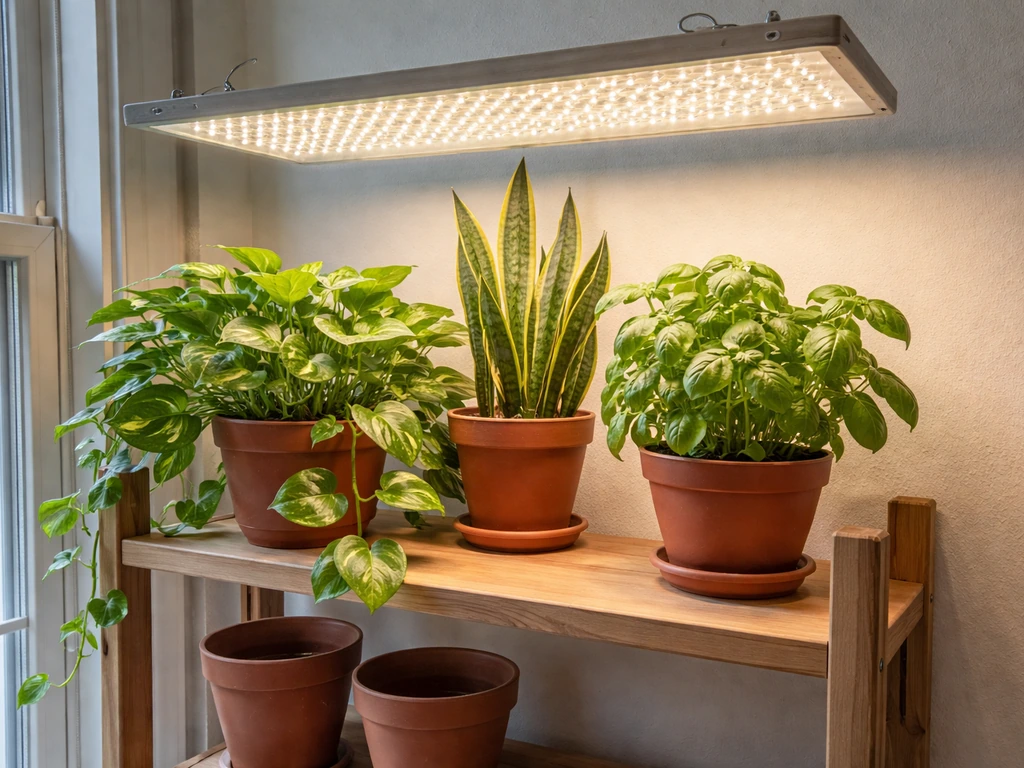
Yes, LEDs can grow houseplants (here's the honest biology)
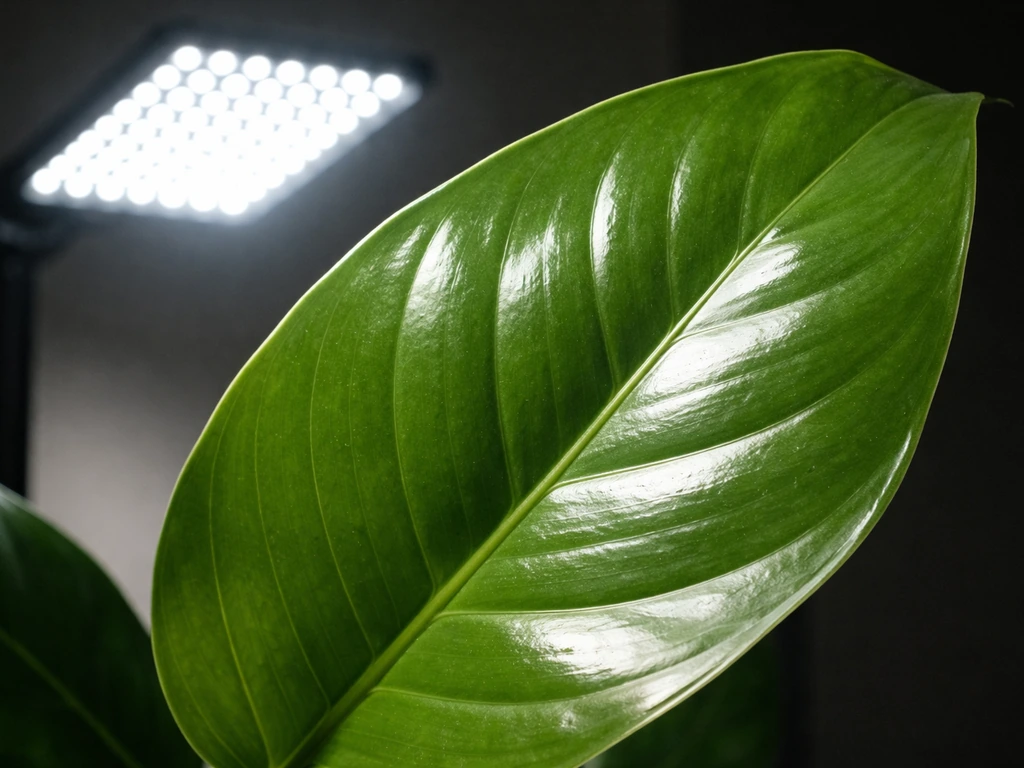
Plants need light to photosynthesize, and they don't actually care whether that light comes from the sun, a fluorescent tube, or an LED panel. What matters is that the light hits the right wavelengths and delivers enough energy. Chlorophyll, the molecule doing the actual work inside plant cells, absorbs light most efficiently in the blue range (around 400–500 nm) and the red range (around 600–700 nm). LED technology is genuinely excellent at delivering both. NASA research comparing red LEDs to cool-white fluorescent bulbs confirmed that spectrum choices measurably affect plant growth when light intensity is held equal, and that supplementing red LEDs with blue light improves outcomes further. So the science is solid: LEDs can drive real, healthy plant growth, not just survival.
The practical implication is that you don't need sunlight, you need photons in the right wavelengths and enough of them. LEDs, especially modern full-spectrum and grow-specific models, deliver exactly that. The challenge for most indoor gardeners isn't whether LEDs work in principle; it's figuring out the specific setup that works for their plants, their room, and their schedule.
Light intensity, spectrum, and what your plants actually need
The most important thing to understand is that brightness, for plants, isn't measured in lumens (that's for human eyes). Plants respond to PPFD, which stands for Photosynthetic Photon Flux Density, measured in micromoles per square meter per second (μmol·m⁻²·s⁻¹). It sounds technical but it's just the count of useful photons landing on your plant each second. You can think of it as the plant's version of brightness. PPFD decreases as you move a light further away, which is why distance matters so much.
Different houseplants have very different PPFD needs. Low-light plants like philodendrons can thrive at 50–250 PPFD, while African violets sit in a similar zone at 50–150 PPFD. Succulents, which naturally live in bright conditions, want 100–200 PPFD minimum and often more. A PAR or PPFD meter (many inexpensive ones are available as smartphone apps or standalone devices) takes the guesswork out of this. Rather than trusting the watt rating on a box, measuring the actual output at your plant's level is the only reliable way to know what your plants are getting.
Full-spectrum white vs. blurple (red+blue) LEDs
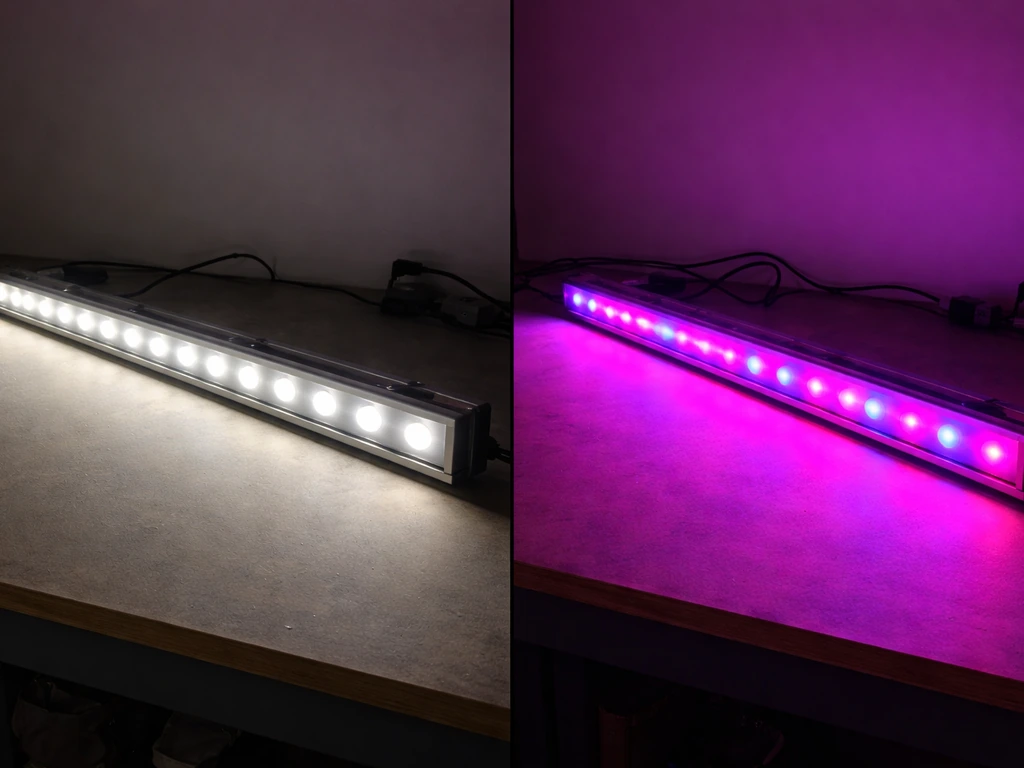
You'll run into two main categories of LED grow lights: full-spectrum white LEDs that look like regular bright white light, and "blurple" lights that combine red and blue LEDs and glow purple. Both can grow houseplants successfully. Full-spectrum white LEDs are generally more pleasant to live with in a home setting since they don't cast that sci-fi purple glow over everything, and they tend to give a more balanced spectrum. Blurple panels are often cheaper and efficient, and research confirms that red-plus-blue combinations drive photosynthesis well. If aesthetics matter and you want the light to blend into your living space, go full-spectrum white. If you're growing in a closet or a utility shelf where looks don't matter, blurple gets the job done at a lower price point.
| LED Type | Spectrum | Best For | Aesthetic Impact |
|---|---|---|---|
| Full-spectrum white LED | Broad, includes red, blue, green, and more | Living rooms, shelves, anywhere visible | Looks like natural light, minimal visual disruption |
| Red+blue (blurple) LED | Targeted red and blue wavelengths | Grow tents, closets, utility spaces | Purple glow, noticeable in living spaces |
| Warm white LED bulb | Skews toward red/yellow, low blue | Very low-light plants only, supplemental use | Normal light appearance, limited growth support |
One thing to avoid is assuming any LED bulb will work. A standard warm-white LED from a hardware store is fine for ambiance but lacks enough blue spectrum output to support healthy plant growth long-term. If you're serious about growing plants under artificial light, look for lights specifically marketed as grow lights or full-spectrum plant lights with PPFD data provided by the manufacturer.
Placement, distance, and how long to run your lights
Distance is where most people make their first mistake. Position a light too far away and the PPFD drops dramatically, leaving your plant in the equivalent of deep shade. Get it too close and you risk heat stress, short stubby stems, and crinkled or leathery leaves. As a general starting point, most houseplant LED grow lights work well placed 1 to 3 feet from the plant canopy. For large floor plants, keeping an LED fixture at least 3 feet from the top of the plant is a good baseline to avoid heat issues and allow even light spread. For smaller plants on a shelf or propagation station, 12 to 18 inches is often the sweet spot, but always check with a PPFD meter if you can.
Spacing between multiple fixtures also matters if you're lighting a wider area. Fixture layout decisions benefit from considering both the distance from the plant canopy and the spacing between individual light units, as OSU Extension notes for even LED coverage spacing between multiple fixtures. Overlapping coverage from two smaller lights often beats one bright light positioned in the center, because it reduces dark spots at the edges of your plant collection. Think of it like watering: you want even coverage, not a flood in the middle and drought at the edges.
Photoperiod: how many hours per day do LEDs need to run?
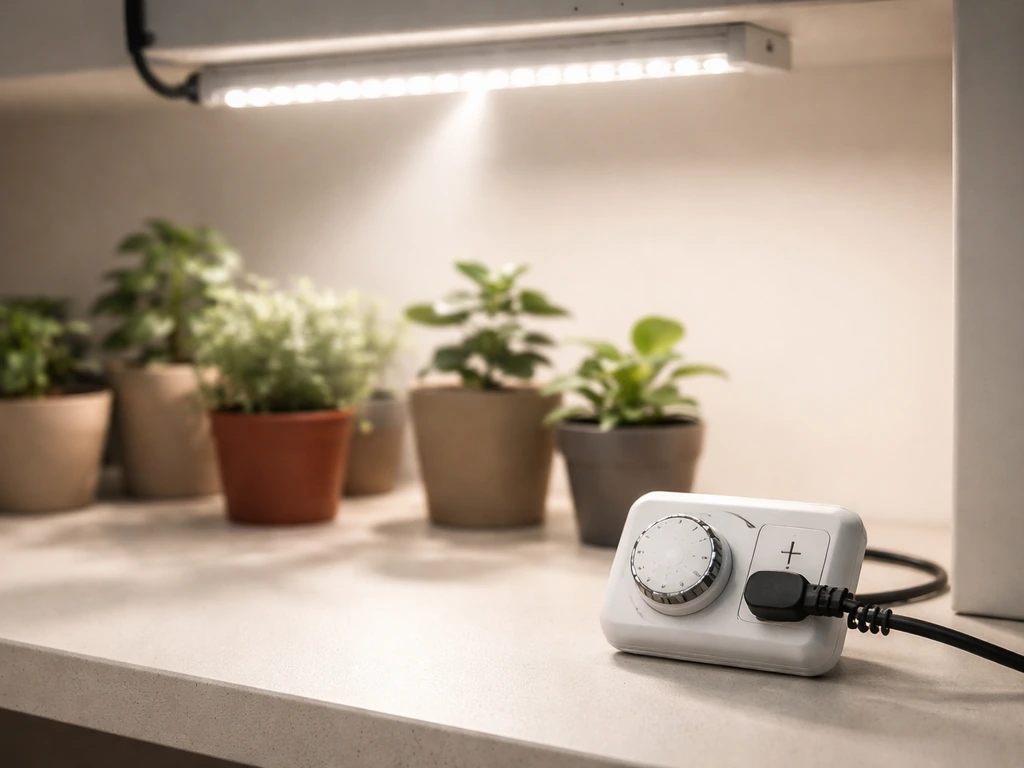
Photoperiod is just the number of hours of light your plants receive each day, and it's the other half of the equation alongside intensity. UMD Extension notes that light exposure and its intensity influence photosynthesis and plant traits, so getting the daily light window right matters for growth changes, not just survival photoperiodic exposure. Most houseplants grow well with 12 to 14 hours of LED light per day. This mimics a long, productive growing day and works for the majority of tropical houseplants, which don't have strong photoperiodic flowering triggers. A simple plug-in timer costs a few dollars and takes all the effort out of this, which I'd honestly call essential gear, not optional.
The combination of PPFD and photoperiod gives you what researchers call the Daily Light Integral (DLI), which is basically the total dose of light your plant receives in a day. A plant getting moderate PPFD for 14 hours can accumulate the same DLI as a plant getting higher PPFD for fewer hours. This is useful to know because it means you have some flexibility: if your light isn't super bright, you can compensate by running it a bit longer, within reason. Don't push past 16 hours though; plants benefit from a dark period too.
Choosing the right LED setup for your actual space
Before buying anything, think about the scale and purpose of your setup. Are you supplementing weak window light for a few plants on a windowsill? Adding light to a bookshelf where nothing natural reaches? Or building out a full propagation station or plant shelf from scratch? Each scenario calls for a different approach.
- Windowsill supplemental light: A single LED bar or small panel (look for at least 50–100 PPFD at 12 inches) placed above or beside plants that get some natural light is usually enough for low-light species.
- Plant shelf or bookshelf: LED strip lights or bar-style grow lights mounted under each shelf work well. Measure the PPFD at plant level to confirm you're hitting target ranges before committing plants to those spots.
- Dedicated grow space or closet: A higher-output panel or multiple bars gives you full control. This is where blurple or higher-watt full-spectrum panels shine, and where a PPFD meter pays for itself immediately.
- Large floor plants: A floor-standing grow light or an overhead pendant-style LED at 3+ feet above the canopy avoids heat stress while still delivering enough light for most tropical species.
On budget: you don't need to spend hundreds of dollars to grow houseplants successfully under LEDs. Plenty of affordable full-spectrum LED bars in the $20–50 range work fine for low-to-medium light plants. Where money matters more is if you're trying to grow succulents, herbs, or any plant that needs higher light intensity, since cheaper lights often don't have the output to hit those higher PPFD targets at a useful distance. Check manufacturer PPFD specs or look for independent reviews before buying if you're targeting higher-light plants.
It's also worth noting that questions like whether normal LED bulbs are sufficient versus dedicated grow lights, or whether plants strictly need to be positioned directly under the fixture, are worth thinking through before you finalize a setup. Coverage angle and fixture position affect how much usable light actually reaches your plant canopy, especially for bushy or wide plants.
Signs your plants are getting too little (or too much) LED light
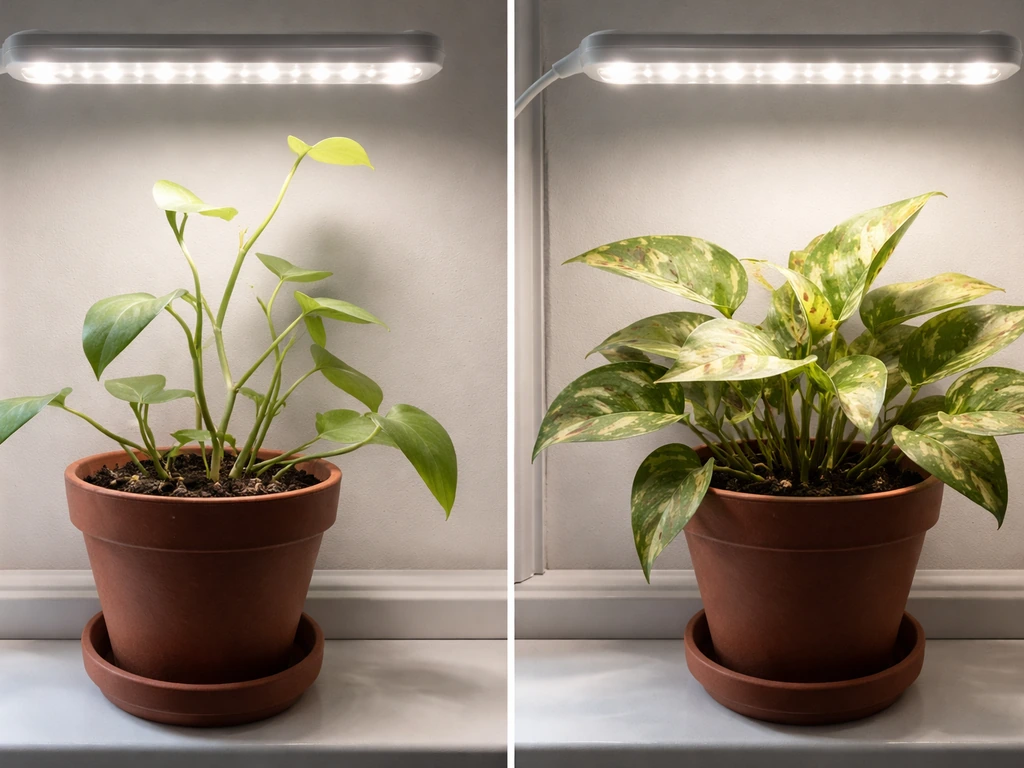
Plants are pretty good at telling you when something is off with their lighting. The key is knowing how to read the signals before the plant is in serious trouble.
Signs of not enough light (underlighting)
- Stretching or etiolation: stems grow long and spindly as the plant reaches toward the light source. This is the most classic sign.
- Leaning: the whole plant angles toward the brightest available light, even if that's a distant window.
- Smaller new leaves: new growth comes in noticeably smaller than older leaves on the same plant.
- Yellowing (chlorosis): leaves lose their green color, starting with older or lower leaves, because there's not enough light energy to maintain chlorophyll production.
- Slowed or stopped growth: the plant seems stuck, not pushing new leaves for weeks or months.
- Loss of lower leaves: leaves drop from the bottom up as the plant abandons less productive growth.
Signs of too much light (overlighting or too-close placement)
- Leaf scorch or bleaching: brown, papery patches on leaves, especially on shade-loving plants like ferns or calatheas.
- Short, stubby petioles: leaf stems become abnormally short and compact.
- Crinkled or leathery leaves: leaves look puckered, stiff, or abnormally textured, a classic sign the light is too close.
- Crispy leaf edges: particularly on plants that prefer indirect light or high humidity.
How to fix lighting problems step by step
- If you see stretching or yellowing, move the light closer to the plant (reduce distance by 6 inches at a time) or increase your photoperiod by 1–2 hours per day, then wait 2 weeks to assess.
- If you see scorching or crinkled leaves, raise the fixture further from the plant (increase distance by 6 inches at a time) or reduce daily light hours.
- If growth is slow across the board despite seemingly correct distance, check your PPFD with a meter. The light output may simply be too low for your target plant group.
- If one side of a plant is growing differently from the other, rotate the pot a quarter turn every week and check whether your fixture is centered above the plant.
- If problems persist after distance and duration adjustments, consider whether the plant is simply the wrong match for your light level. Some plants genuinely need more than an affordable LED bar can deliver.
What actually works: LED tips for common houseplant types
Not all houseplants have the same light appetite, and one of the most freeing realizations for indoor gardeners is that you don't have to force every plant to survive under the same setup. Matching the plant to the light level you can realistically provide beats trying to max out an underpowered fixture.
Low-light champions (easiest to grow under LEDs)
Pothos, philodendrons, snake plants, ZZ plants, and peace lilies are about as forgiving as houseplants get. They naturally grow under forest canopies where dappled, low-intensity light is the norm. Under LEDs, they're happy with 50–150 PPFD and a 12–14 hour photoperiod. Even a modest LED bar positioned 18 inches above these plants will keep them healthy and growing. These are the plants I'd recommend to anyone just starting out with artificial lighting because the margin for error is wide.
Medium-light plants (a bit more demanding)
African violets, spider plants, dracaenas, and most ferns fall in the middle range, roughly 100–250 PPFD. These do well under a decent-quality full-spectrum LED bar or panel. The main thing to watch is that you're not letting the light source drift too far from the plant, especially with African violets, which will tell you immediately when they're unhappy by producing distorted, pale leaves or refusing to bloom.
High-light plants (need the most from your LED setup)
Succulents, cacti, herbs like basil and cilantro, and any fruiting or flowering plant push into the 200+ PPFD range, and some need significantly more. These are the plants where cheap or underpowered LEDs fall short. If you're trying to grow a succulent collection under artificial light and they're stretching dramatically, it's almost always an intensity problem, not a spectrum problem. Invest in a higher-output fixture, position it closer (while monitoring for heat), and run it for the full 14 hours. Winter is also when these plants suffer most under artificial light since day lengths drop and many people underestimate how much supplemental light is needed to compensate.
The honest takeaway is that LED lights work, and for most of the plants people actually grow indoors, they work really well. The setup takes a little thought up front, but once you dial in the distance, spectrum, and timer, you can grow a thriving plant collection in a windowless corner. Give it a few weeks, watch how your plants respond, and adjust from there. Plants are patient teachers if you pay attention.
FAQ
How do I tell if my LED setup is bright enough for my specific plants?
Look for output information in PPFD (or PAR) at canopy height. If you cannot measure, use a PPFD meter once, then set a consistent fixture distance and record what plants do over 2 to 4 weeks (leaf color, spacing, and whether new growth is compact). Stretching plus paler leaves usually means insufficient PPFD, not a “bad plant.”
Can I use a normal E26 or E27 LED bulb instead of a dedicated grow light?
It depends on the bulb’s spectrum and actual photon output, not the “plant friendly” wording on the label. Many standard warm-white bulbs have too little blue and often cannot provide enough PPFD at a typical room distance. If you try one, keep the bulb very close and verify with PPFD readings if you can.
What distance should I use if my light does not come with PPFD specs?
Start in the commonly safe range (about 12 to 18 inches for small plants, roughly 1 to 3 feet for larger setups), then adjust based on plant response. If you see heat stress (bleaching, crispy tips) lower the fixture, but if you see stretching and widening internodes, raise intensity by moving closer or using a higher-output model.
How many hours per day should I run LED lights in winter versus summer?
If you are replacing short daylight, you will typically need longer photoperiods in winter than in summer. Many houseplants do well with 12 to 14 hours, but increase only if plants are still “underlit” (slow growth, pale new leaves). Avoid exceeding about 16 hours, and keep a consistent dark period to support healthy rhythms.
Do LEDs need to be directly above the plant, or can they be off to the side?
They do not have to be perfectly overhead, but coverage angle matters. If your fixtures are angled or offset, the edges of the canopy can drop in PPFD and lead to uneven growth. If plants on one side stretch more than the other, reposition the light or add a second fixture to even out the beam spread.
Is it better to use one stronger LED or several smaller lights?
Several smaller fixtures are often easier to get even coverage across multiple plants or a shelf. Overlap from two lights usually reduces dark corners, which helps keep growth uniform. If you choose one fixture, expect a gradient in light across the footprint, so place plants accordingly.
Why are my plants stretching toward the light even though the light is on?
Most stretching indoors is an intensity or coverage problem, not a spectrum problem. Check whether the fixture is too far away, whether the beam is narrow, and whether the photoperiod is long enough. Also consider that some plants need higher PPFD than others, so you might be unintentionally running low-light plants in an “underpowered” setup.
What are the signs of too much light from LEDs, and what should I do?
Too much intensity often shows up as leaf scorching (tan or bleached patches), curled or crispy edges, and darkening that looks stressed rather than vibrant. Reduce photoperiod first, then increase distance or dim output, and recheck for heat buildup around the canopy.
Do LEDs produce enough heat to cause problems?
They can, especially with compact fixtures that run hot or if placed very close. If leaves are warm to the touch, the fixture has poor ventilation, or plants show heat stress while PPFD seems high, increase distance slightly and ensure airflow. Heat stress can mimic light problems, so keep both in mind.
How close should a shelf-grown plant be to the LED bar for best results?
For shelf or propagation-style setups, 12 to 18 inches is a common starting point, but the optimal distance depends on the fixture’s beam angle and output. Use a PPFD meter if possible, otherwise adjust gradually by observing new growth over a few weeks, since plants respond with a lag.
Should I rotate plants under LEDs?
Yes, especially if the light source is offset or you have a single fixture. Rotating by about 90 degrees every week helps prevent one-sided growth and gives you a more even canopy, which makes it easier to diagnose true light issues versus fixture geometry.
What is Daily Light Integral (DLI), and how do I use it without doing math?
DLI is the total daily light dose, essentially “how much PPFD you get multiplied by hours.” If you cannot calculate, use a practical approach: keep photoperiod steady (for example 12 to 14 hours) and adjust distance or fixture strength until growth looks right. If brightness is limited, a longer photoperiod can help, but do not push beyond about 16 hours.
If my succulents stretch under LEDs, is it always a spectrum issue?
Usually it is not. Stretching in succulents is most often an intensity problem, meaning the LEDs are not delivering enough PPFD at the plant’s height. Move the light closer while monitoring for heat, or switch to a higher-output grow fixture designed for 200+ PPFD plants.
How quickly will I see changes after adjusting LED light distance or timer?
You often see response within 1 to 2 weeks, but leaf changes can lag. Watch for new growth first, since it reflects the current light conditions better than older leaves. If nothing changes after 3 to 4 weeks, revisit coverage and PPFD, not just spectrum.