
Ferns don't need direct sunlight to grow indoors, and in most home situations, direct sun will actually hurt them. What they do need is consistent bright, indirect light for around 6 to 8 hours a day. Think of a spot where the room is clearly lit but the sun's rays never land directly on the fronds. Get that right, and most ferns will thrive without ever seeing a single sunbeam.
Do Ferns Need Sunlight to Grow Indoors? Light Guide
Marcus Hartley
7 Jun 2026
Sunlight vs. bright light: what's the real difference for ferns?
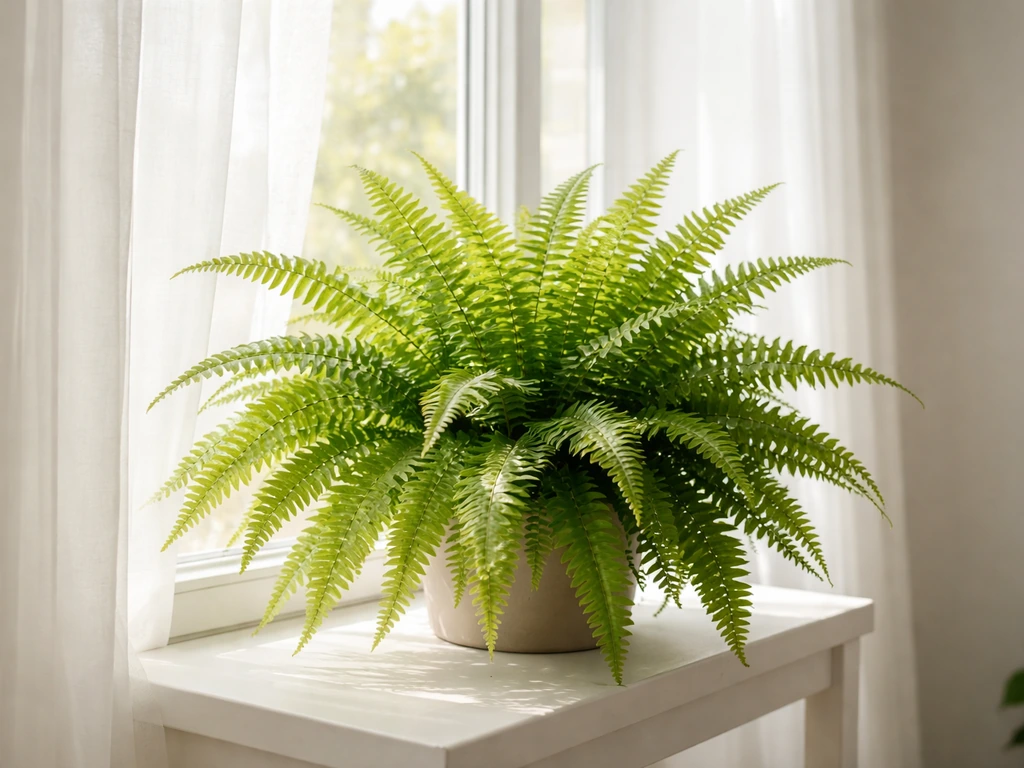
This distinction trips a lot of people up. "Sunlight" and "bright light" sound interchangeable, but for ferns they're very different things. Direct sunlight means the sun's rays are physically hitting the leaf surface, raising the leaf temperature and delivering light intensities that can exceed 10,000 foot-candles on a clear day.
If you're wondering whether does grass need sunlight to grow, keep in mind that ferns can actually overheat in direct sun even when they still need bright light direct sunlight. Most ferns evolved under a forest canopy where they receive filtered, dappled light, far below that level. University of Minnesota Extension is blunt about it: direct sunlight will overheat tropical ferns, burning the fronds before the plant even has a chance to use that energy.
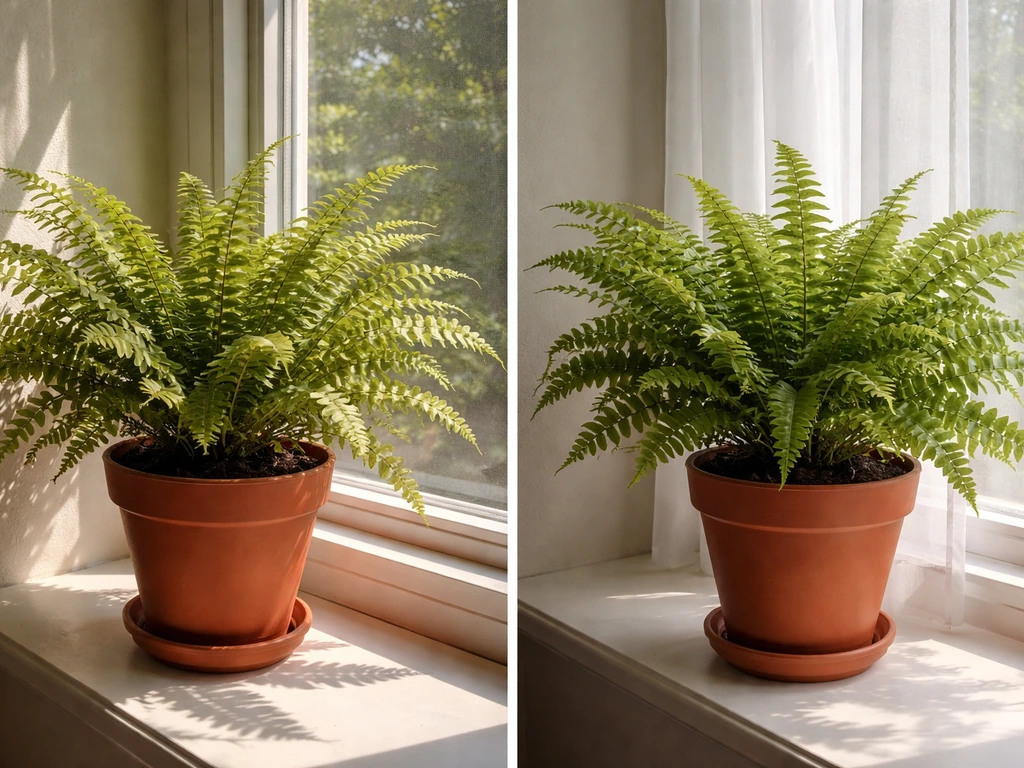
Bright indirect light, on the other hand, is what you'd measure in a well-lit room near a window but shielded from the actual sun. University of Maryland Extension describes medium-bright indoor light as roughly 100 to 500 foot-candles, which is the sweet spot for ferns in east or west-facing rooms. One foot-candle equals about 10.76 lux, so you're looking at roughly 1,000 to 5,000 lux as a working indoor target for most common fern varieties. For Boston ferns specifically, one published range puts the ideal illuminance at around 3,200 to 21,500 lux (300 to 2,000 foot-candles), which shows how wide the workable window actually is.
What ferns actually need from light
Intensity
Most indoor ferns land in the medium-to-bright indirect category. A quick qualitative test from University of Minnesota Extension: if there's enough light in the spot to read a newspaper comfortably without squinting, you're in the ballpark. If you need to turn on a lamp to read, it's probably too dim for a fern long-term.
Duration
Aim for 6 to 8 hours of good indirect light per day as your baseline. If you're supplementing with artificial light, University of Minnesota Extension notes that 12 hours of artificial light daily is sufficient for most indoor-grown plants, so that's a solid ceiling to work with when you're running a grow light.
Spectrum
Plants use primarily blue and red wavelengths for photosynthesis. Blue light (around 400 to 500 nm) drives leafy, compact growth; red light (around 600 to 700 nm) supports overall energy production. A common ratio cited for foliage plants is roughly 90% red to 10% blue, though full-spectrum bulbs marketed for houseplants already handle this balance for you. For ferns, which are all about lush, green foliage, a full-spectrum LED or fluorescent tube is all you need to worry about.
Best spots to place ferns near windows
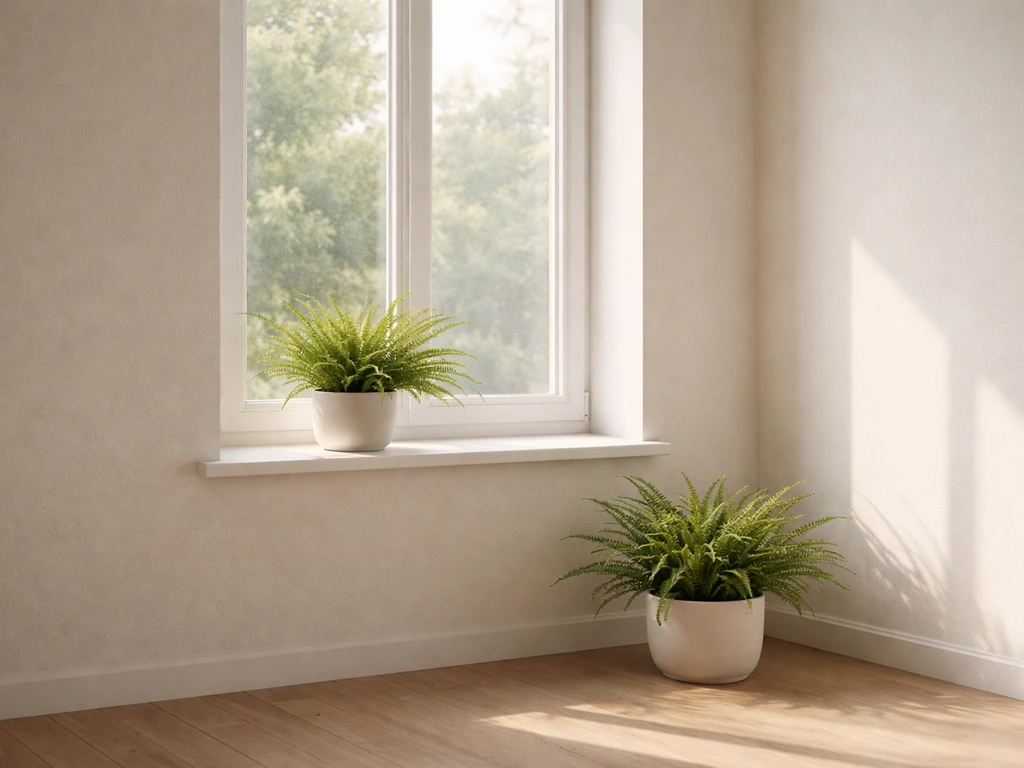
Window direction makes a bigger difference than most people realize. Here's how to think about each exposure in a typical home:
| Window Direction | Light Quality | Best Placement for Ferns | Notes |
|---|---|---|---|
| North-facing | Low, consistent, no direct sun | Right on the windowsill or within 1–2 feet | Works for shade-tolerant ferns like bird's-nest; may be too dim for maidenhair |
| East-facing | Gentle morning sun, indirect rest of day | On or near the sill; gentle morning rays are usually fine | Ideal for most ferns including Boston and maidenhair |
| West-facing | Stronger afternoon sun | 1–3 feet back from the glass, or use a sheer curtain | Direct afternoon rays can scorch; filter with a curtain or step back |
| South-facing | Brightest, longest direct sun | 3–5 feet back, or behind a sheer curtain | Too intense right at the glass; great if you pull the fern well into the room |
The main rule: the stronger the window, the more distance you need between the glass and the plant. University of Maryland Extension confirms that light intensity drops significantly with distance from the source, so even a south-facing room can work if you position the fern far enough back. A sheer curtain is your best budget tool for diffusing direct rays without eliminating the light entirely.
A Boston fern care guide from Fairfax County Cooperative Extension puts it simply: east-facing windows or placement behind a sheer curtain are the go-to recommendations. That advice holds for most ferns you'll bring home from a garden center.
Growing ferns under artificial light
If your apartment doesn't have great natural light, or you want to keep a fern somewhere away from windows entirely, artificial lighting is a completely viable option. I've grown Boston ferns under fluorescent shop lights in a basement with zero windows, and they did fine. The key is choosing the right bulb type, getting the distance right, and running the lights long enough each day.
LED grow lights
LED grow lights are the most energy-efficient option and run cool, which matters for ferns since they don't want heat stress. Look for a full-spectrum LED panel rated for houseplants or foliage. Position the light 12 to 20 inches above the tops of the fronds as a starting point, then watch the plant for two weeks. If growth looks leggy or pale, lower the light; if frond tips look crispy, raise it or reduce hours. Run LEDs for 12 hours per day on a timer.
Fluorescent bulbs (T5 and T8)
T5 and T8 fluorescent shop lights are a budget-friendly alternative that works well for ferns. They produce less heat than older HID-style grow lights and are widely available at hardware stores. Use a full-spectrum or 6500K (daylight) tube, position the fixture 6 to 12 inches above the fronds (fluorescents are less intense than LEDs, so they need to be closer), and run them for 12 to 14 hours a day. A basic plug-in timer from any hardware store keeps you from having to remember to switch them on and off.
Quick setup checklist for artificial fern lighting
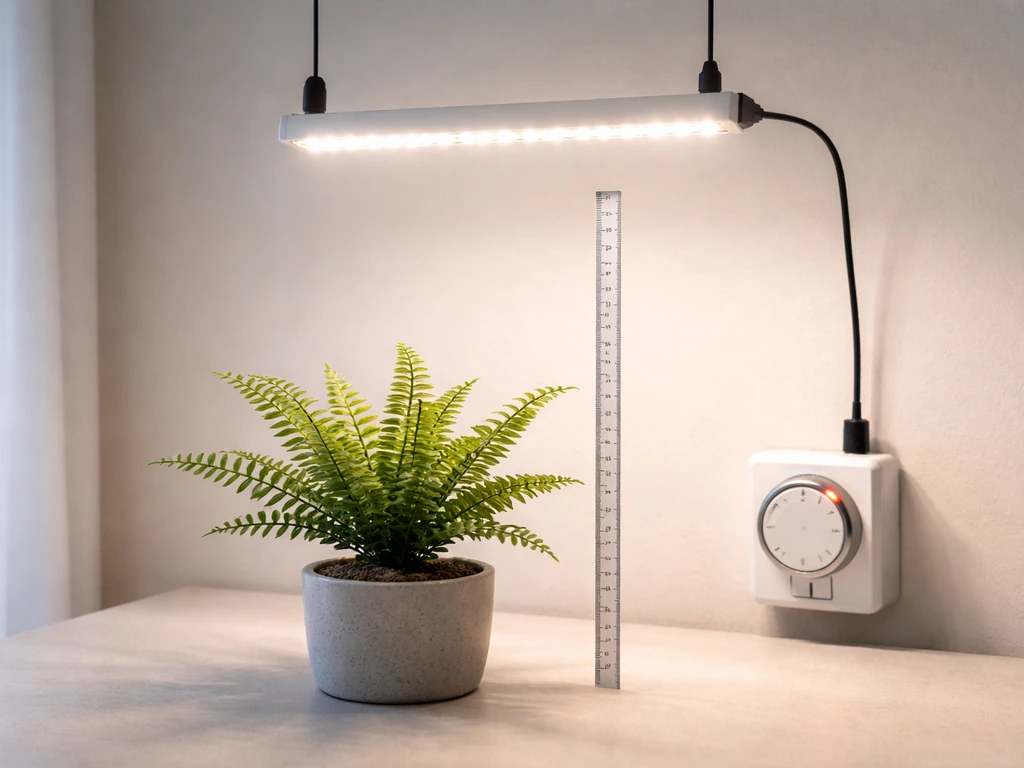
- Use a full-spectrum LED or T5/T8 fluorescent bulb rated for plants or with a color temperature around 5000–6500K
- Start LEDs at 12–20 inches above the frond tips; start fluorescents at 6–12 inches
- Run lights for 12 hours per day on a timer
- Keep temperatures in the growing area stable; grow lights shouldn't raise ambient heat significantly for ferns
- Rotate the pot occasionally so all fronds get even exposure
Signs your fern isn't getting the right amount of light
Light problems often get misdiagnosed as watering or humidity issues, which wastes time and can make things worse. Before you adjust your watering schedule, check the light situation first. Here's what to look for: UC IPM notes that plant growth can be retarded by either too much or too little light, and that low-light symptoms include larger or thinner leaves and premature leaf drop, starting on the most shaded foliage.
Too little light
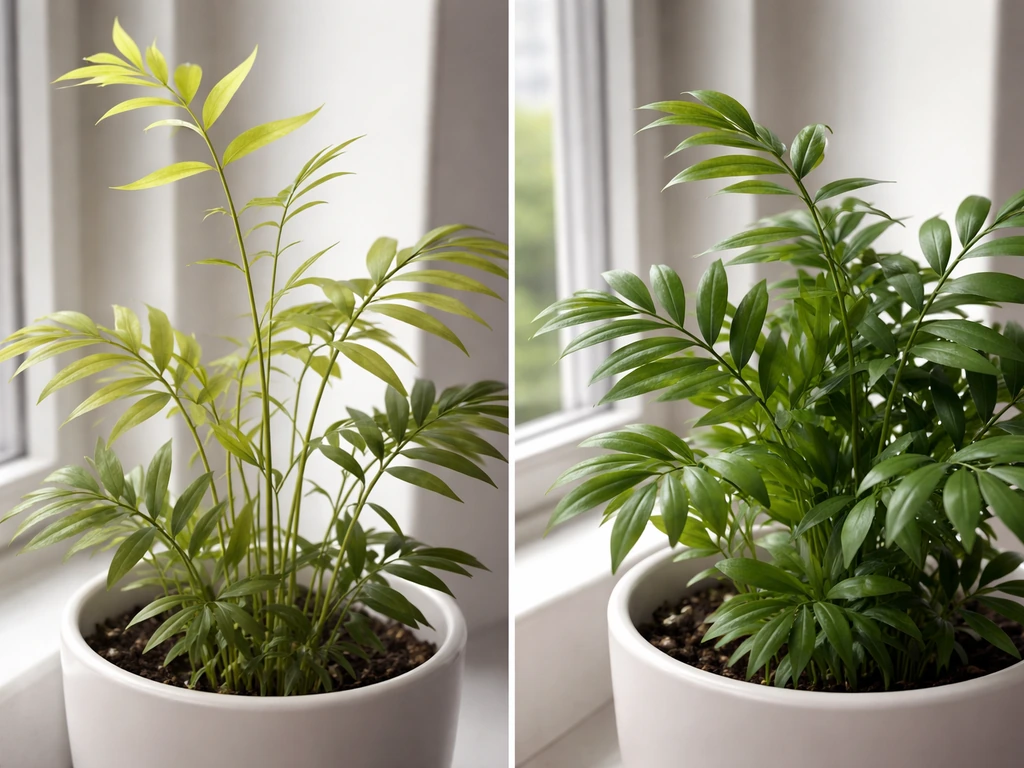
- New fronds grow pale, yellowish, or washed-out instead of deep green
- Stems and fronds are stretched out and spindly (this is etiolation, the plant reaching desperately for more light)
- Older or lower fronds drop off first, starting with the most shaded growth
- Overall growth slows dramatically or stops between waterings
- Leaves may appear larger and thinner than normal as the plant tries to maximize light capture
Too much light or direct sun exposure
- Brown or white scorched patches on frond surfaces, especially where sun rays hit directly
- Frond tips and edges turn crispy and dry
- Overall frond color fades or bleaches out
- Fronds curl or wilt even when the soil moisture is fine
- Soil dries out much faster than usual because of heat
The fix for too little light is to move the plant closer to a window or add a grow light. The fix for too much is to step the plant back from the glass, add a sheer curtain, or reduce the hours your grow light runs. Penn State Extension makes a good point about acclimation: whenever you move a fern to a brighter or dimmer spot, give it 2 to 3 weeks to adjust before drawing conclusions.
Penn State Extension also emphasizes that many factors can contribute to poor plant health, so when diagnosing issues you should consider how light intensity and acclimation affect the plant acclimation to light intensity. An abrupt move from dim to bright can cause temporary leaf drop even if the new spot is actually better for the plant long-term.
Light works alongside humidity, watering, and soil
University of Minnesota Extension is direct about this: ferns often need specialized growing requirements, and light problems are almost always intertwined with other environmental factors. If you get the light right but the humidity is too low, the fronds will still brown at the tips. Here's how to dial in the full picture alongside your lighting setup:
- Humidity: Most ferns want 50–70% relative humidity. Group plants together, use a pebble tray with water, or run a small humidifier nearby. Bathrooms with windows are often naturally ideal.
- Watering: Ferns like evenly moist soil but not waterlogged roots. Check the top inch of soil; water when it's just starting to dry out. The brighter your light setup, the faster soil dries, so adjust frequency seasonally.
- Soil: Use a well-draining potting mix with some organic matter. A mix of potting soil and perlite (roughly 2:1) works well for most indoor ferns.
- Temperature: Keep ferns between 60–75°F (15–24°C). Avoid cold drafts from windows in winter and hot air from heating vents.
- Fertilizer: A balanced liquid fertilizer at half-strength once a month during spring and summer is plenty. Don't fertilize in low-light conditions; the plant can't use the nutrients without adequate light to drive growth.
Light tolerance varies by fern type
Not all ferns have the same light tolerance, which matters when you're deciding exactly where to put one or whether to supplement with artificial light. Here's a practical breakdown of common indoor fern varieties:
| Fern Type | Light Tolerance | Ideal Indoor Placement | Direct Sun OK? |
|---|---|---|---|
| Boston Fern (Nephrolepis exaltata) | Moderate to bright indirect | East window or behind sheer curtain at south/west | No |
| Maidenhair Fern (Adiantum spp.) | Low to medium indirect | North or east window; very sensitive to direct rays | No — most sensitive of common ferns |
| Bird's-Nest Fern (Asplenium nidus) | Bright indirect | East or west window, not in direct sun | No — direct sun causes leaf scorch |
| Staghorn Fern (Platycerium bifurcatum) | Partial sun; tolerates more light | East or west exposure; some brief morning sun is fine | Brief morning sun is tolerated |
| Kimberly Queen Fern (Nephrolepis obliterata) | Bright indirect; similar to Boston | East window or filtered south/west window | No |
| Rabbit's Foot Fern (Davallia spp.) | Low to medium indirect | North or east window | No |
Maidenhair ferns are the trickiest of the bunch. They want lower light than a Boston fern but are extremely sensitive to humidity swings and drafts, so a north-facing spot away from air vents is often your best bet. Bird's-nest fern, which has its own specific care nuances worth exploring, follows similar rules: bright but never direct, and K-State Extension explicitly warns against letting the sun shine directly on the leaves. Staghorn ferns are the outlier, tolerating a little more light and even brief morning sun, which is worth knowing if you're short on bright-indirect spots.
If you're growing other plants indoors alongside your ferns, it's worth knowing that light sensitivity varies dramatically across species. Plants like cress or sprouts, for example, have different light requirements than shade-adapted ferns, so a spot that's perfect for your fern may not work for everything else in the room. Do sprouts need sunlight to grow? Usually they do, but the amount depends on the sprout type and how you’re growing them. Cress does not need direct sunlight to grow, but it does need bright light or grow lights to develop well cress or sprouts. It pays to know what each plant actually needs rather than grouping them all together.
The practical bottom line
Ferns are genuinely one of the easier plant groups to keep happy indoors once you understand that their enemy is direct, intense sun, not light itself. Give them a bright-but-filtered spot, aim for 6 to 8 hours of good indirect light daily, and supplement with a full-spectrum LED or fluorescent grow light if your windows can't deliver that. This same “sunlight is optional if the light is right” idea is helpful when you’re figuring out does seaweed need sunlight to grow. Match the light setup to the humidity and watering, and you'll have lush, green fronds that make it look like you know exactly what you're doing. Because you will.
FAQ
Can ferns get sunlight through a window, as long as I keep them “near” the glass?
Yes, but only if it stays indirect. If your fern is right behind glass, the light can become effectively stronger and hotter than you expect, especially on south windows. Use a sheer curtain and keep the plant far enough back, then reassess after 2 to 3 weeks for acclimation.
What happens if my fern does not get 6 to 8 hours of bright indirect light?
In low light, growth slows and fronds may look pale or leggy, but the bigger risk is that you start compensating with extra water, which can lead to root issues. If you need to run a grow light, aim for a consistent daily schedule (often 12 hours) rather than giving bursts of light.
Is morning sunlight safer than afternoon sunlight for indoor ferns?
For most indoor fern setups, morning light is usually easier than afternoon light because afternoon sun is more intense and more likely to overheat fronds. If you only have a south-facing window, start further back than you think and diffuse rays with a sheer curtain.
How can I tell if my room is bright enough for ferns without using foot-candle or lux numbers?
If your space is dim enough that you need a lamp to read comfortably, it is usually too low for long-term fern health. In that case, place a full-spectrum LED panel closer (within the recommended range) and use a timer so light duration stays steady.
If my fern tips are browning, does it always mean the light is wrong?
Distilled or filtered water matters much more for mineral-sensitive plants than for light, but low light and high mineral buildup can both show up as browning. Before changing fertilizer, separate variables: first correct light intensity (move back or add a light), then only adjust water quality and feeding afterward.
Can I gradually move a fern to a brighter location without shocking it?
Yes, but acclimate slowly. Move the fern closer to brighter light in small steps over 1 to 3 weeks, and avoid jumping from a dark corner to a bright window. Temporary leaf drop can happen even when the brighter spot is ultimately better.
Do heat buildup and light stress go together for ferns?
Most ferns tolerate typical household temperatures if airflow is gentle, but they still get stressed by direct sun heat. On hot days, even “indirect” placement can become too warm if the plant sits too close to an unshaded window.
How close should my grow light be to the fern, and what if I see leggy growth?
A common mistake is using a bulb that is technically “for plants” but placing it too far away. With LEDs, start around 12 to 20 inches above the fronds, then adjust based on color and frond texture over two weeks.
Do I need to rotate my fern under a grow light or window?
Yes, and it can be uneven even if you think the light is “on.” Rotate the pot weekly so fronds develop evenly, and check that the fronds are all within the effective light footprint, not just the side closest to the bulb.
How many hours per day can I run a grow light before it becomes too much for ferns?
Short answer, be cautious with constant full-intensity. Most ferns do best with consistent bright indirect light, and grow lights are typically run about 12 hours per day. If you run them much longer, watch for crispy tips and consider reducing daily hours first.
If I remove my fern’s access to windows entirely, can artificial lighting replace sunlight successfully?
No, ferns do not need bright direct sun to grow, but they do need adequate light to photosynthesize and avoid wasting energy. If you cannot provide that with windows, fluorescent or LED lighting is a practical substitute.