
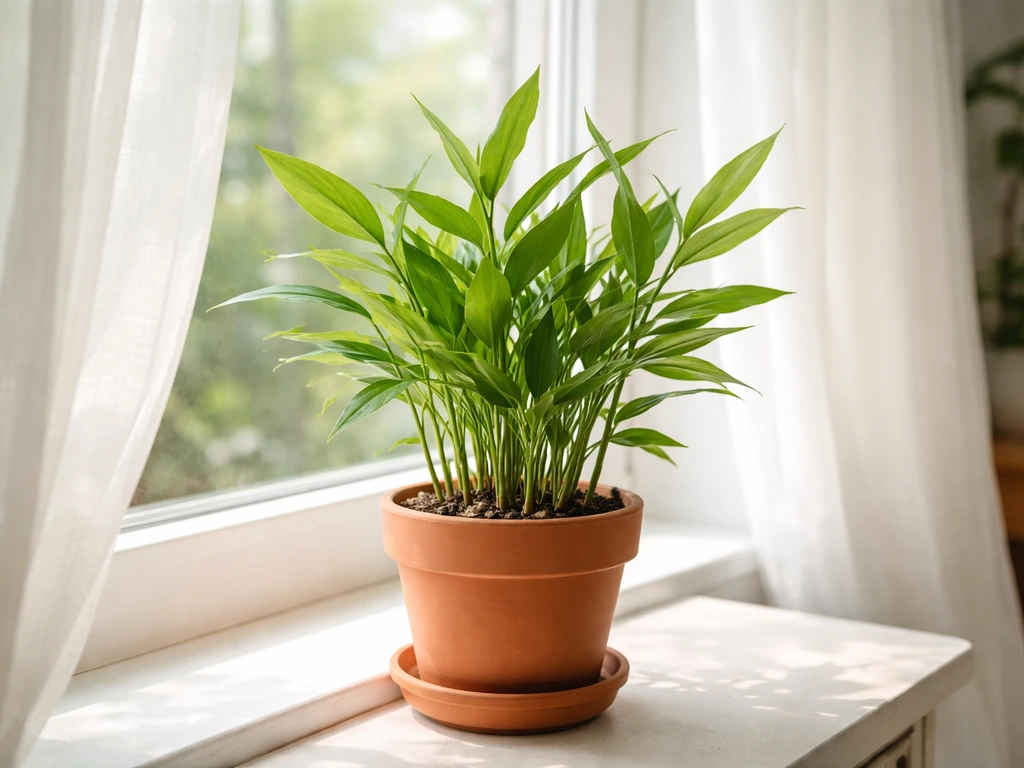
Ginger does not need direct sunlight to grow. It actually prefers bright indirect light and can do surprisingly well under grow lights indoors. What it does need is enough total light intensity and enough hours of it each day, because those two things together drive the photosynthesis that feeds both the leafy top growth and the rhizome developing underground. Direct sun can even stress ginger if it's harsh midday exposure. So if you're growing it inside, you're already on the right track.
Does Ginger Need Sunlight to Grow Indoors? Light Guide
Marcus Hartley
8 Jun 2026
Sunlight vs light: what ginger actually needs
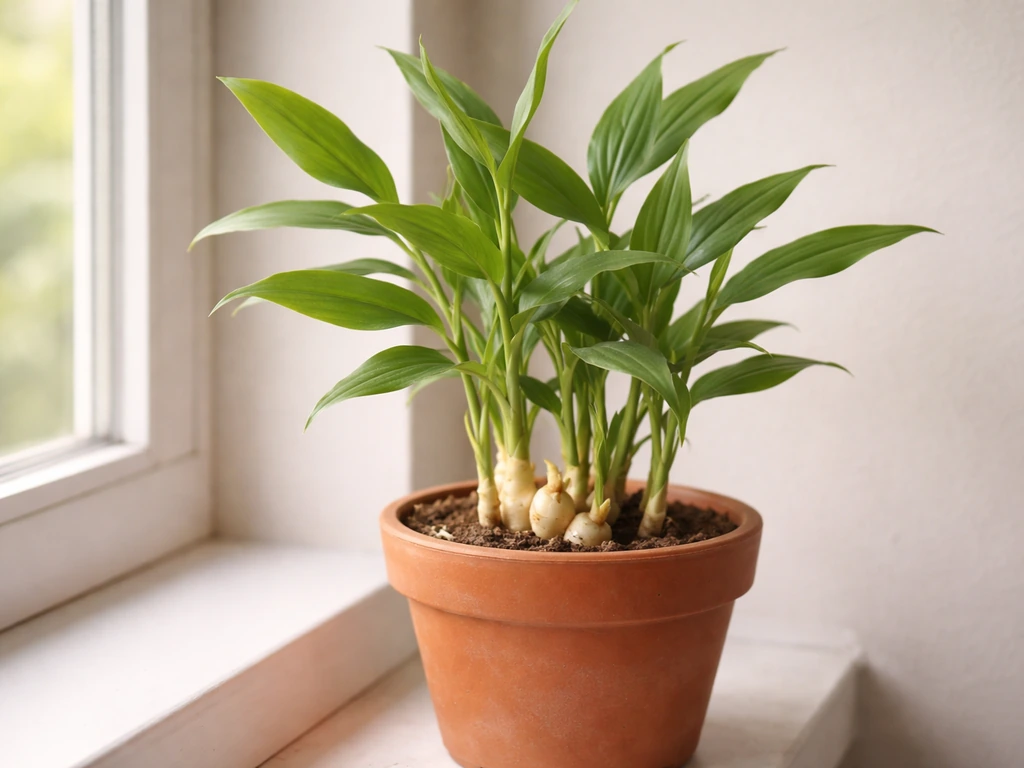
There's an important distinction here that trips a lot of people up. "Sunlight" usually means direct outdoor sun, which can hit around 111,000 lux at noon. "Light" for plant purposes means the total photosynthetically active energy hitting your plant's leaves, measured in PPFD (micromoles per square meter per second) across however many hours per day. Ginger responds to light, not specifically to sunlight. It's classified as a semi-shade plant, meaning in its natural environment it grows under a canopy and does not want full sun all day.
What ginger's biology actually responds to is three things: light intensity (how bright), light duration or photoperiod (how many hours), and to some extent light quality (the spectrum, particularly the blue-to-red ratio). Research has shown that longer photoperiods of 16 hours versus 12 hours measurably increase rhizome number, rhizome weight, and total yield. So when you're setting up your indoor grow, you're not trying to replicate a sunny windowsill, you're trying to give ginger enough photosynthetically useful light across enough hours each day.
Indoor light requirements (intensity and hours)
For indoor ginger, aim for a PPFD of roughly 200 to 400 µmol/m²/s at the canopy level. That's the brightness range that supports healthy leafy growth and gives the rhizome what it needs to develop. You can think of it as bright indirect light, like a spot near but not directly in a south-facing window. If you're using grow lights, this is your target at canopy height, not at the bulb.
For hours, 14 to 16 hours of light per day is a strong target. The research backs this up: greenhouse experiments growing ginger at around 200 µmol/m²/s showed significantly better rhizome yields at 16 hours versus 12 hours. A useful way to frame this is through Daily Light Integral (DLI), which combines brightness and hours into one number. A DLI of at least 12 mol/m²/day is a reasonable indoor target for ginger.
Purdue Extension’s home hydroponics guide for leafy greens notes that a DLI of about 12, 17 mol·m−2·d−1 is common, which can serve as a quantitative target framework when planning light hours and intensity for indoor leafy growth Daily Light Integral (DLI).
Below about 8 mol/m²/day, you'll likely see leggy, pale growth. At or above 12, you're in productive territory.
| Light scenario | Estimated PPFD | Daily hours | Approximate DLI | Likely result |
|---|---|---|---|---|
| Dim indoor corner | <50 µmol/m²/s | 8–10 hrs | <2 mol/m²/day | Very slow growth, etiolation |
| Bright indirect window (north/east) | 50–150 µmol/m²/s | 6–8 hrs | 2–5 mol/m²/day | Weak, slow but alive |
| Bright south/west window | 150–300 µmol/m²/s | 6–8 hrs | 6–10 mol/m²/day | Decent growth, manageable |
| Grow light (well-placed) | 200–400 µmol/m²/s | 14–16 hrs | 12–20 mol/m²/day | Strong growth, good rhizome development |
Best options for low-light homes (window placement vs grow lights)
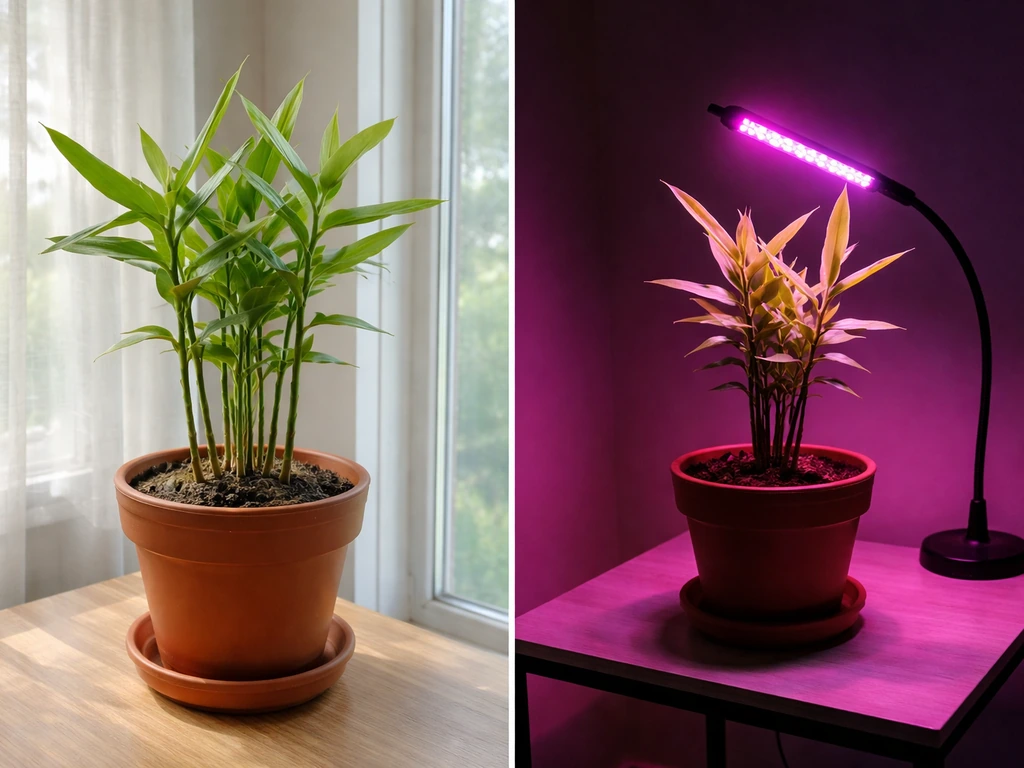
If you have a bright south- or west-facing window, ginger can do well there, especially in spring and summer when day length is naturally longer. Keep the pot close to the glass (within a foot or two) but out of harsh direct midday beams. Sheer curtains actually help here since ginger naturally grows under canopy. A south-facing windowsill in summer can deliver close to adequate light if you're lucky with the hours.
North- or east-facing windows are a tougher call. The intensity is usually too low for strong rhizome development, and the hours of bright light are limited. Ginger will survive in these spots but it probably won't thrive. You'll get top growth that's more spindly than lush, and the rhizome will be slow to bulk up. If this is your only window option, supplementing with a grow light even for part of the day makes a noticeable difference.
A grow light is genuinely the most reliable solution for indoor ginger, especially in winter or in apartments with limited windows. It removes the guesswork around cloud cover, season, and window orientation. A quality full-spectrum LED on a timer beats a mediocre window situation almost every time. The upfront cost is modest, and the results are much more predictable.
If you're comparing this to other shade-tolerant indoor plants like ferns or bird nest ferns, ginger does need more light than those, so a grow light is worth the investment if ginger is your goal. Ferns are a good comparison point because they have different light needs and often do well with partial shade rather than intense, direct sun. Bird nest ferns can tolerate lower light than ginger, but they still need some consistent light to grow well.
How to set up grow lights for ginger (distance, duration, bulb choice)
The most common mistake people make with grow lights is placing them too far away and then wondering why nothing is happening. Distance matters enormously because light intensity drops off quickly as you move the bulb further from the canopy.
Distance
For most full-spectrum LED panels used at home, 12 to 18 inches above the ginger canopy is a good starting position. Start at the higher end (18 inches) and watch the plant for a week. If growth is slow or shoots are stretching toward the light, move it closer. If leaf tips are looking bleached or the soil is drying out very fast, back it off a bit. The goal is to hit that 200 to 400 µmol/m²/s range at canopy level. If you have a PPFD meter or a phone app that estimates it, use it. If not, the 12 to 18 inch rule is a reliable starting point.
Duration
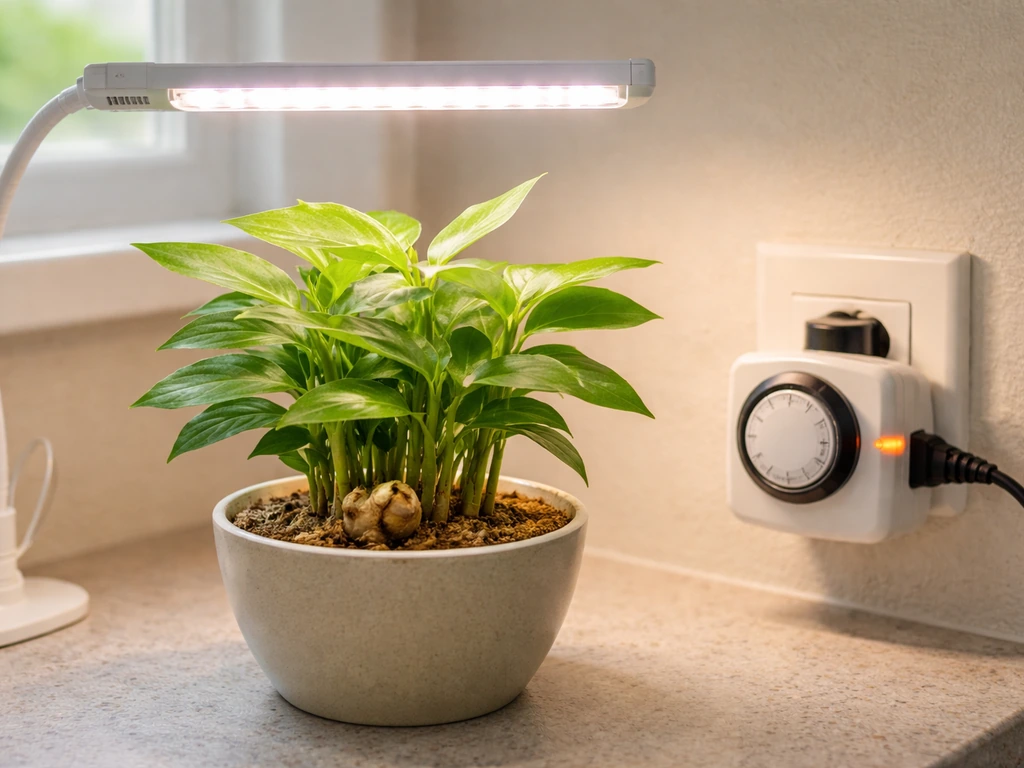
Set a timer for 14 to 16 hours of light per day. This matches the research on ginger photoperiod and lines up with general herb grow-light practice. Give the plant a consistent dark period of 8 to 10 hours. Ginger, like most plants, benefits from that rest period. An outlet timer costs a few dollars and removes all the guesswork. Running lights for 14 hours starting at 7am and ending at 9pm works well and fits around normal household schedules.
Bulb choice
A full-spectrum LED is the best all-around choice. It covers both the red wavelengths that drive photosynthesis and the blue wavelengths that research has shown affect ginger rhizome development and plant structure. Fluorescent T5 or T8 shop lights can work if you place them close (6 to 10 inches) since they're lower intensity, but they're less efficient than LEDs and generate more heat for the same output. Purple/blurple LEDs that only emit red and blue wavelengths are functional but not ideal. A white full-spectrum LED panel in the 30 to 60 watt range is more than enough for one or two pots of ginger.
Can ginger grow without sunlight? What to expect in low light
Technically, ginger can push a sprout in near darkness, because the rhizome carries stored energy. You'll see pale, yellowish shoots emerge even in very dim conditions. But that growth is etiolation, which is the plant stretching desperately toward any available light source. Etiolated ginger shoots are fragile, elongated, and pale. The plant is burning through its stored reserves without being able to replenish them through photosynthesis. Without adequate light, the rhizome won't bulk up, the leaves won't develop properly, and the plant will eventually decline.
In genuinely low-light conditions (a dim room, a basement, a north-facing window with no supplemental light), you should lower your expectations significantly. Ginger grown this way can stay alive for a while but won't produce much of a harvest. If you're growing for the leaves and the novelty, it might limp along. If you want actual ginger rhizomes to harvest, you need decent light.
This is similar to how some plants like cress or sprouts can push initial growth in low light from seed energy, but sustained healthy growth requires photosynthesis. But to actually grow strong sprouts, they still need sufficient light for healthy development some plants like cress or sprouts can push initial growth in low light.
Seaweed does not generally need sunlight in the same way terrestrial plants do, but it does require the right light conditions to photosynthesize effectively does seaweed need sunlight to grow.
Troubleshooting slow growth, weak shoots, and yellowing leaves
Most indoor ginger problems trace back to light before they trace back to anything else. Here's how to read the symptoms:
- Shoots are very long and thin, leaning toward the window or light source: classic etiolation, your light is too dim or too far away. Move the plant closer to the window or lower the grow light.
- Leaves are pale green or yellowish overall: often a light deficiency (not enough DLI). Check your hours and intensity. Also rule out overwatering, which causes similar symptoms.
- Leaves are yellowing at the tips or edges with otherwise okay color: more likely a watering or humidity issue rather than light. Ginger likes consistent moisture.
- No new shoots emerging after 4 to 6 weeks: check light levels first, but also check that the rhizome isn't rotting from cold, wet soil. Ginger needs warmth (above 60°F/15°C) to sprout reliably.
- New shoots look healthy but growth is extremely slow: you may be hitting the minimum light threshold but not enough to drive vigorous growth. Try extending the photoperiod to 16 hours or moving the light a few inches closer.
- Leaf tips appear bleached or whitish: possible light burn from a grow light that's too close or too intense. Back the light off by 4 to 6 inches and watch for improvement over a week.
One thing worth saying: ginger is naturally a slow grower compared to something like cress or fast-sprouting herbs. Don't confuse ginger's pace with a problem. A healthy ginger plant under good light still moves slowly. The difference is that healthy slow growth produces lush green leaves and gradually expanding rhizomes, while light-deprived slow growth produces pale, stretched, weak plants.
Quick decision guide: what to do today based on your lighting
Here's the practical summary. Figure out which situation you're in and act from there:
- You have a bright south- or west-facing window: place your ginger pot within 1 to 2 feet of the glass, avoiding direct harsh midday sun. This is your best low-cost setup. If it's winter or you're north of about 40 degrees latitude, consider adding a grow light on a 14-hour timer to compensate for short days.
- You have a north- or east-facing window: supplement with a full-spectrum LED set 12 to 16 inches above the canopy on a 14 to 16 hour timer. The window alone probably won't cut it for good rhizome development.
- You have no useful natural light (basement, interior room): a grow light is not optional, it's your only path to growing ginger successfully. Get a full-spectrum LED panel, set it 12 to 18 inches above the pot, run it for 16 hours daily.
- Your ginger is already showing pale or leggy shoots: move your light source closer today, or extend the daily light hours. If using a window, try adding even a cheap LED desk lamp to supplement. Aim to get above a DLI of 12 mol/m²/day.
- You're deciding whether ginger is the right plant for your space: if your best available spot delivers less than about 6 hours of bright indirect light per day and you can't add a grow light, consider starting with a more shade-tolerant plant. Ginger will survive in low light but it won't reward you with much.
The bottom line is that ginger is more forgiving than people think when it comes to sunlight specifically, but it still needs meaningful light intensity and enough hours of it to do well. Even though ginger does not rely on direct sun, you still need enough light for the plant to photosynthesize and grow properly sunlight specifically. Getting those two numbers right, even roughly, is the single biggest thing you can do to grow ginger successfully indoors.
FAQ
Can I grow ginger in a window, or do I absolutely need a grow light?
You can grow ginger in a window if you get enough total bright hours, especially in spring and summer on a south- or west-facing exposure. North and east windows often fall short on intensity, so if you see slow rhizome thickening, add a grow light for part of the day rather than moving the pot only slightly.
How do I know if the light is too weak, even if the plant looks green?
Weak light can still produce some green foliage, so watch for early warning signs: shoots stay small, leaves look narrower and spaced farther apart, and the plant progresses slowly without noticeable rhizome bulking over weeks. If growth is clearly “alive but not producing,” your DLI is likely below the productive range.
What’s the difference between “too much light” and “too much direct sun” for indoor ginger?
Full intense indoor light from a grow light usually supports growth if you stay within the target PPFD and photoperiod. Harsh direct sun through a window can overheat or stress leaves even if your total light seems adequate, so use sheer curtains or move the pot out of midday beams.
Should I rotate the pot to keep growth even?
Yes, rotate it every week or so so the leaves receive more uniform light from the direction of the window or lamp. Uneven light exposure commonly leads to lopsided canopy growth, which can also make it harder to judge whether your PPFD at canopy height is truly correct.
Do I need continuous light, or is it better to let ginger rest in the dark?
Let it have a consistent dark period. A timer set for 14 to 16 hours on and 8 to 10 hours off helps avoid stress and supports normal growth cycles. Running lights 24 hours can encourage weak, stretched growth patterns in many indoor setups.
Can I use a cheap light if I keep it close to the plants?
Sometimes, but be careful because low-efficiency lights lose intensity fast with distance and can produce hotspots. If you use T5/T8 fixtures, keep them close (roughly 6 to 10 inches) and verify canopy brightness with a meter or a reliable PPFD estimation method, since eye-balling distance often misses the target.
What happens if my light duration is shorter than 14 hours?
Shorter photoperiods often reduce rhizome number and overall yield, even if you still see top growth. If you cannot reach 14 to 16 hours, you can partly compensate by increasing intensity, but try to prioritize total daily light (DLI) rather than only hours or only brightness.
Is it okay if my ginger gets dim light at night from room lamps?
Brief, low-level illumination is usually not a big deal, but try to keep the main dark period actually dark enough for rest. If your room lights stay bright or flicker strongly through the night, ginger may not follow the intended photoperiod pattern.
How close should I place the grow light if I can’t measure PPFD?
Start within the commonly effective zone, about 12 to 18 inches above the canopy, and then adjust using symptoms. If you see stretching toward the light or slow development, move closer; if tips look bleached or the soil dries extremely fast, move the light back slightly to reduce intensity.
Do I need different lighting targets once ginger starts sprouting versus when it’s growing rhizomes?
Keep the same general targets, but be more attentive to preventing etiolation early on. Stored-energy sprouts can appear in low light, but sustained green, compact growth is a sign your light is strong enough for ongoing photosynthesis to support rhizome development.
How low can the light be and still get a harvest?
Ginger can survive in quite low light, but “survive” is not the same as producing harvestable rhizomes. If the room stays near dim all the time, expect minimal harvest, and consider supplementing with a grow light to reach at least the lower productive DLI range.