
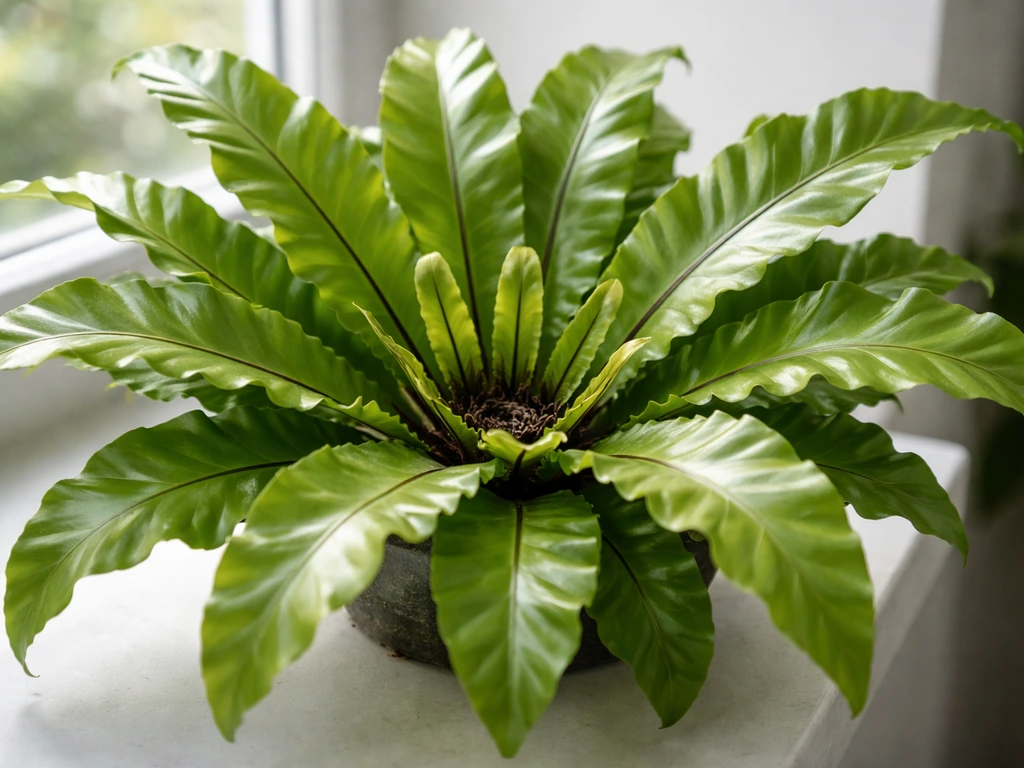
Bird's nest fern (Asplenium nidus) does not need direct sunlight to grow. In fact, direct sun will scorch its fronds. What it needs is bright indirect light, which closely mimics the dappled canopy light it gets on the forest floor in its natural tropical habitat. It will also tolerate lower light levels than many houseplants, making it a solid choice for apartments and rooms away from big windows. If you want the quickest answer, do ferns need sunlight to grow? A bird's nest fern does best with bright indirect light rather than direct sun. The key distinction is this: sunlight is not required, but some quality light absolutely is.
Does Bird Nest Fern Need Sunlight to Grow? Light Guide
Marcus Hartley
10 Jun 2026
Does a bird's nest fern need sunlight or bright indirect light?
Asplenium nidus is an epiphytic fern, meaning it grows anchored to trees in tropical rainforests rather than in the ground. Up in those tree canopies, it never really gets blasted by direct sun. The light that reaches it is filtered through layers of leaves above, arriving soft, bright, and diffuse. That's the exact quality of light you're trying to recreate indoors.
Bright indirect light means the plant is in a well-lit space but not sitting where a beam of direct sunlight lands on its leaves at any point during the day. The Missouri Botanical Garden specifically advises avoiding both direct sun and dense shade for Asplenium nidus, describing it as ideal for indoor areas with 'good indirect light and respectable humidity.' The Royal Horticultural Society echoes this, warning that leaves will scorch in direct summer sunlight. Kansas State University Extension simply calls it out as a 'bright indirect light' plant. Three reputable sources, same answer.
So to be completely clear: if you're asking whether you need a sunny south-facing windowsill for this plant, the answer is no. If you're asking whether you can stuff it in a dark hallway and call it done, also no. Bright indirect light is the sweet spot, and it's achievable in most homes with a little thought about placement.
What bright indirect light actually looks like at home
This is where a lot of plant parents get tripped up, because 'bright indirect light' sounds vague. Here's how to translate it into actual window placement in your space.
Best window directions
| Window Direction | Light Quality | Placement Notes |
|---|---|---|
| North-facing | Low to moderate indirect light | Workable for bird's nest fern, but growth will be slow; best for low-light tolerance |
| East-facing | Gentle morning sun, indirect the rest of the day | Near-ideal; place the fern right at or near the window |
| West-facing | Warm afternoon sun, indirect in the morning | Good; keep 1–2 feet back if afternoon sun is intense in summer |
| South-facing | Brightest light, strong direct sun midday | Keep the fern 3–5 feet back or behind a sheer curtain to diffuse |
In my own apartment, I've had great luck with bird's nest ferns on an east-facing windowsill. They get a couple of hours of soft morning light and then steady bright ambient light for the rest of the day. That setup produced noticeably larger, glossier fronds compared to a north-facing spot I tried earlier where the plant just sat there looking dull for months.
If you have a south-facing window, don't give up on it. Just set the fern back a few feet or hang a sheer curtain. What you're filtering out is the UV intensity and direct beam, not all the brightness. The room can still be very bright and the plant will love it.
The hand-shadow trick
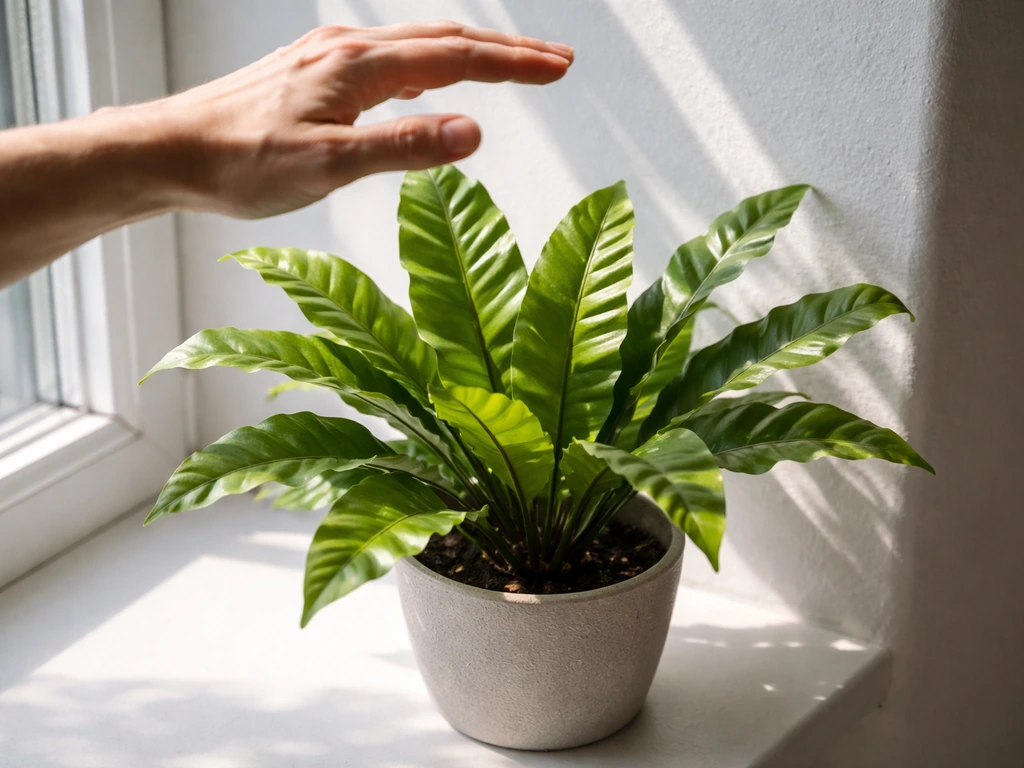
Here's a quick, tool-free test. Hold your hand about a foot above the plant's location in the middle of the day. If you see a sharp, crisp shadow, the light is too direct. If there's no shadow at all, it's too dim. A soft, blurry shadow with visible edges means you're in the bright indirect range. Simple and reliable.
Signs of too little vs. too much light
Your fern will tell you when something's wrong. You just need to know what to look for. These symptoms don't always show up overnight, but once you know the patterns, they're easy to spot before the plant gets seriously stressed.
Too little light
- Growth slows dramatically or stops, especially noticeable in spring and summer when it should be putting out new fronds
- New fronds emerge smaller than older ones or stay tightly curled and fail to unfurl properly
- Fronds look dull, pale, or yellowish rather than the deep, glossy green they should be
- The center 'nest' looks sparse and new growth is weak or limp
- Soil stays wet longer than expected because the plant isn't actively growing and using water
Too much light or direct sun
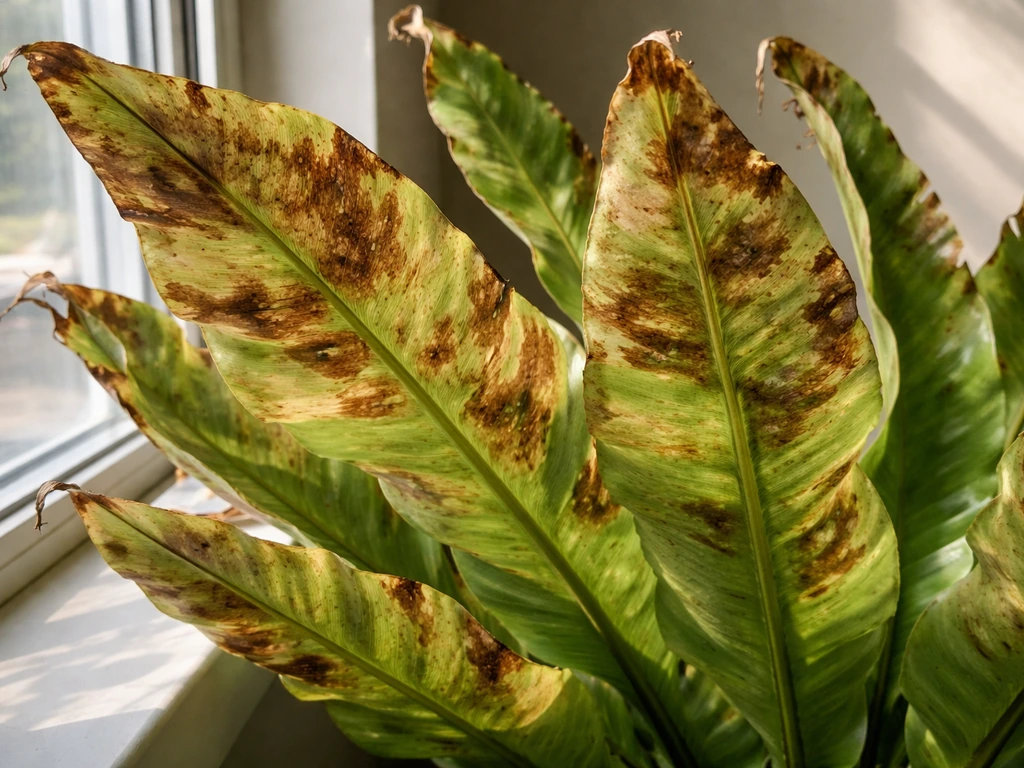
- Brown or tan patches appearing on the frond surface, often in a splotchy or streaky pattern (classic sun scorch)
- Frond tips and edges turn crispy and brown
- Fronds bleach out to a washed-out, light green or yellowish color along the areas hit by direct light
- The whole plant looks faded even though it's watered correctly
- Fronds curl or crinkle as a stress response to intense light and associated heat
It's worth noting that brown tips can also come from low humidity or inconsistent watering, so don't assume light is the only culprit. But if the browning is concentrated on the side of the plant facing the window, and the pattern is splotchy or bleached rather than uniformly crispy at the tips, light is almost certainly your issue.
Growing bird's nest fern under artificial light
Good news: bird's nest fern responds well to grow lights, which makes it a genuinely practical plant for spaces with no good natural light. Sprouts, like many seedlings, also need the right kind of light to grow well grow lights. Artificial lighting isn't a compromise here. Done right, it can actually be more consistent than relying on windows, where light levels shift with seasons, cloud cover, and the angle of the sun.
LED grow lights
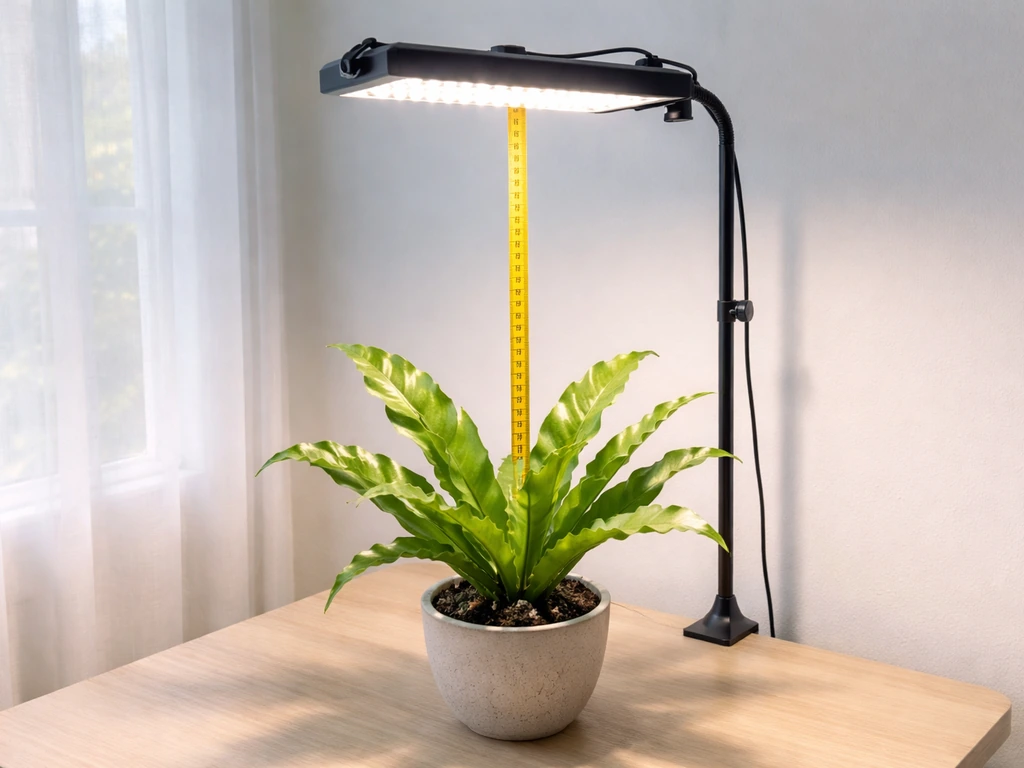
Full-spectrum LED grow lights are the best option for bird's nest ferns. They run cool (important for a plant that doesn't want heat stress), they're energy-efficient, and modern full-spectrum LEDs deliver the right balance of red and blue wavelengths that chlorophyll actually uses for photosynthesis. You don't need an expensive high-intensity fixture. Grow lights can help a plant that does not get enough natural sunlight to still receive the light it needs. A mid-range panel or even a clip-on LED desk grow light will work for one or two plants.
- Distance: Position the LED fixture about 12–18 inches above the plant. This replicates a bright indirect light environment without heat stress. If the light is very low-intensity, move it closer to 8–10 inches.
- Duration: Run the light for 12–14 hours per day on a timer. Ferns don't require a special photoperiod to trigger flowering (they don't flower), so this schedule is purely about giving enough total light energy per day.
- Light type: Full-spectrum LEDs (5000–6500K color temperature) or a dedicated grow light labeled 'full spectrum' are both fine. Avoid lights marketed only for flowering (heavy red spectrum) as these aren't optimized for foliage plants.
Fluorescent and other artificial lighting
Fluorescent lights, including T5 and T8 tubes, can absolutely grow a bird's nest fern. They're lower intensity than LEDs, so you'll need to keep the fixture closer, around 6–12 inches above the plant, and run them for the full 14 hours. Standard T5 grow fluorescents work well and are cheap to run. Even a decent quality desk lamp with a daylight bulb (5000–6500K) placed 8–10 inches from the plant will support low to moderate growth if that's all you have access to. It won't be dramatic growth, but the plant will stay healthy.
Low-light setups: what's actually enough?
Bird's nest fern is genuinely more shade-tolerant than a lot of popular houseplants, which is part of why it's such a good indoor choice. But 'shade-tolerant' doesn't mean 'can survive in a dark corner.' There's a minimum threshold, and it's useful to be honest about what to expect on either side of it.
In a low-light room, like a space with only a north-facing window or one that's set well back from any windows, the fern will likely survive and hold its existing fronds. What it probably won't do is put out significant new growth, especially in winter. The fronds may be a bit smaller and less vivid than you'd see in brighter conditions. If you're okay with a steady, slow-growing plant that looks nice without changing much, a low-light spot can work. If you want to see active new fronds unfurling regularly, you'll need either a brighter window or a grow light supplement.
Other fern types worth comparing: the broader question of whether ferns need sunlight to grow follows the same general logic as bird's nest fern, since most popular indoor ferns are forest-floor plants that evolved under canopy cover. The threshold of 'enough light' is similar across the family, though some varieties are even more shade-tolerant.
Quick troubleshooting checklist
If your bird's nest fern looks off right now, run through this before making any changes. Small tweaks to placement usually solve most light problems without needing to buy anything.
- Check for direct sun: Walk past the plant at different times of day and see if any direct beam lands on the leaves. If it does, move the plant back 2–3 feet or add a sheer curtain.
- Assess overall room brightness: Can you comfortably read a book by natural light in that spot without a lamp? If not, the light is probably too low for active growth.
- Look at new growth: Is the plant putting out any new fronds? In spring and summer, you should see at least one or two new fronds unfurling. If nothing is moving, suspect low light.
- Check for scorch patterns: Are brown patches on frond surfaces (not just tips)? Splotchy bleaching points to excess direct light. Crispy tips alone are usually humidity or watering-related.
- Audit your grow light setup: If using artificial light, verify the distance (12–18 inches for LEDs), daily duration (12–14 hours), and whether the bulb is actually full-spectrum.
- Adjust light before changing anything else: Don't reach for fertilizer or change your watering routine until the light situation is sorted. A plant in poor light uses less water and less fertilizer. Over-fertilizing a low-light plant makes things worse.
- Rotate the plant: If one side is noticeably more developed than the other, the plant needs to be turned. A quarter turn every 2–3 weeks keeps growth even.
Keeping light right over time
Light conditions in your home are not static, and this is something a lot of plant parents forget. What works in June might leave your fern starved for light by December. The sun's angle changes significantly between seasons, especially if you're in a northern latitude. A south-facing window that was indirect and perfect in summer can become much lower intensity in winter. Meanwhile, an east window that was lovely in spring might push too-direct morning light in midsummer.
The practical habit to build is seasonal reassessment. Every time the clocks change or you notice a shift in how bright your rooms feel, take a few minutes to re-evaluate where your fern is sitting. Moving it a foot closer to the window in autumn and a foot back in summer is often all the adjustment you need.
Rotation matters too. Give the plant a quarter turn every two to three weeks so every side gets equal light exposure. This prevents the plant from growing lopsided and keeps the 'nest' looking full and symmetrical. It's an easy habit to build into a regular watering routine.
Finally, watch the plant itself as your main monitoring tool. A healthy bird's nest fern under good light will be producing fresh, bright green fronds that uncurl gracefully from the center, with a glossy, slightly wavy texture. If that's what you're seeing, whatever you're doing is working. If the plant looks stagnant, dull, or stressed, light is the first variable to revisit. Most of the time, moving it closer to a window or switching on a grow light for a few extra hours a day is all it takes to get things back on track.
FAQ
How many hours of bright indirect light does a bird nest fern need each day?
There is no exact hour count, but aim for a consistent, bright setting most of the day. A practical target is similar to how you live in a bright room, for example 6 to 10 hours of good ambient light, while keeping it away from any direct sun beam at any point.
Can bird nest ferns handle an occasional direct sun ray, like a brief morning spot?
Short, occasional contact can be risky, especially if it turns into sunbeams for even part of midday. If you must use a bright window, use indirect filtration such as a sheer curtain, and observe for bleaching or crispy patches on the side facing the window.
What’s the best way to tell if my fern is getting too much light versus too little light?
Too much light usually shows up as bleached or yellowing fronds and scorched, crispy areas that often start on the brightest side. Too little light typically means slower or stalled new fronds, darker dull growth, and smaller fronds emerging from the center.
Where should I place the fern if I only have a north-facing window?
A north window often works, but place it closer rather than further back, and consider supplementing with a grow light during winter. Rotate more frequently if the window light is uneven across the depth of the room.
Do grow lights need a timer, or can I leave them on all day?
Use a timer. Running lights about 12 to 14 hours per day is usually enough, and leaving them on longer can contribute to stress or heat from the fixture. Consistency matters more than maximizing brightness.
How far should I keep a grow light from a bird nest fern?
Follow the fixture’s guidance, but as a starting point keep LEDs roughly 6 to 18 inches away and adjust based on color and leaf condition. If the fronds look pale or the plant seems to slow while crisping occurs, increase the distance.
Will fluorescent lights work if they are behind a glass cabinet or near reflective surfaces?
Glass cabinets can reduce effective light, and reflective surfaces can create hotspots. If you use fluorescent, keep the light close as recommended in your setup (often 6 to 12 inches), and avoid placing the plant where a single reflective surface sends direct glare.
Should I rotate my bird nest fern daily to keep it symmetrical?
No, every day is usually unnecessary. A quarter turn every two to three weeks is enough for most homes, unless the window is very directional and changes rapidly in brightness.
Does light affect frond color even if the plant still looks healthy?
Yes. With adequate bright indirect light, new fronds tend to be brighter green and unfurl with a glossy, lively texture. In dim light, the fern may survive but new growth can look less vivid even before obvious damage appears.
If my fern’s fronds are turning brown at the tips, is it always a light problem?
Not always. Brown tips are also common with low humidity, inconsistent watering, or salty fertilizer residues. Check whether browning is confined to the sun-facing side and looks bleached or splotchy, otherwise treat humidity and watering first before changing light placement.
What should I do if my apartment has very little natural light year-round?
Plan on using grow lights. Place the fern where it gets the most reliable light, then run a timer for about 12 to 14 hours daily. Reassess every few weeks by looking for new fronds emerging from the center, not just how “bright” the room feels.